



Nicotine Pouches Market Trends, Size, Share, Key Companies, Production Capacity, and Forecast 2026-2035
Deepa Pandey is a healthcare market research analyst. In nicotine pouch monitoring, she researched product take rates, consumer interest in smoke-free products, flavors to innovate, the strength of nicotine, and retail distribution while keeping an eye on regulatory trends that impact the global nicotine alternatives market. Her work supports manufacturers, distribution and retail partners, investors, and other industry stakeholders in a better understanding of competing products and new growth prospects. The nicotine pouches market reached USD 8.81 billion in 2026.
Source: https://www.precedenceresearch.com/nicotine-pouches-market
 Get a Sample
 Table Of Content


Nicotine Pouches Market Size, Share, Trends Report 2026
Deepa Pandey has more than 5 years of experience in the consumer products and emerging tobacco alternatives space. She states that the nicotine pouches category is at a new level of growth. The nicotine pouches market is forecasted to expand from USD 8.81 billion in 2026 to USD 65.55 billion by 2035, growing at a CAGR of 24.98% from 2026 to 2035. Increased consumer demand for smoke-free nicotine consumption and products continue to innovate with new flavor options, new pouch sizes, and new nicotine levels. These strengths have allowed manufacturers to significantly diversify their product offering and geographical presence.
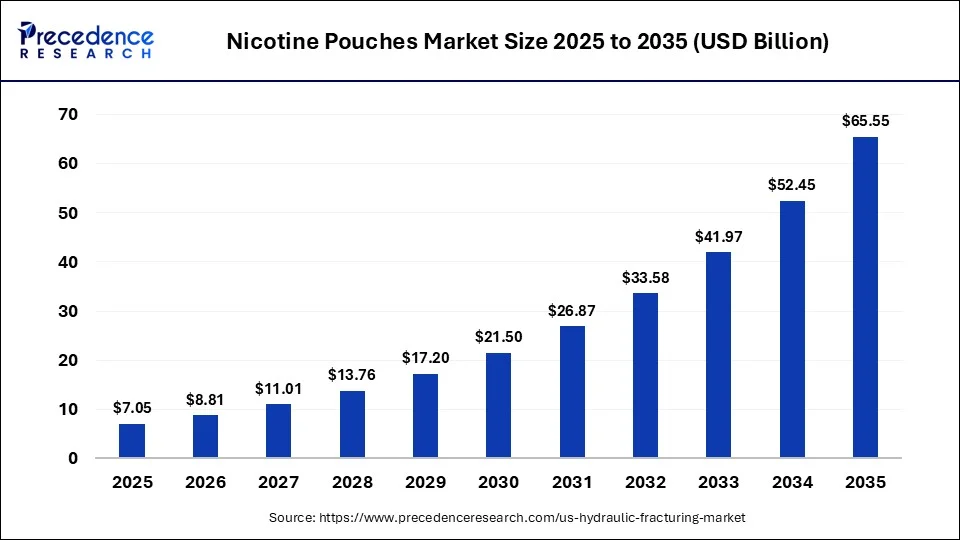
Deepa Pandey says the increasing trend towards a rise in demand for discreet tobacco-free alternatives and the added availability of products are the three primary drivers for market growth. Moreover, remodelling of regulations in Europe, the U.S., as well as other emerging markets will impact the product commercialization and competitive strategies considerably. The global nicotine pouches market is expected to grow at a CAGR of 24.98% throughout the forecast period.
Key Takeaways
- By product type, the tobacco-derived nicotine pouches segment led the market with a share of 72.45% in 2026.
- By nicotine strength, the low-strength segment led the market with a 24.85% share in 2026.
- By flavor, the mint and menthol segment captured a major revenue share of 49.35% in 2026.
- By format, the slim pouches segment captured the largest market share of 58.4% in 2026.
- By distribution channel, the convenience stores segment led the market with a share of 35.75% in 2026.
- ZYN only joins the competitive fray at 100 with VELO, much clearer by a margin for the three largest multinational tobacco companies.
- Sales of BAT's Modern Oral grew 47.4% to £1.165bn, and PMI's global shipments went up 36.6% to 879.6mn cans, ensuring that Imperial Brands was the one to dive into the No.8 spot in the top 10.
- ZYN has taken a significant stride by increasing volume shipments in the United States from 4 million cans in 2017 to 794 million in 2026, but has yet to cross the hurdle of a tie in volume share or retail value share in the United States.
- Available information suggests that smaller lines of products have lost ground to ZYN (which is present in 55 markets) and a smaller counterpart, BAT's Modern Oral, which is available in 49 markets, thereby proving that international scale as a whole remains restricted to the top tier of the field.
- The strength range for ZYN is 3 mg- 11 mg, On' between 2mg - 9 mg, and the sub-brands of each, ZYN ULTRA and ZYN CORE, specify a lower strength range within the larger boxed range.
Market Overview
The nicotine pouches market was worth USD 8.81 billion in 2026 and is expected to grow at a CAGR of 24.98% until 2035. Oral nicotine products can come in any form. But nicotine pouches are those where the nicotine is typically packaged in a small pouch that's placed between the gum of the cheeks and the upper lip to release the nicotine into the mouth, without any combustion.
Additionally, shifts in consumer preferences, continuing product innovation, new channels of retail and electronic distribution, and a rapidly evolving regulatory environment. This sensitivity category requires further regulatory, taxation, age control, and public-health policy awareness and is commercial data and should be regarded as non-endorsing product, health and/or safety information.
Key Insight: Nicotine pouches are expected to be worth as much as USD 8.81 billion in 2026, and are compounding at a rate that has more to do with regulatory environments in various countries, rather than consumer demand.
Nicotine Pouches Market Company, Competitive & Buyer Intelligence Data
The nicotine pouch market is accelerating toward market expansion of sizeable oral nicotine packaged products, robust brand offerings, broader regulatory approval, and more premiumization in this growing and diverse category. Major companies also release data showing that commercial products are distributed this quickly. In 2026, PMI had 879.6 million nicotine-pouch cans in its portfolio, of which 794 million were supplied by ZYN.
The category saw strong activity, with British Airways delivering £1.165 billion in modern oral, an increase of 47.4%. On the other hand, regulatory approval is emerging as a growing competitive factor in the USA. By August 2026, 43 products had been approved by the FDA for sale, such as 11 new products in the ZYN ULTRA brand and more from the on! brand.
Key Insight: These three metrics demonstrate that PMI's regulatory authorization is progressing in tandem with its scale and revenue, as well as the 43 FDA-approved products by August 2026.
Which Nicotine Pouch Companies Have the Strongest Market Position?
Source: Precedence Research Database
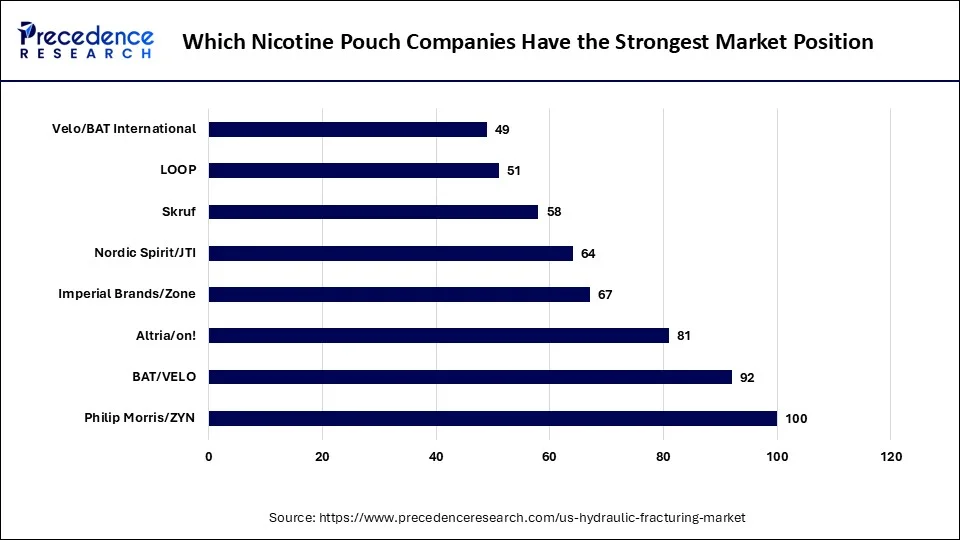
ZYN, the Philip Morris International brand, leads the competitive pack with a score of 100. This shows a complex score across four categories, revealing disclosed shipment scale, brand strength, geographical reach and product portfolio, and regulatory position. The top three multinational tobacco companies far outperform the rest. BAT's VELO brand comes in at 92, ahead of Altria's, and the last three finish far behind at 81.
Imperial Brands' Zone brand follows with a score of 67, Nordic Spirit (on the JTI) stands at 64, and Skruf is at rank 58. Then there is Velo under BAT International at 49, then LOOP at 51 at the end of the list. This clear distinction between the top three and those who came after them indicates there is a current competitive split between a smaller number of big, well-resourced multinationals and a wider band of independent brands.
Key Insight: ZYN opens up the competitive index at 100 with VELO and on! at 92, leaving a distinctively clear margin for competitive advantage for the three biggest multinational tobacco companies.
How Fast Are Leading Nicotine Pouch Companies Growing Their Business?
| Company | Metric | Growth |
| Philip Morris/ZYN | Nicotine pouch shipments | 36.60% |
| BAT/Modern Oral | Revenue | 47.40% |
| BAT/Modern Oral | Volume | 47% |
| Imperial Brands/NGP | Revenue | 8.80% |
| BAT/Velo U.S. | Revenue | Triple-digit |
| PMI/ZYN U.S. | Offtake | 25% |
Source: Precedence Research Database
Philip Morris International's nicotine pouch shipments rose by 36.6%. BAT's Modern Oral product category reacted with revenue growth of 47.4% year-over-year and growth of 47.1% in volume, in tandem with the other growth. Imperial Brands reported more modest but still solid increases of 8.8% for its next-generation products.
Revenue growth from BAT's Velo brand was specifically triple-digit in the U.S., while ZYN offtake in the United States increased by 25% during the same period, according to PMI. BAT reported Modern Oral revenue of £1.165 billion in 2025, an increase of 47.4% year over year, while PMI reported global sales of 879.6 million cans of nicotine pouches (+36.6% YoY).
Key Insight: BAT's Modern Oral revenue rose by 47.4% to £1.165bn, while PMI's global shipments climbed 36.6% to 879.6mn cans, enough to put at least Imperial Brands' business 8.8% growth at the bottom of the top five.
How Many Nicotine Pouches Are Leading Companies Selling?
| Company/Brand | 2025 Shipment Volume |
| ZYN | 794 million cans |
| PMI Total Nicotine Pouches | 879.6 million cans |
| BAT Modern Oral | 12.2 billion pouches* |
| ZYN U.S. | 794 million cans |
| ZYN U.S. 2024 | 581 million cans |
| ZYN U.S. 2023 | 385 million cans |
Source: Precedence Research Database
The shipment data indicates a significant size gap between market leaders of the top three platforms in terms of nicotine pouches shipped. In 2025, ZYN shipped 794 million cans versus PMI's reported ZYN U.S. shipments of 794 million, as its total nicotine pouches shrank to 879.6 million cans.
On the other hand, the exact number of pouches shipped by BAT is not explicitly reported in BAT's 2025 annual report. As the revenue is disclosed by BAT in its annual report, the BAT 2025 thirty-day-ending report has estimated the volume using a database, which comes to 12.2 billion pouches. Aman sees that, when focused on ZYN's own growth story, the volume of this one brand has increased in two years from 385 million cans in 2023 to 581 million cans in 2024 and then to 794 million cans in 2025.
Key Insight: Unlike the directly reported shipment data by PMI, the two unwritten calls, BAT's Modern Oral and ZYN, are estimates derived from a database.
How Has ZYN's U.S. Nicotine Pouch Volume Expanded?
Source: Precedence Research Database
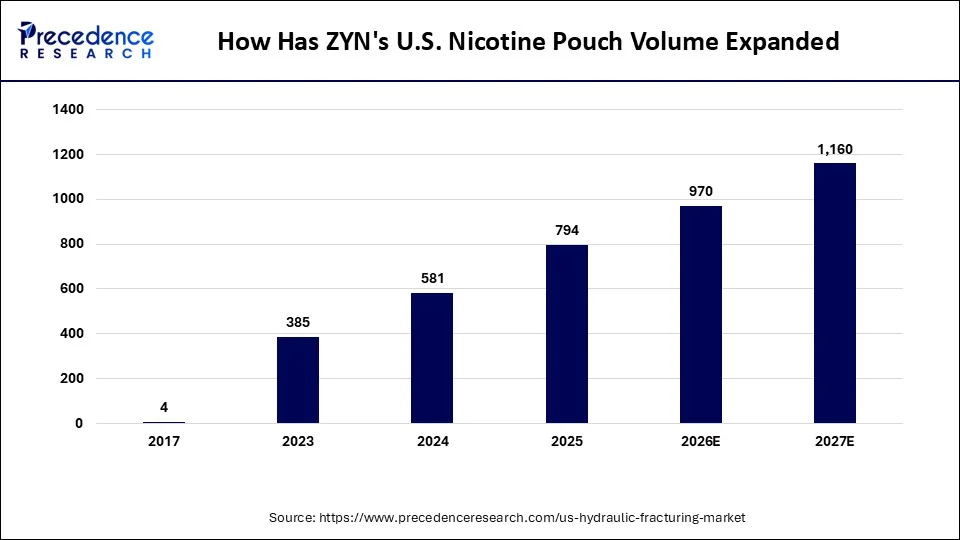
It's one of the best-stated public product category expansions for nicotine pouch products that I've ever seen anywhere in this market. In the U.S., shipments were a mere 4 million cans at first, and increased to 385 million cans in 2023, 581 million cans in 2024, then 794 million cans in 2025. I believe, rather than company guidance, project further growth to 970 million cans in 2026 and 1.16 billion cans in 2027. PMI independently attributes a US volume share of 61.5% and a retail value share of 67.2% to ZYN. They both imply a dominant brand share in its own category, as opposed to just one leading share out of a number of similar brands.
Key Insight: ZYN has seen U.S. shipments increase from 4 million cans in 2017 to 794 million in 2025, taking a clear step forward, but not acquiring a tie-down in the U.S. volume share by brand nor retail value share.
What is the U.S. Competitive Share Position of ZYN?
| Indicator | 2025 |
| ZYN Volume Share | 61.50% |
| ZYN Retail Value Share | 67.20% |
| Share of Category Volume Growth | 50% |
| ZYN Offtake Growth | 25% |
| ZYN Shipment Growth | 37% |
Source: Philip Morris International
Analyzing PMI's investor materials reveals that, across all of the indicators provided, ZYN is holding a top-tier position in an increasingly large U.S. nicotine pouches market. According to data by Nielsen, the volume share of ZYN rose to 61.5% in 2025, and the retail value in the same year stood at 67.2%, as reported in ZYN's own financial statements.
Britannian's PMI also finds that ZYN enjoyed 50% of the total category volume growth during the last year. Taking about 50% of all the volume growth in the category. ZYN's offtake increased by 25% for the corresponding period, while shipment volume increased by 37%. Two separate but related measures, which provided double-negative confirmation for retail sell-through and manufacturing shipments, both had positive growth even if not by the same rate.
Key Insight: ZYN's share of total U.S. category volume growth came in at 50% in 2025, and the company's share of U.S. volume at 61.5% and retail value at 67.2% backed up its lead in 2025 beyond just incremental growth.
How Broad is the Geographic Reach of Major Nicotine Pouch Brands?
| Company/Brand | Markets |
| ZYN | 5500.00% |
| BAT Modern Oral | 4900.00% |
| ZYN U.S. | 100.00% |
| Zone | 2+ |
| Velo Plus | 1 national U.S. market |
Source: Precedence Research Database
Aditi believes that, as companies venture into markets where oral nicotine is already being used to some extent, international expansion is emerging as an ever-growing competitive advantage. The international footprint will be at a point where PMI reports that ZYN is in 55 markets by the end of 2025. BAT states that its Modern Oral products will be in 49 markets by then as well.
In this comparison, the U.S. is treated as a single national market for ZYN, and the Zone brands are reported in two or more markets for Imperial Brands. Velo Plus is known to work in one country in the U.S., and on! is set to work at Altria. PLUS product is also now distributed throughout the U.S. The two largest multinational companies, ZYN and BAT, appear to be the only two companies to be widely present throughout several continents. On the other hand, the smaller or newer product lines are not as widely sold as you would think based on the evidence available.
Key Insight: ZYN's presence in 55 markets and BAT's Modern Oral presence in 49 markets place the two largest global brands well ahead of smaller product lines, confirming international scale remains concentrated at the very top of the field.
How Many Nicotine Pouch Products are Currently Authorized in the U.S.?
| Manufacturer/Brand | FDA-Authorized Products |
| Swedish Match/ZYN | 3100.00% |
| Helix/on! | 1200.00% |
| Other authorized manufacturers | 0* |
| Total | 4300% |
Source: U.S. FDA
An increasing competitive challenge is regulatory approval by the U.S. FDA. Nicotine pouch manufacturers are not currently able to legally sell a nicotine pouch product in the U.S. unless it first receives approval from the FDA. ZYN, the supplier of Swedish match products, has FDA clearance for 31 products, the most of any single manufacturer, and On!, the supplier of Helix, has 12.
No other manufacturer currently seems to have its brand on an FDA-approved list. This also currently shows 43 products that are licensed. A zero for any company on this list does not automatically indicate a lack of a company's overall industry presence for the category, as this is only what the company has been authorized by the FDA.
Key Insight: There are 31 of the 43 FDA-authorized nicotine pouch products offered by a single manufacturer (SwedishMatch) and 12 offered by another (Helix).
Which Nicotine Strengths are Being Commercialized by Leading Brands?
Source: U.S. FDA
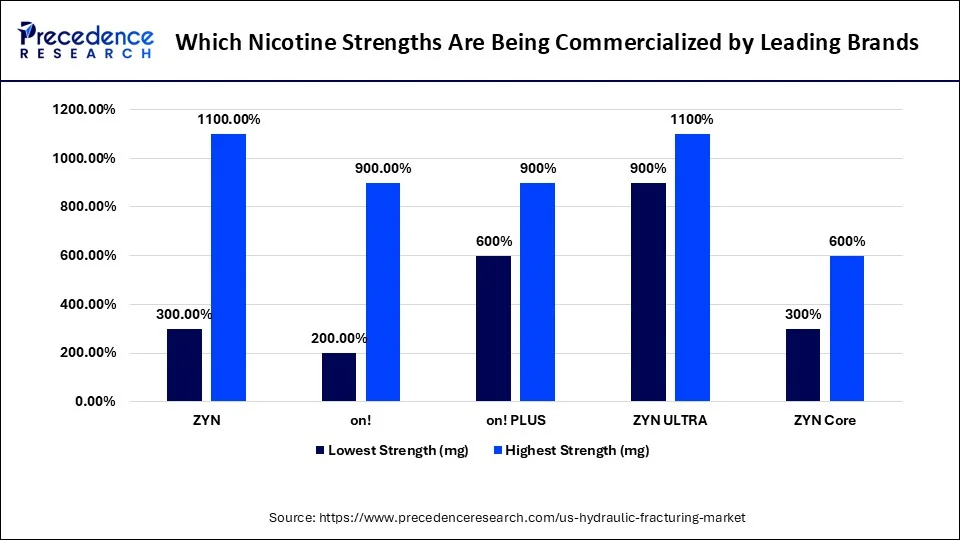
This product market is growing in the number of products containing multiple levels of nicotine, enabling brands to cater to different levels of nicotine delivered. The authorized ZYN range of products is from 3 mg to 11 mg, whereas on! range is slightly wider, from 2 milligrams to 9 milligrams.
ZYN ULTRA, a new addition in the ZYN family, is a more recent generation and is available in a narrower range of 9 mg to 11 mg in particular. That puts it towards the higher end of the ZYN spectrum. Some ZYN Core brings about 3 mg and 6 mg, which spans across some of ZYN's lower strength offerings. Furthermore, Velo does not have one level of strength, but multiple, across its specific group of products.
Key Insight: ZYN's range is from 3mg to 11mg, while On!'s range is 2mg to 9mg, and each sub-brand, such as ZYN ULTRA or ZYN Core, indicates a smaller strength range within the larger boxed range.
How are Leading Companies Differentiating Their Nicotine Pouch Products?
| Company | Key Differentiation |
| PMI / ZYN | Premium positioning and broad flavor portfolio |
| BAT / VELO | Velo Plus and Velo Shift innovation |
| Altria / on! | NICOSILK technology and on! PLUS |
| Imperial / Zone | Updated pouch design and new flavors |
| JTI / Nordic Spirit | Broad oral nicotine portfolio |
| Skruf | Established Scandinavian oral-nicotine positioning |
Source: Precedence Research Database
As far as positioning, PMI has gone around the premium brand with a wide range of flavors. Also, BAT has gone more advanced than that with newer product innovations such as Velo Plus and Velo Shift specifically. Altria differentiates on! thanks to its proprietary NICOSILK technology and its on! Imperial Brands separates Zone from the rest of the PLUS product line with a new set of flavors and insights from the improved pouch design.
Nordic Spirit positions Nordic around a wide portfolio of oral-nicotine products. Skruf has spent a longer period in more niche businesses within an oral-nicotine portfolio specific to Nordics. Velo Shift was developed in 2025, featuring a new pouch shape, hexagonal can, and Altria's description.
Key Insight: BAT's 2025 Velo Shift launch, with its new pouch shape and hexagonal can, and Altria's NICOSILK-based on! PLUS both illustrate how format and material innovation, not just flavor, are becoming genuine points of competitive differentiation.
Buyer Intelligence
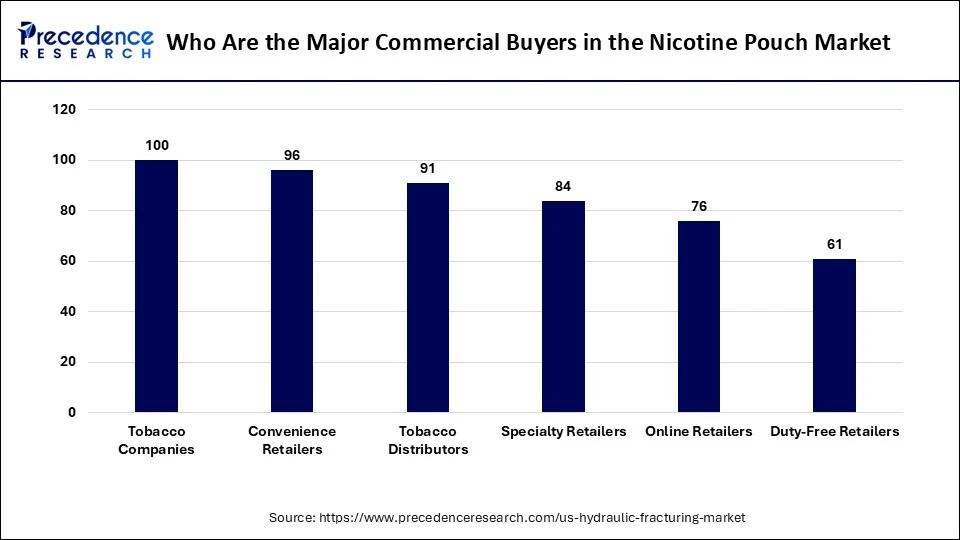
Who are the Major Commercial Buyers in the Nicotine Pouch Market?
Source: Precedence Research Database
Tobacco companies, distributors, retailers, and a specific group of channels are specialized nicotine-product spaces, all with their own respective roles in the commercial buyer segment of this market. The categories that encompass the backbone of tobacco's commerce base, including convenience retailers, tobacco distributors, and tobacco companies, anchored the buyer-importance index at 100. Duty-free retailers finish at the bottom, with 61. The relatively high ranking of convenience stores over specialty and online stores is indicative of the fact that convenience stores. They are relatively more central to their customers than more specialized or occasional buyers, which makes their convenience of location and service a key advantage.
Key Insight: Everyday retail shops sit right behind tobacco in terms of buyer importance at 100, ahead of specialty retailers and online channels at 97 and 86, respectively, indicating everyday retail's importance to the category.
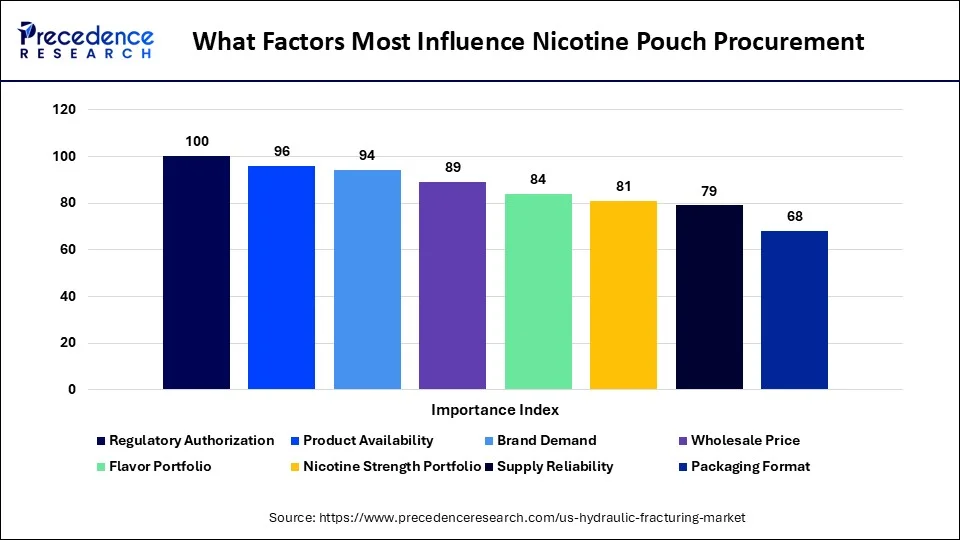
What Factors Most Influence Nicotine Pouch Procurement?
Source: Precedence Research Database
Regulatory status, supply consistency, brand strength, and product portfolio breadth are key considerations for manufacturers and distributors in this area when it comes to purchasing. Authorized is at 100 on this procurement importance index, ahead of product availability at 96. Brand demand is at 94, all of which are very busy fields because they all have gotten closer together in a market where unauthorized products can't be put on the shelf.
Wholesale price is trailing at 89, flavor portfolio at 84, and nicotine strength portfolio at 81. Supply reliability ranks at 79, followed by packaging format, which ranks at 68, the least influential factor measured. Automatically at the very top of this list, ahead of price and indeed even ahead of brand demand, is regulatory authorization. It is the ultimate gatekeeper influencing procurement decisions for this category, and not just commercial demand.
Key Insight: At 100, ahead of product availability and brand demand, it is obvious that procurement is not driven by commercial considerations alone, but is primarily driven by regulatory authorization.
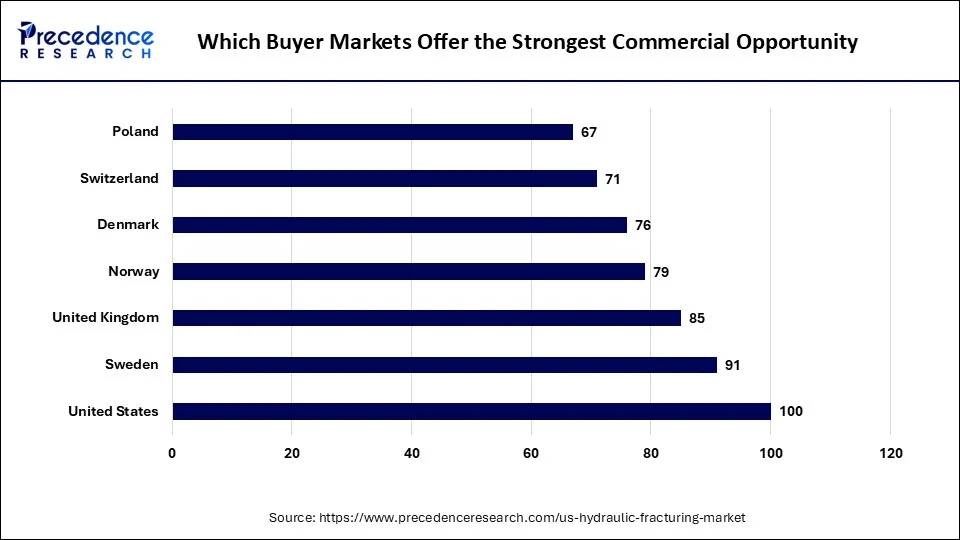
Which Buyer Markets Offer the Strongest Commercial Opportunity?
Source: Precedence Research Database
Bigger markets with known norms of oral nicotine consumption and expanding regulatory structures offer the most promising growth opportunity for bigger pouch producers. It is impossible to draw the opportunity index comparison benchmark from the U.S., as its index is 100. The other markets, Sweden and the United Kingdom, do not reach even half of that at 91 and 85, respectively, both by scale and maturity in regulation.
Norway at 79, Denmark at 76, Switzerland at 71, and Poland at 67 follow a line dominated by markets with a tradition of consumption of oral tobacco or nicotine. The U.S., Sweden, Denmark, Norway, Switzerland, the United Kingdom, and Poland are BAT's main Modern Oral markets. These align almost as closely with the opportunity index and indicate that industry strategy and market evaluation by 3rd parties have converged on the same group of priority countries.
Key Insight: The U.S., Sweden, and the U.K. lead the pack in the opportunity index, at 100, 91, and 85, respectively, which correlates well with BAT's own published list of largest modern oral markets.
Key Market Intelligence
The size and velocity of ZYN and VELO, the two key comps, are the all-time strongest competitive cues throughout this entire analysis. PMI shipped 879.6m nicotine-pouch cans covering its entire portfolio, with ZYN alone shipping 794m of those, versus BAT's Modern Oral revenue, which was valued at £1.165bn, an increase of 47.4% Y-o-Y.
The rules in place in the U.S. are helping to make it a more competitive marketplace. By August 2026, the FDA had finally approved 43 products that make nicotine pouches, comprising 11 new ZYN ULTRA products and other on! products available for sale. Taken together, these figures indicate regulatory and commercial progress in the USA. Both are moving forward, not as two-way negotiations but with complexity on one side, clarity of the laws on the other.
Key Insight: ZYN and VELO are leading the trend for pouch nicotine growth, and U.S. FDA authorization approvals will bolster their competitive and commercial trajectory.
Segmentation Analysis
By Product Type
Source: Precedence Research Database
Although tobacco-derived nicotine pouches are now the largest share, at 72.45%, in the market in 2026, this is the segment seeing the greatest decline, with a CAGR of 23.95%, the slowest of the three. They will still capture 65.80% of the market in 2035. Synthetic nicotine pouches will grow from 21.30% to 29.15% of market share in the coming years, at a 28.65% CAGR due to manufacturers continuing to work on alternative formulations for extractions that aren't typically tobacco-based. The second-smallest segment (other nicotine pouches) declines in market share at a 22.10% CAGR and is observed at 5.05% to 6.25%.
Key Insight: The three product categories will all grow moderately, with synthetic nicotine having a CAGR of 28.65% by 2035, to gain almost eight points of market share, although the tobacco-based pouches will still be the larger category throughout.
By Nicotine Strength
Source: Precedence Research Database
Medium strength is the largest segment, with a market share of 47.60% in 2026 and a gradual increase at a 24.55% CAGR to 45.85% in 2035. The demand for each level of strength is very different depending on the consumer's preference and, in certain markets, regulatory limits on the maximum quantity of nicotine. The moderate growth rate of low strength is comparable to high strength. Low strength moves from 24.85% to 25.70% market share at a 25.35% CAGR.
Key Insight: High strength dominates with the highest growth at 25.40%, only marginally outpaced by low strength's growth at 25.35%, while medium strength remains the largest share between 2005 and 2010 with a slightly lower 24.55%.
By Flavor
Source: Precedence Research Database
Mint and menthol is the dominant flavor profile segment, accounting for 49.35% of the market in 2026, rising to 45.10% by 2035 at a 24.05% CAGR. This is the lowest of the five market categories. Fruit flavors were one of the fastest-growing options besides typical mints, with a CAGR of 27.05% and the share increasing from 20.80% to 24.75%.
Manufacturers keep expanding their offerings beyond the typical mints to include fruit flavors. Citrus has captured between 11.65% and 12.40% market share with a CAGR of 26.05%. On the other hand, Coffee has captured between 8.25% and 8.85% market share with a CAGR of 25.75%, trailing behind fruit but outperforming the category leader.
Key Insight: Fruit flavors are growing at a faster rate at 27.05% CAGR, followed by mint and menthol flavors, whose 49.35% share is still the largest flavor segment in the market.
By Format
Source: Precedence Research Database
Slim pouches represent the largest format segment due to their general portability, factors that matter considerably to how and where consumers actually use this product. Slim pouches hold 58.40% market share in 2026, extending further to 61.25% by 2035 at a 25.50% CAGR.
Mini pouches grow from 25.35% to 26.80% market share at a 25.60% CAGR, the fastest of the three despite trailing slim pouches on overall share. While large and original pouches fall from 16.25% to 11.95% market share at a 21.15% CAGR, the slowest format in the table by a meaningful margin.
Key Insight: The fastest-growing format is mini pouches, growing at 25.60%, while large and original pouches are the slowest of the three.
By Distribution Channel
Source: Precedence Research Database
Convenience stores are the most important distribution channel, accounting for 35.75% market share in 2026. This is expected to grow at a 23.85% CAGR, reaching 32,40% market share by 2035. Specialty stores are expected to shrink to 15.15% market share at a CAGR of 22.90%. Online retail is projected to increase from 18.45% to 27.10% market share at a 30.20% CAGR as digital commerce and direct-to-consumer models continue to evolve in the markets, leaving the legal scope to do so.
Key Insight: Online retail grows at a 30.20% CAGR, or almost ten points ahead of the second fastest growth channel, as digital and direct-to-consumer development is taking place where regulations are allowing.
By Region
Source: Precedence Research Database
In 2026, Europe accounted for 43.80% of the market, but this would fall to 40.15% by 2035 at a CAGR of 23.95%, which is the highest CAGR in the region. The largest regional market highlighted, North America, is growing at the fastest rate of 25.90% CAGR, with market share between 39.25% and 42.60%. This is expected to surpass Europe by the end of the forecast period.
Asia-Pacific's market share expands from 8.45% to 9.60% and grows at a 26.35% CAGR. On the other hand, Latin America loses market share from 5.05% to 4.65% and achieves a CAGR of 24.05% from a relatively small base. The smallest region (MEA) sees the most downward trend, from 3.45% to 3.00% at the slowest CAGR of 22.85%.
Key Insight: Asia Pacific is expected to register the highest CAGR of 25.90%, ensuring its emergence as the largest regional market by 2035, outperforming North America's 23.95% CAGR growth.
Nicotine Pouches Market Segments
By Product Type
- Tobacco-Derived Nicotine Pouches
- Synthetic Nicotine Pouches
- Other Nicotine Pouches
By Nicotine Strength
- Low Strength
- Medium Strength
- High Strength
By Flavor
- Mint & Menthol
- Fruit
- Citrus
- Coffee
- Other Flavors
By Format
- Slim Pouches
- Mini Pouches
- Large/Original Pouches
By Distribution Channel
- Convenience Stores
- Supermarkets & Hypermarkets
- Specialty Stores
- Online Retail
- Other Channels
By Region
- Europe
- North America
- Asia Pacific
- Latin America
- Middle East & Africa
Questions This Report Deliberately Leaves Open
- How large is the global nicotine pouches market expected to become by 2030, and how much further could it grow by 2035?
- As BAT responds with on! PLUS NICOSILK technology and VELO Shift, what is the sustainability of ZYN's U.S. volume and retail value shares for the company (61.5% and 67.2%, respectively)?
- What is expected to drive the growth of the market for Synthetic Nicotine Pouches, while Tobacco-Derived Nicotine Pouches are expected to retain their dominance in the market?
- Given that ZYN expects to come from a base of only 4 million cans shipped in the U.S. in 2017 to 794 million cans shipped in 2025 (858 million in 2026, and 1,160 million in 2027), how much additional space is left in this one market for category growth?
- Do the FDA's authorization of 43 nicotine pouch products (31 ZYN products, 12 on! products) and zero revealed authorizations from other brands give the two incumbents a competitive moat and make it harder for new brands to break into the market?
- Why is Online Retail expected to be the fastest-growing distribution channel at a 30.20% CAGR, despite direct-to-consumer nicotine sales facing regulatory restrictions in many jurisdictions?
- What is the threat of regulatory concentration risk on the nicotine pouches market if Europe holds a higher market share of 43.80% with a 25.90% annual growth rate, while North America is followed by a higher growth rate?
- What does BAT's focus on the U.S., Sweden, Denmark, Norway, Switzerland, the U.K., and Poland as its primary Modern Oral markets reveal about the regulatory environments capable of supporting nicotine pouch adoption and commercial scale?
- When you see top companies like PMI, BAT, and Altria growing their NGP revenue by triple digits or close to it, whilst Imperial Brands grew marginally by 8.8%?
- What is the better long-term opportunity: the high-strength nicotine pouches, which were responsible for 27.55% market share with 25.40% CAGR growth, or the Medium Strength segment, which already showed the largest market share of 47.60%?
- What levels of confidence can be placed in ZYN's projected shipment figures across the U.S. for 2026 and 2027, given that it only provides historical data for the previous five years (2017-2025), and the future estimates are based on figures from the Precedence Research Database?
- How will Regulatory Authorization, ranked as the leading procurement factor with an importance index of 100, influence which companies can realistically compete in the U.S. nicotine pouches market?
- How should investors and competitors interpret the difference between BAT's directly reported Modern Oral revenue and volume growth of 47.4% and 47.1%, respectively, and the database-derived estimate of 12.2 billion pouches, particularly when the report notes that this volume figure is not directly disclosed by the company?
- With flavors under increased regulatory (and tax) pressure from several jurisdictions, should any new entrants focus on the fastest-growing product segment (Fruit flavor category at 27.05% CAGR) or the largest (49.35% market share) category (Mint & Menthol)?
- How much competitive pressure could smaller disclosed brands such as Skruf and LOOP face as ZYN and VELO continue to record the fastest disclosed growth rates among the leading brands in the nicotine pouches category?
For inquiries regarding discounts, bulk purchases, or customization requests, please contact us at sales@precedenceresearch.com
Frequently Asked Questions





Ask For Sample
No cookie-cutter, only authentic analysis – take the 1st step to become a Precedence Research client
 Get a Sample
.webp)



 sales@precedenceresearch.com
 Schedule a Meeting
