



Non-woven Fabrics Market Size, Leading Companies, Company Technology / Innovation, Production Capacity, Raw Material Pricing, Export & Import Analysis, Manufacturing Cost, Market Share, and Demand Forecast
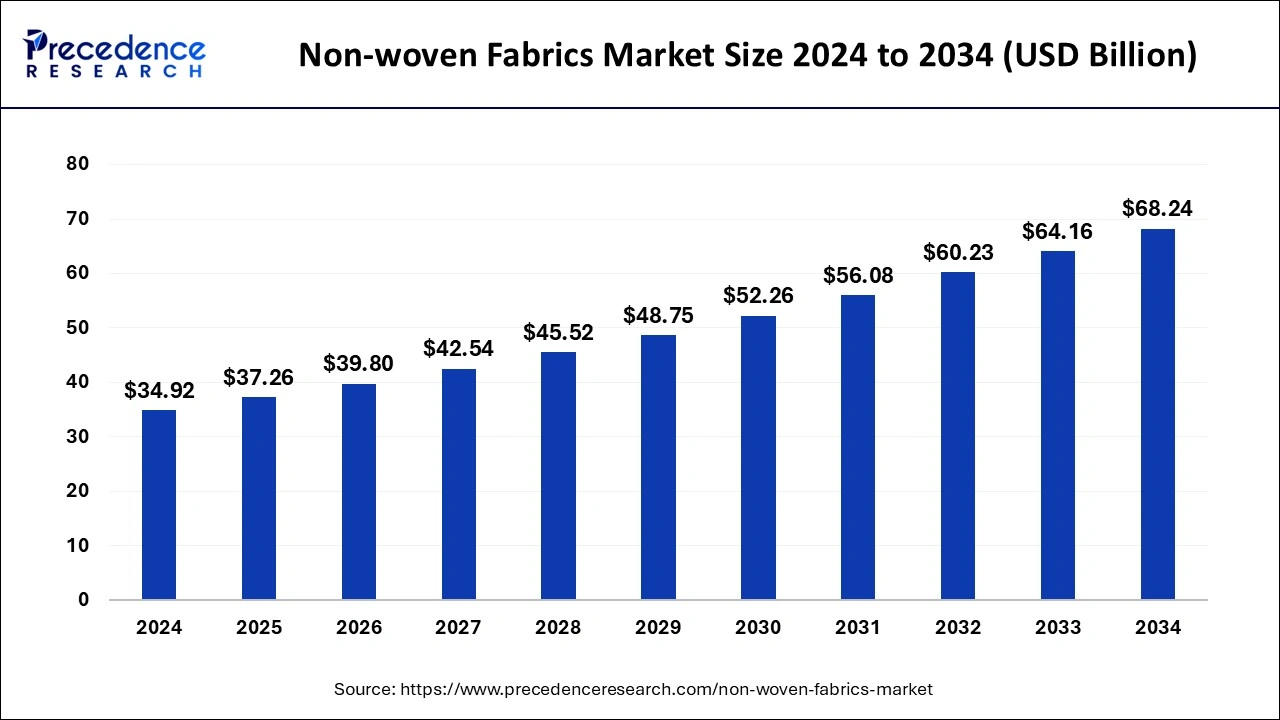
The global non-woven fabrics market is projected to grow from USD 39.80 billion in 2026 to USD 72.22 billion by 2035, registering a CAGR of 6.84%. Growth is driven by rising demand for hygiene and personal care products, expanding healthcare and medical applications, increasing use in construction geotextiles and automotive components, advancements in AI-enabled manufacturing and quality control, and growing adoption of lightweight, durable, and sustainable non-woven materials.
Source: https://www.precedenceresearch.com/non-woven-fabrics-market
 Get a Sample
 Table Of Content


What is Non-woven Fabrics Market Size?
The global non-woven fabrics market is valued at USD 39.80 billion in 2026 and is expected to reach USD 72.22 billion by 2035 with a CAGR of 6.84% from 2026 to 2035.
Market Highlights
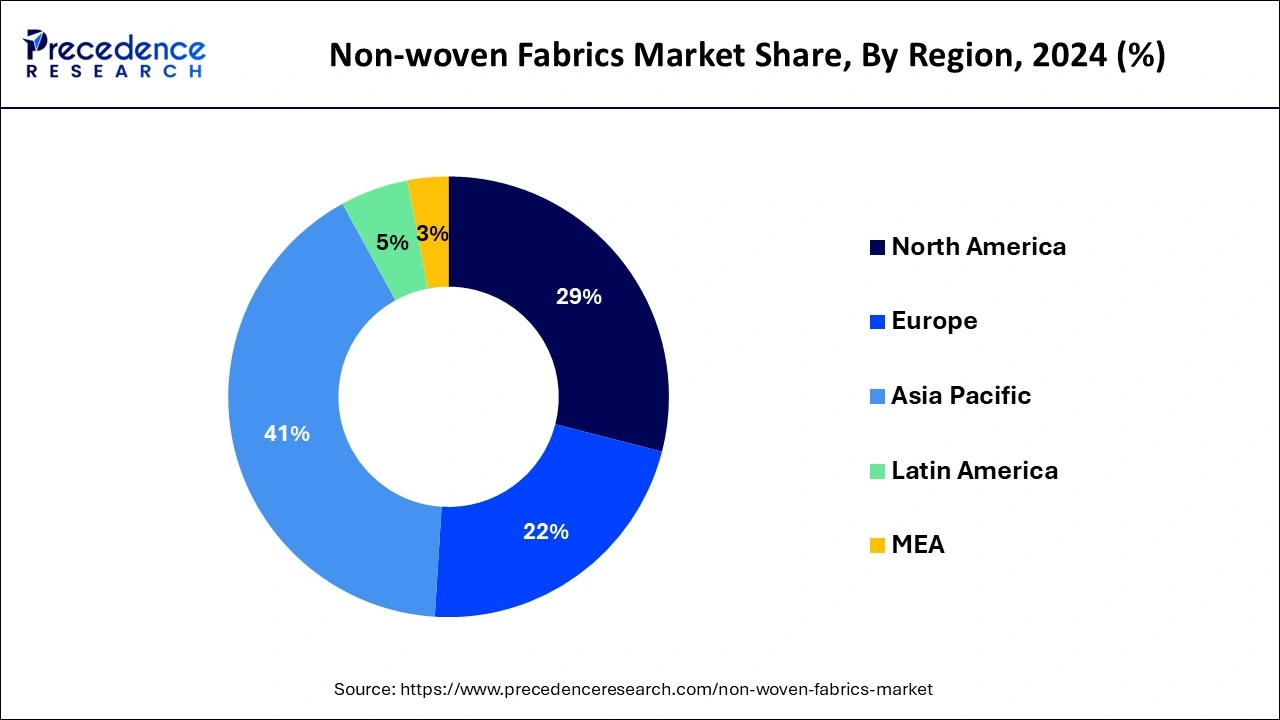
- Asia Pacific led the global market with the highest market share of 41% in 2025.
- By Product, the polypropylene segment has held the largest market share of 60% in 2025.
- By Application, the durables segment captured the biggest revenue share of 50% in 2025.
Key AI Integration in the Non-Woven Fabrics Market
Artificial Intelligence is significantly transforming the non-woven fabrics market by enhancing manufacturing efficiency, enabling advanced quality control through computer vision, and fueling innovation in smart textiles , along with sustainability. This integration is a key factor driving market growth, with the nonwoven and hygiene products segment expected to be one of the fastest-growing end-use areas for AI applications.
AI, primarily computer vision combined with machine learning, is revolutionizing defect detection. Additionally, high-resolution cameras scan fabrics in real-time to identify flaws, color mismatches, and irregularities with high accuracy, far exceeding manual inspection. The FabGoalie AI and Smartex systems are examples of commercial deployments in this field.
Non-woven Fabrics Market Growth Factors
Rising awareness related to personal hygiene products that include sanitary napkins, baby diapers, and adult incontinence products along with the increasing population with age group above 60 years across the globe expected to be the key factor that drives the market growth for nonwoven fabrics over the analysis period. Moreover, flame resistance coupled with superior strechability offered by the product estimated to positively influence the market growth.
Nonwoven fabrics are prominently used in the road construction projects as geotextiles this enhances the durability of roads. Their increasing demand in the construction sector is mainly because of their low maintenance cost. Further, increasing construction activities across the predominantly across the developing countries expected to propel the demand for non-woven fabrics over the upcoming years.
Apart from the construction sector, positive growth outlook on automotive and transportation industry estimated to further influence the market growth for non-woven fabrics over the forecast timeframe. Non-woven fabrics are significantly used in the manufacturing of several interior as well as exterior parts of the automobile because of their moldability, durability, and light weight properties. In addition, the automotive industry predicted to grow notably with the increasing demand for electric and battery-powered passenger cars that again triggers the growth for non-woven fabric products in the industry.
Non-Woven Fabrics Market Outlook
- Industry Growth Overview: The non-woven fabrics market is expanding rapidly from 2026 to 2035, driven by rising demand from hygiene, medical, construction, and automotive applications driven by cost efficiency and versatility.
- Global Expansion: The market is expanding worldwide due to rising demand for lightweight, durable, and cost-effective materials in the healthcare, hygiene products, automotive, and construction sectors. Additionally, rising awareness of eco-friendly and disposable products is boosting adoption across both developed and emerging economies.
- Major Investors: Major investors in the market include global giants such as Freudenberg Group, Kimberly-Clark, DuPont, Ahlstrom-Munksjö, Toray Industries, Fitesa, Glatfelter, and PFNonwovens, focusing heavily on medical, industrial, hygiene, and sustainable product innovation, often through R&D, strategic acquisitions, and new plant setups, mainly in Asia-Pacific.
Market Scope
| Report Highlights | Details |
| Market Size in 2025 | USD 37.26 Billion |
| Market Size in 2026 | USD 39.80 Billion |
| Market Size by 2035 | USD 72.22 Billion |
| Market Growth Rate from 2026 to 2035 | CAGR of 6.84% |
| Largest Market | Asia Pacific |
| Base Year | 2025 |
| Forecast Period | 2026 to 2035 |
| Segments Covered | Product, Application, and Region |
| Regions Covered | North America, Europe, Asia-Pacific, Latin America and Middle East & Africa |
Segment Insights
Product Insights
Polypropylene emerged as the leading product segment across the global market and accounted for a volume share of more than 60% in 2025. Polypropylene products are extensively used by the industry participants because of their availability in different grades and properties that can be modified by using auxiliary chemicals and treatment processes.
Polyester expected to be the second largest product segment across the market and anticipated to register a steady growth rate during the upcoming years owing to their increasing penetration in applications such as agriculture, automotive, and medical & surgical equipment.
Carded Polyester fabric also estimated to register notable growth in the coming years because it offers higher stability along with superior internal bond strength due to uniformity in the fiber alignment. The aforementioned properties offered by the product projected to propel its demand particularly in the production of feminine hygiene pads, adult incontinence, infant diapers, and toddler training pants.
Application Insights
Durable application accounted for the major volume share in the global non-woven fabrics market with more than 50% of the market share in 2025and expected to maintain the same trend during the upcoming years. Rising spending in the construction activities majorly in the developing countries such as China, India, and Brazil that has significantly triggered the demand for non-woven fabrics as geotextiles estimated to drive the demand for non-woven fabrics in durable application segment.
Apart from durable, disposable segment anticipated to witness substantial growth over the forthcoming years. The growth of the segment is mainly because of constant replacement of reusable medical non-woven fabrics with disposable fabrics in order to prevent contamination among patients. Further, rising population with age group more than 60 years along with high birth rate across various nations such as Japan, the U.S., Germany, Monaco, UK, China, and India expected to further thrive the market growth for disposable non-woven fabrics.
Technology Insights
The spunlaid segment dominated the market in 2025. Spunlaid technologies are smartly expanding to high-end hygiene-based items like diapers. The rising number of infants and, accordingly, the baby products sales hype for diapers. The production process promotes the adoption of this technology, driving more accuracy in personal care. The robust involvement of polypropylene-related spunlaid fabrics enables the manufacturing unit to run its operations with more affordability in its textile businesses.
The air laid segment is expected to grow during the forecast period. This dry manufacturing technique connects to the air streams with the storage space in the active screen for web integrity. This web formation, complementing the integrated system operations, further enhances short fibers. The appropriate air currents followed by the pressure allow the tech operation to complete its layer of completion to meet the final fabric product. The rising demand for these fabrics in personal care is signalling smart revenue to the segmental market.
Regional Insights
Asia Pacific Non-woven Fabrics Market Size and Growth 2026 to 2035
The Asia Pacific non-woven fabrics market size is estimated at USD 15.28 billion in 2025 and is anticipated to reach around USD 29.61 billion by 2035, poised to grow at a CAGR of 6.84% from 2026 to 2035
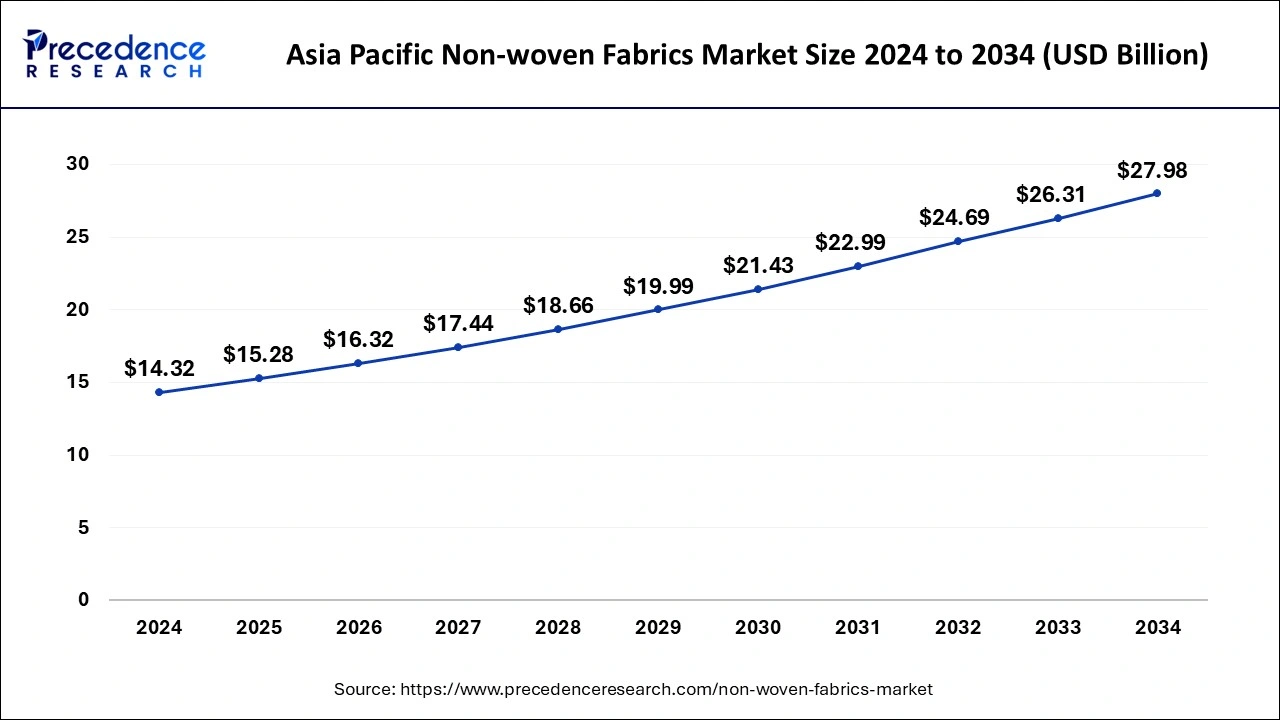
The Asia Pacific led the global nonwoven fabrics market with more than 41% volume share in the year 2025. The prominent growth of the region is mainly due to increasing birth rate along with ageing population in the region that requires extra attention towards their hygiene. In addition to this, by providing good education to youth along with stringent laws regarding birth detection in hospitals, the government in the region has targeted to stop the female infanticide that expected to improve the female to male ratio. This approach is further anticipated to propel the demand for female hygiene products in the region.
India Non-Woven Fabrics Market Trends
Key trends include the shift to sustainable materials (rPET, bio-binders) due to plastic bans, increased use of advanced tech like spunlace, and growing applications in geotextiles, with India emerging as a significant global producer and exporter. Rising industrialization, urbanization, and government initiatives promoting domestic manufacturing are also driving up demand for cost-effective, versatile non-woven materials.
Moreover, increased spending towards construction activity in order to develop internal infrastructure in emerging economies such as China and India further projected to boost the demand for non-woven fabric in the region.
What Potentiates the Market in North America?
North America projected to register notable growth for the global nonwoven fabrics market on account of rising reconstruction activities for upgrading the infrastructure along with significant growth of the transportation sector. Besides this, maturity in the disposable nonwoven application in the region anticipated to hinder the market growth over upcoming years.
U.S. Non-Woven Fabrics Market Analysis
The market in the U.S. is expanding due to increasing demand in healthcare (PPE, hygiene), infrastructure (geotextiles), and hygiene products (diapers, wipes, adult care), driven by an aging population, higher health awareness, and technological advances like spunbond. Additionally, strong adoption in automotive, construction, and filtration applications, along with technological advancements in material production, is fueling market growth.
What Opportunities Exist in Europe?
Europe presents significant opportunities in the non-woven fabrics market, driven by growing demand in the hygiene, medical, and automotive sectors, particularly for sustainable and high-performance materials. Increasing consumer preference for eco-friendly and biodegradable products is encouraging manufacturers to innovate and expand production of sustainable non-wovens. Additionally, government regulations and initiatives promoting recycling and waste reduction are creating avenues for advanced non-woven applications in packaging and construction.
Latin America's Business Reach in the Non-woven Fabrics Market
Latin America market is considered to be a significantly growing area, due to commendable business strategies and alliances with the automotive and hygiene sectors. The growing construction projects for regional development are expanding the demand for fabrics. The immersive transformation in the automotive industry is driving production of eco-friendly non-wovens. The countryside powerhouses are strongly developing their position in the regional market expansion. The responsible medical sector is constantly accelerating the use of non-wovens, promoting spunbond technologies. This bolsters the business opportunities across the hygiene sector.
MEA's Innovation in the Market
MEA market is expected to grow at a notable CAGR in the foreseeable future. Sustainable materials are leading the future of the regional market. The common content unification of modern materials is the smart innovation in the textiles business. Manufacturers are strongly transitioning the material space with possible eco-friendly aspects that will bring green revenue to the regional market. The growing industrialization and construction sites are building a robust pipeline for non-wovens to further prove their existence in the regional development dynamics, supporting erosion control and biodegradable fabrics.
UAE Market Trends
UAE non-woven fabrics market trends are bound to the luxurious infrastructure and constant developmental projects for the region to retain its position in the tourism headlines. The rising volume of personal hygiene products allows more business grants into the market, businesses and expansion.
Value Chain Analysis of the Non-Woven Fabrics Market
- Feedstock Procurement
It includes a strategic supply chain process that secures diverse raw materials, mainly synthetic polymers along with natural fibers, for manufacturing. - Fabric Production/Manufacturing
Converts raw fibers into non-woven fabrics using technologies such as spunbond, meltblown, or needle-punching. - Distribution & Logistics
Ensures timely delivery of non-woven fabrics to various industries, including healthcare, hygiene, automotive, and construction.
Key Players in the Non-Woven Fabrics Market & Their Offerings
- Mitsui: Through its joint venture Mitsui Chemicals Asahi Life Materials, Mitsui offers a variety of advanced nonwoven fabrics for industrial, hygiene, and lifestyle items.
- Fibertex: It offers a wide range of technical nonwoven fabrics for various industries, focusing on high-performance, customizable solutions that use advanced technologies like nanofibers and plasma treatment.
- Fitesa: It offers a wide range of innovative nonwoven fabrics, films, and composites for the Hygiene, Industrial, Medical, and Wipes markets, using technologies such as spunmelt, meltblown, spunbond, carded, airlaid, and spunlace.
Non-woven Fabrics Market Companies
- Du Pont Chevron Corporation
- Ahlstrom Incorporation
- Polymer Group Incorporation
- Fiberweb
- Asahi Kasei Corporation
- AVGOL
- Providencia
- First Quality
- PEGAS
- Toray
Segments Covered in the Report
By Product
- Polyester
- Polypropylene
- Nylon
- Others
By Technology
- Carded
- Spunlaid
- Wet Laid
- Air Laid
By Application
- Disposables
- Durables
By Region
- North America
- Europe
- Asia Pacific
- Latin America
- Middle East and Africa
For inquiries regarding discounts, bulk purchases, or customization requests, please contact us at sales@precedenceresearch.com
Frequently Asked Questions
Tags





Ask For Sample
No cookie-cutter, only authentic analysis – take the 1st step to become a Precedence Research client
 Get a Sample




 sales@precedenceresearch.com
 Schedule a Meeting
