



Polypropylene Market Size, Key Companies, Company Technology / Innovation, Production Economics, Trade Analysis, Material Efficiency, Market Penetration, Company Investment Strategies, and Sustainability Trends
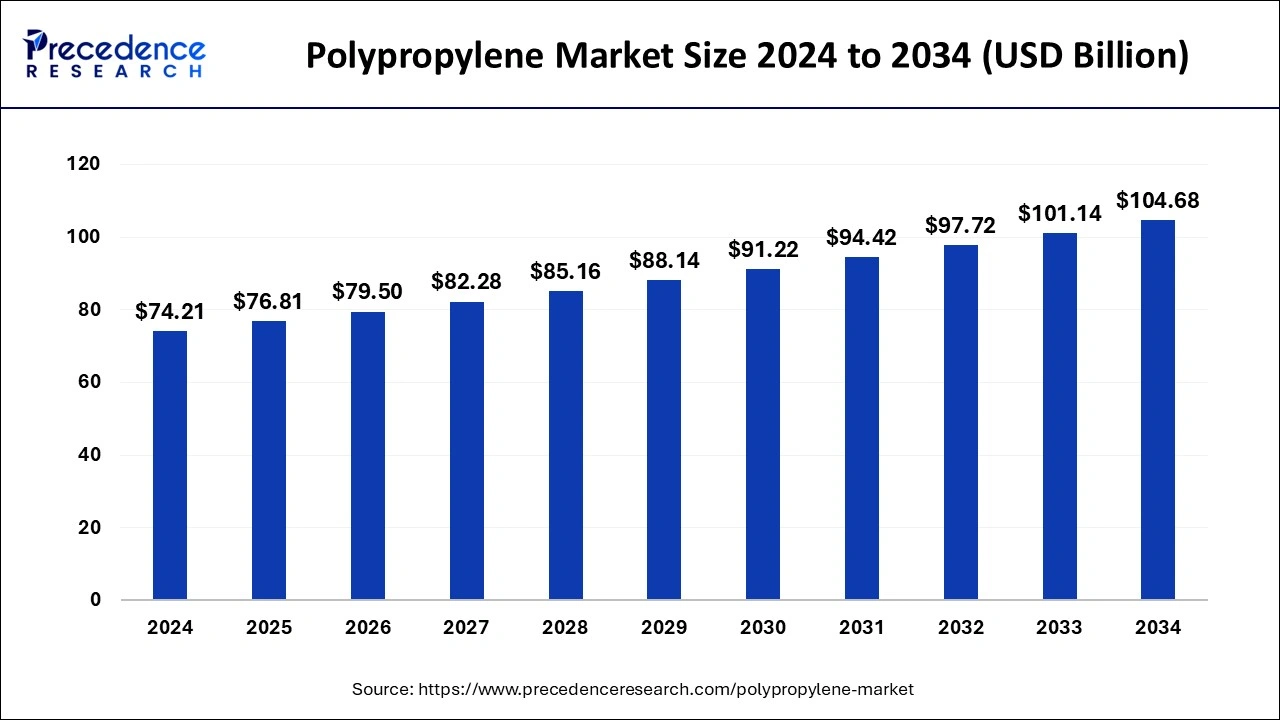
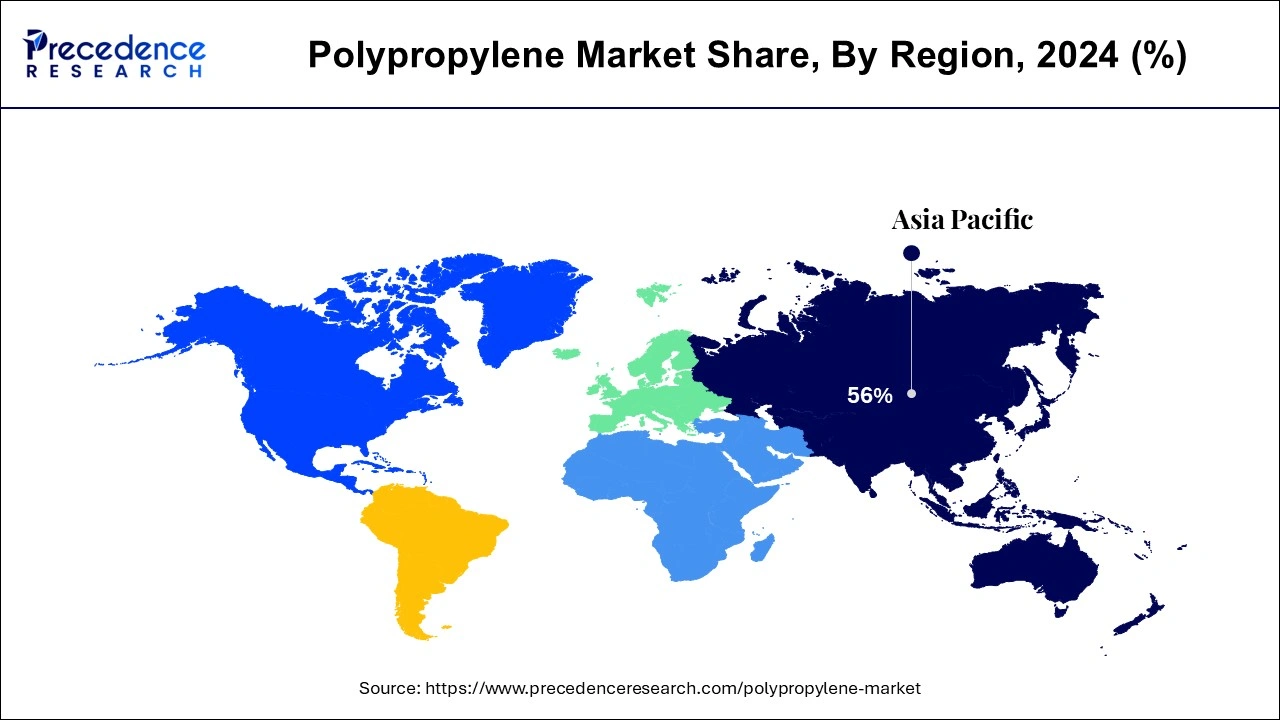
The global polypropylene market was valued at USD 202.25 billion in 2026 and is projected to reach USD 293.54 billion by 2035, growing at a CAGR of 14.35% from 2026 to 2035. Market growth is driven by increasing demand for lightweight, durable, and recyclable materials across the packaging, automotive, healthcare, construction, and consumer goods industries. Advancements in recycling technologies, bio-based polypropylene, and circular economy initiatives are further supporting market expansion. Asia Pacific accounted for 56% of the global market share in 2025, driven by its strong petrochemical infrastructure and expanding manufacturing base, while North America and Europe continue to grow through investments in sustainable polymer production and advanced recycling technologies.
Source: https://www.precedenceresearch.com/polypropylene-market
 Get a Sample
 Table Of Content


What is Polypropylene Market Size?
The global polypropylene market size accounted for USD 193.91 billion in 2025 and is predicted to increase from USD 202.25 billion in 2026 to approximately USD 293.54 billion by 2035, expanding at a CAGR of 14.35% from 2026 to 2035. The growth of the polypropylene market can be attributed to its low costs, ease of processing, broad spectrum of applications, increasing demand in various industries and innovative breakthroughs in polypropylene development.
Polypropylene Market Key Takeaways
- Asia Pacific led the global market with the highest market share of 56% in 2025.
- By polymer type, the homopolymer segment was the highest revenue holder in 2025.
- By process, the injection molding segment accounted highest revenue share in 2025.
- By end-use, the automotive segment has held biggest revenue share in 2025.
- By applications, the film and sheet segment accounted for a highest revenue share in 2025.
Market Overview
Growing demand for lightweight, durable, and recyclable materials across the packaging, automotive, healthcare, and consumer goods industries is driving sustained expansion of the polypropylene market worldwide. Polypropylene is a thermoplastic polymer manufactured by polymerizing propylene with a minimum of 90% of functional groups. It has good chemical resistance, mechanical properties, moisture resistance, and good processing properties.
The material is processed into injection-molded, extruded, blow-molded, thermoformed, and fiber products, with a variety of applications. Advances in recycling technologies and high-quality recycled polypropylene manufacturing are facilitated by the increased uptake of the circular economy concept and its practices around the globe. Furthermore, the continued production uptick further validates long-term demand for polypropylene in the packaging, automotive, construction, and consumer product production industries.
When AI Meets Polypropylene: Transforming the Polypropylene Market
The integration of artificial intelligence AI can be applied for recycling polypropylene such as for differentiating various types of propylene for precise sorting, in quality control for examining manufacturing defects, for characterization of polymer by analysing data from analytical techniques, in predictive maintenance and for design optimization of polypropylene products thereby improving their functionality and reducing development costs.
Polypropylene Market Growth Factors
The increasing application of polypropylene across various end-use industries including automotive, packaging, medical, building & construction, and many others drives the demand for the product over the upcoming years. Polypropylene is a light weight material that offers broad range of superior properties such as high tensile strength, low moisture resistance, staining resistance, and resistant to various chemical solvents, acids, & bases because of which it is largely preferred in the aforementioned industries.
Shifting trend towards lighter materials in automotive sector in order to improve the fuel efficiency and curb the pollution rate act as a booming factor for the market growth of polypropylene in the industry. Similarly, it is highly preferred as a packaging solution in food & beverage industry owing to its excellent moisture resistance property that increases the life of the packaged food and prevents it from degradation.
On the other hand, lockdown imposed by different governments to control the spread of COVID-19 pandemic has significantly impacted to the consumption of polypropylene as well as its demand has declined rapid across various end-use industries. Manufacturers are facing difficulties while running production lines because of insufficient supply of raw material and restrictions on logistics along with limitations for the movement of people that further cascade negative impact towards the product demand. Besides this, increasing requirement for specialized polypropylene particularly in the healthcare sector in order to manufacture medical gowns, masks, and other safety equipment expected to propel the demand for the product in the upcoming years.
Polypropylene Market Trade Analysis
- Due to their hydrocarbon resources and petrochemical production facilities, the Middle East has a unique strategic position as an exporter of polypropylene.
- Furthermore, producers in the Middle East take advantage of competitively priced propylene feedstocks, ensuring a constant stream of polypropylene exports to Europe, Africa, and South Asia. Long-term supply contracts and regional port-based logistics hubs will only enhance the region's position as an exporter.
- As a significant portion of the European Union's polypropylene imports comes from outside Europe, there are many external suppliers that deliver polypropylene to the automotive, packaging, and consumer goods sectors.
- The flow of Trade into the EU is significantly affected by environmental regulations, import tariffs, and energy costs, which further reduce producers' ability to compete against EU-based producers.
- Comparatively, North America has a relatively balanced trade profile for polypropylene exports, which are primarily supported by the country's shale-based feedstock advantage and strong domestic consumption of polypropylene.
Major Polypropylene Market Trends
- Recyclable and Circular Polypropylene Solutions Continue to Become Prominent: One of the fastest growing trends on the market currently is the rise of circular and recyclable polypropylene solutions. There has been an influx of manufacturers investing in both mechanical and chemical recycling technologies and producing high-quality recycled polypropylene that meet performance standards for the packaging, automotive, and consumer goods markets.
- Lightweight Material Substitution Will Continue to Shape the Market: Lightweight material substitution will shape the market as a significant trend in the automotive and transportation sectors. Typically found as heavy materials (metal and glass), polypropylene is being used as a replacement for such materials because of its excellent strength to weight ratio, high chemical resistance, and great cost effectiveness.
- Polymer Modification and Catalyst Advancements are Driving Additional Market Evolution: Advancements in polymer modification and catalyst technologies continue to drive market evolution. For example, factories have begun developing metallocene-based catalysts and producing improved impact-modified polypropylene grades that are capable of providing greater material flexibility, toughness, and thermal resistance than previously offered polypropylenes.
Shaping Tomorrow: Polypropylene Market Outlook
- Industry Growth Overview: The growing demand from the automotive and packaging industries is driving the industrial growth of the market. Moreover, a growth in the healthcare, electronics, and construction sectors is also contributing to this growth.
- Sustainability Trends: The sustainability trends focus on enhancing the recycling methods to implement a circular economy model and increasing the shift towards biobased polypropene derived renewable sources to meet the regulatory standards.
- Major Investors: Large integrated energy and chemical corporations and major asset management firms are the major investors in the market. SABIC, ExxonMobil Chemical Company, Braskem, and Sinopec are some of the major investors in the market.
Future Outlook and Strategic Recommendations
- Long-Term Industry Outlook: The long-term industry outlook for polypropylene is directed toward sustainability, focusing on bio-based alternatives derived from renewable biomass and ethanol, mainly driven by net-zero goals. Scalable chemical recycling, including pyrolysis and depolymerization, will convert mixed plastic waste into virgin-grade materials, while nanomaterial integration unlocks advanced applications in aerospace and medicine, all strictly regulated by stringent global environmental mandates.
- Emerging Business Models: Manufacturers are rapidly moving away from linear production and shifting towards modern manufacturing for Circular-as-a-Service (CaaS), where suppliers lease products and manage closed-loop recovery of materials to ensure packaging and components repurposing. Companies are diversifying raw materials by leveraging propane dehydrogenation technology, while utilizing AI, IoT, and blockchain for supply chain traceability of recycled content, thereby buffering overall volatile fossil fuel prices.
- Strategic Recommendations for Stakeholders: Stakeholders can drive sustainable growth by investing in circular infrastructure and localized collection networks to secure raw materials. To ensure seamless operations and avoid market friction, stakeholders should monitor updates for polypropylene materials to avoid distribution restrictions. Furthermore, companies should leverage subsidies in government-sponsored Petrochemical and Plastic Parks and prioritize research and development of light weighting to enhance fuel efficiency and comply with emission targets.
Market Scope
| Report Highlights | Details |
| Market Size in 2025 | USD 193.91 Billion |
| Market Size in 2026 | USD 202.25 Billion |
| Market Size by 2035 | USD 293.54 Billion |
| Growth Rate from 2026 to 2035 | CAGR of 5.40% |
| Largest Market | Asia Pacific |
| Base Year | 2025 |
| Forecast Period | 2026 to 2035 |
| Segments Covered | Product, Application, Region |
| Regions Covered | North America, Asia Pacific, Europe, Latin America, Middle East and Africa |
Market Dynamics
Driver
Increasing Demand for Sustainable Packaging Materials
Increasing demand for sustainable and lightweight packaging materials across the food and e-commerce industries is expected to drive the market. Its strong position in flexible and rigid packaging is extended with continuous innovation of barrier films made from materials that can be recycled, and the development of packaging innovations. Furthermore, the rising sustainability regulations, expanding packaged food production, and increasing investments in recyclable plastic packaging are projected to sustain long-term demand across global packaging industries.
Restraint
Hamper Market Growth Through Feedstock Price Volatility
Persistent volatility in propylene and crude oil prices, which is expected to increase production cost uncertainty across the polypropylene value chain, hinders market growth. The shifting prices of resin, coupled with a lack of flexibility in pricing products downstream, can put profits at risk. Furthermore, expanding environmental regulations and sustainability requirements are likely to limit conventional polypropylene consumption in selected applications.
Opportunity
Growing Automotive Lightweighting Initiatives Anticipated to Accelerate Polypropylene Adoption
Growing automotive lightweighting initiatives across passenger and commercial vehicle manufacturing are anticipated to create immense opportunities for the players competing in the market. PP has been increasingly adopted by automotive manufacturers for bumpers, dashboards, interior trims, battery cases, air ducting, and under-the-hood parts. Additionally, the production of EVs brings more opportunities for PP use, as lightweight parts enhance EV energy use efficiency and extend EV driving distance without sacrificing performance.
Segment Insights
Process Insight
How Did Injection Molding Establish Its Leadership in the Polypropylene Market?
The injection molding segment dominated the market in 2025 due to its ability to produce large volumes in a short time with excellent dimensional stability. Injection-molded polypropylene was used in consumer goods, automotive, electrical, healthcare, and industrial equipment. Manufacturers were choosing the material for its durability, lightweight performance, and outstanding design flexibility.
ENGEL was also showcasing the latest foaming technology at PTXPO 2025 in 2025, in alignment with material- and cost-efficient molding solutions, helping in the sustainable production of polypropylene. Furthermore, the advanced robotics further reinforced injection molding as the dominant polypropylene processing technology in the coming years.
The blow molding segment is expected to grow at the fastest CAGR between 2026 and 2035, owing to the increasing demand for creating lightweight bottles, industrial containers, pharmaceutical packaging, and fluid reservoirs in the automotive industry. Packaging manufacturers increasingly adopt advanced extrusion and injection blow molding technologies to improve productivity while reducing resin consumption and manufacturing waste.
Type Insights
What Enabled Homopolymer to Retain the Largest Share of the Polypropylene Market?
The homopolymer segment dominated the market in 2025, as it offered advantages in terms of high stiffness, tensile strength, and excellent processability in large-scale industrial manufacturing applications. The use of homopolymer polypropylene was common for rigid packaging, textiles, and thin-walled injection-molded products for various industries. The material also allows fast processing, allowing manufacturers to enhance output without compromising dimensional accuracy and manufacturing waste.
The copolymer segment is expected to grow at the highest CAGR between 2026 and 2035, owing to the increasing demand for impact-resistant materials across automotive, healthcare, packaging, and industrial applications. The properties of copolymer polypropylene include low-temperature impact resistance, toughness, and flexibility, making it useful in making components that have high levels of durability and can withstand harsh operating environments.
Application Insights
Why Was Film & Sheet the Leading Application in the Polypropylene Market?
The film & sheet segment dominated the market in 2025 due to its good mechanical strength, printability, and barrier properties. Manufacturers increasingly utilize polypropylene films and sheets for food packaging, pharmaceutical blister packs, industrial wrapping, labels, and protective packaging. Furthermore, PlasticsEurope's aim is to promote the increased use of recyclable polypropylene film packaging solutions while highlighting packaging circularity.
The fiber segment is expected to grow at a rapid CAGR between 2026 and 2035, owing to increased demand for lightweight, chemically-resistant, and load-bearing materials within the fields of hygiene, medical, automotive, and construction. Healthcare manufacturers continue to grow their use of nonwoven polypropylene fiber in surgical gowns, face masks, and medical drapes that utilize PP fibers and require consistent material performance throughout the day.
End-Use Insights
What Positioned the Automotive Sector as the Largest End-Use Industry in the Polypropylene Market?
The automotive segment dominated the market in 2025 due to the industry's increasing preference for lightweight, durable, and cost-efficient materials that improve vehicle performance and manufacturing efficiency. Polypropylene was used extensively in the manufacture of bumpers, dashboards, door panels, battery housings, air ducts, wheel arch liners, and interior trim for low-density and high-impact resistance properties.
According to the European Automobile Manufacturers' Association (ACEA), in 2024, around 11.4 million passenger cars were manufactured in the EU, indicating the continued demand for engineering plastics, including polypropylene. Furthermore, continuous investments in electric mobility, lightweight vehicle platforms, and recyclable automotive materials reinforced automotive manufacturing as the leading polypropylene end-use sector throughout the historical period.
The medical segment is expected to grow at the highest CAGR between 2026 and 2035, driven by rising demand for sterile and chemically resistant polypropylene applications in the healthcare manufacturing sector, which are lightweight materials. As polypropylene becomes a more popular choice for healthcare manufacturers, they are beginning to use advanced grades of the material to ensure dimensional stability while meeting medical quality criteria and regulatory standards.
Regional Insights
Why Did Asia Pacific Dominate the Polypropylene Market?
Asia Pacific led the market, capturing the largest revenue share in 2025, due to the region's integrated petrochemical infrastructure, expanding manufacturing base, and rapidly growing demand across the packaging, automotive, electronics, and consumer goods industries. Polymer output in China, India, Japan, and South Korea kept increasing with high investment in refinery and petrochemical plants for the region to ensure its supply security.
What is the Asia Pacific Polypropylene Market Size?
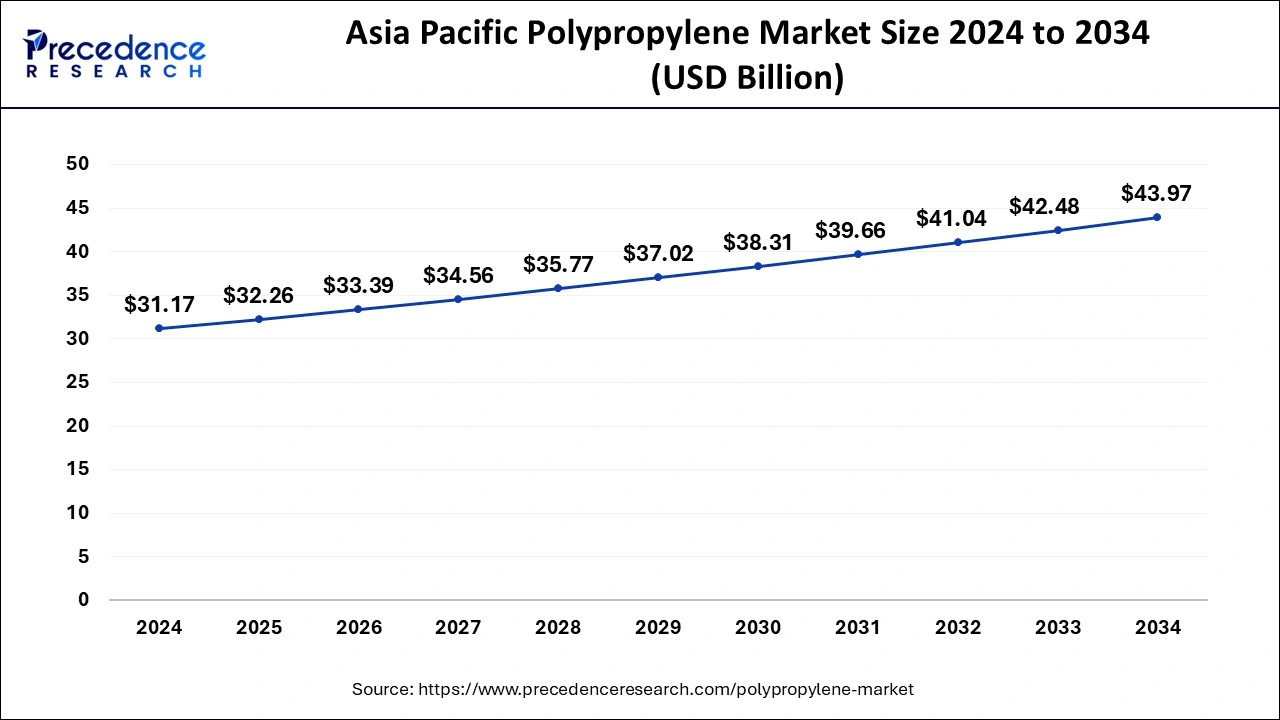
The Asia Pacific polypropylene market size is estimated at USD 77.56 billion in 2025 and is predicted to be worth around USD 119.29 billion by 2035, at a CAGR of 4.4% from 2026 to 2035.
Asia's plastics manufacturing dominance is further illustrated in PlasticsEurope Fast Facts 2025, which showed that Asia consumed 57.2% of all world plastics in 2024, and 42.5% of which was produced in China alone. Furthermore, increasing investments in downstream plastics processing and export-oriented manufacturing reinforced Asia Pacific as the leading regional market throughout the historical period.
China: The Growth Engine of the Asia Pacific Polypropylene Market
China leads the market due to its fostering fast growth of the advanced manufacturing and electric vehicle, consumer electronics, and high-value packaging sectors. Continued high investment in SM, renewable energy equipment, and modern packaging production is further solidifying China's position in the regional PP value chain.
The North America Region Held the Second-Largest Market in 2025
North America is the region that held the second-largest market share in 2025 and is estimated to grow at a strong CAGR over the projected period, supported by the region's ample supply of shale-based feedstocks, advanced technology in processing, and the growing investments in circular plastics production.
The U.S. is making continued investments in its polypropylene manufacturing capabilities by investing in downstream petrochemical complexes that provide support to domestic and export customers. Furthermore, the increasing use of lightweight automotive components, medical devices, and high-performing packaging materials will help boost the regional polypropylene industry.
U.S. Driving Innovation Across the North American Polypropylene Market
The U.S. is a major contributor to the market due to increasing investments in advanced polypropylene technologies supporting domestic manufacturing. Domestic consumption of polypropylene remains strong, facilitated by generally high shale-based feedstock supply, growing industrial automation, and the addition of medical devices.
Europe Holding Significant Market Share in 2025
The Europe region is expected to grow at a rapid CAGR between 2026 and 2035, driven by the region's robust policy framework promoting recycling, circular economy, and sustainable polymer innovation in industries, driving the continuing expansion of polypropylene. Increased investment will be a driving factor for polypropylene's continued growth in Europe in chemical recycling, recycling of polymers, and production of polymers from sustainable industrial waste.
Germany Advancing Sustainable Polypropylene Manufacturing in Europe
In Germany, the polypropylene market is expected to increase its research activities in the areas of polymer processing, polymer recycling technologies, and sustainable plastics production. Chemical recycling, lightweight mobility solutions, and precision manufacturing are further key drivers for the policy-driven growth of polypropylene use in Germany.
Latin America Holding Notable Market Share in 2025
The Latin America region is expected to grow at a notable CAGR between 2026 and 2035, bolstering the supply of sustainable resin to packaging and consumer goods manufacturers. Braskem continued to progress in its partnership in the field of circular economy to increase the use of recycled resin in Latin America. Furthermore, the region's manufacturing activity was reflected in continued reports of increased international trade in manufactured plastic products and industrial materials from the International Trade Centre (ITC).
Brazil Expanding Polypropylene Opportunities Across Latin America
Brazil is a major player in the polypropylene market, fuelled by higher investments in flexible packaging, industrial conversion facilities, and applications in the manufacture of consumer products. The International Trade Centre (ITC) reported continued strong international trade activity for manufactured plastic products and industrial materials for regional industrial development.
Middle East & Africa Holding Considerable Market Share in 2025
The Middle East & Africa region is expected to grow at a strong CAGR between 2026 and 2035, owing to the growing petrochemical investments, integrated refinery projects, and a growing downstream capacity for plastics.
Emphasis remains on the use of hydrocarbons for polypropylene production in the Gulf countries in order to build up production inside the country, and also export. Additionally, Borouge also promoted its advanced polyolefin production in 2025 while providing high-performance polyolefins for infrastructure, packaging, and healthcare markets.
Saudi Arabia Accelerating Polypropylene Production in the Middle East & Africa
In Saudi Arabia, the polypropylene market is expected to continue its expansion of regular industrial exports and ongoing investments in sustainable polymer technologies. Saudi Arabia's investments in cutting-edge petrochemical production, recycling endeavors, and circular manufacturing endeavors were maintained as a focus topic throughout 2025 by the Gulf Petrochemicals and Chemicals Association (GPCA).
Regulatory Guidelines for the Polypropylene Market
- U.S. Environmental Protection Agency (EPA): The EPA regulates polypropylene production at the manufacturing level to reduce environmental impact. Through its New Source Performance Standards (NSPS) for the Polymer Manufacturing Industry, the EPA strictly controls emissions of Volatile Organic Compounds (VOC) and hazardous air pollutants.
- U.S. FDA: The FDA tightly regulates polypropylene for safety under Title 21 of the CFR, specifically 21 CFR 177.1520. Formulations must meet exact extractive limitations and purity requirements before being deemed safe for food and pharmaceutical contact. The regulations strictly mandate allowable extraction levels, specific density parameters, and melting points depending on the intended food type and thermal exposure.
- EU REACH and PPWR: The EU REACH Regulation strictly limits the use of chemicals, including SVHCs (Substances of Very High Concern), and intentionally added microplastics. Furthermore, the upcoming EU Packaging and Packaging Waste Regulation (PPWR) mandates a transition to circular packaging, demanding recycled content targets and strict design-for-recycling criteria.
- India Bureau of Indian Standards (BIS): The Indian government mandates adherence to IS 10910 for polypropylene and its copolymers used in contact with foodstuffs, pharmaceuticals, and drinking water. Manufacturers must meet strict Overall Migration Limits and use only permitted, virgin-grade additives and colorants.
What are the Government Initiatives in the Polypropylene Market?
- The European Union implemented the PPWR policy to promote the recycling of polypropylene packaging and reduce plastic waste based on circular economy concepts.
- New Plastic Waste Management regulations were set in place by the Indian Government, mandating the use of recycled plastics in polypropylene packaging from fiscal year 2025-26 onwards based on EPR.
- The Chinese government adopted the practice of recycling plastic due to the installation of polypropylene recycling facilities, along with encouraging the use of sustainable packaging material. In addition, many countries within the European Union implemented their own action plan related to the circular economy concerning polypropylene recycling.
Mapping the Journey: Polypropylene Market Value Chain Analysis
- Feedstock Procurement
Sourcing propylene monomer from major oil and gas companies and chemical producers is involved in the feedstock procurement of polypropylene.
Key players: SABIC, ExxonMobil Company, LyondellBasell Industries - Quality Testing and Certification
The quality testing and certification of polypropylene involves the mechanical, chemical, and physical tests as per the set standards.
Key players: SGS SA, Bureau Veritas, Intertek Group plc. - Regulatory Compliance and Safety Monitoring
The regulatory compliance and safety monitoring of the polypropylene focuses on compliance with the stringent national and international standards set by regulatory bodies.
Key players: LyondellBasell Industries, SABIC, SGS SA, Intertek Group plc.
Competitive Landscape
The global polypropylene market is moderately consolidated, with global petrochemicals providers, integrated refining companies, and specialty polymer producers. Regional resin suppliers compete with each other based on production capacity, material innovation, and integration of the supply chain. Major companies such as LyondellBasell, SABIC, Borealis, Braskem, ExxonMobil, Dow, INEOS Corp., Reliance Industries, Sinopec, Formosa Plastics Corporation, LG Chem, and Borouge have robust market shares supported by a large manufacturing presence. Regional manufacturers continue expanding specialty compounds and application-specific materials to strengthen competitiveness across rapidly industrializing economies.
Manufacturers continue increasing investments in advanced recycling technologies and next-generation catalyst systems, improving polypropylene production efficiency. In 2025, Braskem expanded renewable and recycled polypropylene offerings, supporting global brand owners pursuing circular packaging objectives. Furthermore, as chemical recycling technologies and next-generation polymer engineering advances continue to roll out, competition becomes increasingly fierce while changing the competitive landscape for the global polypropylene market in the long-term.
The Innovations Leaders: Polypropylene Market Key Players' Offering
|
Companies |
Headquarters |
Products |
|
LyondellBasell Industries |
U.S. |
Purell, Hostalen, Hystron |
|
SABIC |
Saudi Arabia |
SABIC PP |
|
ExxonMobil Company |
U.S. |
ExxonMobil PP |
|
LG Chem |
South Korea |
Various PP resins |
Polypropylene Market Companies
- Lyondellbasell Industries Holdings B.V.: One of the largest suppliers of PP worldwide, LyondellBasell supplies numerous different grades of propylene homopolymers, random copolymers, and impact copolymers for use in a variety of end-use applications, including packaging, automotive, and industrial.
- Exxon Mobil Corporation: Chemical has developed advanced, high-performance polypropylene resins that have excellent durability, stress resistance, ease of processing, and demonstrate enhanced strength, rigidity, and thermal/stress resistance characteristics of automotive, healthcare, and consumer products.
- SABIC: Offers higher-performing and more sustainable solutions to industrial and consumer markets (including circular and bio-based products).
- BASF SE: A major German chemical producer offering a wide range of plastics and performance materials, including high-performance thermoplastics and engineered polymers used in automotive, construction, and consumer goods applications.
- LG Chem: South Korea's leading chemical firm, providing petrochemicals and specialty polymers such as ABS, SAN, PVC, polyolefins, and polypropylene for use in automotive, electronics, packaging, and industrial sectors.
- Trinseo S.A.: U.S. based materials company supplying plastics and engineered resins, including polypropylene, ABS, SAN, PC/ABS blends, and recycled content polymers for automotive, packaging, electronics, and construction markets.
- Total S.A: Global energy and chemicals company producing polypropylene, polyethylene, polystyrene, and circular/recycled polymers for diverse applications in automotive, packaging, medical, and construction industries.
- Westlake Chemical Corporation: U.S. petrochemical manufacturer offering polyolefin thermoplastics, including polypropylene and polyethylene, plus fluoropolymers and engineered materials for industrial, chemical processing, and consumer applications
Other major Key Players
- China Petrochemical Corporation
- Eastman Chemical Company
Latest Announcements
- In November 2024, Highland Plastics, a leader in innovative polymer solutions announced the launch of its breakthrough Kelvinite 2100 halogen-free flame-retardant polypropylene (HFFR PP) which will fulfill the demands of automotive suppliers and other industries affected by recent ban of China on antimony exports. Ben Simmons, CEO of Highland Plastics said that, “Kelvinite 2100 not only eliminates the sourcing challenges associated with antimony—it also provides unmatched performance that legacy FRPP materials simply cannot provide. With Kelvinite 2100, manufacturers can confidently meet flame-retardancy and environmental standards without compromising on quality or reliability. And, we can deliver with a 4-week lead time to meet immediate demand.”
- In September 2024, Braskem, a global market leader and innovative producer of biopolymers announced the launch of its pioneering bio-circular polypropylene (PP) which will serve as a sustainable solution for restaurant and snack food industries. Bill Diebold, Vice President, Braskem America Polyolefins, said that, “Our bio-circular PP is currently being supplied to various converters which support the Quick Service Restaurant (QSR) industry. Ideal users include QSR chains, retail food suppliers, traditional restaurants, and snack food companies especially those seeking to enhance circularity from their cooking oil usage. This versatile material is suitable for a wide range of applications, including food packaging, flexible packaging (such as films), and consumer goods.”
Collaboration Landscape
- In July 2026, PureCycle Technologies is partnering with RM TOHCELLO and Mitsui & Co. to integrate ultra-pure recycled polypropylene into BOPP films. The companies plan to publicly announce the launch of these sustainable packaging materials to the Japanese market in 2027, after successful pilot trials and overcoming historical purity and performance barriers.
(Source: https://www.purecycle.com) - In September 2025, LyondellBasell partnered with Futamura Chemical, Iwatani Corporation, and Shiseido to develop sustainable cosmetic packaging using bio-based materials. This partnership features LYB CirculenRenew, a bio-based polypropylene polymer, in the outer film of select items within Shiseido's premium Clé de Peau Beauté line.
(Source: https://www.lyondellbasell.com)
Recent Developments
- In June 2026, KBR introduced a patented polymer dissolution technology (PDT) for purifying and recycling polyethylene and polypropylene, aimed at addressing the mismatch between plastic consumption and current recycling capabilities. Thermoplastics, which can be melted and reused, dominate global plastic production, especially in the packaging and FMCG sectors. KBR's PDT, developed by ReVentas, allows for efficient polymer dissolution without proprietary solvents or extreme conditions.
- In June 2026, Borouge International launched a bio-based polypropylene grade with 10% renewable feedstock, enhancing its sustainable materials portfolio. This development supports lower-carbon drinking water infrastructure while meeting high-performance standards for water distribution systems.
- In May 2026, Nouryon announced its development of Perkadox PM-60ST-GR, which is an organic peroxide solution used to improve the properties of recycled polypropylene plastics for use in packaging, automobile parts, and consumer products.
- In September 2025, the world's first food-grade recycled polypropylene (rPP) solution was introduced by Prevented Ocean Plastic together with Innovia Films. The product range was developed using Starlinger Viscotec technology and includes food-safe rPP packaging for bottles, closures, trays, and BOPP flexible film structures.
Segments Covered in the Report
By Process
- Blow Molding
- Extrusion
- Injection Molding
- Others
By Type
- Copolymer
- Homopolymer
By Application
- Film & Sheet
- Raffia
- Fiber
- Others
By End-use
- Building & Construction
- Electrical & Electronics
- Automotive
- Medical
- Packaging
- Others
By Region
- North America
- Latin America
- Europe
- Asia-pacific
- Middle and East Africa
For inquiries regarding discounts, bulk purchases, or customization requests, please contact us at sales@precedenceresearch.com
Frequently Asked Questions
Tags





Ask For Sample
No cookie-cutter, only authentic analysis – take the 1st step to become a Precedence Research client
 Get a Sample




 sales@precedenceresearch.com
 Schedule a Meeting
