



Pharmacy Benefit Management Market Size, Trends, Growth, and Forecast to 2035
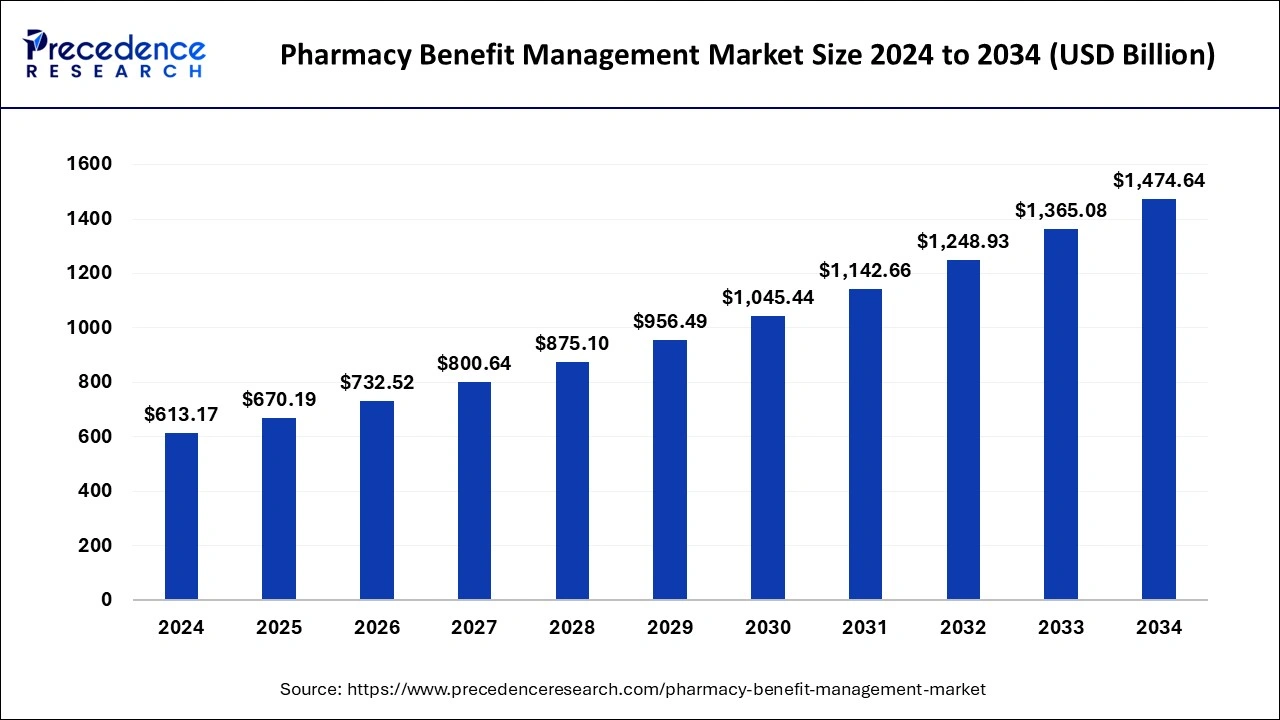
The global pharmacy benefit management (PBM) market was valued at USD 670.19 billion in 2025 and is projected to reach USD 1,588.59 billion by 2035, expanding at a CAGR of 9.01% from 2026 to 2035. Market growth is driven by rising pharmaceutical spending, increasing prevalence of chronic diseases, an aging global population, expanding health insurance coverage, and the growing adoption of AI-powered pharmacy benefit management solutions that improve drug cost management, claims processing, and patient outcomes.
Source: https://www.precedenceresearch.com/pharmacy-benefit-management-market
 Get a Sample
 Table Of Content


What Is Driving the Growth of the Global Pharmacy Benefit Management Market?
The global pharmacy benefit management market size accounted for USD 670.19 billion in 2025 and is predicted to increase from USD 732.52 billion in 2026 to approximately USD 1,588.59 billion by 2035, expanding at a CAGR of 9.01% from 2026 to 2035. The market is witnessing substantial growth driven by increasing pharmaceutical expenditures, a rapidly expanding elderly demographic, and the rising global burden of chronic diseases.
Key Takeaways
- North America dominated the market with a major market share in 2025.
- Asia Pacific is expected to grow at the fastest CAGR between 2026 and 2035.
- By service, the specialty pharmacy services segment contributed the highest market share in 2025.
- By service, the benefit plan design and administration segment is growing at a strong CAGR between 2026 and 2035.
- By service provider, the insurance companies segment held a major market share in 2025.
- By service provider, the retail pharmacy segment is expected to expand at a notable CAGR from 2026 to 2035.
- By business model, the health insurance management segment captured the highest market share in 2025.
- By business model, the government health programs segment is poised to grow at a healthy CAGR between 2026 and 2035.
Market Overview
Pharmacy benefit manager (PBM) specializes as a third-party supervisor. Pharmacy benefit management is an association of drug guides which manages, examines, and manages all the topics in relation with healthcare, and offers advantages of drug programs to the employers. Moreover, it aids in offering management with medical services as well as biologic medications at lowered costs. The cost deduction is attained over refunds with drug producers, coming in agreements with pharmacies, concocting, and remunerating prescription drug alleges and by employing with self-protected associations and government plans. This benefit management liberates the list of medication drugs which involve all drugs enfolded by the name of its advantageous plans, at which point producers are available to provide rebates. PBM is able to be varied and bendable starting from a little, to enormous in size. A few of the sectors of the pharmacy benefit manager involve checking clinical lineups for a vast populace, low price therapeutic alternates, medication therapy management programs & details regarding tablet splitting, and services of mail order.
How will AI revolutionize the Pharmacy Benefit Management Market?
Artificial Intelligence (AI) is revolutionizing the market by clinical improvement, workflow automation, and amplifying patient care. Prior authorizations and claims processing are automated by AI-driven natural language processing. ML algorithms scrutinize claims data to detect and flag anomalous prescribing and billing patterns, reducing financial waste. Predictive AI models examine patient histories to predict high-risk utilization and identify patient's non-adherent to medication. AI not only enables real-time adjustments to formularies via assessing drug effectiveness and costs but also streamlines the supply chain by ensuring value-based pathways for treatment optimization.
Pharmacy Benefit Management Market Trends
- Scrutinizing Vertical Integration in the Market: Nowadays, PBM has become intensely established in processing the vast majority of prescriptions by major giants. These vertically integrated organizations undergo validation for favoring their own mail-order pharmacies and steering patients.
- Regulators targeting PBM Specialty drug markups: Various financial conflicts of interest, with vertically integrated PBMs margining specialty generic drugs by a much percent. Regulators are actively challenging these rather than perverse drug rebate systems that lead to price gouging of life-saving medications.
- Agencies Adopting PBM Accountability: Regulatory bodies are intensely scrutinizing rebate structures and negotiation practices. Many agencies, like the Federal Trade Commission, look over major PBMs to confirm that drug pricing mechanisms lower costs for consumers.
- Transforming PBM Operations with AI and Real-time Analytics: To handle surging medication costs, volumes, and complex prior authorizations, PBMs are actively adopting digital technologies. Strong trend toward using AI and data analytics to refine inventory and streamline prescription management with automated prior authorizations in real-time.
Pharmacy Benefit Management Market Growth Factors
Pharmacy benefit management refers to the group of companies that act as the middlemen between the insurance companies and drug manufacturers and pharmacies for the purpose of securing lower drug costs for the insurance companies and insurers. The significantly rising prevalence of various chronic diseases among the global population is a primary driver of the global pharmacy benefit management market. The most prominent diseases that constitutes maximum deaths includes cancer, cardiovascular diseases, respiratory diseases, and diabetes. The si8gnificantly rising healthcare costs and healthcare expenditure in the developed and developing nations is boosting the growth of the global pharmacy benefit management market. The rising prevalence of chronic diseases and rising healthcare expenditure is augmenting the demand for the prescription drugs across the globe. This is boosting the demand for the pharmacy benefits management services across the globe.
Furthermore, the rising drug prices across the globe is resulting in increased healthcare spending which is a prominent factor behind the rising demand for the pharmacy benefit management services among the healthcare insurance providers. The rising healthcare expenditure owing to the rising adoption of the expensive drugs for rare diseases is supporting the market growth significantly. The growing penetration of the health insurance providers and rising consumer awareness regarding the benefits of health insurances is expected to boost the demand for the pharmacy benefit management services among the health insurance providers across the globe. The rapid adoption of the pharmacy benefit management services among the drug manufacturers, retail pharmacies, and health insurance providers is shifting the preferences of the service providers towards the advanced workflows that utilizes machine learning technologies. The introduction of the artificial intelligence and machine learning technologies in the pharmacy benefit management services is expected to offer various growth opportunities to the market players.
Growing Advocacy of Machine Learning to Make Regular Workflow
The growing adoption of benefit management services amid the pharmacy links, drug producers, as well as insurance suppliers are changing their propensities of the service suppliers from traditional flow of the work to develop workflow by employing machine learning. As a consequence, associations can offer an exquisite supply chain, speedy mail order delivery and feed to a vast number of coverage and merchandise pharmacy links inside the time limit.
For example, a key player in the U.S., CapitalRx is using artificial intelligence (AI), and machine learning procedures to lower manmade error and lowering in time for the processing of claim. Hence, the implementation of AI and ML technology into the flow of work is harnessing associations to steer down the cost of medical and rise the efficacy of the procedures of coverage.
Market Report Coverage and Key Metrics
| Report Coverage | Details |
| Growth Rate from 2026 to 2035 | CAGR of 9.01% |
| Market Size in 2025 | USD 670.19 billion |
| Market Size in 2026 | USD 732.52 Billion |
| Market Size by 2035 | USD 1,588.59 Billion |
| Largest Market | North America |
| Fastest Growing Region | Asia Pacific |
| Base Year | 2025 |
| Forecast Period | 2026 to 2035 |
| Segments Covered | Service, Service Provider, and Business Model, Regions |
| Regions Covered | North America, Europe, Asia-Pacific, Latin America, and Middle East & Africa |
Market Dynamics
Driver
Confronting the Specialty Drug Surge and Complexity
The main drivers are increasing budgetary constraints for plan sponsors and the rolling release of high-cost specialty drugs. Due to the complexity of the pharmaceutical landscape, payers, including employers, insurers, and health plans, control utilization, negotiate price discounts, and process claims, all of which actively depend on PBMs.
Restraint
Immersive Market Concentration and Transparency Issues
Despite its strong potential, the market is constrained by the feedback centered on the shortage of transparency, agency problems, and conflicts of interest. This incomprehensibility with vertical integration, just like PBMs holding mail-order pharmacies, results in the greater net prescription costs for plan sponsors and smaller community pharmacies shuttering.
Opportunity
Unlocking the Power of Value-Based Contracting
The market is having a noticeable opportunity to shift towards value-based pharmaceutical contracting from volume-based contracting. PBMs can improve medication adherence, along with rationalizing prescribing, by opening up possibilities to reduce total healthcare costs. This can be achieved by directly tying drug reimbursement to clinical outcomes rather than sheer dispensing volume.
Market Segmentation Analysis
Service Insights
How did the Specialty Pharmacy Services Segment Dominate the Pharmacy Benefit Management Market?
The specialty pharmacy services segment dominated the market in 2025. This dominance mainly stems from the upsurge in the expensive biologics and the increasing prevalence of chronic diseases. This is fostered by PBM-owned specialty pharmacies, significantly driving the share of expensive drug spending by directing plan enrollees to their own mail-order pharmacies. These also offer services to specialized cold-chain logistics and nurses for biologics, along with intensive patient adherence monitoring. These medications have considerable price tags; PBMs use specialty pharmacies to manage their clinical and financial risk.
The benefit plan design and administration segment is anticipated to have the fastest growth during the forecast period. This is mainly due to broadening medical insurance coverage and escalating prescription costs leads to customized drug formularies, structuring affordable copayments along with the implement utilization reviews. PBM also ensures beneficiaries are guided toward generic alternatives and affordable high-value medications, leading to a structured drug tier list. PBM value administrators also design rules like prior authorization and step therapy to prevent the overutilization of non-essential medications.
Service Provider Insights
What made the Insurance Companies Segment Dominate the Pharmacy Benefit Management Market?
The insurance companies segment dominated the market in 2025. This dominance is mainly driven by mergers, acquisitions, and vertical integration, as PBMs and pharmacies control formularies process, claims, procurement terms, and steer beneficiaries toward their retail networks. Vertical integration merges with large PBMs to centralize prescription drug financing. Also, insurer-owned PBMs guide patients to their pharmacies, rising market shares in the specialty drugs. Formulary control dictates drug access by tiered co-payments and restrictive formularies for larger manufacturing rebates.
The retail pharmacy segment is anticipated to have the fastest growth during the forecast period. This is due to its widening as PBMs leverage local pharmacies for chronic care demands. This growth is further fostered by the network expansion of retail pharmacies, which serve as accessible care points for an aging population with larger profitability. Value-added services like community pharmacies offer clinical services through a PBM partnership for efficient trend management. Additionally, current examination into PBM pricing, with various policies and laws, has an impact on retail pharmacies' processing claims.
Business Model Insights
Why did the Health Insurance Management Segment Dominate the Pharmacy Benefit Management Market?
The health insurance management segment held the market dominance in 2025. This dominance is mainly due to its ability to control PBMs, shape formulations, and hammer out the drug discounts for major and significant healthcare plans. Mergers between major insurance companies and PBMs result in the vertically integrated players managing huge patient populations and managed care. PBMs also manage pharmaceutical spending and steer patients to owned pharmacies, providing health insurance management and efficient outpatient medication formularies to enhance accessibility and cost reduction.
The government health programs segment is expected to have the fastest growth during the forecast period. This growth mainly stems from the increasing healthcare coverage and growing drug spending, and the greater demand for cost control in many government programs. PBMs not only offer the infrastructure to process large-scale claims but also help to enforce expense-reduction tactics. Additionally, government payers are emphasized by the federal and state coverage mandates for chronic disease management to embrace PBM administrative services and their compliance with evolving government regulations.
Market Regional Analysis: North America, Europe, Asia-Pacific
What is the U.S. Pharmacy Benefit Management Market Size?
The U.S. pharmacy benefit management market size was evaluated at USD 459.65 billion in 2025 and is projected to be worth around USD 1,124.14 billion by 2035, growing at a CAGR of 9.36% from 2026 to 2035.
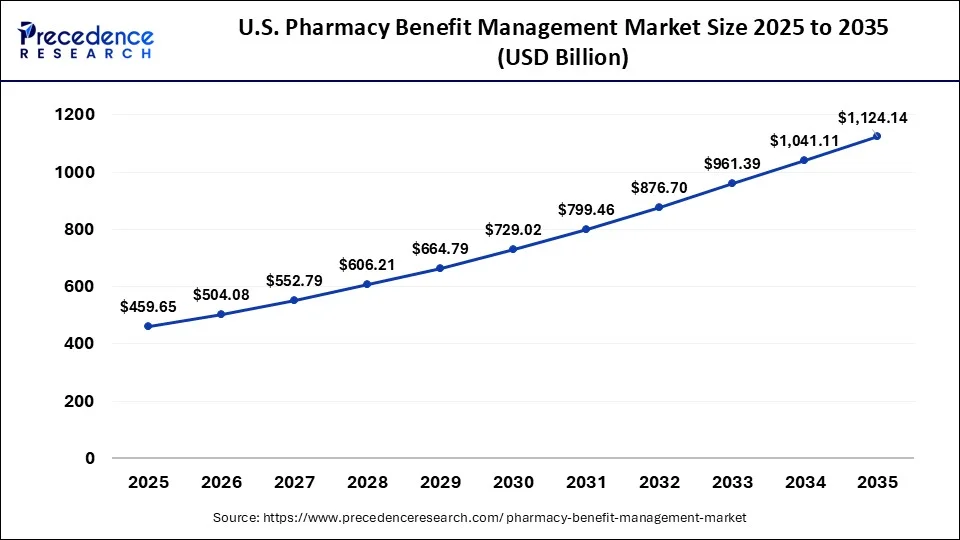
North America dominated the global pharmacy benefit management market in 2025. The US is home to leading pharmaceutical manufacturers, leading insurance providers, leading pharmacy benefit management service providers, and leading retail pharmacy chains. The increased adoption of the health insurances among the US population has supported the market growth. It is estimated that more than half of the US population is suffering from one or more chronic diseases. The high healthcare expenditure and increased adoption of the insurance policies have led to the growth of the North America pharmacy benefit management market. As per the Centers for Medicare and Medicaid Services, the total healthcare expenditure in US increased to US$ 4.1 trillion or an increase of 9.7% in 2020 as compared to the previous year. The huge penetration of the health insurance providers in the region has led to the growth of the North America pharmacy benefit management market. Most of the patients in US depends on the reimbursements for receiving treatment for various diseases. The favorable reimbursement policies of the government have also supported the market growth in North America.
The U.S. solidifies its market lead in Pharmacy Benefit Management (PBM) in North America because of its well-established healthcare system and wide insurance coverage. Major PBM companies such as CVS Caremark, Express Scripts, and OptumRx have well-structured drug pricing negotiations, formulary management, mail order pharmacy services, and government programs. Recent government initiatives aimed to further regulate drug pricing and increase transparency, such as the Inflation Reduction Act, will strengthen the U.S. leadership role.
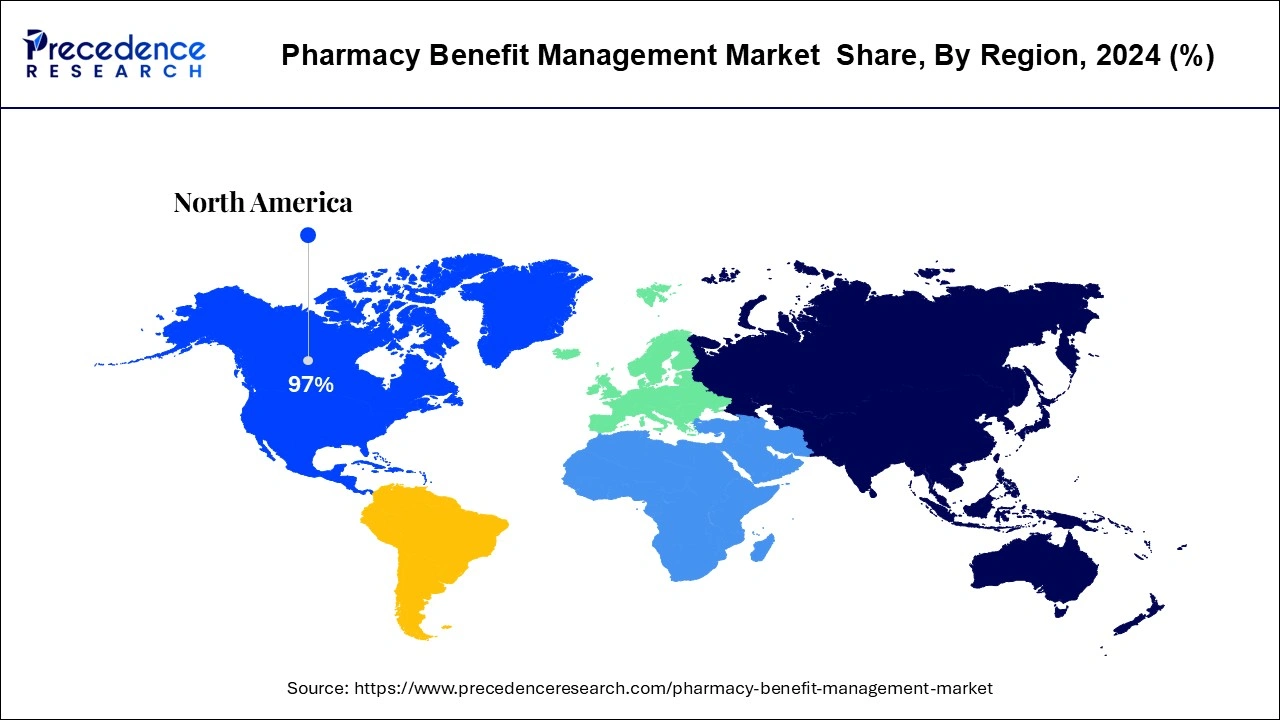
Asia Pacific is expected to witness a significant growth rate during the forecast period. This is attributed to the rising adoption of the healthcare insurances among the population. The rising prevalence of chronic diseases and rising healthcare expenditure in the region is supporting the market growth. Moreover, the rising penetration of several pharmacy benefit management service providers in the region is expected to boost the growth of the market in the foreseeable future.
In China, a historical shift in the healthcare system, along with the increasing digitalization of the medical record system, and the rapid expansion of private insurance has led to rapid growth and development of the PBM market in China. Centralized drug purchasing and drug price negotiations mandated by the government draw on PBM principles and promote continued growth. Collaborative partners in drug benefit management, and technologies targeting improved medication adherence are increasingly being adopted by insurers and companies. Expanding chronic conditions and urbanization along with the growing demand for cost-effective, technology-based pharmacy services amplify the need for the PBM platform in China.
Why Europe is Growing in the Pharmacy Benefit Management Market?
Europe is expected to grow at a notable CAGR in the market. The exponential rise in healthcare expenditure and the strong presence of the oldest demographics increase the demand for pharmacy benefit management. The expansion of specialty medicine and the rise in drug pricing transparency increase the adoption of pharmacy benefit management. The growing development of automated reimbursement systems and the use of value-based care drive the overall market growth.
Germany Market Trends
Germany is a robust contributor to the market in the European region. The high rate of chronic conditions and the mandates for collective price negotiations increase demand for pharmacy benefit management. The popularity of high-value therapy and the expanding e-pharmacies increases the adoption of pharmacy benefit management. The need for management of the rebate supports the market growth.
What Drives Growth of the Pharmacy Benefit Management Market in Latin America?
Latin America is expected to grow significantly in the coming years. The prevalence of non-communicable diseases and the growing use of private insurance increase the adoption of pharmacy benefit management. The rising digitalization in pharmacy and the explosion of generic drugs increase demand for pharmacy benefit management. The focus on controlling healthcare costs and continuous medication demand among the elderly people increases the use of pharmacy benefit management, driving the overall market growth.
Brazil Market Trends
Brazil is growing in the market due to the growing cancer-related treatment needs. The focus on structured drug benefits and the growing teleconsultation increases demand for pharmacy benefit management. The presence of the Popular Pharmacy Program and the growing private insurance increases the adoption of pharmacy benefit management. The explosion of retail pharmacy chains and the growing use of high-cost medicines support the overall growth of the market.
How will the Middle East and Africa grow in the Pharmacy Benefit Management Market?
The Middle East and Africa are experiencing significant growth in the global market. This growth is mainly driven by the rising prevalence of chronic diseases, rapid adoption of health insurance, and the intense demand to control pharmaceutical costs. Furthermore, governments are significantly digitizing inventory management and pharmaceutical tracking to overcome difficulties in sourcing materials effectively. Governments are also actively facilitating the utilization of cheaper local generic drugs to face and deal with increasing pharmaceutical price inflation and drug and medical cost escalation.
The UAE Pharmacy Benefit Management Market Trends
The UAE plays a distinctive role within the region, mainly characterized by PBMs offering a centralized and data-driven framework designed to streamline healthcare while expanding a healthier population and reducing skyrocketing medical costs. Many government initiatives by the UAE government are transforming healthcare with digital integration and AI. Centralized platforms like Shafafiya and Riayati automate e-claims and patient data, and MOHAP and DHA leverage unified systems to strictly track controlled drugs.
Market Competitive Landscape: Leading Companies and Strategies
The global pharmacy benefit management market is highly consolidated and established, and many leading players, including CVS Health, Express Scripts, and OptumRx, emphasize competitive advantage through vertical integration and algorithmic formulary management to maximize cost-efficiency and negotiate deeper manufacturer rebates owing to increasing healthcare expenditures and the growing volume of specialized prescription drugs.
Looking ahead, the emerging players and startups, including Capital Rx, Rightway, and SmithRx, have opportunities in digital health integration and AI-driven utilization management to analyze patient outcomes and lower systemic administrative costs. However, these players also face challenges due to the extreme market dominance of a few major legacy firms that control the majority of equivalent claims.
Pharmacy Benefit Management Market Companies
- CVS Health
- SS&C Technologies, Inc.
- Anthem Inc.
- Medimpact
- Express Scripts Holding Company
- Benecard Services, LLC
- CaptureRx Inc.
- Change Healthcare
- OptumRx, Inc.
- Cigna
Government Announcement
- In February 2024, the New York State Department of Financial Services (DFS) superintendent proposed new market conduct regulations regarding Pharmacy Benefit Managers (PBMs) in New York State. DFS stated it expects the proposed regulations to help protect New Yorkers' access to prescription drugs, prohibit business practices that increase drug costs, and ensure that small independent pharmacies compete on equal footing with large pharmacies affiliated with PBMs.
Recent Developments in the Pharmacy Benefit Management Market (2025–2026)
- In May 2026, Optum Rx launched a new transparent PBM model with new digital tools. The tools include Price Wise and ShowMyScript. Price Wise digital tool offers associated fees and medication pricing. ShopMyScript offers users the ability to compare home delivery options and pharmacy pickup. The tools enhance the prescription cost visibility.
(Source: https://www.digitalhealthnews.com) - In May 2025, HealthEZ, a national third-party benefits administrator, introduce EZrx, a next-generation pharmacy solution that leverages six cost-reduction strategies to deliver up to 50% savings compared to traditional pharmacy benefit plans. This solution supports self-funded plans by targeting high-cost prescriptions and optimizing pharmacy spend.
(Source: https://www.businesswire.com) - In November 2024, CerpassRx, a leader in pharmacy benefit management (PBM), announced the launch of the Intelligent Specialty Engine, an AI-enabled platform powered by Waltz Health to manage specialty drug spend. This intelligent marketplace ensures patients and payers receive the optimal combination of price, service, and clinical outcomes.
(Source: https://hitconsultant.net) - In May 2025, Waltz Health, a digital health company developing smarter, technology-enabled ways to price, distribute and prescribe medications, announced a new partnership with WellDyne to launch a transparent specialty pharmacy solution powered by Waltz Connect. WellDyne will leverage Waltz Connect's dynamic pharmacy marketplace and AI-driven routing engine to intelligently match prescriptions to the most cost-effective and clinically appropriate pharmacy, including WellDyne's own high-performing specialty pharmacy, HealthDyne.
(Source: https://www.businesswire.com) - In July 2024, Governor Josh Shapiro from Pennsylvania signed a bipartisan regulatory bill meant to control the behavior of pharmacy benefit managers (PBMs).
- In January 2023, Optum Rx Price Edge was launched to help buyers discover the lowest drug prices that exist on or off the pharmacy benefit. With this, leading service members can compare their on-benefit cost-sharing expenses to the available prices through discount cards.
- In April 2023, Cigna's pharmacy benefit management unit introduced a new pricing model, containing detailed rebate data due to rising U.S. legislative scrutiny on pharmaceutical middlemen's secrecy in drug pricing.
Segments Covered in the Report
By Service
- Specialty Pharmacy Services
- Benefit Plan Design & Administration
- Formulary Management
- Pharmacy Claims Processing
- Others
By Service Provider
- Retail Pharmacies
- Insurance Companies
- Standalone Pharmacy Benefit Management Providers
By Business Model
- Government Health Programs
- Employer-sponsored Programs
- Health Insurance Management
By Region
- North America
- Europe
- Asia-Pacific
- Latin America
- Middle East & Africa
For inquiries regarding discounts, bulk purchases, or customization requests, please contact us at sales@precedenceresearch.com
Frequently Asked Questions





Ask For Sample
No cookie-cutter, only authentic analysis – take the 1st step to become a Precedence Research client
 Get a Sample




 sales@precedenceresearch.com
 Schedule a Meeting
