



Point-of-Use Water Treatment Systems Market Size, Key Companies, Company Market Share, Sales Volume, Consumer Demand, Pricing Trends, Distribution Performance, Competitive Positioning, and Growth Forecast
Point-of-Use Water Treatment Systems Market (By Type: Faucet-mounted Filters, Pitcher Filters, Counter Top Filters, Under the Counter Filters, Others; By Category: Gravity Filters, UV Filters, RO Fliters, Others; By Application: Light Commercial, Residential, Non-Residential) - Global Industry Analysis, Size, Trends, Leading Companies, Regional Outlook, and Forecast 2026 to 2035
Source: https://www.precedenceresearch.com/point-of-use-water-treatment-systems-market
 Get a Sample
 Table Of Content


What is the Point of Use Water Treatment Systems Market Size?
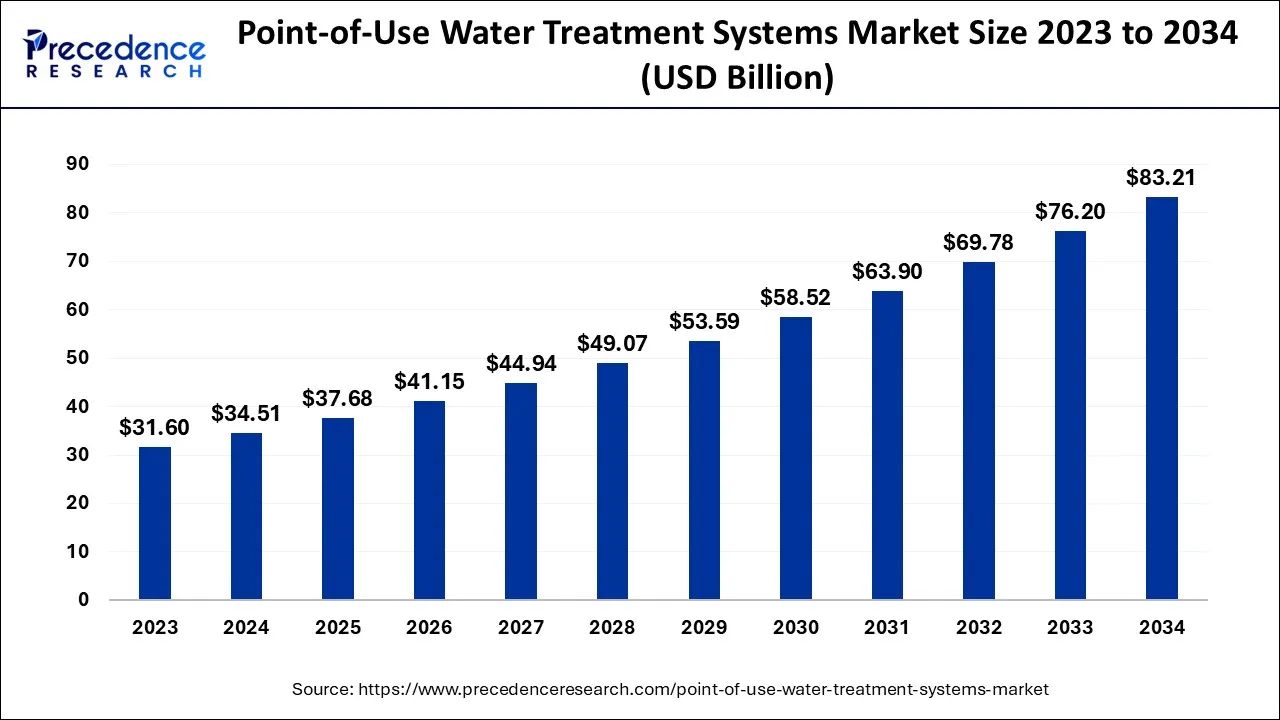
The global point-of-use water treatment systems market size was worth around USD 37.68 billion in 2025 and is predicted to increase from USD 41.15 billion in 2026 to approximately USD 89.83 billion by 2035, growing at a CAGR of 9.08% over the forecast period from 2026 to 2035.
Point-of-Use Water Treatment Systems Market Key Takeaways
- In terms of revenue, the market is valued at $37.68 billion in 2025.
- It is projected to reach $89.83 billion by 2035.
- The market is expected to grow at a CAGR of 9.08% from 2026 to 2035.
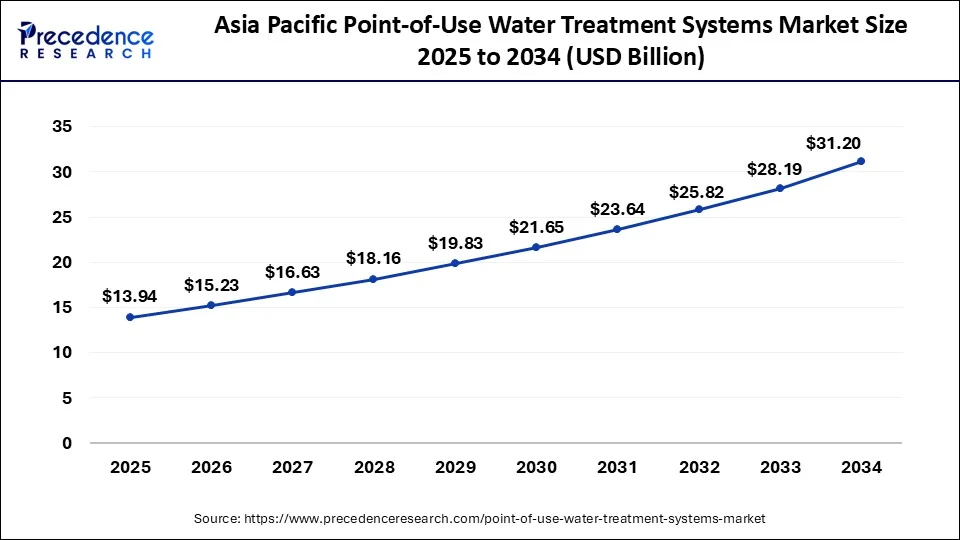
- Asia Pacific region contributed more than 37% of revenue share in 2025, while market size in the region accounted for USD 12.77 billion in 2025 and is projected to be worth around USD 31.20 billion by 2035, poised to grow at a CAGR of 9.35% from 2026 to 2035.
- By Type, the countertop filters segment led the global market in 2025.
- By Category, the RO filters segment captured the largest revenue share in 2025.
- By Application, the residential segment accounted for the largest share in 2025.
Market Overview
The point-of-use water treatment systems market refers to the industry that manufactures and sells water treatment systems designed for use at individual water access points, such as at home, in businesses, or in public spaces. These systems typically use technologies such as reverse osmosis, ultraviolet (UV) disinfection, or activated carbon to purify or filter water to remove impurities, contaminants, and potentially harmful substances. These systems are installed at a single water connection, commonly beneath the counter in bathrooms, kitchens, and other locations with showers and faucets. These systems are thought to be the best option for the last stage of water filtration in small commercial buildings or at home due to the lower volume treatment. These systems work in tandem with point-of-entry water treatment systems to provide total purification, including the removal of hazardous pollutants and water softening.
Point-of-Use Water Treatment Systems Market Growth Factors
- Increasing health consciousness: With the uncertainty of waterborne illnesses, many consumers are becoming increasingly aware of the need for safe water purification procedures as well as the use of home-based water purification systems.
- Urbanization and gaps in infrastructure: Many urban centers are expanding faster than local and state governments can develop public water infrastructure, increasing consumers' reliance on decentralized water treatment systems. As cities continue to grow in size and population, point-of-use water treatment systems will continue to influence how people acquire drinking water.
- Advancing technology: The evolution of technologies related to smart filtration, connectivity, and consumer-friendly systems (e.g., portable water treatment systems) will appeal to a growing tech-savvy audience, impacting the number of consumers opting for point-of-use water treatment systems.
- Environmental issues: Increased consumer appreciation for environmentally friendly and waste-reducing water purification technologies will spur further acceptance of reusable and energy-efficient water treatment systems.
Increased frequency of water pollution events– The increased frequency of municipal contamination, in combination with health concerns from cities, is increasing consumers' willingness to purchase independent freshwater treatment systems.
Market Scope
| Report Coverage | Details |
| Market Size by 2035 | USD 89.83 Billion |
| Market Size in 2025 | USD 37.68 Billion |
| Market Size in 2026 | USD 41.15 Billion |
| Growth Rate from 2026 to 2035 | CAGR of 9.08% |
| Largest Market | Asia Pacific |
| Base Year | 2025 |
| Forecast Period | 2026 to 2035 |
| Segments Covered | Type, Category, Application and Region |
| Regions Covered | North America, Europe, Asia-Pacific, Latin America, and Middle East & Africa |
Market Dynamics
Drivers
Rising awareness towards water-borne diseases – People are infected and caused waterborne diseases by Pathogens such as protozoa, bacterial, virus, algae, parasitic worm or other metal pollutants. Drinking water which has been contaminated with pathogens and metals can cause illnesses such as typhoid, chlorella, diarrhoea, campylobacteriosis, lead poisoning, malaria or any other diseases. Consumption of untreated raw or water contaminated beverages, use of showers, wash hands and eat food may spread these illnesses. Awareness and information on waterborne diseases and pollution have increased, as people are more concerned about the health of their own bodies while they choose clean drinking water to prevent severe illnesses.
The surge in the number of water borne disease is expected to boost the size of the market. For instance, according to the report of the Centers for Disease Control and Prevention, U.S. waterborne pathogens cause 7,000 deaths, 120,000 hospitalizations, 7 million illnesses, and $3 billion in healthcare costs in U.S. alone. In addition, efforts to improve water availability in both developed and developing countries are being stepped up by a number of environmental organisations which aim at raising awareness about the advantages of drinking clean water for health. Point of use water treatment systems are able to reduce the incidence and severity of waterborne illnesses and disease, as well as improving the quality of drinking water. As awareness of waterborne diseases increases, the demand for such systems continues to grow worldwide.
Rising water contamination - Water contamination happens when pollutants are either directly or indirectly dumped into the water without proper treatment to eliminate dangerous substances. The most important water pollutants produced by humans are microbial infection, nutrients, heavy metals, continuous organic matter, suspended sediment, pesticides and oxygen depleting compounds. The heat could be a cause of contamination, because it warms the water. Degradation of water quality is usually due to pollutants.
A series of measures, such as filtration, disinfection or chemical treatment, are carried out in order to remove this water before it is given to different residential and commercial establishments for consumption. Unfortunately, even when point-of-use water treatment systems remove some pathogenic microbes and inorganic substances from the water, others still remain. Moreover, such water pollutants are rising on a day-to-day basis, and water which needed to be treated is expected to surge the point-of-use water treatment systems market.
Government regulations and guidelines - Governments around the world have implemented regulations and guidelines for water quality, which has led to increased demand for point of use water treatment systems to meet these standards. For instance, U.S. has the Safe Drinking Water Act that sets standards for drinking water quality. The law regulates contaminants such as lead, arsenic, and nitrate, and requires public water systems to regularly test their water and make the results available to the public. The Drinking Water Directive is a European Union law that sets minimum requirements for drinking water quality. The law regulates contaminants such as bacteria, viruses, and chemicals, and requires public water systems to regularly test their water and make the results available to the public. The National Primary Drinking Water Regulations are a set of guidelines issued by the Chinese government that set standards for drinking water quality. The guidelines regulate contaminants such as bacteria, viruses, and chemicals, and require public water systems to regularly test their water and make the results available to the public. Such regulations and guidelines regarding water quality are expected to propel the demand for the market.
Key Market Challenges
High Cost - Despite the fact that water treatment has several benefits, point-of-use water treatment system installation is expensive. A water softener, for example, which is used to turn hard water into soft water, can cost between USD 2,000 and USD 4,000. The cost of installing a water softener is considerable because professionals and installers are needed. Some of the point-of-use water treatment systems have substantial operating and maintenance expenses. For instance, the energy used for cooling and heating in the distillation systems is significant. In some Asian and African nations, these issues are particularly prominent. The delivery and storage of water are also lacking in underdeveloped nations in Asia and Africa. Consumers can restrain from installing point-of-use water treatment systems owing to such high cost which can hold back the growth of the market.
Environmental impact - Some point of use water treatment systems, such as reverse osmosis, can produce wastewater that may contain high levels of contaminants. Disposing of this wastewater can have environmental implications and may contribute to water scarcity in some regions. Along with these, Wastewater discharge, Energy consumption, Filter disposal, and water scarcity can hamper the growth of the market. Some point of use water treatment systems, such as reverse osmosis and distillation systems, can generate wastewater that may contain high levels of contaminants. This wastewater must be disposed of properly to prevent environmental contamination. If the wastewater is not treated and disposed of properly, it can pollute local water sources and harm wildlife. Some point of use water treatment systems, such as reverse osmosis and distillation systems, can generate wastewater that may contain high levels of contaminants. This wastewater must be disposed of properly to prevent environmental contamination. If the wastewater is not treated and disposed of properly, it can pollute local water sources and harm wildlife. Such harm of the product is expected to hamper the growth of the market.
Opportunities
Technological advancements: Advancements in water treatment technologies such as reverse osmosis (RO), ultraviolet (UV) disinfection, and activated carbon have made point of use water treatment systems more effective and efficient. RO is a water filtration technology that uses a semi-permeable membrane to remove dissolved solids, contaminants, and impurities from water. RO systems have become more efficient and affordable in recent years, making them a popular choice for point of use water treatment systems. UV disinfection uses ultraviolet light to kill bacteria, viruses, and other pathogens in water. UV systems have become more compact and affordable, and are often used in combination with other treatment technologies such as carbon filtration or RO.
Activated carbon filters use a porous carbon material to remove organic compounds, chlorine, and other impurities from water. Advances in carbon filtration technology have led to more effective filters that can remove a wider range of contaminants. Such technological advancements is expected to further propel the demand for the point-of-use water treatment systems market.
Clean water scarcity: Some of the countries in Asia-Pacific such as Bangladesh, Pakistan, and Nepal and most African countries such as Nigeria, Ghana, and Ethiopia suffer enormous challenges connected to clean water. Many undeveloped and emerging nations lack the financial stability necessary to give access to clean drinking water. According to the WHO, diarrhoea, which is brought on by tainted water, kills 8.5% and 7.7% of people worldwide each year in Asia and Africa, respectively. Additionally, it claims that countries like Argentina, Bangladesh, India, Chile, and Mexico drink water that contains arsenic, which damages the skin.
Segment Insights
Type Insights
On the basis of type the point-of-use water treatment systems market is segmented into pitcher filters, faucet-mounted filters, under the counter filters, countertop filters, and others. The market is being dominated by the countertop filters segment. These countertop devices don't require intricate plumbing connections for operations, are straightforward to install, and are carefully built to gain little room. They also provide water of a high standard. These systems use ceramic or activated carbon filters, which are regarded as the best filter medium for removing impurities while preserving water's flavour. In 2021, the market's second-largest product category was under-the-counter filters. Often, these devices are mounted beneath the kitchen counter. These systems have faster flow rates, so the water distributes more quickly and takes less time to fill the bottle. Also, mounting these filters doesn't involve a lot of changes and saves space over the kitchen counter.
Category Insights
Based on the category the point-of-use water treatment systems market is segmented into gravity filters, UV filters, RO filters, and others. The RO filters market category, out of these, had the biggest revenue share in 2024. RO systems are extremely sophisticated membrane filtering technologies that can produce water with the same quality as bottled water by eliminating 99% of pollutants. As a result, these systems are widely used to purify water. They are regarded as the ideal method for treating hard water. In addition, these systems cost more money, take longer to treat water, and eliminate necessary minerals like calcium, magnesium, sodium, and iron that affect the flavour of the water.
The gravity filters segment is the second-largest segment owing to its simplicity and ease of installation. As all water purification relies on gravity force, they don't need power. Also, these systems may be installed anywhere in the house and require less upkeep. However in order for gravity filters to work well, filter media must be changed frequently.
Application Insights
The market is segmented into residential, light-commercial, and non-residential. The residential segment accounted for the largest share on the basis of application in 2024 and is expected to maintain its dominance during the forecast period. Water consumption is higher in residential buildings than in light commercial buildings. According to estimates from the United States Environmental Protection Agency, the average American family uses more than 300 gallons of water per day. Showers account for approximately 20% of indoor water use, while faucets account for 19% and washing clothes account for 17%. Light commercial buildings include banks, restaurants, small shopping centres, offices, educational premises and others of the same type. Large scale water purification systems, which offer similar benefits to residential compact water filtration systems, are installed in light commercial buildings.
Regional Insights
What is the Asia Pacific Point-of-Use Water Treatment Systems Market Size?
The Asia Pacific point-of-use water treatment systems market size was exhibited at USD 13.94 billion in 2025 and is projected to be worth around USD 33.78 billion by 2035, growing at a CAGR of 9.25% from 2026 to 2035.
The point-of-use water treatment systems market is further segmented into North America, Asia-Pacific, Europe, Latin America, and Middle East & Africa. Asia Pacific had the largest market share and is expected to grow the fastest during the forecast period. The region's rapid urbanisation creates lucrative growth opportunities for point-of-use water treatment systems. According to World Bank data, East Asia and the Pacific are the world's fastest urbanising regions, with a rate of 3% per year. This region is home to one-third of the world's urban population. Due to increased awareness of the benefits of water treatment systems, China is the largest consumer of water treatment systems, followed by Japan. In the future, India is expected to have the highest growth rate.
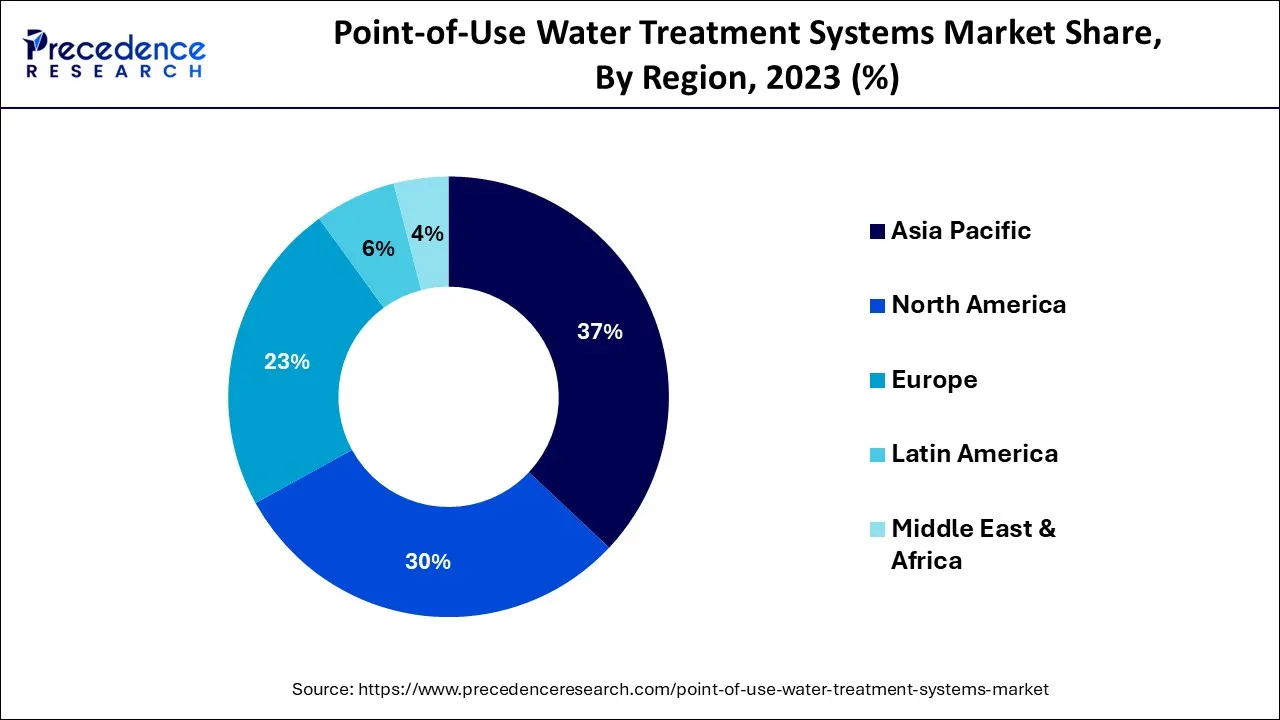
Water treatment systems are most widely used in Japan, South Korea, and Australia. As a result, Asia Pacific is expected to maintain its market dominance during the forecast period. Europe came in second, with Germany leading the way, followed by the United Kingdom. The rising demand for point-of-use water treatment systems in this region would result from rising household water consumption. According to the European Environment Agency, households in Europe consume more than 12% of total water consumption. On a daily basis, 144 litres of water are distributed per person. According to the European Commission, the average tap water consumption per person in Germany and the United Kingdom in 2015 was 122 litres and 150 litres, respectively.
Europe: Rapidly Adopting Sustainable Water Filtration Technologies
The European market for point-of-use water treatment systems is supported by a combination of strong market demand, increasing consumer awareness of issues related to water quality, and strong regulations pertaining to safe drinking water. Urban households are increasingly purchasing compact systems that use advanced technology and are based on sustainability principles to purify their water.
Germany's rapid growth as the fastest-growing country within the region is due to having the most developed residential infrastructure and the fastest rate of adoption of advanced point-of-use water purification technologies.
Latin America: Rapidly Expanding Access to Clean Drinking Water
The driving forces behind the growing demand in Latin America for point-of-use systems are continuing urbanization, deteriorating water delivery systems, and increasing concerns about the safety of their water supply. Middle-class households and Small shops are purchasing low-cost point-of-use systems at a rapidly increasing rate.
Brazil is the fastest-growing country within Latin America as a result of the expanding awareness of health benefits related to the use of purified drinking water and the rapidly increasing use of these technologies in residential applications.
Middle East & Africa: Rapidly Decreasing the Impact of Water Scarcity
Water scarcity, dependence upon desalination as a source of water supply, and fluctuating water quality supplied by municipal utilities will continue to shape the MEA market for point-of-use water purification systems. Point-of-use systems are rapidly emerging as an effective solution for providing access to safe, potable water to both residential and commercial customers.
Saudi Arabia has one of the fastest-growing markets in the MEA. The growth of residential infrastructure and water quality improvement initiatives is driving demand for point-of-use water purification technologies in Saudi Arabia.
Value Chain Analysis of the Point-of-Use Water Treatment Systems Market
- Raw Material & Component Manufacturing: This portion of the Value Chain includes the determination of the required components, including activated carbon, RO membranes, UV lights, ceramic filters, and smart sensors.
Key Players: DuPont, Toray, LG Chemical, and Pentair. - System Design, Assembly, and Technology Integration: During this stage, multiple technologies are combined to create user-friendly, compact systems for residential, commercial, and light industrial applications.
Key Players: 3M, Culligan International, Panasonic, and A.O. Smith. - Distribution, Installation, and After-Sales Services: This part of the Value Chain includes logistics and retailing, e-commerce, and installation services. Long-term maintenance contracts, cartridge replacement programs, and customer education are essential to create a loyal customer brand and generate recurrent revenue.
Key Players: Eureka Forbes, Kent RO Systems, Honeywell, and Unilever Pureit.
Point of Use Water Treatment Systems Market Companies
- General Ecology Inc.
- Global Water Solutions Ltd.
- Eureka Forbes Ltd.
- Katadyn Group
- Coway Co. Ltd.
- Kent RO Systems Ltd.
- Best Water Technology Group
- Helen of Troy Ltd.
- LG Electronics
- Panasonic Corporation
- Unilever Plc
- Culligan International Company
- Pentair Plc
- Brita LP
- A.O. Smith Corporation
Recent Developments
- In September 2024, the KSB Group launched a new generation of submersible motor pumps on the market. The pumps of the type series called AmaRex Pro are driven by high-efficiency motors of the IE5 class.
- In July 2023, Hindustan Unilever Limited (HUL) announced the launch of the Pureit Revito Series of water purifiers. The water purifier saves up to 70% of the water and enriches purified water with essential minerals like calcium and magnesium.
- In February 2023, Samsung introduced easily regenerable air purification filter technology applying photocatalysts. Newly developed filter simultaneously removes particulate matter and volatile organic chemicals as primary air pollutants while retaining initial performance for up to 20 years.
- October 2021- Pentair paid approximately USD 255 million in cash for Pleatco. Pleatco is a company that makes water filtration products for pools and spas. Pentair expands its distribution network in the United States and Europe with this acquisition.
- July 2021 - Smith Corporation announced the all-cash acquisition of Master Water Conditioning Corporation, a water treatment company based in Pennsylvania. Master Water's purchase demonstrates the company's commitment to the North American water treatment industry, which is a key component of the company's goal of providing new, innovative water heating and treatment solutions.
- December 2020 - Coway Malaysia has unveiled its newest water purifier model, Coway Kecil, which features direct filtration technology. It was created with the goal of saving space in mind. This new release has an extremely sleek design that fits perfectly in small spaces. Coway won the platinum award in the water purifier category after the launch of this water purifier.
Segments Covered in the Report
By Type
- Faucet-mounted Filters
- Pitcher Filters
- Counter Top Filters
- Under the Counter Filters
- Others
By Category
- Gravity Filters
- UV Filters
- RO Fliters
- Others
By Application
- Light Commercial
- Residential
- Non-Residential
By Region
- North America
- Europe
- Asia-Pacific
- Latin America
- Middle East and Africa
For inquiries regarding discounts, bulk purchases, or customization requests, please contact us at sales@precedenceresearch.com
Frequently Asked Questions





Ask For Sample
No cookie-cutter, only authentic analysis – take the 1st step to become a Precedence Research client
 Get a Sample




 sales@precedenceresearch.com
 Schedule a Meeting
