



Reusable Water Bottle Market Revenue, Leading Companies, Company Technology / Innovation, Product Adoption, Consumer Preferences, Pricing Analysis, Inventory Performance, Competitive Positioning, and Demand Trends
Reusable Water Bottle Market (By Material: Plastic, Stainless Steel, Glass, Silicone, Others; By Distribution Channel: Supermarkets and Hypermarkets, Specialty Stores, Convenience Stores, Online) - Global Industry Analysis, Size, Trends, Leading Companies, Regional Outlook, and Forecast 2026 to 2035
Source: https://www.precedenceresearch.com/reusable-water-bottle-market
 Get a Sample
 Table Of Content


What is the Reusable Water Bottle Market Size?
The global reusable water bottle market size is accounted at USD 10.17 billion in 2025 and predicted to increase from USD 10.64 billion in 2026 to approximately USD 15.92 billion by 2035, expanding at a CAGR of 4.58% from 2026 to 2035. There is increased demand for reusable water bottles because of environmental awareness and the health implications of single-use plastics. The market continues to grow through technology advancement and new designs. Environmental campaigns and government efforts are leading the expansion of this business in rural and urban areas.
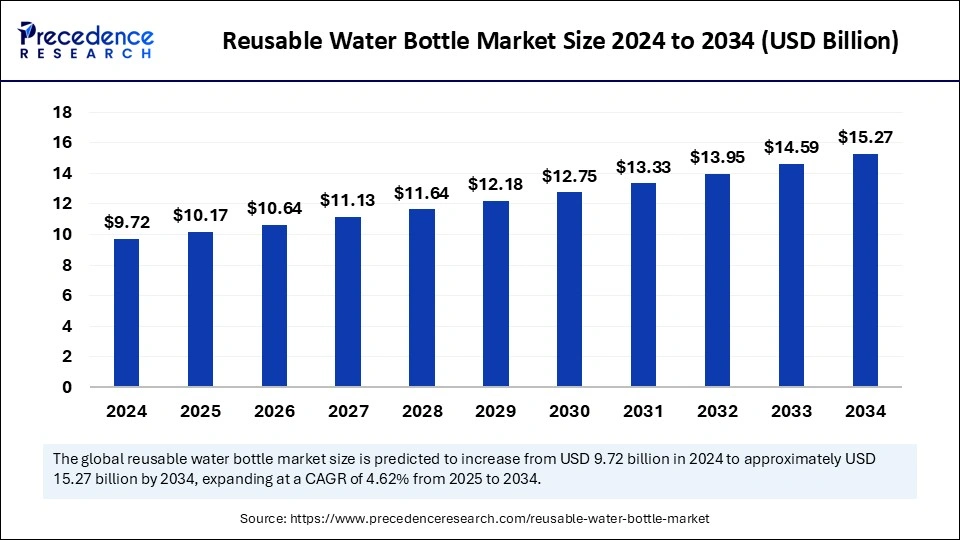
Reusable Water Bottle Market Key Takeaways
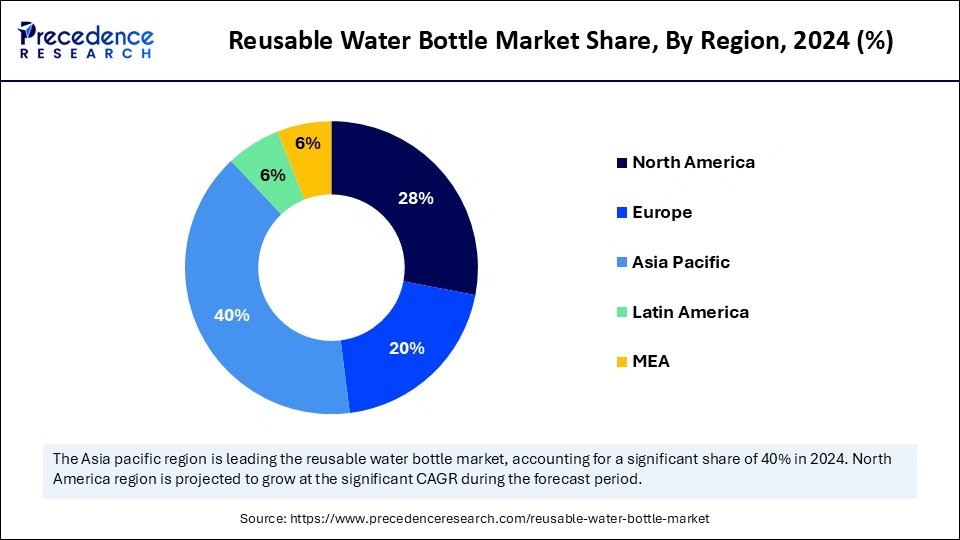
- Asia Pacific dominated the market by holding more than 40% of market share in 2025.
- North America is expected to grow at a CAGR of 5.2% during the forecast period of 2026 to 2035.
- By material, the plastic segment contributed the largest market share of 36% in 2025.
- By material, the stainless-steel segment is expanding at a CAGR of 5% over the forecast period of 2026 to 2035.
- By distribution channel, the hypermarkets and supermarkets segment held the largest market share of 40% in 2025.
- By distribution channel, the online sales segment is projected to grow at a CAGR of 5.4% during the forecast period.
What is the Reusable Water Bottle?
The reusable water bottle market is a developing business that manufactures and sells environmentally friendly containers for use again and again, providing an environmental-friendly solution in place of one-time used plastics. Bottles are crafted with materials such as stainless steel, glass, and BPA-free plastics to cater to environment-conscious consumers. The industry is favoring innovations in design, usability, and material, favoring the ambitions of global sustainability and consumer appeal towards green products.
The market encourages innovation in materials, functionality, and design, aligning with global sustainability requirements and consumer needs for environmentally friendly products. The bottles are highly sought after by fitness enthusiasts, working professionals, travelers, and environmentally friendly users and are used extensively in homes, gyms, workplaces, and schools because of their portability and environmental advantages.
Artificial Intelligence (AI) in the Reusable Water Bottle Market
Artificial Intelligence is transforming the reusable water bottles industry through enhanced product design, manufacturing efficiency, and consumer experience. AI determines customer trends and preferences to make customized bottles, streamlines manufacturing, and optimizes recycling. AI also facilitates customized hydration tracking, supply chain optimization, market trend forecasting, and intelligent product features. AI-based analytics assist manufacturers in grasping consumer behavior and customizing products. AI also assists with product customization using in-built functions and maximizes the material lifecycle to minimize its impact on the environment.
HidrateSpark TAP in December 2021 is a connected water bottle that combines AI analytics and IoT technology to monitor hydration levels and send personalized reminders. The bottle connects to an AI-driven app that reads user data and environmental conditions. It has LED light reminders and the first patent-pending Tap-to-Track technology enabling users to monitor their water intake in the HidrateSpark App.
Reusable Water Bottle Market Growth Factors
- Enhanced environmental awareness: The demand for sustainable and recyclable substitutes is picking up speed owing to increasing awareness of the environment and the need to reduce plastic waste. Bans on single-use plastics and government policies are fueling this trend.
- Health concern and sustainability: The market for environmental products like reusable water bottles is growing with the health benefits and eco-friendly reasons surrounding environmentally friendly lifestyles. The bottles are popular due to their non-toxic and BPA-free materials, which are particularly well suited for use during sports and outdoor activities, supporting healthier lifestyles.
- Technological advancement: Technological advancements, including insulated bottles and intelligent hydration tracking functionalities, have boosted product functionality and attractiveness, engaging more consumers. Creative designs, including vacuum insulation and filtration technologies, have also engaged a larger customer base.
- Government policies and regulations: Government policies and regulations, such as single-use plastic prohibitions, have hastened the uptake of reusable water bottles, fuelling market growth and increasing demand for eco-friendly alternatives, especially in countries with more stringent regulations.
- Economic consideration: Reusable water bottles also have important economic advantages, including long-term cost savings over single-use alternatives, which make them attractive to price-sensitive consumers, particularly in cost-conscious markets such as Asia Pacific.
Market Outlook
- Industry Growth Overview: The industry is growing through increased awareness, which is leading to reusable bottle adoption. Consumers are switching to high-quality insulated products that promote health and sustainability objectives in the world.
- Sustainability Trends: Recycled metals and bioplastics become the focus. Single-use plastics are minimized by the use of eco-friendly material innovations in brands.
- Global Expansion: Europe and North America uphold demand. The awareness and regulations are high to facilitate the use of premium reusable bottles in developed markets.
- Major investors: Hydro Flask, Stanley, CamelBak, Nalgene, Klean Kanteen, and S'well are fuelled by innovation by investing in materials and product design.
Market Scope
| Report Coverage | Details |
| Market Size by 2035 | USD 15.92 Billion |
| Market Size in 2025 | USD 10.17 Billion |
| Market Size in 2026 | USD 10.64 Billion |
| Market Growth Rate from 2026 to 2035 | CAGR of 4.58% |
| Dominating Region | Asia Pacific |
| Fastest Growing Region | North America |
| Base Year | 2025 |
| Forecast Period | 2026 to 2035 |
| Segments Covered | Material, Distribution Channel and Regions. |
| Regions Covered | North America, Europe, Asia-Pacific, Latin America, and Middle East & Africa |
Market Dynamics
Drivers
Environmental sustainability
One of the major drivers in the market for reusable water bottles is rising awareness and concern regarding the sustainability of the environment. The reusable water bottle market is driven by growing international awareness of environmental sustainability, especially the adverse effects of single-use plastics on the environment. There is a growing concern among consumers regarding plastic pollution, climate change, and depletion of natural resources, thereby promoting an environmentally friendly option such as reusable water bottles.
Government policies, organizations and advances in technology have driven the use of reusable water bottles, with temperature control insulation, inbuilt filtration systems, and self-cleaning capabilities making them more functional. Consumers also appreciate the cost savings of reusable bottles as they provide long-term value over single-use bottled water. The combination of green consciousness, policy support, and advanced product features continues to fuel the expansion of the reusable water bottle market.
The governments of Odisha and Nagaland have put stricter laws on single-use plastics, so demand for reusable ones has risen.
- In October 2024, Odisha prohibited plastic bottles and carry bags and in July 2023, they prohibited carry bags and cutlery. This has led companies to come up with innovative reusable water bottle options.
Restraint
High cost and hygiene concerns
The reusable water bottle market is challenged by the initial cost of high-quality glass and stainless steel, which is expensive and may discourage price-conscious consumers from making the change to reusable water bottles. The market is challenged by limited awareness in developing markets, poor quality products and issues of hygiene due to cleaning and maintenance of reusable bottles.
Users often replace their reusable bottles because of odor and hygiene issues, which impact consumer retention and reduce the environmental advantages of using reusable bottles. To solve these issues, manufacturers are looking to create cheaper alternatives and design better bottles to clean more easily. These factors combined restrict the potential of the market for growth, especially in countries with less environmental consciousness or purchasing power.
Opportunity
Integration of innovative technologies
The reusable water bottle market is anticipated to expand as consumers become more interested in sustainable and high-tech products. Some of the recent developments are smart hydration tracking, UV-C sterilization, and temperature regulation. These technologies make the user experience more convenient and fit with international trends of sustainability and health-oriented lifestyles. Prospects exist in combining advanced technologies to improve user experience and ensure sustainability, including smart water tracking, self-cleaning features, and fragrance-infused flavor enhancement. These multi-functional products address the needs of contemporary consumers.
Air Up bottles, such as the WaterH Boost, provide intelligent hydration monitoring with a built-in LED display. The WaterH Boost connects to devices for tracking hydration levels.
- In May 2024, Air Up bottles utilize scent pods to add flavor without chemicals or sugars, appealing to those who like plain water. The LARQ bottle employs proprietary UV-C LED technology to clean water and self-clean, killing bacteria and viruses, making it a safe option.
Segment Insights
Material Insights
The plastic segment dominated the reusable water bottle market in 2025 because it is affordable, strong, and economical. The bottles are less costly to manufacture than other materials such as stainless steel or glass and are thus accessible to price-conscious consumers. The bottles are recognized for their durability and resistance to shattering and are thus a favorite for regular use, traveling, and sports. Customers now prefer reusable plastic bottles more than disposable ones because they last longer and are eco-friendly. The market also provides numerous design choices, including collapsible or foldable types, making them ideal for active lifestyles.
- In February 2025, Hydro Flask introduced the Micro Hydro bottle, a lightweight and compact reusable water bottle with double-wall vacuum insulation, leakproof construction, and four bright colors. This introduction underscores the increasing dominance of plastic reusable bottles in fulfilling varied consumer demands.
The stainless-steel segment will experience rapid growth over the forecast period of 2025 to 2034, owing to their sustainability, durability, and health benefits. The combination of copper and stainless steel provides antimicrobial benefits and health benefits. The market is also drawing vacuum-insulated stainless steel bottles, which are ideal for outdoor activities, offices, and fitness, appealing to a broad audience. The increasing trend of these bottles is drawing consumers who are looking for eco-friendly and long-lasting hydration solutions.
Distribution Channel Insights
The hypermarkets and supermarkets segment held the highest reusable water bottle market share in 2025 because of their convenience, wide range of products, and affordability. These formats appeal to a wide demographic with convenience and product variety. Physical products enable customers to evaluate quality, design, and functionality presentation before purchasing, enhancing sales. Regular promotional offers and price cuts appeal to price-sensitive buyers, further entrenching them in the market.
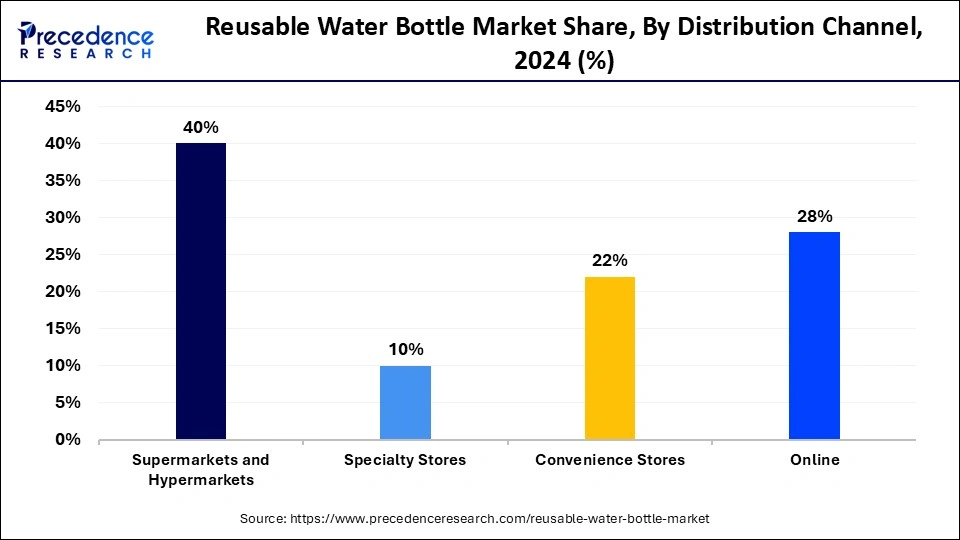
The online sales segment is anticipated to witness significant growth during the forecast period. This is due to the adoption of e-commerce along with the use of smart devices and the ease of online payment options. Companies such as 24Bottles and United Bottles have been able to use online platforms to drive sales, particularly during the COVID-19 pandemic. Online platforms provide an extensive range of products, affordable prices, and promotional deals that are attractive to budget-friendly and technologically savvy consumers. The convenience of custom logo printing and personalized choices also draws manufacturers as they can sell globally and fulfill the increasing demand for reusable bottles.
Regional Insights
What is the Asia Pacific Reusable Water Bottle Market Size?
Asia Pacific reusable water bottle market size was exhibited at USD 4.26 billion in 2026 and is projected to be worth around USD 6.47 billion by 2035, growing at a CAGR of 4.74% from 2026 to 2035.
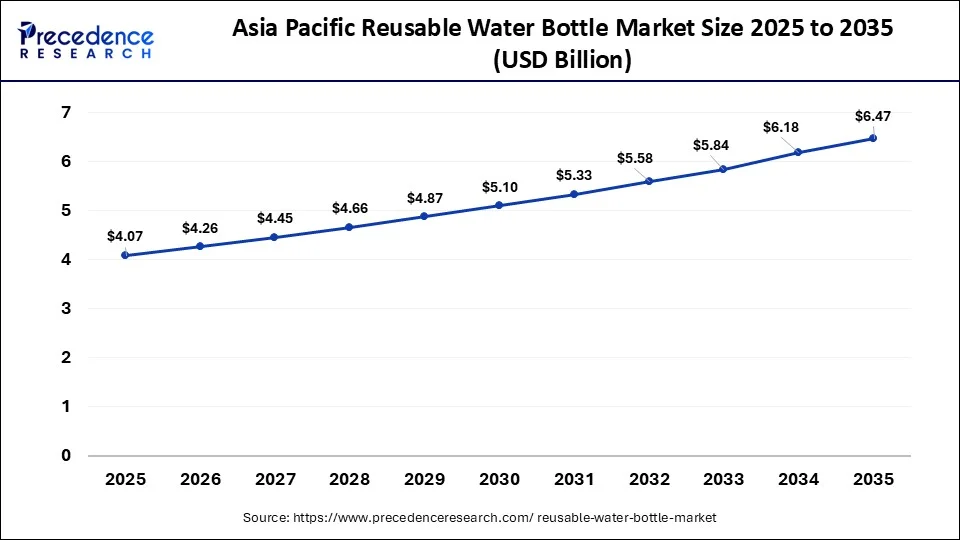
Asia Pacific held the largest share of the reusable water bottle market in 2025. This is because of the huge population growth rate in India and China and the increased demand and supply of multi-purpose water. The region is also experiencing high urbanization, increases in disposable incomes, and environmental awareness, hence the booming market for reusable water bottles.
Reusable Water Bottle Industry Trends in China & India
China and India are growing rapidly, this growth as these countries have high populations and powerful environmental drives. Governments of these nations, even with obstacles such as the lack of recycling infrastructure, are working hard to introduce eco-friendly material usage and induce consumers to opt for reusable water bottles. Recent developments and partnerships, including the partnership of CSIRO with Indian and Australian partners in 2023, have further boosted the trend. The Indian government has introduced quality control for reusable water bottles, including the ISI mark requirement to maintain product quality and safety.
North America is seen to grow at the fastest rate in the reusable water bottle market during the foreseen period due to urbanization, lifestyle shifts, and increasing demand for sustainable living. There has been a huge demand for reusable water bottles as individuals have adopted healthier lifestyles and are cutting back on plastic usage. The move by the U.S. Interior Department to eliminate single-use plastics on public land by 2032 is a testament to the sustainability commitment of the region, forcing consumers to gravitate towards reusables. The sophisticated infrastructure and strong distribution systems of the region also aid the mass use of reusable water bottles, which augments the high commitment to green practices and the favorability of the sports and outdoor lifestyle of the region.
U.S. Reusable Water Bottle Market Trends
The U.S. reusable water bottle market is gaining prominence in North America because of environmental issues along with design advancements and prominent brands. Consumers are embracing reusable water bottles as a replacement for single-use PET bottles in light of plastic pollution awareness. The market will grow at the highest CAGR during 2025-2030.
- In June 2022, CamelBak collaborated with the National Park Foundation to encourage sustainable hydration habits, cementing the dominance of the U.S. in the reusable water bottle market.
Europe is seen to generate a considerable share of the global reusable water bottle market, fueled by stringent environmental regulations and an increasing consumer emphasis on sustainability. The policies of the European Union to minimize single-use plastics and encourage reusable materials have greatly boosted the use of reusable water bottles. The increasing popularity of athleisure and outdoor recreation among millennials and Gen Z further fuels the demand for reusable water bottles.
Germany Market Trends
The region's market is witnessing a rise in local brands that cater to environmentally conscious consumers. As sustainability becomes a high priority, the market is expected to expand further, supported by favorable regulations and consumer trends.
Germany, the UK, and France are at the forefront of plastic waste reduction due to their high level of environmental consciousness and robust government policies. The sophisticated recycling infrastructure and pervasive environmental awareness campaigns of Europe support the world's move towards reusable products, and thus, it is a central region in the market.
What are the Key Trends in the Reusable Water Bottle Market in Latin America?
Latin America is expected to have significant growth during the forecast years, driven by increasing urbanization, rising disposable incomes, and a growing awareness of environmental issues. Countries like Brazil and Mexico are witnessing a surge in demand for sustainable products, as they are supported by government initiatives to reduce plastic waste.
Brazil Market Trends
The country's market landscape is evolving steadily, with companies focusing on affordability and functionality. As the market matures, innovation and sustainability will be key drivers of growth and development in the region.
How is the Middle East and Africa Region Growing in the Reusable Water Bottle Market?
The Middle East and Africa region is anticipated to witness significant market growth, driven by increasing awareness of environmental issues and a shift towards sustainable practices. Countries like South Africa and the UAE are leading players in the region, with various initiatives aimed at reducing plastic waste and promoting eco-friendly products.
Saudi Arabia Market Trends
The region's market landscape is characterized by a mix of international and local players, all of whom are focusing on affordability and accessibility. As awareness of sustainability grows, the market is expected to expand, further supported by government initiatives and changing consumer preferences.
Supply Chain Analysis of the Reusable Water Bottle Market
- Product Conceptualization and Design: Bottle designs that are ergonomic and environmentally friendly are developed and conform to the durability, health trends, and consumer expectations on sustainability.
Key players: Hydro Flask, CamelBak - Raw Material Procurement: Stainless steel and polymers of food grade are procured, and the safety and cost of impact on the environment are maintained during the production.
Key players: Posco (Stainless Steel), Jindal Stainless, Eastman Chemical - Manufacturing and Assembly: Ingredients are refined and fitted into bottles, which are durable, leak-proof, and the products of any design are of the same quality.
Key players: Newell Brands, SIGG Switzerland AG, LocknLock - Branding and Packaging: There are eco-friendly packaging and branding features that are utilized, which add more popularity and product differentiation in the context of a competitive consumer market.
Key players: ProAmpac, Avery Dennison - Retail Distribution of Reusable Water Bottles: Logistics networks distribute the bottles to the retail stores and online platforms to make sure that the bottles are ready whenever the sustainability-driven consumer demand increases.
Key players: Amazon, Walmart, Target
Reusable Water Bottle Market Companies
- Tupperware Brands Corporation: Tritium Sells BPA-free Eco Bottles. Portable in design with leak-proof lids, ergonomic shapes, and reusable materials, safe in a dishwasher.
- SIGG Switzerland AG, GmbH: Offers aluminum and Tritan bottles. Specializes in lightweight construction, durability, and fashionable leak-proof designs of drinking items to be used daily.
- CamelBak Products, LLC: Provides hydration bottles for performance. Characteristics of insulated steel and Tritan design with high flow nozzles, user-friendly design, and ergonomics.
Other Major Key Players
- Klean Kanteen
- Contigo
- Aquasana Inc.
- Hydaway
- Nalgene
- S'well
Leaders' Announcement
- In August 2024, Stanley collaborated with activewear apparel company Calia to introduce a line of tumblers and water bottles with fresh colors and patterns along with blending functionality and style appealing to consumers looking for performance and good looks in the reusable water bottles space.
- In October 2024, Owala collaborated with Hearth and Hand of Joanna Gaines with the Magnolia line at Target to launch limited water bottle colors, Copper Bells, and Peaceful Pine, with multifunctional lids and a home and lifestyle brand look.
- In November 2023, German water bottle manufacturer Air Up collaborated with Eastman to produce a new collection of reusable bottles made from Tritan Renew material with 50 percent certified recycled content.
Recent Developments
- In March 2025, Frank Green, under the direction of Benjamin Young, is strengthening its sustainable drinking vessel range by introducing stainless steel bottles designed to make sustainability fashionable for people everywhere, made possible with investment from NAB.
- In March 2025, Stanley introduces three pastel colors for their popular tumblers at Target, Hydrangea, Mint Julep, and Creamsicle, available in 40-ounce Quencher Tumbler, 30-ounce Quencher and 24-ounce IceFlow AeroLight Flip Straw Tumbler known for durability and insulation.
Segments Covered in the Report
By Material
- Plastic
- Stainless Steel
- Glass
- Silicone
- Others
By Distribution Channel
- Supermarkets and Hypermarkets
- Specialty Stores
- Convenience Stores
- Online
By Geography
- North America
- Europe
- Asia-Pacific
- Latin America
- Middle East and Africa
For inquiries regarding discounts, bulk purchases, or customization requests, please contact us at sales@precedenceresearch.com
Frequently Asked Questions





Ask For Sample
No cookie-cutter, only authentic analysis – take the 1st step to become a Precedence Research client
 Get a Sample




 sales@precedenceresearch.com
 Schedule a Meeting
