



Polysorbate Market Size, Key Companies, Company Production Capacity, Manufacturing Efficiency, Capacity Utilization, Raw Material Consumption, Cost Structure, Export Trends, Company Expansion Strategies, and Competitive Landscape
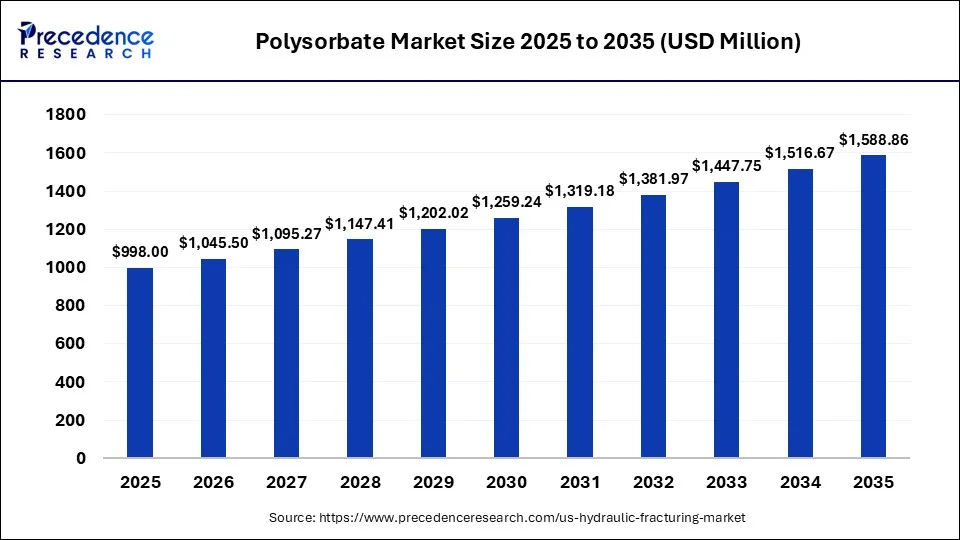
The polysorbate market was valued at USD 1045.50 million in 2026, expanding at a CAGR of 4.76% during the forecast period from 2026 to 2035. The driving factor for the market is the rising need from the cosmetics and personal care industry, fueled by greater user awareness of skincare and frequent new product launches. Our healthcare research analyst, Vidyesh Swar, analysed this value. He typically investigates market size, manufacturing raw materials, segment growth drivers, and emerging biopharmaceutical applications.
Source: https://www.precedenceresearch.com/polysorbate-market
 Get a Sample
 Table Of Content


Polysorbate Market Growth, Innovations, and Market Size Forecast 2035
The primary driving factor for the polysorbate market is the expansion of applications in the food, pharmaceutical, and personal care industries. The polysorbate market is forecasted to expand from USD 1045.50 million in 2026 to USD 1588.86 million by 2035, growing at a CAGR of 4.76% from 2026 to 2035. The market is driven by rising production of monoclonal antibodies and complex injectable drugs that rely on polysorbates, such as PS20 and PS80, to prevent protein aggregation and degradation. Further, growth in convenience and bakery foods drives the need for shelf-stable dairy and dessert stabilizers.
Key Takeaways
- By product type, the polysorbate 80 segment led the market with a 35.40% share in 2025.
- By grade, the pharmaceutical grade segment captured a major revenue share of 38.65% in 2025.
- By application, the pharmaceuticals segment captured the largest market share of 31.85% in 2025.
- By function, the emulsifier segment led the market with a share of 34.85% in 2025.
- By form, the liquid segment led the market with a share of 62.85% in 2025.
- By end user, the pharmaceutical companies segment led the market with a share of 29.85% in 2025.
- By distribution channel, the direct sales segment led the market with a share of 43.85% in 2025.
- In September 2025, Croda declared expansion of its Super Refined facility in Leek, UK, along with continued investments in the U.S. and Japan.
- NOF's 2025 integrated report identifies Polysorbate 80 (HX2) as a surfactant for injection as well as vaccine preparations within its Pharmaceuticals, Medicals and Health segment.
- BASF's pharmaceutical-grade ingredient portfolio involves Kolliphor PS 20, Kolliphor PS 60, and even Kolliphor PS 80, corresponding to Polysorbate 20, 60, and 80.
Introduction
The polysorbate market comprises nonionic surfactants utilized as solubilizers, emulsifiers, stabilizers, wetting agents, and even dispersing agents across pharmaceutical, biopharmaceutical, cosmetics, personal-care, food, and specialty formulations. Polysorbate 20 (PS20) and Polysorbate 80 (PS80) are mainly important in biologic and protein formulations because they assist protect therapeutic proteins from adsorption, interfacial stress, and aggregation. Based on the supplied 4.76% CAGR, the market is anticipated to increase from USD 998 million in 2025 to nearly USD 1.59 billion by 2035.
Analyst View
The market is characterized by relatively steady growth rather than a rapid expansion cycle because polysorbates are mature excipients with established usage across multiple formulation categories. Moreover, the principal growth opportunity is increasingly concentrated in pharmaceutical and biopharmaceutical grades, where purity, peroxide control, fatty-acid profile, lot consistency, and regulatory documentation are becoming more important. Thus, industry research identifies PS20 and PS80 as the dominant surfactants in biological drug products, while ongoing research aims to control their degradation and evaluate alternatives.
Market Segmentation By Product Type
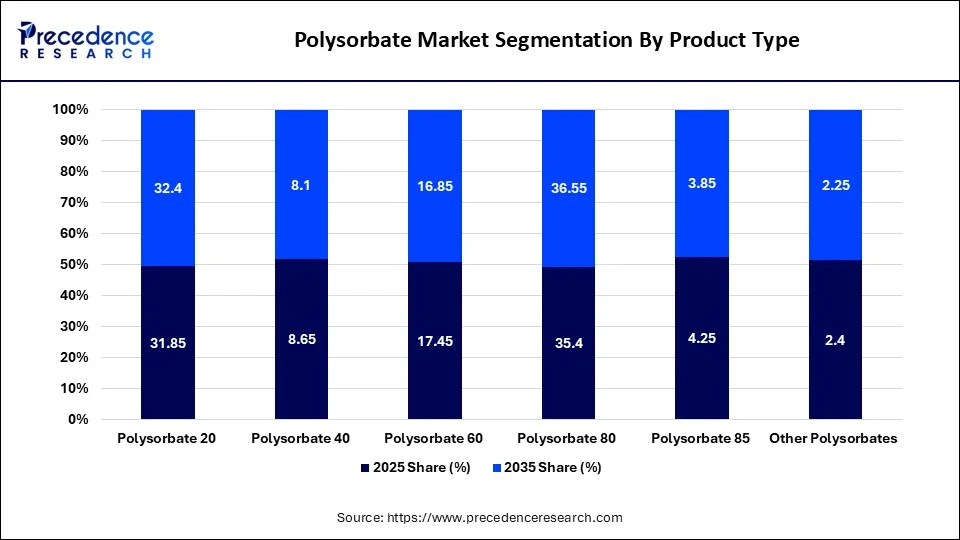
Polysorbate 80 is the largest product category, accounting for 35.40% of the market in 2025, because of its critical role as a high-efficiency stabilizer and solubilizer in vaccines, biopharmaceuticals, and advanced injectables. It improves consistency in processed foods such as ice cream and baked goods and prevents aggregation in complex biologics and even monoclonal antibodies.
Analyst View - Product Type
PS80's position is closely connected with protein, along with biologic formulation demand. FDA research identifies PS20 and PS80 as commonly utilized surfactants for stabilizing therapeutic proteins against interfacial stresses, while commercial suppliers increasingly differentiate products via high-purity specifications and tighter impurity control. The increasing share of PS80 therefore reflects not simply volume growth but increasing need for higher-quality, injectable-compatible and even biopharmaceutical-grade material.
Market Segmentation By Grade
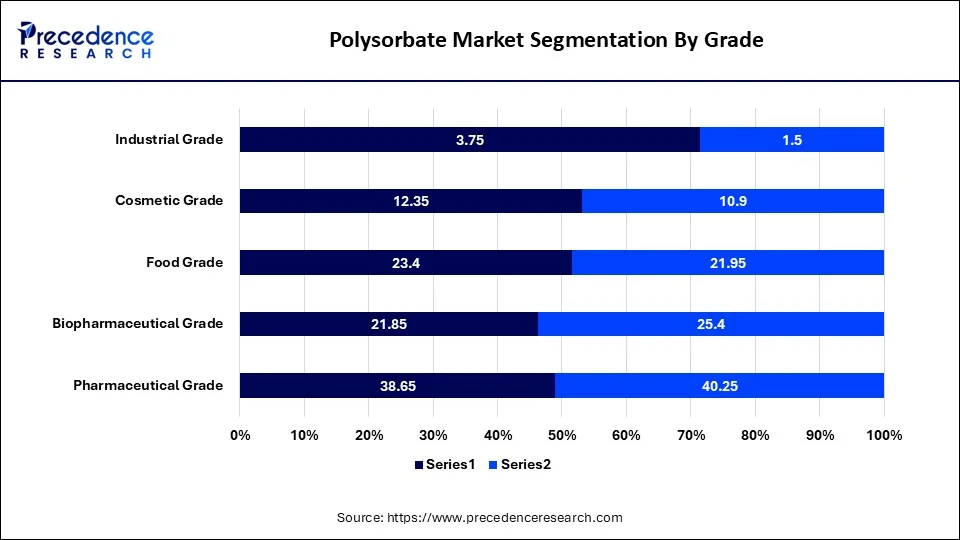
Pharmaceutical grade is the largest category at 38.65% due to surging global need for complex biologic drugs, vaccines, and sterile injectables that demand high-purity stabilizing excipients, while biopharmaceutical grade is the fastest-growing segment at 6.40% CAGR as it acts as an essential stabilizer for monoclonal antibodies, sensitive biologics, and vaccines.
Analyst View - Grade
The grade mix shows the market moving toward higher-value excipient applications. Merck's high-purity PS80, for instance, is positioned for biomolecule formulation and then carries controls for bioburden and endotoxins, while its Emprove portfolio offers regulatory documentation and supply-chain information for pharmaceutical along with biopharmaceutical applications. This creates a premiumization opportunity for suppliers able to provide consistent fatty-acid composition, low endotoxin or bioburden, low peroxide levels, multi-compendial compliance, and detailed batch documentation.
Market Segmentation By Applications
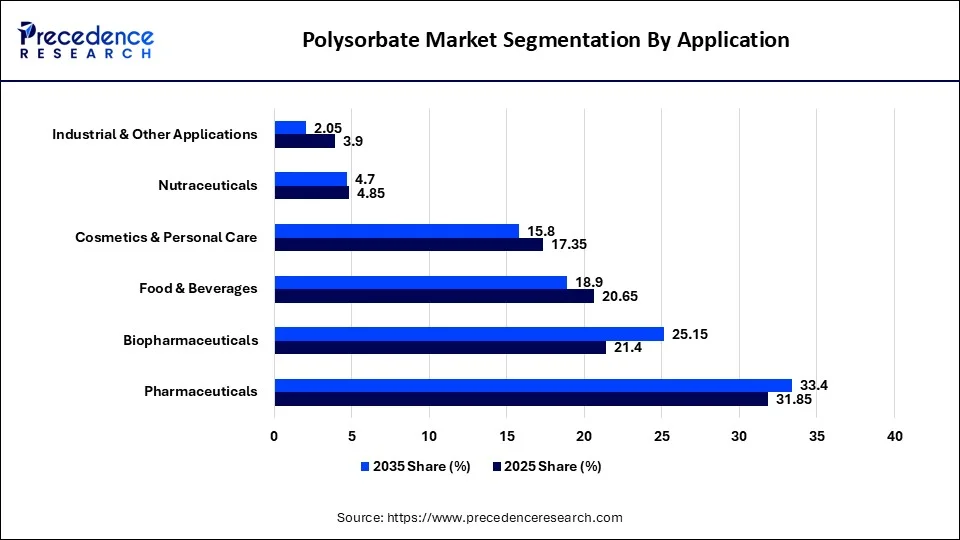
Pharmaceutical applications represent the largest market at 31.85% due to the rising need for advanced drug solubilization, biologic stabilization, alongside vaccine manufacturing. Biopharmaceutical applications show the fastest growth at a 6.55% CAGR, as polysorbates, mainly Polysorbate 20 and 80, act as essential stabilizing excipients that prevent protein aggregation, denaturation, and even surface adsorption in fragile biologic drugs and vaccines.
Analyst View - Application
The biopharmaceutical share shift is supported by the widespread usage of polysorbates in protein formulations. A 2025 pharmaceutical-industry survey involving firms including Pfizer, Merck, Lilly, GSK, and AbbVie describes PS20 and PS80 as the most popular surfactants in biological drug products because of their stabilizing properties along with an established parenteral-use profile. At the same time, polysorbate degradation has become an essential formulation-development issue, creating a need for improved excipient grades rather than simply higher volumes of conventional material.
Market Segmentation By Function
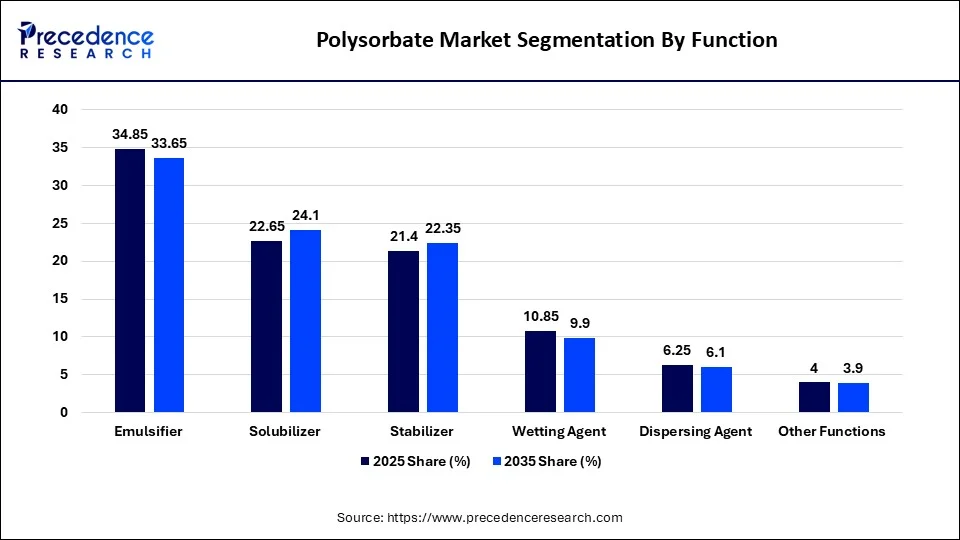
Emulsification is the largest function at 34.85% because manufacturers demand reliable ingredients that mix oil and water, prevent separation, and enhance texture across food, pharma, and cosmetics. Growth in skincare, beauty, and concentrated or waterless cosmetics raises the need for high-performance emulsifiers that manage complex active ingredients.
Analyst View - Function
Solubilization and stabilization are increasingly essential in complex drug formulations. Commercial PS80 products are explicitly marketed for emulsification and wetting, while high-purity grades are also utilized to stabilize biomolecule formulations. The faster growth of solubilizer and stabilizer applications thus reflects the increasing formulation complexity of injectable and biologic products.
Market Segmentation By Form
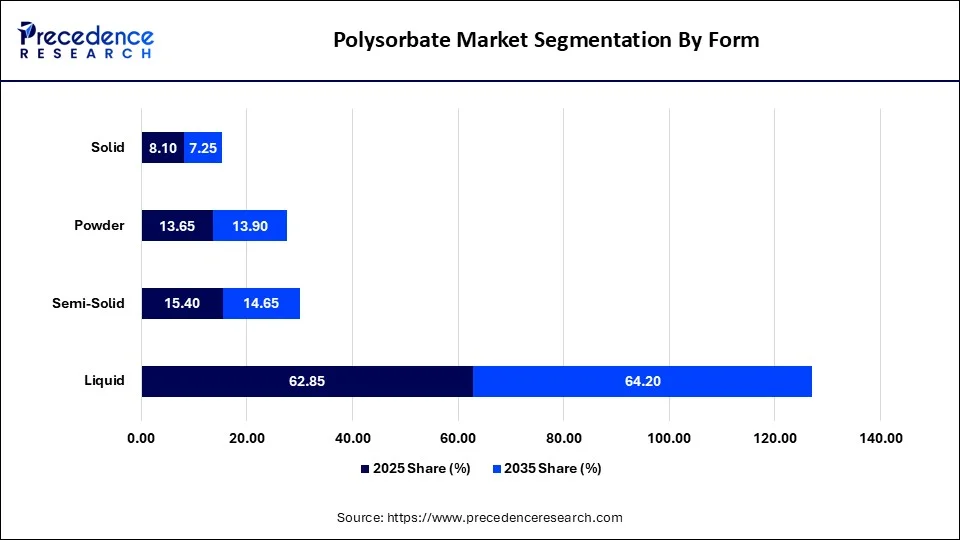
Liquid polysorbates dominated the market with a 62.85% share in 2025, increasing to 64.20% by 2035, because they provide unmatched versatility, ease of use, and also seamless compatibility across pharmaceutical, cosmetic, and food applications.
Analyst View - Form
Liquid polysorbate remains commercially important due to its direct incorporation into liquid pharmaceutical, injectable, food, along with cosmetic formulations. Merck describes PS80 as a viscous liquid as well as lists applications across liquid formulations, ophthalmics, pharmaceutical or biopharmaceutical processes, and even solubility enhancement.
Market Segmentation By End User
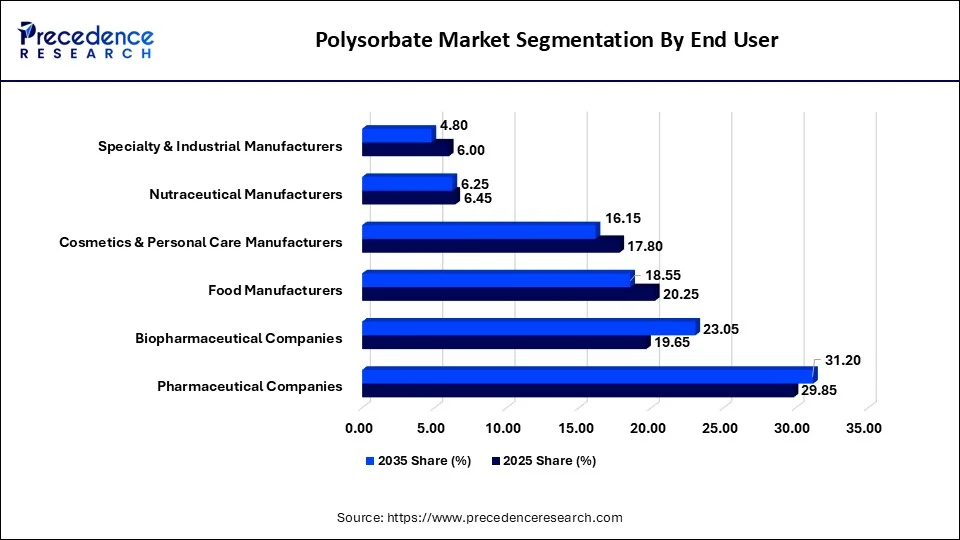
Pharmaceutical companies represent 29.85% of demand in 2025 because these compounds are essential excipients that stabilize complex biologic drugs, vaccines, as well as injectable formulations. The biopharmaceutical end-user segment grows at a 6.45% CAGR by utilizing polysorbates such as Polysorbate 20 and 80 as critical excipients that stabilize complex, modern drug formulations.
Analyst View - End User
The end-user mix is thus becoming increasingly pharmaceutical-centric. Biopharmaceutical manufacturers place higher impact on raw-material characterization, as polysorbate degradation can generate free fatty acids along with subvisible particles that can affect protein quality. FDA research has specifically investigated these degradation pathways and even their potential impact on therapeutic proteins. This creates a strong opportunity for suppliers that can move beyond commodity excipient sales toward analytical characterization, formulation support, technical support, and regulatory documentation.
Market Segmentation By Distribution Channel
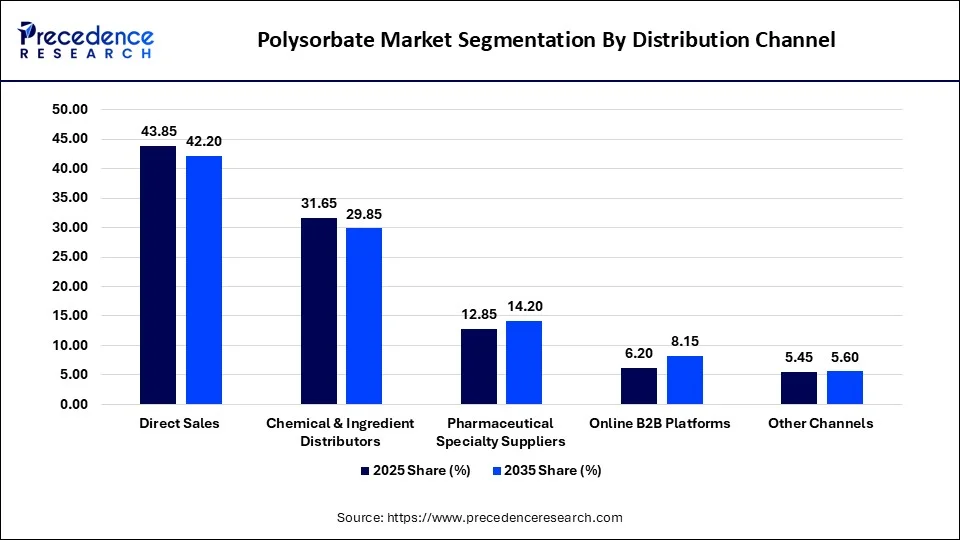
Direct sales remain the largest channel at 43.85% as chemical producers and life science end-users want better product purity transparency, tighter supply chain control, and lower intermediary costs.
Analyst View - Distribution Channel
Pharmaceutical excipients are highly specification-based, which favors direct manufacturer relationships and specialist distributors capable of offering certificates, regulatory packages, and technical documentation. However, digital B2B procurement is creating an additional channel for standardized grades along with smaller-volume purchases. The premium opportunity remains with pharmaceutical specialty suppliers as qualified excipient sourcing demands significantly more documentation than conventional industrial chemical purchasing.
Regional Market Segmentation
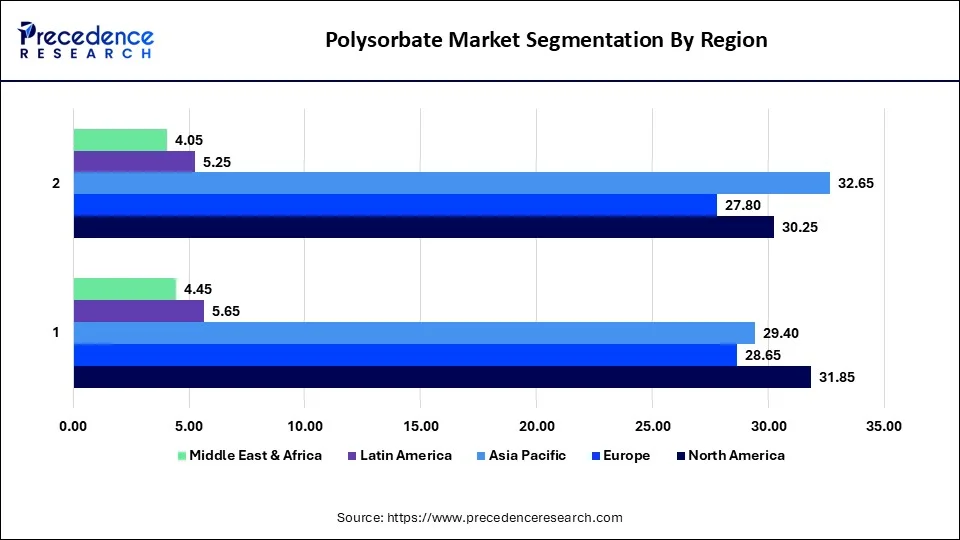
North America is the largest regional market in 2025 at 31.85% and is growing in the polysorbate market due to high demand from advanced biopharmaceutical manufacturing, innovative personal care applications, and mature processed food sectors, narrowly ahead of Asia Pacific at 29.40%. Asia Pacific records the fastest regional CAGR at 5.85% as rising middle-class populations, as well as higher spending on personal care in Southeast Asia, India, and China, have boosted the creation and utilization of skincare and haircare products, where polysorbates function as effective solubilizers that combine with emulsifiers.
Analyst View - Region
Asia Pacific's projected share gain reflects the growth of pharmaceutical manufacturing, biologics, injectable production, and local formulation capacity. The region also provides a significant manufacturing base for excipients and pharmaceutical ingredients. North America and Europe remain important as they concentrate innovative pharmaceutical and biotechnology firms and have stringent excipient qualification requirements. Asia Pacific, however, provides the strongest volume-growth opportunity under the supplied forecast.
Pharmaceutical & Biopharmaceutical Demand Dynamics
The polysorbate market is increasingly associated with the development and manufacturing of biologics. PS20 and PS80 are broadly used in protein formulations because they decrease surface adsorption and assist protect proteins from aggregation and a few interfacial stresses. A pharmaceutical-industry survey involving 16 major biotechnology firms examined current polysorbate use, degradation, quality control, and manufacturing practices, illustrating the importance of polysorbates as a controlled raw material in biopharmaceutical production.
Analyst View
Biologics create a mainly attractive demand environment as excipient requirements are more stringent than many conventional applications. Buyers increasingly demand detailed information on fatty-acid composition, degradation behavior, peroxide value, impurities, storage, batch consistency, and container compatibility. The market therefore has an important premium segment in which technical specifications can be more commercially important than price alone.
Polysorbate Degradation & Quality Intelligence
Polysorbates can degrade via oxidation and hydrolysis. FDA research found that PS20 degradation can release free fatty acids and lead to subvisible particle formation, with implications for protein quality. Research also identifies factors including temperature, light, oxygen, and even metal ions as contributors to polysorbate degradation.
| Quality Parameter | Commercial Importance |
| Peroxide Level | Controls oxidative risk |
| Fatty-Acid Profile | Influences stability and degradation |
| Free Fatty Acids | Important for particle formation |
| Aldehydes | Potential protein-quality concern |
| Bioburden | Important for pharmaceutical manufacturing |
| Endotoxins | Critical for injectable applications |
| Trace Metals | Can influence oxidative degradation |
| Batch Consistency | Supports formulation reproducibility |
| Compendial Compliance | Supports regulatory qualification |
| Storage Stability | Protects excipient quality before use |
Analyst View
Quality control is becoming a major competitive differentiator. NOF's high-purity PS80, for example, is designed with low levels of peroxide and a few impurities and is provided as a multi-compendial injectable-grade product. Thus, this suggests a continuing shift from commodity polysorbate toward application-specific, high-purity and even low-impurity grades.
Competitive & Company Intelligence
Croda
Croda's Pharma portfolio involves Super Refined Polysorbate 20, Polysorbate 60, and Polysorbate 80. The firm positions these materials for solubilization and stabilization of sensitive APIs across oral, topical, injectable, and ophthalmic formulations.
In September 2025, Croda declared expansion of its Super Refined facility in Leek, UK, along with continued investments in the U.S. and Japan. The investment was intended to expand production capabilities for its high-purity excipient portfolio.
Croda has thus highlighted formulation stability work showing that residual catalyst in standard pharmaceutical-grade PS80 can lead to instability in certain formulations, while its Super Refined grade demonstrated enhanced stability in the cited formulation example.
Analyst View
Croda is competing primarily via purity, formulation performance, and technical differentiation, rather than treating polysorbate as a basic surfactant commodity. Moreover, its investment in additional production capacity also indicates continued confidence in the need for high-purity pharmaceutical excipients.
NOF Corporation
NOF provides Polysorbate 80 (HX2) as an ultrapure injectable-grade pharmaceutical excipient. The firm identifies low peroxide, low cell toxicity, low hemolysis, low allergy or degranulation characteristics, and multi-compendial compliance across USP/NF, EP, ChP, and JP. NOF's 2025 integrated report identifies Polysorbate 80 (HX2) as a surfactant for injection along with vaccine preparations within its Pharmaceuticals, Medicals and Health segment.
Analyst View
NOF's positioning demonstrates the significance of injectable and vaccine-grade polysorbate as a premium application. Low peroxide and impurity specifications are mainly relevant where the excipient comes into direct contact with sensitive protein or antigenic components.
Merck
Merck's SAFC/EMPROVE portfolio involves Polysorbate 20 and Polysorbate 80 for pharmaceutical and biopharmaceutical applications. Its PS80 portfolio involves Essential and higher-purity Expert grades, with documentation and quality packages programmed for regulated manufacturing.
Merck's high-purity PS80 is positioned for biomolecule stabilization and solubilizing, emulsifying, and wetting functions, with controls for bioburden and even endotoxins in the Expert grade.
Analyst View
Merck's tiered excipient portfolio demonstrates how the market is being segmented according to application risk along with documentation requirements. This creates room for differentiated pricing between general pharmaceutical grades as well as high-purity grades intended for higher-risk biopharmaceutical applications.
BASF
BASF's pharmaceutical-grade ingredient portfolio involves Kolliphor PS 20, Kolliphor PS 60, and Kolliphor PS 80, thus corresponding to Polysorbate 20, 60, and 80. Its portfolio also includes other pharmaceutical solubilizers and even surfactants such as poloxamer 188 and vitamin E TPGS.
Analyst View
BASF's portfolio states the competitive environment beyond polysorbate alone. Excipient suppliers increasingly provide multiple surfactant technologies, allowing formulation developers to determine polysorbates against alternative materials according to stability, compatibility, and formulation requirements.
Alternatives & Competitive Technology
Polysorbates face competition from other surfactants, mainly poloxamer 188 and hydroxypropyl beta-cyclodextrin in certain biopharmaceutical applications. A 2025 industry survey specifically investigated alternatives to polysorbates in biological drug products and noted that PS20 and PS80 remain the most popular surfactants because of their stabilizing properties and established safety profile. Research has also examined poloxamer 188 as a potential alternative to PS20/PS80 due to concerns surrounding polysorbate degradation.
Analyst View
Alternative excipients represent a competitive pressure rather than an immediate displacement event. Meanwhile, polysorbates have substantial formulation history, regulatory familiarity, and established supply chains. However, degradation concerns can encourage formulation developers to evaluate alternatives in the latest biologic programs, mainly where stability margins are narrow.
Buyer Intelligence
| Buyer | Key Purchasing Criteria | Major Requirement |
| Pharmaceutical Manufacturers | Purity, compendial compliance, consistency | GMP documentation |
| Biopharmaceutical Companies | Peroxide, fatty-acid profile, stability | High-purity grades |
| Vaccine Manufacturers | Low impurities, injectable suitability | Low peroxide/endotoxin |
| CDMOs | Supply reliability, documentation, flexibility | Multi-client qualification |
| Food Manufacturers | Functional performance, cost, regulatory status | Food-grade consistency |
| Cosmetics Companies | Emulsification, texture, purity | Formulation performance |
| Nutraceutical Producers | Quality, compatibility, cost | Consistent supply |
| Distributors | Shelf stability, documentation, packaging | Broad grade availability |
Analyst View
Pharmaceutical and biopharmaceutical buyers thus generally have higher switching barriers because changing an excipient can demand formulation studies, stability testing, analytical characterization, and even potentially regulatory documentation. Consequently, once a polysorbate supplier is qualified, supply reliability along with batch-to-batch consistency can become as important as unit price.
Key Growth Drivers
Biologics & Protein Therapeutics
Growing biological-drug manufacturing supports the need for PS20 and PS80 as protein-stabilizing surfactants.
Injectable Formulations
High-purity polysorbates are used in injectable and vaccine formulations, thus supporting premium-grade demand.
Pharmaceutical Excipient Consumption
Increasing formulation complexity raises demand for excipients capable of solubilizing and stabilizing sensitive APIs.
High-Purity Excipient Premiumization
Suppliers are investing in products with lower peroxide, lower impurities, better characterization, and broader compendial coverage.
Specialty Formulations
Ophthalmic, inhaled, topical, and other specialized formulations offer additional demand channels. Croda specifically identifies PS20/PS80 across injectable, topical, oral, and ophthalmic applications.
Digital Procurement
The supplied 7.65% CAGR for online B2B platforms indicates rising use of digital procurement for standardized chemical and excipient purchasing.
Key Market Challenges
| Challenge | Market Impact |
| Oxidative degradation | Can affect formulation stability |
| Hydrolytic degradation | Can generate free fatty acids and particles |
| Batch variability | Creates formulation and qualification risks |
| Raw-material quality | Influences polysorbate impurity profile |
| Alternative excipients | Creates substitution pressure |
| Regulatory qualification | Increases supplier switching barriers |
| Pharmaceutical-grade manufacturing | Requires high quality-control investment |
| Price pressure in food/cosmetics | Limits premium pricing outside pharma |
| Supply-chain requirements | Encourages dual sourcing and qualification |
| Increasing analytical requirements | Raises QC and characterization costs |
Analyst View
The major challenge is the tension between polysorbates' established utility and their chemical complexity. They remain highly useful surfactants, but degradation can create formulation-quality concerns. Moreover, FDA research and industry surveys have therefore pushed the market toward stronger raw-material controls, degradation monitoring, along with supplier qualification.
Strategic Outlook 2026-2035
The polysorbate market is anticipated to grow from USD 998 million in 2025 to nearly USD 1.59 billion by 2035, based on the supplied 4.76% CAGR. The most important structural trend is the rising importance of pharmaceutical and biopharmaceutical grades. Pharmaceutical grade rises from 38.65% to 40.25%. Meanwhile, biopharmaceutical grade expands from 21.85% to 25.40%. At the application level, biopharmaceuticals rise from 21.40% to 25.15%, growing at a 6.55% CAGR.
PS80 remains the leading product and rises to 36.55% market share, while PS20 remains the second-largest product. Both are strongly connected to biologics, along with injectable formulation demand. At the same time, the market is evolving technologically. Polysorbate degradation via oxidation and hydrolysis is driving increased attention to peroxide control, impurity characterization, analytical testing, fatty-acid composition, and alternative excipients. FDA research and pharmaceutical-industry surveys state that degradation control has become an important section of biopharmaceutical formulation strategy.
Regionally, Asia Pacific represents the largest share-growth opportunity, thus moving from 29.40% to 32.65% by 2035. Pharmaceutical manufacturing expansion across India, China, and other Asian markets should support local need for qualified excipients and pharmaceutical-grade polysorbates.
Final Analyst View
The polysorbate market is evolving from a volume-driven surfactant market toward a quality- and application-driven pharmaceutical excipient market. The largest future opportunity is not simply increasing polysorbate consumption across all industries. It is the premiumization of PS20 and PS80 for biologics, injectable drugs, vaccines, and other sensitive formulations, where customers increasingly require low-peroxide materials, controlled impurity profiles, consistent fatty-acid composition, compendial compliance, and comprehensive regulatory documentation.
The competitive landscape is consequently changing toward suppliers that can combine high-purity manufacturing, regulatory documentation, analytical characterization, formulation expertise, and global supply reliability. Meanwhile, Croda's investment in expanded high-purity excipient capacity, NOF's ultrapure injectable PS80, and Merck's differentiated Emprove PS80 grades all state this movement toward higher-specification excipients. The principal strategic risk is the development of alternative surfactants and even excipients for biologics. Industry research is actively evaluating alternatives like poloxamer 188, while newer excipient technologies seek to decrease degradation-related formulation risks.
Overall, the market's strongest commercial trajectory is centered on PS80, PS20, pharmaceutical or biopharmaceutical grades, injectable formulations, solubilization along with stabilization functions, and even pharmaceutical manufacturing growth in Asia Pacific.
Expert Insights
The polysorbate market covers the production, distribution, and application of non-ionic surfactants utilized as emulsifiers, stabilizers, and even solubilizers across the cosmetic, food, and pharmaceutical industries. I believe that market demand is shifting toward premium, "Super Refined" and "Ultrapure" grades for sensitive applications like mRNA therapeutics and biologics, and increased use in drug delivery, vaccines, and protein formulations, such as polysorbate 80, boosts market growth.
Our Experts
- The primary market research process was carried out by Vidyesh Swar, Senior Research Associate, who also designed the methodology and conducted market segmentation, competitive analysis, regional trend analysis, recycling technology analysis, and forecasts, laying the foundation for the analytical part of the report.
- Aman Singh, Head of Research, has gathered and checked regulatory policies, information on recycling capacity, company financial information, production information, commodity price information, and numerous other quantitative information sources, which are obtained independently, thereby increasing the quality of evidence supporting calculations of the market values.
- Aditi Shivarkar, VP Research, has validated and refined the research material, verified facts, corrected inconsistencies, and completed the research document, making it accurate and to the point.
Polysorbate Market Segments Covered in the Report
By Product Type
- Polysorbate 20
- Polysorbate 40
- Polysorbate 60
- Polysorbate 80
- Polysorbate 85
- Other Polysorbates
By Grade
- Pharmaceutical Grade
- Biopharmaceutical Grade
- Food Grade
- Cosmetic Grade
- Industrial Grade
By Application
- Pharmaceuticals
- Biopharmaceuticals
- Food & Beverages
- Cosmetics & Personal Care
- Nutraceuticals
- Industrial & Other Applications
By Function
- Emulsifier
- Solubilizer
- Stabilizer
- Wetting Agent
- Dispersing Agent
- Other Functions
By Form
- Liquid
- Semi-Solid
- Powder
- Solid
By End User
- Pharmaceutical Companies
- Biopharmaceutical Companies
- Food Manufacturers
- Cosmetics & Personal Care Manufacturers
- Nutraceutical Manufacturers
Specialty & Industrial Manufacturers
By Distribution Channel
- Direct Sales
- Chemical & Ingredient Distributors
- Pharmaceutical Specialty Suppliers
- Online B2B Platforms
- Other Channels
By Region
- North America
- Europe
- Asia Pacific
- Latin America
- Middle East & Africa
For inquiries regarding discounts, bulk purchases, or customization requests, please contact us at sales@precedenceresearch.com
Frequently Asked Questions
Tags





Ask For Sample
No cookie-cutter, only authentic analysis – take the 1st step to become a Precedence Research client
 Get a Sample




 sales@precedenceresearch.com
 Schedule a Meeting
