



Power-to-X Market Size, Energy Production, Consumption Patterns, Pricing Analysis, Grid Performance, and Competitive Landscape
Power-To-X Market (By Type: Power-to-H2, Power-to-CO/Syngas/Formic Acid, Power-to-NH3, Power-to-Methane, Power-to-Methanol, Power-to-H2O2; By End Use: Transportation, Agriculture, Manufacturing, Industry, Residential, Others) - Global Industry Analysis, Size, Trends, Leading Companies, Regional Outlook, and Forecast 2026 to 2035
Source: https://www.precedenceresearch.com/power-to-x-market
 Get a Sample
 Table Of Content


What is the Power-To-X Market Size?
The global power-to-x market size is calculated at USD 392.93 million in 2025 and is predicted to increase from USD 439.29 million in 2026 to approximately USD 1177.44 million by 2035, expanding at a CAGR of 11.60% from 2026 to 2035. Power-to-X is essential to meet the increasing demand for energy and achieve a carbon-neutral society, and it unlocks carbon-neutral solutions through electrolysis and CO2 reutilisation.

Power-To-X Market Key Takeaways
- In terms of revenue, the market is valued at $392.93 million in 2025.
- It is projected to reach $1177.44 million by 2035.
- The market is expected to grow at a CAGR of 11.80% from 2026 to 2035.
- By Technology, the power-to-H2 segment has captured the highest revenue share of around 44.7% in 2025.
- By End-use, the transportation segment has represented largest revenue share of 38.2% in 2025.
- By End-use, the agriculture segment has accounted revenue share of around 17.6% in 2025.
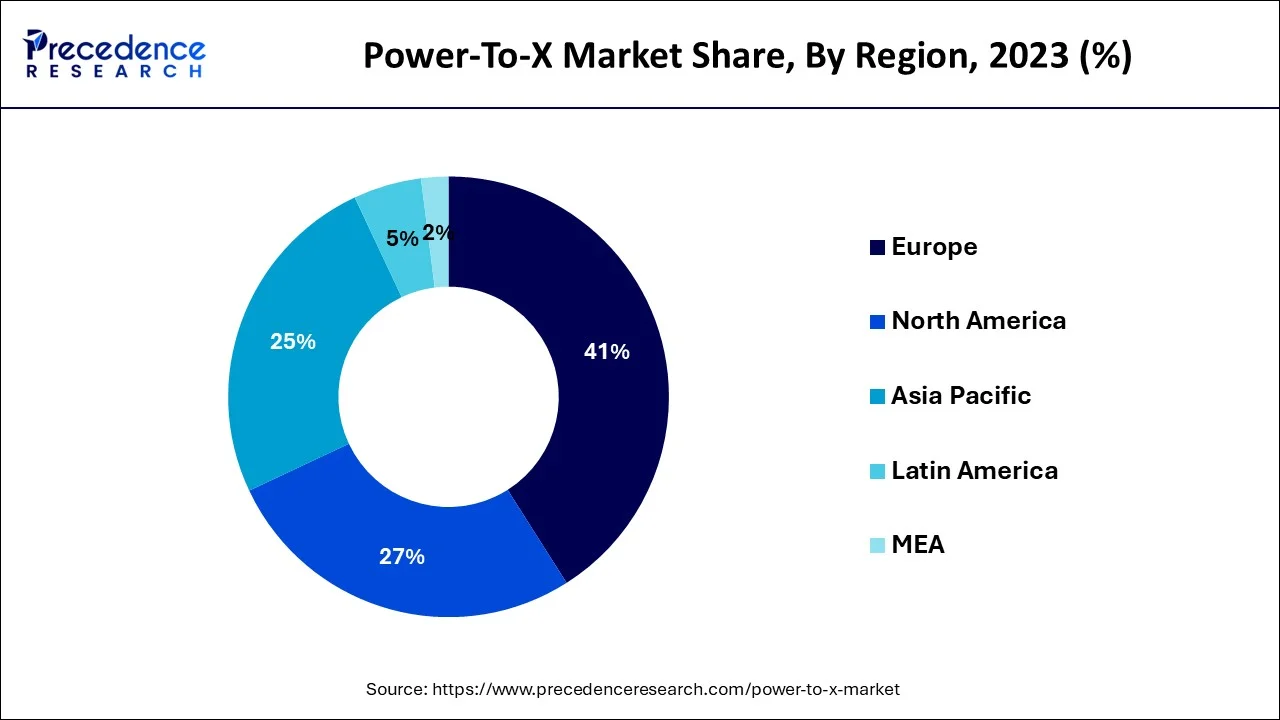
- By Region, Europe power-to-x market has held revenue share of over 41% in 2025.
Market Overview
Power-to-x is a group of electricity conversion, energy storage, and reconversion pathways that require extra electricity, typically when the load exceeds the renewable energy supply, and the supply fluctuates. Power can now be employed outside of the electrical industry thanks to power-to-x conversion technologies. P stands for power, while X stands for the kind of energy gases, liquids, or heat that is changed from surplus electricity for storage. Additionally, renewable hydrogen can be used in secondary conversion processes, such as methanation and hydrogenation, to create a range of hydrocarbon compounds, as well as in the Haber-Bosch reaction to create ammonia. Power-to-X is a general term used to explain how energy changes into something else. Electrical heating, for instance, typically uses Power-to-X. utilizing electricity, like in the case of a boiler that generates heat for space heating or hot water.
What is the Revolutionary Impact of AI in the Power-To-X Market?
AI holds immense promise in the energy sector to revolutionize the digitalization, distribution, decarbonization, and democratization of energy. AI-powered automation plays a key role in driving net-zero goals. AI balances H2 production, power production, and conversion in real time to ensure system uptime and maximum yield. AI aligns production with infrastructure challenges and market demand across chemicals, transport, and power sectors. It supports export logistics, real-time trading decisions, and sector coupling.
Power-To-X Market Growth Factors
The element hydrogen is the most prevalent on earth and holds great promise for innovation. It can be utilized as a fuel or energy source as well as a raw material in the manufacturing sector. Fuel-cell technology is already in use, and electrolysis technologies are about to become profitable. The power-to-x market is expected to grow at a significant rate owing to its demand.
- The growing demand for energy.
- Increasing demand of green hydrogen and ammonia.
How Does Government Bodies Support the Power-To-X Market?
- The U.S. government supported the green hydrogen and Power-to-X endeavors through the Hydrogen Earthshot program, green hydrogen tax incentives, and Department of Energy funding for low-carbon fuels.
- Germany formulated the National Hydrogen Strategy that focuses on promoting green hydrogen production, power-to-X processes, and global cooperation for fuel and energy generation.
- India launched the National Green Hydrogen Mission to support hydrogen hubs, renewable energy hydrogen production, and infrastructural setup for ammonia and synthetic fuel transportation.
- Chile established the National Green Hydrogen Strategy with a goal of becoming an exporter of green hydrogen and synthetic fuels via the deployment of electrolyzers.
Market Outlook
- Industry Growth Overview: The Power-to-X industry is projected to continue growing rapidly, primarily because of global industrial efforts to achieve net-zero operations, develop renewables for energy storage, and adopt green fuels, as well as by strategic partnerships being formed on a global scale that are supporting greater numbers of electrolyzers installed across the next decade.
- Global Expansion: The international collaborative efforts of governments around the globe to develop hydrogen roadmaps is driving the increase of cross border infrastructure, hydrogen export corridors, and large-scale demonstration plants. Many emerging markets are rapidly building electrolyzer capacity to establish themselves as the world's preeminent suppliers of green fuels.
- Startup Ecosystem: The start-up landscape for the Power-to-X industry is vibrant, as many new entrants are entering the market. New companies are being created that are introducing innovations related to modular electrolyzers, carbon neutral fuel synthesis, and hydrogen logistics. Many of these new entrants have raised venture capital and are forming alliances around the world in order to bring down the cost of their technologies through digital-first, large-scale solutions.
Market Scope
| Report Coverage | Details |
| Market Size by 2035 | USD 1177.44 Million |
| Market Size in 2025 | USD 392.93 Million |
| Market Size in 2026 | USD 439.29 Million |
| Growth Rate from 2026 to 2035 | CAGR of 11.60% |
| Base Year | 2025 |
| Forecast Period | 2026 to 2035 |
| Largest Market | Europe |
| Segment Covered |
Type, End Use and Region |
| Regions Covered |
North America, Europe, Asia-Pacific, Latin America and Middle East & Africa |
Which Growth Factors are Transforming the Power-To-X Market?
- Power-to-X technology transforms green electricity into important energy carriers such as chemicals, synthetic fuels, or hydrogen.
- This allows storage and utilization of green electricity in sectors like refineries that cannot use it directly.
- Power-to-X technology provides a potential solution through the conversion of excess renewable energy into many different forms.
Market Dynamics
Drivers
- The global market for green hydrogen will be driven by growing concern about reducing carbon emissions - Concern over carbon emissions and global warming is growing. Governments from all over the world have put in place a variety of laws and rules that demand a decrease in carbon emissions from different enterprises. During the electrolysis process, which yields hydrogen, water is split into hydrogen and oxygen using electricity. Resources, both renewable and nonrenewable, are used to produce electricity. Hydrogen can also be produced using electrolyzers that use electricity produced by solar or wind energy. This invention promotes the production of hydrogen which is good for the environment. In order to lessen their carbon footprint, many businesses opt for on-site electrolyzers with capacities ranging from 1 to 5 MW, which considerably fuels the expansion of the global industry.
- Growing demand of energy - The requirement for the conversion of energy from one phase to another useable form is driving up the demand for Power-to-X technology from major businesses for heat, transportation, and energy generation. In the projected years, it's anticipated that the market for Power-to-X would rise because of the rising demand for hydrogen in sectors including steel manufacturing and refineries.
- Advantages of energy storage - Power-to-advantages x's over currently being tested energy storage technologies like batteries and pumped hydro, which are scale, time, and site-specific and unable to transport energy over large distances, are a big factor in the market's revenue growth. P2X technology will make it simpler to incorporate renewable energy into other energy-intensive industries that are crucial to the world economy (including manufacturing, transportation, and agriculture), eventually replacing fossil fuels in these industries. Power-to-x fuels can aid in accelerating the process of decarbonization in various industries and achieving environmental objectives. This should accelerate the global market's revenue growth even more.
Challenges
- A lack of knowledge regarding green ammonia - The development of green ammonia technology has only begun. Electrochemical synthesis, photochemical synthesis, or chemical looping are some of the methods used to directly produce ammonia from water and nitrogen. Nevertheless, these procedures come with a number of substantial technological difficulties, which call for time and R&D expenditures. For the most part, ammonia is still produced using traditional techniques. Among chemical makers, a lack of awareness is the biggest issue with green ammonia.
- Moreover, the creation and storage of hydrogen has the potential to store extra renewable electric power for a long time, it is much less effective than alternative storage technologies. As a result, significant cost reductions in hydrogen production are required before it can compete.
Opportunity
Promoting the use of electric vehicles to expand the global green hydrogen market
- Electric cars employ hydrogen fuel cells as its battery. Air pollution and, to a lesser extent, the use of fossil fuels, which are becoming increasingly scarce, are both decreased by electric vehicle reductions in carbon emissions. In order to promote the use of electric vehicles, several governments are providing consumers and manufacturers with a variety of rules and incentives. Governments all across the world, for instance, are putting in place electrified public transportation systems and building public infrastructure.
- As the market for electric vehicles expands, it is also anticipated that the need for electrolyzes would rise as a result of the increased need for hydrogen. This means that during the projection period, these characteristics are anticipated to offer profitable chances for industrial expansion.
Segments Insights
Type Insights
The power-to-hydrogen segment has dominated the market in 2025. Hydrogen generated from renewable resources can be converted into heat or electricity and used in a variety of ways to supply electricity and power homes. As a result, renewable energies will always be abundantly available in the event of weather-related power variations. Green hydrogen can be utilized as a bridge to transform green electricity or power into transportation fuel or to be used as a feedstock in industrial processes. Market participants will be able to incorporate wind energy into a container ship's fuel tank using green hydrogen and fuels created from it, including green ammonia. Hydrogen, therefore, has the capacity to significantly raise the decarbonization potential of renewable energy sources.
The power-to-methanol segment is expected to grow at the fastest CAGR in the market during the forecast period due to its key role in converting renewable electricity into a highly versatile, liquid chemical carrier. It resolves issues of long-term renewable energy storage and decarbonises sectors that cannot be easily electrified.
End Use Insights
The transportation segment has dominated the market in 2025. The demand for eco-friendly automobiles with reduced environmental carbon emissions is predicted to increase, which will lead to growth in the transportation sector. The expansion of this market is being driven by the increase in the region's production and sales of electric vehicles that use rechargeable batteries. The inability of long-haul shipping, intercontinental aircraft, and heavy-duty trucking to convert power directly is also driving up demand for the Power-to-X industry during the projection.
The agriculture segment is estimated to grow at the fastest rate in the market during the predicted timeframe due to key advantages of power-to-X to replace fossil fuels with carbon-neutral alternatives, help reduce global CO2 emissions, and enable long-term storage of excess renewable energy. It offers opportunities for sectors that are hard to decarbonise with renewable electricity, such as agriculture, steel, plastic, glass, and heavy transport.
Regional Insights
What is the Europe Power-To-X Market Size?
The Europe power-to-x market size is estimated at USD 161.10 million in 2025 and is expected to be worth around USD 489.90 million by 2034, rising at a CAGR of 11.76% from 2026 to 2035.
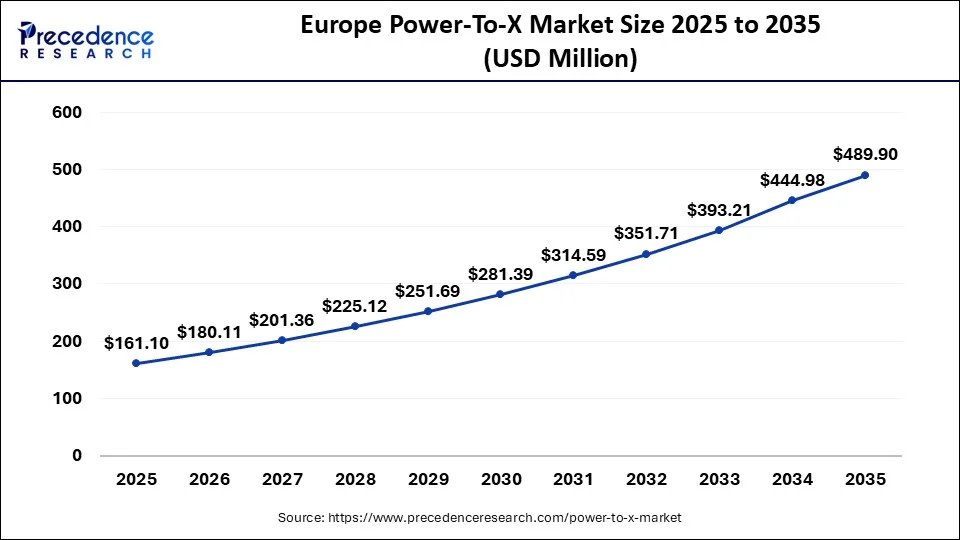
In 2025, Europe became the power-to-x market with the biggest revenue share. The region's growing reliance on renewable energy sources to achieve its vision of a carbon-free economy is largely responsible for the market's revenue growth. Additionally, the use of power-to-x technology to replace fossil fuels with carbon-neutral alternatives is anticipated to significantly contribute to market expansion. Due to the presence of key industry players in the area, including Linde, REFHYNE, and Ceres Power, the power-to-x market in Europe is predicted to experience strong revenue growth over the projection period.
What is the Key Role of the Power-To-X Market in Germany?
Germany is growing and expanding in the market due to the massive expansion of solar and offshore wind farms, which makes the heavy energy consumption commercially logical. Germany made an agreement with the European Commission on the German power plant strategy to build gas-fired power plants and secure Germany's electricity supply.
What Makes Europe the Global Leader in Power-to-X Technology Development?
Europe continued to lead the development of power-to-x technologies due to the stringent decarbonization targets imposed by EU green deal, coupled with substantial investments in infrastructure supporting green hydrogen. Germany, Denmark, Spain and the Netherlands are leading the way forward with power-to-x pilot projects, including development of renewable hydrogen corridors, synthetic fuels through ammonia production hubs. Europe has developed strong regulatory frameworks, collaborations in industry, funded by continuous amount of financially supported eu investments foreshadowing European innovations will shape the future in reform of global power-to-x technology.
How is Asia-Pacific Emerging as the Most Attractive Power-to-X Market?
Asia-Pacific is anticipated to remain one of the most enticing markets, accounting for the bulk of the market's revenue share throughout the course of the projection decade. During the projected period, Asia-Pacific is anticipated to be the segment with the most opportunity. In the Asia-Pacific green hydrogen market, China holds the greatest market share. China dominates the global market for green hydrogen, accounting for one-third of production with a 20 million-ton output. The demand for power-to-x technology is increasing as a result of the region's growing industrialization, urbanization, and support for renewable energy sources. These are some of the main drivers of the Asia Pacific industry's expansion.
How is the Expansive Reach of the Power-To-X Market in India?
India is advancing in the market through national green hydrogen mission incentives, electrolyser PLI schemes, massive power surplus potential, and focus on industrial decarbonisation. India focuses on boosting its internal energy generation capabilities, and the Government of India has taken biofuel initiatives that are essential to achieve energy independence.
How Are the U.S. and Canada Strengthening Their Roles in the North American Power-to-X Market?
North America is observed to grow at a considerable growth rate in the upcoming?period, fueled by favorable government policies and considerable private investments. The U.S. is at the forefront, supported by measures like the Inflation Reduction Act, which provides incentives including a USD 3/kg tax credit for hydrogen production, drawing global investors. The Department of Energy has allocated billions for hydrogen hubs and PtX infrastructure. Firms such as Air Products, Plug Power, and Linde are constructing large-scale hydrogen production and synthetic fuel facilities. Canada is also progressing, utilizing its abundant hydropower resources and hydrogen capabilities, with provinces like Quebec, Alberta, and British Columbia backing green and blue hydrogen initiatives.
Canada is positioning itself as a prominent participant in the Power-to-X sector, concentrating on green and blue hydrogen production. The nation's Hydrogen Strategy establishes objectives and funding to promote hydrogen production and associated infrastructure. Provinces such as Quebec and British Columbia are investing in hydrogen production using electrolysis, while Alberta is concentrating on steam methane reforming. Canada aims to export hydrogen and synthetic fuels to both the U.S. and Europe, capitalizing on its natural resources.
Why is Latin America Becoming a Major Opportunity Center for Power-to-X Projects?
Latin America is experiencing an increase in the application of power-to-x technologies because of the number of solar and wind resources available, the presence of attractive green hydrogen policies, and low-cost renewable electricity. Prominent green hydrogen exporting countries of Latin America such as Chile, Brazil, and Argentina are positioned to capitalize on large scale electrolyser installations and international collaboration. With its favourable climate, supporting legislation and auction systems, as well as increasingly export-oriented strategies, Latin America is well positioned to emerge as a hotspot for power to x in the next decade.
How can the Power-To-X Market Expand in Brazil?
Brazil is transitioning toward massive expansion of low-cost renewable capacity, billion-dollar subsidies, technology investments, and export-oriented hubs. Brazil advances low- carbon hydrogen and carbon capture regulation. The regulation boosts infrastructure sharing among multiple projects based on transparency, principles of open access, and non-discrimination.
How does the Power-To-X Market Majorly Impact the Significant Growth of MEA?
MEA is expected to grow significantly in the market in the coming years, propelled by regulatory incentives to mitigate global supply chain disruptions, attract international electrolyser and battery gigafactories, and localise project execution. The Middle East plays a leadership role in clean energy infrastructure funding, and financing for energy infrastructure is a complex challenge for both climate action and development globally. Most African countries lack access to sufficient capital and adequate energy infrastructure.
What is the Major Footprint of Saudi Arabia in the Power-To-X Market?
Saudi Arabia is transforming due to strategic megaprojects aimed at global energy export diversification, national frameworks, economic policies, and substantial state funding. Saudi Arabia plans to award 14 GW of renewable energy projects in 2026. It aims to achieve progress toward its clean energy ambitions under Vision 2030.
Value Chain Analysis - Power-To-X Market
- Resource Extraction
Non-renewable resources, water, and minerals are extracted to manufacture hydrogen and synthetic fuels.
Key Players: Siemens Energy, Nel ASA, Air Liquide - Power Generation
Electricity generated from renewable energy sources like wind and solar is used in the electrolysis process to produce hydrogen and synthetic fuels.
Key Players: Linde, MAN Energy Solutions, ITM Power - Management of Distribution Networks
Distribution of hydrogen and synthetic fuels is conducted via pipelines, terminals, and industrial distribution networks.
Key Players: Air Products & Chemicals, Shell, TotalEnergies - Energy Storage Solutions
Technique solutions ensure stable energy storage and the longevity of hydrogen and fuel cells.
Key Players: Mitsubishi Hitachi Power Systems, Plug Power, Siemens Energy - Infrastructure Monitoring and Maintenance
The use of smart grids ensures optimal energy management and stable operation of the infrastructure.
Key Players: ABB, Schneider Electric, GE Vernova - Regulatory Compliance and Energy Trading
Companies follow carbon regulations, renewable energy standards, and participate in hydrogen and carbon credit trading.
Key Players: ENGIE, BP, Equinor
Competitive Landscape
The power-to-X market is driven by aggressive decarbonization mandates, climate compliance with hard national security, and heavy investments in modular e-fuel production to secure independent fuel supplies. Technology and engineering giants are Siemens Energy, Topsoe, and MAN Energy Solutions, while electrolyser and pure-play hydrogen leaders are thyssenkrupp nucera, Plug Power, and Rely. Moreover, global project developers and energy utilities are ENGIE, Rheinmetall, Stormfisher Hydrogen, and Linde Plc. The top companies like Air Products are specialized in heavy-duty gas compression, separation, and global distribution logistics. R&D efforts of companies contribute to co-developing the next generation of large-scale industrial proton exchange membrane stacks and focus on localized supply chains, advanced digital twins, and modular e-fuel integration.
Top Companies in the Power-To-X Market and Their Offerings
- Ceres Power: Proprietary cells, engineered stacks, the Ceres factory license, dual use architecture, industrial compatibility, thermal plant integration, industrial green hydrogen, and utility deployment.
- HPEM2GAS: Self-pressurizing PEM electrolyser stacks, nanostructured, low-noble-metal electrocatalysts, power-to-gas grid injection, power-to-fuel, rapid response-balance of plant systems, etc.
- FH2R: Green hydrogen for high-flow mobility supply, industrial and manufacturing decarbonisation feedstock, stationary fuel cell power generation, grid balancing, demand response services, etc.
- Thyssenkrupp: 120-MW plug-and-play electrolyzer system solution, 360-degree lifecycle services, green hydrogen production, green methanol technology, etc.
- IRENA: Green hydrogen trade analysis toolkit, collaborative framework on green hydrogen, gaseous green hydrogen, renewable cost database, etc.
Power-To-X Market Companies
- Air Liquide: Involved in hydrogen production, carbon capture, and renewables for Power to X projects.
- MAN Energy Solutions: Specializes in electrolysis, methanation, and energy conversion for large-scale Power to X projects.
- Linde: Focuses on green hydrogen infrastructure, gas processing, and energy distribution.
- Mitsubishi Hitachi Power Systems: Specializes in hydrogen-ready power generation equipment, energy storage, and decarbonization technology.
- Air Products & Chemicals: Involved in hydrogen refueling infrastructure, renewable ammonia, and gasification.
Other Major Key Players
- Ceres Power
- HPEM2GAS
- FH2R
- Thyssenkrupp
- IRENA
- Neles
- Underground Sun Conversion
- Weidmüller
- Heat Smart Orkney
- Copenhagen Infrastructure Partners
- Jupiter 1000
Recent Developments
- In February 2026, X-energy broke ground on its TX-1 high-tech nuclear fuel manufacturing facility in Oak Ridge, Tennessee. X-energy built the TX-1 facility specifically to fabricate its unique TRISO-X nuclear fuel for the next generation of small modular reactors. (Source: https://energiesmedia.com)
- In April 2025, TotalEnergies reached agreements to purchase nearly one gigawatt of wind and solar assets in Canada from RES, which includes the 184 MW Big Sky Solar project in Alberta along with over 800 MW of additional projects. This acquisition aligns with TotalEnergies' objective to enhance its renewables capacity to 35 GW by the close of 2025.
Segments Covered in the Report
By Type
- Power-to-H2
- Power-to-CO/Syngas/Formic Acid
- Power-to-NH3
- Power-to-Methane
- Power-to-Methanol
- Power-to-H2O2
By End Use
- Transportation
- Agriculture
- Manufacturing
- Industry
- Residential
- Others
By Region
- North America
- Europe
- Asia-Pacific
- Latin America
- Middle East & Africa (MEA)
For inquiries regarding discounts, bulk purchases, or customization requests, please contact us at sales@precedenceresearch.com
Frequently Asked Questions
Tags





Ask For Sample
No cookie-cutter, only authentic analysis – take the 1st step to become a Precedence Research client
 Get a Sample




 sales@precedenceresearch.com
 Schedule a Meeting
