



Food and Beverages Market Size to Attain USD 14.72 Trillion by 2034
Published: 28 Oct 2025
Author: Precedence Research



Food and Beverages Market Size and Forecast 2025 to 2034
The global food and beverages market size was calculated at USD 8.22 trillion in 2024 and is predicted to grow from USD 8.71 trillion in 2025 to approximately USD 14.72 trillion by 2034, growing at a CAGR of 6% from 2025 to 2034.
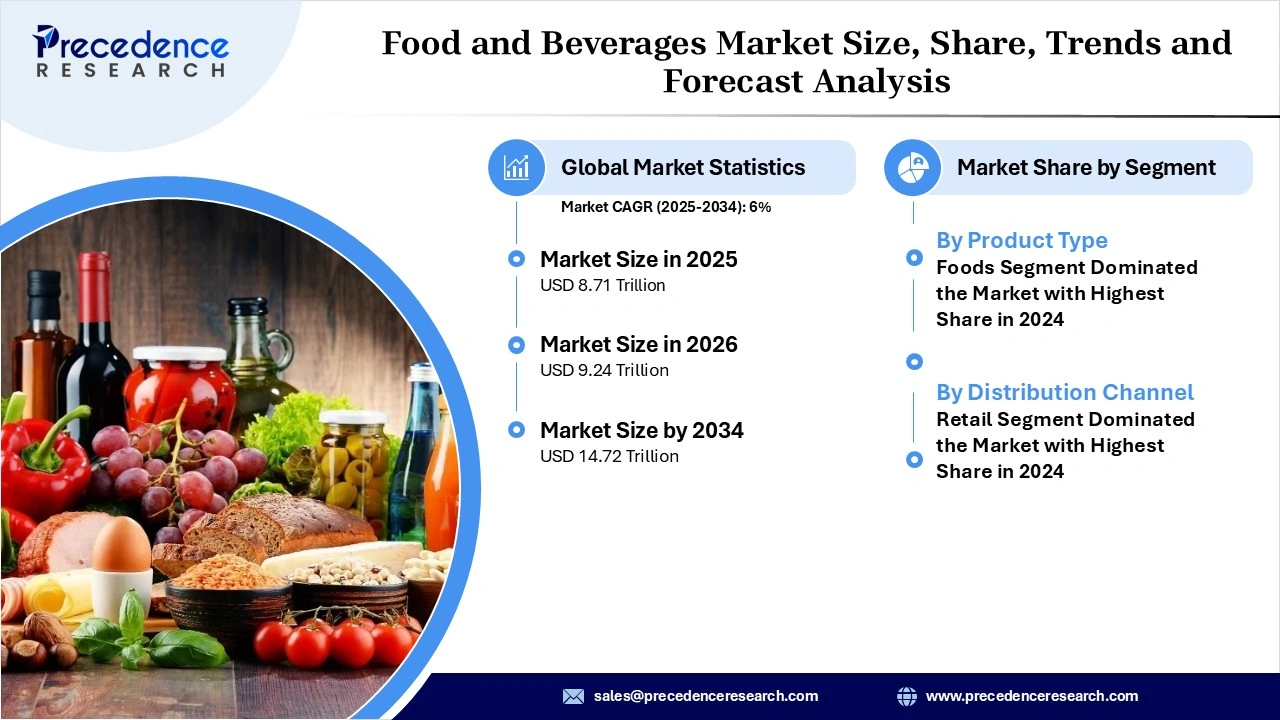
Food and Beverages Market Snapshot
The food and beverage industry is a broad sector that includes all businesses involved in the production, distribution, and sale of food and drink items to consumers. This sector is vital to the worldwide economy. The food and beverage industry is witnessing a consumer movement that highlights convenience, sustainably sourced items, organically cultivated foods, and a rise in plant-based choices.
Market Opportunities in Health-focused Food & Innovation
The market offers many opportunities, particularly for companies that emphasize innovation and adapt to customer preferences. There is growing interest in functional food that offer enhanced nutritional benefits, as well as the potential for fortified beverages that address different health needs. The fusion of technology and food innovation is generating fresh products and experiences, maintaining a dynamic market that responds to consumer needs.
Key Growth Factors
- Increase in disposable income globally. Individuals with greater wealth are able to spend more on premium food and beverages, resulting in a boost in sales for businesses that provide these items. Moreover, consumers are showing a growing interest in health and wellness, which is boosting the demand for healthier choices.
- Technological advancements contribute to driving growth in the industry. Technological advancements like automation and robotics enhance processes by increasing efficiency and minimizing waste. Shifts in consumer habits have also propelled growth. Online ordering has gained immense popularity, enabling customers to effortlessly request their favorite foods from home or work with only a few buttons clicks.
Market Restraint: Supply Chain Disturbances
Supply chain issues and disruptions within the supply chain pose considerable challenges to the global food and beverage sector. The irregular supply of raw materials disrupts and delays production. This raises the manufacturing expenses, which build up due to the rising shipping costs. Additionally, the market encounters challenges stemming from varying raw material prices and geopolitical concerns.
Food and Beverages Industry Coverage
| Report Attribute | Key Statistics |
| Forecast Year | 2025 to 2034 |
| Base Year | 2024 |
| Market Size in 2025 | USD 8.71 Trillion |
| Market Size by 2034 | USD 14.72 Trillion |
| CAGR from 2025 to 2034 | 6% |
| Dominated Region | North America |
| Fastest Growing Region | Asia Pacific |
| Regions Covered | North America, Europe, Asia-Pacific, Latin America and Middle East & Africa |
Food and Beverages Market Segmental Analysis
Product Type Analysis
Foods segment led the market, driven by a growing consumer preference for easy meal options that need minimal preparation time. Additionally, the increasing demand for convenience food, such as ready-to-eat meals, microwave snacks, and pre-cut vegetables, offers a quick and simple choice for busy individuals and families, consequently influencing market growth.
Beverage’s segment is observed to grow at the fastest rate during the forecast period. This increase is linked to changing consumer preferences for ready-to-drink beverages, especially in developing countries, rising per capita alcohol consumption, and a desire for high-end products. Consumers are increasingly seeking beverages that offer health benefits in addition to basic hydration. The inclination of consumers opting for non-alcoholic beverages has resulted in the creation of a brand-new category of high-end, refined soft drinks tailored for adult preferences.
Distribution Channel Analysis
Retail segment held the dominating share of the food & beverages market in 2024. Retail channels include supermarkets, hypermarkets, e-commerce retailers, and different other outlets. Due to the availability of numerous brands and products in a single place, supermarkets and hypermarkets in this sector dominate the market share. Retailers leverage advanced supply chains and significant investments in cold chain systems to ensure product availability, preserve freshness, and reduce losses.
The e-commerce segment is expected to expand significantly in the forecast period, fueled by increased consumer demand for convenience and efficient solutions, the widespread availability of smartphones, and the appeal of customized and specialized products. Businesses leverage e-commerce for its ability to offer broader choices, facilitate subscription services and meal kits, provide personalized suggestions, and enable faster, more efficient delivery options like same-day service.
Food and Beverages Market Regional Analysis
North America
The food & beverages market in North America dominated the market in 2024. The market's expansion is primarily driven by an increase in consumer demand for convenience foods, greater health awareness, and continuous innovation in product ranges, especially within the premium and organic segments. The market is highly competitive, including several key players like PepsiCo Inc., The Coca-Cola Company, Nestle USA, Tyson Foods Inc., and Kraft Heinz. These companies have established a strong foothold in the market through diverse product ranges, innovative marketing strategies, and expansive distribution networks.
United States
Consumer-driven trends impact the US food and beverage market. The primary trends include wellness and health, technology, and sustainability. Unique and innovative products will thrive in this market as consumers seek new food and beverage experiences. A notable interest exists for local products, paired with a growing fascination in international food and beverage options.
Asia Pacific
Asia Pacific expects the significant growth during the forecast period. The rise in disposable income among the middle class in various countries, combined with the strong presence of international and local firms offering a diverse range of beverages in the Asia Pacific region, propels the expansion of the Asia Pacific food and beverages market. Increasing worries regarding the creation of a new product that features organic, natural, and plant-derived components, along with eco-friendly packaging to preserve product quality and longevity, is also fueling the industry's expansion. The growing trend of low-sugar, no-alcohol, and RTD drinks is further enlarging the Asia Pacific beverages market size on a global scale.
Strategic Moves by Key Players
- In September 2025, PepsiCo, Unilever, and other significant retail and food and beverage firms-initiated STEP up for Agriculture, an unprecedented partnership aimed at expanding regenerative agriculture via locally customized support frameworks
- In January 2025, Food and grocery delivery platform Swiggy introduced a new app,Snacc, for delivery of snacks, drinks and meals in 15 minutes. The launch came at a time when the food delivery apps in India were fostering to deliver everything from biryani to hot beverages to consumers' doorsteps in under 10-15 minutes.
Food and Beverages Market Leading Companies
- PepsiCo Inc.
- Nestlé S.A.
- The Coca-Cola Company
- Anheuser-Busch InBev
- JBS S.A.
- Tyson Foods Inc.
- Mondelez International Inc.
- Unilever PLC
- Danone S.A.
- General Mills Inc.
- Kellogg Company
- Mars, Incorporated
- Archer Daniels Midland Company (ADM)
- Cargill, Incorporated
- Conagra Brands, Inc.
- Kraft Heinz Company
- Associated British Foods plc
- Diageo plc
- Red Bull GmbH
- Heineken N.V.
Segments Covered in the Report
By Product Type
- Food
- Packaged Foods
- Ready-to-Eat Meals
- Frozen Foods
- Canned Foods
- Dried Foods
- Instant Foods
- Snacks
- Potato Chips
- Extruded Snacks
- Nuts & Seeds
- Popcorn
- Crackers
- Tortilla Chips
- Confectionery
- Chocolates
- Candies
- Gum
- Sugar Confectionery
- Bakery Products
- Bread
- Cakes & Pastries
- Cookies & Biscuits
- Pies & Tarts
- Dairy Products
- Milk & Cream
- Cheese
- Butter & Margarine
- Yogurt & Curd
- Ice Cream & Frozen Desserts
- Meat & Poultry
- Fresh Meat
- Processed Meat
- Frozen Meat
- Canned Meat
- Seafood
- Fresh Seafood
- Frozen Seafood
- Canned Seafood
- Sauces, Dressings & Condiments
- Cooking Sauces
- Salad Dressings
- Ketchup & Mustard
- Spices & Seasonings
- Pickles & Chutneys
- Baby Food
- Infant Formula
- Baby Cereals
- Baby Snacks
- Packaged Foods
- Beverages
- Non-Alcoholic Beverages
- Water
- Bottled Water
- Sparkling Water
- Flavored Water
- Soft Drinks
- Carbonated Soft Drinks
- Non-Carbonated Soft Drinks
- Juices
- Fruit Juices
- Vegetable Juices
- Blended Juices
- Dairy & Dairy Alternative Beverages
- Milk
- Plant-Based Milks
- Yogurt Drinks
- Flavored Milks
- Tea & Coffee
- Packaged Tea
- Packaged Coffee
- Ready-to-Drink Tea & Coffee
- Functional Beverages
- Energy Drinks
- Sports Drinks
- Nutritional Drinks
- Probiotic Drinks
- Fortified Water
- Alcoholic Beverages
- Beer
- Wine
- Spirits
- Ready-to-Drink Alcoholic Beverages
- Cider & Perry
- Liqueurs
- Non-Alcoholic Beverages
By Distribution Channel
- Retail
- Supermarkets & Hypermarkets
- Convenience Stores
- Specialty Stores
- Discount Stores
- Foodservice
- Quick Service Restaurants (QSR)
- Full-Service Restaurants
- Cafés & Coffee Shops
- Catering Services
- E-commerce
- Online Grocery Stores
- Direct-to-Consumer Platforms
- Institutional
- Schools & Universities
- Hospitals & Healthcare Facilities
- Corporate Offices
- Government & Military Institutions
By Region
- North America
- Europe
- Asia Pacific
- Middle East and Africa (MEA)
- Latin America
Access the Full Study Instantly | Download Sample Pages of the Report Now@ https://www.towardsfnb.com/download-sample/5853
Feel Free to Get in Touch with Us for Orders or Any Questions at: sales@towardsfnb.com