



Peptide Therapeutics Market Revenue to Attain USD 87.21 Bn by 2035
Published: 18 May 2026
Author: Precedence Research



Peptide Therapeutics Market Revenue and Trends 2026 to 2035
The global peptide therapeutics market revenue reached at USD 52.59 billion in 2025 and is projected to grow from USD 56.06 billion in 2026 to approximately USD 87.21 billion by 2035, at a CAGR of 5.19% from 2026 to 2035. Peptide therapeutics have recently become a major concern as peptide-based drugs have been growing in popularity with respect to the treatment of chronic and complex diseases. Peptide therapeutics are also highly specific, effective, and safer, which makes them a significant part of modern pharmaceutical research and development.
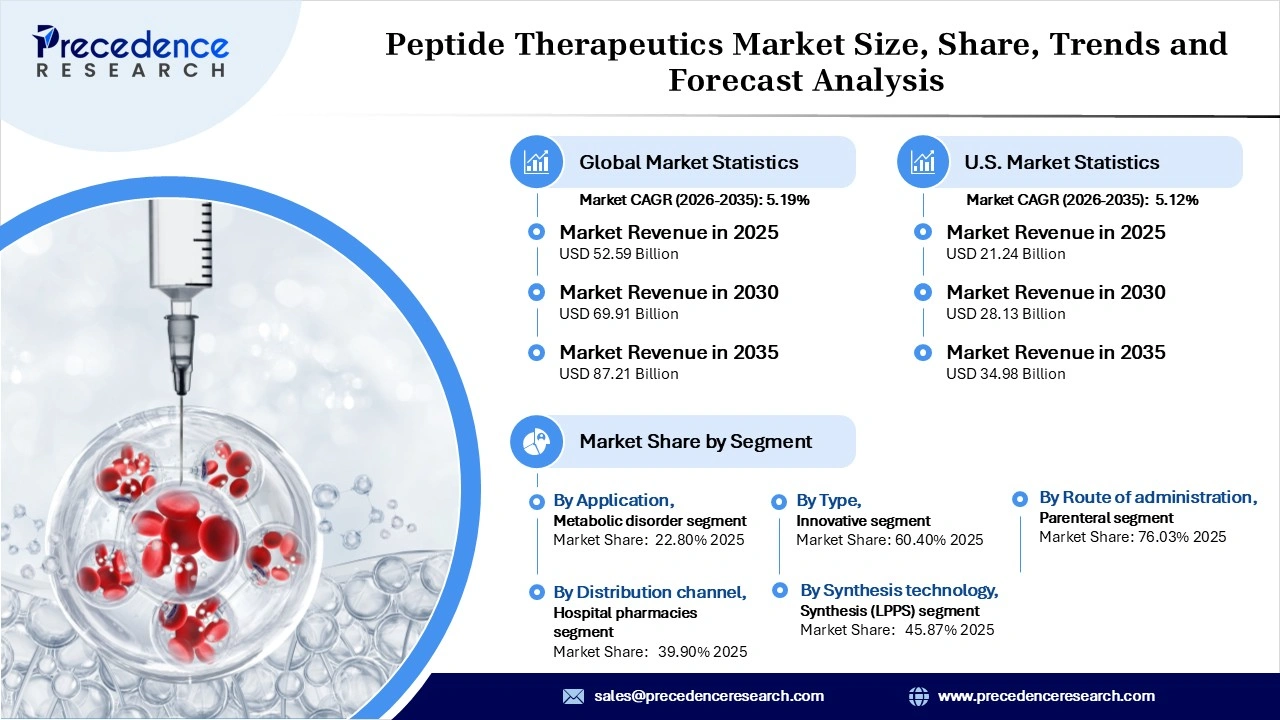
Market at a Glance
Globally, the prevalence of metabolic disorders, cancer, gastrointestinal diseases, and hormonal imbalances is driving the peptide therapeutics market. The efficacy and robustness of peptide-based therapeutics are being greatly enhanced through the development of peptide synthesis techniques, peptide delivery systems, and biotechnology studies. The targeted therapeutics action and reduced toxicity of peptides, compared to traditional drugs, are driving the growth of the pharmaceutical companies investing in innovative peptide drug development. The pharmaceutical companies are investing in innovative peptide drug development because of the targeted action and reduced toxicity of peptide drugs compared to traditional ones. Further, the increasing demand for personalized medicine and biologics is driving market growth across the globe.
Regional Insights
North America dominated the market in 2025, as the area is endowed with cutting-edge health care infrastructure, high spending on health care, and considerable investment in biopharmaceutical innovation. The rise of obesity-related, diabetes-related, cancer-related, and gastrointestinal issues in the region is fuelling the demand for sophisticated peptide-based treatment solutions. Favourable regulatory support and growing clinical trials activities are further contributing to market growth in North America. Moreover, the expanding use of personalized medicine and targeted therapies is further bolstering the region's position as the leader in the market.
Asia Pacific is projected to be the fastest-growing market by holding a certain CAGR, owing to the growing healthcare infrastructure and rising pharmaceutical manufacturing operations in the region. The increasing share of chronic diseases, advanced therapies, and healthcare awareness in the region is driving the market demand. The growing prevalence of chronic diseases, rising awareness of healthcare, and increased access to advanced therapies are majorly contributing to the market demand across the region. Peptide drug development capabilities are constantly being invested in by countries like China, India, Japan, etc. in biotechnology research. The increasing number of contract manufacturing units and cost-effective manufacturing units is further contributing to the regional market expansion.
Segmental Insights
Application Insight
The metabolic disorder segment dominated the market in 2025, with the growth of diabetes and obesity, due to its ability to effectively target hormonal activity and glucose metabolism. Peptide therapeutics are widely used in metabolic diseases. Peptide-based diabetes drugs, especially GLP-1 receptor agonists, have enhanced the market position of the segment. Pharmaceutical companies are constantly creating more sophisticated formulations of peptides that produce greater and longer-lasting effects for metabolic diseases. Besides, the growing consciousness around lifestyle diseases and the need for targeted treatment solutions remain a driving force for dominating the segment.
The gastrointestinal disorder segment is expected to be the fastest-growing in the market during the forecast period, as peptide therapeutics are receiving importance for the ability to offer targeted therapy, with less systemic side effects for gastrointestinal diseases. The development of peptide engineering and drug delivery systems is enhancing treatment efficacy in digestive system diseases. The use of peptide-based therapies is gaining popularity in the healthcare industry for their ability to help reduce inflammation and facilitate tissue repair mechanisms. Besides that, the gastrointestinal peptide therapeutics are likely to drive segment growth with the increasing clinical research activities in the forecast period.
Type Insight
The innovative peptide-based therapeutics segment has dominated the market in 2025, owing to the high investments made in novel drug discovery and approval of advanced peptide therapeutics. Compared to conventional treatments, innovative peptides are more effective, more specific, and more effective for the patient. The pharmaceutical and biotechnology industry is investing heavily in research and development efforts, with the aim of developing the next generation of peptide drugs for complex diseases. The rising need for personalized and precision medicine is further fueling the growth of innovative peptide therapeutics in the world. Moreover, the progress of peptide modification technologies has increased the stability, bioavailability, and effectiveness of drugs in clinical use.
The generic peptide therapeutics segment is expected to be fastest growing in the market by holding a significant share in the year 2025, driven by highest growth rate as patents of various blockbuster peptide drugs are expiring. Advanced therapies are available to more patients as a result of the generic peptide therapies that offer alternate treatment options at a lower cost. Global generic peptide product uptake is being driven by rising healthcare costs and a rising demand for affordable medicines. To satisfy growing demand for generic formulations, manufacturers are implementing more production capacity and enhancing peptide synthesis technologies. Also, favorable regulatory guidelines for biosimilars and generics are likely to drive the growth of this market.
Route of Administration Insight
The parenteral administration of peptide drugs segment has dominated the market in 2025, due to the fact that most peptide drugs need to be administered via injection to ensure stability and bioavailability. Injectable peptide therapies deliver fast-acting therapeutic results and are better absorbed than traditional oral medications. Parenteral administration is the preferred choice among healthcare professionals for chronic disease management, such as diabetes, cancer and hormonal disorders. Such sustainability is being addressed by the development of more sophisticated injectable delivery systems, including prefilled pens and sustained-release formulations, by pharmaceutical companies. Pharmaceutical companies are working on more innovative injectable products, such as prefilled pens, and sustained-release formulations, to make them more convenient for the patient. Moreover, the effective clinical effects of injectable peptide-based medicines persist as a major driver of the substantial share of this segment.
The oral segment is expected to be fastest growing in the market by holding a significant share in the year 2025, as patients are trying to be more convenient in treatment and more compliant in taking their medications. New developments in peptide stabilization and the enhancement of absorption are leading to effective oral peptide formulations. Oral medications are becoming a more attractive option for patients over injections because they can be administered orally and are less bothersome. Oral peptide delivery systems are a very active field of study for pharmaceuticals, with a focus on making peptides more accessible as a therapy and increasing patient compliance. Moreover, the success of the commercialization of oral peptide drugs is anticipated to present significant growth prospects for the segment in the forecast period.
Distribution Channel Insight
The hospitals segment dominated the market in 2025, as peptide drugs were extensively used in hospitals and specialty healthcare centers. Peptide therapies need to be professionally administered, monitored, and prescription-managed, leading to robust demand via hospital pharmaceuticals. Hospitals are also the primary place where chronic disease, cancer treatment, and complex metabolic treatments involving peptide medications are provided. There are also dedicated healthcare professionals and sophisticated treatment facilities that are available to boost the dominance of the segment. Moreover, the growing hospitalisation and the growing use of biologic treatment also contribute to the growth in this segment.
The online pharmaceutical retailers segment is expected to be the fastest-growing in the market during the forecast period, due to the fast rate of growth of digital healthcare and E-pharmacy platforms across the world. Internet shopping is becoming a preferred method of purchase for consumers because of its convenience, home delivery, and greater access to specialty medications. The rising rate at which internet services and smartphone usage are taking over the world is also adding to the popularity of online distribution of pharmaceuticals. Online channels also offer competitive pricing, subscription management, and digital prescription management, which improves the customer experience. Moreover, the rise in the adoption of telemedicine and digital health services is likely to drive the market growth in this segment.
Synthesis Insight
The liquid phase synthesis segment accounted for the maximum share in the peptide therapeutics market because of its use in large-scale peptide manufacturing. The method of synthesis is very flexible and is especially useful for the preparation of complex peptide molecules with high purity. For the commercial production of a few existing peptide therapeutics, pharmaceutical manufacturers are using liquid phase synthesis. The approach is also favored for certain peptide modifications and large batch production. In addition, the growing process optimization and purification technologies are also helping to maintain dominance in the liquid phase synthesis segment.
The solid phase synthesis peptide segment is projected to experience the highest growth rate, owing to its efficiency, automation compatibility, and high purity peptide sequences production. This technology decreases the synthesis time and enhances the scalability for research and commercial peptide synthesis. Solid-phase synthesis techniques are becoming increasingly popular in pharmaceutical and biotechnology companies for the synthesis of novel peptide therapeutics and personalized medicine. Further improvements in production efficiency and complexity are being seen with the development of automated synthesizers and resin technology. Additionally, the custom peptides and complex therapeutic molecules segment is expected to see rapid growth over the period owing to the rising demand.
Peptide Therapeutics Market Companies
- Eli Lilly & Company
- Amgen Inc.
- Pfizer, Inc.
- Ever Neuro Pharma GmbH
- Bausch Health
- Abbvie
Segments Covered in the Report
By Application
- Gastrointestinal Disorder
- Metabolic Disorder
- Neurological Disorder
- Cancer
- Others
By Type
- Generic
- Innovative
By Route of Administration
- Oral
- Parenteral
- Pulmonary
- Mucosal
- Others
By Distribution Channel
- Hospital Pharmacies
- Retail Pharmacies
- Online Drug Stores
By Synthesis Technology
- Solid Phase Peptide Synthesis (SPPS)
- Liquid Phase Peptide Synthesis (LPPS)
- Hybrid Technology
By Region
- North America
- Latin America
- Europe
- Asia-pacific
- Middle and East Africa
Get this report to explore global market size, share, CAGR, and trends, featuring detailed segmental analysis and an insightful competitive landscape overview @ https://www.precedenceresearch.com/sample/2548
You can place an order or ask any questions. Please feel free to contact us at sales@precedenceresearch.com |+1 804 441 9344