



RF GaN Market Size, Key Companies, Company Market Share, Chip Production Volume, Wafer Capacity, Technology Adoption, Pricing Trends, Competitive Positioning, and Demand Analysis
RF GaN Market (By Material Type: GaN-on-Si, GaN-on-SiC, Other Material Types (GaN-on-GaN, GaN-on-Diamond); By Application: Military, Telecom Infrastructure (Backhaul, RRH, Massive MIMO, Small Cells), Satellite Communication, Wired Broadband, Commercial Radar and Avionics, RF Energy) - Global Industry Analysis, Size, Trends, Leading Companies, Regional Outlook, and Forecast 2026 to 2035
Source: https://www.precedenceresearch.com/rf-gan-market
 Get a Sample
 Table Of Content


What is the RF GaN Market Size?
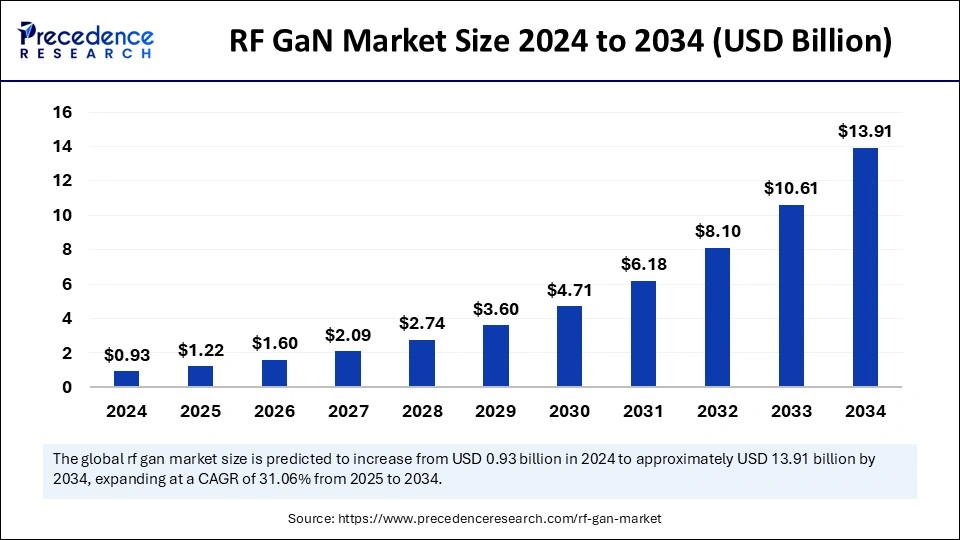
The global RF GaN market size accounted for USD 1.22 billion in 2025 and is predicted to increase from USD 1.60 billion in 2026 to approximately USD 16.68 billion by 2035, expanding at a CAGR of 29.89% from 2026 to 2035. RF Gallium Nitride (GaN) technology maintains high growth rates because of increasing demand in 5G infrastructure, aerospace, defense, and telecommunications, offering higher efficiency and power.
RF GaN Market Key Takeaways
- Asia Pacific dominated the RF GaN market with the largest market share of 43% in 2025.
- North America is anticipated to grow at a notable CAGR during the during the forecasted years.
- By material type, the GaN-on-Si segment contributed the largest market share in 2025.
- By material type, the GaN-on-Sic segment is anticipated to show considerable growth in the forecast period.
- By application, the military segment held the largest market share in 2025.
- By application, the RF energy segment is anticipated to show considerable growth over the forecast period.
What is the RF GaN?
The RF GaN functions as a crucial semiconductor with wide-gap band capabilities, which enables the fundamental applications of high-power electronics and wireless communication, radar technologies, satellite communication, and military purposes. The RF GaN market benefits from increased RF GaN adoption in electric and hybrid vehicles to manage power conversion and vehicle control functions.
The market expands due to increased demand in 5G infrastructure and electric vehicles, and defense applications because this material enables superior performance with better signal quality at lower power consumption to serve as an essential component for next-generation communication systems. Capital expenditures in high-performance semiconductor components propel RF GaN market growth because multiple industries, such as defense, aerospace, telecommunications, and electric vehicles, show intensified demand levels.
Artificial Intelligence (AI) Integration in the RF GaN Market
Artificial Intelligence improves GaN-based RF system performance through better power management, continuous monitoring, and self-diagnosis functions. Artificial intelligence systems enable military operation through enhanced radar and communication capabilities by adjusting to changing environmental conditions, which provides more reliable and efficient performance. The merger of Artificial Intelligence with RF GaN technology shows great potential to push major industrial improvements in telecommunications defense, and electric vehicles through better efficient solutions.
- In July 2024, GlobalFoundries obtained Tagore Technology's Gallium Nitride technology to expand its power management solutions serving automotive and IoT systems and AI data centers. Through this acquisition, GlobalFoundries improved its power management capabilities and enhanced its GaN intellectual property for Generative AI technologies.
RF GaN Market Growth Factors
- Military and aerospace applications: RF GaN components contribute to the military sector and aerospace utilization through stability under demanding conditions and through compact design and reliability characteristics. Defense and aerospace industries keep expanding RF GaN applications at unprecedented levels to achieve next-level communication systems and enhance tactical performance for their radar applications, satellite communications, and electronic warfare capabilities.
- Advancements in RF power electronics: The rising market demand for RF GaN as an essential power component in radar and satellite communication systems and base stations drives industry growth. The advanced characteristics enabled by RF GaN technology expand market adoption for high-frequency applications between telecommunications and defense industries along with various RF power systems.
- Miniaturization and high efficiency: The growth of RF GaN technology depends on the industry demand for miniature components with improved efficiency. This technology excels at miniaturization in small antennas, satellite systems, and portable electronic devices because its small size, together with high power, allows market growth of high-performance miniaturized products.
Market Outlook
Industry Growth Overview: 5G/6G rollout, defense radar upgrades, satellite communication evolution in Wolfspeed, Qorvo, and Sumitomo Electric ecosystems.
- Sustainability Trends: Reduced energy consumption through efficiency and more environmentally friendly production through manufacturing progress through NXP Semiconductors and Infineon Technologies portfolios.
- Global Expansion: Europe's emphasis on the modernization of telecom with the help of MACOM Wolfspeed's collaborative innovation.
- Startup Ecosystem: New companies are creating specialized frequency solutions that are used to complement leadership by Qorvo, Sumitomo Electric, and NXP Semiconductors.
Market Scope
| Report Coverage | Details |
| Market Size by 2035 | USD 16.68 Billion |
| Market Size in 2025 | USD 1.22 Billion |
| Market Size in 2026 | USD 1.60 Billion |
| Market Growth Rate from 2026 to 2035 | CAGR of 29.89% |
| Dominated Region | Asia Pacific |
| Fastest Growing Market | North America |
| Base Year | 2025 |
| Forecast Period | 2026 to 2035 |
| Segments Covered | Material Type, Application, and Regions |
| Regions Covered | North America, Europe, Asia-Pacific, Latin America and Middle East & Africa |
Market Dynamics
Drivers
Rising demand for telecom infrastructure
The continuous technological advancement at high speeds to meet growing data requirements and connectivity needs. RF GaN technology has become the dominant industrial solution because it delivers superior power and enhanced frequency capability. This capability presents an essential requirement for delivering top-quality media content through streaming videos, online gaming, and data-heavy services. Telecommunications networks advancing their 5G infrastructure drive up the RF GaN market. GaN technology takes hold of the telecom infrastructure sector markets because of its improved efficiency and fast speed with its minimal interference capabilities.
Potential use in 5G infrastructure
GaN stands out for 5G technology requirements because it possesses electrical characteristics such as excellent thermal performance, wide bandgap behavior, and exceptional electron mobility. GaN-based devices improve the transmission of high-frequency signals better than silicon-based parts at lower energy consumption levels. GaN technology operates at elevated temperatures and higher voltages without degrading transistor quality while powering 5G networks that need extended power abilities and broader frequency capability. Through GaN technologies, the cellular infrastructure gains better power efficiency and frequency capability extension. The telecom operations of the future rely heavily on GaN, which establishes itself as a vital technology for these operations.
Restraint
High manufacturing costs
RF GaN market penetration faces significant limitations due to the high expenses involved in production. The materials needed for manufacturing GaN devices through gallium and nitrogen demand higher rates than the materials employed for silicon-based products. The manufacturing process of GaN layers involves greater complexity and higher expenses when compared to the simpler and less expensive silicon wafer production method. Producing GaN devices necessitates using specialized substrates either made of SiC or GaN-on-GaN, which cost significantly more than conventional silicon substrates commonly used in other semiconductors. The packaging requirements for GaN devices increase production difficulty because insufficient heat management demands complex and expense-intensive solutions.
Opportunity
Miniaturization of RF GaN devices
The reduction of size in consumer electronics becomes possible through compact GaN RF components, which manufacture mobiles and laptops more compact while keeping the same operational standards. In telecommunications facilities, GaN power amplifiers have become reduced in size because this trend makes base stations more compact. The market will experience substantial changes through the application of miniature GaN components in the automotive industry.
The reduction of size possible in GaN-based radar systems makes better-advanced driver-assistance systems and enables the advancement of autonomous vehicle development. GaN devices applied to electric vehicles help create more lightweight vehicles because of their decreased size, thereby enabling better energy efficiency and longer driving distances. GaN technology will lead industry innovation through future developments that will influence consumer electronics as well as telecommunications and automotive systems to meet the market need for smaller high-performance devices.
Segment Insights
Material Type Insights
The GaN-on-Si segment accounted for the largest share of the RF GaN market. The industry relies on silicon due to its affordable production and well-established silicon manufacturing methods. GaN-on-Si technology stands out because of its reduced manufacturing expenses compared to GaN-on-SiC and other equivalent GaN technologies. Large silicon wafers serve as platforms to integrate GaN, which enables the creation of bigger device structures benefiting scalability.
The high-frequency functions enabled by GaN-on-Si technology find applications in consumer electronics devices, telecommunications systems, and various other electronic devices. The demand for cost-efficient, high-performance RF solutions expects GaN-on-Si to maintain its essential position across applications between wireless communications and consumer electronics.
- In August 2024, Finwave Semiconductor and GlobalFoundries announced their collaboration to develop RF GaN-on-Silicon technology, which focused on boosting cellular handset applications. The collaboration between these organizations worked on enhancing mobile device power efficiency and signal quality.
The GaN-on-SiC technology will experience significant growth during the study period because it delivers superior performance through its exceptional thermal capabilities and power efficiency rate. GaN-on-SiC stands out as the preferred material choice when implementing demanding RF systems used in telecommunications, military technologies, and radar systems.
GaN-on-SiC gains popularity in RF devices because it effectively controls heat, which enhances the operational ability of devices. The implementation of GaN-on-SiC technology decreases device defects and minimizes leakage to improve both the reliability and operational lifetime of devices. GaN-on-SiC technology demands continued growth through its crucial advantages, which fit well with aerospace, defense, and high-power RF applications.
- In June 2024, WIN Semiconductors announced the beta release of their new robust mmWave gallium nitride (GaN) on silicon carbide (SiC) technology NP12-0B. A key feature of this technology platform consists of a 0.12μm gate RF GaN HEMT design, which integrates multiple enhancements to reinforce die-level moisture protection and RF power handling capabilities.
Application Insights
The military segment held the largest RF GaN market share in 2025. Defense system modernization creates an increasing demand for high-power semiconductor devices. GaN emerges as an optimal material for military use because it operates with excellent performance characteristics in high-power settings, thus supporting radar functions as well as communication systems and electronic warfare capabilities.
RF GaN power devices find wide application in manufacturing components for military aircraft and vehicles because they support essential operations that include surveillance, object detection, and early warning systems. The defense sector continues to grow because of increasing requirements for powerful amplifiers and transistors used for detection systems, which expands the role of GaN technology.
- In July 2023, Comtech PST introduced its nitride-based RF power amplifier module to serve electronic warfare (EW) needs from 1 MHz to 18 GHz frequencies through output powers ranging from 20W to multi-kilowatt levels.
The RF energy segment is anticipated to show considerable growth over the forecast period. The exceptional power control features, as well as the high efficiency and heat management capabilities of GaN devices, create the optimal solution for RF energy applications where plasma lighting, medical treatments, and industrial heating operations are implemented.
The RF GaN market continues its expansion because GaN technology delivers high power while maintaining low energy loss requirements needed for high-frequency applications. The industrial growth of RF energy solutions will heavily depend on the operational capabilities of GaN-based power amplifiers to enhance system performance while reducing energy waste.
Regional Insights
What is the U.S. RF GaN Market Size?
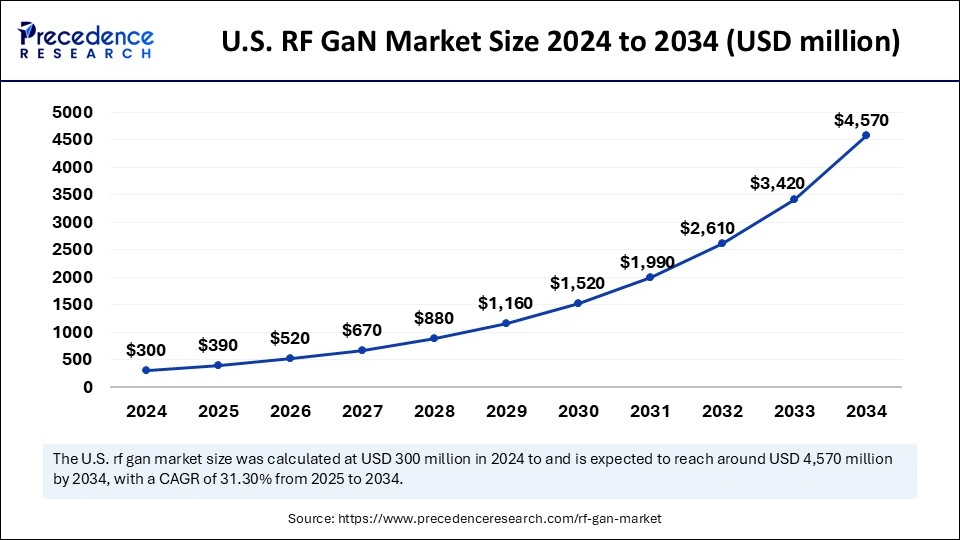
The U.S. RF GaN market size was exhibited at USD 520 million in 2026 and is projected to be worth around USD 5,493 million by 2035, growing at a CAGR of 30.28% from 2026 to 2035.
Asia Pacific Market Trends
Asia Pacific accounted for the largest share of the RF GaN market in 2025. Rapidly developing telecommunications infrastructure in the region, specifically through the 5G network expansion, has strongly increased the market demand for RF GaN-based solutions. The market continues expanding rapidly as manufacturers increasingly use RF GaN technology in consumer electronics and automotive applications. Asian nations such as China, Japan, South Korea, and India conduct significant investments in next-generation technologies, specifically targeting improvements in telecommunications and satellite communication systems.
The fast development of telecom infrastructure, including the extensive 5G network rollout across China, produces strong demand for RF GaN devices. The Chinese telecommunications infrastructure increases efficiency in signal transmission and power amplification through the strategic implementation of RF GaN solutions. China's satellite and military programs and increasing focus on satellite communications create additional demand for GaN-based components.
North American Market Trends
North America is anticipated to witness the fastest growth in the RF GaN market during the forecasted years. The strong technological base and telecommunication network infrastructure of the region push forward RF GaN development. Advanced technologies have recently become mainstream across this region, thus transforming it into a core research and development center for RF GaN applications. Significant R&D funding enabled the development and widespread usage of RF GaN devices throughout different industries, where their applications proved essential for 5G wireless networks.
The RF GaN market has achieved exceptional strength in the United States because of its advanced technology sector and substantial investment in telecom infrastructure development. The United States is actively dedicating funds to develop 5G networks and high-tech sectors of defense and aerospace, which prompts increased acceptance of GaN-based systems.
- In September 2023, the U.S. National Science Foundation Directorate for Technology Innovation and Partnerships (TIP) put USD 25.0 million toward developing advanced technologies and communications for accelerating 5G network security operations.
Europe Market Trends
The European RF GaN market is expanding rapidly because of the advanced telecommunications networks, fundamental industrial capabilities as well and growing scientific research activities. RF GaN components find their primary application in wireless communication systems to enable 5G technology, thus driving market expansion. The continued heavy investments of European countries into 5G deployment require RF GaN devices to support high-performance, efficient power amplification, and signal processing. GaN suppliers gain substantial business opportunities because defense and aerospace industries need advanced communication systems, radar applications, and electronic warfare capabilities.
Value Chain Analysis of the RF GaN Market
- Raw Material Procurement: The acquisition of high-purity silicon, GaN epitaxial substrates, and specialty gases necessitates substrate formation and production chemistry stability.
Key players: SUMCO, GlobalWafers, Siltronic - Wafer Fabrication: This is the process of performing complex cleanroom operations that construct functional semiconductor circuits on the surfaces of the wafer with high accuracy.
Key players: TSMC, Samsung Foundry - Photolithography and Etching: Photolithography and Etching Photolithography involves patterning with light and chemical removal to form the structure of electronic circuits on a micron scale.
Key players: ASML, Nikon, Canon - Doping and Layering Processes: With impurities and layered materials with controlled transistor functionality, the electrical properties may be modified.
Key players: Applied Materials, Lam Research, Tokyo Electron - Assembly and Packaging of RF GaN: RF dies are encased in thermally conductive packages that provide security and good transmission of signals.
Key players: ASE Group, Amkor Technology, JCET
RF GaN Market Companies
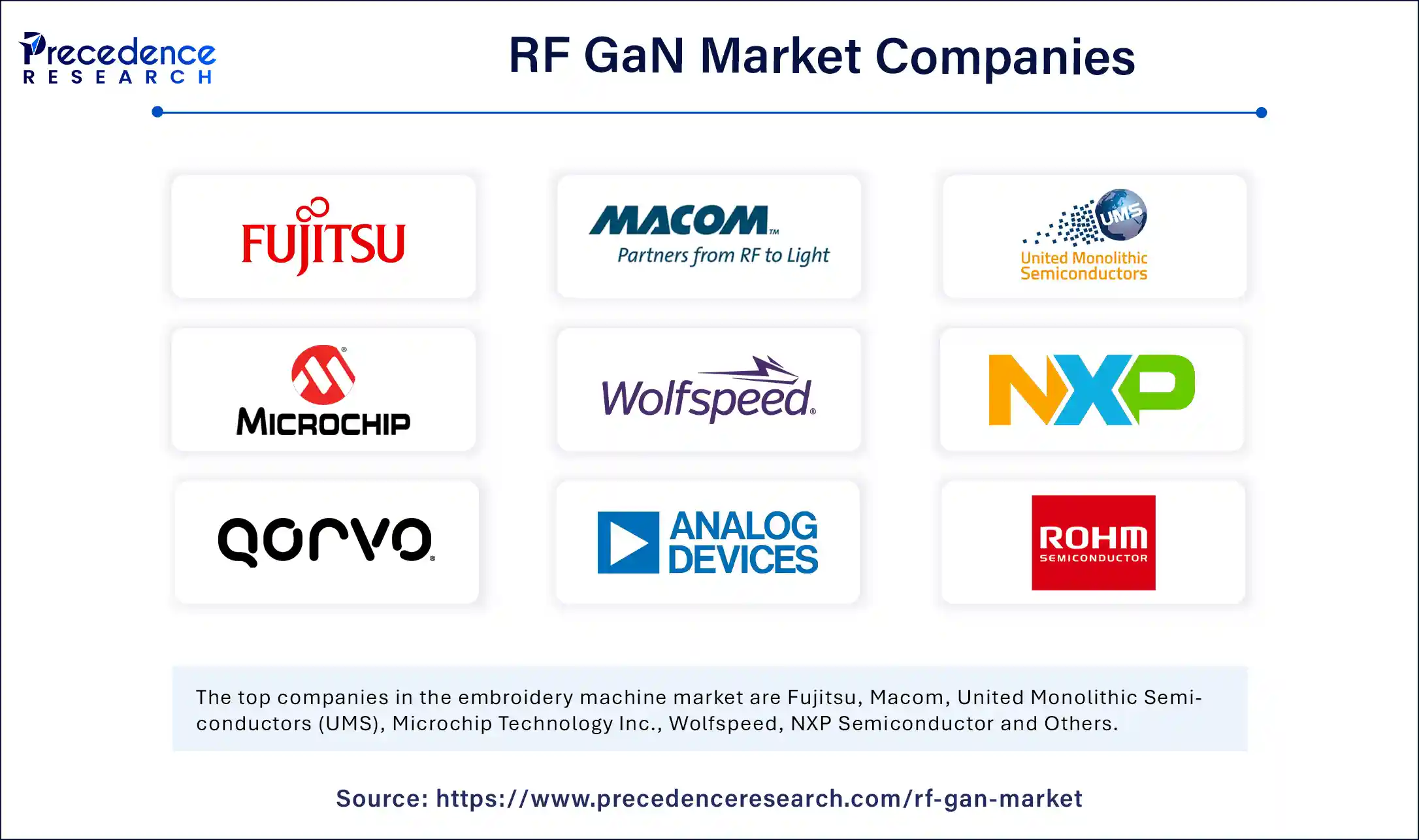
- Fujitsu: Creates power amplifiers using GaN-HEMT that operate in the W-band, X-band radar, and future 5G/6G wireless backhaul networks.
- Macom: Offers GaN-on-Si and GaN-on-SiC HEMTs and MMICs to the aerospace defense and advanced base station applications.
- United Monolithic Semiconductors (UMS): Provides GaN-on-SiC MMICs and open foundry systems to space defense, automotive, and radar systems.
Other Major Key Players
- Microchip Technology Inc.
- Wolfspeed
- NXP Semiconductor
- Qorvo, Inc.
- Analog Devices Inc.
- ROHM Semiconductors
- STMicroelectronics NV
- Infenion technologies
Recent Developments
- In June 2025, the National Semiconductor Translation and Innovation Centre for Gallium Nitride (NSTIC (GaN NUM0 was inaugurated by Dr. Tan See Leng. The centre focuses on advancing GaN semiconductor technology to enhance Singapore's competitiveness in 5G, 6G, radars, and satellite communications. (https://www.a-star.edu.sg )
- In January 2025, Guerrilla RF, Inc released the GRF0020D and GRF0030D GaN on SiC HEMT power amplifiers, offering up to 50W of saturation power. These amplifiers target wireless infrastructure, military, aerospace, and industrial heating markets seeking to integrate bare die into custom MMICs. (https://www.businesswire.com )
- In January 2025, Guerrilla RF, Inc. introduced the GRF0020D and GRF0030D as the initial members of their new GaN on SiC HEMT power amplifier product series. The GaN HEMT transistors offer 50W of saturated power to clients in wireless infrastructure, military, aerospace as well and industrial heating applications that need integrated bare die for their custom MMICs.
- In June 2024, Tagore Technology introduced the TS8729N and TS8728N series of high-power GaN SPDT switches for broadband applications. The switches deliver superior power handling in addition to outstanding insertion loss to serve L- and S-Band radar and cellular infrastructure.
Segments Covered in the Report
By Material Type
- GaN-on-Si
- GaN-on-SiC
- Other Material Types (GaN-on-GaN, GaN-on-Diamond)
By Application
- Military
- Telecom Infrastructure (Backhaul, RRH, Massive MIMO, Small Cells)
- Satellite Communication
- Wired Broadband
- Commercial Radar and Avionics
- RF Energy
By Geography
- North America
- Asia Pacific
- Europe
- Latin America
- Middle East and Africa
For inquiries regarding discounts, bulk purchases, or customization requests, please contact us at sales@precedenceresearch.com
Frequently Asked Questions
Tags





Ask For Sample
No cookie-cutter, only authentic analysis – take the 1st step to become a Precedence Research client
 Get a Sample




 sales@precedenceresearch.com
 Schedule a Meeting
