



Toluene Market Size, Key Companies, Company Market Share, Production Capacity, Raw Material Pricing, Export & Import Analysis, Manufacturing Cost, Competitive Positioning, and Demand Forecast
Toluene Market (By Derivative Type: Benzene & Xylene, Toluene Diisocyanatos, Gasoline Additives, Others; By Application: Drugs, Dyes, Blending, Cosmetic Nail Products, Others; By Production Process: Reformate Processes, Pygas Processes, Coke/Coal Processes, Styrene Processes) - Global Industry Analysis, Size, Trends, Leading Companies, Regional Outlook, and Forecast 2026 to 2035
Source: https://www.precedenceresearch.com/toluene-market
 Get a Sample
 Table Of Content


What is the Toluene Market Size?
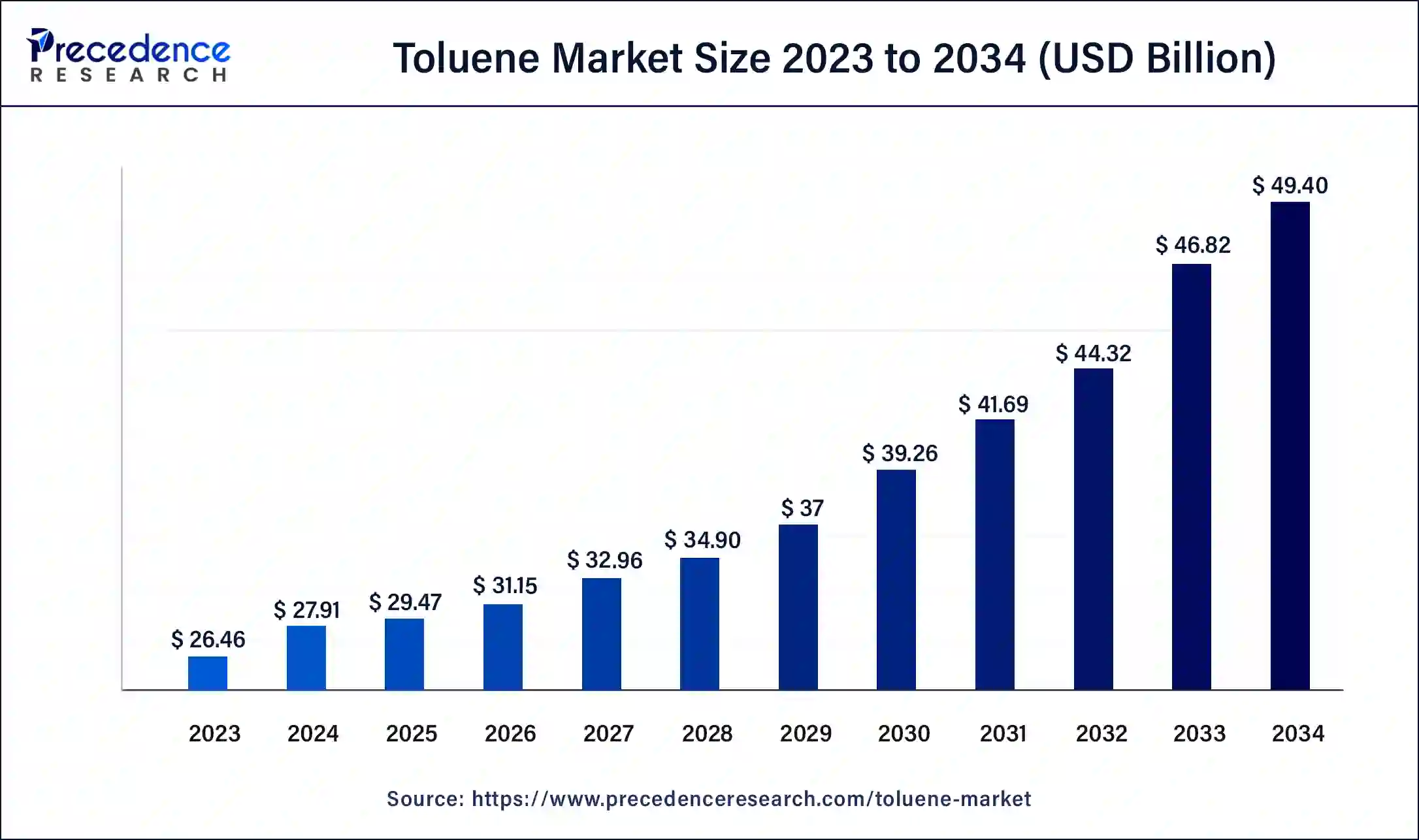
The global toluene market size is calculated at USD 29.47 billion in 2025 and is predicted to increase from USD 31.15 billion in 2026 to approximately USD 51.93 billion by 2035, expanding at a CAGR of 5.83% from 2026 to 2035.
Toluene Market Key Takeaways
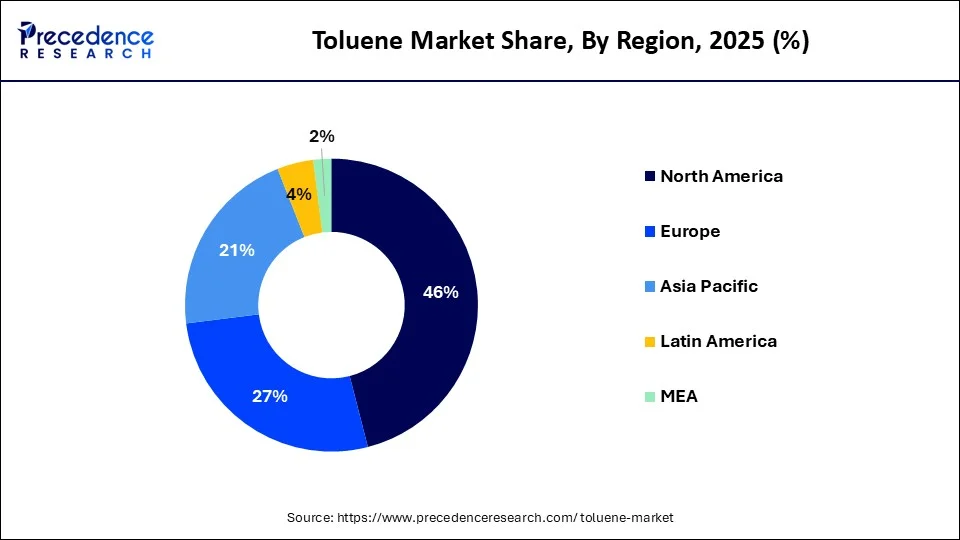
- North America contributed more than 46% of revenue share in 2025.
- Asia Pacific is estimated to expand the fastest CAGR between 2026 and 2035.
- By Derivative Type, the benzene and xylene segment has held the largest market share of 59% in 2025.
- By Derivative Type, the gasoline additives segment is anticipated to grow at a remarkable CAGR of 12.8% between 2026 and 2035.
- By Application, the reformate processes segment generated over 43% of revenue share in 2025.
- By Application, the styrene processes segment is expected to expand at the fastest CAGR over the projected period.
- By Production process, the reformate processes segment had the largest market share of 39% in 2025.
- By Production process, the styrene processes segment is expected to expand at the fastest CAGR over the projected period.
Market Overview
The toluene market is a dynamic segment of the global chemical industry primarily driven by its versatile applications. Toluene, an aromatic hydrocarbon, serves as a valuable solvent in various industries, including chemicals, petrochemicals, paints and coatings, and pharmaceuticals. It is also utilized in the synthesis of numerous chemicals and as a blending component in gasoline.
The market's growth is fueled by the expanding automotive and construction sectors, which increase demand for paints and fuels, and the chemical industry's robust growth, which relies on toluene as a feedstock. The market is influenced by environmental regulations due to toluene's potential health and environmental risks, promoting the development of eco-friendly alternatives.
How is AI Enhancing the Toluene Industry?
AI is changing the toluene industry by optimizing production, improving supply chain logistics, and allowing predictive maintenance, leading to higher efficiency as well as reduced environmental impact. AI-powered systems can forecast equipment failures, reducing downtime and lowering maintenance expenses.
For instance, AI-powered predictive maintenance has assisted refineries in saving millions annually by preventing equipment failures. AI optimizes logistics by identifying potential bottlenecks and improving real-time shipment tracking, leading to a more resilient supply chain.
- In April 2026, CAS launched the CAS Newton. CAS Newton is an AI-enabled platform designed to enhance the chemical manufacturing process. The R&D centers can use CAS Newton in secure environments by integrating it with proprietary data through APIs, MCPs, and third-party AI platforms.
(Source: https://manufacturingchemist.com)
Toluene Market Growth Factors
- Toluene, a versatile aromatic hydrocarbon, serves as a valuable solvent in various industries, including chemicals, petrochemicals, paints, and pharmaceuticals.
- Toluene is used for chemical synthesis, as a gasoline blending component, and in the manufacturing of various chemicals.
- Growth in the automotive and construction sectors fuels demand for paints, coatings, and fuels, boosting the toluene market.
- The robust performance of the chemical industry, where toluene is a crucial feedstock, contributes to market growth.
- Opportunities exist for developing eco-friendly alternatives to toluene to address environmental concerns.
- The market offers prospects for innovation and sustainable practices, promoting green production processes and eco-conscious strategies.
- The toluene market is driven by its diverse applications and growth in key sectors like automotive, construction, and the chemical industry. However, environmental regulations, price volatility, and health and environmental risks pose challenges. Opportunities arise from developing eco-friendly alternatives and embracing sustainability and innovation.
- Innovations in toluene production techniques, such as catalytic processes and improved separation methods, offer cost-efficient opportunities.
Toluene Market Outlook
- Industry Growth Overview: The toluene market is expected to expand at a significant rate from 2025 to 2034, driven by strong demand for industrial solvents, gasoline blending, and downstream derivatives such as TDI, benzene, and specialty chemicals. The rapid industrialization, along with expanding applications in paints, coatings, and pharmaceuticals, further fuels market growth.
- Sustainability & Regulatory Shift: Environmental sustainability and safety regulations are increasingly influencing the toluene industry, especially in the U.S., Europe, and East Asia. The tightening of VOC emissions regulations, workplace safety standards, and chemical handling norms is prompting refiners and chemical producers to adopt cleaner aromatics extraction methods and solvent recovery processes. Additionally, regulatory bodies like EPA, ECHA, and Japanese METI provide guidelines for compliance in production, storage, and transportation, influencing the market.
- Global Expansion: Major toluene producers are strategically expanding production capacity to meet rising downstream demand, especially in polyurethane intermediates, paints, coatings, and chemical derivatives. Asian producers, including Sinopec, CNPC, and Reliance Industries, are increasing BTX and reformate plants to serve their domestic and regional derivative sectors. ExxonMobil, Chevron Phillips, and Valero Energy in North America are boosting their refining and aromatics production to meet demands for solvents and fuel blending, thereby driving global market growth.
- Major Investors: Major investors include large integrated petrochemical and energy‑sector companies such as ExxonMobil, Royal Dutch Shell, BASF SE, LyondellBasell Industries, and Sinopec, which invest heavily in refining, BTX (benzene‑toluene‑xylene) complexes, and downstream production capacity. By expanding production capacity, optimizing processes, and integrating refining with chemical manufacturing, these investors ensure a stable supply of toluene, support the development of derivatives, such as solvents, TDI, and specialty chemicals, and enable global distribution, thereby driving global market growth and meeting increasing industrial demand.
- Innovation & Emerging Technology Landscape: Innovation in the toluene industry focuses on energy-efficient aromatics extraction, catalytic reforming, and cleaner conversion processes for derivatives like TDI, benzene, and TNT. Companies such as Lummus Technology, Honeywell UOP, and Mitsui Chemicals lead in next-generation process technologies to improve yield, reduce energy use, and cut emissions. Additionally, technological advances are expected to continue being a key factor in maintaining competitiveness, meeting derivative demand, and supporting sustainability goals.
Market Scope
| Report Coverage | Details |
| Market Size by 2035 | USD 51.93 Billion |
| Market Size in 2026 | USD 31.15 Billion |
| Market Size in 2025 | USD 29.47 Billion |
| Growth Rate from 2026 to 2035 | CAGR of 5.83% |
| Largest Market | North America |
| Base Year | 2025 |
| Forecast Period | 2026 to 2035 |
| Segments Covered | Derivative Type, Application, Production Process, and Region |
| Regions Covered | North America, Europe, Asia-Pacific, Latin America and Middle East & Africa |
Market Dynamics
Driver
Evolving chemical industry and rising electronics manufacturing
The toluene market experiences significant growth driven by an evolving chemical industry. Toluene serves as a vital raw material in the production of benzene and xylene, both essential components for a wide range of chemical processes. With the chemical sector continually evolving and expanding its applications in various industries, the demand for toluene remains robust. This growth is further propelled by the increasing need for toluene in the manufacturing of specialty chemicals, adhesives and sealants.
Additionally, the surge in electronics manufacturing has a substantial impact on the Toluene market. High-purity toluene is indispensable in the semiconductor industry, where it is used for its exceptional solvency properties. With the ever-growing electronics sector, characterized by rapid technological advancements and increased demand for electronic devices, the need for high-purity toluene continues to rise. As electronic components become more intricate and specialized, the Toluene market is poised to benefit from the expansion of the electronics manufacturing industry.
Restraint
Fluctuating crude oil prices and substitute products
Fluctuating crude oil prices can create uncertainties in the toluene market, causing manufacturers to grapple with unpredictable cost variations. The reliance on petroleum refining as a primary source of toluene production further intensifies this challenge. In times of rising crude oil costs, the production of toluene becomes more expensive, translating to higher prices for end-users. This price volatility adds complexity to budgeting and planning for both manufacturers and consumers, potentially impacting their decisions in the market. As a result, managing these cost fluctuations and ensuring supply stability becomes a crucial task for industry players.
Opportunity
Bio-based toluene production and increased use in the energy sector
The toluene market experiences a surge in demand due to two significant factors: the emergence of bio-based toluene production and its increased use in the energy sector. Bio-based toluene, derived from renewable feedstock, aligns with the global shift toward sustainable and environmentally friendly practices. As environmental concerns grow, industries are increasingly turning to bio-based toluene as a greener alternative to the conventional petroleum-based version.
The growing adoption of toluene in the energy sector is notably driven by its integral role in advanced energy technologies. Particularly, toluene plays a crucial part in the production of solar cells. As the field of solar energy continues to expand and gain recognition as a clean and renewable energy source, the demand for toluene in photovoltaic applications surges. Its utilization in solar cells enhances their efficiency and performance, underscoring toluene's importance in the pursuit of sustainable energy solutions. This increased use of toluene in the energy sector reflects the industry's commitment to innovation and environmental consciousness, further propelling the toluene market's growth.
Technological Advancement
Technological advancements in the toluene market impact certain sectors such as fuel and automotive industries, electronics, microelectronics, and industrial applications. Technology in the microelectronics and electronics industries helps in the processing and dissolution of materials for printed circuit boards and semiconductors. Toluene in the electronics industry contributes to the advancement and development of consumer electronics such as laptops and smartphones. In the Automotive and fuel industries, toluene is a main ingredient to reduce emissions and improve engine operation. The engine technology, like direct injection and turbocharging, is in heavy demand for high-octane fuels.
Technology helps in production and refinement. The advancement in the extraction process and increased investment in research and development accelerate the growth of the market. The improved and new methods boost enhancements to reshape the factors of the toluene market. The fuel additive applications optimize the engine performance. The well-regulated emissions and advancement in engine technology lead to the highest demand for toluene industries. The other environmental concern prioritized by technologies is a huge contribution to the global market.
Segment Insights
Derivative Type Insights
The disposables segment has held 59% revenue share in 2024. In the toluene market, benzene and xylene stand out as essential derivative types. Benzene, a crucial chemical compound derived from toluene, finds extensive use in the production of various plastics, synthetic fibers, and rubber materials, contributing significantly to these industries. On the other hand, xylene, another noteworthy derivative, serves as a key component in the manufacturing of plastics, polyester fibers, and various solvents, further underlining its importance in the chemical and industrial sectors. These derivative types represent vital facets of the toluene market, shaping its trajectory and driving its applications across multiple industries.
The gasoline additives segment is anticipated to expand at a significant CAGR of 12.8% during the projected period. Gasoline additives are key components in the toluene market, where toluene is used as an octane booster for gasoline. This application is experiencing growth as fuel efficiency and emissions regulations become more stringent, driving the need for additives that enhance engine performance while maintaining compliance with environmental standards. These trends underscore the enduring relevance and versatility of toluene derivatives in the evolving chemical and automotive industries.
Application Insights
Drugs segment is anticipated to hold the largest market share of 43% in 2024. In the toluene market, the application of toluene in drugs remains essential, particularly in the pharmaceutical industry. Toluene is a key component in the synthesis of various drug compounds, offering solvency and stability in drug formulations. As the pharmaceutical sector continues to advance and innovate, the demand for toluene remains steady. The development of new drugs, particularly in areas like oncology and neurology, fuels the market.
On the other hand, the cosmetic nail products segment is projected to grow at the fastest rate over the projected period. Toluene's presence in nail polishes provides durability, shine, and a smooth finish. The nail industry has been trending toward safer, toluene-free formulations due to increasing consumer awareness of the health hazards associated with toluene exposure. As a result, the market is witnessing a shift toward toluene-free and eco-friendly nail products.
Production Process Insights
The reformate processes segment had the highest market share of 39% in 2024 based on the production process. Reformate processes involve the production of toluene as a byproduct of catalytic reforming in petroleum refineries. This process has gained attention due to the increasing demand for high-octane gasoline, as toluene is a valuable component in blending gasoline. A trend in the reformate process segment is the emphasis on refining techniques to enhance the toluene yield and purity while adhering to stringent environmental regulations. These processes continue to play a crucial role in toluene production, aligning with the growing need for cleaner fuel alternatives.
The styrene processes segment is anticipated to expand at the fastest rate over the projected period. Styrene processes focus on the use of toluene as a feedstock for the production of styrene monomer. Styrene is a key raw material in the manufacturing of various plastics and synthetic rubber. A trend in the styrene process segment is the innovation in catalytic systems to improve styrene yield and optimize energy consumption. Given the expanding applications of styrene-based products, these processes are poised for sustained growth, further propelling the toluene market.
Regional Insights
What is the U.S. Toluene Market Size?
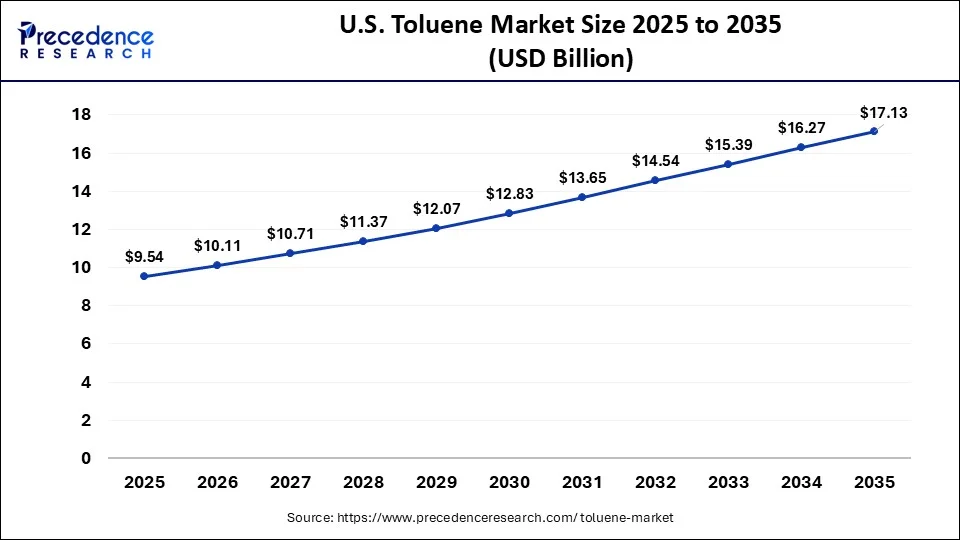
The U.S. toluene market size is valued at USD 9.54 billion in 2025 and is expected to reach USD 17.13 billion by 2035, growing at a CAGR of 6.03% from 2026 to 2035.
North America has held the largest revenue share 46% in 2025. In North America, the toluene market has experienced fluctuations due to the impact of the COVID-19 pandemic. The initial market slowdown was attributed to reduced industrial activities, particularly in the automotive and construction sectors. However, with the gradual reopening of economies and increased infrastructure projects, the demand for toluene, a vital component in adhesive paints and coatings, is projected to rebound. Furthermore, the growing emphasis on sustainability and environmental regulations is driving research and development efforts towards producing bio-based toluene, aligning with the region's eco-friendly initiatives.
U.S. Toluene Market Trends
The U.S. is a major player in the North American market due to its well-developed refining facilities and high demand for downstream derivatives such as TDI, benzene, and industrial solvents. An increase in the production of automotive oils, construction materials, and electronics boosts the use of solvents and polyurethane in this region. The market in the U.S. is also driven by domestic capacity expansions and modernization projects.
What Makes Asia Pacific the Fastest-Growing Region in the Toluene Market?
Asia Pacific is estimated to observe the fastest expansion. In Asia Pacific, the toluene market has remained robust. Asia Pacific is a key player in the global chemicals industry, and its surging manufacturing activities, especially in countries like China and India, contribute to consistent demand for toluene. The region's focus on infrastructure development and growth in the automotive sector bolsters the market. Additionally, bio-based toluene production is gaining traction as Asia Pacific champions sustainable practices and seeks alternatives to traditional toluene sources.
Asia Pacific holds the largest industrialization rate, which leads to economic growth mainly in countries like South Korea and China. This country contributes to the growth factor on a large scale. The demand for toluene in various industries such as electronics, automotive, chemicals, and textiles. These aspects encourage the vast production of toluene.
China Toluene Market Trends
China is leading the charge in Asia Pacific, driven by rapid industrialization, expanding polyurethane production, and growing paints, coatings, and adhesives industries. The investment in energy-saving aromatics extraction and VOC minimization is expected to facilitate market growth in this region.
India Toluene Market Trends
The Indian market is growing steadily, driven by rising demand from the paints, coatings, adhesives, and chemical manufacturing sectors. Increasing industrialization, urbanization, and expansion of the automotive and construction industries are boosting the consumption of toluene as a solvent and chemical intermediate. Additionally, the development of domestic refining and petrochemical infrastructure is supporting stable supply and market growth.
What Influences the Growth of the Market in Europe?
In Europe, the toluene market reflects a dynamic landscape, influenced by several key factors. The region's commitment to environmental sustainability and stringent regulations has led to increased efforts to develop and implement bio-based toluene production processes. European manufacturers have been investing in research and development to align with these sustainable goals. Additionally, the region's robust automotive and construction industries contribute to a steady demand for toluene, primarily used in the production of paints, coatings, and adhesives for various applications, from automotive refinishing to architectural projects. These factors together shape a competitive and evolving toluene market in Europe.
Germany Toluene Market Trends
In Germany, the market is driven by its robust chemical manufacturing industry and the presence of leading companies like BASF and Covestro. There is a high demand for pure toluene in paint & coatings, adhesives, and specialty chemicals industries. Additionally, the increasing demand for toluene derivatives from the pharmaceutical, automotive, and electronics industries contributes to market growth.
What Factors Fuel the Toluene Market Growth in Latin America?
Latin America's market growth is supported by its well-integrated petrochemical complexes and the expanding polyurethane and coatings industries. Rising demand for toluene in fuel blending, adhesives, and solvents is expected to continue as the region's automotive, construction, and chemical manufacturing sectors develop. Additionally, active trade across Latin America helps stabilize the market. Brazil leads the Latin American market thanks to its well-developed petrochemical industry and growing downstream production of adhesives, paints, coatings, and polyurethane.
Brazil Toluene Market Trends
Brazil's market is supported by a strong need for toluene diisocyanates, vital for manufacturing flexible foam in the automotive, furniture, and insulation industries. There is a rising trend of adopting solvent recovery units along with advanced purification technologies to improve resource efficiency and even comply with environmental standards.
The growth of the automotive and aerospace industries is also contributing to higher demand for toluene-based products such as coatings and fuel additives. Additionally, ongoing investments in petrochemical infrastructure and refining capacity are helping stabilize supply and meet the country's industrial requirements.
What Opportunities Exist in the Middle East & Africa?
The Middle East & Africa (MEA) offers immense opportunities for the toluene market due to the presence of large-scale refineries in countries such as Saudi Arabia, the UAE, and South Africa. The rapid development of construction, automotive, and chemical industries across GCC countries is driving strong demand for solvents, adhesives, and coatings in the region. Saudi Arabia is a major contributor to the market, driven by its abundant crude oil supply and large-scale refining capacity. There is a growing focus on increasing domestic toluene production to reduce reliance on imports, thereby fueling market growth.
Saudi Arabia Toluene Market Trends
The Saudi Arabian market is driven by increasing need in petrochemicals, solvents, and the automotive sector. The market is primarily targeted at toluene diisocyanate production and even solvent applications, with the nation leading the GCC in production.
The market is witnessing steady growth, fueled by strong demand from the petrochemical, paints, coatings, and adhesives industries. Expanding industrialization and infrastructure development are driving increased consumption of toluene as a solvent and chemical intermediate.
Competitive Landscape
The toluene market is highly fragmented owing to the presence of large petrochemical companies, regional refiners, start-ups, and specialty chemical manufacturers. These brands are competing across production capacity, feedstock availability, pricing strategies, and downstream integration. The new entrants are increasingly focusing on enhancing operational efficiency, improving supply chain optimization, and integrating advanced technologies to increase profitability. Key players include TotalEnergies SE, Royal Dutch Shell PLC, Exxon Mobil Corporation, China Petroleum & Chemical Corporation (Sinopec), and BP plc. These brands are adopting numerous strategies, such as business expansions and investments, to upscale their businesses.
Strategic partnerships, long-term supply agreements, and joint ventures remain common approaches that are highly adopted by the top players to strengthen their positions and ensure their availability in the local market. This industry has seen an immense downfall due to the rising geopolitical issues, coupled with stringent government policies regarding chemical manufacturing. The increasing research and development activities related to the production of sustainable toluene, as well as strategic joint ventures, are likely to reshape the industry in the future.
Toluene Market – Value Chain Analysis
- Crude Oil & Feedstock Supply: The value chain begins with the supply of crude oil and natural gas condensates, which serve as the primary feedstocks for producing toluene through catalytic reforming and steam cracking.
Key Players: Saudi Aramco, ExxonMobil, BP, PetroChina, Kuwait Petroleum Corporation. - Refining & Aromatics Production: Refineries and petrochemical complexes process naphtha and reformate streams to extract toluene using catalytic reformers, steam crackers, and aromatics units.
Key Players: ExxonMobil, Royal Dutch Shell, TotalEnergies, Sinopec, CNPC, Valero Energy. - Toluene Conversion & Derivative Manufacturing: Produced toluene is converted into high-value derivatives, including TDI (toluene diisocyanate), benzene (via hydrodealkylation), TNT, solvents, and specialty chemicals.
Key Players: Covestro, BASF SE, Mitsui Chemicals, Dow, Hanwha Solutions, Wanhua Chemical. - Distribution & Logistics: Bulk toluene and derivatives are transported by tank trucks, railcars, pipelines, and marine vessels, with chemical distributors ensuring regulatory compliance and safe handling.
Key Players: Brenntag, Univar Solutions, IMCD Group, Sinopec Marketing, Helm AG. - End-Use Industry Consumption: Toluene is consumed across multiple downstream sectors, including paint & coatings, adhesives, chemicals, pharmaceuticals, rubber processing, and gasoline blending for octane enhancement.
Key End Users: PPG Industries, Sherwin-Williams, 3M, ExxonMobil (fuel blending), Bayer, Pfizer (solvent applications).
Toluene Market Companies
- Exxon Mobil Corporation (U.S.): A major global producer of aromatics, ExxonMobil manufactures high-purity toluene through its integrated refining and petrochemical operations.
- Royal Dutch Shell PLC (UK/Netherlands): Shell produces toluene across its global refinery network, supplying material for gasoline blending, solvents, and petrochemical intermediates.
- TotalEnergies SE (France): TotalEnergies generates toluene as part of its aromatics slate, serving industrial solvents, chemical synthesis, and fuel additive markets.
- China Petroleum & Chemical Corporation – Sinopec (China): Sinopec is one of the world's largest toluene producers, supporting China's massive downstream derivatives industry, including TDI and benzene.
- BP plc (UK): BP's refining sites produce toluene used for petrochemical feedstocks, gasoline blending, and industrial solvent manufacturing.
- LyondellBasell Industries N.V. (Netherlands): LyondellBasell manufactures toluene within its aromatics chain for use in solvents, styrenics, and performance chemicals.
- Covestro AG (Germany): Covestro utilizes toluene as a key raw material for polyurethane intermediates, particularly TDI used in foams and coatings.
- BASF SE (Germany): BASF produces and consumes toluene for coatings, high-performance materials, and chemical intermediates within its global manufacturing network.
- Chevron Phillips Chemical Company LLC (U.S.): CP Chem is a major supplier of aromatics, including toluene, serving solvent applications, gasoline components, and chemical intermediates.
- China National Petroleum Corporation (CNPC): CNPC generates large toluene volumes across its nationwide refineries to supply China's expanding petrochemical sector.
- Braskem S.A. (Brazil): Braskem produces toluene in its integrated petrochemical complexes, supporting Latin America's solvent and chemical derivatives markets.
- Formosa Plastics Corporation (Taiwan): Formosa produces toluene within its refining and aromatics operations, supplying downstream chemical and plastics manufacturing.
- Indian Oil Corporation Limited – IOCL (India): IOCL manufactures toluene at its major refineries, supporting India's solvents, pharmaceuticals, and coatings industries.
- Valero Energy Corporation (U.S.): Valero produces toluene through its refining assets, supplying fuel blending, industrial solvent, and petrochemical feedstock applications.
- Mitsui Chemicals, Inc. (Japan): Mitsui Chemicals integrates toluene into its production of high-value derivatives, including solvents and performance materials.
Recent Developments
- In May 2025, PetroChina South China decreased toluene prices in China. The country has downgraded the price rate by Yuan 100/mt to Yuan 5400/mt. This is a relief for the country's automotive, electronics, and other sectors.
- In January 2025, the Union Minister Hardeep Singh Puri launched MRPL's product, toluene. This is an expansionary contribution to the toluene market. This initiative will help boost innovation by adding new features to the product.
- In 2022, Covestro expanded its product line by introducing polyether polyols derived from renewable sources, offering toluene diisocyanate (TDI) and methylene diphenyl diisocyanate (MDI) for the production of polyurethane foams, contributing to sustainable solutions in the chemical industry.
- In 2022, Covestro broadened its offerings with renewable toluene diisocyanate (TDI), making it accessible to customers worldwide. This renewable TDI serves as a key ingredient in the production of flexible polyurethane foam, further emphasizing the company's commitment to sustainability.
Segments Covered in the Report
By Derivative Type
- Benzene & Xylene
- Toluene Diisocyanatos
- Gasoline Additives
- Others
By Application
- Drugs
- Dyes
- Blending
- Cosmetic Nail Products
- Others
By Production Process
- Reformate Processes
- Pygas Processes
- Coke/Coal Processes
- Styrene Processes
By Geography
- North America
- Europe
- Asia-Pacific
- Latin America
- Middle East and Africa
For inquiries regarding discounts, bulk purchases, or customization requests, please contact us at sales@precedenceresearch.com
Frequently Asked Questions
Tags





Ask For Sample
No cookie-cutter, only authentic analysis – take the 1st step to become a Precedence Research client
 Get a Sample




 sales@precedenceresearch.com
 Schedule a Meeting
