



UK Spa Services Market Size, Key Companies, Company Market Share, Sales Volume, Consumer Demand, Pricing Trends, Distribution Performance, Competitive Positioning, and Growth Forecast
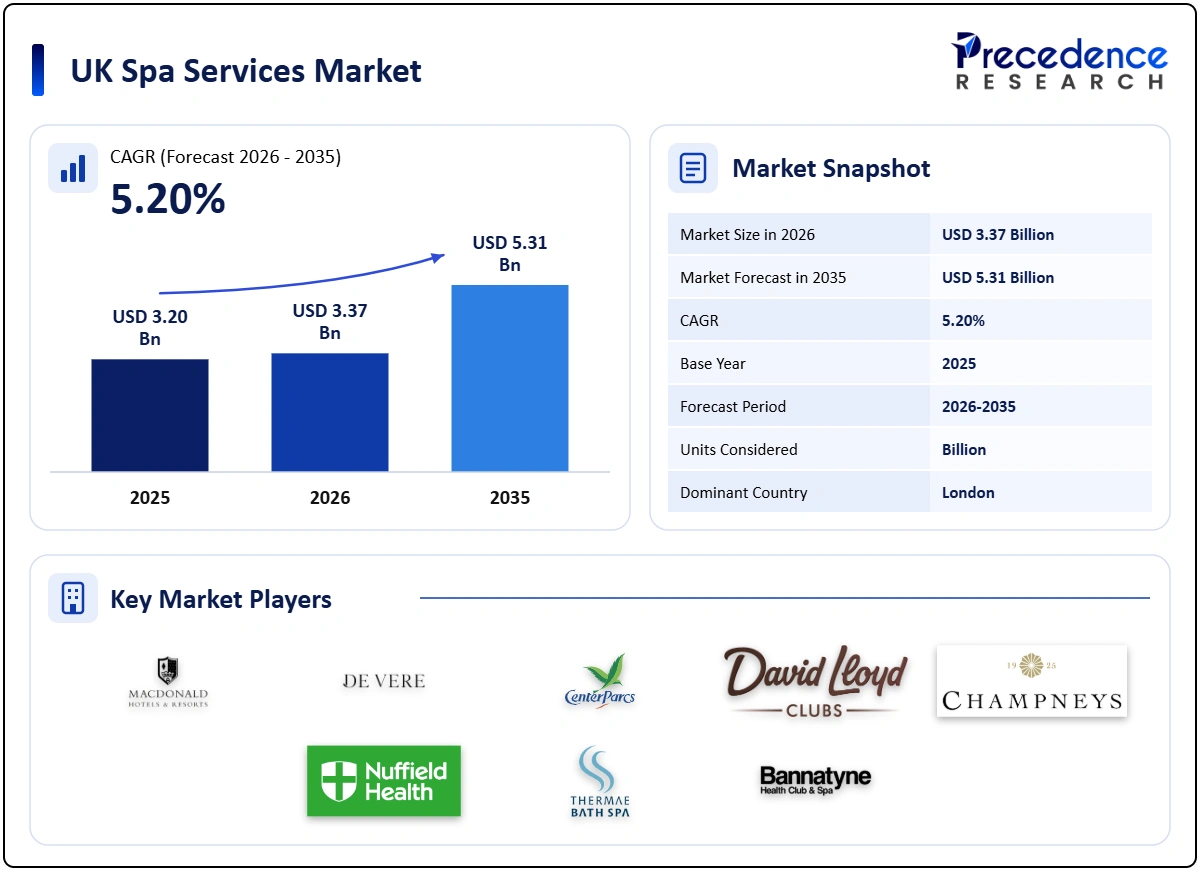
Vidyesh Swar, a Consumer Goods Industry Expert, finds that the UK spa services market has reached USD 3.37 billion in 2026 and is projected to reach USD 5.31 billion by 2035, growing at a CAGR of 5.20%. Leading UK spa services market brands and companies such as Champneys, Bannatyne Group, Center Parcs are competing across high-demand segments including spa type, service, customer type, booking channel and region.
Source: https://www.precedenceresearch.com/uk-spa-services-market
 Get a Sample
 Table Of Content
Key Takeaways
Market Size & Growth Outlook
- Market size in 2025: USD 3.20 billion
- Estimated market size in 2026: USD 3.37 billion
- Projected market size by 2035: USD 5.31 billion
- CAGR (2026-2035): 5.20%
Regional Market Spotlight
- London dominated the market with a 24.00% share in 2025.
- Southeast held a 20.00% share in 2025 and is estimated to be the fastest-growing region, at a CAGR of 6.24% from 2026 to 2035.
- In 2025, Midlands & East contributed 16.00% of the market share.
Segmental Spotlight
- By spa type, hotel & resort spas accounted for the largest share of 46.00% in 2025.
- In 2025, massage dominated the service segment with a 32.00% market share.
- Females emerged as the leading customer type segment in 2025, capturing a 74.00% share.
- Direct represented the largest booking channel segment, holding 56.00% of the market in 2025.
UK Spa Services Market Size, 2025-2035 (USD Billion)
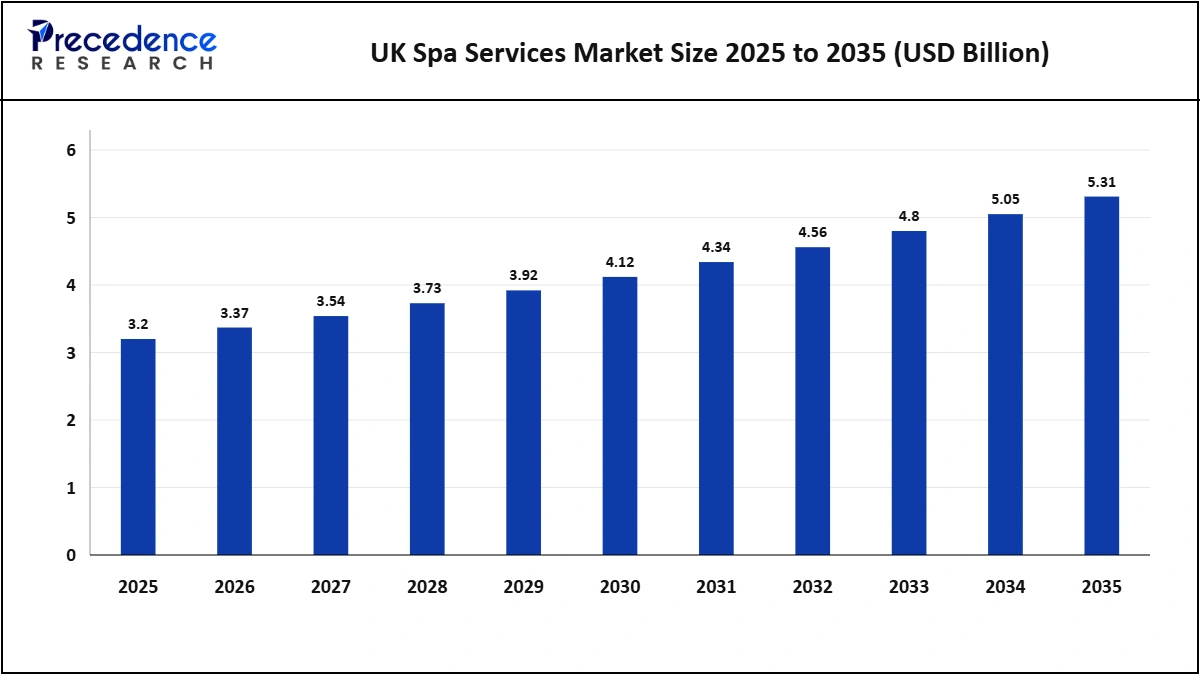
Note: 2025 is the base year; 2026-2035 values are forecasts.
Sources: Expert interviews, secondary sources, Precedence Research database, and Precedence Research analysts.
The market is projected to grow from USD 3.20 billion in 2025 to USD 5.31 billion by 2035, driven by the growing integration of wellness into everyday lifestyles and consumer spending habits. Rising interest in relaxation, stress management, and preventive wellness is encouraging more consumers to visit spas, while thermal experiences and hydrotherapy treatments are attracting new customer segments. Increasing demand for premium spa experiences across hotels and resorts is expected to further support market expansion. Consequently, the market is projected to reach USD 4.12 billion by 2030, registering a CAGR of 5.20% during the forecast period.
Analyst View: Growing consumer focus on wellness, stress management, and self-care will support steady market expansion. Thermal therapies and premium spa experiences will create new demand opportunities, while competition and discretionary spending pressures may moderate growth.
Market Trends
- Thermal circuits: Saunas, cold plunges, and heat-and-ice circuits are gaining popularity as consumers seek immersive wellness and recovery experiences.
- Retail day spas: Spas located within retail stores and shopping centers are expanding access to convenient wellness and beauty treatments.
- Wellness breaks: Overnight spa stays and wellness packages are attracting consumers seeking short breaks focused on relaxation and rejuvenation.
- Men's spa use: Male participation in spa services is increasing, supported by growing interest in grooming, skincare and wellness treatments.
- Online booking: Online booking platforms and digital gift vouchers are making spa services more accessible and convenient for consumers.
Market Dynamics
The UK spa services market remains fragmented, with competition among independent day spas, hotel and resort spas, destination wellness facilities and established spa chains. Demand is supported by growing consumer interest in wellness, self-care and stress management. However, rising labor, energy and property costs, coupled with VAT-related pricing pressures, are squeezing operator margins. Smaller independent spas may face greater challenges in managing operating expenses, while larger operators can benefit from stronger brand recognition, diversified services and operational efficiencies.
Drivers
Wellness spending
UK consumers are increasingly incorporating wellness and self-care activities into their regular spending habits, supporting demand for spa treatments and relaxation services.
Spa breaks
Short domestic breaks combining accommodation with spa experiences remain popular among consumers seeking convenient opportunities for relaxation and rejuvenation.
Thermal trend
Growing interest in sauna sessions, cold-water immersion and heat-and-cold therapies is attracting younger consumers and encouraging demand for thermal spa experiences.
Gift vouchers
Spa days and wellness experiences are popular gifting options for birthdays, anniversaries and other special occasions, supporting bookings through gift vouchers and online platforms.
Table: Market Drivers - Impact & CAGR Contribution (2026-2035)
| Driver | Impact | ≈ CAGR Contribution | Time Horizon | Key Regions |
| Wellness spending | High | +2.03 pp | Short to long term | All covered regions, strongest in London |
| Spa breaks | Medium | +1.71 pp | Medium to long term | All covered regions, fastest uptake in South East |
| Thermal trend | Medium | +1.46 pp | Short to medium term | All covered regions |
| Gift vouchers | Low | +1.14 pp | Long term | London and South East |
Note: Contributions are indicative estimates of each factor's effect on annual growth.
Sources: Expert interviews, secondary sources, Precedence Research database, and Precedence Research analysts.
Wellness spending, spa breaks, thermal experiences, and gift vouchers drive most growth in the UK spa services market.
Restraints
Cost of living
Rising living costs are putting pressure on household budgets, prompting consumers to reduce discretionary spending on spa treatments and other non-essential wellness services.
Staff shortages
Spa operators face challenges in recruiting and retaining qualified therapists and trained staff, potentially limiting service capacity, increasing labor costs, and affecting customer experience.
High VAT and costs
The high VAT rate, combined with rising energy, labor, and property costs, is increasing operating expenses and putting pressure on spa operators' profit margins.
Market Restraints - Impact & Negative CAGR Contribution (2026-2035)
| Restraint | Impact | ≈ Negative CAGR Contribution | Time Horizon | Key Regions |
| Cost of living | High | -0.51 pp | Short to medium term | All covered regions |
| Staff shortages | High | -0.38 pp | Medium term | Smaller and price-sensitive markets |
| High VAT and costs | Medium | -0.25 pp | Short term | London and other mature markets |
Note: Contributions are indicative estimates of each factor's effect on annual growth.
Sources: Expert interviews, secondary sources, Precedence Research database, and Precedence Research analysts.
Cost of living pressure is the main restraint, followed by staff shortages and high VAT and costs in the UK spa services market.
Opportunities
Thermal investment
Investment in outdoor thermal facilities, including heated pools, saunas and cold-plunge areas, presents opportunities for spa operators to attract new customers.
Corporate wellness
Growing employer interest in employee wellbeing creates opportunities for spa operators to partner with businesses and offer corporate wellness packages, discounted treatments and employee spa benefits.
Medical wellness
Rising consumer interest in recovery, preventive health and longevity services creates opportunities for spas to expand into medically guided wellness treatments.
Market Segmentation: 2025 Share and Size
UK Spa Services Market by Spa Type, 2025 Share (%)
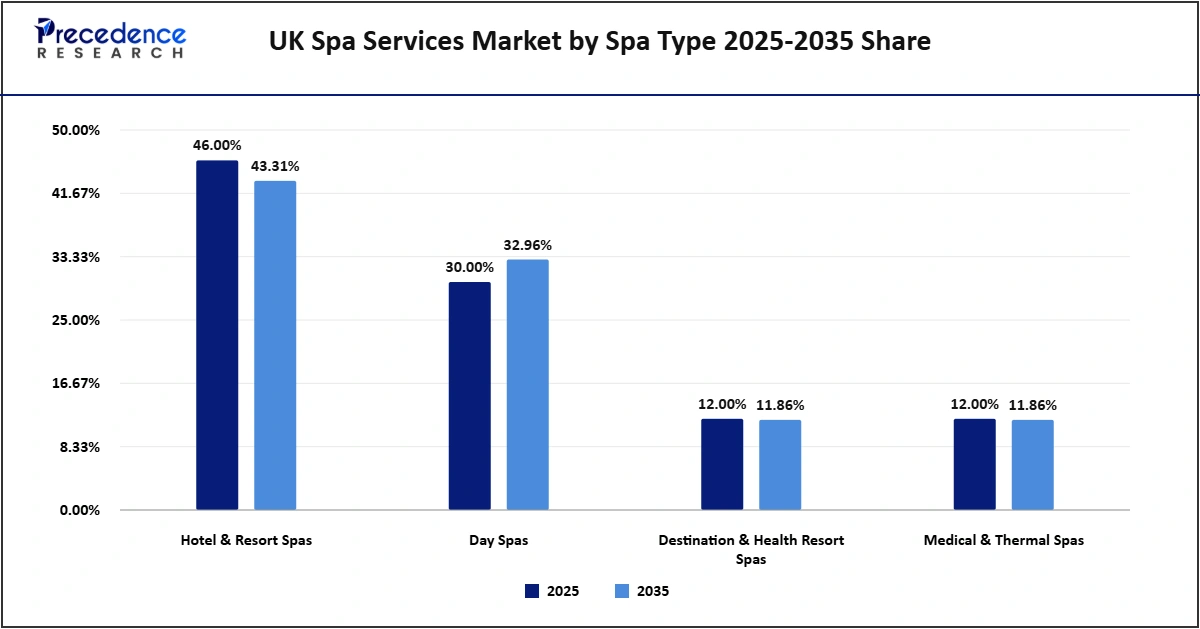
Note: 2025 is the base year; 2035 shares and CAGRs are forecasts.
Sources: Expert interviews, secondary sources, Precedence Research database, and Precedence Research analysts.
Hotel and resort spas lead because spa breaks at country houses and city hotels are the core of UK spa spending. Day spas grow fastest as operators open in shopping centers and stores.
Hotel & Resort Spas: This segment accounted for 46.00% of the market in 2025 and is projected to grow at a CAGR of 4.60% from 2026 to 2035. Hotel & resort spas lead due to their ability to combine spa treatments with accommodation, leisure facilities, and overnight wellness experiences.
Day Spas: Holding a 30.00% market share in 2025, day spas are expected to expand at a CAGR of 6.20% during the forecast period. Day spas are growing fastest due to increasing demand for convenient, affordable, and accessible spa experiences that fit into consumers' busy lifestyles without requiring overnight stays.
Destination & Health Resort Spas: The segment captured 12.00% of the total market in 2025 and is anticipated to register a CAGR of 5.00% between 2026 and 2035. Increasing preference for wellness-focused holidays and personalized retreat programs is encouraging consumers to choose destination spas.
Medical & Thermal Spas: Representing 12.00% of the market in 2025, this segment is forecast to maintain steady growth at a CAGR of 5.00% over the forecast period. Greater awareness of therapeutic wellness benefits and demand for specialized treatments are supporting the adoption of medical and thermal spas.
UK Spa Services Market by Service, 2025 Share (%)
| Segments | 2025 Share | 2035 Share | CAGR 2026-2035 |
| Massage | 32.00% | 30.32% | 4.69% |
| Facials & Skincare | 24.00% | 23.73% | 5.09% |
| Thermal & Hydrotherapy | 16.00% | 18.08% | 6.49% |
| Body Treatments | 14.00% | 13.94% | 5.09% |
| Others | 14.00% | 13.94% | 5.09% |
Note: 2025 is the base year; 2035 shares and CAGRs are forecasts.
Sources: Expert interviews, secondary sources, Precedence Research database, and Precedence Research analysts.
Massage leads because it is the most booked spa treatment. Thermal and hydrotherapy experiences grow fastest as guests seek saunas, cold plunges, and heat-and-ice circuits.
Massage: With a market contribution of 32.00% in 2025, massage is expected to witness sustained expansion at a CAGR of 4.69% from 2026 to 2035. Massage dominates due to its broad appeal across customer segments, versatility in addressing relaxation, stress relief, and muscle recovery needs, and availability across most spa formats.
Facials & Skincare: The segment held a substantial 24.00% share of the market in 2025; growth is supported by increasing consumer focus on skin health, anti-ageing treatments, and personalized skincare services.
Thermal & Hydrotherapy: In 2025, thermal & hydrotherapy represented 16.00% of the overall market, driven by rising consumer interest in sauna experiences, cold-water immersion, and therapeutic bathing.
Body Treatments: The segment's market share stood at 14.00% in 2025, while its growth trajectory is expected to reflect a CAGR of 5.09% during 2026-2035. Rising demand for exfoliation, body wraps, and treatments is encouraging consumers to explore a wider range of spa services.
Others: Capturing a 14.00% market share in 2025, this segment is expected to expand at a CAGR of 5.09% between 2026 and 2035. Growing interest in holistic wellness, beauty maintenance, and complementary activities such as nail care and wellness classes is supporting demand for these services.
UK Spa Services Market by Customer, 2025-2035 Share (%)
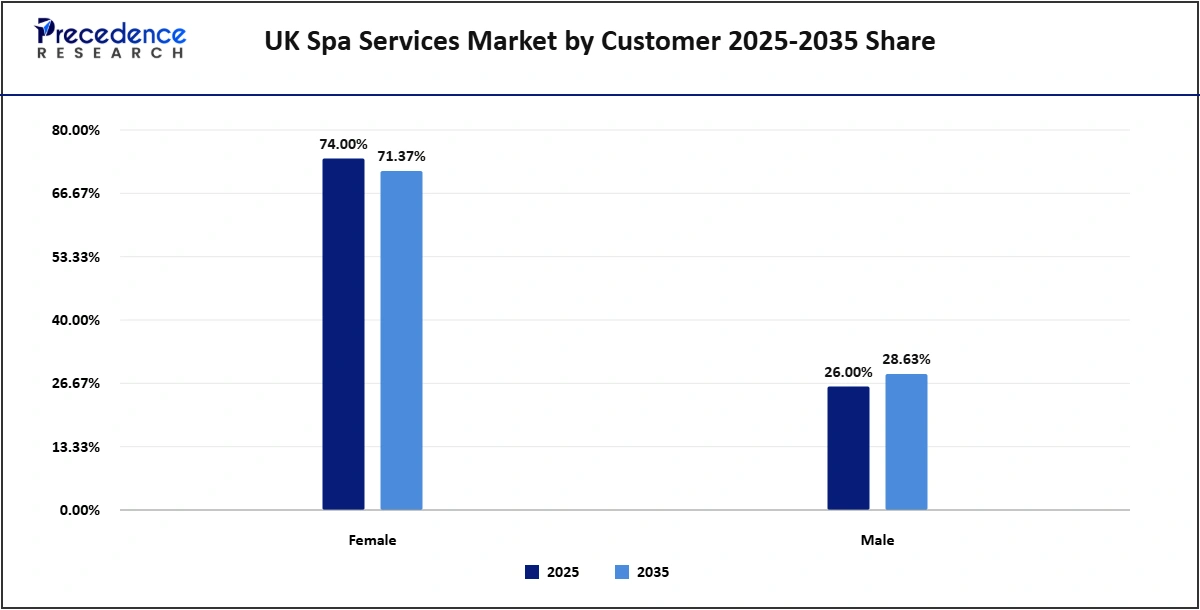
Note: 2025 is the base year; 2035 shares and CAGRs are forecasts.
Sources: Expert interviews, secondary sources, Precedence Research database, and Precedence Research analysts.
Women lead because they book most spa days and treatments. Men grow faster as spa use becomes mainstream.
Female: This segment accounted for 74.00% of the market in 2025 and is projected to grow at a CAGR of 4.82% from 2026 to 2035. Female leads due to historically higher participation in spa treatments, skincare, beauty services, and wellness activities.
Male: The segment captured 26.00% of the total market in 2025 and is anticipated to register a CAGR of 6.22% between 2026 and 2035. Male growth is driven by increasing male awareness of personal grooming, skincare, stress management, and the benefits of regular wellness treatments.
UK Spa Services Market by Booking Channel, 2025 Share (%)
| Segments | 2025 Share | 2035 Share | CAGR 2026-2035 |
| Direct | 56.00% | 52.73% | 4.56% |
| Online Platforms & Vouchers | 44.00% | 47.27% | 5.96% |
Note: 2025 is the base year; 2035 shares and CAGRs are forecasts.
Sources: Expert interviews, secondary sources, Precedence Research database, and Precedence Research analysts.
Direct bookings lead because hotels and spas sell through their own websites and contacts. Online platforms and gift vouchers grow fastest.
Direct: With a market contribution of 56.00% in 2025, the segment is expected to witness sustained expansion at a CAGR of 4.56% from 2026 to 2035. The direct segment is dominating due to established relationships between spa operators and customers, allowing convenient bookings, personalized service, and direct access to packages and promotions.
Online Platforms & Vouchers: In 2025, the segment represented 44.00% of the overall market and is expected to achieve a CAGR of 5.96% over the 2026-2035 period. Online platforms and gift vouchers are driven by increasing preference for digital convenience, easy price comparisons, promotional deals, and flexible gift voucher options.
Analyst View: The UK spa services market will remain anchored by hotel & resort spas, massage services, female customers, and direct bookings. However, day spas, thermal & hydrotherapy services, male participation, and online bookings are expected to grow faster, supported by demand for convenient, experience-led and digitally accessible wellness services.
Country Analysis
UK Spa Services Market by Country, 2025 Share (%)
| Country | 2025 Share | 2035 Share | CAGR 2026-2035 |
| London | 24.00% | 22.79% | 4.64% |
| South East | 20.00% | 22.03% | 6.24% |
| Midlands & East | 16.00% | 15.82% | 5.04% |
| North | 14.00% | 13.75% | 5.04% |
| Scotland, Wales & Northern Ireland | 14.00% | 13.75% | 5.04% |
| South West | 12.00% | 11.86% | 5.04% |
Note: 2025 is the base year; 2035 shares and CAGRs are forecasts. Sources: Expert interviews, secondary sources, Precedence Research database and Precedence Research analysts.
London leads because of luxury hotel spas and tourism. The South East grows fastest with country house hotel spas near London.
Regional Insights
London: Accounting for 24.00% market share in 2025, London is expected to expand at a CAGR of 4.64% during the forecast period. London dominates due to its high concentration of luxury hotels, premium spa facilities, and strong demand from affluent residents, business travelers, and international tourists.
South East: With a market contribution of 20.00% in 2025, South East is expected to witness sustained expansion at a CAGR of 6.24% from 2026 to 2035. The South East growth is driven by rising demand for accessible luxury wellness retreats and supported by the region's concentration of country house hotels.
Midlands & East: Representing 16.00% of the market in 2025, Midlands & East is forecast to maintain steady growth at a CAGR of 5.04% over the forecast period. Growth is supported by established spa resorts, leisure destinations, and increasing demand for short wellness breaks among domestic travelers.
North: Holding a 14.00% market share in 2025, North is expected to expand at a CAGR of 5.04% during the forecast period. Rising interest in countryside retreats, destination wellness experiences and urban day spas is supporting regional demand.
Scotland, Wales & Northern Ireland: This region accounted for 14.00% of the market in 2025 and is projected to grow at a CAGR of 5.04% through 2035. Scotland, Wales & Northern Ireland are driven by demand for nature-based wellness retreats, golf resort experiences and spa services offered by country hotels.
South West: In 2025, the South West contributed 12.00% of the overall market and is expected to achieve a CAGR of 5.04% over the 2026-2035 period. The region benefits from its strong appeal as a leisure destination, with coastal wellness retreats and natural thermal spa experiences attracting domestic and international visitors.
Analyst View: London will remain the leading regional market, supported by its concentration of luxury hotels and premium spa facilities. The South East is expected to record the fastest growth driven by rising demand for accessible luxury wellness retreats and its strong base of country house hotels. Furthermore, the Midlands & East, North, Scotland, Wales & Northern Ireland, and South West are expected to witness steady growth, supported by established spa resorts, countryside and coastal retreats, golf resorts, and increasing demand for short wellness breaks and destination spa experiences.
Competitive Landscape
Top 8 Companies in the UK Spa Services Market, 2025
| Rank | Company Name | 2025 Share (%) | Key Products / Business | Headquarters |
| 1 | Champneys | 3.50% | Destination resorts and day spas | United Kingdom |
| 2 | Bannatyne Group | 3.00% | Day spas and hotel spas | United Kingdom |
| 3 | Center Parcs | 2.50% | Aqua Sana resort spas | United Kingdom |
| 4 | David Lloyd | 2.00% | Club spas | United Kingdom |
| 5 | Nuffield Health | 1.50% | Club spas | United Kingdom |
| 6 | Thermae Bath Spa | 1.00% | Natural thermal spa | United Kingdom |
| 7 | Macdonald Hotels | 1.00% | Hotel spas | United Kingdom |
| 8 | De Vere | 1.00% | Hotel spas | United Kingdom |
Note: Company shares are 2025 estimates.
Sources: Company press releases, expert interviews, secondary sources, Precedence Research database and Precedence Research analysts.
Champneys led the UK spa services market with 3.50% share of 2025 revenue, followed by Bannatyne Group at 3.00% share and Center Parcs at 2.50% share. Champneys leads with destination resorts and day spas, Bannatyne Group competes with day spas and hotel spas, and Center Parcs offers Aqua Sana resort spas. David Lloyd, Nuffield Health, Thermae Bath Spa, Macdonald Hotels, and De Vere compete through club spas, natural thermal spas, and hotel spas.
The top 8 market players accounted for 15.50% of 2025 revenue, while the remaining 84.50% was shared among thousands of independent hotel and day spas. The UK spa services market is highly fragmented, and competition centers on location, treatment quality, thermal facilities, brand partners, and price.
Company Snapshots
Champneys: Headquartered in the United Kingdom, Champneys held 3.50% of the UK spa services market in 2025, built largely on destination resorts and day spas. The Precedence Research Companies Quadrant places it as a Leader.
Bannatyne Group: This company competes mainly through day spas and hotel spas. From its base in the United Kingdom, it captured 3.00% of 2025 revenue and is rated a Leader in the Precedence Research Companies Quadrant.
Center Parcs: With 2.50% of the UK spa services market share in 2025, Center Parcs draws on Aqua Sana resort spas. The company is based in the United Kingdom and appears as a Leader in the Precedence Research Companies Quadrant.
David Lloyd: Based in the United Kingdom, it accounted for a 2.00% share in 2025. Its club spas are in the Leader group of the Precedence Research Companies Quadrant.
Nuffield Health: Representing a 1.50% share in 2025 makes Nuffield Health a notable participant in the UK spa services market. It is headquartered in the United Kingdom, focuses on club spas, and is classed as a Leader in the Precedence Research Companies Quadrant.
Thermae Bath Spa: In 2025, this company held a 1.00% position in the UK spa services market around a natural thermal spa. Headquartered in the United Kingdom, it is shown as a Leader in the Precedence Research Companies Quadrant.
Macdonald Hotels: Most of Macdonald Hotels' presence in this market comes from hotel spas. The company is headquartered in the United Kingdom, held roughly 1.00% of 2025 revenue, and is rated an Innovator in the Precedence Research Companies Quadrant.
De Vere: UK-based, De Vere captured a 1.00% share of the market in 2025. Its range is built around hotel spas, and the company, based in the United Kingdom, is placed as an Innovator in the Precedence Research Companies Quadrant.
Companies Ecosystem
The UK spa services ecosystem links product brands, spa operators, booking platforms, therapists and industry bodies, with each stage adding value before products reach end users. Spas sell cosmeceuticals and aromatherapy oils in retail areas, and some link treatments with digital health and behavioral health programs.
UK Spa Services Market Ecosystem
| Ecosystem Stage | Role in the Market | Key Companies |
| Product Brands | Supply treatments | ESPA, Elemis, Aromatherapy Associates |
| Spa Operators | Run spas | Champneys, Bannatyne, hotels |
| Booking Platforms | Sell spa days | Spabreaks.com, Wowcher, gift voucher sites |
| Therapists | Deliver treatments | Therapists and staff |
| Industry Bodies | Represent operators | UK Spa Association |
Sources: Company press releases, expert interviews, secondary sources, Precedence Research database, and Precedence Research analysts.
Product Brands: Spas use brands to sell signature treatments and retail.
Spa Operators: Operators invest in thermal suites and outdoor pools.
Booking Platforms: Platforms bring many first-time guests.
Therapists: Hiring therapists is a challenge.
Industry Bodies: The industry is campaigning for lower VAT.
Value in the UK spa services market flows from upstream material and technology suppliers to manufacturers and service providers, then through distribution partners to end users. Companies that integrate several stages or build long-term relationships with end users capture a larger share of this value.
Precedence Research Companies Quadrant
The Precedence Research Companies Quadrant positions key participants in the UK spa services market by market strength, reflecting revenue scale, market share and geographic reach, and by innovation and growth strategy, reflecting product portfolio breadth, R&D intensity and partnerships. Positions reflect each company's estimated 2025 share of the UK spa services market and our assessment of its product innovation, portfolio breadth and partnerships.
Sources: Company press releases, expert interviews, secondary sources, Precedence Research database and Precedence Research analysts.
Leaders: Champneys, Bannatyne Group, Center Parcs, David Lloyd, Nuffield Health, and Thermae Bath Spa combine high market share with broad portfolios and strong innovation.
Innovators: Macdonald Hotels and De Vere bring newer technologies and specialized products.
Recent Developments
- October 2025: Excalibur Group acquired Spabreaks.com to strengthen its presence in the spa, wellness and leisure sectors. The platform continues to operate independently, supported by Excalibur's marketing, technology and operational capabilities.
- September 2026: The UK Spa Association backed a campaign to cut VAT on spa, beauty and wellness services from 20% to 10%, citing rising operating costs and the need to support business growth, employment and investment.
UK Spa Services Market Segments
By Spa Type
- Hotel & Resort Spas
- Day Spas
- Destination & Health Resort Spas
- Medical & Thermal Spas
By Service
- Massage
- Facials & Skincare
- Thermal & Hydrotherapy
- Body Treatments
- Others
By Customer
- Female
- Male
By Booking Channel
- Direct
- Online Platforms & Vouchers
By Region
- London
- South East
- South West
- Midlands & East
- North
- Scotland, Wales & Northern Ireland
Research Methodology: The UK spa services market covers services offered by hotel and resort spas, day spas, destination and health resorts, and medical and thermal spas. It includes massage, facials, skincare, body treatments, thermal therapies and hydrotherapy for male and female customers, booked directly or through online platforms and vouchers. The 2025 base year was built bottom-up from demand volumes and average prices by spa type, service, customer and booking channel and region, and checked top-down against the market-specific revenues of leading companies and public industry data. Segment, regional and company values were allocated from spa type, service, customer and booking channel and region demand. Key estimates were verified by cross-checking company disclosures, regulatory and industry data, and published third-party estimates, and inputs that could not be reconciled were excluded. All segment, regional and company figures were reconciled to the same 2025 base year, and the 2026-2035 forecast, which applies a constant CAGR from the 2025 base, was recalculated and validated.
Analyst View: The UK spa services market is expected to witness steady growth, supported by rising consumer interest in wellness, self-care and stress management, alongside growing demand for thermal therapies, spa breaks and premium experiences. However, cost-of-living pressures may constrain discretionary spending, while staff shortages and rising labor, energy and property costs will weigh on operator margins. More potential for growth will arise from increased use of day spas, digital reservations, and a variety of wellness services.
Sources and References
- Spa Business. "Ecommerce company Excalibur Group acquires Spabreaks.com". October 2026. News. (Source: spabusiness.com)
- Leisure Opportunities. "UK spa sector joins industry campaign for VAT cut". September 2026. News. https://www.leisureopportunities.co.uk/news/UK-spa-sector-joins-collective-industry-campaign-for-VAT-cut/363701
For inquiries regarding discounts, bulk purchases, or customization requests, please contact us at sales@precedenceresearch.com
Frequently Asked Questions





Ask For Sample
No cookie-cutter, only authentic analysis – take the 1st step to become a Precedence Research client
 Get a Sample




 sales@precedenceresearch.com
 Schedule a Meeting
