



Ultra-thin Glass Market Size, Key Companies, Company Production Capacity, Manufacturing Efficiency, Capacity Utilization, Raw Material Consumption, Cost Structure, Export Trends, and Competitive Landscape
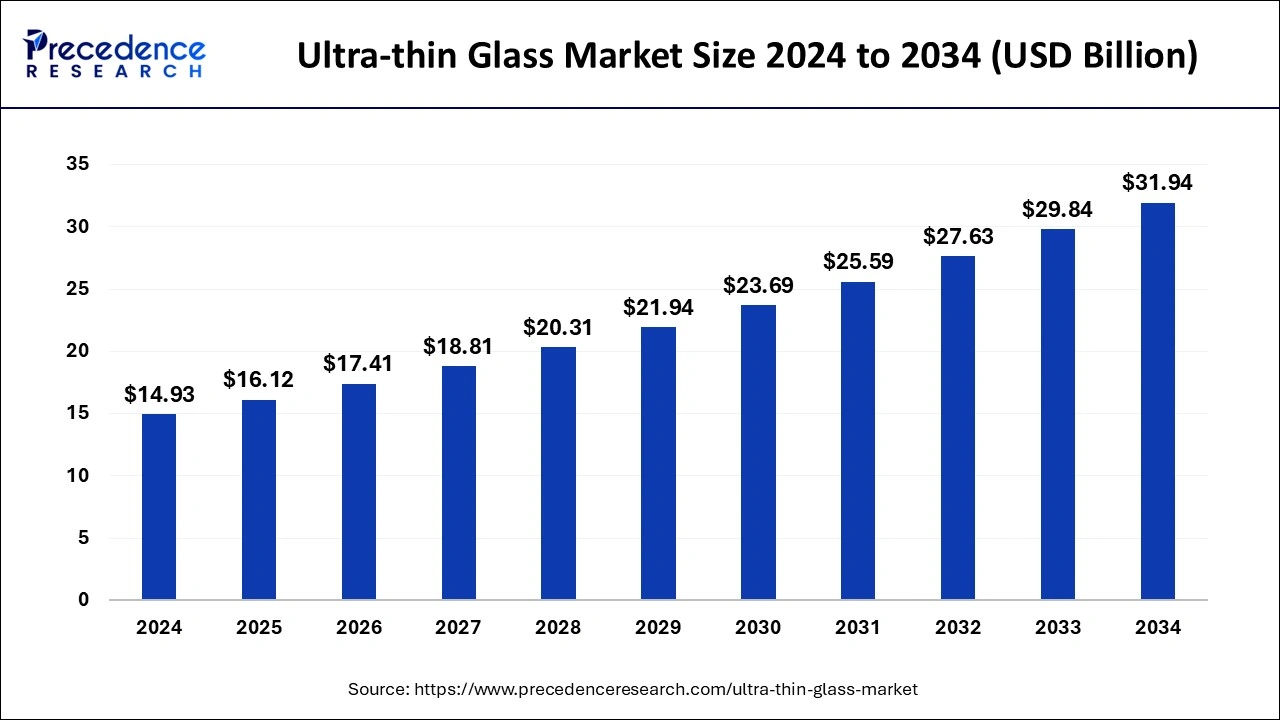
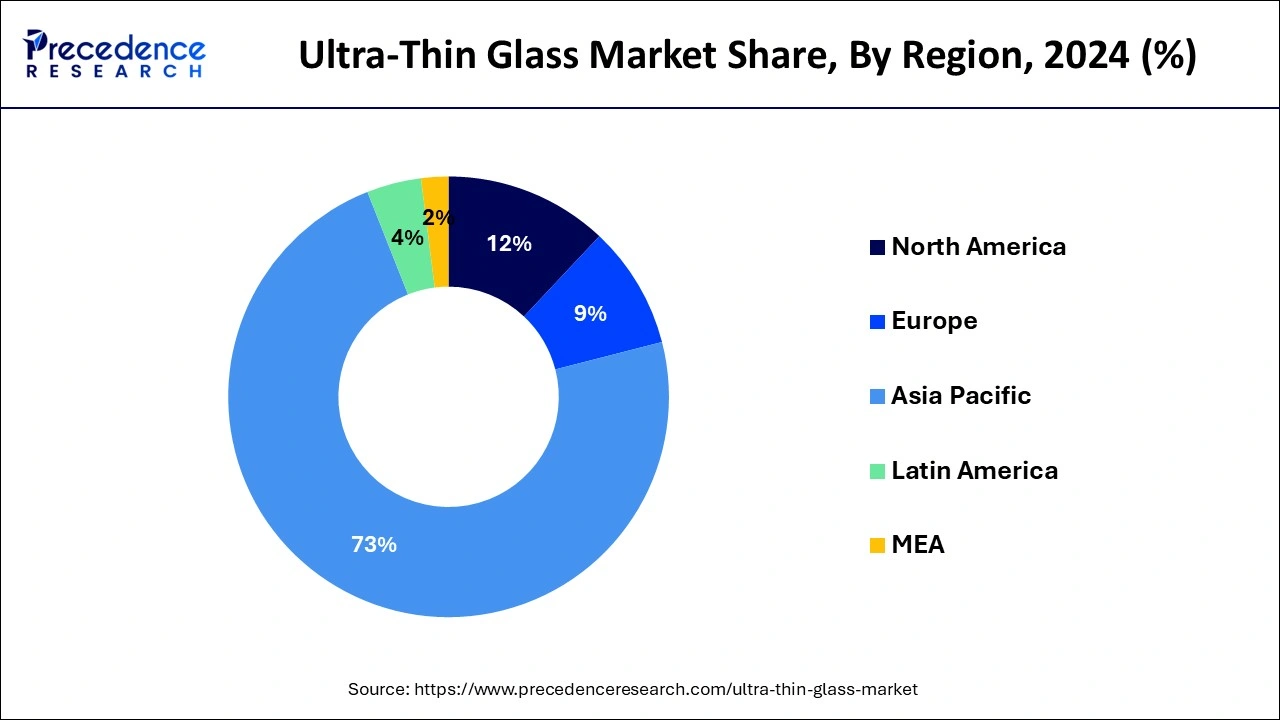
The global ultra-thin glass market was valued at USD 17.41 billion in 2026 and is projected to reach USD 34.11 billion by 2035, growing at a CAGR of 7.78% from 2026 to 2035. Market growth is driven by rising demand for smartphones, foldable devices, flat panel displays, semiconductors, automotive electronics, and solar energy applications. Ultra-thin glass offers superior flexibility, transparency, scratch resistance, and durability, making it an essential material for next-generation consumer electronics and advanced display technologies. Asia Pacific dominated the market with a 73% share in 2025, supported by strong electronics manufacturing in China, South Korea, and India, while Europe and North America are witnessing steady growth driven by renewable energy investments and semiconductor expansion.
Source: https://www.precedenceresearch.com/ultra-thin-glass-market
 Get a Sample
 Table Of Content


What is Ultra-Thin Glass Market Size?
The global ultra-thin glass market size was estimated at USD 17.41 billion in 2026 and is anticipated to reach around USD 34.11 billion by 2035, expanding at a CAGR of 7.78% from 2026 to 2035
Market Highlights
- Asia Pacific held a market share of 73% in 2025.
- By application, the flat panel displays segment is expected to capture the biggest revenue share in 2025.
- By application, the semiconductor segment is expected to witness the fastest growth, fueled by the rising adoption of ultra-thin glass in advanced chip packaging and interposer technologies, as well as increasing demand for integrated chips across automotive, networking, renewable energy, and industrial applications.
How is AI Influencing the Ultra-Thin Glass Industry?
Artificial intelligence is changing the ultra-thin glass industry by improving manufacturing precision, enabling real-time, high-speed automated defect inspection, and even optimizing production parameters for better yield, along with energy efficiency. AI-driven computer vision systems are utilized to identify microscopic defects, like scratches, bubbles, or inclusions, faster and even more accurately than manual inspection, guaranteeing high-quality, ultra-thin glass for sensitive electronics.
AI-based systems enhance sustainability by optimizing energy usage in glass melting and improving the sorting of cullet for recycling, which decreases the requirement for raw materials.
Ultra-Thin Glass Market Growth Factors
Ultra-thin glass offers attractive properties that include flexibility, abrasion & corrosion resistance, surface smoothness, gas barrier capability, and transparency because of which it is largely suitable for electronic & optical sensors, touch & display panels, semiconductors, energy storage devices, and organic electronics. Increasing demand for electronic devices such as Light Emitting Diodes (LEDs), Liquid Crystal Displays (LCDs), Organic LEDs (OLEDs), monitors, smartphones, and laptops expected to flourish the demand for flat panel displays that in turn boosts the market growth for ultra-thin glasses in the coming years.
Furthermore, increasing production of smartphone coupled with increasing demand for large display sizes of the electronic devices is likely to propel the market for the flat panel displays in the forthcoming years. For instance, in July 2018, Xiaomi introduced Hongmi Note 5, a new smartphone in Seoul, South Korea that uses tempered ultra-thin glass of around 0.3 mm thickness. This initiative by the company assists it in expanding its market hold in South Korea.
Besides smartphones, smartwatches are the other most prominent wearable technology that has gained prominent share over the recent past in healthcare, security, entertainment, and other sectors. In the wake of same, several manufacturers have increased their production as well as shipment volume attractively in the past year. For instance, in 2018, the shipment value of smartwatches for Garmin International, Samsung Group, Fitbit Inc., and Apple Inc. were 3.2 Million units, 5.3 Million units, 5.5 Million units, and 22.5 Million units respectively. Hence, increased production of smartwatches anticipated to flourish the growth of market for ultra-thin glasses.
Market Scope
| Report Coverage | Details |
| Market Size in 2025 | USD 16.12 Billion |
| Market Size in 2026 | USD 17.41 Billion |
| Market Size by 2035 | USD 34.11 Billion |
| Growth Rate from 2026 to 2035 | CAGR of 7.78% |
| Largest Market | Asia Pacific |
| Base Year | 2025 |
| Forecast Period | 2026 to 2035 |
| Segments Covered | By Application Type |
Segment Insights
Application Insights
Flat panel displays held the largest market share in 2025. Prime factors that are driving the growth of the segment are growing demand from consumer electronic devices such as LCDs and LEDs. TV panel manufacturers are expected to be the largest investors in large-size screens because to cater the demand for high resolutions and picture quality. For instance, in December 2017, BOE Technology Group Co., Ltd., an electronic components manufacturer based in China enhances its production line for Gen 10.5 TFT-LCD with 75 inch and 65 inch display screens in Anhui province, China. This expected to uplift the product demand over the upcoming years.
In semiconductors segment, ultra-thin glass is majorly used in interposer and chip packaging applications because it is highly transparent as well as operates at high frequencies, thus offers better performance. Hence, with the high market growth of chip packaging due to introduction of advanced electronic devices the market for ultra-thin glasses in semiconductor segment also expected to proliferate during the forthcoming years. In addition to this, the increasing demand for integrated chips across various industrial applications that include LED lightings & sensors in transportation, networking devices, smart meters, photovoltaic (PV) inverters, and human-machine interface systems also propels the market growth for semiconductor segment prominently over the coming years.
Regional Insights
Asia Pacific Dominated the Ultra-Thin Glass Market in 2025
The Asia Pacific was accounted as the largest region in the global ultra-thin glass market with a volume share of approximately 73% in 2025. The prominent growth of the region is mainly attributable to the increasing demand for flat panel displays particularly in India, China, and South Korea. China holds around half of the global fabrication plants for flat panel display screens followed by South Korea.
Asia Pacific Ultra-thin Glass Market Size and Growth 2026 to 2035
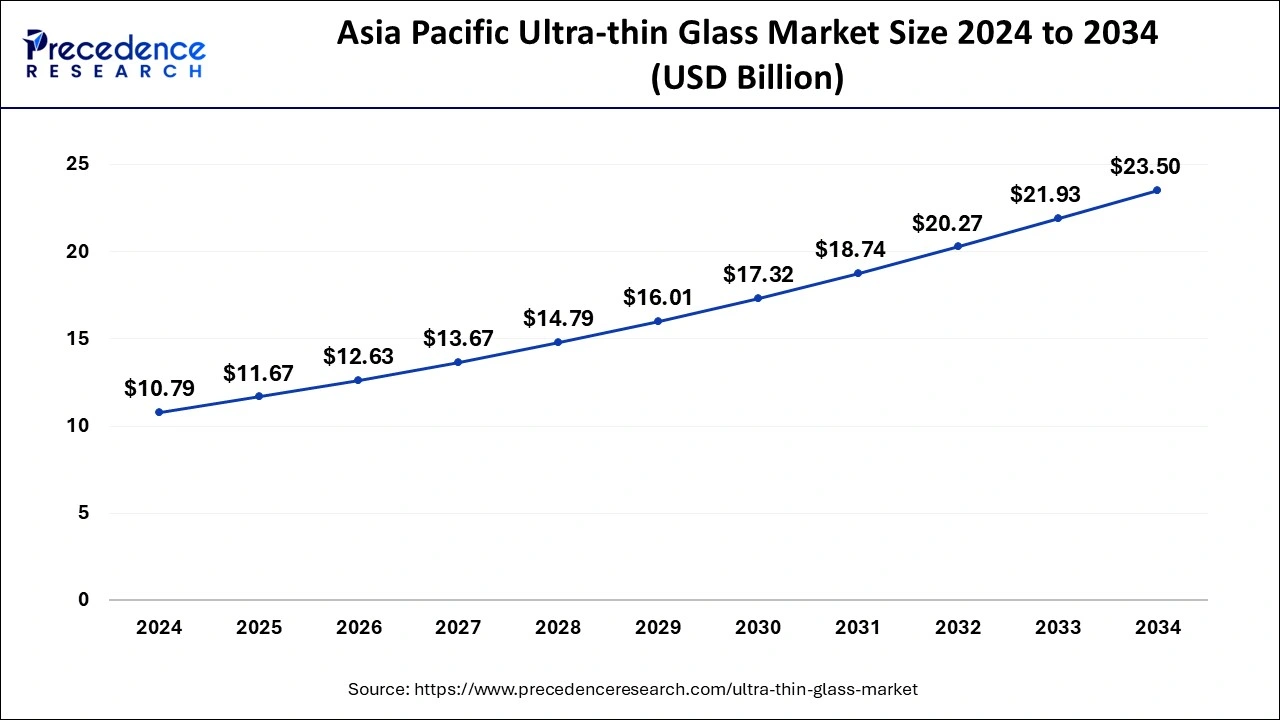
The Asia Pacific ultra-thin glass market size was evaluated at USD 11.67 billion in 2025 and is predicted to be worth around USD 25.13 billion by 2035, rising at a CAGR of 7.97% from 2026 to 2035
Major manufacturing companies of LED and LCD are expanding their regional presence in these countries in order to cater the rising demand of customers. For instance, in May 2018, Corning Inc. introduced its new manufacturing facility for LCD glass substrate in Anhui province, China. The plant is mainly dedicated towards the production of TFT- grade Gen 10.5 substrates that uses Corning's EAGLE XG Slim glass during the manufacturing process. This further anticipated to fuels the growth of the market in the region.
India Ultra-Thin Glass Market Trends
India's ultra-thin glass market is driven by the need for smartphones, tablets, and wearable devices such as smartwatches or fitness bands, which demand lightweight, durable, and touch-sensitive screens. Growing integration of advanced displays in car interiors, sensors, and even IoT-enabled devices is driving market expansion.
Europe to Witness Strong Growth Driven by Renewable Energy
Europe projected to witness prominent growth rate of around 6.5% in terms of value over the upcoming years. Major factors contributing towards the growth of the region are propelling demand for solar energy, LEDs, LCDs, and automotive sectors. The above factor expected to trigger the demand for the product over the upcoming years.
As per the Solar Power Europe, the renewable target set by the region is for the greenhouse gas emission reduction by nearly 40%. In the wake of same, some of the countries in the region for example Germany predicted to increase its capacity of solar energy generation by around 8GW to meet the renewable target. This is further likely to upscale the demand for the product over the analysis timeframe.
Germany Market Trends
Germany is a key contributor within the region, mainly due to its exceptional precision engineering and prominent automotive manufacturing. The Glass 2045 Initiative, backed by the German Federal Ministry for Economic Affairs and Climate Action, emphasizes decarbonizing the glass industry through investments in green hydrogen and electrified manufacturing. German manufacturers also align with EU Green Deal mandates fostering recyclable ultra-thin glass and strict recycling requirements.
How will North America Grow in the Market?
North America is experiencing notable growth in the global market due to high consumer demand for foldable consumer electronics and exceptional federal policies like the CHIPS Act that boost regional microelectronics and semiconductor packaging. Glass materials, which include ultra-thin glass, replace traditional substrates in 5G or 6G microelectronics due to inherently low signal loss and low dielectric constants. The government also promotes advanced glazing through the Inflation Reduction Act of 2022, providing tax incentives for energy-efficient materials.
U.S. plays a distinctive role in the region, characterized by its well-established consumer electronics and semiconductor ecosystems, supported by the CHIPS Act and DOE programs, which directly encourage the development of durable, energy-efficient ultra-thin glass. Many known companies and their innovations, like Corning, are investing in innovations that improve the durability and flexibility of glass for use in advanced technology like foldable smartphones.
How will Latin America be positioned in the Market?
Latin America is positioned as a significantly growing region in the global market, due to the rapid adoption of foldable consumer electronics, rapidly expanding automotive production, and increased deployment of lightweight photovoltaic solar panels, further reinforced by increasing infrastructure and manufacturing investments. Higher smartphone penetration and the increasing demand for sleek, flexible screens in Brazil and Mexico. Projects in high-sunlight regions like Chile and Brazil require specialized ultra-thin glass.
Brazil plays a distinctive role within the region, mainly due to its being a primary source of industrial raw materials and minerals, especially for specialized silica and glass, catering to the consumer electronics and pharmaceutical packaging markets. Strategic trade agreements and strict sanitary regulations from the National Health Agency (ANVISA) also ensure the quality of materials leveraged in these sectors with the desired requirements for medical use and food contact.
How will the Middle East and Africa Grow in the Market?
The Middle East and Africa are a significantly growing region in the global market. This is mainly driven by increasing consumer electronics, mega infrastructure projects, and rapidly increasing investments. Smart cities and Giga-projects in Gulf countries are driving a rapid surge for energy-efficient glazing. Increasing adoption of solar energy leverages ultra-thin glass for photovoltaic and flexible solar modules. Major economic blueprints, especially Saudi Vision 2030, also support expansion of sustainable architecture and solar power.
The UAE plays a pioneering role in the region, characterized by exceptional consumer electronics and smart-city architecture, driven by the demand for its extreme climate and energy-efficient glass. Many government initiatives, including Operation 300bn and the UAE Green Agenda 2030, also encouraged advanced materials research and development and the use of recycled materials in modern infrastructure.
Value Chain Analysis for the Ultra-Thin Glass Market
- Feedstock Procurement
It directly impacts the ability of producers to meet stringent performance requirements, such as scratch resistance, bendability, and optical clarity.
Key Players: SCHOTT AG, Nippon Electric Glass Co., Ltd. / NEG, CSG Holding Co., Ltd. - Chemical Synthesis and Processing
They are vital to the ultra-thin glass (UTG) market, allowing the transformation of fragile, extremely thin glass sheets into durable, flexible, and high-performance components suitable for advanced electronics and even display technologies.
Key Players: SCHOTT AG, Nippon Electric Glass Co., Ltd., Nippon Sheet Glass (NSG) Co., Ltd., CSG Holding Co., Ltd. - Compound Formulation and Blending
It includes the precise, usually proprietary, mixing of raw materials, such as silica, soda lime, and borosilicate, along with specialized additives to tailor the physical, chemical, along with optical properties of glass thinner than 1 mm.
Key Players: Corning Incorporated, SCHOTT AG, AGC Inc., Nippon Electric Glass Co., Ltd.
Top Companies in the Ultra-Thin Glass Market and their offerings
- Nippon Electric Glass: Nippon Electric Glass provides products that are manufactured using overflow forming technology, allowing bendable, roll-to-roll capable, and even chemically strengthened solutions for automotive displays, smartphones, and electronics.
- Luoyang Glass Company: Luoyang Glass Company's products aim at high-tech applications, including display screens, ITO conductive glass, and solar panel components.
- Xinyi Glass: Xinyi Glass offerings involve precision-engineered glass for consumer electronics, automotive displays, and energy-saving applications, funded by advanced coating technologies.
Other Major Key Players
- Corning Incorporated
- AGC Inc.
- CSG Holding Co., Ltd.
- SCHOTT AG
- Changzhou Almaden
- Nippon Sheet Glass Co., Ltd
- Emerge Glass
Segments Covered in the Report
By Application
- Automotive Glazing
- Semiconductors
- Flat Panel Displays
- Others
By Region
- North America
- Europe
- Asia-Pacific
- Latin America
- Middle East & Africa
For inquiries regarding discounts, bulk purchases, or customization requests, please contact us at sales@precedenceresearch.com
Frequently Asked Questions
Tags





Ask For Sample
No cookie-cutter, only authentic analysis – take the 1st step to become a Precedence Research client
 Get a Sample




 sales@precedenceresearch.com
 Schedule a Meeting
