



Flat Glass Market Size, Key Companies, Company Market Share, Production Capacity, Raw Material Pricing, Export & Import Analysis, Manufacturing Cost, Market Share, and Demand Forecast
Flat Glass Market (By Product Type: Tempered, Basic, Insulated, Laminated, Others; By Technology: Float Glass, Sheet Glass, Rolled Glass; By Raw Material: Sand, Soda Ash, Recycled Glass, Dolomite, Limestone, Others; By End-Use: Safety and Security, Solar Control, Others; By Type: Fabricated, Non-Fabricated; By Application: Construction, Automotive, Others) - Global Industry Analysis, Size, Trends, Leading Companies, Regional Outlook, and Forecast 2026 to 2035
Source: https://www.precedenceresearch.com/flat-glass-market
 Get a Sample
 Table Of Content


What is the Flat Glass Market Size?
The global flat glass market size is valued at USD 325.89 billion in 2025 and is predicted to increase from USD 340.98 billion in 2026 to approximately USD 510.78 billion by 2035, expanding at a CAGR of 4.60% from 2026 to 2035. The flat glass market is driven by the expansion in construction and infrastructure activities globally, mainly due to rapid urbanization in emerging economies.
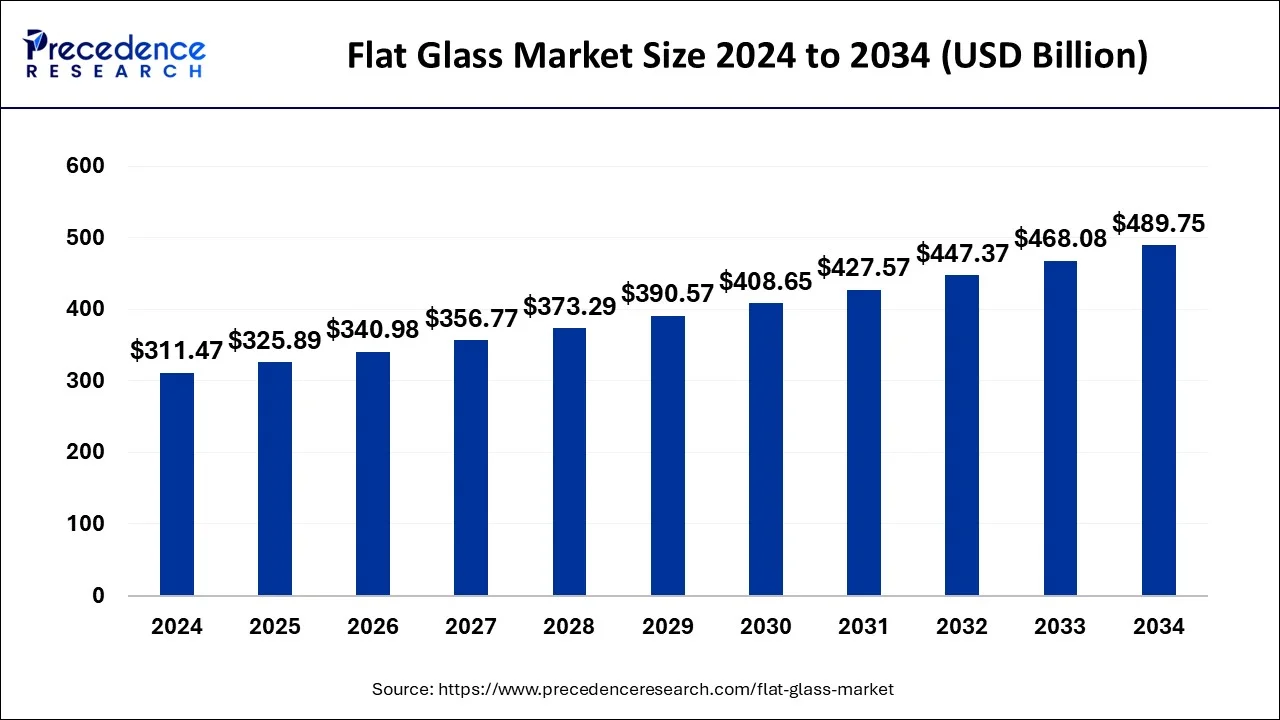
Flat Glass Market Key Takeaways
- The tempered glass market is expected to reach at a CAGR of over 8.8%.
- The laminated glass market is poised to reach at a CAGR of 8.9% from 2026 to 2035.
- The North America flat glass market is projected to hit at a CAGR of over 7.8% between 2026 to 2035.
- The Europe flat glass market is growing at a CAGR over 6.9% from 2026 to 2035.
- The Germany flat glass market is poised to reach at a CAGR of 6.3% from 2026 to 2035.
Market Overview
The flat glass market refers to the manufacturing and distribution of flat glass for various applications, such as in the construction, architecture, and automotive industries. Flat glass is used in the production of cabinet doors, table coverings, furniture, and vehicle components. It provides high structural flexibility and temperature resistance. It is in high demand due to its translucent property, its ability to keep buildings warm, easy to maintain, and is highly customizable for multiple applications.
Key AI Integration in the Flat Glass Industry
Artificial Intelligence (AI) is rapidly integrating into the flat glass industry, mainly to optimize manufacturing processes, improve quality control, and even facilitate the development of smart glass products. This integration is boosted by the demand for increased efficiency, sustainability, along competitiveness amid labor shortages and even growing energy expenses.
By determining data from sensors together with historical performance, AI can forecast equipment failures before they occur. This allows proactive maintenance scheduling, reducing costly downtime and even extending the lifespan of machinery.
Flat Glass Market Market Outlook
- Industry Growth Overview: The flat glass market is growing, driven by rising demand for energy-efficient and smart glass, and regulatory support for renewable energy. Quick urbanization and infrastructure advancement in evolving economies are increasing the demand for flat glass in residential and commercial constructions for windows.
- Global Expansion: The flat glass market is experiencing global expansion, as the expansion of the automotive, construction, and solar energy sectors. Asia Pacific dominated the market due to massive infrastructural advancement, including residential and non-residential buildings.
- Major investors: The major investors in the flat glass market generally include a combination of founding families/insiders, massive institutional asset management organizations, and public retail investors who hold shares in publicly traded organizations.
Flat Glass Market Key Trends
- Smart/Switchable Glass: increasing demand for energy-efficient commercial/public buildings with improved privacy/control of public occupancy through electrochromic/thermochromic flat glass.
- Carbon-neutral Manufacturing: manufacturers utilizing lower-carbon melting processes, hydrogen fuels, and more recycled cullet to comply with new/stricter emission levels by reducing environmental impact.
- Integrated Solar Glass: as more solar installations are going up, so is demand for materials that provide high light transmission for photovoltaic modules.
- Advanced Functional Coatings: increasing growth for low-e, anti-reflective, self-cleaning, and acoustic coatings is allowing value-added applications to be grown across many different types of architecture and for automotive glazing.
- Automation/Industry 4.0 Growth: use of automation to increase production yield rates of flat glass while lowering the production costs through artificial intelligence quality/control systems reviewing production process; predictive furnace maintenance and use of digital twin technology will further increase yield rates.
Global Overview of the Flat Glass Trade
- The volume of Global Flat Glass trade recorded more than 3300 shipments of imports during the past year, with a 50% increase in growth over the previous year.
- The highest importers of flat glass were Bulgaria, Turkey, and the U.S., while the highest exporters were China, Turkey, and the U.S.
- An estimated 800+ exporters to global trade have been reported, and 1100+ active importers are currently importing flat glass, indicating a wide range of demand for flat glass across multiple borders.
Flat Glass Market Growth Factors
Rising penetration of solar energy installations along with supportive government regulations are likely to propel the industry value for flat glass during the upcoming years. Solar energy is the fastest growing renewable energy across the globe with countries racing for asserting their dominance in the burgeoning market. As per the statistics revealed by the Global Change Data Lab, the total installed capacity for solar energy across the world in the year 2019 was 580.76 GW and the capacity grew to 707.50 GW by the year 2020. According to the Solar Energy Industries Association (SEIA), solar energy has registered an annual growth rate of 42% in the last decade and the this is anticipated to grow further during the forecast period.
The accelerating growth of solar energy is prominently supported by the growing demand for electricity coupled with reducing cost of solar installations. For instance, average-sized residential system price has fallen from a pre-incentive price of US$ 40,000 in the year 2010 to US$ 20,000 by the year 2020. Hence, the increasing solar energy demand is intent to propel the market for flat glass during the upcoming years.
Apart from drastic rise solar energy installation, rising penetration of glass architecture in non-residential and residential applications in another major factor that drives the growth of flat glass market over the analysis timeframe. Building & construction sector is one of the major end-user sectors in the global flat glass market. This is mainly because of various developments in the architecture segment.
Market Scope
| Market Scope | Details |
| Market Size in 2025 | USD 325.89 billion |
| Market Size in 2026 | USD 340.98 billion |
| Market Size by 2035 | USD 510.78 billion |
| Growth Rate from 2026 to 2035 | CAGR of 4.60% |
| Base Year | 2025 |
| Forecast Period | 2026 to 2035 |
| Segments Covered | By Product, Application, and Region |
| Regions Covered | North America, Europe, Asia-Pacific, Latin America and Middle East & Africa |
Segments Insights
Product Type Insights
Which Product Type Segment Dominated the Flat Glass Market?
The tempered segment held a dominant position in the market in 2025 as tempered glasses are five times stronger than annealed glasses. Flat tempered glass is heat-treated safety glass that is used across multiple applications. It has also greater resistance to thermal stress and bear high temperatures up to 290 oC. Tempered flat glass are safer as their particles don't harm after breakage. It is widely used for architectural glazing, interior design, vehicle windows, and electronic screen protectors.
The insulated segment is expected grow at the fastest CAGR in the market between 2026 and 2035. Insulated glass contains two or more glass panes separated by a tight spacer to provide an air tight seal. It has thermal insulating properties, reducing the transfer of heat between a building's inside and outside area. It offers other benefits, such as enhanced comfort, high energy efficiency, and environmental benefits.
Technology Insights
Why did the Float Glass Segment Dominate the Flat Glass Market?
The float glass segment held the largest market share in 2025 and is expected to grow with the highest CAGR in the market during the studied years due to its high clarity, easy to process, and high durability. Float glass is made by floating molten glass on a bed of molten metal, such as tin. Due to its high optical clarity, float glass is used in windows, mirrors, tabletops, picture frames, and shower enclosures. Additionally, float glass is easily customizable in terms of its appearance.
Raw Material Insights
How the Sand Segment Dominated the Market?
The sand segment dominated the market in 2025 since sand is the primary source of silicon dioxide. The preparation of flat glass requires a high proportion of silica and a high level of chemical purity. The composition of silica in sand determines the transparency, strength, and durability of a flat glass. Sand is acquired from fossil beach, river, lake, or wind deposit for preparing flat glass due to their desired chemical and physical properties.
The recycled glass segment is expected to expand rapidly in the market in the coming years due to the growing demand for environmental sustainability, reducing the use of raw materials. Governments of different nations launch initiatives to support circular economy, which involves closed loop recycling of flat glass to divert waste from landfills. Recycled glass or cullet is believed to reduce energy consumption and significantly decrease carbon emissions.
End-Use Insights
Which End-Use Segment Led the Flat Glass Market?
The safety and security segment led the market in 2025 due to the high strength and durability of flat glass. Flat glass is used for safety and security purpose to ensure additional protection against external impact. Flat glass can be modified, laminated, or reinforced with polycarbonate or wire mesh to ensure optimal security. Laminated safety glass has become an essential component in modern architecture and construction.
The solar control segment is expected to witness the fastest growth in the market over the forecast period. Solar control glass is a specially coated glass used to reduce the amount of heat entering the building. It absorbs and reflects the sun's rays and helps control the glare. It is most commonly used in the construction of domestic and commercial buildings for roofs, windows, skylights, and façades.
Type Insights
Why did the Fabricated Segment Dominate the Flat Glass Market?
The fabricated segment contributed the biggest market share in 2025 and is expected to sustain its dominance over the studied period due to its widespread use across building and design projects. Fabrication of flat glass refers to undergoing a secondary processing to improve its strength, safety, and thermal efficiency. Common fabrication methods include tempering, laminating, coating, and insulating.
Application Insights
What Made Construction the Dominant Segment in the Market?
The construction segment accounted for the highest market share in 2025 due to increasing government construction projects and rising incentives from government and private organizations. The construction sector drives economic growth, with robust infrastructure investments, expanding logistics, and a focus on sustainable development. Flat glass serves as the base for processed products, such as tempered, laminated, and low e-glass in structural facades, windows, and curtain walls.
The automotive segment is expected to grow significantly during the forecast period, due to the increasing demand for electric vehicles, growing preference for aesthetic cars, and the rising production of automobiles. Flat glass is used for vehicle windshields, rear glass, side windows, and sunroofs, ensuring passenger safety.
Regional Insights
What is the Asia Pacific Flat Glass Market Size?
The Asia Pacific flat glass market size is exhibited at USD 192.28 billion in 2025 and is expected to be worth around USD 304.62 billion by 2035, rising at a CAGR of 4.71% from 2026 to 2035.
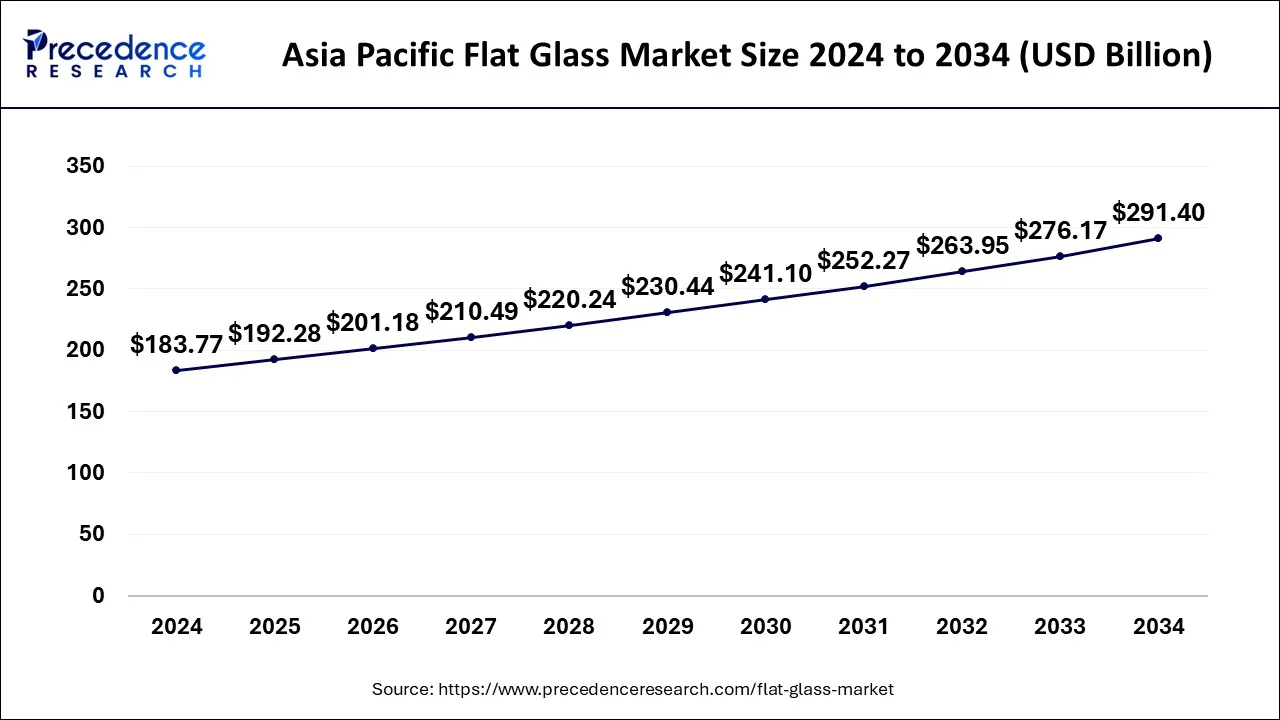
The Asia Pacific leads the global flat glass market and accounted for more than 59% of revenue share in the year 2025. This is primarily because of rapid infrastructural development in the developing nations across the Asia Pacific.
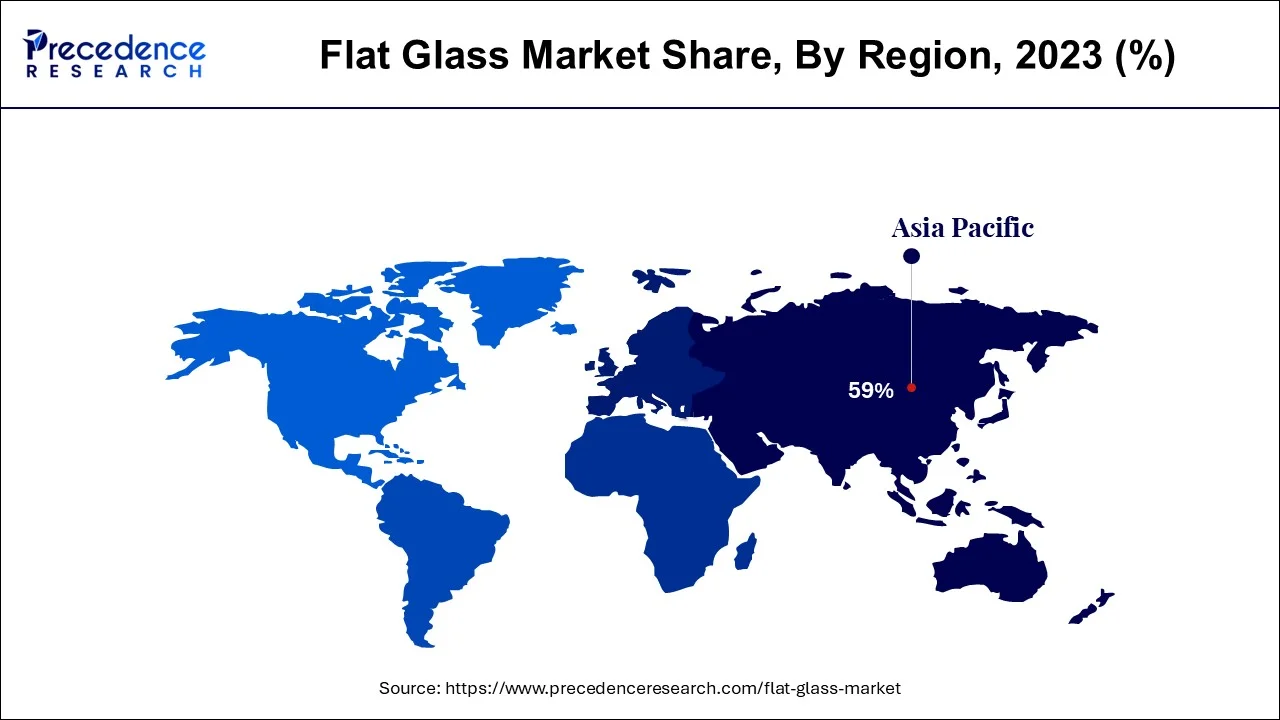
Increasing investment in advanced infrastructure
Asian Development Bank has quoted that the Asia Pacific region needs to invest US$ 1.7 trillion per year on its infrastructure till 2034 in order to retain its growth momentum. In terms of sectors, power sector accounted for nearly 56% of the total infrastructure investment, transport 32%, water & sanitation 3%, and telecommunications accounted for 9%. Among all Asian nations, Southeast Asia is the most emerging region because of rapid development in the manufacturing, automotive, construction, and various other industries.
China: Rapid urbanization and infrastructure development
China has a massive domestic demand from fast urbanization, infrastructure projects, and a massive automotive sector, as well as government initiatives that promote large-scale construction and energy-efficient materials. An increasing middle class with rising disposable incomes also drives demand for premium and aesthetically pleasing glass products.
Government regulations and green building
North America is the fastest-growing market in market as significant spending in residential, commercial, and infrastructure projects creates massive demand for flat glass in facades, windows, and partitions. Stringent regulations and regulatory programs, like LEED certification, encourage the application of energy-efficient products such as low-E and insulated glass. This focus on sustainability is a major driver for the market.
U.S.: Technological advancements
In the U.S., growing manufacturing of vehicles, specifically electric and advanced models, drives the demand for specialized flat glass, such as lightweight and smart glass services for windshields, windows, and sunroofs. There is a robust emphasis on research and development to produce advanced, high-performance flat glass, which drives the growth of the market.
Europe: Technological advancements
Europe is experiencing substantial growth in the market due to the region is a leader in emerging and adopting novel technologies, like vacuum-insulated units, smart glass, and coated glass, to meet market requirements for energy conservation and performance. The European construction area's push for sustainability directly drives the market for high-performance architectural glazing, as mandated by construction codes in countries such as Germany, France, and the UK.
UK: Technological Advancements
In the UK growing use of flat glass in modern architectural enterprises for commercial buildings, plus facades, windows, and interior partitions, drives market growth. Initiatives such as the Smart Export Guarantee (SEG) have increased demand for dedicated, high-value flat glass applied in solar panels, driving a shift toward sustainability.
Latin America's Clear Outlook: Emerging Growth Shapes the Flat Glass Market
Latin America's flat glass market is experiencing emerging growth driven by rising construction activity, expanding urbanization, and increasing investments in infrastructure development. Growing demand from the residential and commercial building sectors, along with the adoption of energy-efficient and solar-control glass, is supporting market expansion. Additionally, the recovery of the automotive industry and the gradual shift toward sustainable building materials are creating new opportunities for flat glass manufacturers across the region.
Brazil Flat Glass Market Trends
Brazil's market is witnessing steady growth, supported by rising construction activity, infrastructure modernization, and gradual recovery in the automotive sector. Increasing demand for energy-efficient, tempered, and laminated glass in residential and commercial buildings is driving product innovation and capacity utilization. Additionally, growing adoption of solar control and low-emissivity glass, aligned with sustainability goals and energy-saving regulations, is enhancing market prospects.
Will the Middle East and Africa Grow in the Flat Glass Market?
The Middle East and Africa region is expected to grow at a notable CAGR during the forecast period due to rapidly expanding construction and automotive industries and favorable government policies. The region witnesses a large number of commercial real estate and infrastructure projects, promoting the demand for flat glass. Government bodies launch sustainability initiatives to encourage stakeholders to focus on energy-efficient materials. The region has an established infrastructure to manufacture flat glass, fulfilling local needs.
UAE Market Trends
The UAE market is driven by large-scale architectural projects, a rapidly expanding automotive sector, and increasing investments by government organizations. The UAE records the highest number of high-rise buildings, accounting for approximately 5.4 million. The increasing number of registered vehicles also contributes to market growth. During daytime, the number of vehicles on the roads in Dubai reaches 3.5 million.
Value Chain Analysis – Flat Glass Market
Raw Material
The raw materials for flat glass involve silica sand, soda ash, and limestone, along with other additives such as dolomite and recycled glass.
- Key Players: AGC Inc. and Saint-Gobain
Chemical Synthesis and Processing
Flat glass is produced application of the float glass process, where a particular combination of raw materials (predominantly silica sand, soda ash, and limestone) is melted in a furnace and then floated onto a bath of molten tin to form a flawlessly flat and uniform sheet.
- Key Players: Nippon Sheet Glass (NSG) Co., Ltd.
Compound Formulation and Blending:
Flat glass is significantly a soda-lime-silica glass with a particular chemical composition and an exact, automated blending process to confirm quality and uniformity.
- Key Players: Guardian Industries and Fuyao Glass Industry Group
Competitive Landscape
The flat glass market is semi-consolidated, with the presence of flat glass manufacturers, processors, distributors, fabricators, glazing contractors, and machinery suppliers. Cardinal Glass Industries, AGC Inc., Asahi Kasei, Nippon Sheet Glass Co., Ltd, AIS Glass, Saint-Gobain, and ÅžiÅŸecam are major players involved in flat glass.
The flat glass industry faces formidable challenges, such as high energy intensity, decarbonization barriers, and recycling infrastructure deficits. The future of the industry is driven by a shift towards energy efficiency and green architecture. The increasing incentives by government bodies facilitate the growth of the construction sector.
Top Vendors in the Flat Glass Market & Their Offerings
|
Company |
Headquarters |
Key Strengths |
Latest Info (2025) |
|
Japan |
Extensive R&D capabilities |
Central Glass Ltd. continues to offer a variety of architectural flat glass products. |
|
|
Japan |
Strong foundation in Innovation |
In October 2025, AGC Glass Europe and SOLAR MATERIALS announced a strategic partnership to advance PV flat glass circularity. |
|
|
Cevital Group |
Algeria |
Extensive diversification |
Cevital Group strengthens its presence in France through the launch of new industrial projects. |
|
Euroglas |
Ujazd Poland |
Innovative glass solutions |
Euroglas serves the construction market in the Benelux countries with tailor-made glass. |
|
China Glass Holding Ltd. |
China |
Strong research and development capabilities for innovation |
The industry is focusing on innovations such as energy-efficient and smart glass. |
Other Major Key Players
- Fuyao Glass Industry Group Co., Ltd.
- Xinyi Glass Holdings
- Nippon Sheet Glass Co., Ltd.
- Guardian Industries
- ?i?ecam Group
- Saint-Gobain
- Vitro
Recent Developments
- In November 2025, Ukraine, with support from the World Bank, signed an agreement between the International Finance Corporation (IFC) and NovaSklo to launch the country's first high-tech float-glass production plant. The plant aims to localize production, support reconstruction projects, and strengthen the domestic industrial base. (Source: https://odessa-journal.com)
- In September 2025, Obeikan Glass and Liaoning Zhongyuan collaborated to launch a second float glass line in Yanbu, Saudi Arabia. The launch aims to strengthen Obeikan Glass's industrial presence and will have a capacity of 650 tpd. (Source: https://www.glass-international.com)
- In October 2023, Vitro declared that it had signed an additional contract with First Solar to offer high-tech glass front sheets for the solar panels, which First Solar manufactures in North America. Vitro will now invest nearly USD 180 million in adapting its current facilities to meet the requirements of the new contract expansion. (Source: vitroglazings.com)
- On August 13, 2025, Saint-Gobain began construction of its 7th float glass line and associated insulation production lines in Oragadam, Chennai. The production line aims to boost local capacity (1,000 tonnes/day) while integrating advanced digital controls and energy-efficient technologies to enhance operational performance. (https://www.glassonweb.com)
Segments Covered in the Report
By Product Type
- Tempered
- Basic
- Insulated
- Laminated
- Others
By Technology
- Float Glass
- Sheet Glass
- Rolled Glass
By Raw Material
- Sand
- Soda Ash
- Recycled Glass
- Dolomite
- Limestone
- Others
By End-Use
- Safety and Security
- Solar Control
- Others
By Type
- Fabricated
- Non-Fabricated
By Application
- Construction
- New
- Refurbishment
- Interior
- Automotive
- OEM
- Aftermarket
- Others
By Region
- North America
- U.S.
- Canada
- Europe
- U.K.
- Germany
- France
- Asia Pacific
- China
- India
- Japan
- South Korea
- Rest of the World
For inquiries regarding discounts, bulk purchases, or customization requests, please contact us at sales@precedenceresearch.com
Frequently Asked Questions
Tags





Ask For Sample
No cookie-cutter, only authentic analysis – take the 1st step to become a Precedence Research client
 Get a Sample




 sales@precedenceresearch.com
 Schedule a Meeting
