Vane Anemometers Market Size, Share and Trends 2026 to 2035

Vane Anemometers Market (By Product Type: Handheld Vane Anemometers, Fixed/Wall-Mounted Vane Anemometers, Portable Vane Anemometers, Wireless/IoT-Enabled Vane Anemometers; By Application: HVAC System Monitoring, Industrial Process Monitoring, Environmental & Meteorological Monitoring, Research & Laboratory Use, Cleanrooms & Indoor Air Quality; By End-User Sector: Industrial Facilities, Commercial Buildings, Residential Users, Meteorological/Weather Stations, Research & Academic Institutions; By Technology/Feature Type: Analog/Basic Devices, Digital Vane Anemometers, Smart/IoT-Connected Vane Anemometers; By Distribution Channel: Direct Sales, Distributors & Resellers, Online/E-commerce Platforms) - Global Industry Analysis, Size, Trends, Leading Companies, Regional Outlook, and Forecast 2026 to 2035

Last Updated : 05 Dec 2025  |  Report Code : 7177  |  Category : Semiconductor and Electronic   |  Format : PDF / PPT / Excel
Revenue, 2025
USD 290.85 Mn
Forecast Year, 2035
USD 492.59 Mn
CAGR, 2026 - 2035
5.41%
Report Coverage
Global

What is the Vane Anemometers Market Size?

The global vane anemometers market size is estimated at USD 290.85 million in 2025 and is predicted to increase from USD 306.58 million in 2026 to approximately USD 492.59 million by 2035, expanding at a CAGR of 5.41% from 2026 to 2035. The vane anemometers market is driven by the rising demand for accurate airflow measurement across industrial, HVAC, and environmental monitoring applications.
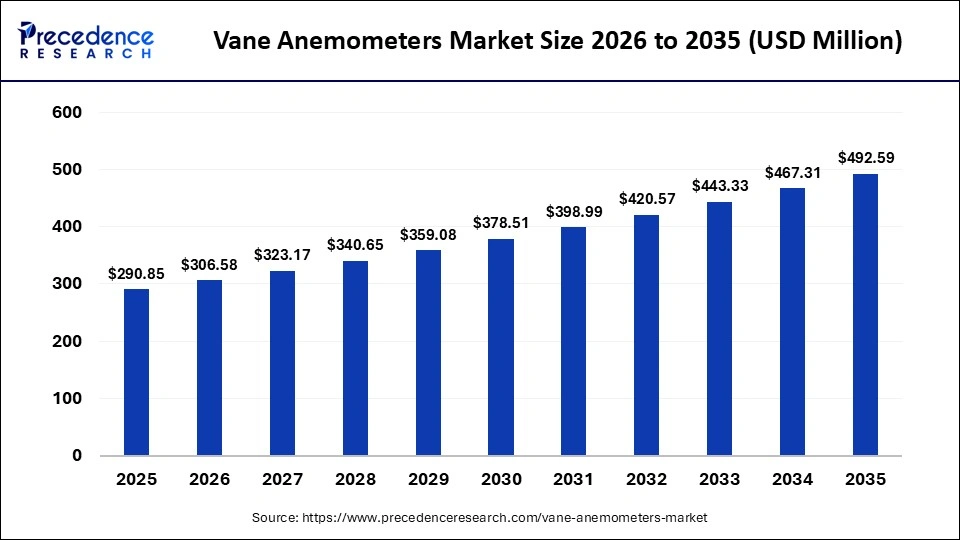
Vane Anemometers Market Size 2026 to 2035

Market Highlights

  • North America dominated the market with more than 35% of market share in 2025.
  • The Asia Pacific is expected to grow at the fastest CAGR of 7.60% in the market between 2026 and 2035.
  • By product type, the handheld vane anemometers segment contributed the highest market share of 45% in 2025.
  • By product type, the wireless / IoT-enabled vane anemometers segment is growing at a notable CAGR of 7% between 2026 and 2035.
  • By application, the HVAC system monitoring segment contributed the largest market share of 40% in 2025.
  • By application, the environmental & meteorological monitoring segment is expected to grow at a CAGR of 8% between 2026 and 2035.
  • By end-user sector, the industrial facilities segment captured the biggest market share of 38% in 2025.
  • By end-user sector, the meteorological / weather stations segment is expanding at a remarkable CAGR between 2026 and 2035.
  • By technology/feature type, the digital vane anemometers segment accounted for the highest market share of 50% in 2025.
  • By technology/feature type, the smart / IoT-connected vane anemometers segment is growing at the fastest CAGR of 11.20% between 2026 and 2035.
  • By distribution channel, the direct sales (B2B) segment generated the biggest market share of 70% in 2025.
  • By distribution channel, the online / e-commerce platforms segment is expected to grow at the strong CAGR of 10.50% between 2026 and 2035.

From HVAC to Environmental Monitoring: Vane Anemometers Market Forecast

Vane anemometers are fine-tuning devices that measure wind speed and airflow velocity through rotating vanes or propeller-like components. These gadgets are used for basic testing of HVAC systems, monitoring ventilation, indoor air testing, industrial process optimization, environmental research, and evaluating wind-energy sites. They assist in crucial decision-making in areas such as pollution monitoring and equipment checks because of their flexibility, ease of use, and ability to deliver real-time, accurate measurements. The market is expanding as technology improves durability, portability, and precision to meet the demands of digital environments and sustainability-focused industries.

The increased adoption of ventilation standards in workplaces, hospitals, and educational institutions, along with stricter global Indoor Air Quality (IAQ) regulations, is boosting demand for precise airflow monitoring devices. Additionally, the rapid development of energy-efficient HVAC systems, driven by concerns over carbon reduction and rising electricity costs, is encouraging building engineers to use vane anemometers as a tool to optimize system performance and achieve balance. Further advancements in renewable energy projects and environmental monitoring initiatives position vane anemometers at the center of numerous new sustainable infrastructure endeavors.

How is AI Integration Transforming the Vane Anemometers Market?

The integration of artificial intelligence is significantly transforming the vane anemometer market by improving accuracy, predictability, and real-time decision-making in airflow measurement. AI-based algorithms are increasingly popular for sensor drift correction, noise reduction, and data calibration, ensuring more precise airflow readings in critical environments like clean rooms, industrial ventilation systems, and HVAC diagnostics. Intelligence-driven analytics systems also convert raw airflow data into actionable insights, supporting energy optimization, indoor air quality management, and environmental compliance. AI-powered vane anemometers are becoming essential tools in smart buildings, industries, and automation-driven operations, helping create more sustainable environments.

Vane Anemometers Market Outlook

The vane anemometers market is expected to grow at the fastest rate between 2025 and 2034 because industries require accurate airflow measurements for safety, HVAC performance, and regulatory compliance. The growth is further driven by expanding applications in manufacturing, clean rooms, and environmental monitoring.


The market is expanding worldwide due to stringent indoor air quality regulations and increased investment in more energy-efficient building systems. Emerging regions like Asia Pacific, Latin America, and the Middle East & Africa offer significant market opportunities due to expanding industrialization and infrastructure modernization.


Major investors in the market include manufacturers of environmental monitoring equipment, HVAC system providers, industrial automation companies, and venture-backed sensor technology firms. They contribute by funding R&D for more accurate and durable instruments, expanding production capabilities, and driving adoption across sectors such as manufacturing, renewable energy, and building management systems.


Market Scope

Report Coverage Details
Market Size in 2025 USD 290.85 Million
Market Size in 2026 USD 306.58 Million
Market Size by 2035 USD 492.59 Million
Market Growth Rate from 2026 to 2035 CAGR of 5.41%
Dominating Region North America
Fastest Growing Region Asia Pacific
Base Year 2025
Forecast Period 2026 to 2035
Segments Covered Product Type, Application, End-User Sector, Technology/Feature Type, Distribution Channel, and Region
Regions Covered North America, Europe, Asia-Pacific, Latin America, and Middle East & Africa

Vane Anemometers Market Segment Insights

Product Type Insights

The handheld vane anemometers segment dominated the vane anemometers market, accounting for 45% in 2025, as they are widely used in HVAC testing, industrial ventilation testing, field testing, and environmental testing. They are preferred for their portability, ease of use, and ability to provide immediate measurements for technicians, engineers, and auditors who need quick, on-site airflow evaluations. The increased demand for energy-efficiency audits, routine HVAC maintenance, and growing awareness of indoor air quality standards also bolstered segmental growth. The segmental dominance is further supported by improvements in ergonomics, displays, multiparameter sensing, and affordability, which promote greater adoption.

The wireless / IoT-enabled vane anemometers segment is expected to grow at a 7% CAGR over the forecast period. This is mainly due to their widespread use in intelligent buildings, clean rooms, industrial process automation, and energy optimization systems. They record data remotely, connect to the cloud, and continuously monitor the environment. They also transmit high-frequency airflow data directly to centralized dashboard displays, enhancing transparency and predictive maintenance of operations. The demand is growing as the use of Industry 4.0, IoT-based HVAC controls, and smart environmental monitoring solutions is on the rise.

The fixed / wall-mounted vane anemometers segment is expected to grow significantly in the upcoming period due to their widespread use in laboratory setups, pharmaceutical clean rooms, industrial ventilation, and data centers. They are permanent, ensuring continuous and extensive monitoring of air velocity to uphold safety, sterility, and energy efficiency standards. Additionally, these devices are compatible with automated HVAC control systems and can provide stable data to optimize performance and evaluate the indoor environments quality.


Application Insights

The HVAC system monitoring segment dominated the vane anemometers market with a 40% share in 2025 because of the essential role vane anemometers play in ensuring airflow balance, accuracy, and efficiency in ventilation for residential, commercial, and industrial buildings. Increasing concerns about indoor air quality (IAQ), stricter building efficiency standards, and the growing popularity of smart HVAC controllers are key factors that support the segment dominance. Vane anemometers are used to verify airflow within ducts, address ventilation problems, and improve system performance during installation and maintenance.

The environmental & meteorological monitoring sector is expected to grow at a 8% CAGR in the upcoming years due to increased funding for weather stations, pollution monitoring networks, and climate research initiatives. Vane anemometers are vital for measuring wind speed, airflow patterns, and turbulence in both open and semi-closed environments, aiding in accurate environmental assessment. Greater awareness of climate change, stricter environmental reporting standards, and broader adoption of precision agriculture technology are boosting demand for vane anemometers for environmental monitoring. Their field-ready design, accuracy, and portability make them essential tools for meteorologists, environmental agencies, and research institutions.

The industrial process monitoring segment is expected to grow significantly over the projection period because industries need accurate airflow measurements to enhance equipment efficiency, ensure worker safety, and meet environmental regulations. Vane anemometers are commonly used in manufacturing plants, chemical processing facilities, mines, and power plants to measure exhaust ventilation, cooling airflow, and contamination control. The push toward automation and predictive maintenance further drives demand, with companies integrating airflow sensing into intelligent monitoring systems to reduce downtime, increase operational reliability, and conserve energy.


End-User Sector Insights

The industrial facilities segment led the vane anemometers market with about 38% share in 2025. This is mainly due to the critical role of vane anemometers in ensuring ventilation efficiency, worker safety, and process optimization in manufacturing settings. The relevance of accurate airflow measurements to industries is high, as they help regulate emissions, manage particulate levels, and ensure sensitive equipment operates at peak performance. The trend toward the adoption of automated monitoring systems, more stringent occupational safety norms, as well as the emphasis on energy-efficient operations reinforced the demand.

The meteorological weather stations segment is expected to grow at the fastest CAGR during the forecast period due to its extensive applications in climate monitoring, HVAC management, and environmental assessment. Meteorological departments require high-precision instruments to determine wind patterns for forecasting and climate studies. In weather stations, vane anemometers help balance airflow, improve indoor air quality, and optimize energy use, issues that are critically important as sustainability standards rise. Increasing demand is also driving the expansion of smart building infrastructure and the adoption of automated environmental monitoring systems.

The commercial buildings segment is expected to grow significantly in the coming years. Devices like vane anemometers are essential in commercial buildings to ensure optimal ventilation efficiency, energy conservation, and occupant comfort. They help measure airflow accurately within HVAC systems and assist facility managers in detecting imbalances, maintaining air quality, and meeting the evolving demands of building performance. The rising demand for airflow monitoring is driven by the increasing focus on green building certifications, the expansion of smart building solutions, and the boost in retrofitting projects. Businesses and governments aim to reduce operational energy costs and enhance indoor environmental quality.


Technology/Feature Type Insights

The digital vane anemometers segment led the market with a 50% share in 2025, as they offer superior accuracy, ease of use, and data logging capabilities. Digital devices are favored in industries because they enable real-time monitoring, rapid diagnostics, and enhanced reliability in airflow determination. Their integration with current industrial automation systems and their capacity to archive and transmit information enhanced adoption in manufacturing, heating, ventilation, and air conditioning systems.

The smart/IoT-connected vane anemometers segment is expected to grow at the fastest CAGR of 11.20%. during the projection period, as industries are adopting connected monitoring solutions. These devices enable remote, continuous, and uninterrupted airflow monitoring, accessible via cloud services and mobile apps. They are integrated into predictive maintenance systems and smart building management, providing real-time feedback and improving performance. As sustainability practices increase and organizations emphasize energy efficiency, the demand for IoT-enabled airflow monitoring is growing.

The analog/basic devices segment is expected to grow at a significant rate in the upcoming years. Basic or analog vane anemometers are useful because they are cheaper, more durable. The applications of these devices are predominantly in the educational process, for small-scale HVAC checks and field tests, as well as for simple airflow measurements. Some industrial customers also appreciate that they are operate in inhospitable conditions without using batteries or digital components. However, analog vane anemometers are still used as economical solutions for simple, everyday airflow measurement tasks.


Distribution Channel Insights

The direct sales (B2B) segment dominated the vane anemometers market with a 70% share in 2025, driven by strong relationships between manufacturers and industrial clients. This enables customized solutions and bulk orders. Businesses prefer direct purchases to ensure product authenticity, technical support, and smooth integration with existing systems. Additionally, direct sales allow manufacturers to offer competitive prices, tailored after-sales services, and faster delivery, strengthening their market share in the B2B sector. Distributors also provide extensive regional coverage, expedited delivery, and local services, making them the preferred channel for professionals when procuring these products.

The online/e-commerce platforms segment is expected to grow at a 11.50% CAGR over the forecast period due to the increasing adoption of e-commerce platforms by industrial buyers and research institutions seeking convenience and wider product availability. Online channels offer easy access to detailed product specifications, competitive pricing, and customer reviews, helping buyers make informed decisions quickly. Additionally, the growth of digital procurement and remote ordering systems in industries is accelerating the shift toward online purchases for efficient and timely procurement of measurement instruments.

The distributors & resellers segment is expected to grow significantly in the coming years, as they play a key role in supplying vane anemometers to the regional market, especially where manufacturers have limited supplies in direct markets. They provide localized inventory, technical support, demonstrations, calibration assistance, and quick service: features highly valued among industrial and commercial users. Their close connections with HVAC contractors, maintenance service firms, and environmental testing companies enable them to regularly demand products. Although this segment is similar to direct sales outlets, its independent reseller networks are used to reach more markets, build brand presence, and deliver products to the last mile without issues.


Vane Anemometers Market Regional Insights

The North America vane anemometers market size is estimated at USD 101.80 million in 2025 and is projected to reach approximately USD 174.87 million by 2035, with a 5.56% CAGR from 2026 to 2035.

North America Vane Anemometers Market Size 2026 to 2035

Why Did North America Lead the Global Vane Anemometers Market in 2025?

North America led the global market with the highest share of 35% in 2025, driven by its highly developed industrial system, extensive use of HVAC systems, and strict regulations on ventilation in workplaces and environmental monitoring. Industries such as manufacturing, aerospace, pharmaceuticals, automotive, and energy require precise airflow measurement to ensure safety and efficiency. Additionally, the region benefits from early adoption of digital and IoT-powered airflow monitoring tools, supported by a well-established technological infrastructure and widespread awareness of energy optimization. The development of smart building solutions, cleanrooms, and sustainability-focused projects has also contributed significantly to the regions dominance.


The U.S. vane anemometers market size is calculated at USD 76.35 million in 2025 and is expected to reach nearly USD 132.03 million in 2035, accelerating at a strong CAGR of 5.63% between 2026 and 2035.

U.S. Vane Anemometers Market Size 2026 to 2035

U.S Vane Anemometers Market Analysis

The U.S. is a major contributor to the North American vane anemometers market due to its well-established industrial activities, HVAC services, and strong focus on air quality and safety standards. The aerospace, biotechnology, semiconductors, and automotive industries rely heavily on precise airflow measurement to ensure controlled conditions and comply with strict management regulations. Additionally, the U.S. leads in wind power installation, laboratories, and cleanrooms. The development of digital, smart, and data-logging anemometers shows that the country is technologically prepared.

Vane Anemometers Market Share, By Region, 2025 (%)

Asia Pacific is expected to grow at the fastest CAGR of 7.60% during the forecast period. This is mainly due to the high demand for vane anemometers, driven by rapid industrialization, growth in electronics and semiconductor manufacturing, and increased infrastructure investment in China, India, South Korea, and Southeast Asia. Due to stricter regulations and greater focus on worker safety, the region is seeing increased adoption of advanced HVAC systems, cleanrooms, and environmental monitoring solutions. Additionally, greater awareness of indoor air quality in commercial spaces and the expansion of smart city and smart building projects support market growth. The declining cost of digital devices and increased local production further boost momentum in Asia Pacific.

China Vane Anemometers Market Trends

In China, vane anemometers are in high demand due to rapid industrial growth, an expanding manufacturing sector, and increased investments in automation systems and quality control. The strong HVAC market in the country, driven by urbanization, commercial building development, and greater awareness of indoor air quality, is significantly boosting demand for airflow measuring devices. Additionally, tightening government regulations concerning workplace safety, emissions, and ventilation are encouraging the wider adoption of advanced digital and smart anemometers. China excels in local production and cost-effective technological innovation, strengthening its position as a major market and global supplier.


The European vane anemometers market is witnessing notable growth due to high regulatory standards in the region, a focus on ecological sustainability, and a high level of industrialization. EU guidelines on energy efficiency, ventilation quality, emissions, and indoor air quality are being implemented across a wide range of commercial buildings, factories, laboratories, and clean rooms. The established HVAC market and the current burst of green building projects also demand accurate airflow measurement tools in Europe. Also, the regions leadership in renewable energy, specifically wind energy projects, creates a stable market for accurate wind and airflow monitoring devices. The increasing use of IoT-enabled devices, the ongoing modernization of industrial facilities, and a greater understanding of the importance of workplace safety are further reinforcing the stable growth of the European market.

UK Vane Anemometers Market Trends

The UK vane anemometers market is driven by high demand for HVAC services, building management systems, and environmental monitoring. As the nation becomes more concerned with energy conservation, the retrofitting of older buildings, and adherence to ventilation principles, including those emphasized in the context of post-pandemic indoor air quality efforts, vane anemometers find more applications across commercial and community infrastructure. The active construction sector and the UK strict regulatory frameworks on workplace safety and emissions also support adoption. Also, constant investment in renewable energy and highly developed research centers increases the need for accurate airflow measurement devices.


Vane Anemometers Market Companies

Specializes in Testo 410i and Testo 416 vane anemometers, which are used to provide high-precision measurements of airflow, volume flow, and temperature to HVAC professionals.


Provides heavy-duty airflow instruments such as the Fluke 925 Vane Anemometer, which is used to test and diagnose industrial ventilation and to maintain.


OMEGA Engineering has come up with versatile models, including the HHF1000 series, which is a combination of vane airflow measurement, temperature, and data-logging functions.


TSI has the recent equipment, including VelociCalc 5725, that is very accurate in measuring airflow, temperature, and humidity in clean rooms and laboratories.


Provides low-priced instruments like the ultra-popular Extech 45118 and AN300 series that are utilized to accomplish HVAC airflow, CFM, and environmental monitoring tasks.


Other Major Companies

  • Vaisala
  • Siemens AG
  • PCE Instruments
  • Gill Instruments
  • FT Technologies
  • Lufft
  • NRG Systems
  • Kanomax USA Inc.
  • Davis Instruments
  • Adolf Thies GmbH & Co. KG
  • Campbell Scientific
  • Kusam-Meco
  • Lutron Electronic
  • Dwyer Instruments
  • Biral Ltd.

Recent Development

  • In September 2023, SparkFun released its ESP32-based Arduino IoT Weather Station kit, which includes both a vane anemometer and a cup anemometer to enable accurate wind measurements. The system gathers real-time data on wind speed and direction, all connected through the Arduino IoT Cloud.(Source: https://www.cnx-software.com)

Vane Anemometers MarketSegments Covered in the Report

By Product Type

  • Handheld Vane Anemometers
  • Fixed/Wall-Mounted Vane Anemometers
  • Portable Vane Anemometers-
  • Wireless/IoT-Enabled Vane Anemometers

By Application

  • HVAC System Monitoring
  • Industrial Process Monitoring
  • Environmental & Meteorological Monitoring
  • Research & Laboratory Use
  • Cleanrooms & Indoor Air Quality

By End-User Sector

  • Industrial Facilities
  • Commercial Buildings
  • Residential Users
  • Meteorological/Weather Stations
  • Research & Academic Institutions

By Technology/Feature Type

  • Analog/Basic Devices
  • Digital Vane Anemometers
  • Smart/IoT-Connected Vane Anemometers

By Distribution Channel

  • Direct Sales (B2B)
  • Distributors & Resellers
  • Online/E-commerce Platforms

By Region

  • North America
  • Europe
  • Asia-Pacific
  • Latin America
  • Middle East & Africa

For inquiries regarding discounts, bulk purchases, or customization requests, please contact us at sales@precedenceresearch.com

Frequently Asked Questions

Answer : The vane anemometers market size is expected to increase from USD 290.85 million in 2025 to USD 492.59 million by 2035.

Answer : The vane anemometers market is expected to grow at a compound annual growth rate (CAGR) of around 5.41% from 2026 to 2035.

Answer : The major players in the vane anemometers market include Vaisala, Siemens AG, PCE Instruments, Gill Instruments, FT Technologies, Lufft (OTT Hydromet), NRG Systems, Kanomax USA Inc., Davis Instruments, Adolf Thies GmbH & Co. KG, Campbell Scientific, Kusam-Meco, Lutron Electronic, Dwyer Instruments, and Biral Ltd.

Answer : The driving factors of the vane anemometers market are the rising demand for accurate airflow measurement across industrial, HVAC, and environmental monitoring applications.

Answer : North America region will lead the global vane anemometers market during the forecast period 2026 to 2035.

Ask For Sample

No cookie-cutter, only authentic analysis – take the 1st step to become a Precedence Research client

Meet the Team

With over 14 years of experience, Aditi is the powerhouse responsible for reviewing every piece of data and content that passes through our research pipeline. She ensures the accuracy, relevance, and clarity of insights we deliver. Her expertise spans ICT, automotive, and several cross-domain industries.

Learn more about Aditi Shivarkar