



Vitamin Supplements Market Size, Key Companies, Company Market Share, Production Volume, Consumption Trends, Pricing Analysis, Export & Import Dynamics, Competitive Positioning, and Demand Forecast
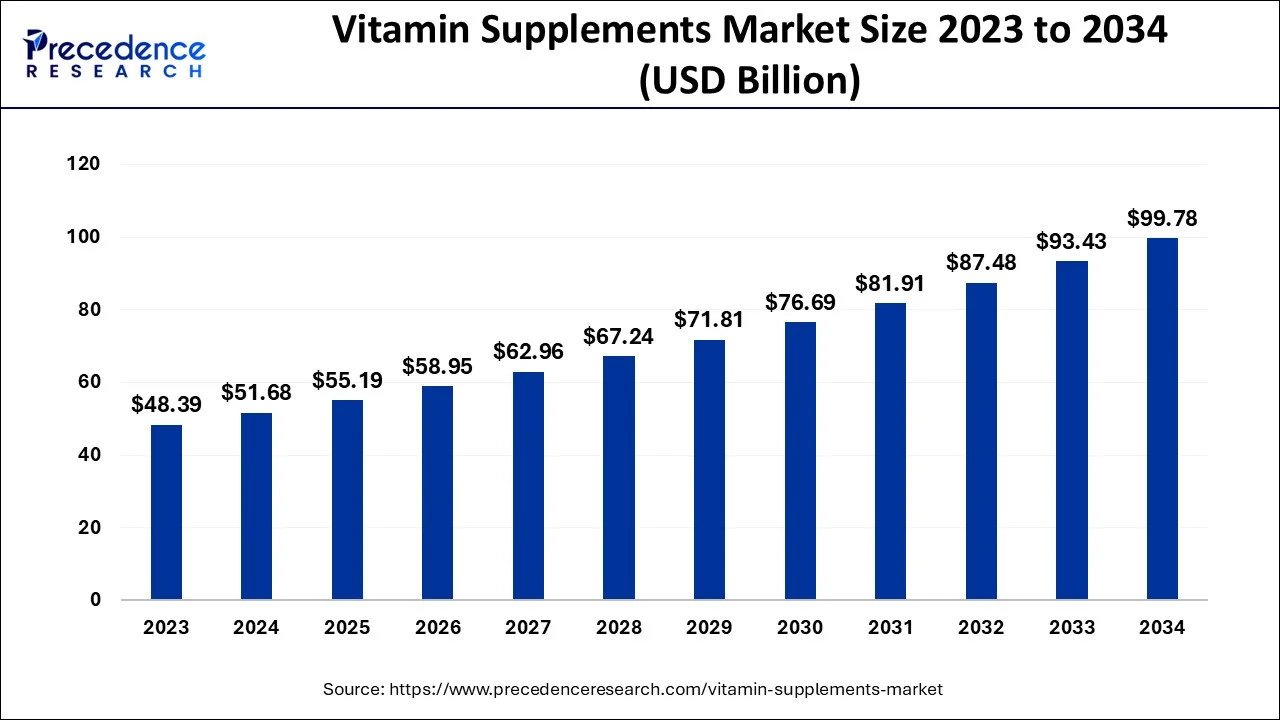
The global vitamin supplements market stood at USD 58.95 billion in 2026 and is projected to reach approximately USD 102.68 billion by 2035, registering a CAGR of 6.41% over the forecast period. The growth of the Vitamin Supplements Market is driven by rising health awareness, increasing focus on preventive healthcare and immunity, and growing demand for daily nutritional support. The expanding ageing population, e-commerce adoption, and introduction of convenient and innovative formats such as gummies, powders, and chewable tablets are further supporting market growth.
Source: https://www.precedenceresearch.com/vitamin-supplements-market
 Get a Sample
 Table Of Content


Vitamin Supplements Market Size and Forecast 2026 to 2035
The global vitamin supplements market size was estimated at USD 58.95 billion in 2026 and is anticipated to reach around USD 102.68 billion by 2035, expanding at a CAGR of 6.41% from 2026 to 2035. The global vitamin supplements market growth is attributed to the increasing awareness among consumers related to wellness, health, and nutrition.
Vitamin Supplements Market Key Takeaways
- The global vitamin supplements market was valued at USD 58.95 billion in 2026.
- It is projected to reach USD 102.68 billion by 2035.
- The vitamin supplements market is expected to grow at a CAGR of 6.80% from 2026 to 2035.
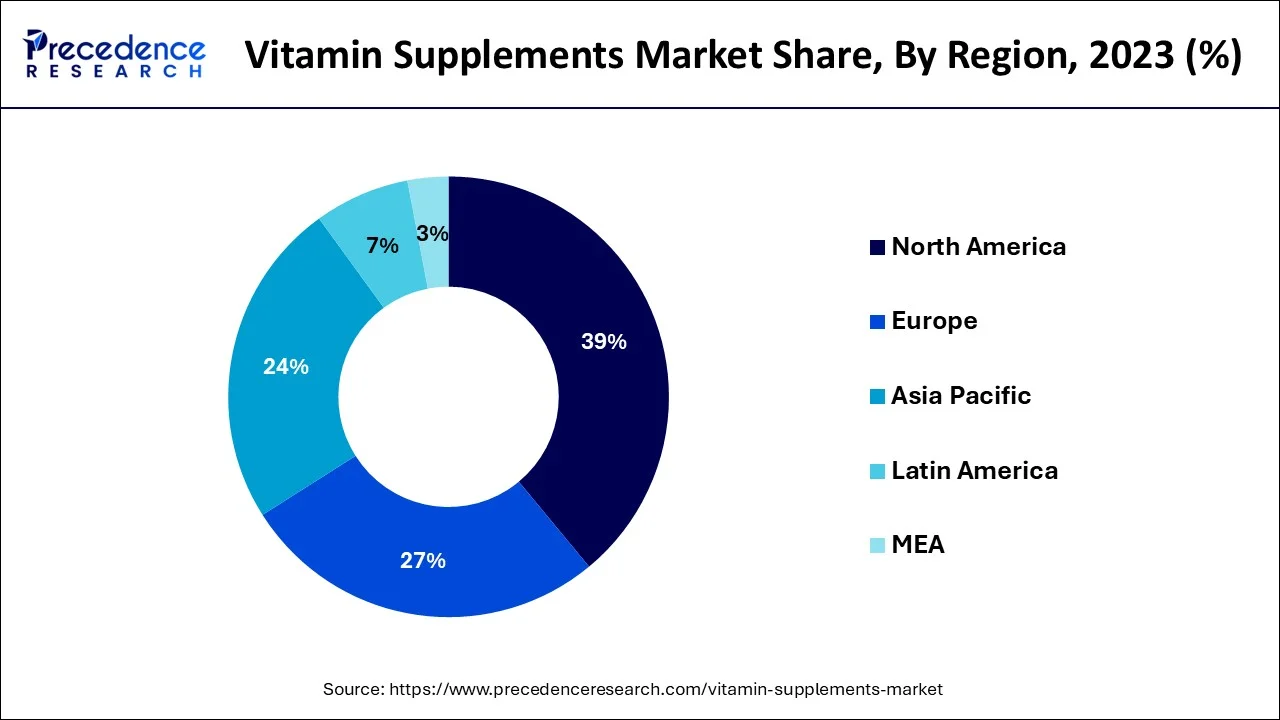
- By region, the North America has dominated the market with a revenue share of around 39% in 2025.
- By type, the multivitamin segment accounted for 43% of revenue share in 2025.
- By distribution channel, the offline segment has held a revenue share of around 76% in 2025.
- By form, the tablets segment held a revenue share of 42.5% in 2025.
Market Overview
Vitamin Supplements are intended to supplement the diet and are different from conventional food. Vitamins support healthy bodily growth and operation. The normal functioning of the organism depends on the hormones, coenzymes, and antioxidants that vitamins serve as. The use of vitamins, minerals, immune-boosting foods, organic products, supplements, and other dietary aids has increased. According to the National Health Service of the United Kingdom, a shortage of vitamin D can induce bone discomfort in adults with osteomalacia and rickets in children. Additionally, as a result of COVID-19, people began concentrating on their food in order to boost their immunity.
Vitamin Supplements Market Growth Factors
- Rising health awareness - Consumers are paying more attention to preventive healthcare, immunity, daily nutrition needs and healthy ageing. This shift encourages the wider adoption of vitamin supplements.
- Growing ageing population - The growing elderly population creates strong demand for vitamins and mineral supplements supporting bone health, immunity and energy.
- Expansion of E commerce - The growing online pharmacies and e commerce have made supplements access easier. This supports market growth.
- Product innovation - Manufacturers are introducing gummies, chewable tablets, powders that make consumption easier and can be incorporated in daily routine.
Market Outlook
- Industry growth overview - The vitamin supplements market is expected to grow steadily as consumers focus more on preventive healthcare, immunity, healthy ageing, and daily nutrition. The growth is further supported by a rapid rise in e commerce platforms.
- Global expansion - Companies are expanding across Asia Pacific, Latin America, and the Middle East and Africa to improve the reach of the product.
- Major Investors - The well established nutrition and consumer health companies and pharmaceutical firms are investing in the vitamin supplement market.
- Startup ecosystem - The startups are entering the market with personalized vitamins, subscription models, functional blends and direct to consumer services. This will improve customization, transparency and stronger customer engagement.
Market Scope
| Report Coverage | Details |
| Market Size in 2025 | USD 55.19 Billion |
| Market Size in 2026 | USD 58.95 Billion |
| Market Size by 2035 | USD 102.68 Billion |
| Growth Rate from 2026 to 2035 | CAGR of 6.41% |
| Base Year | 2025 |
| Forecast Period | 2026 to 2035 |
| Segments Covered | By Type, By Form, By Distribution Channel, By End User |
| Regions Covered | North America, Europe, Asia-Pacific, Latin America, Middle East & Africa |
Market Dynamics
Drivers
Increased healthcare cost
- Healthcare costs are the real expenses incurred when delivering healthcare services, such as the price of operations, therapies, and prescriptions. Costs for healthcare are rising in poor countries and are astronomically expensive in wealthy economies. The cost of healthcare is rising.
- According to an article by the National Library of Medicine, Macroeconomic indicators have a direct impact on healthcare costs since rising income levels allow governments to collect more tax revenue. Inflation has an impact on public healthcare costs since it raises or lowers the cost of products and services, particularly those related to health. The Tennessee Advisory Commission on Intergovernmental Relations found that from 2017 to 2018, healthcare spending in the United States climbed by 4.6%, reaching a total of $3.6 trillion. People are turning to Vitamin Supplements to maintain their health in order to reduce healthcare costs as a result of the growth in healthcare costs.
Increasing preference regarding vitamins in daily diet
- An increase in the daily preference for vitamins- Self-care has become a crucial part of modern consumers' lifestyles. The increased emphasis on health and immunity has resulted in a considerable change in consumer eating habits. The use of organic products, supplements, and other dietary assistance, as well as vitamins, minerals, and foods that boost immunity, has increased. According to the National Health Service of the United Kingdom, vitamin D deficiency can induce rickets, a condition that causes deformed bones in children, and osteomalacia, a condition that causes painful osteoporosis in adults. Additionally, as a result of COVID-19, people began concentrating on their food in order to boost their immunity. These elements contribute to the market for Vitamin Supplements expanding significantly.
Challenges
Stringent government regulation
- Government regulations governing the production and distribution of Vitamin Supplements have been very rigorous. Dietary components and final dietary supplement products are also subject to FDA regulation. Dietary supplements are governed by a distinct set of rules by the FDA than "ordinary" food and medication items. It is against the law for producers and distributors of dietary supplements and components to advertise contaminated or falsely labelled goods.
- The Federal Food, Drug, and Cosmetic Act, as revised by DSHEA and FDA rules, states that these companies are in charge of examining the safety and labelling of their products before marketing to make sure they comply with all of those standards. After a product enters the market, the FDA has the power to take legal action against any adulterated or falsely labelled dietary supplement. Government restrictions of this nature may limit market expansion.
Opportunities
The rise in the geriatric population
- The majority of supplement users are elderly folks. To meet their daily nutritional needs and develop their bones and muscles, elderly folks need Vitamin Supplements. According to the Australian government's Better Health Channel, vitamin E is frequently cited as a potential fountain of youth since it contains anti-ageing qualities.
- There is, however, no proof that supplementing with high amounts of any vitamin may stop or undo the consequences of ageing. The United Nations predicts that by 2050, one in six individuals would be over 65 (16%), up from one in 11 in 2019 (9%). On July 1, 2019, 54.1 million Americans were 65 years of age or older, according to the U.S. Census Bureau. It is anticipated that the industry will have a lot of room to develop given the size of the ageing population.
Segmental Insights
Type Insights
Vitamin A, Vitamin B, Vitamin C, Vitamin D, Vitamin E, Vitamin K, and multivitamins are the types of vitamins that make up the global market for dietary supplements. In 2022, the multivitamin segment had a dominant market share. Around 40% of the market is accounted for by multivitamins, which are anticipated to continue to rule the market during the projected period. Customers take multivitamins to meet their daily needs for all the important vitamins needed to promote healthy body growth and function.
Form Insights
Based on form, the Vitamin Supplements market is classified into tablets, powders, capsules, gummies, and others. Due to its widespread availability and ease of use, the tablet category is anticipated to dominate the market over the projection period. Vitamin Supplements in pill form are regularly consumed by adults worldwide. Even though the natural coating has a higher solubility, other factors that influence the effectiveness and calibre of the absorption also come into play.
All of these factors are expected to raise demand for Vitamin Supplements in tablet form throughout the course of the projected period. Tablet form is one of the simplest ways to take Vitamin Supplements. It can be taken both with and without a prescription. The oral route of administration is one of the simplest and most practical ways to take supplements and medications, hence it is in high demand across the globe.
Distribution Channel Insights
Supermarkets and hypermarkets, retail pharmacy, online sales, and others are the distribution channel considered in the scope Cross-border sales of Vitamin Supplements through online sales channel is on an exponential increase. Factors including low risk and easy and quick shipping propel the growth of online sales.
A retail pharmacy is a retail shop that offers prescribed drugs, tablets, and beauty & health products. These stores prepare, dispense, review products, and provide additional clinical services. Moreover, these stores aim to ensure the safe, effective, and affordable use of products and provide information to consumers. Dietary supplements products, including Vitamin Supplements products, are available easily along with medicines through these retail pharmacies.
Vitamin Supplements products such as vitamin A, vitamin B, vitamin C, vitamin D, and others are related to the nutrition of the person and hence, retail pharmacies have become a popular distribution channel for Vitamin Supplements products. The easy availability and convenience associated with the buying of Vitamin Supplements products from pharmacies propel the growth of this segment. Furthermore, manufacturers are targeting this sales channel to reach the maximum number of consumers and to increase the sales volume during the forecast period, owing to an increase in the number of pharmacies globally.
End User Insights
Adults, geriatrics, and others are the end-user considered in the scope of the market. The adult segment dominated the market with 47% of the market share in 2024. A rising senior population, particularly in low- and middle-income regions like Asia-Pacific and LAMEA, is predicted to make the geriatric category grow at the highest rate. The adult market is expanding as a result of increasing cases of vitamin insufficiency and greater knowledge of the health advantages of dietary supplements. The percentage of the population in the working age group (15–59 years) is predicted to increase from 60.7% in 2011 to 65.1% in 2036, according to the Technical Group on Population Projections Report of the Indian government. The growth of Vitamin Supplements among adults is anticipated to be fueled by expanding employment in developing countries and the rising standard of living.
Regional Insights
How North America Dominate the Market Revenue in 2025?
North America dominated the vitamin supplements market in 2025. The market growth in the region is attributed to the increasing consumer awareness about health and wellness, increasing consumption of enriched and fortified products, increasing demand for supplements and functional foods and increasing prevalence of health-related diseases and obesity. The U.S. and Canada are dominated countries driving the market growth.
The U.S. dominated the market revenue in 2025, driven by increasing consumer shift towards personalized health solutions, increasing demand delivery formats such as liquids, powders and gummies and enhancing consumer experience. Multivitamin minerals supplementation resulted in 14% lower odds of small size for gestational age, 12% lower odds of preterm birth and 13% lower odds of low birth weight than iron and folic acid supplementation alone.
On the basis of region, North America was the largest market in 2025. The region has the highest market share of 39% in 2024. North America is the major market for Vitamin Supplements owing to increased consumer awareness regarding the daily requirements of vitamins, easy availability of Vitamin Supplements, the presence of a huge geriatric population, and the high standards of living of consumers.
U.S. Vitamin Supplements Market Size and Growth 2026 to 2035
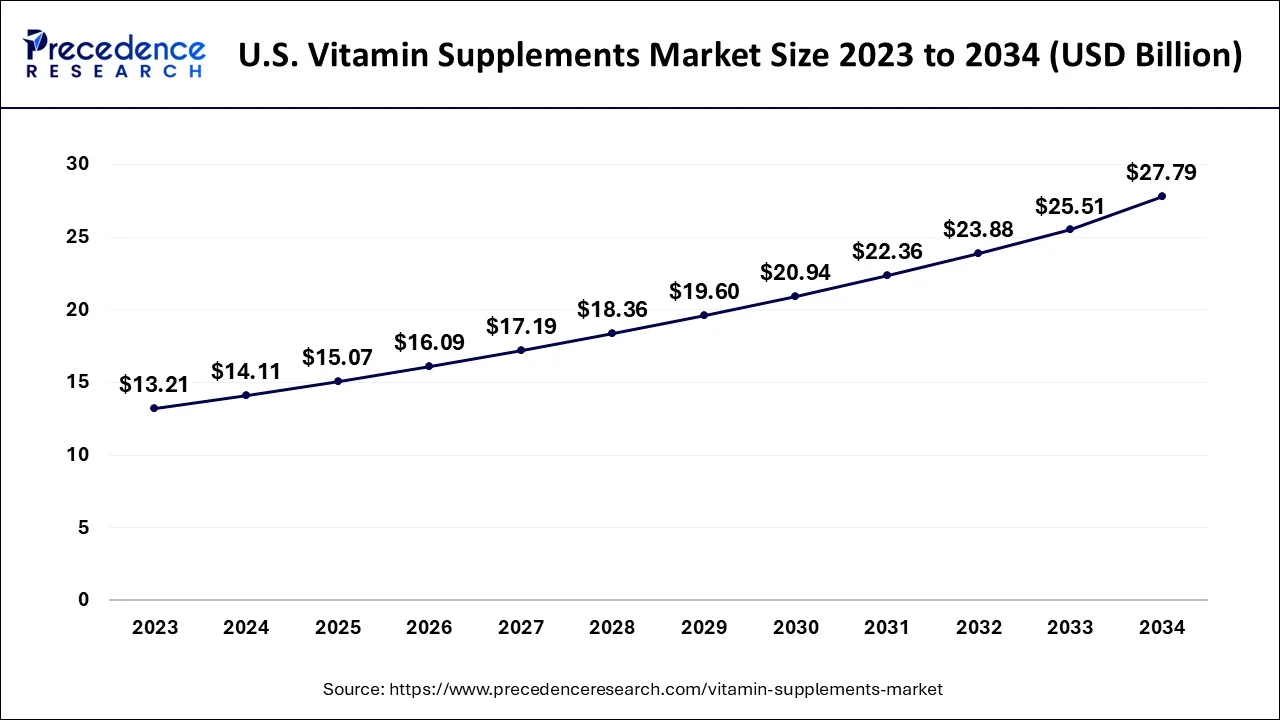
The U.S. vitamin supplements market size was estimated at USD 16.09 billion in 2026 and is expected to be worth around USD 28.43 billion by 2035, rising at a CAGR of 6.55% from 2026 to 2035.
Asia Pacific Vitamin Supplements Market Trends
Asia Pacific is expected to grow fastest during the forecast period. The market growth in the region is attributed to the increasing demand for vitamin supplements and increasing consumer preference towards health and wellness. China, India, Japan and South Korea are the fastest growing countries driving the market growth.
Which Factors Influence the Fastest Growth of the Asia Pacific Market?
Asia Pacific is expected to grow at the fastest CAGR in the vitamin supplements market during the forecast period. The growth is driven by rising health awareness, changing diets, and expanding middle class populations. Demand is particularly increasing for vitamin D, Vitamin C, and B complex. The growing online pharmacies and e commerce platforms are making supplements more accessible, and rising disposable incomes are encouraging adoption of preventive healthcare solutions. These factors are contributing to the market growth in the Asia Pacific.
China Market Trends
China accounts for the largest share of the vitamin supplements market in Asia-Pacific in 2025. The growth is driven by growing consumer interest in preventive healthcare, immunity, and nutritional management. The young generation is focusing on healthy eating and diet consciousness, fitness, immunity and daily nutrition, which encourages adoption of vitamin supplements. The government in the country promotes the benefits of consuming healthy foods and nutritional products; this encourages manufacturers to focus on developing nutrient fortified foods with regulatory compliance.
Which Factors Made Europe a Significantly Growing Region in the Market?
Europe is expected to grow at a considerable CAGR in the vitamin supplements market in the coming period. The growth is supported by established consumer awareness, strong retail networks, and widespread interest in preventive nutrition. The region has strict regulatory guidelines to approve vitamins and mineral supplements to protect consumers from potential safety risks. The demand is particularly strong for multivitamins, vitamin D and minerals for immunity, energy, and bone health. Medical professionals also recommend vitamin supplement consumption due to their health benefits.
Germany Market Trends
Germany leads the European vitamin supplements market in 2025 due to their strong pharmacy distribution, awareness, and interest in preventive healthcare. The rapidly growing e commerce and online pharmacies provide wide access to all kinds of scientifically supported supplements. After the COVID 19 pandemic, the population is focused on proactive wellness. Consumers also check product quality, safety and transparent labelling to avoid any potential risks and get maximum health benefits from supplements. The EU food supplement regulations also shape product composition and labelling in the German market
What are the Advancements in the Market in Latin America?
Latin America held a considerable share of the vitamin supplements market in 2025, supported by rising health awareness, increasing disposable incomes, and strong demand for preventive healthcare solutions. The country experiences rising demand for vitamin C, vitamin D, multivitamins, calcium and iron related products to support immunity, energy and overall wellness. The government in the region promotes the consumption of vitamin supplements to meet daily nutritional requirements and further encourages adoption of vitamin solutions across the region.
Brazil Market Trends
Brazil accounts for the largest share of the Latin American vitamin supplements market in 2025, due to its large consumer base, expanding wellness culture, and established pharmaceutical and retail infrastructure. The demand for vitamins, minerals and supplements associated with immunity, fitness and healthy ageing is continuously rising. The local manufacturers are expanding their product portfolio to meet demand. The expanding e commerce platforms and pharmacy chains have improved product availability, which further supports the market growth across Brazil.
What are the Key Trends in the Market in the Middle East and Africa Region?
The Middle East & Africa held a notable share of the vitamin supplements market in 2025, driven by population growth, urbanization and increasing adoption of preventive wellness. Online retail and pharmacies are improving product availability, while international brand collaboration continues to strengthen their regional position in the Middle East, which further contributes to market growth. WHO identifies micronutrient deficiencies as a major global health concern, particularly across low and middle income countries such as South Africa.
Saudi Arabia Market Trends
Saudi Arabia represents the leading market within the Middle East and Africa vitamin supplements market in 2025, supported by a younger population, high health consciousness, and rising disposable incomes. Consumers are demanding vitamin D, calcium, magnesium, vitamin C and specialized nutritional products across all age groups, which boosts market growth. The rapid growth in e commerce, modern retail infrastructure and demand for premium products are creating favourable conditions for sustained market growth in the country.
Supply Chain Analysis
- Research and Development: Research and development in the vitamin supplements market focuses on studying nutritional needs, consumer preferences, and safety. The researchers also focus on improved absorption.
Key Players: American Health Formulations (AHF), Amway (Nutrilite), Pfizer Inc - Clinical Trials and Regulatory Approvals: Products are tested for efficacy, safety, ingredient quality and health benefits, followed by regulatory approvals to ensure healthcare standards, and can be legally sold in different regional markets.
Key Players: Nestlé Health Science, Abbott Laboratories and Bayer AG - Formulation and Final Dosage Preparation: Formulation and final dosage preparation involve developing a safe, effective, and patient-friendly dosage form, such as tablets and capsules, powders, and gummies.
Key Players: DSM Nutritional Products, BASF SE and Glanbia Nutritionals - Packaging and Sterilization: The final product is packed carefully to avoid contamination and misuse. Bottles, blister packs, sachets, and other formats protect products from moisture, light, and contamination.
Key Players: Amcor plc, Berry Global Group, Inc. and Gerresheimer AG - Distribution to Hospitals, Pharmacies: Manufacturers supply products through established distributor networks and direct hospital partnerships, ensuring consistent product availability across hospitals, clinics, and retail healthcare outlets.
Key Players: Abbott Laboratories, Nestlé Health Science (incorporating Nature's Bounty and Garden of Life), and Sun Pharmaceutical Industries & Cipla - Patient Support and Services : Patients often require education programs, simple usage guides, and support services to help patients avoid misuse and follow prescriptions properly.
Competitive Landscape
The vitamin supplements market is highly competitive, with global pharmaceutical, nutrition, wellness and consumer health companies competing through product quality, scientific research, branded formulations and broad distribution across the globe. The leading companies in the market include Glanbia plc, Good Health New Zealand, NOW Foods, The Nature's Bounty Co., Pfizer Inc., Bayer AG, GlaxoSmithKline plc, and Herbalife Nutrition. The companies are investing in research and development, clear formulations, and sustainable packaging to strengthen their market position.
For future growth in the vitamin supplements market, companies should prioritize clinically supported formulations, transparent ingredients, convenient formats and stronger online distribution.
Top Companies in the Vitamin Supplements and Their Offerings
- Haleon plc (Formerly GSK Consumer Healthcare) - A United Kingdom based major consumer health company that offers multivitamins and nutritional supplements for different age groups.
Key offerings - Centrum and Emergen - Amway - A United States company offering multivitamins, minerals, plant based supplemets and immunity products.
Key offerings - Nutrilite - Pharmavite LLC (Subsidiary of Otsuka Pharmaceutical) - It is a United States based company offering vitamins, minerals and herbal supplements.
Key offerings - Nature Made, MegaFood, Uqora and core vitamins - Nestlé Health Science - A Switzerland based and operates in specializes nutrition and consumer health, with products spanning vitamins, minerals and nutritional solutions
Key offerings - The company offers Garden of Life organic vitamins, Pure Encapsulations, Solgar, and Orgain organic plant based protein powders. - L Catterton (Owner of Thorne HealthTech) - A United States based company.
Key offerings - Thorne and advanced clinical supplements including methylated B complex and gut micro biotic formulas. - Unilever PLC - A United Kingdom based and global consumer goods company with a growing presence in health and wellness.
Key offerings - SmartyPants vitamins, Olly nutrition and Nutrafol
Other Major Key Players
- Amway Corp.
- American Health Formulations (AHF)
- FullWell
- Garden of Life, LLC.
- Good Health New Zealand
- Healthy Life Pharma (P) Limited,
- Klean Athlete
- Llama Naturals
- NOW Foods
- Nordic Naturals
- Olly PBC
- Pharmavite
- RBK Nutraceuticals
- The Nature's Bounty Co.
- Vital Proteins LLC
Recent Developments
- In March 2026, AstaReal AB launched a vegan vitamin D3+K2 supplement made from lichen, a natural and sustainable alternative to animal derived lanolin. The supplements address winter vitamin D deficiency and restrictive diets. The D3+K2 supplement helps to maintain strong bones, normal muscle function and a well functioning immune system.
- In August 2026, HiWell Absorfyx announced the launch of new oil of Oregano with black seed oil and vitamin D3 supplements in enteric coated softgel format. The supplement incorporates botanical ingredients that are preferred by consumers and fit into everyday wellness routines.
- In April 2025, a line of nutritional products, GLP-1 Support from Whole Health Rx was launched by the Vitamin Shoppe. The aim behind this launch was to address the health and nutritional needs of people taking GLP-1 medications for weight management.
- In January 2024, the sports nutrition company, Cizzle Brands Corporation announced the launch of Spoken Nutrition, its premium NSF Certified for Sport nutraceutical line of products. This product is formulated by functional medicine, nutritionists, and dieticians to address the needs of their professional athletes.
- In Jan 2020, Franchise Group LLC introduced a new product Vthrive in its product portfolio in order to increase the portfolio across the globe.
Segments Covered in the Report
By Type
- Vitamin A
- Vitamin B
- Vitamin C
- Vitamin D
- Vitamin E
- Vitamin K
- Multivitamin
By Form
- Tablets
- Powder
- Capsule
- Gummies
- Others
By Distribution Channel
- Supermarkets and hypermarkets
- Retail Pharmacy
- Online sales
- Others
By End User
- Adult
- Geriatric
By Geography
- North America
- Europe
- Asia-Pacific
- Latin America
- Middle East & Africa (MEA)
For inquiries regarding discounts, bulk purchases, or customization requests, please contact us at sales@precedenceresearch.com
Frequently Asked Questions
Tags





Ask For Sample
No cookie-cutter, only authentic analysis – take the 1st step to become a Precedence Research client
 Get a Sample




 sales@precedenceresearch.com
 Schedule a Meeting
