



Zero Gravity Entertainment Market Trends, Companies, Revenue / Sales Performance, Subscriber Growth, Pricing Strategies, Cloud Adoption, Infrastructure Expansion, Competitive Landscape, and Industry Outlook
Zero Gravity Entertainment Market (By Product Type: Virtual Reality Experiences, Augmented Reality Experiences, Zero-Gravity Rides, Zero-Gravity Sports, Others; By Application: Amusement Parks, Gaming Centers, Themed Attractions, Educational Institutions, Others; By Age Group: Children, Teenagers, Adults; By Distribution Channel: Online Platforms, Offline Stores) - Global Industry Analysis, Size, Trends, Leading Companies, Regional Outlook, and Forecast 2026 to 2035
Source: https://www.precedenceresearch.com/zero-gravity-entertainment-market
 Get a Sample
 Table Of Content


What is the Zero Gravity Entertainment Market Size?
The global zero gravity entertainment market size was calculated at USD 2.47 billion in 2025 and is predicted to increase from USD 2.85 billion in 2026 to approximately USD 10.48 billion by 2035, expanding at a CAGR of 15.55% from 2026 to 2035. The market is driven by growing space tourism and demand for immersive microgravity experiences.
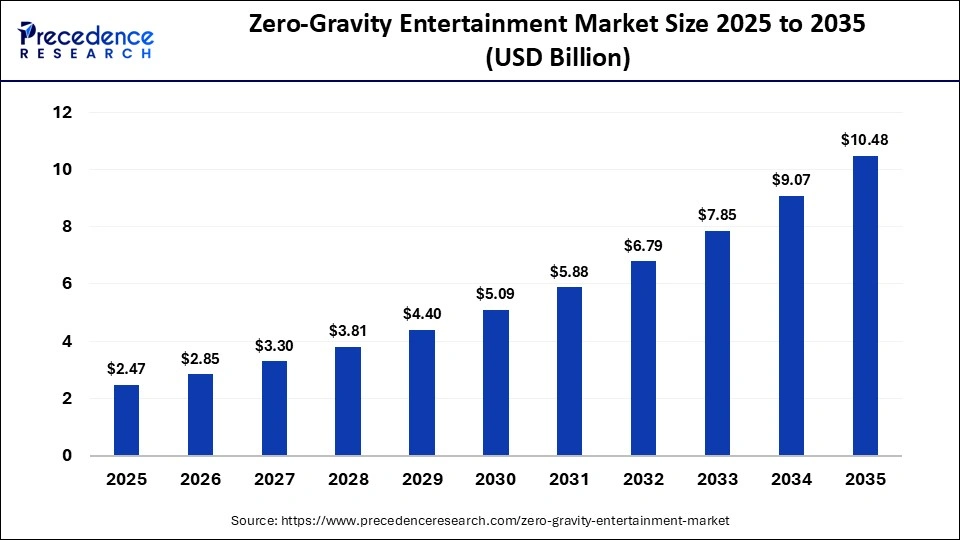
Market Highlights
- By region, North America accounted for the largest share of the market in 2025.
- By region, Asia Pacific is expected to witness the fastest growth during the forecasted years.
- By product type, the virtual reality experiences segment held a significant share of the market in 2025.
- By product type, the zero-gravity sports segment is expected to grow at a considerable rate in the market over the forecast period.
- By application, the amusement parks segment held a significant share of the market in 2025.
- By application, the gaming centers segment is anticipated to grow at a significant rate in the market over the forecast period.
- By age group, the children segment held a significant market share in 2025.
- By age group, the adults segment is anticipated to show the fastest growth in the market over the forecast period.
- By distribution channel, the online platforms segment dominated the market in 2025.
- By distribution channel, the offline stores segment is expected to grow at a significant rate in the market over the forecast period.
Elevating Experiences: Innovation Reshaping the Zero-Gravity Entertainment Market
The zero-gravity entertainment market is geared toward providing simulated weightlessness at the hands of high-tech devices. It is a mixture of virtual reality, augmented reality, and motion-based simulation systems. These technologies reproduce the conditions of microgravity that occur in space. Consumers are increasingly calling out to be entertained in an immersive and interactive format. Rapid advancements in VR and AR technologies are significantly driving market growth. High-resolution headsets are enhancing realism and user immersion, while improved motion-sensing systems enable more accurate physical interaction within simulated environments. Additionally, the integration of zero-gravity simulations into educational science programs is expanding the application scope and boosting adoption across academic institutions.
Zero-Gravity Entertainment Market Trends
- The rising adoption of advanced VR and AR technologies is creating highly immersive zero-gravity simulations that are more realistic, engaging, and widely accessible in entertainment centers, science museums, and specialized experience venues.
- Strategic partnerships between entertainment companies and space tourism providers are driving consumer interest in microgravity experiences, bridging the gap between virtual simulations and actual space exposure.
- The development of compact, cost-effective motion platforms is expanding market access, enabling malls, theme parks, and gaming centers to offer zero-gravity attractions without heavy infrastructure investment.
- The growing trend toward experiential and high-tech entertainment is fueling demand for immersive attractions, stimulating continuous advancements in haptic feedback, motion tracking, and multi-sensory simulation technologies.
How is AI Integration Stimulating Experience in Zero-Gravity Entertainment?
Artificial Intelligence integration is enhancing zero-gravity entertainment by enabling highly personalized and adaptive experiences. It increases realism, personalization, and efficiency in operation. AI-driven motion control systems adjust the parameters of the simulator dynamically in real time and generate more realistic and reactive microgravity experiences. AI-driven computer vision allows tracking the movements accurately, making sure that every user action and the virtual world are synchronized. AI can be used to optimize the haptic feedback systems to provide more realistic sensations. Also, AI is able to improve the content creation process, creating adaptive plots and space missions, building them according to user preferences.
Market Scope
| Report Coverage | Details |
| Market Size in 2025 | USD 2.47 Billion |
| Market Size in 2026 | USD 2.85 Billion |
| Market Size by 2035 | USD 10.48 Billion |
| Market Growth Rate from 2026 to 2035 | CAGR of 15.55% |
| Dominating Region | North America |
| Fastest Growing Region | Asia Pacific |
| Base Year | 2025 |
| Forecast Period | 2026 to 2035 |
| Segments Covered | Product Type, Application, Age Group, Distribution Channel, and region |
| Regions Covered | North America, Europe, Asia-Pacific, Latin America, and Middle East & Africa |
Segments Insights
Product Type Insights
Why did the Virtual Reality Experiences Segment Dominate the Zero-Gravity Entertainment Market?
The virtual reality experiences segment dominated the market by holding a significant share in 2025 because VR offers highly immersive and realistic simulations of microgravity, enhancing user engagement and satisfaction. Compared to real zero-gravity environments, which require specialized infrastructure and are extremely costly to operate, VR-based simulations deliver space-like experiences using advanced motion tracking, visual realism, and high-quality design at a fraction of the investment. Additionally, VR experiences offer flexible content updates, enabling operators to refresh themes or scenarios without major changes to infrastructure, making them more practical and scalable for entertainment venues.
The zero-gravity sports segment is expected to grow at a significant rate in the upcoming period because more consumers are becoming fond of physically active and participatory entertainment experiences. Although virtual simulations offer an immersive experience, most users are now demanding a real-world experience that gives thrill, movement, and physical challenge. Zero-gravity sports are becoming more accessible to commercial operators due to technological advances in safety systems, controlled gravity simulation, and motion-tracking systems. Also, the availability in new markets is growing due to investments in specialized and innovation-driven facilities.
Application Insights
Why did the Amusement Parks Segment Lead the Zero-Gravity Entertainment Market?
The amusement parks segment led the market in 2025 because these venues attract large footfalls and prioritize immersive, high-thrill attractions to enhance visitor experiences. Zero-gravity simulators and motion-based rides integrate seamlessly into amusement park offerings, providing unique entertainment that differentiates parks from competitors. Additionally, established infrastructure, strong investment capacity, and a focus on experiential attractions make amusement parks the primary adopters of zero-gravity entertainment technologies.
The gaming centers segment is expected to grow at a significant CAGR in the coming years because of their well-organized operating model and high-level visitor throughput. Such locations are concentrated centers where advanced immersive technologies can be implemented effectively and enable operators to make the most of the available equipment and ensure a stable stream of customers. These centers benefit from consumer familiarity with interactive entertainment, providing a lower entry barrier and predictable demand. Frequent content updates, new simulations, and diversified packages further enable gaming centers to generate multiple revenue streams and maximize the utilization of zero-gravity attractions.
The educational institutions segment is expected to grow at a notable rate over the forecast period. Zero-gravity simulations and immersive environments are being incorporated in schools, universities, and research centers as a part of improving STEM education, specifically physics, engineering, and space science. These technologies are used to allow students to see the visual representations of complicated scientific ideas, simulate physical phenomena, and conduct practical experimentation that cannot be achieved using a conventional classroom setting. The move toward interactive and technology-based education is also encouraging these institutions to invest in more modern simulation platforms that enhance retention and interaction. Also, collaborations between market players and academic establishments are broadening the opportunities for access to specialized equipment and curriculum integration.
Age Group Insights
Why did the Children Segment Dominate the Zero-Gravity Entertainment Market?
The children segment dominated the market with a significant share in 2025. This is because young audiences are highly attracted to immersive, interactive, and novelty-driven experiences. Zero-gravity simulations and motion-based attractions offer fun, safe, and educational engagement that appeals to children and encourages repeat visits. Additionally, arents are willing to invest in entertainment that combines physical activity, learning, and adventure, making this segment a key driver of market demand.
The adults segment is expected to grow at the fastest rate during the forecast period because zero-gravity entertainment is becoming more of a mainstream experience instead of a niche appeal. Growing disposable income, shift in lifestyle choices, and rising interest in high-end leisure activities are all encouraging adults to take part. The majority of the adult population is also seeking specific experiences that will combine adventure, novelty, and personal enrichment, particularly in the field of experiential tourism and wellness-oriented recreation. There is also increased adult involvement in the zero-gravities, with corporate involvement programs, team building exercises, and professional training simulations.
The teenagers segment is expected to grow at a notable rate throughout the projection period, as their affinity for immersive technology, interactive entertainment, and socially engaging experiences is high. This is a highly receptive population to events that are oriented towards newness, and they are likely to adopt new entertainments at a younger age in comparison with other age brackets. Zero-gravity and virtual worlds simulations are appropriate to their digital lives, knowledge of games, and they want to engage in high-adrenaline leisure activities. Group entertainment is also a very active activity of teenagers in gaming centers and immersive attractions, which boosts the number of visits and recurrent spending.
Distribution Channel Insights
Why did the Online Platforms Segment Lead the Zero-Gravity Entertainment Market?
The online platforms segment led the zero-gravity entertainment market in 2025, as these platforms are convenient, accessible, and efficient in connecting consumers to zero-gravity experiences. Operators have the advantage of real-time data analytics, promotions, and dynamic pricing mechanisms that would improve the conversion rate and retention of customers. Online platforms also possess full previews, digital marketing material, and personalized suggestions, which enhance consumer trust before purchasing. It is further enhanced with mobile applications, a secure payment gateway, and automated scheduling systems, which make transactions simpler.
The offline stores segment is expected to grow at the fastest CAGR over the forecast period, as more consumers consider experiential retailing and physical touch in their decision-making. In-person demonstrations have a high degree of influence, as many customers like to connect with immersive technologies and buy or book experiences directly. The physical locations enable operators to offer guided trials, personal consultations, and exposure to practicality that contribute to trust and comprehension. Growth of experience showrooms, tourist destinations that are associated with tourism, and combined entertainment spaces are also increasing offline interaction.
Regional Insights
Why did North America Lead the Global Zero-Gravity Entertainment Market?
North America led the zero-gravity entertainment market by holding a major share in 2025, driven by its advanced technological ecosystem and early adoption of immersive technologies, such as virtual reality, augmented reality, and AI-based simulation systems. The presence of leading entertainment technology companies and fully developed experiential spaces commercialized zero-gravity entertainment across the region. High consumer purchasing power and a strong culture of luxury entertainment further drive adoption. Interest in space tourism and science-themed attractions has popularized microgravity simulations, while partnerships and joint ventures between entertainment and technology firms continue to accelerate product development and innovation.
U.S. Market Trends
The U.S. has a well-developed aerospace ecosystem and entertainment technology sector, thus making it the world's number one country. Companies are investing heavily in the development of simulated microgravity rides, virtual reality entertainment centres, and commercial space tourism experiences that continue to raise consumer interest in futuristic leisure activities and therefore position the United States as the leading country for the future development of global zero-gravity entertainment due to the large number of private investments in the industry along with technology advancements and advancements linked to NASA.
Why is Asia Pacific Undergoing the Fastest Growth in the Zero-Gravity Entertainment Market?
Asia Pacific is expected to grow at the fastest CAGR during the forecast period, driven by a rising middle-income population, higher disposable incomes, and growing demand for advanced entertainment experiences. Countries such as China, Japan, and South Korea are actively investing in immersive VR- and AR-based simulation technologies. Market growth is further supported by strong government initiatives promoting digital innovation and smart entertainment infrastructure, while urbanization and the expansion of shopping centers, theme parks, and gaming zones create new opportunities for zero-gravity attractions.
China Market Trends
China is the leading country for the Asia Pacific market due to the large number of investments being made in digital entertainment infrastructure and innovation in commercial aerospace. The largest companies continue to build immersive entertainment venues that incorporate virtual reality and artificial intelligence driven simulation technologies. Increased consumer spending on premium entertainment, and the fast growth of advanced gaming technologies have all contributed to market growth. Government supported innovation programs and the continuing interest in commercial space tourism continue to enhance China's standing within the regional market for zero-gravity entertainment.
How is the Opportunistic Ruse of Europe in the Zero-Gravity Entertainment Market?
Europe is expected to grow at a significant rate in the market, driven by high demand for immersive and experiential entertainment products. The fact that the region has a well-developed tourism sector with a rich cultural heritage makes it easier to incorporate zero-gravity attractions within museums, science centers, and themed entertainment places. European nations are investing heavily in digital transformation projects that are driving the adoption of VR and AR technologies in the entertainment and education. Government innovation programs further support the development of advanced simulation platforms by startups and technology companies, fostering growth in immersive experiences.
Germany Market Trends
Germany is the leading country in Europe due to its advanced industrial technology ecosystem and strong engineering capabilities. Germany supports the development of innovative technologies in virtual reality, aerospace entertainment technologies, and science-based attractions to promote innovation and the adoption of innovative technologies. More German entertainment operators are providing immersive digital experiences to attract the next generation of tourists and for the younger generation of consumers. Within the European market there is growing public interest in space exploration and experiential education, which will lead to continued strong demand for new zero-gravity entertainment.
How is Latin America Growing in the Zero-Gravity Entertainment Market?
Latin America is expected to experience significant growth during the predicted timeframe, due to increased tourist activity, more use of virtual reality entertainment options, and an increased attraction towards scientific entertainment options. Companies within the entertainment sector have started investing in gaming hubs and recreational facilities aimed at engaging the younger generation.
Brazil Market Trends
Brazil stands out among other countries, with the rapid growth of the entertainment sector in the country, the growth of tourism, and an increasing requirement for new types of recreational offerings. Inclination towards the development of virtual reality entertainment facilities, interactive gaming zones, and science museums, where users can enjoy zero gravity simulation facilities.
How is the Middle East and Africa Advancing in the Zero Gravity Entertainment Market?
The Middle East and Africa are expected to grow at a considerable CAGR in the upcoming period, owing to significant investments in tourism infrastructure and futuristic entertainment projects. The countries have been concentrating on providing attractions that include immersive spaces, themed recreational spaces, and simulated experiences to allure global tourists.
UAE Market Trends
The UAE is considered a prime market because of its flourishing tourism sector, its lavish entertainment industry, and future entertainment attractions in which they are investing heavily. There is an increase in demand for virtual reality activities and indoor simulation parks.
Zero-Gravity Entertainment Market Companies
- SpaceX
- Blue Origin
- Virgin Galactic
- Zero Gravity Corporation
- World View Enterprises
- Bigelow Aerospace
- Boeing
- Lockheed Martin
- Airbus
- Sierra Nevada Corporation
- Northrop Grumman
- Thales Alenia Space
- Space Adventures
- XCOR Aerospace
- Orbital Sciences Corporation
- Rocket Lab
- Firefly Aerospace
- Relativity Space
- Axiom Space
- Nanoracks
Recent Developments
- In December 2025, Zero Latency VR collaborated with Seef Entertainment to open high-tech VR attractions in Bahrain and increase its presence in the Middle East. Another move by the company was an agreement with a company to expand its operations in the Philippines.
(Source: https://www.auganix.org) - In April 2025, Zero Latency VR announced a new location in Rabat, Morocco, and with this location, its free-roam VR experiences can now be found on all six of the inhabited continents. This underlined its fast international expansion and extension of its international presence.
(Source: https://invest.zerolatencyvr.com) - In May 2024, Zero Gravity Corporation collaborated with The Interstellar Group to increase parabolic flights and opportunities in the area through research. The partnership is expected to start the operation of a zero-gravity experience in the year 2026 in South Korea with a combination of technical expertise and support of local infrastructure.
(Source: https://www.prweb.com)
Segments Covered in the Report
By Product Type
- Virtual Reality Experiences
- Augmented Reality Experiences
- Zero-Gravity Rides
- Zero-Gravity Sports
- Others
By Application
- Amusement Parks
- Gaming Centers
- Themed Attractions
- Educational Institutions
- Others
By Age Group
- Children
- Teenagers
- Adults
By Distribution Channel
- Online Platforms
- Offline Stores
By Region
- North America
- Europe
- Asia-Pacific
- Latin America
- Middle East & Africa
For inquiries regarding discounts, bulk purchases, or customization requests, please contact us at sales@precedenceresearch.com
Frequently Asked Questions





Ask For Sample
No cookie-cutter, only authentic analysis – take the 1st step to become a Precedence Research client
 Get a Sample




 sales@precedenceresearch.com
 Schedule a Meeting
