



3T MRI System Market Size, Companies, Share, Patient Volume, Treatment Adoption Rates, Pricing Analysis, Regulatory Landscape, Competitive Positioning, and Demand Forecast
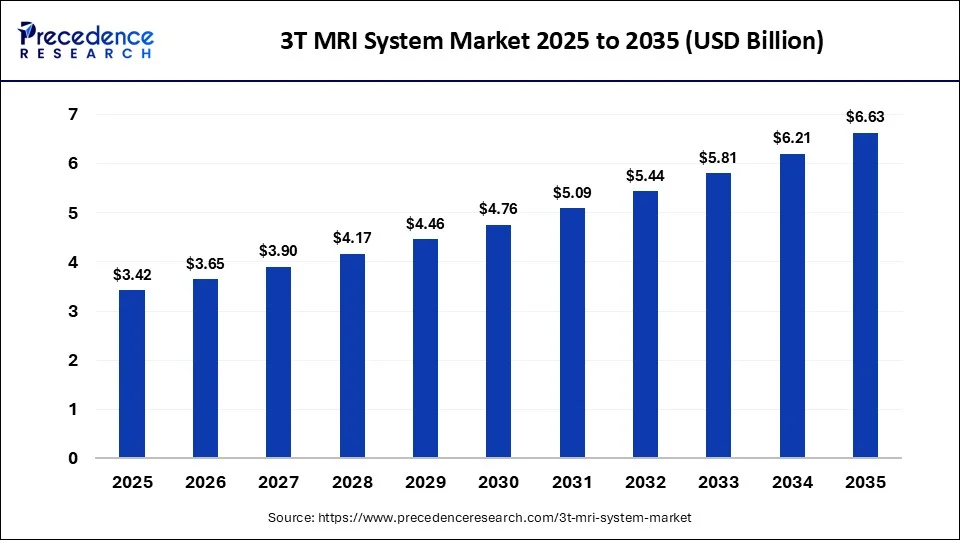
Rohan Patil, a Healthcare Industry Expert, highlights that the 3T MRI system market has reached USD 3.65 billion in 2026 and is on track to reach USD 6.63 billion by 2035, advancing at a CAGR of 6.85%. Key 3T MRI system market companies shaping the market include Siemens Healthineers, GE HealthCare, Koninklijke Philips N.V., while major growth segments span product type, architecture, application, end user, installation type, field configuration, patient type, distribution channel.
Source: https://www.precedenceresearch.com/3t-mri-system-market
 Get a Sample
 Table Of Content


3T MRI System Market Size and Forecast 2026 to 2035
The global 3T MRI system market size accounted for USD 3.42 billion in 2025 and is predicted to increase from USD 3.65 billion in 2026 to approximately USD 6.63 billion by 2035, expanding at a CAGR of 6.85% from 2026 to 2035. The market is driven by the increasing prevalence of neurological disorders, like Alzheimer's and Parkinson's, and complex cancers, which need the superior spatial resolution and tissue contrast offered by 3T systems for early, highly accurate diagnosis.
Key Takeaways
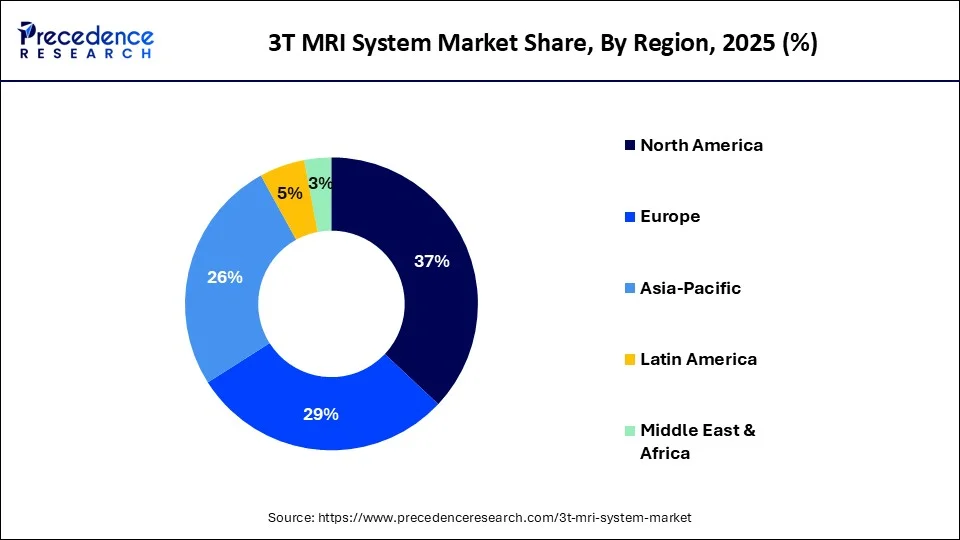
- North America led the 3T MRI system market by holding a major share of 37% in 2025.
- Asia-Pacific held a 26% share of the market in 2025 and is expected to grow at the fastest CAGR of 8.6% during the projection period.
- By product type, the closed-bore 3T MRI systems segment held a dominant position in the market with a 62% share in 2025.
- By product type, the wide-bore 3T MRI systems segment held a 33% share of the market in 2025 and is expected to grow at the fastest CAGR of 8% during the projection period.
- By application, the neurology segment held a dominant position in the market with a 26% share in 2025.
- By application, the cardiology segment held an 11% share of the market in 2025 and is expected to grow at the fastest CAGR of 8.1% during the projection period.
- By end user, the hospitals segment held a dominant position in the 3T MRI system market, with a 56% share in 2025.
- By end user, the academic and research institutes segment held a 7% share of the market in 2025 and is expected to grow at the fastest CAGR of 7.8% during the projection period.
- By installation type, the fixed MRI systems segment held a dominant position in the market with a 94% share in 2025 and is expected to sustain its dominance with a CAGR of 6.9% during the forecast period.
- By installation type, the mobile MRI systems segment held a 6% share of the market in 2025 and is expected to grow at a CAGR of 4.8% during the projection period.
- By distribution channel, the direct sales segment dominated the market with a share of 68% in 2025 and is expected to grow at the fastest CAGR of 7.1% in the coming years.
- By distribution channel, the medical equipment distributors segment held a 22% share of the market in 2025 and is expected to grow at a CAGR of 5.9% during the projection period.
Market Overview
The 3T MRI system industry surrounds the manufacturing, sales, and distribution of magnetic resonance imaging (MRI) scanners that operate at a magnetic strength of 3 Tesla. It is considered the fastest-growing segment in diagnostic imaging, favored for its ability to manufacture highly detailed images of soft tissue and blood vessels while significantly decreasing scan times. It is driven by the need for superior soft-tissue contrast, higher spatial resolution, and even faster scan times. This field strength is increasingly preferred for complex oncology, neurology, and cardiovascular diagnostics.
3T MRI System Market Trends
- The shift toward 3T is driven by its higher signal-to-noise ratio (SNR) compared to 1.5T systems, yielding clearer soft-tissue contrast for functional brain mapping (fMRI), complex musculoskeletal evaluations, and early tumor detection.
- Premium replacement demand and the requirement for continuous technological innovation drive heavy competition. While 1.5T remains the overall volume leader, 3T acceptance is accelerating in academic medical centers and even specialized diagnostic clinics.
Market Report Coverage and Key Metrics
| Report Coverage | Details |
| Market Size in 2025 | USD 3.42 Billion |
| Market Size in 2026 | USD 3.65 Billion |
| Market Size by 2035 | USD 6.63 Billion |
| Market Growth Rate from 2026 to 2035 | CAGR of 6.85% |
| Dominating Region | North America |
| Fastest Growing Region | Asia Paicfic |
| Base Year | 2025 |
| Forecast Period | 2026 to 2035 |
| Segments Covered | Product Type, Architecture, Application, End User, Installation Type, Field Configuration, Patient Type, Distribution Channel, and Region |
| Regions Covered | North America, Europe, Asia-Pacific, Latin America, and Middle East & Africa |
Market Dynamics
Drivers
Helium-Free Platforms
Helium-free platforms are the main drivers for the market because they eliminate the demand for massive liquid helium refills, massive vent pipes, and emergency quench stacks. Liquid helium is a finite, increasingly volatile resource prone to worldwide shortages and price spikes. Helium-free systems function on a permanently sealed, micro-amount of helium, making hospitals immune to future helium inflation or supply disruptions.
Restraint
Strict Safety Compliance
Strict safety compliance restricts the 3T MRI system market as the ultra-high magnetic field and high radiofrequency power increase risks such as tissue heating, implant displacement, and even violent projectile accidents. The strong 3T magnetic field interacts aggressively with metallic medical implants. Complying with safety restrictions means that many patients with older implants, for example, pacemakers, stents, or neurostimulators, are contraindicated for 3T scans, forcing facilities to depend on lower-strength 1.5T scanners.
Opportunity
AI-driven Image Reconstruction
AI-driven reconstruction transforms the 3T MRI market by solving its biggest bottlenecks: long scan times and high expenses. 3T scanners carry steep capital and operational costs. AI-driven software upgrades provide a massive financial opportunity for clinics to modernize older equipment, enhance diagnostic capabilities, and reduce the demand for repeat scans caused by patient movement. By shortening complex protocols, AI software assists in bridging the operational gap left by the worldwide shortage of skilled MRI technicians, thus effectively democratizing premium 3T MRI diagnostics across community hospitals and imaging chains.
Market Segmentation Analysis
Product Type Insights
Why Did the Closed-Bore 3T MRI Systems Segment Lead the 3T MRI System Market?
The closed-bore 3T MRI systems segment held a dominant position in the market with a 62% share in 2025, driven by preference for high-resolution clinical imaging. They employ intelligent, AI-enhanced gradient drivers that balance maximum gradient performance with energy efficiency and even reduced hardware heating. Many contemporary high-power gradient drivers utilize SiC switching devices to manage the massive thermal loads and high voltages demanded to drive 3T coils.
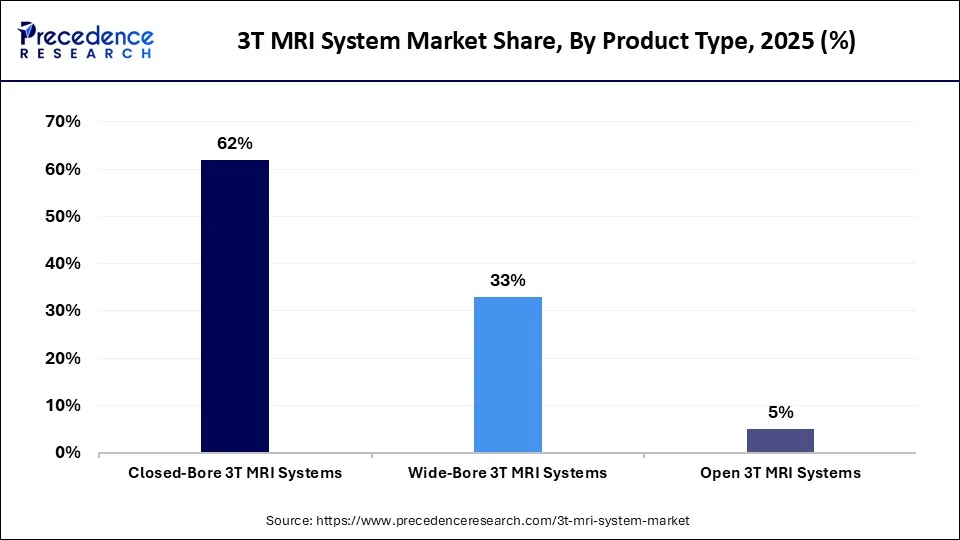
The wide-bore 3T MRI systems segment held a 33% share of the market in 2025 and is expected to grow at the fastest CAGR of 8% during the projection period. This is mainly due to the greater patient comfort along with the obesity-friendly design. The increased signal-to-noise ratio of a 3T system enables faster image acquisition. This means patients spend less time immobilized on the scanning table, and thus, there is less risk of motion-related blur ruining the scan.
The open 3T MRI systems segment held a 5% share of the market in 2025 and is expected to grow at a CAGR of 4.9% during the projection period. This is driven by limited availability because of technical complexity. Open MRI machines are designed to offer a more comfortable experience for patients, mainly those who suffer from claustrophobia or have larger body sizes. Unlike conventional MRI scanners that enclose the individual in a cylindrical bore, open MRI machines have an open design, thus making them less intimidating.
Application Insights
How the Neurology Segment Led the 3T MRI System Market in 2025?
The neurology segment led the market with a 26% share in 2025, driven by the rising incidence of neurological disorders. 3T MRI is broadly used in neurology to evaluate and diagnose conditions like brain tumours, stroke, multiple sclerosis, and epilepsy. The higher image resolution offered by 3T MRI enables neurologists to detect subtle changes in the brain, aiding in the accurate diagnosis and even treatment planning for their patients.
The cardiology segment held an 11% share of the market in 2025 and is expected to grow at the fastest CAGR of 8.1% during the projection period. This is mainly due to the increasing use of cardiac MRI. 3T scanners enhance contrast for late gadolinium enhancement. This enables clinicians to easily differentiate between healthy and scarred, fibrotic, or infarcted heart tissue after an event such as a heart attack. 3T MRI has emerged as a valuable tool in cardiology, allowing the assessment of cardiovascular diseases with exceptional accuracy. The higher spatial resolution and enhanced signal-to-noise ratio of 3T MRI contribute to better visualisation of the heart's structures and function, assisting in the diagnosis of conditions like congenital heart defects, heart disease, and myocardial infarction.
The orthopedics segment held an 18% share of the market in 2025 and is expected to grow at a CAGR of 6.3% during the projection period. This is due to rising sports injury diagnoses. In orthopaedics, 3T MRI plays a vital role in evaluating musculoskeletal injuries and disorders. From assessing joint injuries to identifying ligament tears, 3T MRI offers orthopaedic specialists detailed images, enabling precise diagnosis and personalised treatment plans.
End User Insights
Which End User Segment Dominated the 3T MRI System Market?
The hospitals segment dominated the market with a 56% share in 2025, driven by the largest procurement of advanced MRI systems. Higher signal strength enables faster data acquisition. This not only decreases the time patients must hold their breath or remain completely, but also decreases motion-related image artifacts. Because each scan takes less time, hospitals can accommodate a higher volume of patients daily, assisting to reduce long waitlists for vital diagnostic imaging.
3T MRI System Market Share, By End User, 2025 (%)
| End User | 2025 | 2035 | CAGR (%) |
| Hospitals | 56 | 53 | 6.30% |
| Diagnostic Imaging Centers | 29 | 31 | 7.50% |
| Ambulatory Surgical Centers (ASCs) | 5 | 5 | 6.20% |
| Academic & Research Institutes | 7 | 8 | 7.80% |
| Specialty Clinics | 3 | 3 | 6.60% |
The academic and research institutes segment held a 7% share of the market in 2025 and is expected to grow at the fastest CAGR of 7.8% during the projection period. This is mainly due to the growth of neuroscience and clinical research. 3T scanners enable researchers to clearly delineate small brain structures, microvessels, and even gray-white matter boundaries. This is essential for studying neurodegenerative conditions, like Alzheimer's, Parkinson's, and neurological disorders.
The diagnostic imaging centers segment held a 29% share of the market in 2025 and is expected to grow at a CAGR of 7.5% during the projection period. This is due to rising outpatient diagnostic imaging demand. The increased signal strength enables rapid data acquisition. For diagnostic centers, this translates to higher daily patient throughput. For patients, it means less time confined inside the machine. Many modern 3T systems feature a broader and shorter magnet bore, which helps alleviate claustrophobia. The combination of a more spacious opening and even shorter scan times significantly enhances patient comfort.
Installation Type Insights
How the Fixed MRI Systems Segment Dominated the 3T MRI System Market?
The fixed MRI systems segment contributed the biggest market share of 94% in 2025, driven by permanent hospital and imaging center installations. As the stronger magnet captures high-definition images much faster, healthcare facilities can thus achieve higher patient throughput. Moreover, this reduced scan time also diminishes the likelihood of motion artifacts caused by patient discomfort or breathing.
3T MRI System Market Share, By Installation Type, 2025 (%)
| Installation Type | 2025 | 2035 | CAGR (%) |
| Fixed MRI Systems | 94 | 95 | 6.90% |
| Mobile MRI Systems | 6 | 5 | 4.80% |
The mobile MRI systems segment held a 6% share of the market in 2025 and is expected to grow at the fastest CAGR of 4.8% during the projection period. This is mainly because of restricted deployment for remote healthcare access. Newer compact 3T systems are remarkably lighter and consume far less liquid helium than older models, making transportation and siting much easier.
Distribution Channel Insights
Which Distribution Channel Segment Dominated the 3T MRI System Market?
The direct sales segment accounted for the highest market share of 68% in 2025 and is expected to grow at the fastest CAGR of 7.1% in the coming years. This is due to OEMs maintaining direct relationships with healthcare providers. Direct purchasing enables clinics to configure modern systems with AI reconstruction along with advanced pulse sequences, decreasing scan durations to accommodate higher daily imaging volumes.
3T MRI System Market Share, By Distribution Channel, 2025 (%)
| Distribution Channel | 2025 | 2035 | CAGR (%) |
| Direct Sales | 68 | 70 | 7.10% |
| Medical Equipment Distributors | 22 | 20 | 5.90% |
| Third-party Procurement & Leasing | 10 | 10 | 7.00% |
The medical equipment distributors segment held a 22% share of the market in 2025 and is expected to grow at a CAGR of 5.9% during the projection period. This is due to the regional sales and service support. Diagnostic centers, specialty clinics, and private hospitals frequently now invest in 3T machines as a premium marketing tool to attract patients and top-tier referring physicians. Moreover, 3T scanners are highly sought after for complex neurology, cardiology, functional MRI (fMRI), and prostate imaging, where highly detailed soft-tissue contrast is critical.
The third-party procurement and leasing segment held a 10% share of the market in 2025 and is expected to grow at a CAGR of 7% during the projection period. This is due to the growing financing options for healthcare facilities. MRI software, AI-reconstruction pipelines, along with gradient hardware, advance rapidly. Moreover, third-party leasing prevents healthcare professionals from being trapped with depreciating, obsolete technology. Leasing contracts frequently enable facilities to upgrade to newer models as technological standards shift.
Market Regional Analysis: North America, Europe, Asia-Pacific
Which Factors Drive the 3T MRI System Market in North America?
North America held a major market share of 37% in 2025. This is due to the high adoption of advanced diagnostic imaging systems. 3T systems offer the enhanced spatial detail needed for accurate tumor staging and the early detection of neurodegenerative conditions such as Alzheimer's and Parkinson's.
U.S. 3T MRI System Market Size and Growth 2026 to 2035
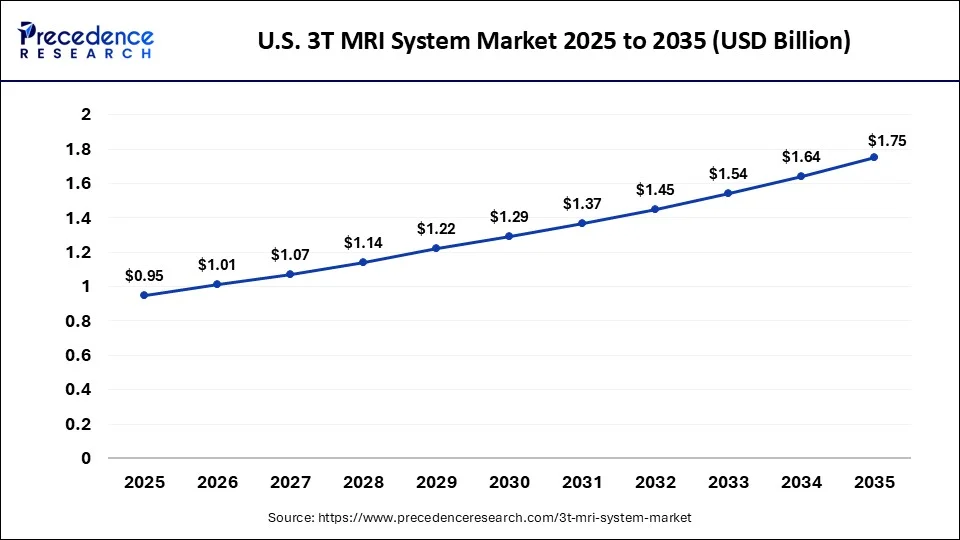
The U.S. 3T MRI system market size was evaluated at USD 0.95 billion in 2025 and is projected to reach around USD 1.75 billion by 2035, growing at a CAGR of 6.30% from 2026 to 2035.
U.S. Market Analysis
The U.S. demand for 3T MRI systems is driven by a demand for high-resolution neurological and musculoskeletal imaging. However, high equipment costs and the rise of AI-enhanced 1.5T scanners are thus causing some hospitals to balance their purchases between the two to lower operational costs. The recent commercialization of AI-driven image enhancement software has now significantly driven the diagnostic quality and scanning speed of 1.5T systems.
Europe: The Second-Largest Market
Europe held the second-largest 3T MRI system market share at 29% in 2025 and is expected to grow at a notable CAGR of 6.1% during the projection period, driven mainly by superior spatial resolution and faster workflows; thus, they are heavily utilized in major European healthcare hubs such as Germany, France, and the UK for oncology, neurology, and musculoskeletal imaging. The faster scanning times, thus, combined with quieter operations and wider bore openings, decrease claustrophobia and the need for patient sedation.
UK Market Analysis
3T magnets offer twice the signal strength of 1.5T magnets in the UK, delivering clearer and even sharper soft-tissue contrast. Upgraded 3T software along with Artificial Intelligence (AI) algorithms significantly cut scan times, thus making the process less claustrophobic. Wide-bore models also enable easier accommodation of larger or anxious patients.
Asia-Pacific: The Fastest-Growing Region
Asia-Pacific held a 26% share of the market in 2025 and is expected to grow at the fastest CAGR of 8.6% during the projection period, driven by expanding healthcare investments and rising diagnostic demand. 3T systems struggled with the longer scan times and operational complexities. In APAC, this barrier is now overcome with AI-driven image reconstruction, such as deep learning. This enables facilities in the region to manage massive patient volumes without sacrificing diagnostic accuracy.
China Market Analysis
The 3T MRI system is revolutionizing healthcare in China. It delivers double the magnetic strength of standard 1.5T machines and produces ultra-high-resolution images of nerves, soft tissues, and vessels. This allows early, accurate diagnoses of complex neurological, oncological, and even cardiovascular conditions.
What Drives the 3T MRI System Market in Latin America?
Latin America held a 5% share of the market in 2025 and is expected to grow at a significant CAGR of 6.3% during the projection period, driven by improving access to advanced imaging technologies. The superior signal-to-noise ratio of 3T scanners offers critical clarity for evaluating complex neurological conditions, for example, multiple sclerosis, epilepsy, and orthopedic conditions, assisting in avoiding unnecessary or exploratory surgeries.
Brazil Market Analysis
The stronger magnetic field significantly improves the signal-to-noise ratio, providing high-definition imaging demanded for complex neurological disorders in Brazil. It is important for mapping brain tumors, detecting subtle lesions in multiple sclerosis, detecting specific regions responsible for epilepsy, and thus, evaluating early-stage Alzheimer's disease.
How is the Opportunistic Rise of the 3T MRI System Market in the Middle East and Africa?
The Middle East and Africa held a 3% share of the market in 2025 and are expected to grow at a notable CAGR of 6% during the projection period, driven by increasing investments in tertiary healthcare facilities. The Middle East and Africa region is witnessing a stark rise in chronic conditions such as cancer, cardiovascular diseases, and even neurological disorders. 3T systems provide a much higher signal-to-noise ratio and sharper contrast than 1.5T scanners, enabling specialists to detect micro-lesions, early-stage tumors, and minute vascular abnormalities.
Saudi Arabia Market Analysis
The 3T MRI is vital to Saudi Arabia's Vision 2030 healthcare goals. It delivers superior image resolution and faster scan times, thus proving vital for early and precise diagnoses of neurological disorders, like multiple sclerosis, prostate and breast cancer staging, along with complex musculoskeletal injuries across the Kingdom.
Market Competitive Landscape: Leading Companies and Strategies
The 3T MRI system market is highly consolidated, with competition led by major global producers such as Siemens Healthineers, Philips Healthcare, GE HealthCare, Canon Medical Systems, and United Imaging Healthcare. These firms compete through technological innovation, which includes AI-powered image reconstruction, improved gradient performance, faster scan times, low-helium or helium-free designs, and improved patient comfort.
Moreover, established players leverage strong global distribution networks, extensive service capabilities, and long-term hospital partnerships, while emerging manufacturers, mainly from China, compete with cost-effective systems and also expand international reach. Strategic collaborations, software upgrades, product launches, and investments in advanced imaging technologies remain major competitive strategies as the need for high-resolution diagnostic imaging continues to grow.
3T MRI System Market Companies
- Siemens Healthineers
- GE HealthCare
- Koninklijke Philips N.V.
- Canon Medical Systems
- FUJIFILM Corporation
- Krsnaa Diagnostics Ltd.
- Shanghai United Imaging Healthcare (UIH)
- Neusoft Medical Systems
- Magnetica
Recent Developments 3T MRI System Market (2025-2026)
- In May 2026, AiM Medical Robotics declared a partnership agreement with Siemens Healthineers for the implementation of an interface enabling AiM's robotic platform to function with MRI systems from Siemens Healthineers.(Source: https://www.globenewswire.com)
- In May 2026, Royal Philips declared Titanion MR, its ultra-high-gradient 3.0T MRI, the leading worldwide forum for magnetic resonance research. Titanion is programmed to advance MRI beyond anatomical and functional imaging by allowing clinicians and researchers to apply quantitative and even biologically informative imaging approaches.(Source: https://www.philips.com)
Segments Covered in the Report
By Product Type
- Closed-Bore 3T MRI Systems
- Wide-Bore 3T MRI Systems
- Open 3T MRI Systems
By Architecture
- Superconducting MRI Systems
- Permanent Magnet MRI Systems
By Application
- Neurology
- Orthopedics
- Cardiology
- Oncology
- Breast Imaging
- Abdominal Imaging
- Musculoskeletal Imaging
- Vascular Imaging
- Whole Body Imaging
- Others
By End User
- Hospitals
- Diagnostic Imaging Centers
- Ambulatory Surgical Centers (ASCs)
- Academic and Research Institutes
- Specialty Clinics
By Installation Type
- Fixed MRI Systems
- Mobile MRI Systems
By Field Configuration
- Horizontal Field MRI Systems
- Vertical Field MRI Systems
By Patient Type
- Adult
- Pediatric
- Geriatric
By Distribution Channel
- Direct Sales
- Medical Equipment Distributors
- Third-party Procurement and Leasing
By Region
- North America
- Latin America
- Europe
- Asia-pacific
- Middle and East Africa
For inquiries regarding discounts, bulk purchases, or customization requests, please contact us at sales@precedenceresearch.com
Frequently Asked Questions
Tags





Ask For Sample
No cookie-cutter, only authentic analysis – take the 1st step to become a Precedence Research client
 Get a Sample




 sales@precedenceresearch.com
 Schedule a Meeting
