



4K TV Market Size, Key Companies, Company Product Portfolio, Semiconductor Production, Component Demand, Cost Structure, Technology Roadmap, Market Penetration, and Competitive Landscape
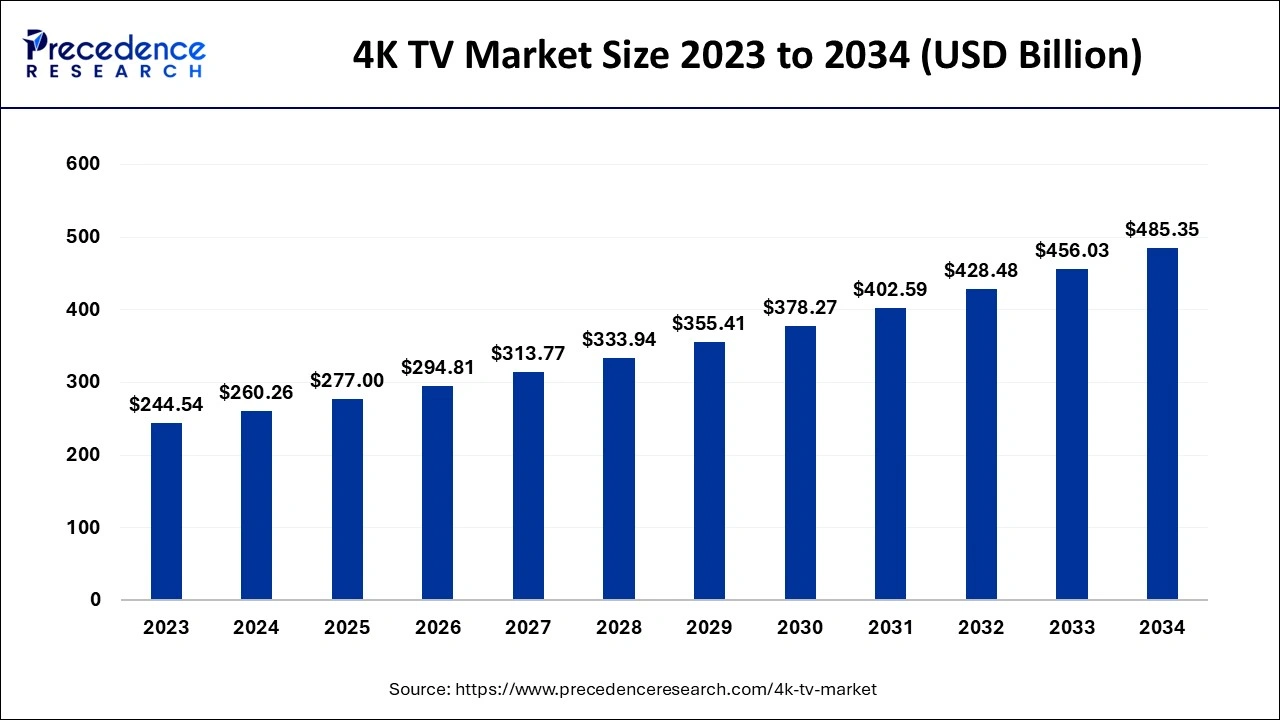
The global 4K TV market is witnessing steady growth, fueled by rising consumer demand for ultra-high-definition entertainment, increasing adoption of smart TVs, and advancements in display technologies such as OLED, QLED, HDR, and AI-powered image enhancement. The market is expected to grow from USD 294.81 billion in 2026 to USD 513.49 billion by 2035, registering a CAGR of 6.37%. Expanding 4K streaming content, growing gaming adoption, smart home integration, and declining prices of premium televisions are accelerating market growth across residential and commercial applications worldwide.
Source: https://www.precedenceresearch.com/4k-tv-market
 Get a Sample
 Table Of Content


What Is Driving the Growth of the 4K TV Market?
The global 4K TV market size accounted for USD 277 billion in 2025, and projected to hit around USD 294.81 billion by 2026, and is expected to exceed USD 513.49 billion by 2035, growing at a CAGR of 6.37% from 2026 to 2035. The demand for higher-resolution TVs is driving the growth of the 4K TV market. Additionally, developments of smart TVs with high dynamic range (HDR) and wide color gamut (WCG) are influencing the market. The growing utilization of 4K gaming is projected to enhance demand for 4K TVs in the upcoming period.
4K TV Market Key Takeaways
- In terms of revenue, the market is valued at $294.81 billion in 2026.
- It is projected to reach $513.49 billion by 2035.
- The market is expected to grow at a CAGR of 6.37% from 2026 to 2035.
- North America dominated the global market with the largest market share of 37% in 2025.
- Asia Pacific is expected to witness significant growth during the forecast period.
- By screen size, the 52 to 65 inches segment contributed the highest market share of 48% in 2025.
- By screen size, the greater than 65 inches segment is anticipated to grow at the fastest CAGR of 9.64% during the forecast period.
Market Overview
The global 4K TV market has witnessed significant growth in recent years due to rising consumer demands for high-quality visual TVs. Government and private organizations' investments are enabling manufacturers to adopt and integrate smart technologies to improve displays like OLED, QLED, and SUHD. These technologies have enhanced imaging and color quality and have improved the consumer experience of 4K TVs, leading to further increased attraction. Growing market competition has led to reduced costs for smart and larger TVs, making them affordable and more preferred by consumers.
Brands are spectacularly collaborating to improve brand reputation and sales by building market strategies and promotion efforts. These partnerships are helping to create smart features for TVs and enhancing further innovations and developments along with increasing economic profits. Ongoing collaboration between manufacturers in the 4K TV market is leading to migration with advanced technologies.
- In June 2024, Everyone TV—the organization leading the evolution of free TV in the UK—announced the joining of multiple novel smart TV brands, including Toshiba, Sharp, Panasonic, and Metz, with the Freely lineup. All these four brands will offer their new streaming services that will be integrated with Freely.
How is Artificial Intelligence (AI) Impacting the 4K TV Market?
Artificial intelligence is significantly transforming the 4K TV market. The integration of AI in TVs is enabling smart content. Consumers are able to have access to their 4K TVs in their smart devices like smartphones and tablets, making it more convenient and easier to handle and operate the streaming. AI integration allows the addition of non-4K content in displays on TVs like it's part of 4K content, making it enjoyable to the consumers and improving consumer experiences. Image and quality upscaling are driving the rapid adoption of AI in TVs.
Technology advancements like ultra-high-definition (UHD) services and content security systems are emerging in the market. The integration of AI is enabling seamless content in the 4K TV market and providing sustainable features, such as energy-saving modes, making them more popular in the industry. With the multiple benefits AI offers, manufacturers are determined to adopt the integrated technologies in 4K TVs extensively.
- In November 2024, Xiaomi REDMI launched the REDMI Smart TV X 2025 Series Smart TVs with 55″, 65″, 75″, and 85″ models featuring stunning 4K displays and supporting 1.07 billion colors, a 94% DCI-P3 wide color gamut, and a 97.3% ultra-high screen-to-body ratio.
4K TV Market Trends
- The Cinematic Update: From a Live Broadcast Machine to a Film Gear: Streaming range and prestige dramas are contributing to rich color science, cinematic depth of field, and immersive lighting to grab the attention of audiences who expect more from their home display.
- Workflow Effectiveness: The future of television is being truly defined by the fanciest gear and who uses the gear effectively, which points to a relevant preparation procedure that manages issues before they reach the package. The attentive kits, which give a rigid foundation for the remaining package, are crafted to assist travelling, manufacturing, and multi-unit applications.
- Development of Accuracy Storytelling: Motion control is updating such appearances once they are received. There is commercial precision present in storytelling as it rigs and creates the branded integrations and product shots softness as an increasingly crucial space of television economics.
- Human Angle: Tailored crews for a Hybrid Globe: Television is currently urging those who can manage two different worlds, such as the fast-turnaround demands of broadcast and the cinematic language of film. This hybridity is meant for the growth of the next generation of television professionals. They are also designing what manufacturing predicts from their partners.
4K TV Market Growth Factors
- Consumer demands: Consumers are seeking smart yet affordable premium and luxury TVs for their houses, apartments, and commercial sites. The increased consumer demand for 4K content and streaming services is encouraging market competition.
- Growing middle-class population: The growing middle-class population is the key reason behind increased demand for consumer electronics like 4K TVs. The increased adoption of digital technologies among the middle-class population is driving demand for 4K TVs.
- Affordability: The competition among manufacturers has increased, leading to the drive for the affordability of the TVs. The easy access and cost-effectiveness are attracting consumers toward 4K TVs.
- Technology advancements: The advancement in display technology with improved imaging quality and viewing experiences is driving the expansion of the 4K TV market. Additionally, the implementation of novel and smart features is likely to boost manufacturing sectors.
- Government initiatives: Government initiatives are enhancing the promotion of digitalization among people. Moreover, investment in local companies is front-loading in the market growth.
Market OutLook
- Industry growth overview: The overall growth of 4K TVs is due to the application of 4K TVs that mainly enhances the viewer's experience by providing an engaging and immersive display. Such ultra-high-definition technology grabs the bright colours and subtle nuances that generate storytelling.
- Global expansion: The global demand for 4K TV are due to development which is meant for technological advancements and rising disposable income among users. Furthermore, the move towards smart home ecosystems and the implementation of artificial intelligence in TVs are further driving the industry.
- Sustainability trends: As the film sector has continued to develop, its carbon footprint also grows. This has pointed towards a rising awareness and the urgency that surrounds the eco-friendly effect, which has drawn the attention of users and industry that have showcased it similarly.
- Startup ecosystem: The startup companies in this industry are growing due to video-on-demand service providers, which are predicted to develop their offers and gain more users by experiencing the pattern updates. Businesses are finding ways to reveal their current products in this industry, and are starting to discover fresh food products. During lockdown, as gyms were being forced to close, the urge for online options such as fitness tracking applications developed.
Market Report Coverage and Key Metrics
| Report Coverage | Details |
| Market Size by 2035 | USD 513.49 Billion |
| Market Size in 2025 | USD 277.00 Billion |
| Market Size in 2026 | USD 294.81 Billion |
| Market Growth Rate from 2026 to 2035 | CAGR of 6.37% |
| Largest Market | North America |
| Base Year | 2025 |
| Forecast Period | 2026 to 2035 |
| Segments Covered | Screen Size, and Regions |
| Regions Covered | North America, Europe, Asia-Pacific, Latin America and Middle East, and Africa |
Market Dynamics
Driver
Consumer demands for 4K contents
The market has witnessed significant growth due to increased consumer demands for the 4K TV market services, such as TV shows, on streaming services like Netflix, Disney+, and Amazon Prime. The manufacturers have made it easy for consumers to access streaming services with 4K content. Additionally, the growing adoption of digitalization, like smartphones, tablets, and laptops, is further making access to 4K content easy for consumers.
Consumers' growing preference for watching sports and live events on 4K displays is driving demands for the advanced 4K TV market. Rising demand for 4K gaming content, like PlayStations, is fueling the expansion. With continuously rising demand for high picture quality, upgraded features, and growing premium choices, the market is transforming to success.
Restraint
High upfront cost
As compared to the HDTVs, 4K TVs are quite expensive. Additional features of HDR, WCG, OLED, and QLED are further increasing the cost of the 4K TVs. Premium brands have high prices, making them unaffordable for the middle-class population. High prices give consumers limited access to the 4K TV market content. Additionally, the availability of smart devices like smartphones, laptops, and tablets helps consumers double-check their decision before buying expensive 4K TVs.
Opportunity
Commercial users
Commercial users like advertisers, retailers, hotels, restaurants, and resorts are holding potential future opportunities for the 4K TV market. Retailers and advertisers have increased their preference for 4K TVs for digital advertisements for more visual influence and impact on consumers. Hotels, resorts, and restaurants are highly adopting 4K TVs to improve their reputations and visual attractions for customers. Such commercial users have witnessed great tourism and local experiences due to the adoption of the 4K TVs.
Moreover, the growing adoption of 4K TVs in academies and training sectors for better learning, remote working or training, and engaging attention are fueling the 4K TV market expansion. The healthcare sector is also seeking a role in the market growth, as the utilization of 4K TVs for high-resolution medical imaging and patient education & understanding has increased. Commercial users like stadiums and corporate sectors are adopting TVs for video conferences and offering consumer experiences with large-screen displays.
Market Segmentation Analysis
Screen Size Insights
The 52 to 65 inches segment dominated the 4K TV market in 2025, as the market has witnessed consumers upgrading the smaller screen sizes to larger sizes of 4K TVs. The 52 to 62-inch screen size of 4K TVs provides an optimal viewing experience for consumers. These TVs are convenient and comfortable for the living rooms. Improved panel technology like OLED and QLED productions is emerging in the segment growth. Additionally, advancements in color gamut technology and high dynamic range are improving consumer experience with the 52- to 62-inch screen size 4K TVs. Manufacturers' innovations are the promotion of their brands, as highlighted products are further driving consumer attraction toward the segment. Additionally, growing online sales and partnerships between manufacturers and retailers are enhancing audience engagement.
The greater than 65 inches segment is anticipated to grow at the fastest rate in the 4K TV market during the forecast period. Improved panel technology like SUHD (super ultra-high definition) is improving the quality of the 4K TVs. This technology enables manufacturers to produce a large range of products. The segment is further rising due to increasing consumer preferences for luxury and premium TVs. With consumers willing to spend on premium products, companies are focusing on wide marketing, leading to attracting consumers.
- In April 2024, Hisense launched its new series of U6N Mini-LED ULED 4K Google TVs in North America. This series was launched alongside the U8N and U7N models with 55 to 85-inch screen sizes. The U6N's Mini-LED with the range-topping 85 model has 600 nits brightness with 512 local dimming zones, and 55 U6N models have 550 nits brightness and 160 zones.
Market Regional Analysis: North America, Europe, Asia-Pacific
What is the U.S. 4K TV Market Size?
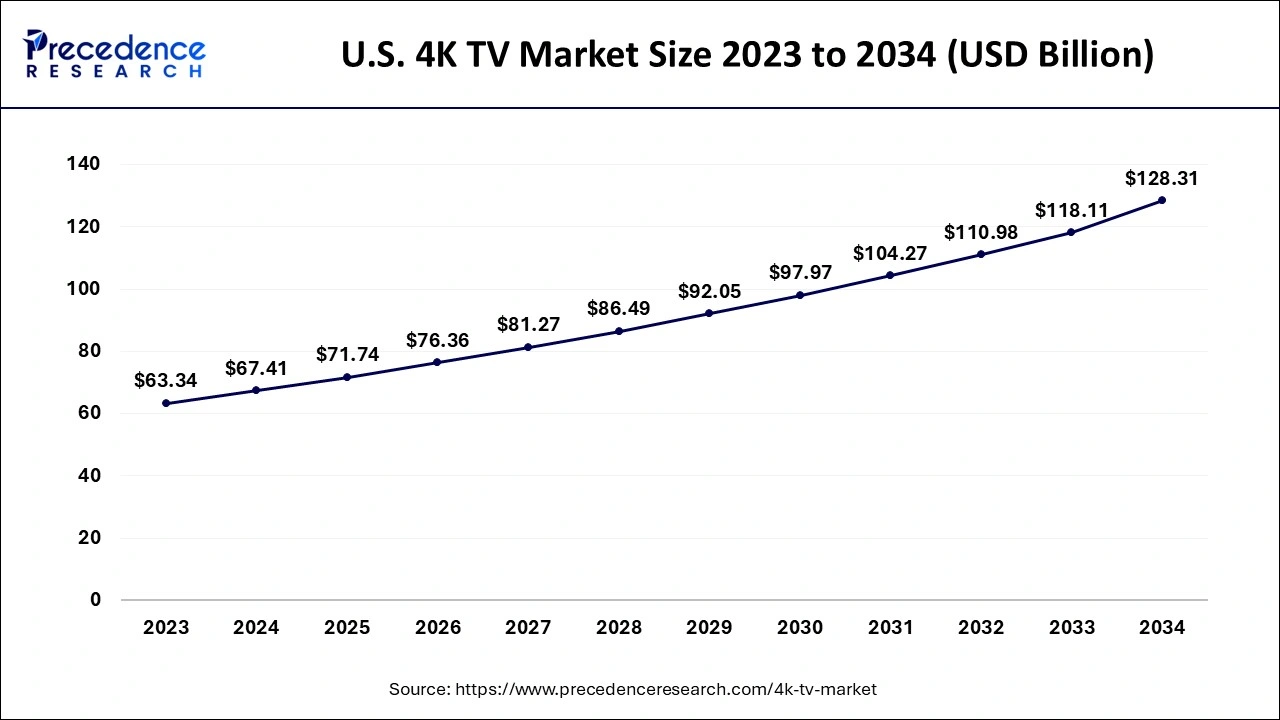
The U.S. 4K TV market size is evaluated at USD 76.36 billion in 2026 and is projected to be worth around USD 136.46 billion by 2035, growing at a CAGR of 6.64% from 2026 to 2035.
North America held the largest market share of 37% in 2025. The presence of established major TV manufacturing companies drives the market in North America. The region is well known for technology advancements, with countries like the United States and Canada investing in the research & developments that are encouraging cutting-edge developments in TV technology. Increasing disposable income allows consumers to spend on luxuries and premium options.
The United States leads the North American 4K TV market with a large consumer base. Also, well-established retail and online networks in the country are providing easy access and availability to consumers. Collaboration of the United States with several other nations is continuously encouraging innovation & development in manufacturing industries. Moreover, the government initiatives are helping to boost the United States market.
- In September 2024, Panasonic announced its new line, launching OLED (Z95A and Z85A) and Mini-LED (W95A) TVs made in Japan from 55 to 85 inches into the U.S. market. This launch reflected Panasonic Corporation's return to the United States after a decade-long absence.
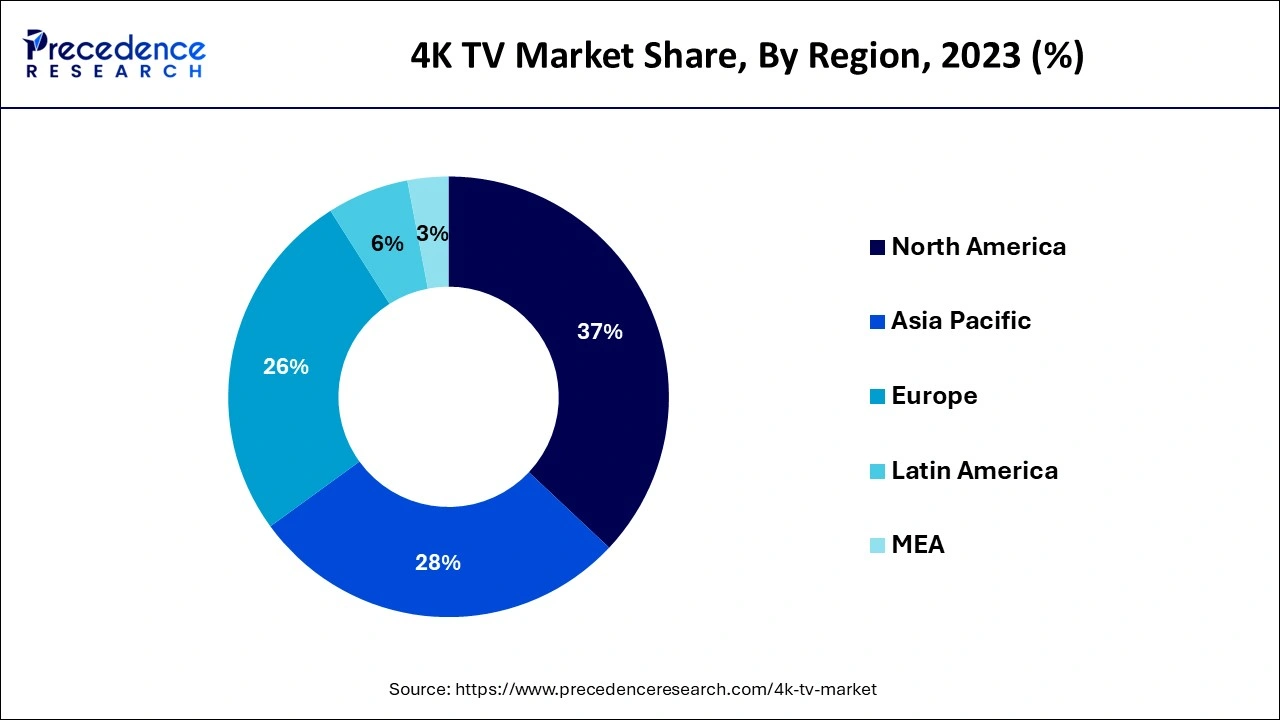
Asia Pacific is expected to witness significant growth in the 4K TV market during the forecast period. A large consumer base helps expand the adoption of 4K TVs in Asia Pacific. The large population of the region is the key factor driving the market. The adoption of digitalization has increased in Asia due to increased disposable income among the middle-class population. Countries like China, India, Indonesia, and Japan have witnessed significant growth in the demand for smart TVs.
India is leading the Asia Pacific's 4K TV market with a huge consumer base. The increasing government investments in infrastructure developments and transportation are supporting nations' markets. Rising productions of TVs from local to large-scale manufacturers are enabling easy access and affordable choices for the country's consumers.
- In November 2024, Indkal Technologies, a Bengaluru-based company, introduced its Acer M series hybrid mini LED QLED smart televisions in India. This TV comes in 65-inch and 75-inch QLED panels. This is a Google TV-based series that operates on Android 11 and is upgradable to Android 14.
- In September 2024, Samsung unveiled its Crystal 4K Dynamic TV with cutting-edge features like 4K upscaling and Dynamic Crystal color technology in India. Samsung also has utilized its AirSlim Design technique to provide a sleek profile for the new Crystal 4K Dynamic TV.
Why is the 4K TV Market Gaining Momentum in Europe?
Europe is expected to grow at a significant CAGR during the forecast period. It is driven by the UHD specification that uses a 10-bit color space and completely supports high dynamic range (HDR) by using formats like HDR10. In the current year, there is increased acceptance of the cinematic appearance in regular sports across Europe, as rights holders, which include La Liga and the Premier League, largely use cinematic cameras for particular shots inside the game to develop the viewer's viewing experience.
Germany Market Analysis
The German market is driven by growing consumer demand for developed display experiences and progress in showcase technology. As HD content has become more accessible through broadcasting and services, users are excessively updating their display devices, which pushes the industry demand forward. The move is towards smart TVs with mixed highlights that have further fueled this trend, which completes a tech-savvy demographic that finds smooth connectivity and perfect picture quality.
How Big is the Growth Potential of the 4K TV Market in the Middle East and Africa?
The Middle East and Africa region is expected to grow at a notable CAGR in the foreseeable future. Consumers choose 4K TV as a premium luxury because 4K displays have quickly transformed into a streamlined household product across this region. There is huge funding in regional telecom infrastructure, which leads to fiber-optic expansion and 5G rollouts, which have quickly developed internet speeds.
UAE Market Analysis
The UAE market is driven by the growth of fiber-optic networks, rising demand for on-demand content, and 5G technology, as regular TV services will need to grow to serve more communicative and flexible solutions. Virtual reality (VR), augmented reality (AR), and AI can also update how consumers use content in the coming days. The UAE has continued to position itself as a regional content distribution center, which is not only accessible for the Gulf region but also for the huge Middle East.
What Drives the Market Within Latin America?
Latin America held nearly 6% share of the liquid crystal polymer market in 2025 and is projected to grow in the coming years, driven by commercial development as there is crucial volume urge form the hospitality industry in terms of tourist destinations like as Dominican Republic, Mexico (Cancun and Riviera Maya) and lastly Colombia, in which vacation resorts and rentals are being regularly updated in inventories with 43 to 55-inch smart 4K TVs.
Brazil Market Analysis
In Brazil, the demand for professional displays, 4K TVs, and gaming devices has featured strong user interest. The country's rising content stages and digital transformation programs have further assisted development. Due to this, import tariffs and economic changes have further posed issues. Overall, Brazil has shown a promising scenario for 4K display acceptance, with further possibilities, which are being driven by growing demand for high-quality visual content and technological upgrades.
Supply Chain Analysis of the 4K TV Market
- Raw Material Procurement: The 4K TV raw materials include the physical elements that are used in production in every functional surface of a current flat-panel television, which include liquid crystal layers, tempered glass, indium tin oxide (ITO) coatings, semiconductor chips, ABS plastics, and lastly, the multi-layer printed circuit boards (PCB).
Key Players: Samsung Display and BOE Technology Group - Wafer Fabrication (Front-end): The wafer fabrication of a 4K TV is being displayed as panel elements are fabricated, as glass carrier wafers should stay constant with the assistance of vacuum, heat, and chemicals, and in several cases, UV-dependent debonding is used.
Key Players: TSMC (Taiwan Semiconductor Manufacturing Company ) and Magnachip Semiconductor - Assembly and Packaging (Back-end): In terms of assembly and packaging, an ultra-high -definition 4K TV serves an exceptional amount of detail by showcasing more pixels on the screen as compared to regular or high-definition TV. 4K has 3,840 horizontal lines and 2,160 vertical lines for resolution space, so that it can be assembled easily wherever the customer wants.
Key Players: Fiex Ltd and Foxconn
Market Competitive Landscape: Leading Companies and Strategies
The specialty cheese market is highly consolidated as the structure runs under a monopolistic competition frame, which is being driven by artificial intelligence that is designing how UHD content is used and produced. AI-driven developing technologies implemented in current TVs enable lower-resolution content to be showcased with near-native UHD quality that fills the gap between display and content capabilities. Additionally, to develop visual quality, AI will reduce manufacturing costs and improve the convenience of shifting to native UHD content.
4K TV Market Companies
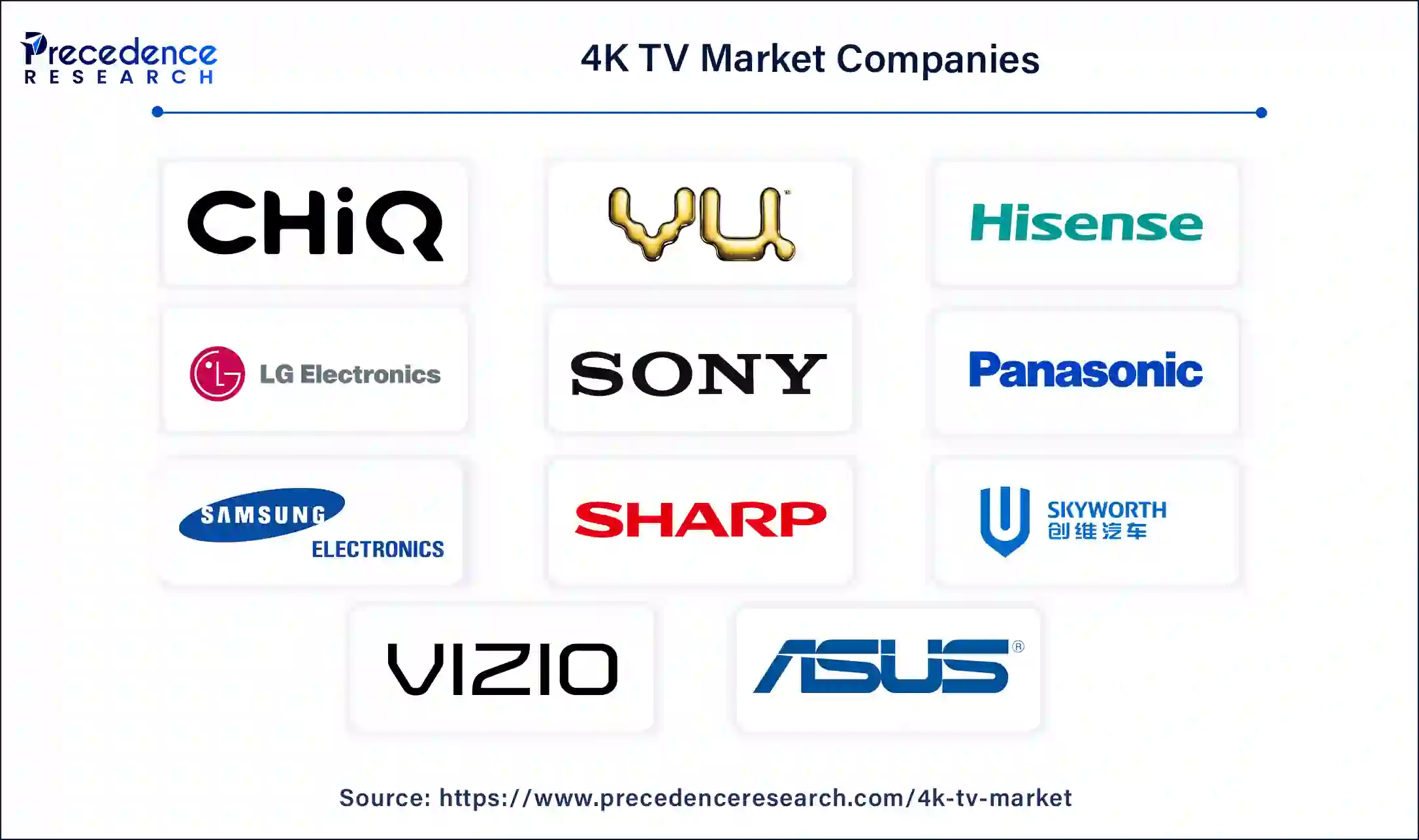
- Changhong (CHiQ)
- Vu Technologies Pvt. Lts.
- Hisense USA (Hisense International)
- LG Electronics, Inc.
- Sony Corporation
- Panasonic Corporation
- Samsung Electronics Co., Ltd.
- Sharp Corporation
- Skyworth Digital Holdings Co., Ltd.
- VIZIO, Inc.
- Asus Tek Corporation
- V? Technologies
Leaders' Announcements
- In September 2024, Yasunari Anan, Executive Vice President of Panasonic Entertainment & Communication Co., Ltd., talked about companies returning to the U.S.;
- “The U.S. is most important for the company, since for 10 years, it has been his goal to find a way to return to the U.S. Now that the long wait has ended, the company is very ready to provide new choices to the U.S. consumers.”
- In November 2024, according to market research firm Circana, Best Buy, the United States's biggest consumer electronics chain, has doubled its hefty TV assortment with 19 models ranging in price from USD 2,000 to USD 25,000 and has introduced roughly 70% of displays in its stores. Which Blake Hampton, Best Buy's senior vice president of merchandising, said: "It's really taken off this year."
Partnerships and deals
- In February 2026, Panasonic will reveal a strategic partnership with Skyworth, in which the Chinese TV maker will promote, generate, and sell the branded TVs. Panasonic has provided quality assurance and expertise for such TVs.
(Source: https://www.oled-info.com) - In July 2026, Network 10 will officially partner with an intelligent TV operating system named Vidaa to reveal streaming channels on Vidaa-linked TVs in Australia. Such a shift in goal is to develop the availability of live content from Network 10's channels without any demand for regular aerial connections.
(Source: https://mumbrella.com.au) - In July 2026, Samsung Electronics Co., Ltd had disclosed a worldwide partnership with Warner Bros. DC and Pictures Studios in order to hit the theatrical release of a unique new superhero adventure named “Supergirl”.With such a partnership, Samsung is providing an approximate film through the Samsung Art Store.
(Source: https://www.samsung.com)
Latest statement or investment by major players
- In January 2026, Investment in media content manufacturing will reach USD 255 billion in 2026, which has grown by 2% every year as per the current forecasts from Ampere Analysis.
(Source: https://www.tvtechnology.com) - In May 2026, Netflix invested over USD 135 billion in television and film series over the past years, as the company has officially stated, emphasizing the streaming of big and developed scenarios of on-demand entertainment.
(Source: https://brandequity.economictimes.indiatimes.com)
Government Support for the 4K TV Market
- In April 2026, the government will actively assist the film manufacturing ecosystem with the assistance of the Communication & Dissemination, Development of Filmic Content (DCDFC) Scheme. This scheme is a central sector scheme which is 100% funded by the Central Government, under which the Government provides direct financial assistance to develop cinematic perfection.
(Source: https://www.pib.gov.in) - In June 2026, the official state government and India's public broadcaster Prasar Bharati will partner to grow a world-class Integrated Film and Television Media Hub on Prasar Bharati's extended land parcel in Malad, Mumbai.
(Source: https://govtserviceinfo.com)
Recent Developments in the 4K TV Market (2025–2026)
- In July 2026, ACT Fibernet will expand its user product profile by disclosing and streaming TV 4K, which is an AI-linked entertainment center whose goal is to simplify content exploration across OTT platforms and live television. Such devices are accessible to ACT Fibernet subscribers and can be rented for Rs.99 per month or bought for Rs. 4,499 + applicable GST.
(Source: https://www.moneycontrol.com) - In July 2026, LG Electronics revealed the LG Standby Me 2 Max, which is a 32-inch 4K reliable touchscreen in the global industry. The rollout has already started in Canada and the United States, which was observed by Italy, France, and Taiwan in August.
(Source: https://finance.biggo.com) - In January 2026, Manhattan TV will reveal the Aero 4K TV streamer with Freely, as a current streaming machine crafted to serve the UK broadcasters' free streaming platform for any television over Wi-Fi.
(Source: https://www.broadbandtvnews.com) - In May 2025, Sony India launched its latest BRAVIA 2 II series televisions, offering a refreshed lineup of 4K Ultra HD LED TVs packed with advanced features and smart capabilities. The new series comes integrated with Google TV and is designed to offer a smoother, more immersive home entertainment experience for Indian consumers. Live Colour technology enhances color reproduction, while 4K X-Reality PRO upscales Full HD content closer to 4K resolution.
(Source: https://timesofindia.indiatimes.com) - In May 2025, TCL introduced five new TV series in India: C6K, C6KS, P8K, P7K, and P6K. The C6K and C6KS are QD Mini-LED TVs available in 55″, 65″, and 75″ sizes. Both have 4K UHD resolution, 93% DCI-P3 color gamut, and use Mini LED backlighting with a VA panel. The P6K is an entry-level 4K HDR TV with DLED backlight and a 60Hz refresh rate. Brightness levels range from 260 to 330 nits, depending on the size.
(Source: https://www.gizmochina.com) - In May 2025, Xiaomi unveiled its QLED TV FX Pro series in India. The new smart TV lineup comes with a 4K QLED panel, built-in Fire TV, and is offered in 43-inch or 55-inch sizes. The Xiaomi QLED TV FX Pro series runs on a quad-core A55 processor and includes 32GB of storage. The new models include Xiaomi's Vivid Picture Engine along with support for HDR10+ content.
(Source: https://www.gadgets360.com) - In September 2025, Samsung introduced the Crystal 4K Dynamic TV. The premium television series elevates viewers' experience by several notches, allowing them to witness the new era of home entertainment. Its Dynamic Crystal Colour technology delivers lifelike variations of colours, enabling consumers to see the subtle details of each shade. The HDR feature increases the range of light levels of the content being viewed, while the Contrast Enhancer feature ensures that it appears more natural and is incredibly detailed with layered contrast.
(Source: https://news.samsung.com) - In August 2024, Haier Appliances India, the No. 1 global major appliances brand for 15 consecutive years, introduced its flagship M95E series QD-Mini LED 4K televisions with unmatched visual brilliance and superior audio and gaming experience. These TVs are peaked with revolutionary Quantum Dot (QD) technology with the support of Harman Kardon speakers and a 144Hz screen refresh rate.
- In September 2024, TiVo, a wholly owned subsidiary of entertainment technology company Xperi Inc., partnered with OEM to introduce its expansion of smart TVs. This program includes 17, including Bush, Daewoo, Digihome, Panasonic, Sharp, Telefunken, and Vestel.
Segments Covered in the Report
By Screen Size
- Below 52 Inches
- 52 To 65 Inches
- Greater Than 65 Inches
By Geography
- North America
- Asia Pacific
- Europe
- Latin America
- Middle East and Africa
For inquiries regarding discounts, bulk purchases, or customization requests, please contact us at sales@precedenceresearch.com
Frequently Asked Questions
Tags





Ask For Sample
No cookie-cutter, only authentic analysis – take the 1st step to become a Precedence Research client
 Get a Sample




 sales@precedenceresearch.com
 Schedule a Meeting
