



5G Base Station Market Revenue, Leading Companies, Company Technology / Innovation, Service Utilization, Infrastructure Capacity, Sales Performance, Pricing Metrics, Competitive Positioning, and Growth Opportunities
5G Base Station Market (By Type: Small Cell, Macro Cell; By End User: Commercial, Residential, Industrial, Government, Smart Cities, Others) - Global Industry Analysis, Size, Trends, Leading Companies, Regional Outlook, and Forecast 2026 to 2035
Source: https://www.precedenceresearch.com/5g-base-station-market
 Get a Sample
 Table Of Content


What is the 5G Base Station Market Size?
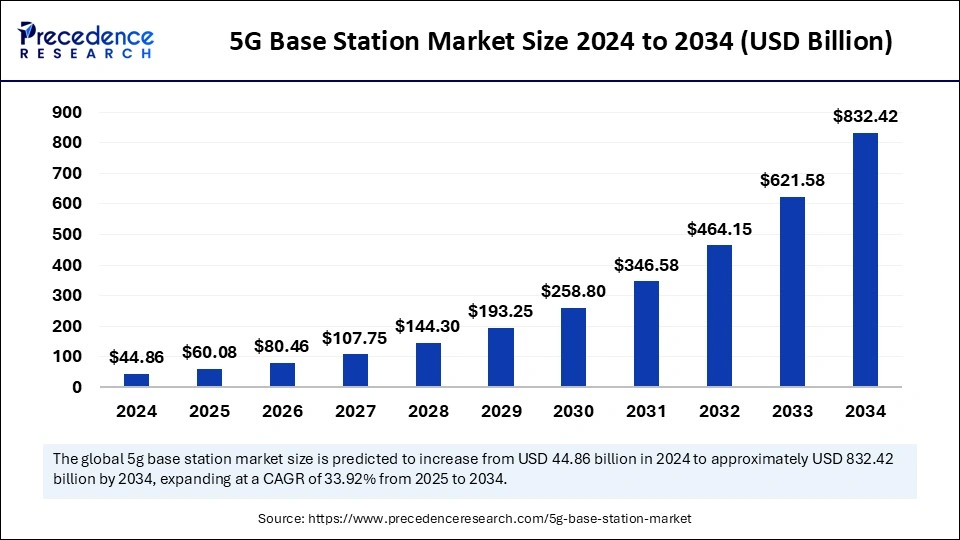
The global 5G base station market size is valued at USD 60.08 billion in 2025 and is predicted to increase from USD 80.46 billion in 2026 to approximately USD 1007.65 billion by 2035, expanding at a CAGR of 32.57% from 2026 to 2035. The expansion of the IoT ecosystem, increasing demand for high-speed connectivity, rising adoption of Internet of Things (IoT) devices, growing awareness regarding the benefit offered by the 5G over its predecessors, and increasing penetration of smartphones are among several factors that are boosting the growth of the 5G base station market.
5G Base Station Market Key Takeaways
- Asia Pacific dominated the global market with the largest market share of 33% in 2025.
- North America is expected to expand at the highest CAGR during the forecast period.
- By type, the small cell segment accounted for the biggest share in 2025.
- By type, the macro cell segment is projected to grow at a significant rate during the projection period.
- By end-user, the industrial segment contributed the highest market share in 2025.
- By end-user, the smart cities segment is likely to grow at the fastest CAGR over the forecast period.
How Artificial Intelligence (AI) Impacts the 5G Base Station Market?
In today's era of a rapidly evolving digital landscape, Artificial Intelligence-powered 5G base stations emerge as a transformative force and hold great potential to improve connectivity. The utilization of AI technologies can effectively manage traffic congestion and optimize frequency allocation, resulting in faster upload and download speeds as well as improved overall network quality. AI continuously monitors traffic patterns to optimize the power consumption of base stations, leading to increased energy efficiency. Moreover, AI automates and improves various operational and maintenance settings, ensuring more efficient network management.
- In October 2024, SKT partnered with Samsung Electronics to use AI to improve the performance of its 5G base stations as it plans to upgrade its wireless network. The South Korean telco announced that the two companies are using AI-based 5G base station quality optimization technology, also known as AI-RAN Parameter Recommender, to carry out the project.
Market Overview
As technology continues to evolve and the world transitions into the era of 5G, the demand for reliable and faster wireless communication is increasing. At the core of this transformation is the 5G base station, which serves as the backbone of the next-generation networks. The base station is vital in providing high-speed and low-latency connectivity. A 5G base station is one of the important elements of a mobile network that connects devices, such as Internet of Things (IoT) gadgets and smartphones, to the core network and the Internet. These stations utilize advanced radio technology to effectively handle the high frequencies and bandwidths associated with 5G, facilitating that the data is transmitted quickly.
5G Base Station Market Growth Factors
- The rising focus on industrial automation is expected to boost the growth of the 5G base station market in the coming years. The expanding use of collaborative robots is fueling the digitization of manufacturing processes. Cobots rely on the low-latency and ultra-reliable communications provided by 5G networks to perform tasks efficiently.
- The rising demand for autonomous and connected cars is projected to create immense growth opportunities in the 5G base station market during the forecast period.
- The rising penetration rate of smartphones and IoT gadgets is anticipated to support the growth of the market in the upcoming years.
- The increasing demand for high-speed data and low latency is likely to accelerate the adoption of 5G base stations, bolstering the market's expansion.
Market Outlook
- Industry Growth Overview: The expanding use of collaborative robots is fueling the digitization of manufacturing processes. Cobots rely on the low-latency and ultra-reliable communications provided by 5G networks to perform tasks efficiently.
- Global Expansion: The Asia-Pacific region is the largest and fastest-growing market, followed by North America. Key players are focusing on expanding their operations in these developing regions to gain market share.
- Major investors: Major investors and key players in the 5G base station market include Huawei, Ericsson, Nokia, Samsung, and ZTE.
- Startup Ecosystem: The 5G base station market's startup ecosystem is highly dynamic, driven by innovation in areas like Open RAN, AI-driven optimization, and private 5G networks.
Market Scope
| Report Coverage | Details |
| Market Size by 2035 | USD 1007.65 Billion |
| Market Size in 2025 | USD 60.08 Billion |
| Market Size in 2026 | USD 80.46 Billion |
| Market Growth Rate from 2026 to 2035 | CAGR of 32.57% |
| Dominating Region | Asia Pacific |
| Fastest Growing Region | North America |
| Base Year | 2025 |
| Forecast Period | 2026 to 2035 |
| Segments Covered | Type, End-User, and Regions. |
| Regions Covered | North America, Europe, Asia-Pacific, Latin America, and the Middle East & Africa. |
Market Dynamics
Drivers
Increasing Demand for Energy-efficient Solutions
The primary energy consumption of 5G base stations depends on some of the major key areas, such as power supply, transmission, the air conditioning system in the computer room, and the electricity costs of the base station, which accounts for over 80% of the overall network energy consumption. There is a high demand for energy-efficient solutions that can be easily integrated into existing infrastructure. Energy-efficient base stations contribute to lower carbon footprints, which aligns with global sustainability goals. In the energy consumption of a base station, the power consumption of the baseband unit (BBU), which is responsible for processing signal codecs is relatively small, and the radio frequency unit (RRU/AAU) is the main source of power consumption. In addition, the rising adoption of cloud computing contributes to market growth since cloud solutions rely on strong network infrastructure. The rising collaborations among key market players drive the growth of the 5G base station market in the coming years.
For instance, in June 2024, Mobix Labs Inc., a fabless semiconductor company specializing in next-generation connectivity solutions, announced a strategic partnership with TalkingHeads Wireless (THW) to develop a new generation of cost-effective, energy-efficient 5G base stations. THW's 5G radio solution uses AI technology to optimize tower energy consumption, while Mobix Labs' broad portfolio of products, including ICs, antennas, and active optical cables and transceivers, delivers significant advantages in performance, efficiency, cost, and size for 5G base stations.
Restraint
Lack of Infrastructure
The lack of infrastructure is expected to hamper the growth of the market. 5G network requires sophisticated infrastructure to broaden coverage. Some lower and middle-income countries still lack 5G technology infrastructure. In addition, building a 5G infrastructure requires substantial investments. This creates barriers, especially for companies with budget constraints, hampering the growth of the global 5G base station market.
Opportunities
Supportive Government Initiatives and Rising Investments
The favorable government initiatives and rising investments in 5G infrastructure are projected to create lucrative opportunities in the 5G base station market. Governments around the world are implementing several favorable policies to accelerate 5G adoption. Many governments provide subsidies and grants to telecommunication companies to accelerate 5G deployment. Moreover, governments of some countries allocate spectrum, ensuring enough spectrum is available for 5G network expansion.
Segment Insights
Type Insights
The small cells segment accounted for the largest share of the 5G base station market in 2025. By leveraging small cells, they can minimize the pressure by offloading traffic from macro cells, which enhances network capacity and reduces congestion. Small cells play an important role in effectively managing the high density of users and devices found in sophisticated and urban areas, shopping malls, stadiums, airports, and other public areas. As more devices connect to the network, the demand for individual base stations rises.
On the other hand, the macro cells segment is expected to witness a significant share during the forecast period. Macro cells are crucial in providing broad coverage for 5G networks, particularly in suburban and rural areas. Large cell towers can cover extensive areas, which is important for achieving widespread 5G connectivity. The rapid expansion of 5G networks extends beyond urban centers, increasing the need for macro cells to meet the coverage demands in less densely populated regions. Thus, driving the segment's growth.
End-user Insights
The industrial segment dominated the 5G base station market with the largest share in 2025. The segment's growth is majorly driven by the rising adoption of Industry 4.0 and the increasing integration of IoT devices in manufacturing facilities. Industries are rapidly embracing 5G technology to enable automation, smart manufacturing, and real-time monitoring through IoT integration. In addition, the low-latency and high-speed capabilities of 5G networks are crucial for driving efficiency and innovation across various sectors like automotive, healthcare, energy, and manufacturing.
The smart cities segment is expected to expand at the fastest rate over the forecast period, owing to the increasing investment in developing smart cities. Factors such as rising government initiatives around the world to develop intelligent urban infrastructure and improve public services through digital transformation further support segmental growth. The convergence of 5G technology in smart city initiatives is gaining immense popularity in several developed regions and emerging economies, owing to the rising investment in digital technologies to improve urban living conditions and operational efficiency. The implementation of 5G base stations in smart cities is critical for facilitating real-time data collection and analysis, improving smart grid operations, and allowing efficient urban resource management. Such factors are anticipated to propel the segment's growth.
Regional Insights
Asia Pacific 5G Base Station Market Size and Growth 2026 to 2035
The Asia Pacific 5G base station market size is exhibited at USD 26.55 billion in 2026 and is projected to be worth around USD 338.07 billion by 2035, growing at a CAGR of 32.79% from 2026 to 2035.
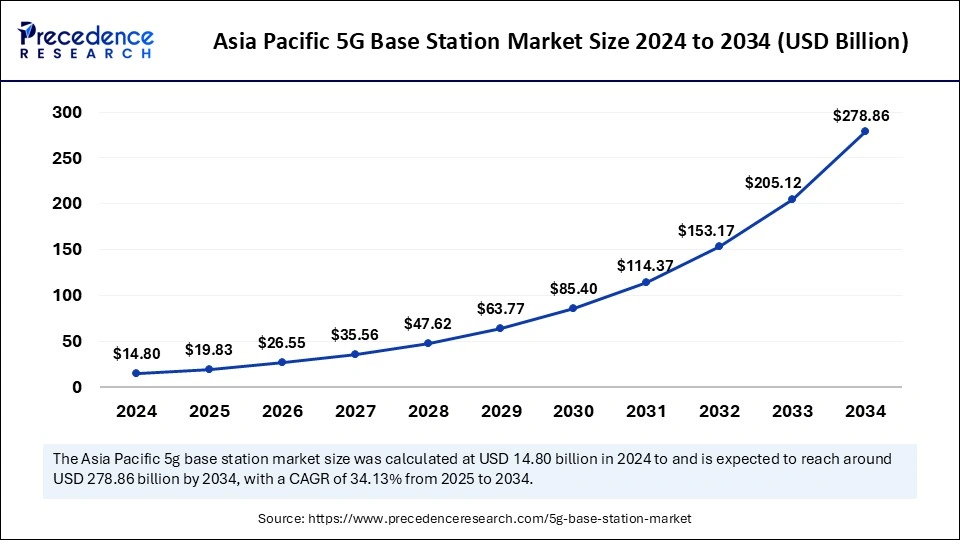
Asia Pacific registered dominance in the 5G base station market by holding the largest share in 2025. This is mainly due to the rapid expansion of the telecommunication sector, especially in emerging countries like India and South Korea. The region is likely to sustain a growth trajectory in the coming years. There is a strong emphasis on digitization across various countries. Thus, governments of various Asian countries are investing heavily to expand 5G infrastructure to support digitization. Moreover, the rapid shift toward Industry 4.0 and the growing demand for high-speed connectivity contribute to regional market growth.
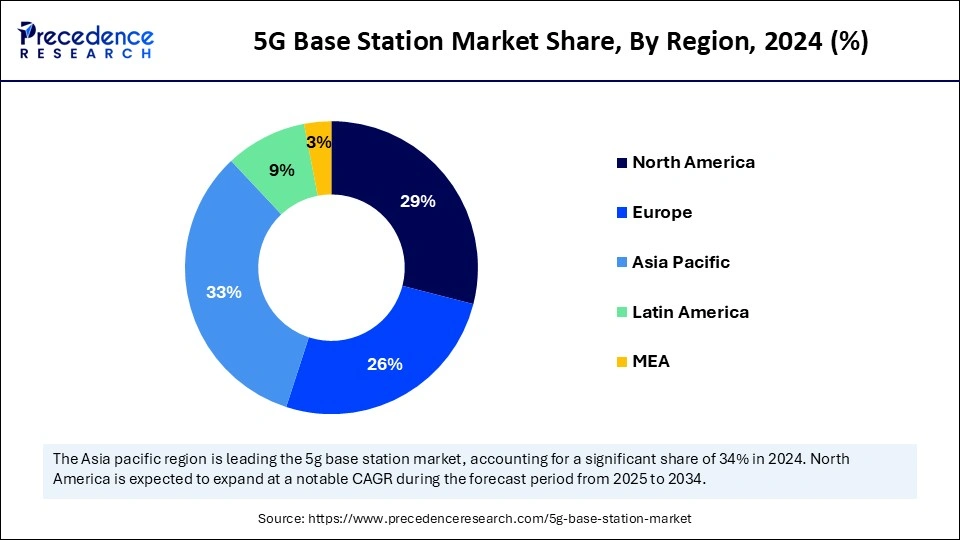
Asia Pacific is expected to witness the fastest growth in the market during the forecast period. North America is expected to witness the fastest growth in the market during the forecast period. This is mainly due to the growing focus on industrial automation, increasing investment in 5G technology, rising demand for reliable connectivity, rising demand for autonomous cars, and increasing internet and smartphone penetration. The U.S. is a major contributor to the market in North America. The country is home to leading telecom operators who invest heavily in 5G technology. The increase in the use of the Internet of Things (IoT) and advanced technologies, along with the digital revolution of the telecommunications sector, are increasing the demand for 5G technology. Supportive federal and state government policies to accelerate 5G adoption further contribute to market growth.
India 5G Base Station Market Trends
In the Asia Pacific, India dominated the market owing to the government initiatives supporting the technology and deployment of 5G network across the country. The market in India is also growing due to new use cases and opportunities in connected vehicles. Smart cities and augmented reality (AR).
U.S. 5G Base Station Market Trends
The U.S. is a major contributor to the market in North America. The country is home to leading telecom operators who invest heavily in 5G technology. The increase in the use of the Internet of Things (IoT) and advanced technologies, along with the digital revolution of the telecommunications sector, is increasing the demand for 5G technology. Supportive federal and state government policies to accelerate 5G adoption further contribute to market growth.
Europe is expected to grow at a notable CAGR over the forecast period. The growth of the region can be attributed to the technological innovations, such as massive MIMO and small cells. Furthermore, both public and private investments in 5G are boosting the regional market in the upcoming years.
Germany 5G Base Station Market Trends
The growth of the market in Germany can be driven by growing demand for high-speed data, technological advancements like massive MIMO, and government support for network expansion. Companies in the country are increasingly using 5G to gain a competitive edge through various applications.
5G Base Station Market Value Chain Analysis
- Research and development (R&D)
This initial stage focuses on the innovation and development of new technologies for 5G networks. - Component manufacturing
This stage involves producing the hardware and software components that make up a base station. - Equipment manufacturing
In this stage, major telecommunications equipment vendors like Huawei, Ericsson, and Nokia assemble the components into complete 5G base station products. - Telecom service operation
This is the final stage, where telecom service providers (TSPs) use the deployed network to offer 5G services to end-users.
5G Base Station Market Companies
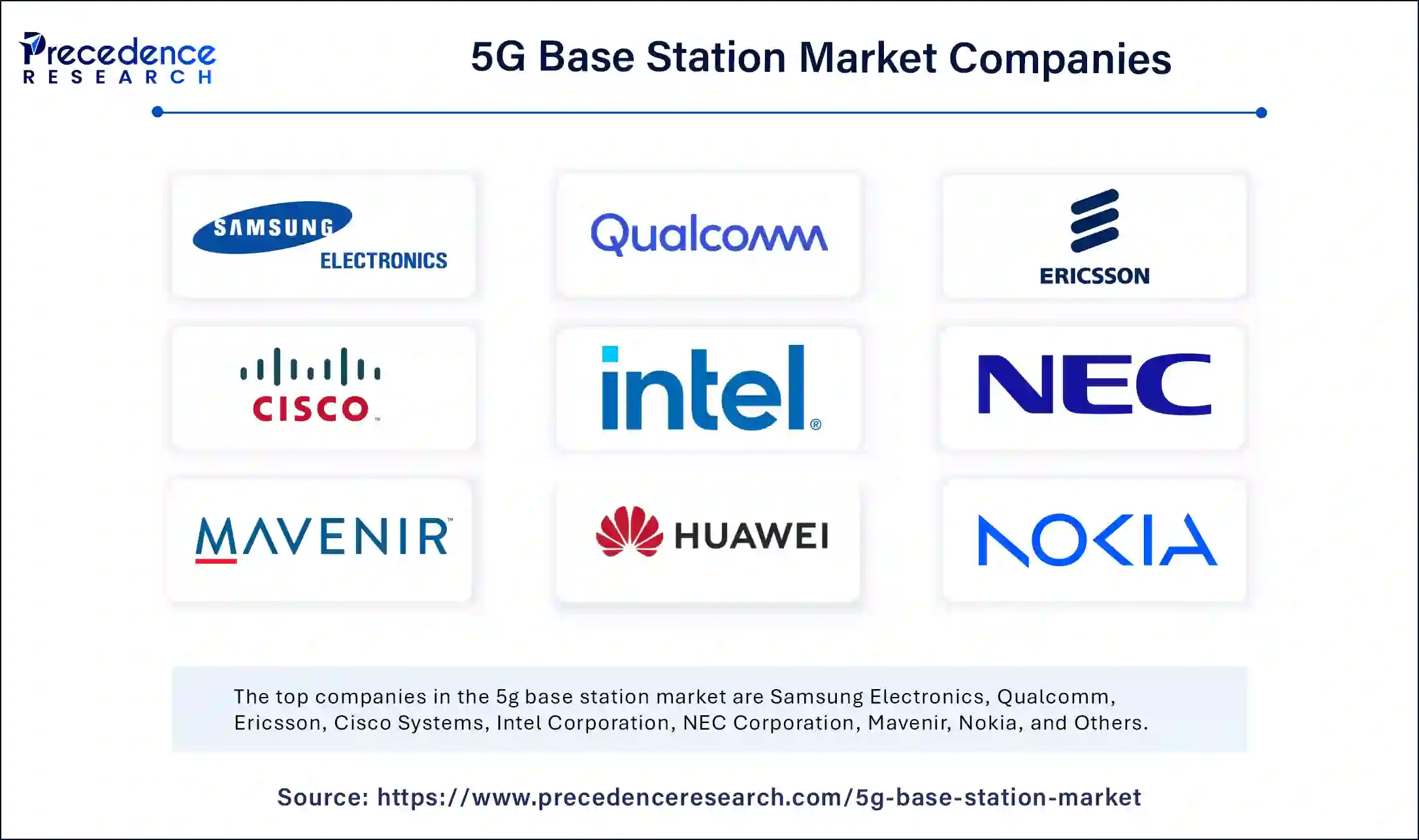
- Samsung Electronics
- Qualcomm
- Ericsson
- Cisco Systems
- Intel Corporation
- NEC Corporation
- Mavenir
- Huawei Technologies
- Nokia
- ZTE Corporation
Key Players' Offering
- Ericsson: Offers a comprehensive 5G radio access network (RAN) portfolio, which includes Massive MIMO radios, baseband units, and Radio Dot indoor solutions.
- Nokia: Provides the AirScale portfolio, which includes next-generation Massive MIMO platforms with advanced beamforming for high-capacity 5G.
Recent Developments
- In February 2025, Chunghwa Telecom, in collaboration with the Institute for Information Industry of the Industrial Technology Research Institute, completed the integration of the ST-2 high-orbit satellite and a 5G base station and became the first in the world to achieve end-to-end two-way video calls based on the 3GPP 5G NR NTN (New Radio for Non-Terrestrial Network) standard communication protocol.
- In February 2025, Kyocera Corporation announced that it has officially begun the full-scale development of an AI-powered 5G virtualized base station, with plans to commercialize the technology.
- In November 2024, Vodafone and AMD announced their plan to collaborate on mobile base station silicon chip designs that will give 5G radios the required horsepower to quickly meet future customer demand for higher-capacity AI and digital services. This initiative will also support Vodafone's aim to reduce the radio antennae size, its energy consumption, and the number of base stations while continuing to give customers excellent coverage.
Segments covered in the report
By Type
- Small Cell
- Macro Cell
By End User
- Commercial
- Residential
- Industrial
- Government
- Smart Cities
- Others
By Region
- North America
- Asia Pacific
- Europe
- Latin America
- Middle East and Africa
For inquiries regarding discounts, bulk purchases, or customization requests, please contact us at sales@precedenceresearch.com
Frequently Asked Questions
Tags





Ask For Sample
No cookie-cutter, only authentic analysis – take the 1st step to become a Precedence Research client
 Get a Sample




 sales@precedenceresearch.com
 Schedule a Meeting
