



Airport Operation Market Trends, Companies, Revenue / Sales Performance, Subscriber Growth, Pricing Strategies, Cloud Adoption, Infrastructure Expansion, Competitive Landscape, and Industry Outlook
Airport Operation Market (By Operation Type: Airside Operations, Landside Operations, Financial & Information Management; By Service/Platform: Baggage Handling & Screening, Passenger Processing, Smart Technologies; By Airport Size: Large International Hubs, Medium & Small Airports) - Global Industry Analysis, Size, Trends, Leading Companies, Regional Outlook, and Forecast 2026 to 2035
Source: https://www.precedenceresearch.com/airport-operation-market
 Get a Sample
 Table Of Content


What is the Airport Operation Market Size?
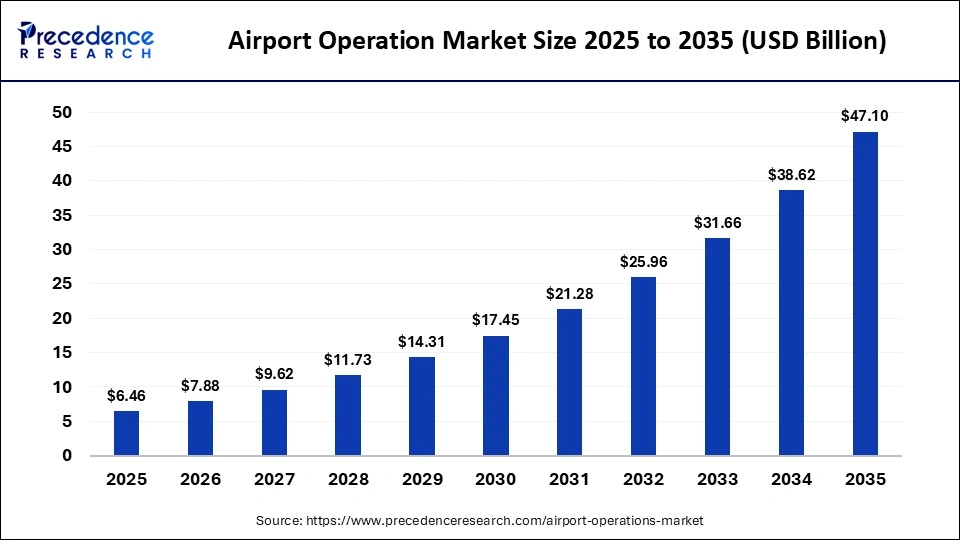
The global airport operation market size was calculated at USD 6.46 billion in 2025 and is predicted to increase from USD 7.88 billion in 2026 to approximately USD 47.10 billion by 2035, expanding at a CAGR of 21.97% from 2026 to 2035.One key driver of the market is the increasing global demand for air travel, which is fueled by rising disposable incomes and a growing middle class in emerging economies. This trend encourages airlines to expand their fleets and networks, thereby increasing the need for enhanced airport facilities and services.
Market Highlights
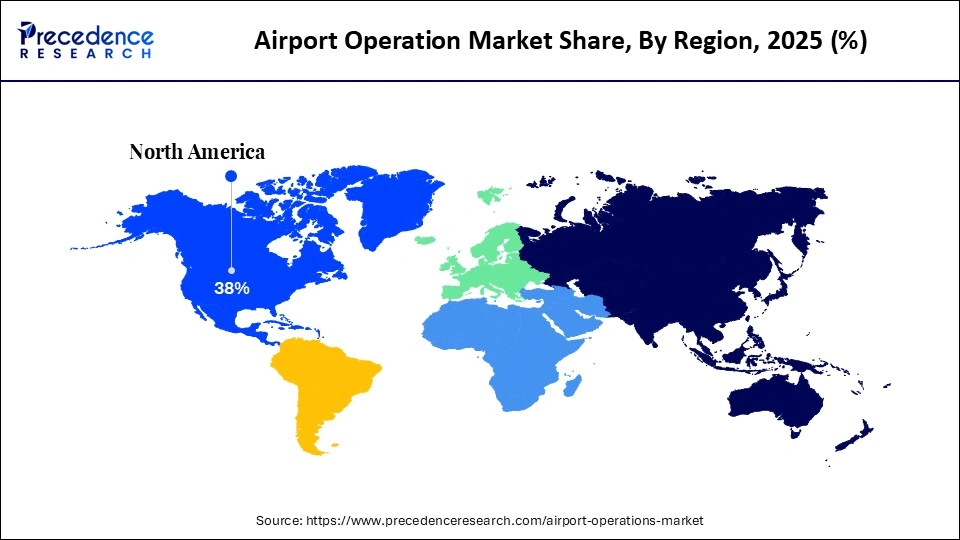
- North America dominated the global airport operation market with the largest share of approximately 38% in 2025.
- Asia-Pacific is expected to grow at the fastest CAGR in the market during the forecast period.
- By operation type, the airside operations segment held a dominant position in the market with the largest share of approximately 42% in 2025.
- By operation type, the landside operations segment is expected to grow at the fastest CAGR in the market between 2026 and 2035.
- By service/platform, the baggage handling & screening segment accounted for a considerable revenue share of approximately 28% in the market in 2025.
- By service/platform, the passenger processing segment is expected to grow with the highest CAGR in the market during the studied years.
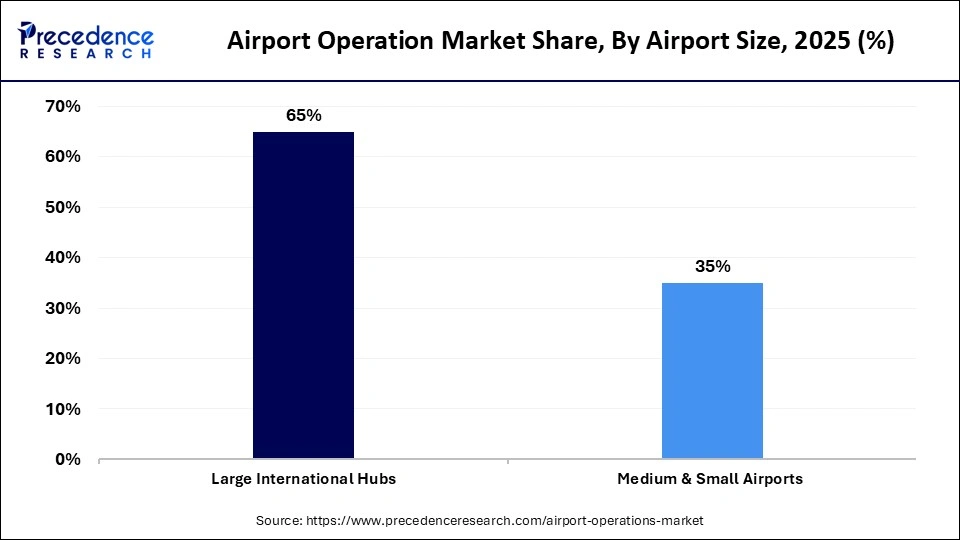
- By airport size, the large international hubs segment led the global market with a share of approximately 65% in 2025
- By airport size, the medium & small airports segment is expected to expand rapidly in the market in the coming years.
Air Operations: The Brain Behind Seamless Air Travel
The airport operation market is an invisible engine that keeps global air travel running smoothly, efficiently, and safely. It encompasses a wide range of systems managing airside operations, terminal activities, passenger flow, baggage handling, and ground support. Rising air passenger traffic, airport modernization programs, and the push for operational efficiency are driving steady market growth. As airports evolve into smart mobility hubs, investments in digital and automated operations are becoming mission-critical rather than optional.
AI development: From Control Towers to Intelligent Ecosystems
Artificial intelligence (AI) is rapidly transforming airport operations from reactive systems into predictive, self-optimizing ecosystems. AI-driven platforms are being deployed for passenger flow forecasting, queue management, predictive maintenance of runways and equipment, and real-time disruption management. Machine learning algorithms analyze historical and live data to optimize gate allocation, turnaround times, and workforce scheduling. Additionally, computer vision and AI-powered surveillance enhance security screening, apron safety, and baggage tracking, significantly reducing delays and operational bottlenecks.
Airport Operation Market Trends
- Shift Towards Smart Airports: Integrated digital platforms unify airside, landside, and terminal operations.
- Rising Adoption of Predictive Analytics: Predictive analytics is enhancing and encouraging delay reduction, asset utilization, and preventive maintenance.
- Automation: Automation of handling and baggage systems is set up to improve turnaround efficiency. It enhances accuracy and reduces manual errors.
- Passenger Experience Management: The increased focus on passenger experience management facilitates real-time crowd control and journey optimization.
- Cloud-based Operations: The cloud-based airport operational database is replacing the legacy on-premise systems. Encouraging bot or online operations for the operation staff present on-job. Making things easy and ensuring every operation is on time.
- Sustainability-driven Operations: This system is leveraging AI to reduce the fuel burn, emissions, and energy consumption.
Market scope
| Report Coverage | Details |
| Market Size in 2025 | USD 6.46 Billion |
| Market Size in 2026 | USD 7.88 Billion |
| Market Size by 2035 | USD 47.10 Billion |
| Market Growth Rate from 2026 to 2035 | CAGR of 21.97% |
| Dominating Region | North America |
| Fastest Growing Region | Asia Pacific |
| Base Year | 2025 |
| Forecast Period | 2026 to 2035 |
| Segments Covered | Operation Type, Service/Platform, Airport Size, and region |
| Regions Covered | North America, Europe, Asia-Pacific, Latin America, and Middle East & Africa |
Segmental Insights
Operation Type Insights
Why the Airside Operations Segment Dominated the Airport Operation Market?
The airside operations segment dominated the market by holding a share of approximately 42% in 2025, because of services that comprise runway operations, air traffic operations, aircraft parking, and ground handling operations. The large number of passengers and heavy flight schedules at major airports require continuous optimization of airside efficiency. This segment is further strengthened by investments in high-level surface movement systems and safety. High capital intensity in airside operations is maintained by regulatory compliance and stringent safety measures.
The landside operations segment is expected to show the fastest growth over the forecast period, driven by terminal control, ground transportation, parking, and passenger flow. Air travel is putting strains on terminal infrastructure, as it drives the intelligent landside investment. Airports are embracing the concept of digital wayfinding, real-time crowd management, and mobility integration platforms. Non-aeronautical revenues are also increasing, compelling airports to improve their landside efficiency. All in all, landside operations are becoming a business priority of customer satisfaction and revenue growth.
Service/Platform Insights
Which Service/Platform Segment Dominated the Airport Operation Market?
The baggage handling & screening segment held a major revenue share of approximately 28% in the market in 2025, due to the need for high security, operational performance, and passenger satisfaction. Airports are still spending heavily on automated baggage handling systems to minimize delays and mishandling rates. High security laws demand the use of sophisticated screening devices and constant upgrading of the system. Reliability and speed are required due to the high level of passenger throughput in major hubs. It is further enhanced by integration with the airport operations control centers.
The passenger processing segment is expected to gain the highest share of the market between 2026 and 2035, which is powered by the push towards touchless and digital airport experiences. Airports are implementing self-service check-in, biometric check-in, and mobile check-in. These technologies minimize time in queues and streamline manpower needs. The increase in passenger traffic and safety expectations after the pandemic is increasing adoption. Airports and airlines are also working together to standardize digital identity solutions.
Airport Size Insights
How the Large International Hubs Segment Dominated the Airport Operation Market?
The large international hubs segment held the largest revenue share of approximately 65% in the market in 2025, because of the large traffic volumes and complicated operational needs. Many international passengers and cargo are processed in these airports and need sophisticated operation systems. They are enhanced by investments in runway capacity, expansion of terminals, and automation. They are also the first to embrace AI-powered airport management systems. Huge hubs have access to strong financial resources, which facilitate investments in next-generation technologies. Their strategic significance is increasing as the world gets more connected.
The medium & small airports segment is expected to expand rapidly in the market in the coming years, due to regional connectivity policies and decentralization of air travel. Governments are also investing in developing regional airports to ease congestion at the major airports. There is a rapid adoption of scalable and cloud-based operational solutions at these airports. Traffic is being boosted by growth in domestic tourism and regional business travel. Low-cost automation is enhancing the efficiency of operations in small facilities.
Regional Insights
How Big is the North America Airport Operation Market Size?
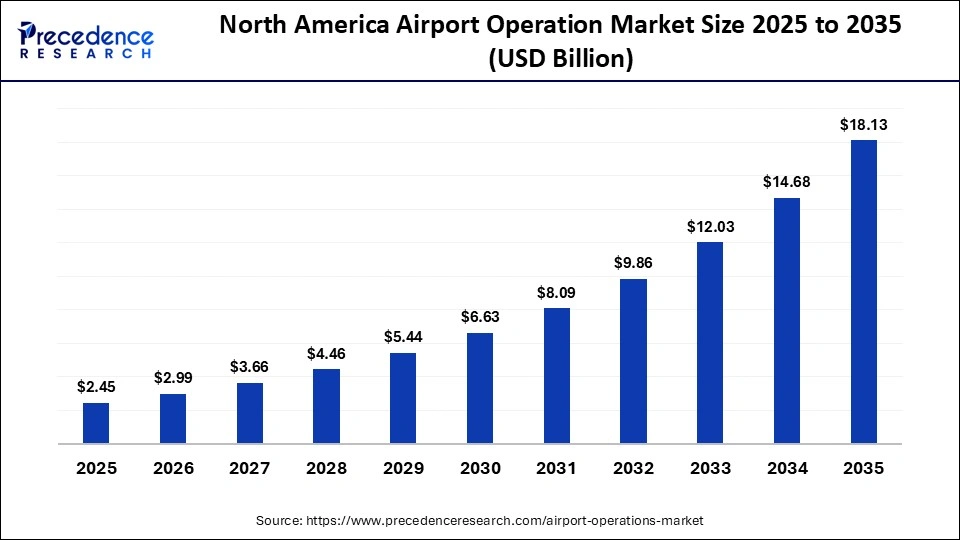
The North America airport operation market size is estimated at USD 2.45 billion in 2025 and is projected to reach approximately USD 18.13 billion by 2035, with a 22.16% CAGR from 2026 to 2035.
Why North America Dominated the Airport Operation Market?
North America dominated the market by holding a share of approximately 38% in 2025, driven by the strong demand for air travel and extensive investments in infrastructure modernization. Regulatory frameworks in this region further support the growth of smart airports, ensuring safety and efficiency in operations. As a region, North America is poised to leverage innovative solutions, such as AI and automation, to maintain its competitive edge in the global airport operations landscape. The region witnesses the highest amount of passenger flow rates traveling to and from North American countries.
What is the Size of the U.S. Airport Operation Market?
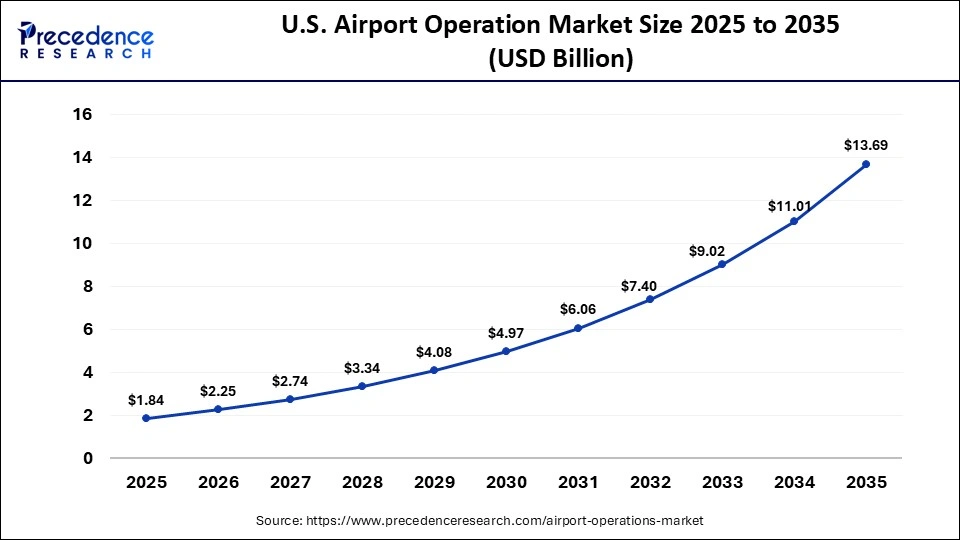
The U.S. airport operation market size is calculated at USD 1.84 billion in 2025 and is expected to reach nearly USD 13.69 billion in 2035, accelerating at a strong CAGR of 22.22% between 2026 and 2035.
Country Level Analysis
The U.S., as the largest aviation market in the region, boasts a vast network of airports that continuously undergo upgrades to enhance efficiency and passenger experience. Canada and Mexico are also expanding their airport capacities to accommodate rising air traffic, with a focus on integrating advanced technologies and sustainable practices.In 2024, approximately 72.4 million tourists visited the U.S., representing an increase of 9% from 2023.
- In October 2025, about 549,000 overseas residents travelled to Canada, of whom 81.5% travelled by air. Mexico witnessed approximately 38.4 million international tourists from January 2025 to October 2025, an increase of 5.8% compared to 2024.
How is Asia-Pacific Growing in the Airport Operation Market?
Asia-Pacific is expected to host the fastest-growing market in the coming years, propelled by booming air travel and blistering growth of aviation infrastructure. The growth of low-cost carriers, the middle-class population, and improved connectivity through air travel boost the pace of modernization in airports. The governments of the region are investing in new airports, terminal developments, and smart airport technologies. The market development of the region is also growing with the push to digitalization and automation.
Country Level Analysis
China is on top of the region in terms of massive airport construction projects and the modern use of smart airport systems in large hubs. The Indian airport's privatization and schemes to connect all regions are becoming a high-growth market, coupled with the modernization process of tier-2 and tier-3 airports. Japan and South Korea prioritize operational efficiency and passenger experience through highly advanced automation and biometric solutions.
Emerging markets in Southeast Asia, such as Indonesia, Vietnam, and Thailand, are undergoing a boom in the upgrade of their airports so as to benefit the growth of tourism. Australia is still working on its airport development and airside optimization to accommodate the increasing global and domestic traffic. China is home to over 552 airports, India has a total of 487 airports, and there are 98 airports in Japan. The rising demand for air travel and the increasing population potentiate the need for more number of operational airports.
Which Factors Drive the Airport Operation Market in Europe
Europe is expected to grow at a notable CAGR in the foreseeable future. The region represents a mature market in terms of its airport management, having great aviation infrastructure and sustainability programs. Steady investments in the development of airports, air traffic management systems, and energy efficient airport management. Increasingly, automation and other technologies have been introduced into airport management.
Germany Market Trends
Germany's Market is driven by expanding due to increased funding for digitizing airport management and developing green aviation infrastructure. Airports are incorporating technology-based processes such as self-service solutions, automated security check-ins, and efficient energy usage. Germany's concern about cutting down greenhouse gas emissions and ensuring improved travel experiences for passengers has spurred innovation in airport operations.
Will Latin America Grow in the Airport Operation Market ?
Latin America is expected to grow at a considerable CAGR in the upcoming period, driven by increasing air travel demand and government investments in airport infrastructure development . Brazil continues to be an important player owing to rising passenger numbers and privatization efforts of the airports. Airlines are using advanced technological systems at their terminals and improving their security and airport performance systems.
Brazil Market Trends
The Brazil market is driven by increased privatization and infrastructure development efforts taking place in the nation. The nation's airports are making upgrades to their terminals, security measures, and operational technologies. Tourism operations and increasing passenger traffic will help boost demand for effective airport management solutions.
What are the Advancements Airport Operation Market in the Middle East and Africa ?
The Middle East and Africa Airport Operations market has witnessed substantial growth owing to increasing international air travels and tourism activities along with new airport expansion plans. United Arab Emirates tops the list with its first-class airports and significant investments in the field of smart airports technology. Airlines have adopted artificial intelligence-based passenger management system, automated check-in facilities, and intelligent security systems to optimize operations and boost their status as global airports.
UAE Market Trends
United Arab Emirates Market include increasing passenger traffic between countries and constant development of airports. AI-based airport management system, biometric recognition technology, and automated check-in systems are becoming more common. The efforts of the UAE to boost its status as an international aviation center have increased investment into modern airport infrastructure and operations technologies.
What Causes Europe to Drive the Growth of the Airport Operation Market Middle East and Africa?
Europe accounted for a significant market share in the Airport operation market. The region's growth is driven by the surge in air traffic, rising investment in infrastructure modernization, and widespread adoption of advanced technologies such as AI & biometrics. The rapid expansion of low-cost airlines has encouraged traditional airports to modernize to handle higher volumes and faster turnarounds.
Germany Security Market Trends
Germany holds a notable share of the market. Several airports in the country are implementing sophisticated technologies to boost efficiency, including AI-driven analytics, automated baggage handling, and biometric systems. Moreover, the rising infrastructure investment has resulted in high-quality ground handling services and enhanced infrastructure, accelerating the market's expansion in the coming years.
Which Factors Are Responsible for Propelling the Growth of the Airport Operation Market in the Middle East and Africa?
The Middle East and Africa region is witnessing remarkable market growth. The region's growth is driven by the rising air passenger traffic, rising expansion of low-cost carriers, and significant investment in infrastructure modernization. Several airports in the region are rapidly adopting AI-driven security, biometric authentication such as fingerprints and facial recognition, and autonomous baggage handling to enhance efficiency and reduce aircraft turnaround times.
United Arab Emirates (UAE) Airport Operation Market Trends
The country is expected to experience considerable growth. The United Arab Emirates is investing heavily in airport infrastructure and modernization to handle surging passenger numbers. The rapid expansion of major airlines significantly increases airline operations. Supportive government initiatives aimed at boosting tourism, along with the rise of low-cost carriers, continue to increase flight movement. Such a combination of factors is anticipated to bolster the market's growth in the country during the forecast period.
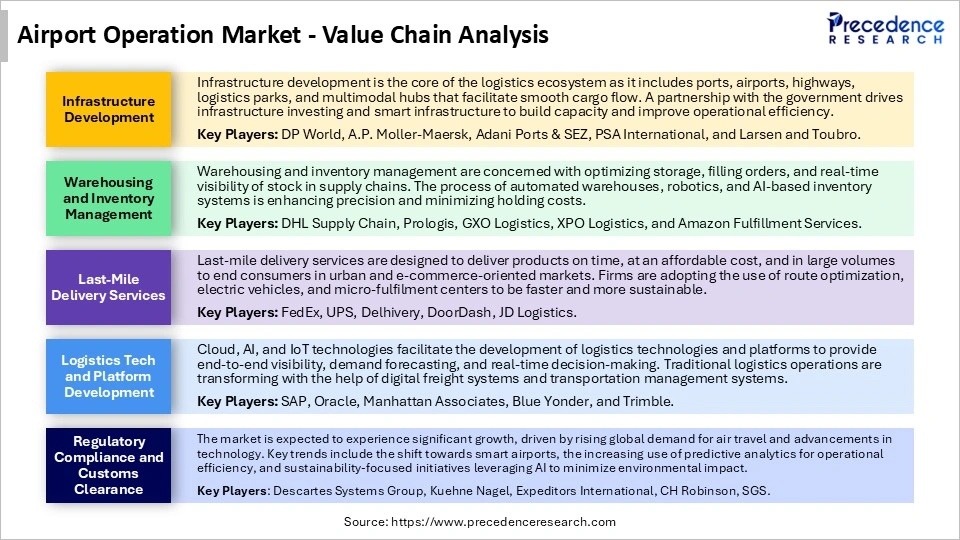
Airport Operation Market Value Chain Analysis
Competitive Landscape
The Airport Operation Market is semi-consolidated, characterized by competition amongst the operators, technology providers, and aircraft services. The top market participants including Aena S.M.E., Fraport AG, VINCI Airports, Aéroports de Paris SA, and Amadeus IT Group hold their position in the market due to the presence of an expansive airport network, advanced technology, and global partnerships.
The business growth of the firms involves airport concession agreements, partnerships, airport digitization initiatives, and adoption of smart airports. AI-driven passenger management, biometrics, automation, and analytics are some of the innovations in the industry. The need for high capital investment, compliance with aviation rules, and infrastructural expenses are some barriers to entry into the market.
Recent Developments
- In February 2026, Assam Chief Minister Himanta Biswa Sarma announced that the new integrated terminal at Lokapriya Gopinath Bordoloi International Airport in Guwahati will commence commercial operations, marking a major addition to the state's aviation infrastructure. .(Source: https://www.newsonair.gov.in)
- In January 2026, Atlanta's Hartsfield-Jackson International Airport announced an investment of $3 million in new equipment to enhance passenger movement during winter storms, following past disruptions. The airport is acquiring specialized snow and ice removal machinery to ensure runways and taxiways remain clear, minimizing delays and improving overall efficiency.
- In January 2026, the Irish Air Corps started operations with its newly acquired Dassault Aviation Falcon 6X, delivering enhanced capability in airlift, medical evacuation, and government transport. The French-built aircraft aimed to support Irish citizens and defense forces personnel across the globe with high speed, safety, and flexibility.(Source: https://www.flightglobal.com)
- In December 2025, Riyadh Air launched the world's first AI-native airline in collaboration with IBM Consulting to transform guest and employee experiences and set a benchmark for the aviation industry. IBM Consulting served as the orchestrator and brought together 59 workstreams and 60 partners, including Adobe, Apple, FLYR, and Microsoft. (Source: https://newsroom.ibm.com)
Segments Covered in the Report
By Operation Type
- Airside Operations
- Landside Operations
- Financial & Information Management
By Service/Platform
- Baggage Handling & Screening
- Passenger Processing
- Smart Technologies
By Airport Size
- Large International Hubs
- Medium & Small Airports
By Region
- North America
- Europe
- Asia-Pacific
- Latin America
- Middle East & Africa
For inquiries regarding discounts, bulk purchases, or customization requests, please contact us at sales@precedenceresearch.com
Frequently Asked Questions
Tags





Ask For Sample
No cookie-cutter, only authentic analysis – take the 1st step to become a Precedence Research client
 Get a Sample



 sales@precedenceresearch.com
 Schedule a Meeting
