



Amniotic Membrane Market Trends, Leading Companies, Company Revenue / Sales Performance, Procedure Volume, Healthcare Spending, Technology Adoption, Reimbursement Analysis, Competitive Landscape, and Growth Outlook
The global amniotic membrane market is expanding steadily as diabetic wound care needs rise, and ophthalmology use grows. Cryopreserved membranes lead, while new formats like hydrogels and powders open fresh opportunities. North America holds the top position, and Asia Pacific offers the strongest growth potential through 2036.
Source: https://www.precedenceresearch.com/amniotic-membrane-market
 Get a Sample
 Report Description


What is the Amniotic Membrane Market Size?
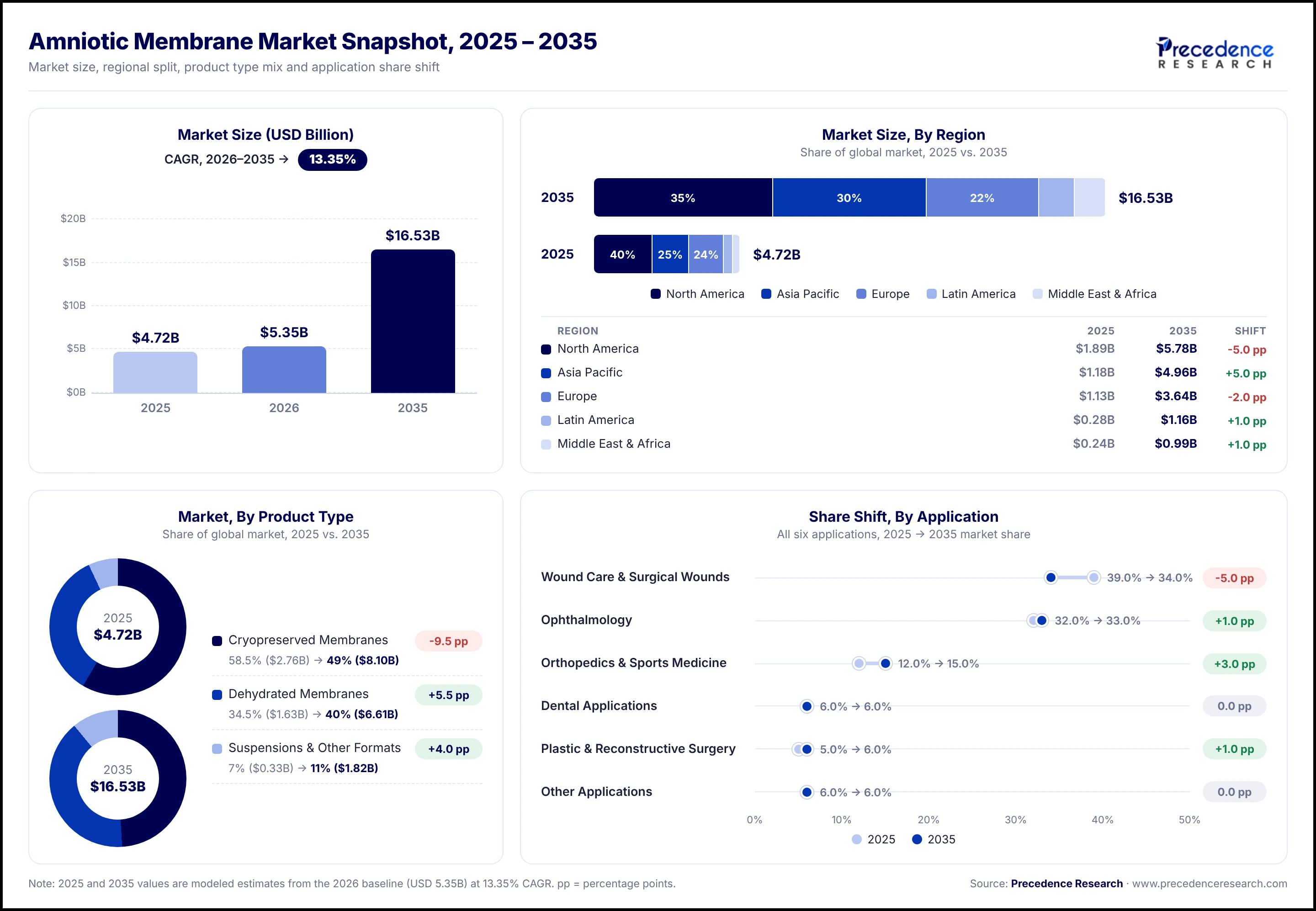
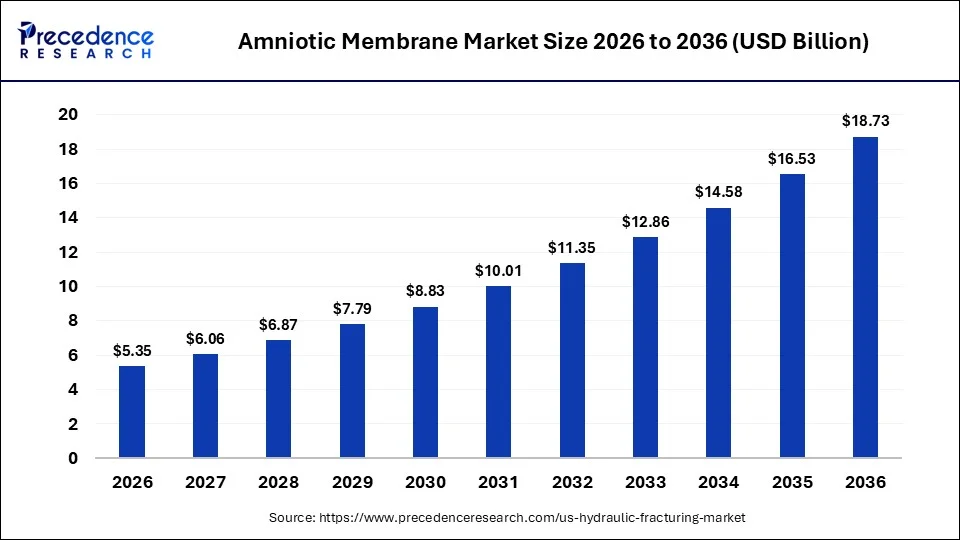
The global amniotic membrane market was valued at USD 5.35 billion in 2026 and is projected to reach USD XX billion by 2036, with an impressive CAGR of 13.35%. This growth is supported by rising demand for amniotic membrane in the ophthalmology sector and a surge in its usage in advanced wound care.
Key Takeaways
- Rising diabetes prevalence and the resulting burden of chronic foot ulcers and non-healing wounds are driving demand for amniotic membrane in advanced wound care.
- Growing clinical evidence of faster healing across wound care, ophthalmic, orthopedic, dental and cosmetic surgery is driving adoption.
- Cryopreserved membranes dominate the market due to their ability to retain key bioactive compounds and extracellular matrix, but dehydrated membranes are gaining ground due to longer shelf life and easier storage and distribution.
- Wound care and surgical wounds are the largest application segment, followed by ophthalmology, where use in corneal reconstruction, ocular surface disorders, and dry-eye procedures is expanding.
- Hospitals remain the leading end user because of surgical and complex wound care volumes, while specialty clinics are growing on demand from ophthalmology, podiatry, and outpatient wound management.
- North America leads on the strength of tissue banking infrastructure and reimbursement pathways, while Asia Pacific offers strong growth potential through expanding ophthalmic care, healthcare infrastructure, and tissue banking.
- Manufacturers can expand through new formats (hydrogels, extracts, powders, and contact-lens-held membranes) and trial-backed evidence for payers, though regulatory uncertainty and the lack of standardized protocols remain key hurdles.
Market Overview
The amniotic membrane is the thin, innermost layer of the placenta that protects a fetus during pregnancy. It is harvested from donated human placental tissue and widely used in ophthalmology and regenerative medicine.
In recent years, the amniotic membrane has been gaining recognition due to its superiority in wound healing, especially in diabetic care and ophthalmology. It is rich in bioactive molecules that optimize wound recovery. This is a major driver of the global amniotic membrane market. As per the data published in the IDF Diabetes Atlas, the number of diabetic patients has increased from 4.6% to 11.1% in the age group of 20-79. One in nine individuals is suffering from this disease. If it is left untreated, it leads to a high prevalence of foot ulcers and gangrene. This is creating a high demand for amniotic membrane.
On the other hand, leading healthcare domains like ophthalmology, orthopedics, dentistry, and cosmetic surgery are also using an amniotic membrane to streamline the healing journey.
Amniotic Membrane Market Trends
Patients are preferring hospital outpatient and surgical settings
Hospital outpatients provide more structured and advanced care as compared to telemedicine or online consultation. At the same time, surgical use of amniotic fluid is also growing, and leading players are indicating this as a long-term opportunity for market growth. This is beneficial for companies actively involved in surgical portfolio and hospital relationships.
Manufacturers are preferring new product formats and clinical evidence for investments
Amniotic product manufacturers are funding trials, especially in diabetic care, rather than depending on observational data due to the rising proof of benefit expectations from payers. Also, they are more focused on product range expansion. For instance, amniotic membrane is now available in powder or particle form. On the other hand, in eye surgery, it was stitched to the wound, but its present form can be held by a contact lens. This can be done in a clinic also.
Analyst View: The focus on hospital outpatient and surgical channels and the move towards trial-based evidence suggests that a more mature market is emerging, in which reimbursement-grade clinical evidence is the key to building a competitive moat. Firms that can build on existing hospital relationships, surgical product sets and diabetic-care trial pipelines will benefit most.
Market Dynamics
Driver
Growing Supportive Clinical Evidence in Advanced Wound Care
Surging demand in advanced wound care is the prime driver behind amniotic membrane market growth. Integration of amniotic membrane into treatment optimizes healing rates in foot ulcers, surgery, sports injury, and ophthalmology. This clinically supported demand base is supporting industry growth.
Restraint
Regulatory Uncertainty and Standardization Shortage
Ethical concerns regarding donor tissue, inconsistency in products, and lack of standardized protocol are restraining industry growth. These factors are slowing down product approval. Amniotic membrane is derived from donated human placentas; hence, manufacturers must meet traceability and screening requirements, and obtain donor consent. But there were multiple ethical concerns about the use of donor tissue in 2025, which is adding compliance cost in production. These factors collectively limit the industry’s growth.
Opportunity
Expansion Across Multiple Domains
Ongoing clinical trials are estimated to offer new opportunities for market expansion throughout the forecast timeline. Rising awareness about amniotic membrane potential among eye care and other sectors will open new doors for growth of the industry. Expanding product range, such as hydrogels, extracts, and powders designed for muscle, cartilage, and tendon repair are gaining prominence in the healthcare.
Analyst view: Clinical validation drives wound-care demand, while donor-tissue compliance and regulatory ambiguity slow approvals; well-capitalized players will win, with hydrogels, powders and ophthalmic and musculoskeletal applications offering the strongest upside.
Segmental Analysis
The prominent segments of the global amniotic fluid market include product type, application, preservation technology, end user, and region.
| Segment | Share 2026 (%) | Market Value 2026 |
|---|---|---|
| Cryopreserved Amniotic Membranes | 58.00% | USD 3.103 Billion |
| Dehydrated Amniotic Membranes | 35.00% | USD 1.873 Billion |
| Amniotic Membrane Suspensions and Other Formats | 7.00% | USD 0.375 Billion |
Cryopreserved Amniotic Membranes generated largest revenue in 2026
On the basis of product type, the industry is segregated into Cryopreserved Amniotic Membranes, Dehydrated Amniotic Membranes, and Amniotic Membrane Suspensions and Other Formats. Cryopreserved is the largest segment, as it has generated 58% of revenue in 2026. It is gaining traction due to its ability to preserve bioactive compounds and extracellular matrix. Additionally, dehydrated amniotic is recognized for its longer shelf life and simplified storage and distribution. On the other hand, injectable regenerative therapies and specialized clinical applications are supporting the growth of the Amniotic Membrane Suspensions and Other Formats.
Analyst view: Cryopreserved products lead on bioactivity and clinical preference, while dehydrated variants win on logistics; suspensions and injectables are the faster-growing niche, driven by regenerative therapy demand.
Wound Care and Surgical Wounds segment is a Major Shareholder in 2026
| Segment | Share 2026 (%) | Market Value 2026 |
|---|---|---|
| Wound Care and Surgical Wounds | 39.00% | USD 2.087 Billion |
| Ophthalmology | 32.00% | USD 1.712 Billion |
| Orthopedics and Sports Medicine | 12.00% | USD 0.642 Billion |
| Dental Applications | 6.00% | USD 0.321 Billion |
| Plastic and Reconstructive Surgery | 5.00% | USD 0.268 Billion |
| Other Applications | 6.00% | USD 0.321 Billion |
By application, the Wound Care and Surgical Wounds segment gained a 39% share of the market due to its applicability in Chronic ulcers, diabetic wounds and advanced wound management. Ophthalmology is the second-largest shareholder, as amniotic membrane is used for Corneal reconstruction, ocular surface disorders and dry-eye procedures in it. Prominent applications of amniotic membrane among Soft-tissue repair and regenerative orthopedic procedures have supported the growth of the Orthopedics and Sports Medicine segment. It has generated the revenue of USD 0.642 Billion in 2026. Additional segments covered are Dental Applications and Plastic and Reconstructive Surgery.
Analyst view: Wound care leads on chronic and diabetic ulcer demand, ophthalmology holds a solid second position, and orthopedics and sports medicine (USD 0.642 billion) is the growth segment as regenerative soft-tissue repair gains traction.
Cryopreservation is Largely Preferred by Manufacturers
| Segment | Share 2026 (%) | Market Value 2026 |
|---|---|---|
| Cryopreservation | 57.00% | USD 3.050 Billion |
| Dehydration and Lyophilization | 35.00% | USD 1.873 Billion |
| Other Preservation Methods | 8.00% | USD 0.428 Billion |
Based on preservation technology, Cryopreservation was valued at USD 3.050 billion, covering 57% of market share due to ability to maintain tissue structure and biological activity. Another technique covered is Dehydration and Lyophilization. It has generated 35% of revenue and is known for its ambient-temperature storage and improved logistics.
Analyst View: Cryopreservation (USD 3.050 billion, 57%) dominates on preserved biological activity, while dehydration and lyophilization (35%) is the strong challenger, driven by ambient storage and easier logistics.
Hospital Is a Major Revenue Generator In 2026
| Segment | Share 2026 (%) | Market Value 2026 |
|---|---|---|
| Hospitals | 40.00% | USD 2.140 Billion |
| Specialty Clinics | 25.00% | USD 1.338 Billion |
| Ambulatory Surgical Centers | 20.00% | USD 1.070 Billion |
| Research and Academic Institutes | 5.00% | USD 0.268 Billion |
| Other Healthcare Providers | 5.00% | USD 0.268 Billion |
| Dental Clinics | 5.00% | USD 0.268 Billion |
By end user, Hospital is a major revenue generator in 2026 with 40% of share. Rising demand for amniotic membrane for surgical procedures and complex wound treatment is a major driver of this segment. Specialty clinics is the second-largest shareholder, generating 25% of revenue due to growing demand for amniotic membrane in ophthalmology, podiatry and outpatient wound management. Other segments covered in the report are Ambulatory Surgical Centers, Research and Academic Institutes, Dental Clinics, and others.
Analyst View: Hospitals lead on surgical and complex wound volumes, while specialty clinics are the growth channel as ophthalmology; podiatry and outpatient wound care shift to lower-cost, accessible settings.
Regional Analysis
| Segment | Share 2026 (%) | Market Value 2026 |
|---|---|---|
| North America | 40.00% | USD 2.140 Billion |
| Europe | 24.00% | USD 1.284 Billion |
| Asia Pacific | 25.00% | USD 1.338 Billion |
| Latin America | 6.00% | USD 0.321 Billion |
| Middle East & Africa | 5.00% | USD 0.268 Billion |
The regional analysis covers the global amniotic membrane market across North America, Europe, Asia Pacific, Latin America, and the Middle East & Africa.
High-end tissue banking, reimbursement pathways and advanced wound care have supported the North American market growth. The region generated largest revenue of USD 2.140 Billion with 45% share in 2026.
Europe has gained USD 643.20 Million i.e. 24% share of the market due to high regenerative medicine adoption and specialist surgical services.
Asia Pacific, on the other hand, has generated USD 1.338 Billion with 22% share in 2026 due to expanding ophthalmic care, healthcare infrastructure and tissue banking across the region.
Latin America is under developing stage, as it has generated USD 0.321 Billion with 6% market share. Growing food safety and environmental testing requirements are boosting the growth of the sector.
Analyst view: North America leads on mature tissue banking, reimbursement support and advanced wound care, with Europe following on strong regenerative medicine adoption. Asia Pacific is the key growth region as ophthalmic care and tissue banking infrastructure expand, while Latin America remains early-stage with room to develop.
Competitive Landscape
| Leaders | Strong Challengers |
|---|---|
| Thermo Fisher Scientific Inc. | Agilent Technologies, Inc. |
| Merck KGaA | Waters Corporation |
| Danaher Corporation | Shimadzu Corporation |
| Specialists | Emerging / Regional Players |
| QIAGEN N.V. | Biotage AB |
| Bio-Rad Laboratories, Inc. | Gilson, Inc. |
| Tecan Group Ltd. | GERSTEL GmbH & Co. KG |
| Revvity, Inc. | Phenomenex, Inc. |
The global amniotic membrane report covers leading active players including MiMedx Group, Inc., Organogenesis Holdings Inc., BioTissue Holdings, Inc., Integra LifeSciences Holdings Corporation, and Amnio Technology, LLC. These companies are holding a combined share of 26% of the global industry.
The report categorizes active companies into four prominent categories. Emerging/ Regional players include Biotage AB, Gilson, Inc., GERSTEL GmbH & Co. KG, and Phenomenex, Inc. Specialists are QIAGEN N.V., Bio-Rad Laboratories, Inc., Tecan Group Ltd., and Revvity, Inc. Strong challengers involve Agilent Technologies, Inc., Waters Corporation, Shimadzu Corporation. And Leaders category includes Thermo Fisher Scientific Inc., Merck KGaA, and Danaher Corporation.
Top market players covered in the report
| Company | Estimated Market Share (%) |
|---|---|
| Thermo Fisher Scientific Inc. | 9.00% |
| Merck KGaA | 7.00% |
| Agilent Technologies, Inc. | 6.00% |
| Danaher Corporation | 5.00% |
| Waters Corporation | 4.00% |
| Combined Top 5 | 31.00% |
| Other Players | 69.00% |
Analyst View: The market is fragmented, with the five named amniotic specialists holding about a quarter of share, leaving room for consolidation and share gains through clinical evidence and new product formats. However, the tiered players listed (Thermo Fisher, Merck KGaA, Danaher, Agilent and others) are analytical and life-science tools companies, not amniotic tissue suppliers.
Companies Ecosystem
The initial stage in the amniotic membrane ecosystem comprises raw Materials / Inputs. This stage covers placental tissue procurement, donor eligibility assessment, and infectious disease screening. Accredited tissue banks, hospitals, maternity centers, and donor-screening laboratories are the prominent raw material suppliers in this phase.
Tissue preservation, dehydration, cryopreservation, and graft-processing technologies come under the Components / Technology stage. MiMedx Group, BioTissue, and Corza Medical are prominent players in this section.
Manufacturing / Production stage involves processing, preservation, quality control and production of amniotic membrane allografts. Major active companies in this category are MiMedx Group, Organogenesis, Amnio Technology, BioTissue, and Skye Biologics.
Processing / Integration covers graft preparation, surgical configurations, and ophthalmic product integration. The active group of companies in this stage are Integra LifeSciences, Corza Medical, and Human Regenerative Technologies.
MiMedx Group, Organogenesis, Integra LifeSciences, and Corza Medical are active in Distribution / Sales. They handle Hospital procurement, specialist sales, clinical education and product distribution.
Recent Developments
- BioStem acquired BioTissue’s surgical and wound care business
BioStem Technologies acquired BioTissue’s wound care unit in Jan 2026. This unit includes the Neox and Clarix amniotic and umbilical cord allografts and its hospital sales network. BioTissue is now focusing on eye care. Its Catalyze product received FDA 510(k) clearance in June 2026. (SEC filing and BioStem release) - MTF Biologics names an exclusive US distributor for AmnioBand
In May 2026, MTF Biologics announced the appointment of New Horizon Medical Solutions as the sole distributor of AmnioBand Membrane to U.S. podiatrists, wound care specialists, mobile care practitioners. The exclusive deal joins the products’ clinical foundation with a distributor focused on the increasingly competitive field of outpatient and mobile care. (MTF Biologics) - Merakris launched AmnioSurge for colorectal surgery (Sept 8, 2026)
Merakris Therapeutics launched AmnioSurge in September 2026. It is a full thickness allograft of amnion-chorion designed to fit colorectal circular staplers and anastomosis sites. The company describes it as a human cell and tissue product subject to FDA’s 21 CFR Part 1271. It highlights amniotic products’ adaptation to specific surgical procedures. (Merakris release)
FAQs
What is driving demand for amniotic membranes?
Mainly diabetes. More people are developing chronic foot ulcers and wounds that don’t heal, and amniotic membranes are rich in natural compounds that speed up recovery. Doctors in eye care, orthopedics, dentistry and cosmetic surgery are also using them as clinical evidence builds.
Which product types and uses lead the market?
Cryopreserved (frozen) membranes lead with a 58% share because they keep their natural bioactive properties. Dehydrated membranes, at 35%, are catching up because they last longer and are easier to store and ship. By use, wound care and surgical wounds are the largest segment at 39%, followed by ophthalmology at 32%.
Which regions lead, and what could slow growth?
North America leads, thanks to strong tissue banking and reimbursement systems, while Asia Pacific has the most room to grow as eye care and healthcare infrastructure expand. The main hurdles are unclear regulations, a lack of standard protocols, and the cost of meeting donor-tissue rules.
Segments Covered in the Report
By Product Type
- Cryopreserved Amniotic Membranes
- Dehydrated Amniotic Membranes
- Amniotic Membrane Suspensions and Other Formats
By Application
- Wound Care and Surgical Wounds
- Ophthalmology
- Orthopedics and Sports Medicine
- Dental Applications
- Plastic and Reconstructive Surgery
- Other Applications
By Preservation Technology
- Cryopreservation
- Dehydration and Lyophilization
- Other Preservation Methods
By End User
- Hospitals
- Specialty Clinics
- Ambulatory Surgical Centers
- Research and Academic Institutes
- Other Healthcare Providers
- Dental Clinics
By Region
- North America
- United States
- Canada
- Mexico
- Europe
- Germany
- United Kingdom
- France
- Italy
- Spain
- Rest of Europe
- Asia Pacific
- China
- Japan
- India
- South Korea
- Australia
- Rest of Asia Pacific
- Latin America
- Brazil
- Mexico
- Argentina
- Rest of Latin America
- Middle East & Africa
- Saudi Arabia
- United Arab Emirates
- South Africa
- Egypt
- Rest of Middle East & Africa
Analyst view
The growth of the amniotic membrane market is driven by the established clinical need in advanced wound care and ophthalmology, where cryopreserved products are dominant, while dehydrated variants are gaining ground on logistical convenience. Hospitals currently represent the largest segment, but specialty clinics and ambulatory surgery centers are prime growth areas. The main headwinds are regulatory uncertainty and costs associated with donor tissue compliance, favoring bigger, vertically integrated companies. The most compelling opportunities are presented by newer formats, such as hydrogels, powders or contact-lens-held membranes, and the expansion into the Asia Pacific region, which should drive the market growth up to 2036.
For inquiries regarding discounts, bulk purchases, or customization requests, please contact us at sales@precedenceresearch.com
Frequently Asked Questions
Tags





Ask For Sample
No cookie-cutter, only authentic analysis – take the 1st step to become a Precedence Research client
 Get a Sample




 sales@precedenceresearch.com
 Schedule a Meeting
