



North America & Asia Transfer Membrane Market Size, Key Companies, Company Production Capacity, Healthcare Infrastructure Growth, Product Utilization, Regulatory Compliance, Company Expansion Strategies, Company Investment Strategies, and Market Outlook
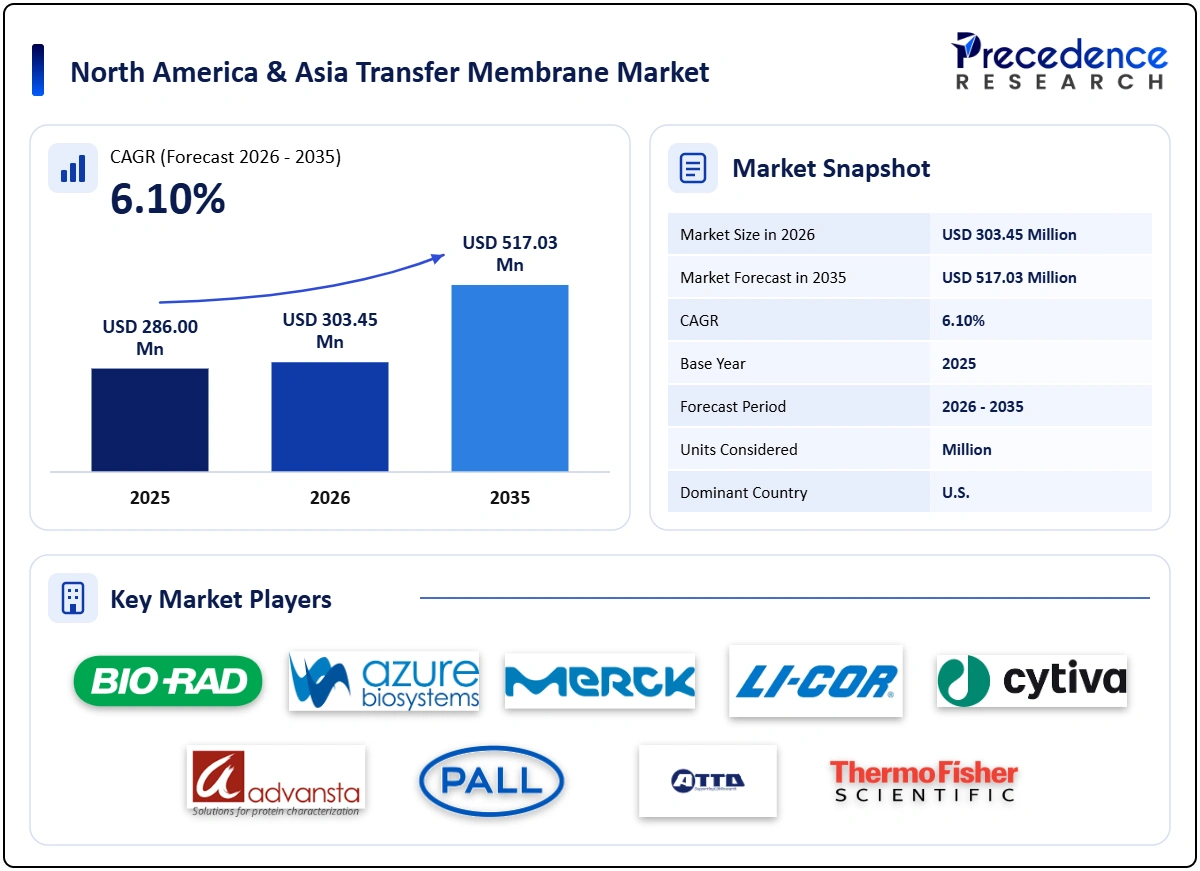
Payal Rabde, a Healthcare Industry Expert, highlights that the North America and Asia Transfer Membrane Market has reached USD 303.45 million in 2026 and is on track to reach USD 517.03 million by 2035, advancing at a CAGR of 6.10%. North America and Asia Transfer Membrane Market companies shaping the market include Key Merck KGaA (MilliporeSigma), Bio-Rad Laboratories, Thermo Fisher Scientific,while major growth segments span membrane type, format, end user.
Source: https://www.precedenceresearch.com/north-america-and-asia-transfer-membrane-market
 Get a Sample
 Table Of Content


Key Takeaways
Market Size & Growth Outlook
- Market size in 2025: USD 286.00 million
- Estimated market size in 2026: USD 303.45 million
- Projected market size by 2035: USD 517.03 million
- CAGR (2026-2035): 6.10%
Regional Market Spotlight
- The U.S. dominated with 44.00% of the market share in 2025.
- China held a 22.00% share in 2025 and is projected to be the fastest-growing country, at a CAGR of 7.20% from 2026 to 2035.
- In 2025, Japan accounted for 13.00% of the market share.
Segmental Spotlight
- By membrane type, PVDF accounted for the largest share of 52.00% in 2025.
- In 2025, rolls & sheets captured 58.00% market share, making it the most widely adopted format.
- Academic & research institutes represented the leading end-user category, holding a 53.00% share.
North America & Asia Transfer Membrane Market Size, 2025-2035 (USD Million)
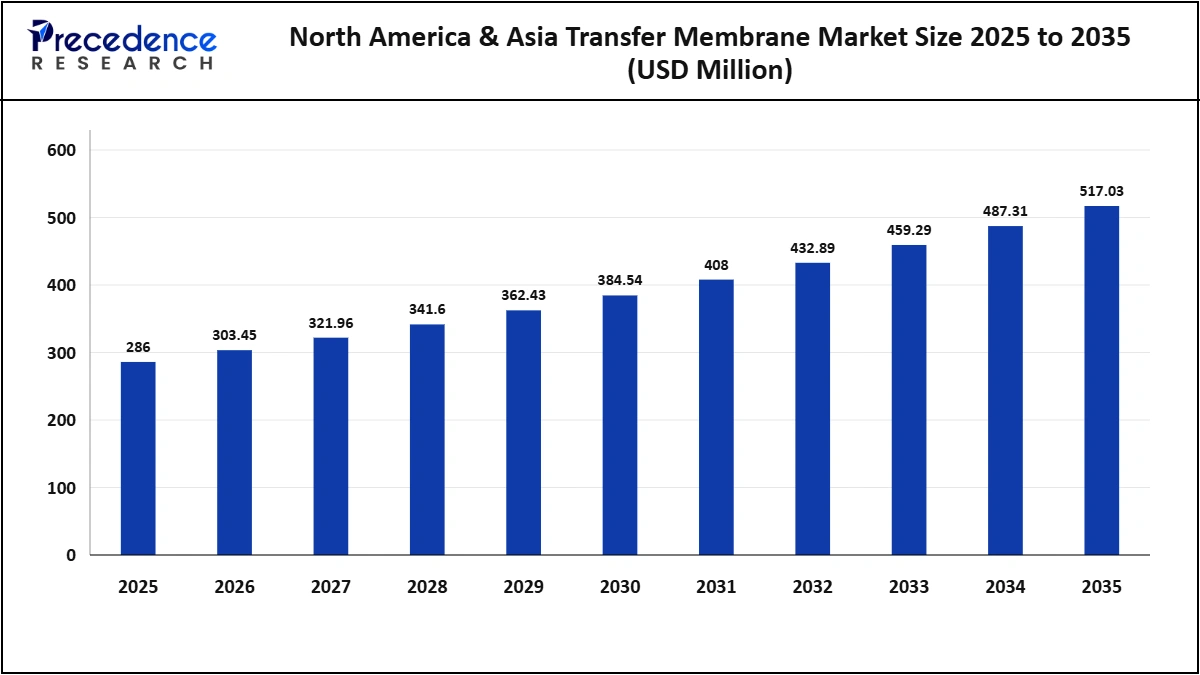
Note: 2025 is the base year; 2026-2035 values are forecasts.
Sources: Expert interviews, secondary sources, Precedence Research database, and Precedence Research analysts.
The North America & Asia transfer membrane market was valued at USD 286.00 million in 2025 and is projected to reach USD 517.03 million by 2035 because western blotting remains a core technique in research and biologics development, and rapid transfer systems lift spending per blot. Research activity and rapid transfer systems support steady growth, lifting the market to USD 384.54 million by 2030 and sustaining a CAGR of 6.10% over the forecast period.
Analyst View: The North America & Asia transfer membrane market is poised for steady growth, supported by sustained western blotting demand across life sciences research and biologics development. Increasing adoption of rapid transfer systems will drive premium product uptake and higher spending per application.
Market Trends
- Rapid dry transfer: Pre-assembled transfer stacks reduce transfer time and simplify western blot workflows.
- Fluorescent multiplexing: Low-fluorescence PVDF membranes support multiplex detection and improve signal clarity.
- Local Asian suppliers: Chinese manufacturers are expanding local production of transfer membrane consumables to strengthen regional supply.
- Automated westerns: Capillary-based automated systems are replacing conventional western blotting in some applications.
- Sustainability: Manufacturers are adopting reduced packaging and solvent-free transfer technologies to minimize environmental impact.
Market Dynamics
The North America & Asia transfer membrane market supplies a mature research technique. Growth comes from biotech expansion in Asia and rapid transfer systems, while capillary-based automated westerns and research funding pressure limit growth in the U.S.
Drivers
Research funding in Asia
Rising research investments in China, India, and South Korea are driving demand for laboratory consumables, including transfer membranes.
Biologics development
Expanding antibody and protein-based drug development is increasing the use of western blotting for protein characterization and validation.
Rapid transfer systems
Growing adoption of rapid transfer instruments and compatible pre-assembled stacks is increasing consumable spending per blot.
Reproducibility focus
Increasing emphasis on research reproducibility and validated experimental results is supporting demand for high-quality, consistent transfer membranes.
Market Drivers - Impact & CAGR Contribution (2026-2035)
| Driver | Impact | ≈ CAGR Contribution | Time Horizon | Key Regions |
| Research funding in Asia | High | +2.38 pp | Short to long term | North America & Asia-wide, strongest in U.S. |
| Biologics development | Medium | +2.01 pp | Medium to long term | North America & Asia-wide, fastest uptake in China |
| Rapid transfer systems | Medium | +1.71 pp | Short to medium term | North America & Asia-wide |
| Reproducibility focus | Low | +1.34 pp | Long term | U.S. and China |
Note: Contributions are indicative estimates of each factor's effect on annual growth.
Sources: Expert interviews, secondary sources, Precedence Research database, and Precedence Research analysts.
Asian research funding, biologics development, and rapid transfer systems drive most growth in the North America & Asia transfer membrane market.
Restraints
Alternative technologies
Increasing adoption of capillary-based western systems and mass spectrometry is reducing reliance on conventional western blotting in certain applications.
U.S. funding pressure
Budget constraints and uncertainty surrounding NIH funding may limit research spending and reduce demand for laboratory consumables.
Price competition
Growing presence of local Asian manufacturers is intensifying price competition and putting pressure on transfer membrane pricing and profit margins.
Market Restraints - Impact & Negative CAGR Contribution (2026-2035)
| Restraint | Impact | ≈ Negative CAGR Contribution | Time Horizon | Key Regions |
| Alternative technologies | High | -0.60 pp | Short to medium term | North America & Asia-wide |
| U.S. funding pressure | High | -0.44 pp | Medium term | Smaller and price-sensitive markets |
| Price competition | Medium | -0.30 pp | Short term | U.S. and other mature markets |
Note: Contributions are indicative estimates of each factor's effect on annual growth.
Sources: Expert interviews, secondary sources, Precedence Research database, and Precedence Research analysts.
Alternative technologies are the main restraint, followed by U.S. funding pressure and price competition in the North America & Asia transfer membrane market.
Opportunities
India and Southeast Asia
Growing biotechnology sectors and increasing research investments in India and Southeast Asia are creating new opportunities for transfer membrane suppliers.
Low-fluorescence membranes
Increasing adoption of fluorescent multiplexing and advanced imaging techniques is creating demand for specialized low-fluorescence membranes.
Bundled workflows
Bundling transfer membranes with compatible buffers, transfer systems, and imaging solutions can strengthen customer loyalty and create opportunities for higher-value product offerings.
North America & Asia Transfer Membrane Market Segmentation: 2025 Share and Size
North America & Asia Transfer Membrane Market by Membrane Type, 2025-2035 Share (%)
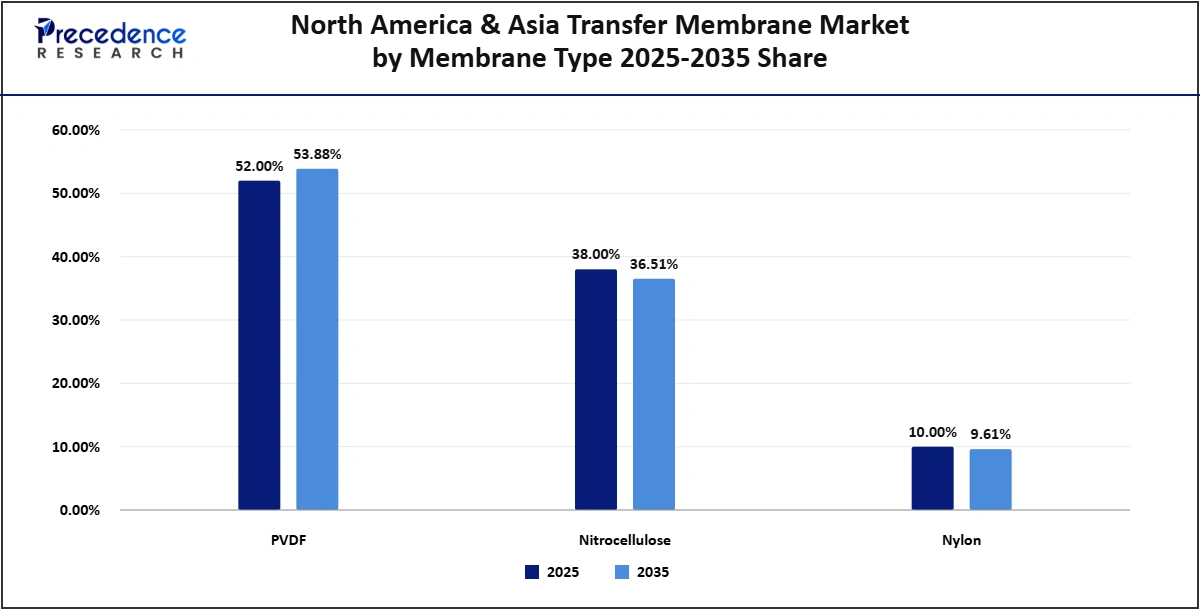
Note: 2025 is the base year; 2035 shares and CAGRs are forecasts.
Sources: Expert interviews, secondary sources, Precedence Research database, and Precedence Research analysts.
PVDF leads because its strength and chemical resistance suit stripping, reprobing, and fluorescent detection. Nitrocellulose remains widely used for routine westerns, while pre-assembled stacks for rapid dry transfer grow fastest.
PVDF: Representing 52.00% of the market in 2025, PVDF is forecast to maintain the fastest growth at a CAGR of 6.48% over the forecast period. PVDF membranes dominate due to their high protein-binding capacity, durability, chemical resistance, and compatibility with both chemiluminescent and fluorescent detection methods.
Nitrocellulose: With a market contribution of 38.00% in 2025, nitrocellulose is expected to witness sustained expansion at a CAGR of 5.68% from 2026 to 2035. Its rapid protein-binding ability, low background signal, and cost-effectiveness support widespread adoption in routine western blotting applications.
Nylon: The segment held a substantial 10.00% share of the market in 2025, with growth projected at a 5.68% CAGR through 2035. Demand benefits from its high nucleic acid-binding capacity and durability, making it suitable for Southern and Northern blotting applications.
North America & Asia Transfer Membrane Market by Format, 2025-2035 Share (%)
| Segments | 2025 Share | 2035 Share | CAGR 2026-2035 |
| Rolls & Sheets | 58.00% | 53.82% | 5.31% |
| Transfer Stacks & Pre-cut | 42.00% | 46.18% | 7.11% |
Note: 2025 is the base year; 2035 shares and CAGRs are forecasts.
Sources: Expert interviews, secondary sources, Precedence Research database, and Precedence Research analysts.
Rolls and sheets lead because most labs still cut membranes for tank and semi-dry transfer. Pre-cut sandwiches and transfer stacks grow fastest as labs adopt rapid systems such as iBlot 3 and Trans-Blot Turbo.
Rolls & Sheets: In 2025, the segment captured 58.00% of the market and is expected to achieve a CAGR of 5.31% over the 2026-2035 period. Due to their flexibility, customizable sizing, and cost-effectiveness, rolls and sheets are suitable for diverse laboratory workflows and high-volume usage.
Transfer Stacks & Pre-cut: The segment's market share stood at 42.00% in 2025, while its growth trajectory is expected to reflect a CAGR of 7.11% during 2026-2035. Increasing adoption of automated and rapid transfer systems is driving demand for compatible pre-assembled stacks.
North America & Asia Transfer Membrane Market by End User, 2025 Share (%)
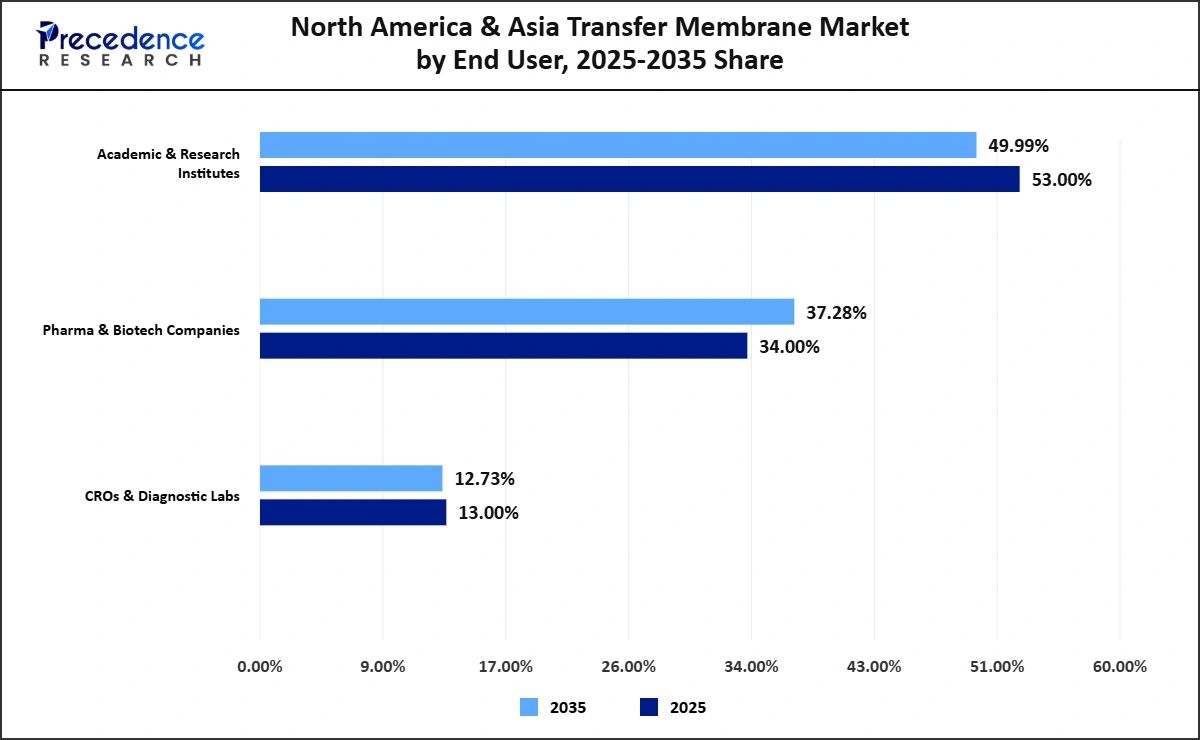
Note: 2025 is the base year; 2035 shares and CAGRs are forecasts.
Sources: Expert interviews, secondary sources, Precedence Research database, and Precedence Research analysts.
Academic and research institutes lead because western blotting is a core technique in biology labs. Pharma and biotech companies grow fastest as China's and India's biotech sectors expand.
Academic & Research Institutes: The segment dominated the market in 2025, accounting for 53% of total revenue, and is expected to register a CAGR of 5.48% from 2026 to 2035. Sustained demand for protein analysis in academic research, supported by government-funded life sciences and biotechnology programs, drives higher consumption of transfer membranes.
Pharma & Biotech Companies: Holding a 34.00% market share in 2025, pharma & biotech companies are expected to expand at a CAGR of 7.08% during the forecast period. Rising investment in biologics, antibody development, and protein characterization is driving greater adoption of western blotting and increasing demand for high-quality transfer membranes.
CROs & Diagnostic Labs: The segment captured 13.00% of the total market in 2025 and is anticipated to register a CAGR of 5.88% between 2026 and 2035. Increasing outsourcing of research activities and rising demand for protein-based diagnostic testing are supporting greater use of western blotting and transfer membranes in CROs and diagnostic labs.
Analyst View: The North America & Asia transfer membrane market is led by PVDF membranes due to their superior protein-binding performance and broad detection compatibility. Rolls & sheets dominate through their flexibility and cost-effectiveness, while transfer stacks & pre-cut are gaining traction with the adoption of automated and rapid transfer systems. Academic & research institutes dominate the end user, but pharma & biotech companies are becoming a significant growth sector due to the rise in protein characterization.
Country Analysis
North America & Asia Transfer Membrane Market by Country, 2025 Share (%)
| Country | 2025 Share | 2035 Share | CAGR 2026-2035 |
| U.S. | 44.00% | 41.95% | 5.60% |
| China | 22.00% | 24.38% | 7.20% |
| Japan | 13.00% | 12.87% | 6.00% |
| India | 6.00% | 5.94% | 6.00% |
| South Korea | 5.00% | 4.95% | 6.00% |
| Canada | 5.00% | 4.95% | 6.00% |
| Rest of Asia | 5.00% | 4.95% | 6.00% |
Note: 2025 is the base year; 2035 shares and CAGRs are forecasts.
Sources: Expert interviews, secondary sources, Precedence Research database, and Precedence Research analysts.
The U.S. leads because of its large research base and well-funded labs. China is the fastest-growing country as research spending rises and local membrane makers expand.
Country Insights
U.S.: Contributing 44.00% of the market in 2025, the U.S. is forecast to maintain steady growth at a CAGR of 5.60% over the forecast period. It has the largest life science research base, and Bio-Rad, Thermo Fisher, and Merck's MilliporeSigma sell through dense distribution networks.
China: With a market contribution of 22.00% in 2025, China is expected to witness sustained expansion at a CAGR of 7.20% from 2026 to 2035. China is growing fastest due to strong research spending, and local suppliers such as Tailin are replacing some imports.
Japan: In 2025, the country represented 13.00% of the overall market and is expected to achieve a CAGR of 6.00% over the 2026-2035 period. Established academic research institutions, strong pharmaceutical R&D activity, and a well-developed laboratory equipment industry are sustaining demand for transfer membranes.
India: The country held a substantial 6.00% share of the market in 2025, with growth projected at a 6.00% CAGR through 2035. Expanding biotechnology hubs, increasing research investments, and growing pharmaceutical manufacturing are driving demand for western blotting consumables.
South Korea: The country's market share stood at 5.00% in 2025, while its growth trajectory is expected to reflect a CAGR of 6.00% during 2026-2035. Strong government support for biotechnology, expanding biopharmaceutical R&D, and established bio-clusters are supporting market growth.
Canada: The country represented 5.00% of revenue in 2025 and is expected to grow at a CAGR of 6.00% through 2035. Increasing biomedical research activity and expanding biotechnology development are driving membrane consumption.
Rest of Asia: This region accounted for 5.00% of the market in 2025 and is projected to grow at a CAGR of 6.00% over the forecast period. Growing life sciences research and increasing investments in laboratory infrastructure across Singapore, Taiwan, and Australia are supporting demand.
Analyst View: The U.S. market benefits from its established life sciences research ecosystem and strong presence of leading membrane suppliers, while China's growth is driven by rising research investments and increasing localization of consumable manufacturing.
Competitive Landscape
Top 10 Companies in the North America & Asia Transfer Membrane Market, 2025
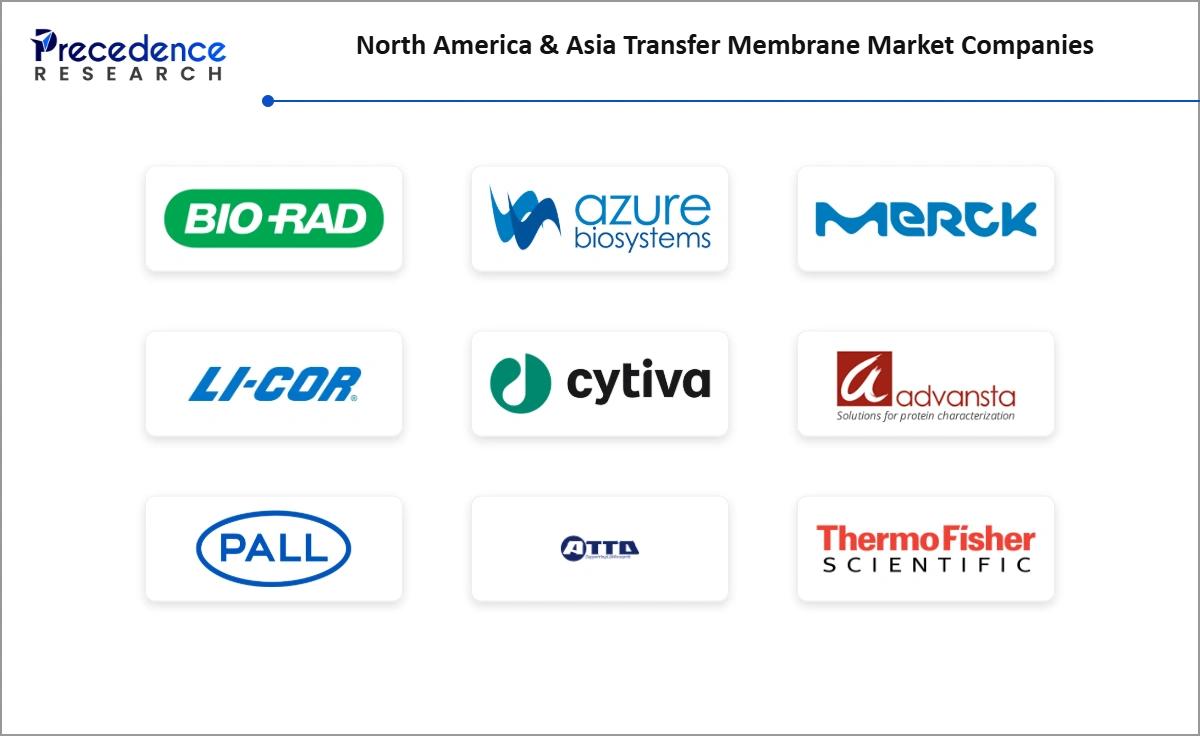
| Rank | Company Name | 2025 Share (%) | Key Products / Business | Headquarters |
| 1 | Merck KGaA (MilliporeSigma) | 22.00% | Immobilon PVDF membranes | Germany |
| 2 | Bio-Rad Laboratories | 19.00% | Immun-Blot membranes and Trans-Blot Turbo packs | United States |
| 3 | Thermo Fisher Scientific | 17.00% | Invitrogen PVDF, nitrocellulose and iBlot stacks | United States |
| 4 | Cytiva | 13.00% | Amersham Hybond and Protran membranes | United States |
| 5 | LI-COR Biosciences | 3.00% | Low-fluorescence membranes | United States |
| 6 | Atto Corporation | 3.00% | Blotting systems and membranes | Japan |
| 7 | Pall (Danaher) | 3.00% | BioTrace membranes | United States |
| 8 | Azure Biosystems | 2.00% | Blotting membranes | United States |
| 9 | Tailin Scitech | 2.00% | PVDF and NC membranes | China |
| 10 | Advansta | 1.00% | Membranes and reagents | United States |
Note: Company shares are 2025 estimates.
Sources: Company press releases, expert interviews, secondary sources, Precedence Research database, and Precedence Research analysts.
Merck KGaA (MilliporeSigma) led the market with 22.00% share of 2025 revenue, followed by Bio-Rad Laboratories at 19.00% share and Thermo Fisher Scientific at 17.00% share. Merck KGaA (MilliporeSigma) leads with Immobilon PVDF membranes, Bio-Rad Laboratories competes with Immun-Blot membranes and Trans-Blot Turbo packs, and Thermo Fisher Scientific offers Invitrogen PVDF, nitrocellulose, and iBlot stacks. Cytiva, LI-COR Biosciences, Atto Corporation, Pall (Danaher), Azure Biosystems, Tailin Scitech, and Advansta compete through Amersham Hybond and Protran membranes, low-fluorescence membranes, blotting systems and membranes, bioTrace membranes, blotting membranes, PVDF and NC membranes, and reagents.
The top 10 market players contributed 85.00% of 2025 revenue, while the remaining 15.00% was shared among regional Chinese and Indian suppliers and distributors. The North America & Asia transfer membrane market is concentrated, and competition centers on binding capacity, background, compatibility with transfer systems and imagers, price, and local distribution.
Company Snapshots
Merck KGaA (MilliporeSigma): Headquartered in Germany, Merck KGaA (MilliporeSigma) held an estimated 22.00% of the North America & Asia transfer membrane market in 2025, built largely on Immobilon PVDF membranes. The Precedence Research Companies Quadrant places it as a Leader.
Bio-Rad Laboratories: It competes mainly through Immun-Blot membranes and Trans-Blot Turbo packs. From its base in the United States, it captured 19.00% of 2025 revenue and is rated a Leader in the Precedence Research Companies Quadrant.
Thermo Fisher Scientific: With 17.00% of the market share in 2025, Thermo Fisher Scientific draws on Invitrogen PVDF, nitrocellulose, and iBlot stacks. The company is based in the United States and appears as a Leader in the Precedence Research Companies Quadrant.
Cytiva: Based in the United States and part of Danaher Corporation, accounted for a 13.00% share in 2025. Its Amersham Hybond and Protran membranes keep it in the Leader group of the Precedence Research Companies Quadrant.
LI-COR Biosciences: Captured a 3.00% share in 2025, making LI-COR Biosciences a notable participant in the market. It is headquartered in the United States, focuses on low-fluorescence membranes, and is classed as a Leader in the Precedence Research Companies Quadrant.
Atto Corporation: Atto Corporation built its 3.00% position in the North America & Asia transfer membrane market around blotting systems and membranes. Headquartered in Japan, it is shown as a Leader in the Precedence Research Companies Quadrant.
Pall (Danaher): Most of Pall (Danaher)'s presence in this market comes from BioTrace membranes. The company is headquartered in the U.S., held 3.00% of 2025 revenue, and is rated an Innovator in the Precedence Research Companies Quadrant.
Azure Biosystems: In 2025, it contributed 2.00% of the market share. Its range is built around blotting membranes, and the company, based in the United States, is placed as an Innovator in the Precedence Research Companies Quadrant.
Tailin Scitech: Operating from China, Tailin Scitech offers PVDF and NC membranes. That portfolio gave it about 2.00% of the North America & Asia transfer membrane market in 2025 and a position as an Innovator in the Precedence Research Companies Quadrant.
Advansta: About 1.00% of 2025 revenue in the North America & Asia transfer membrane market went to Advansta, whose business here centers on membranes and reagents. The company is headquartered in the United States, and the Precedence Research Companies Quadrant rates it as an Innovator.
Companies Ecosystem
The North America and Asia transfer membrane ecosystem links polymer & casting, membrane suppliers, instrument makers, distributors, and labs, with each stage adding value before products reach end users. Membranes are used in clinical trials, research, and regenerative medicine labs that also run enzyme assays.
North America & Asia Transfer Membrane Market Ecosystem
| Ecosystem Stage | Role in the Market | Key Companies |
| Polymer & Casting | Make membrane material | Membrane producers |
| Membrane Suppliers | Package and sell | Merck, Bio-Rad, Thermo Fisher, Cytiva |
| Instrument Makers | Supply transfer systems | Bio-Rad, Thermo Fisher |
| Distributors | Reach labs | Fisher Scientific, VWR, local distributors |
| Labs | Run blots | Universities, pharma, CROs |
Sources: Company press releases, expert interviews, secondary sources, Precedence Research database, and Precedence Research analysts.
Polymer & Casting: Casting quality sets pore size and binding.
Membrane Suppliers: Suppliers link membranes to their instruments.
Instrument Makers: Rapid systems use proprietary stacks.
Distributors: Distributors hold university contracts.
Labs: Labs value consistency and sensitivity.
Value in the North America & Asia transfer membrane market flows from upstream material and technology suppliers to manufacturers and service providers, then through distribution partners to end users. Companies that integrate several stages or build long-term relationships with end users capture a larger share of this value.
Precedence Research Companies Quadrant
The Precedence Research Companies Quadrant positions key participants in the North America & Asia transfer membrane market by market strength, reflecting revenue scale, market share and geographic reach, and by innovation and growth strategy, reflecting product portfolio breadth, R&D intensity and partnerships. Positions reflect each company's estimated 2025 share of the North America & Asia transfer membrane market and our assessment of its product innovation, portfolio breadth and partnerships.
Sources: Company press releases, expert interviews, secondary sources, Precedence Research database, and Precedence Research analysts.
Leaders: Merck KGaA (MilliporeSigma), Bio-Rad Laboratories, Thermo Fisher Scientific, Cytiva, LI-COR Biosciences, and Atto combine high market share with broad portfolios and strong innovation.
Innovators: Pall (Danaher), Azure Biosystems, Tailin Scitech, and Advansta bring newer technologies and specialized products.
Recent Developments
- March 2026: China's Tailin launched its Immutailin PVDF blotting membrane, following the introduction of its nitrocellulose membrane line, strengthening its domestic life sciences consumables portfolio and localization efforts.
- July 2026: Thermo Fisher discontinued its original iBlot Transfer Stack SKUs, directing users towards the newer iBlot 3 transfer stacks, which offer higher throughput and improved transfer consistency.
North America and Asia Transfer Membrane Market Segments
By Membrane Type
- PVDF
- Nitrocellulose
- Nylon
By Format
- Rolls & Sheets
- Transfer Stacks & Pre-cut
By End User
- Academic & Research Institutes
- Pharma & Biotech Companies
- CROs & Diagnostic Labs
By Country
- U.S.
- Canada
- China
- Japan
- India
- South Korea
- Rest of Asia
Research Methodology: The market for membranes used to immobilize proteins and nucleic acids after electrophoresis in the U.S., China, Japan, and other Asian nations was identified as the North America and Asia transfer membrane market. For wet, semi-dry, and dry transfer applications in Western, Southern, Northern, and dot blotting, it offers PVDF, nitrocellulose, and nylon membranes in rolls, sheets, pre-cut formats, and transfer stacks. The 2025 base year was built bottom-up from demand volumes and average prices by membrane type, format and end user and country, and checked top-down against the market-specific revenues of leading companies and public industry data. Segment, country and company values were allocated from membrane type, format and end user and country demand. Key estimates were verified by cross-checking company disclosures, regulatory and industry data, and published third-party estimates, and inputs that could not be reconciled were excluded. All segment, regional and company figures were reconciled to the same 2025 base year, and the 2026-2035 forecast, which applies a constant CAGR from the 2025 base, was recalculated and validated.
Analyst View: The North America & Asia transfer membrane market is positioned for steady growth, supported by expanding biotechnology research, biologics development, and rising demand for advanced transfer systems, particularly in China and India. However, uncertainty in U.S. research funding, pricing pressure from regional suppliers, and the growing adoption of capillary western systems may moderate market expansion.
Sources and References
- Tailin Scitech. "New Launch: Tailin Immutailin PVDF Blotting Membrane". March 2026. Company news. (Source: tailinscitech.com)
- Thermo Fisher Scientific. "iBlot Transfer Stack, PVDF, Regular Size (discontinuation notice)". July 2026. Product notice. (Source: thermofisher.cn)
For inquiries regarding discounts, bulk purchases, or customization requests, please contact us at sales@precedenceresearch.com
Frequently Asked Questions





Ask For Sample
No cookie-cutter, only authentic analysis – take the 1st step to become a Precedence Research client
 Get a Sample




 sales@precedenceresearch.com
 Schedule a Meeting
