



Anime Market Size, Key Companies, Company Product Portfolio, Digital Transformation, Technology Investment, Adoption Rates, Customer Acquisition, Company Market Share, and Market Outlook
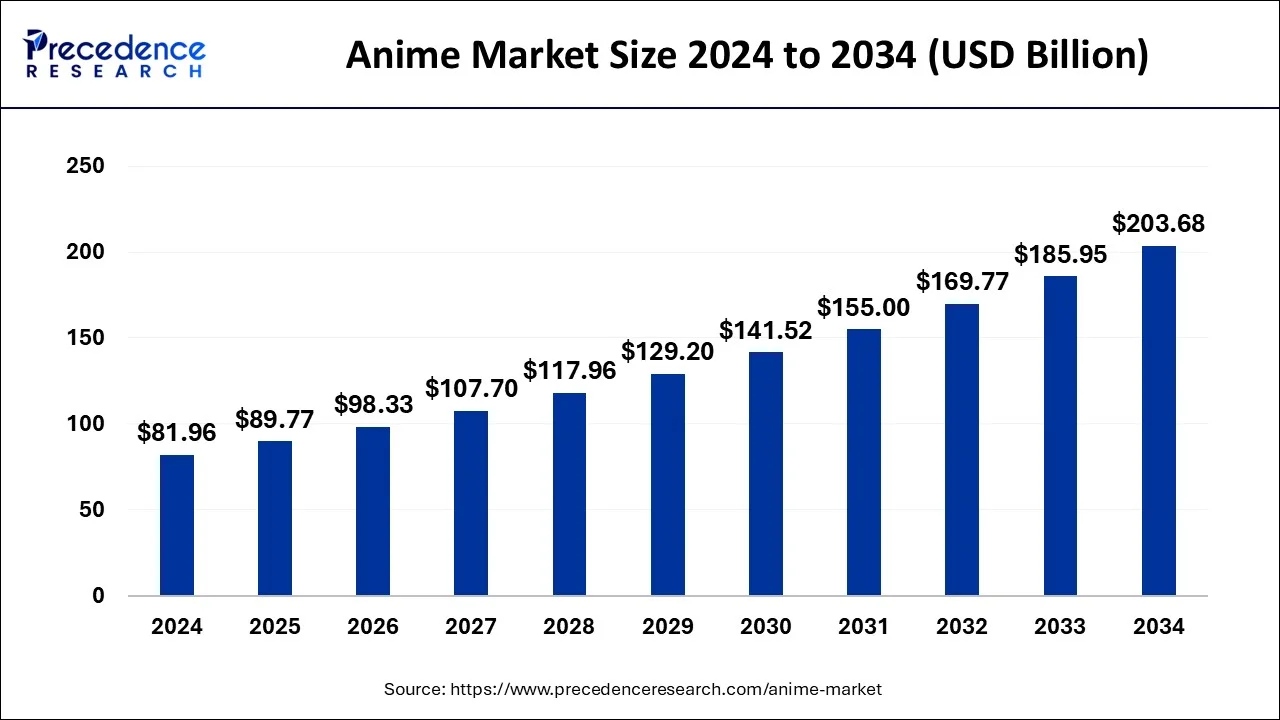
The global anime market was valued at USD 98.33 billion in 2026 and is projected to grow from USD 98.33 billion in 2026 to USD 220.38 billion by 2035, registering a CAGR of 9.40% during the forecast period (2026–2035). Market growth is fueled by the global expansion of streaming platforms, rising demand for anime merchandise, increasing cross-media franchises, and advancements in AI-assisted animation and digital production technologies. Asia Pacific led the market in 2025, while the Middle East & Africa is expected to witness the fastest growth through 2035.
Source: https://www.precedenceresearch.com/anime-market
 Get a Sample
 Table Of Content


What Is the Size of the Global Anime Market?
The global anime market size was estimated at USD 89.77 billion in 2025 and is predicted to increase from USD 98.33 billion in 2026 to approximately USD 220.38 billion by 2035, expanding at a CAGR of 9.40% from 2026 to 2035. The market is witnessing substantial growth, driven by borderless digital streaming accessibility, increased mainstream pop-culture integration, and high-budget cross-media adaptations, which further deepen fan engagement and broaden demographic reach across lucrative international licensing, merchandising, and live-event sectors.
Key Takeaways
- Asia Pacific dominated the market with a major share in 2025.
- The Middle East & Africa is expected to grow at the fastest CAGR between 2026 and 2035.
- By service, the merchandising segment captured the highest market share in 2025.
- By service, the internet distribution segment is poised to grow at a healthy CAGR between 2026 and 2035.
Market Overview
The global anime market encompasses streaming content, both physical and digital media, and character merchandising available through over-the-top (OTT) platforms, retail stores, and specialized conventions. This infrastructure is designed to support the growing engagement of global fans. The market is evolving from niche broadcasting formats to platform-native, globally distributed streaming models. This shift is driven by simulcast releases, AI-assisted animation, and high-quality localized productions. Furthermore, the rising mainstream popularity, demand for premium collectibles, and the expansion of cross-media franchises are escalating market growth.
Government initiatives and cultural export policies are also fostering growth by promoting creative industries, expanding international licensing, and encouraging the adoption of digital production. Programs like the Global Anime Challenge (GAC) are enhancing talent pipelines and supporting the modernization of animation studios in Japan. Additionally, the growth of global streaming platforms, international e-commerce channels, and intellectual property merchandising is further enhancing global adoption.
How Does AI Transform the Anime Market?
Artificial intelligence is revolutionizing the anime market by automating labor-intensive tasks such as in-betweening, coloring, and background generation. This helps studios address significant labor shortages and meet escalating global demand, thereby speeding up production workflows. AI can handle repetitive tasks across all stages of production to focus on core storytelling and intricate character designs. Also, the integration of technology into Japanese pop culture has sparked tensions. Major publishers and the Japanese government pushed back against tech companies to train generative art engines.
- In July 2025, CreateAI Holdings launched the Studio Version of Animon.ai, a major upgrade enabling individual creators to produce professional-grade, 2K HD anime series by improving image generation, along with consistency and video output.
(Sorce: https://www.prnewswire.co.uk)
Technological Advancement
Technological advancements in the anime market feature blockchain, CGI, cloud-based animation production, AI, and industry 4.0 integration. Blockchain technology is used for digital rights management to transfer a fair share of the creators and artists. The cloud-based animation production helps to interact and collaborate, covering the distance by eliminating geographical interruption. Industry 4.0 integration technologies, including IoT and augmented reality, encourage innovations in the anime industry to attract viewers and anime fans.
Advanced animation software and computer-generated imagery (CGI) enable experimentation with visualization to elevate realistic presence on the screen. AI decodes mimicry, pattern, and overall functionality, for a character to appear more relatable. It also automates tasks such as background creation and character design. The anime market is rapidly growing due to technology and commendable sense of use in production doubles the success of this market, boosting the entertainment industry.
Major Trends in the Anime Market
- Simulcasts Redefining Global Streaming: OTT streaming platforms have broken down regional barriers. Services like Crunchyroll, Netflix, and Disney+ are investing heavily in simulcasts and exclusive co-productions, allowing viewers to watch episodes just hours after their release in Japan, boosting subscriber engagement.
- The Strategic Shift in Anime Monetization: Anime movies are rapidly becoming major global moneymakers. Blockbuster franchise films regularly achieve impressive box office numbers worldwide. International theatrical releases are a key strategy for studios to monetize major intellectual properties.
- The Premium Evolution of Anime Merchandise: Merchandise has become the most profitable segment of the anime industry. Fans are increasingly seeking premium and limited-edition items, prompting companies to introduce augmented reality integrations, interactive mobile connectivity, and advanced authentication systems.
- The Future of Hyper-Localized Studios: Studios and streaming platforms are moving away from simple subtitling towards high-quality, multilingual dubbing. This hyper-localization opens up entirely new geographic territories for the expanding global anime audience.
Anime Market Growth Factors
- Growing Popularity among Viewers: The increased production of TV shows and the rising popularity of online shows increase popularity among viewers, boosting market growth.
- Rising Adoption of the Internet: The rising adoption of the Internet globally leads to increased access to anime shows through online platforms.
- Increasing Number of Artists: The increasing number of animators, artists, developers, and other stakeholders are contributing to market growth significantly.
- Technological Advancements: Advanced technologies simplify the production and distribution of anime to a wider audience.
- Rising Disposable Income: The rising disposable income and the improvement in the standard of living also positively influence market growth.
- Growing Population: The growing population of children and young adults globally acts as a driving force for the market.
Future Outlook and Strategic Recommendations for Anime Market
The anime sector is bound to experience considerable growth in the future, with a rise in demand from users beyond the currently operative factors of international viewership from streaming, cinemas, games, and licensing practices. The introduction of AI, cloud-based animation tools, and virtual production technologies will result in a raise in efficiency in production and the quality of the produced materials. New forms of business, including subscription streaming, direct-to-consumer platforms, digital collectibles, immersive experiences for fans, and cross-media IP commercialization will provide new ways of revenue growth. The increasing spending from local governments, media companies, and international co-productions is expected to make global distributions stronger. The stakeholders must ensure the incorporation of the original IP, advance the co-producitional agreements, and responsibly implement AI-assisted processes. Additionally, the companies need to enhance the process of licensing, foster talents, and carefully protect IP.
Market Report Coverage and Key Metrics
| Report Coverage | Details |
| Market Size in 2025 | USD 89.77 Billion |
| Market Size in 2026 | USD 98.33 Billion |
| Market Size by 2035 | USD 220.38 Billion |
| Growth Rate from 2026 to 2035 | CAGR of 9.40% |
| Base Year | 2025 |
| Forecast Period | 2026 to 2035 |
| Largest Market | Asia Pacific |
| Segments Covered | Service Type, and region |
Market Dynamics
Driver
Shift Toward OTT Platforms
The rapid shift toward OTT platforms is driving the anime market by bypassing traditional broadcasting restrictions. This direct approach offers instant global accessibility, significantly larger audience reach, and robust fan engagement. Competitive bidding wars among platforms such as Crunchyroll, Netflix, and Amazon have accelerated this move toward borderless digital distribution, enhancing revenue scalability and bringing Japanese animation to a mainstream international audience.
- For example, HIDIVE has officially expanded its international streaming presence by launching as an ad-free add-on subscription on Amazon Prime Video Channels in the UK, Canada, Australia, and New Zealand.
Restraint
Lack of Skilled Animators
The anime industry faces a severe shortage of skilled animators. This labor scarcity often leads to extreme working conditions and production bottlenecks, sometimes causing delays in release schedules. Additionally, the market contends with high localization costs, cultural translation barriers, and persistent issues with international piracy, which threaten distribution efficiency
Opportunity
Expansion of Cross-Media Franchises
Anime studios have significant opportunities to monetize intellectual properties beyond traditional television and film releases. By integrating anime with video games, merchandise, publishing, and live events, companies can create multiple revenue streams from a single franchise. This approach extends the lifespan of popular titles while strengthening fan engagement and brand loyalty.
Augmented Reality and Virtual Reality
Augmented reality (AR) and virtual reality (VR) create ample opportunities for anime market players in the future. AR and VR offer real-life experiences to viewers, attracting more and more audiences to anime. They are dynamic and interactive, presenting users with a heightened sense of presence and engagement. AR and VR reduce costs and speed up the production process, eliminating the need for physical locations and props.
They offer superior advantages, including immersing people in the story, letting viewers develop an emotional bond, capturing people's attention via visuals, and enhancing the creativity of makers. Improvements in video quality, processing power, mobile bandwidth, and AR/VR hardware are estimated to drive mainstream acceptance of AR/VR technologies, ultimately increasing anime demand. Several studios have already created anime series or films using AR and VR technologies.
Market Segmentation Analysis
Service Insights
What Made Merchandising the Dominant Segment in the Anime Market?
The merchandising segment dominated the anime market by holding a major share in 2025, owing to its strong commercial appeal for studios, direct-to-consumer digital platforms, integration with pop culture and lifestyle, and high-margin collectibles and apparel. E-commerce channels such as Amazon Japan, Rakuten, and specialized brand storefronts account for the majority of sales of exclusive goods without relying on local brick-and-mortar stores. Wearable merchandise enables the 18–25 demographic to express their fandom organically in everyday life, expanding the consumer base to command premium prices.
- In May 2026, Bandai Namco is unveiling made-in-India anime apparel to capitalize on the country's soaring viewership rate. By shifting from imported collectibles, the entertainment conglomerate will locally manufacture and sell exclusive t-shirts for franchises like One Piece and (Source: Naruto.https://respawn.outlookindia.com)
The internet distribution segment is expected to experience the fastest growth during the forecast period. This is largely driven by mobile-first streaming, exclusive platform-commissioned originals, and same-day releases that bypass traditional linear television. Streaming giants like Netflix and Crunchyroll are heavily investing in original series and exclusive licensing, which eliminates geographical wait times and allows fans worldwide to watch new episodes simultaneously. Localized dubbing, subtitling, and regional licensing make anime accessible beyond its traditional Japanese audience, enhancing profitability.
The increasing penetration of the internet, widespread adoption of smartphones and smart devices, and rising disposable incomes are expanding access to anime content worldwide. As consumers increasingly prefer online video platforms, digital distribution has become a key channel for reaching global audiences and driving market growth. Additionally, strategic partnerships between OTT platforms and anime production studios are fueling investment in original anime content, creating new revenue opportunities and accelerating industry expansion.
- In January 2026, Netflix and acclaimed anime studio MAPPA formed a strategic partnership to produce, co-develop, and exclusively stream new, original anime titles to a worldwide audience, strengthening the availability of high-quality Japanese animation on the platform. (Source: https://about.netflix.com)
The video segment is expected to grow at a significant rate in the coming years, driven by the increasing popularity of streaming platforms and the rising global demand for anime content. Consumers are increasingly accessing anime through subscription-based and ad-supported video-on-demand services, which offer convenient, on-demand viewing across multiple devices. Furthermore, investments by streaming platforms in exclusive licensing agreements, simulcasts, and original anime productions are expanding content availability and attracting a larger international audience.
Market Regional Analysis: North America, Europe, Asia-Pacific
How Did Asia Pacific Dominate the Anime Market?
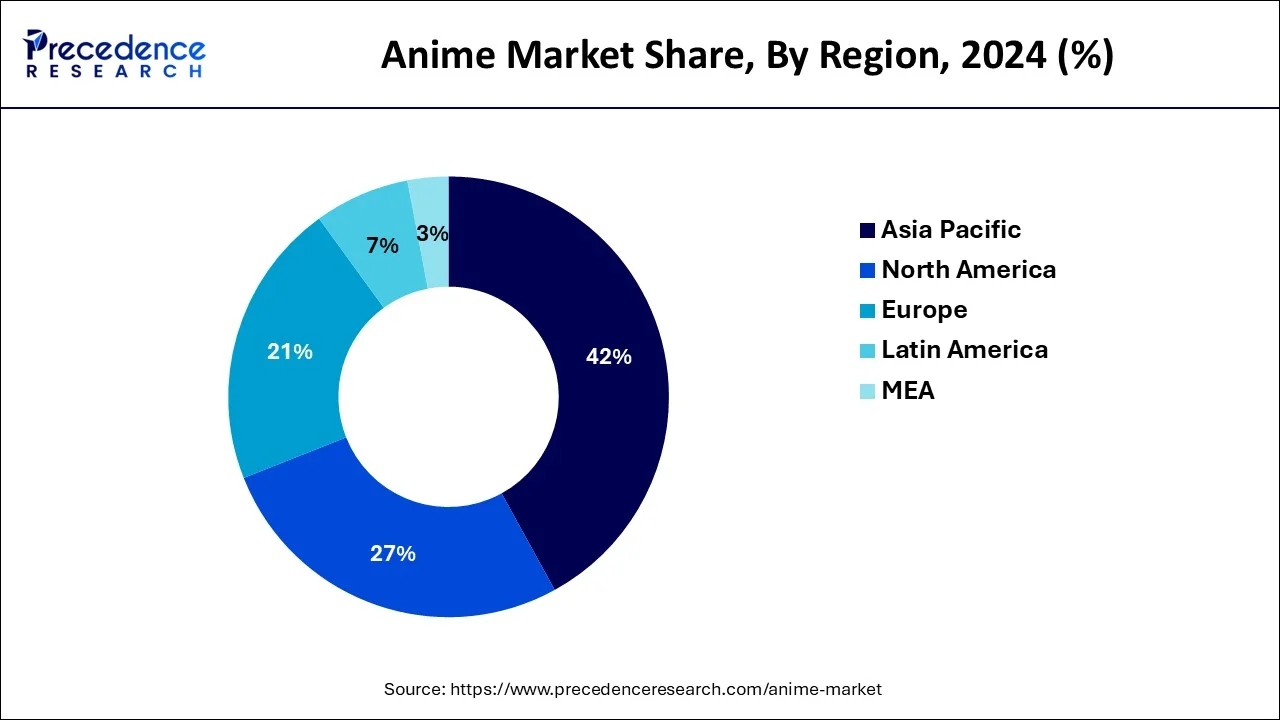
Asia Pacific dominated the anime market with the largest share in 2025 due to Japan's leadership in anime production and the growing popularity of anime across major economies such as China, India, and South Korea. The region benefits from a well-established ecosystem that includes manga publishing, animation studios, merchandising networks, and digital distribution platforms. Additionally, rising internet penetration, increasing smartphone usage, and expanding streaming services continue to drive anime consumption across emerging markets such as India, Indonesia, and Thailand.
What is the Asia Pacific Anime Market Size?
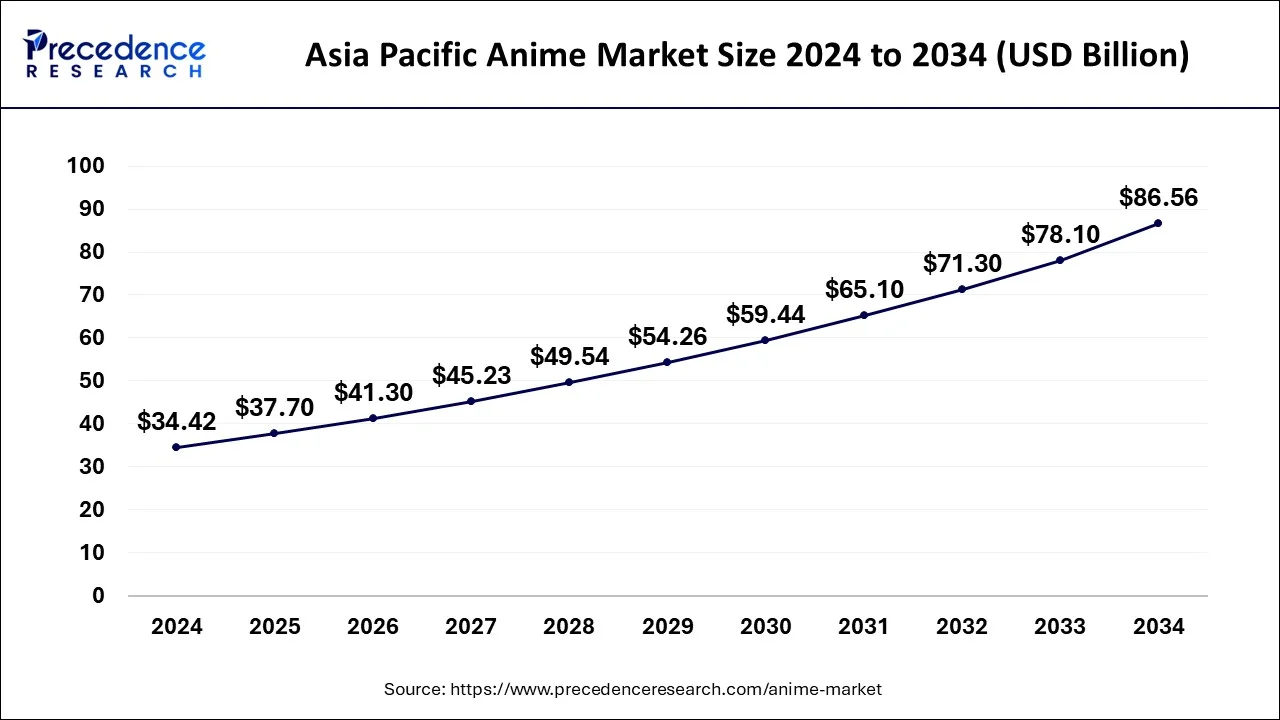
The Asia Pacific anime market size is exhibited at USD 37.70 billion in 2025 and is predicted to be worth around USD 92.56 billion by 2035, rising at a CAGR of 9.40% from 2026 to 2035
Japan Market Trends
Japan remains the global center of anime production, supported by a mature animation industry, strong intellectual property development, and extensive merchandising activities. The country's anime studios continue to collaborate with domestic and international streaming platforms to expand global reach. Growing investments in animation technology, workforce development, and international content distribution are expected to support long-term industry growth.
What Makes the Middle East & Africa the Fastest-Growing Region in the Anime Market?
The Middle East & Africa (MEA) is expected to witness the fastest growth during the forecast period, driven by expanding internet access, rising smartphone adoption, and a young, digitally engaged population. The increasing availability of anime on global and regional streaming platforms is making content more accessible to mainstream audiences. Furthermore, growing interest in gaming, pop culture, and entertainment events is contributing to higher anime consumption across the region.
UAE Market Trends
The UAE is emerging as a key anime market in the region due to its high internet penetration, strong consumer spending, and vibrant entertainment sector. The country regularly hosts international pop-culture events and conventions that promote anime awareness and fan engagement. Rising demand for streaming content and collectibles is further supporting market expansion.
How is the Opportunistic Rise of North America in the Anime Market?
North America is expected to experience substantial growth during the projection period due to the increasing mainstream acceptance of anime, strong streaming platform penetration, and expanding merchandise sales. Anime has evolved from a niche entertainment category into a widely consumed form of media among younger audiences. The growth of conventions, theatrical releases, and licensed products continues to strengthen the region's anime ecosystem.
U.S. Market Trends
The U.S. represents one of the largest markets for anime, supported by high streaming adoption and a large fan community. Major streaming platforms are investing in anime licensing, original productions, and exclusive distribution agreements to meet rising consumer demand. Additionally, growing attendance at anime conventions and increased sales of collectibles and merchandise continue to contribute to market growth.
How Will Europe Emerge in the Anime Market?
Europe is emerging as a significant market due to increasing access to localized anime content, rising popularity of manga, and growing interest in Japanese popular culture. Streaming platforms offering dubbed and subtitled content have expanded anime's reach across diverse language markets. The region is also witnessing increased demand for collectibles, apparel, and other licensed products, supporting broader market development.
Germany Market Trends
Germany is one of the leading anime markets in Europe, supported by strong consumer purchasing power and a well-established fan community. The availability of high-quality localized content, growing theatrical releases, and expanding anime-focused events continue to attract new audiences. Increasing demand for manga and collectible merchandise is further contributing to market growth.
Why is the Market in Latin America Gaining Momentum?
The anime market in Latin America is experiencing strong growth due to increasing internet penetration, expanding streaming services, and a long-standing cultural affinity for anime content. Popular anime series have maintained strong viewership across the region for decades, creating a loyal and multi-generational fan base. Improved access to legal streaming platforms is further accelerating anime consumption among younger audiences.
Brazil Market Trends
Brazil is leading the Latin American market, driven by a large youth population, high digital engagement, and strong demand for streaming content. Streaming providers continue to expand Portuguese-language dubbing and subtitling to cater to local audiences. The growing popularity of anime-related events, merchandise, and theatrical releases is expected to support continued market expansion.
Key Government Regulations for the Anime Market
|
Regulatory Focus Area |
Key Regulation |
Primary Objective |
|
Intellectual Property Enforcement
|
Japan Overseas Copyright Protection
|
Provides state legal assistance to studios to combat international piracy and unauthorized merchandising. |
|
Antitrust and Labor Protections |
Japan Fair Trade Commission (JFTC) Guidelines |
Regulates production committees and streamers to ensure fair profit-sharing and improve working conditions for animators. |
|
Creative Freedom and Expression |
Japan Entertainment Creative Policy |
State-backed initiatives that explicitly restrict domestic censorship, protecting original Japanese storylines from external localization pressures. |
|
Digital Licensing and Distribution |
Copyright Law of Japan |
Protects a creator's exclusive rights over streaming, adaptations, and broadcasting across global digital platforms. |
|
AI and Copyright |
Cultural Affairs Agency AI Guidelines |
Regulates the use of generative AI in art and animation to safeguard human creators' rights and prevent AI-assisted copyright infringement. |
Government Steps to Help the Anime Industry
- Japan is taking steps to help the anime industry grow. The Ministry of Economy, Trade, and Industry has started a long-term plan to grow the business and make it more profitable by selling anime, manga, and video games abroad. To achieve these goals, the government is providing financial assistance, tax benefits, and other incentives to companies exporting their products abroad.
- Help for Young Anime and Manga Creators: Japan is looking to grow the number of talented young people in the field of animation. This is being achieved through grants for young anime and manga creators to help them make new characters and stories.
- Indian Support for Animation and VFX: India is doing various things to help the animation industry grow. It has created the National Centre of Excellence for AVGC, which is tasked with helping develop programs that will help create more opportunities for investment in animation industry.
Market Competitive Landscape: Leading Companies and Strategies
The anime market is highly consolidated and established, and many leading players, including Sony Group's Crunchyroll and Netflix, are focusing on exclusive content licensing and day-and-date global releases to capture worldwide audiences. For instance, strategic investment in cross-media franchise engineering, where studios like Toei Animation tie anime releases to global theatrical runs and lucrative merchandise sales.
Many emerging players like Studio Azuki, Orange, and Studio Geeks Plus have significant opportunities to expand through international production collaborations and mobile platforms in emerging regions. However, these players face barriers such as a chronic shortage of skilled animators, high localization costs, and the persistent threat of digital piracy.
Value Chain Analysis
- Creative Conception and IP Development: This focuses on identifying profitable manga, light novels, and video games, and partnering with production committees to fund the animation adaptation by publishers focusing on intellectual property.
Key Players: Kodansha, Shueisha, and Kadokawa. - Production Process: This involves specialized, labor-intensive, and complex scriptwriting, storyboarding, voice acting, key animation, coloring, and final compositing to streamline efficiencies.
Key Players: Toei Animation, MAPPA, and Studio Ghibli. - Localization and Licensing: This focuses on translating, subtitling, dubbing, and tailoring content for international markets by bridging the gap between Japanese studios and global platforms.
Key Players: Crunchyroll, VIZ Media, and Aniplex. - Distribution and Broadcasting: This involves the delivery of content to the end consumer, offering on-demand and worldwide access.
Key Players: Netflix, Hulu, and Amazon Prime Video. - Monetization and Merchandising: This is the main chain of capturing fan value through physical and digital goods.
Key Players: Bandai Namco Holdings and Good Smile Company.
Key Companies & Market Share Insights
The market is moderately fragmented with the presence of several local companies. These market players are striving to gain higher market share by adopting strategies, such as investments, partnerships, and acquisitions & mergers. Companies are also spending on the development of improved services. Moreover, they are also focusing on maintaining competitive pricing.
The strategic partnerships and other such developmental strategies play a crucial role in the creating more opportunities and thus boosting the growth of the global anime market.
Anime Market Companies
- Kyoto Animation Co. Ltd
- P.A.Works, Inc.
- Production I.G.
- Toei Animation Co. Ltd.
- ManglobeInc.
- Pierrot Co. Ltd
- Madhouse Inc.
- Bones Inc.
- Studio Ghibli, Inc.
- Sunrise, Inc.
Latest Announcement by Industry Leaders
- Rahul Purini, CEO of Crunchyroll, commented that the popularity of anime is expanding in the world of entertainment globally. He also said that a survey published in early 2024 by Vox Media reported that 42% of the American Generation Z watch anime every week. He added that the love of anime among Generation Z and Generation Alpha is driving the growth of anime.
Recent Developments in the Anime Market (2025–2026)
- In May 2026, Nikkei announced the creation of the Nikkei Japan Entertainment Content Stock Index, designed to track the stock prices of 20 Tokyo Stock Exchange-listed companies in entertainment sectors like games and anime, including major players like Sony, Nintendo, and Bandai Namco, surpassing key automakers. (Source: https://asia.nikkei.com)
- In April 2026, KADOKAWA Corporation launched KADOKAWA Creators Co., Ltd., a new animation studio aimed at addressing the workforce crisis in Japan's anime industry. The studio will provide training alongside professional work for entry-level animators and will be part of KADOKAWA's initiative to strengthen its creative workforce. (Source: https://respawn.outlookindia.com)
- In February 2026, Christie's will hold its first New York auction focused on Japanese anime and manga, featuring works like Miyazaki cels and Tezuka drawings. Running from March 18 to 31, the auction aims to attract younger collectors and will showcase over 40 lots, many priced under USD 10,000. (Source: https://news.artnet.com)
- In May 2025, Kadokawa unveiled the teaser visual, main staff, television format, and 2026 premiere for the anime of Takako Shimura's Awajima Hyakkeei manga. Kadokawa also started streaming the anime's “ultra teaser” promotional video.
- In May 2025, brand-new episodes of Sakamoto Days were announced, as Netflix teased in its latest behind-the-scenes featurette, alongside a release date reveal for part 2 of the hit anime series.
- In May 2025, Dragon Ball broke its record to become the most successful anime franchise in history. The iconic anime trilogy surpasses all competition to become Bandai Namco's most lucrative property.
- In November 2024, Netflix and Yamaha Motor collaborated to produce Tokyo Override, an original anime that was released in November. Yamaha Motors specially designed motorcycles for the series.
- In November 2024, Kasagi Labo announced an investment of $10 million for anime production. The sci-fi adventure series “Special Kid Factory” will be the first major project under this investment.
Segments Covered in the Report
By Service
- T.V
- Movie
- Video
- Internet Distribution
- Merchandising
- Music
- Pachinko
- Live Entertainment
By Region
- North America
- Latin America
- Europe
- Asia-pacific
- Middle and East Africa
For inquiries regarding discounts, bulk purchases, or customization requests, please contact us at sales@precedenceresearch.com
Frequently Asked Questions
Tags





Ask For Sample
No cookie-cutter, only authentic analysis – take the 1st step to become a Precedence Research client
 Get a Sample




 sales@precedenceresearch.com
 Schedule a Meeting
