


Asia Pacific, Europe & Middle East Everyday Antiseptic Cleansers Market Size, Key Companies, Company Technology / Innovation, Production Economics, Trade Analysis, Material Efficiency, Market Penetration, Company Investment Strategies,
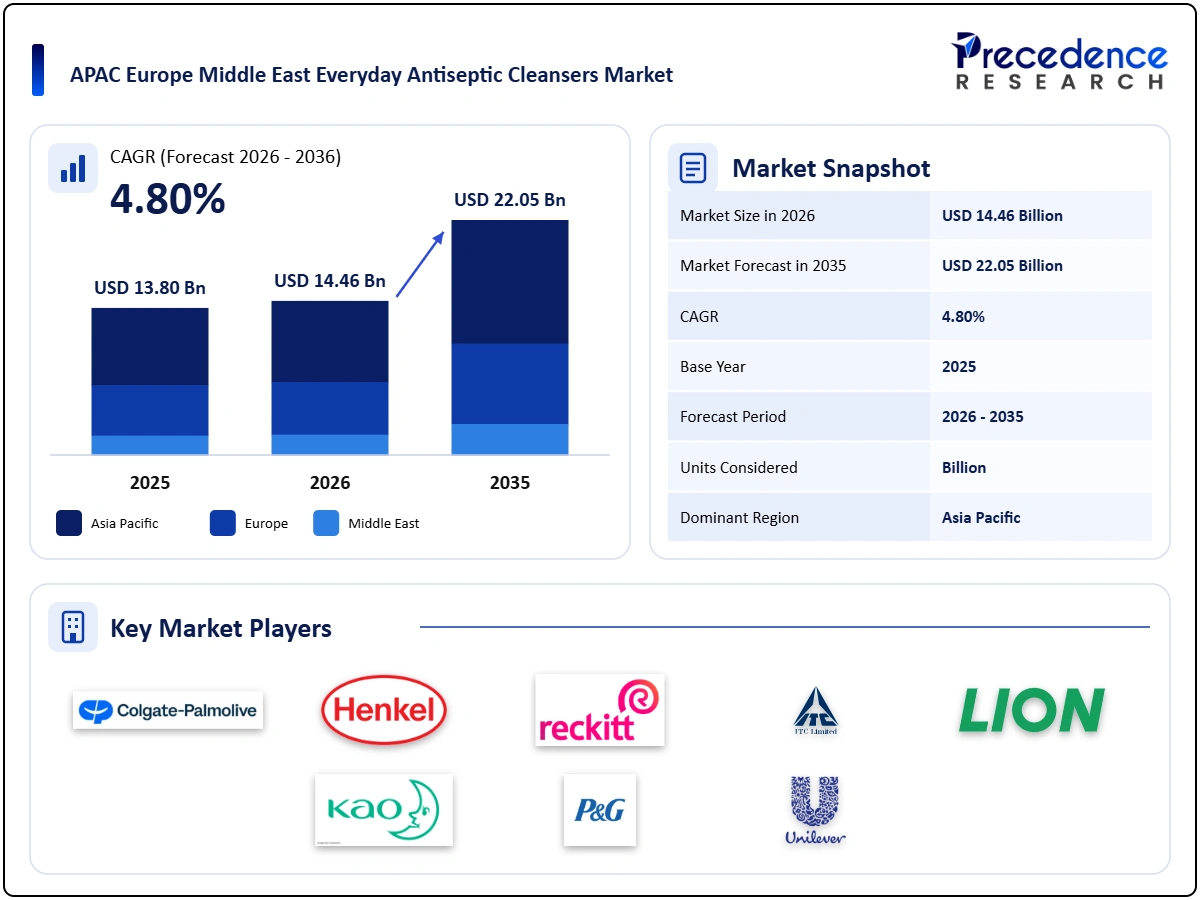
Payal Rabde, a Healthcare Industry Expert, highlights that the apac europe middle east everyday antiseptic cleansers market has reached USD 14.46 billion in 2026 in 2026 and is on track to reach USD 22.05 billion by 2035, advancing at a CAGR of 4.80%. Key apac europe middle east everyday antiseptic cleansers market companies shaping the market include Reckitt , Procter & Gamble (Safeguard), Kao Corporation, while major growth segments span product type, active ingredient, end use, distribution channel and region.
Source: https://www.precedenceresearch.com/apac-europe-middle-east-everyday-antiseptic-cleansers-market
 Get a Sample
 Report Description
Key Takeaways
Market Size & Growth Outlook
- Market size in 2025: USD 13.80 billion
- Estimated market size in 2026: USD 14.46 billion
- Projected market size by 2035: USD 22.05 billion
- CAGR (2026-2035): 4.80%
Regional Market Highlights
- Asia Pacific led the market with a 52.60% (USD 7.26 billion) share in 2025 and is projected to be the fastest-growing region, at a CAGR of 5.26% from 2026 to 2035.
- Europe accounted for 34.20% (USD 4.72 billion) of the market share in 2025.
- The Middle East held 13.20% market share (USD 1.82 billion) in 2025.
Segmental Insights
- By product type, Antibacterial Hand Wash captured 27.80% share and reached USD 3.84 billion in 2025.
- By active ingredient, Chloroxylenol segment held 26.40% market share, reaching USD 3.64 billion in 2025.
- By end use, Household & Personal accounted for 78.40% share and was valued at USD 10.82 billion in 2025.
- By distribution channel, Supermarkets & Hypermarkets registered 38.60% share (USD 5.33 billion) in 2025.
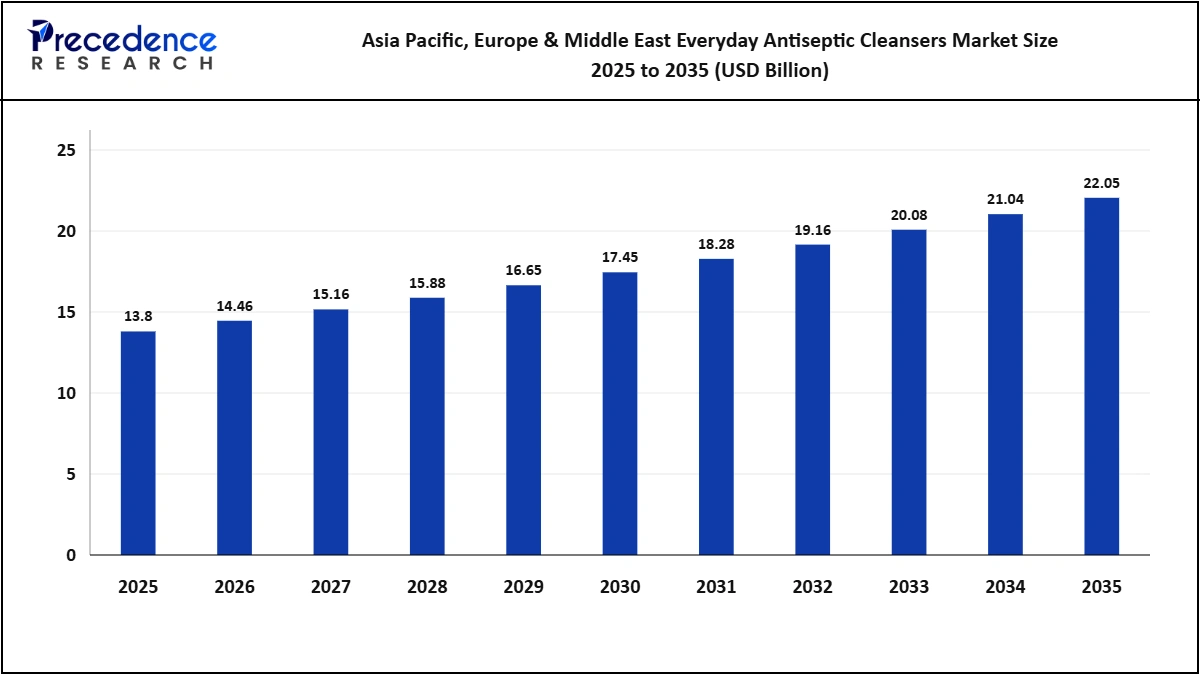
Note: 2025 is the base year; 2026-2035 values are forecasts.
Sources: Expert interviews, secondary sources, Precedence Research database, and Precedence Research analysts.
The Asia Pacific, Europe & Middle East everyday antiseptic cleansers market was valued at USD 13.80 billion in 2025 and is likely to reach USD 22.05 billion by 2035, registering a CAGR of 4.80% over the forecast period. Sustained handwashing habits and regular antiseptic use, along with rising incomes and urbanization across Asia Pacific and the Middle East, drive market growth. Increasing product penetration in rural India and Southeast Asia, growing demand for premium and natural formulations, sustainable refill formats, and expanding e-commerce further support market expansion. These trends sustain demand following the post-pandemic normalization of sanitizer consumption. The market is projected to reach USD 17.45 billion by 2030.
- Analyst View: The market is expected to maintain steady growth, driven by sustained hygiene awareness, rising disposable incomes, and increasing product penetration across emerging Asia Pacific and Middle Eastern markets. Premium formulations, sustainable packaging, and e-commerce expansion are expected to create additional growth opportunities, offsetting the normalization of post-pandemic sanitizer demand. The growth rate reflects steady penetration gains in emerging markets, moderated by mature demand in Europe and lower sanitizer volumes after the pandemic peak.
Market Trends
- Growing demand for natural and plant-based antiseptic formulations.
- Increasing adoption of refill and powder-to-liquid formats.
- Rising use of antiseptic wipes for convenient, on-the-go hygiene.
- Expansion of quick-commerce platforms and online sales channels.
- Evolving EU regulatory reviews of alcohol-based antiseptic ingredients.
- Growing preference for gentle, skin-friendly antiseptic formulations.
Drivers, Restraints and Opportunities
Driver
Strong hygiene habits, rising incomes across Asia Pacific, and public health campaigns promoting handwashing are driving market growth. Expansion of modern retail and stricter institutional hygiene standards further support demand.
Restraint
Post-pandemic normalization has reduced sanitizer demand, while market maturity in Europe, regulatory reviews of active ingredients, concerns about antibacterial overuse, and intense price competition continue to restrain market growth.
Opportunity
Untapped rural markets in South Asia, growing demand for natural and premium variants, sustainable refill packaging, institutional contracts, and expanding online subscriptions and bulk-pack sales offer significant growth opportunities.
Asia Pacific, Europe & Middle East Everyday Antiseptic Cleansers Market Segmentation: 2025 Share and Size
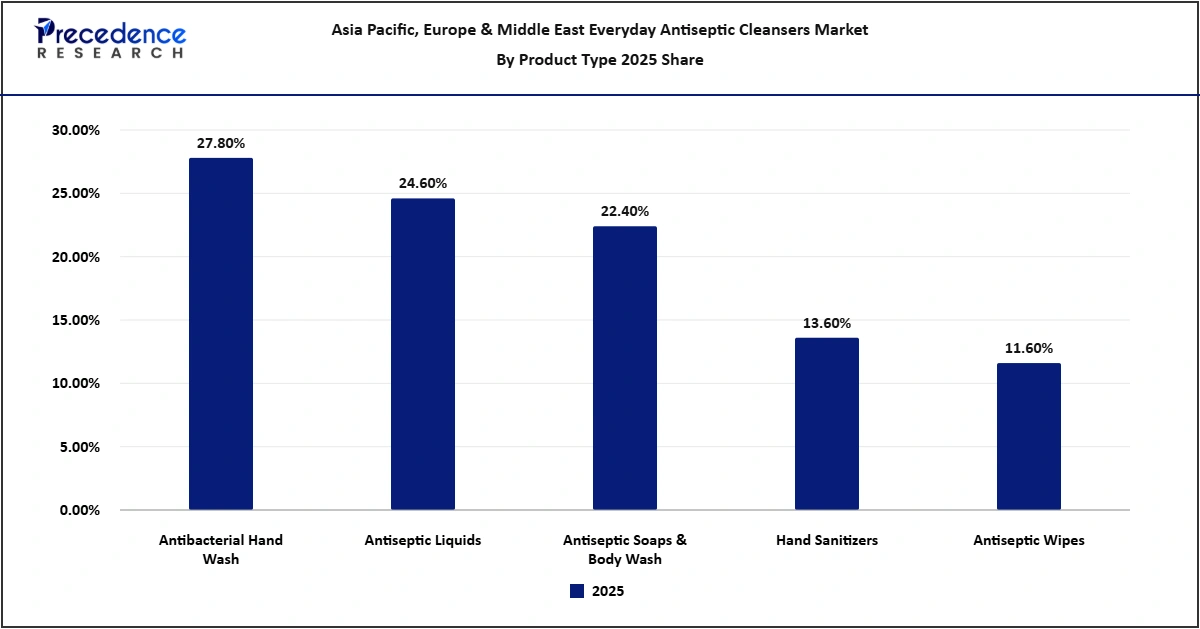
Asia Pacific, Europe & Middle East Everyday Antiseptic Cleansers Market By Product Type 2025 Share
Note: 2025 is the base year; 2035 values are forecasts.
Sources: Expert interviews, secondary sources, Precedence Research database, and Precedence Research analysts.
By product type, the antibacterial hand wash accounted for 27.80% share (USD 3.84 billion) in 2025, antiseptic liquids held 24.60% (USD 3.39 billion), antiseptic soaps and body wash captured 22.40% (USD 3.09 billion), hand sanitizers contributed 13.60% (USD 1.88 billion), and antiseptic wipes accounted for 11.60% (USD 1.60 billion) of the market share in 2025.
Antibacterial Hand Wash: The antibacterial hand wash segment dominated the market in 2025, accounting for 27.80% of revenue, valued at USD 3.84 billion. The segment is projected to reach USD 5.87 billion by 2035, registering a CAGR of 4.36% over the forecast period. Antibacterial hand wash consists of liquid soap formulated with antibacterial agents and sold in pump bottles and refill packs. Its widespread use in households, offices and restaurants supports its leading market share. Established brands such as Dettol, Lifebuoy, Safeguard and Protex maintain strong market presence across the three regions. Affordable refill packs and powder-to-liquid formats further support adoption by reducing the cost per use.
Antiseptic Liquids: The antiseptic liquids segment accounted for 24.60% of the market in 2025, generating USD 3.39 billion in revenue. The segment is projected to reach USD 5.41 billion by 2035, registering a CAGR of 4.76% during 2026-2035. Antiseptic liquids, including Dettol's chloroxylenol-based solutions and Savlon's cetrimide and chlorhexidine formulations, serve a wide range of applications, including first aid, bathing, laundry and household hygiene. These products remain household staples in India, Pakistan, Bangladesh, the Middle East and parts of Southeast Asia, supporting consistent regional demand.
Antiseptic Soaps & Body Wash: With a market valuation of USD 3.09 billion in 2025, it is projected to reach USD 4.92 billion by 2035, exhibiting a CAGR of 4.76% from 2026 to 2035. Antiseptic soaps and body washes are bars and liquids used for daily bathing, a large category in South and Southeast Asia, led by Lifebuoy, Dettol, and Safeguard.
Hand Sanitizers: The hand sanitizers segment accounted for 13.60% of the market in 2025, generating USD 1.88 billion in revenue. The segment is projected to reach USD 2.99 billion by 2035, registering a CAGR of 4.76% through 2035. Hand sanitizers consist of alcohol-based gels and sprays that provide hand hygiene when soap and water are unavailable. Although demand has declined from pandemic peaks, consumption remains above pre-pandemic levels. Growing use across travel, schools, and workplaces supports steady market demand.
Antiseptic Wipes: This segment was valued at USD 1.60 billion in the Asia Pacific, Europe & Middle East everyday antiseptic cleansers market in 2025 and is projected to reach USD 2.86 billion by 2035, at a CAGR of 5.96%. Antiseptic wipes are pre-moistened wipes for hands and skin. They are the fastest-growing product type because of convenience for travel, children, and on-the-go use, and growth in modern retail.
APAC Europe Middle East Everyday Antiseptic Cleansers Market By Active Ingredient 2025 Share & Size
| Segments | 2025 Share | 2025 Value (USD Billion) | 2035 Value (USD Billion) | CAGR 2026-2035 |
| Chloroxylenol | 26.40% | 3.64 | 5.53 | 4.28% |
| Alcohol-Based | 24.80% | 3.42 | 5.41 | 4.68% |
| Benzalkonium Chloride & QACs | 18.60% | 2.57 | 4.06 | 4.68% |
| Chlorhexidine & Cetrimide | 12.40% | 1.71 | 2.70 | 4.68% |
| Natural & Plant-Based | 10.20% | 1.41 | 2.69 | 6.68% |
| Others | 7.60% | 1.05 | 1.66 | 4.68% |
Note: 2025 is the base year; 2035 values are forecasts.
Sources: Expert interviews, secondary sources, Precedence Research database, and Precedence Research analysts.
Chloroxylenol accounted for 26.40% (USD 3.64 billion) in 2025, alcohol-based held 24.80% (USD 3.42 billion), benzalkonium chloride & QACs at 18.60% (USD 2.57 billion), chlorhexidine & cetrimide captured 12.40% (USD 1.71 billion), natural & plant-based actives held 10.20% (USD 1.41 billion), and others registered 7.60% (USD 1.05 billion) of the market share in 2025.
Chloroxylenol: The chloroxylenol segment dominated the market in 2025, generating USD 3.64 billion in revenue. The segment is projected to reach USD 5.53 billion by 2035, registering a CAGR of 4.28% by 2035. Chloroxylenol is a widely used antiseptic active ingredient in products such as Dettol antiseptic liquid, antibacterial soaps, and hand washes. Its leading position reflects the strong presence of Dettol and other established brands across Asia and the Middle East, where chloroxylenol-based products have widespread household use.
Alcohol-Based: Accounting for 24.80% market share, the segment is reaching USD 3.42 billion in 2025 and is projected to reach USD 5.41 billion by 2035, growing at a CAGR of 4.68% from 2026 to 2035. Alcohol-based formulations, using ethanol or isopropanol, are the basis of hand sanitizers. In Europe, ethanol and propan-2-ol are under review as biocidal active substances, which could affect future formulations.
Benzalkonium Chloride & QACs: This segment was valued at USD 2.57 billion in 2025 and is projected to reach USD 4.06 billion by 2035, expanding at a CAGR of 4.68% from 2026 to 2035. Benzalkonium chloride and other quaternary ammonium compounds are used in alcohol-free sanitizers, wipes, and hand washes, valued for gentleness and persistence.
Chlorhexidine & Cetrimide: With a market size of USD 1.71 billion in 2025, the segment represents a 12.40% share and is forecast to reach USD 2.70 billion by 2035, exhibiting a CAGR of 4.68% over the study period. Chlorhexidine & cetrimide are used in antiseptic liquids such as Savlon and in skin cleansers, especially in South Asia.
Natural & Plant-Based: This segment captured 10.20% (USD 1.41 billion) in 2025 and is projected to reach USD 2.69 billion by 2035, at a CAGR of 6.68% from 2026 to 2035. Natural and plant-based actives, such as tea tree oil, neem, thymol, and plant extracts, are the fastest-growing ingredient segment because consumers want gentler, more natural products, and brands are launching herbal antiseptic variants.
Others: The segment contributed a 7.60% share, generating USD 1.05 billion) in 2025 and is projected to represent USD 1.66 billion by 2035, expanding at a CAGR of 4.68% from 2026 to 2035. Others include triclocarban, which has been phased out in many markets, iodine, and hydrogen peroxide.
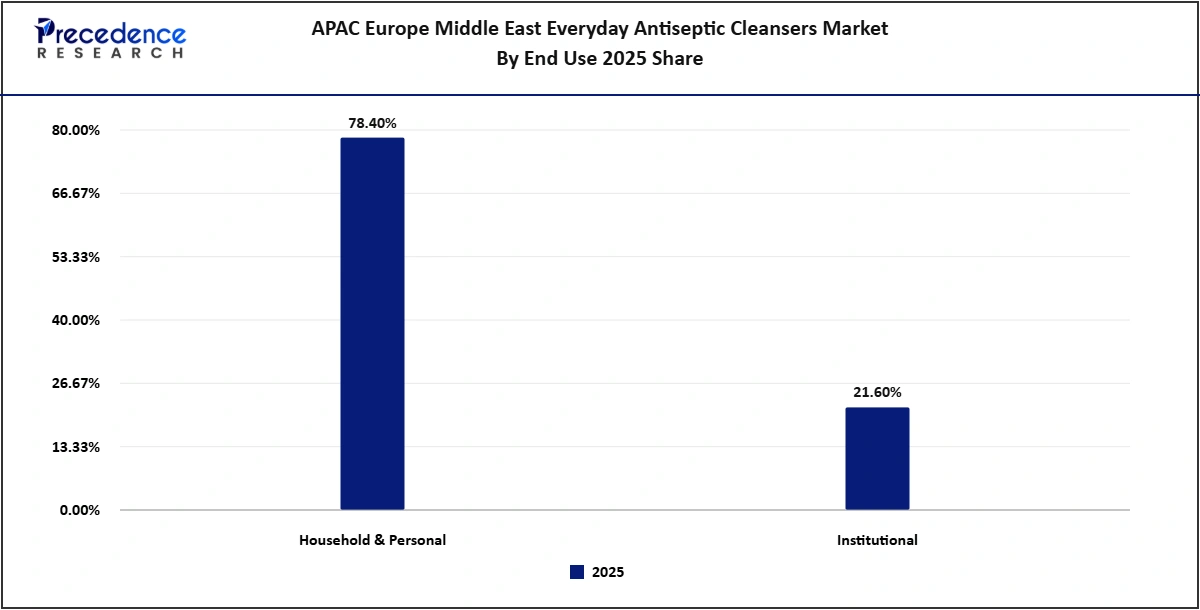
APAC Europe Middle East Everyday Antiseptic Cleansers Market By End Use 2025 Share
Note: 2025 is the base year; 2035 values are forecasts.
Sources: Expert interviews, secondary sources, Precedence Research database, and Precedence Research analysts.
Household & personal use captured 78.40% share (USD 10.82 billion) and the institutional segment accounted for 21.60% share (USD 2.98 billion) in 2025.
Household & Personal: The segment was valued at USD 10.82 billion in 2025 and is forecast to reach USD 16.92 billion by 2035, expanding at a CAGR of 4.58% from 2026 to 2035. Household and personal use is the largest segment because most antiseptic cleansers are bought by families for daily handwashing, bathing, and first aid.
Institutional: This segment generated USD 2.98 billion in 2025 and is estimated to reach USD 5.13 billion by 2035, growing at a CAGR of 5.58% over the forecast period. Institutional use includes schools, offices, restaurants, hotels, transport and public facilities, where hygiene rules and public health campaigns support demand. It is growing faster as hygiene standards rise in Asia Pacific and the Middle East.
APAC Europe Middle East Everyday Antiseptic Cleansers Market By Distribution Channel 2025 Share & Size
| Segments | 2025 Share | 2025 Value (USD Billion) | 2035 Value (USD Billion) | CAGR 2026-2035 |
| Supermarkets & Hypermarkets | 38.60% | 5.33 | 8.05 | 4.23% |
| Convenience & Grocery Stores | 22.40% | 3.09 | 4.86 | 4.63% |
| Pharmacies & Drug Stores | 16.20% | 2.24 | 3.52 | 4.63% |
| Online Retail | 14.80% | 2.04 | 3.88 | 6.63% |
| Others | 8.00% | 1.10 | 1.74 | 4.63% |
Note: 2025 is the base year; 2035 values are forecasts.
Sources: Expert interviews, secondary sources, Precedence Research database, and Precedence Research analysts.
Supermarkets & hypermarkets held a 38.60% share (USD 5.33 billion) in 2025, convenience & grocery stores captured a 22.40% share (USD 3.09 billion), pharmacies & drug stores accounted for a 16.20% share (USD 2.24 billion), online retail at a 14.80% (USD 2.04 billion), and others held 8.00% (USD 1.10 billion) in 2025.
Supermarkets & Hypermarkets: The market valuation of this segment was USD 5.33 billion in 2025 and is projected to reach USD 8.05 billion by 2035, expanding at a CAGR of 4.23% from 2026 to 2035. Supermarkets & hypermarkets are the largest channel in Europe, the Gulf countries, and urban Asia Pacific, offering wide ranges and promotions.
Convenience & Grocery Stores: This segment accounted for 22.40% and reached USD 3.09 billion in 2025 and is estimated to reach USD 4.86 billion by 2035, growing at a CAGR of 4.63% from 2026 to 2035. Convenience & grocery stores, including small neighborhood shops in India and Southeast Asia, are essential for reaching mass consumers with small packs.
Pharmacies & Drug Stores: This segment was valued at USD 2.24 billion in 2025 and is expected to reach USD 3.52 billion by 2035, expanding at a CAGR of 4.63% from 2026 to 2035. Pharmacies & drug stores sell antiseptic liquids, first-aid antiseptics, and sensitive-skin products, especially in Europe and South Asia.
Online Retail: The market size of this segment was USD 2.04 billion in 2025 and is projected to reach USD 3.88 billion by 2035, exhibiting a CAGR of 6.63% from 2026 to 2035. Online retail, including Amazon, Flipkart, Shopee, Lazada, Noon, and quick-commerce apps, is the fastest-growing channel because of convenience, subscriptions, and bulk refills.
Others: This segment accounted for a market share of 8.00% and reached USD 1.10 billion in 2025 and is projected to grow to USD 1.74 billion by 2035, expanding at a CAGR of 4.63% from 2026 to 2035. Others include institutional supply, direct sales, and wholesale clubs.
- Analyst View: Antibacterial hand wash and chloroxylenol-based products lead the market due to their widespread household use and strong brand presence across the regions. Household & personal care remains the dominant end-use segment, while institutional demand is growing with rising hygiene standards. Antiseptic wipes, natural and plant-based ingredients, and online retail are emerging as high-growth areas, supported by convenience, changing consumer preferences, and expanding digital sales channels.
Regional Analysis
Asia Pacific, Europe & Middle East Everyday Antiseptic Cleansers Market by Region 2025 Share
Note: 2025 is the base year; 2035 values are forecasts.
Sources: Expert interviews, secondary sources, Precedence Research database, and Precedence Research analysts.
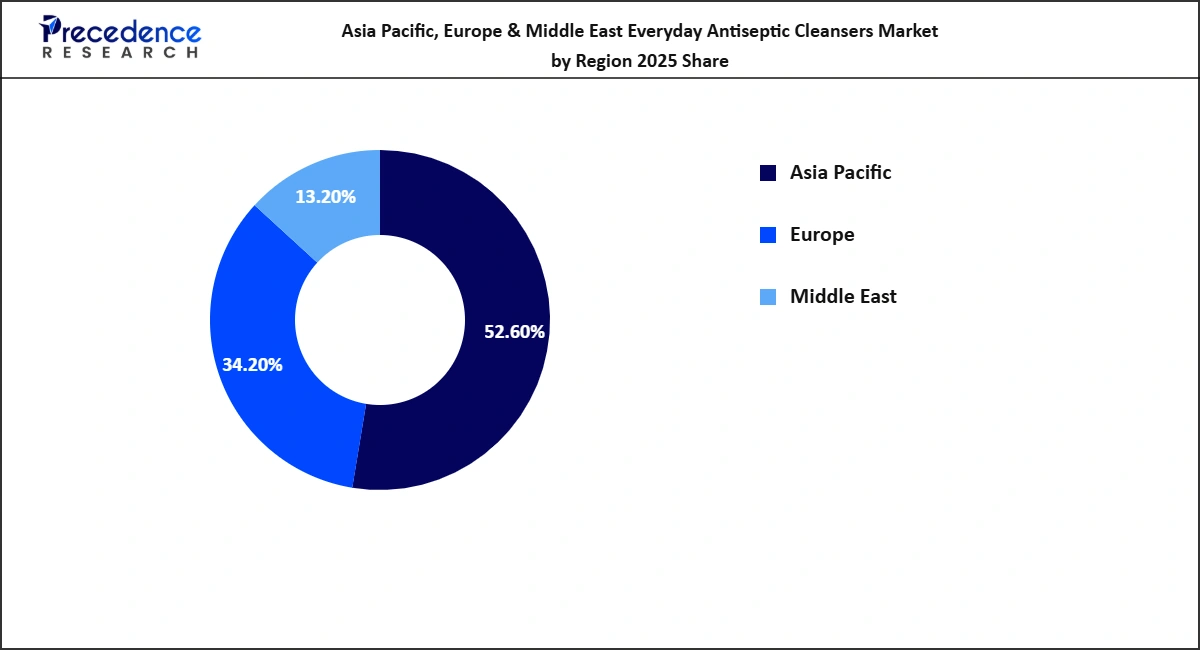
Asia Pacific accounted for 52.60% (USD 7.26 billion) in 2025, Europe for 34.20% (USD 4.72 billion), and the Middle East for 13.20% (USD 1.82 billion) share in 2025. Asia Pacific leads and is also the fastest-growing region.
Asia Pacific: Accounting for 52.60% of the market in 2025, this segment is expected to witness steady growth, reaching USD 12.11 billion by 2035 from USD 7.26 billion in 2025, expanding at a CAGR of 5.26% from 2026 to 2035. Asia Pacific is the largest and fastest-growing region, led by India, China, Indonesia, Pakistan, Bangladesh, Vietnam, and the Philippines, where antiseptic soaps, liquids, and hand washes are used daily. Rising incomes, rural penetration, government handwashing campaigns, and strong brands such as Dettol, Lifebuoy, Savlon, Kirei Kirei, and Walch support growth.
Europe: This region was valued at USD 4.72 billion in 2025 and is forecast to reach USD 7.17 billion by 2035, expanding at a CAGR of 4.26% from 2026 to 2035. Europe is a mature market with high hand wash and sanitizer use, led by the United Kingdom, Germany, France, Italy, and Spain. Growth is modest, and demand is shifting towards gentle, natural and sustainable products. EU biocidal rules, including the review of ethanol and isopropanol, shape formulations.
Middle East: The region contributed 13.20% share and was valued at USD 1.82 billion in 2025 and is projected to reach USD 2.77 billion by 2035, growing at a CAGR of 4.26% from 2026 to 2035. The Middle East, including Saudi Arabia, the UAE, Egypt, and other countries, has strong use of antiseptic liquids such as Dettol and Savlon, high hygiene awareness, a large hospitality sector, and growing modern retail and e-commerce.
Analyst View: Asia Pacific dominates the market and is expected to remain the primary growth driver, supported by rising incomes, expanding rural penetration, and strong demand for everyday antiseptic products. Europe is witnessing steady but moderate growth, with increasing preference for natural, gentle, and sustainable formulations. Meanwhile, the Middle East offers growth potential through rising hygiene awareness, hospitality sector expansion, and wider adoption of modern retail and e-commerce channels.
Competitive Landscape
Top Companies in the Asia Pacific, Europe & Middle East Everyday Antiseptic Cleansers Market
| Rank | Company Name | Market-Specific Revenue (USD Billion) | 2025 Share | Key Products / Business | Headquarters |
| 1 | Reckitt (Dettol) | 2.40 | 17.39% | Dettol antiseptic liquid, soaps and hand wash | United Kingdom |
| 2 | Unilever (Lifebuoy) | 1.90 | 13.77% | Lifebuoy soaps, hand wash and sanitizers | United Kingdom |
| 3 | Procter & Gamble (Safeguard) | 0.70 | 5.07% | Safeguard antibacterial soaps and body wash | United States |
| 4 | Colgate-Palmolive (Protex) | 0.60 | 4.35% | Protex and Palmolive antibacterial products | United States |
| 5 | Kao Corporation | 0.35 | 2.54% | Biore u hand and body wash | Japan |
| 6 | Lion Corporation | 0.35 | 2.54% | Kirei Kirei hand soap | Japan |
| 7 | Henkel | 0.30 | 2.17% | Antibacterial hand and body care | Germany |
| 8 | Walch | 0.30 | 2.17% | Walch antiseptic and hand wash | China |
| 9 | ITC (Savlon) | 0.18 | 1.30% | Savlon antiseptic liquid and hand wash | India |
| 10 | Godrej Consumer Products | 0.12 | 0.87% | Protekt hand wash | India |
Note: Company revenues and shares are 2025 estimates.
Sources: Company press releases, expert interviews, secondary sources, Precedence Research database and Precedence Research analysts.
Reckitt (Dettol) led the market with 17.39% share and was valued at USD 2.40 billion in 2025 revenue, followed by Unilever (Lifebuoy) at 13.77% (USD 1.90 billion) and Procter & Gamble (Safeguard) at 5.07% (USD 0.70 billion) in 2025. Reckitt leads through Dettol, the best-known antiseptic brand across South Asia, the Middle East, Southeast Asia and parts of Europe, covering liquids, soaps, hand washes and wipes. Unilever's Lifebuoy is the leading antibacterial soap and hand wash brand in many Asian markets, and Procter & Gamble's Safeguard is strong in China, the Philippines and Pakistan. Colgate-Palmolive, Kao, Lion, Henkel, Walch, ITC and Godrej Consumer Products compete through Protex, Biore u, Kirei Kirei, antibacterial care, Walch, Savlon and Protekt brands.
The top 10 players accounted for 52.17% share (USD 7.20 billion) of 2025 revenue, while the remaining 47.83% share (USD 6.60 billion) was shared among regional and private-label brands, pharmacy brands and institutional hygiene suppliers. The Asia Pacific, Europe & Middle East everyday antiseptic cleansers market is moderately concentrated around a few global brands, and competition centers on brand trust, germ-protection claims, skin gentleness, fragrance, price and pack sizes, distribution reach and marketing. Private labels and local natural brands compete strongly in Europe and India.
Companies Ecosystem
The Asia Pacific, Europe & Middle East everyday antiseptic cleansers ecosystem links active ingredient and surfactant suppliers and contract manufacturers with brand owners, regulators, retailers and consumers.
| Ecosystem Stage | Role in the Market | Key Companies |
| Ingredient Suppliers | Supply antiseptic actives, surfactants, and alcohol | Chemical and surfactant producers |
| Manufacturers | Formulate and produce cleansers | Brand-owned plants, contract manufacturers |
| Brand Owners | Market antiseptic brands | Reckitt, Unilever, P&G, Colgate-Palmolive, Kao, ITC |
| Regulators | Set biocide and cosmetic rules | ECHA, CDSCO, Gulf standards bodies, national agencies |
| Retail & Consumers | Sell and use products | Supermarkets, kirana stores, pharmacies, e-commerce, households |
Sources: Company press releases, expert interviews, secondary sources, Precedence Research database and Precedence Research analysts.
Precedence Research Companies Quadrant
The Precedence Research Companies Quadrant positions key participants in the Asia Pacific, Europe & Middle East everyday antiseptic cleansers market by market strength, reflecting revenue scale, market share and geographic reach, and by innovation and growth strategy, reflecting product portfolio breadth, R&D intensity and partnerships. Positions reflect each company's estimated 2025 antiseptic cleanser revenue in these regions and our assessment of its innovation, brand strength, and distribution.
Sources: Company press releases, expert interviews, secondary sources, Precedence Research database and Precedence Research analysts.
Leaders: Reckitt (Dettol), Unilever (Lifebuoy), Procter & Gamble (Safeguard), and Colgate-Palmolive (Protex) combine the largest revenue with strong antiseptic brands and wide distribution.
Innovators: Kao, Lion, Walch, ITC (Savlon), and Godrej Consumer Products bring regional brands and new formats in Asia.
Niche Players: Henkel serves narrower regional segments.
Recent Developments
- February 2026: The European Commission adopted Implementing Decision (EU) 2026/380, extending the approval expiry date of propan-2-ol (isopropanol) for use in biocidal products under Product Types 1 (human hygiene), 2 (disinfectants and algaecides), and 4 (food and feed area) to December 31, 2028, allowing additional time for the ongoing renewal assessment.
- November 2025: The European Chemicals Agency's Biocidal Products Committee was set to assess ethanol as a biocidal active substance, including possible carcinogenic and reproductive hazards, with industry warning of risks to hand sanitizer availability. The proposed hazard classification raised concerns among industry stakeholders about possible restrictions, supply disruptions, and reduced availability of alcohol-based hand hygiene products.
APAC Europe Middle East Everyday Antiseptic Cleansers Market Segments
By Product Type
- Antibacterial Hand Wash
- Antiseptic Liquids
- Antiseptic Soaps & Body Wash
- Hand Sanitizers
- Antiseptic Wipes
By Active Ingredient
- Chloroxylenol
- Alcohol-Based
- Benzalkonium Chloride & QACs
- Chlorhexidine & Cetrimide
- Natural & Plant-Based
- Others
By End Use
- Household & Personal
- Institutional
By Distribution Channel
- Supermarkets & Hypermarkets
- Convenience & Grocery Stores
- Pharmacies & Drug Stores
- Online Retail
- Others
By Region
- Asia Pacific (China, India, Japan, Indonesia, Pakistan, Southeast Asia, Rest of Asia Pacific)
- Europe (U.K., Germany, France, Italy, Spain, Rest of Europe)
- Middle East (Saudi Arabia, UAE, Egypt, Rest of Middle East)
Research Methodology
The Asia Pacific, Europe & Middle East everyday antiseptic cleansers market was defined as antiseptic liquids, antibacterial hand washes, antiseptic soaps and body washes, hand sanitizers and antiseptic wipes for everyday household and institutional hygiene, in Asia Pacific, Europe and the Middle East. The 2025 base year was built bottom-up from consumption by product type, active ingredient, end use, channel and region, and average retail prices, and checked top-down against the regional revenues of leading hygiene brands and broader antibacterial personal care estimates. Segment, regional and company values were allocated from product types, active ingredients, end uses, channels and regional consumption. Key estimates were verified by cross-checking company disclosures, regulatory and industry data, and published third-party estimates, and inputs that could not be reconciled were excluded. All segment, regional and company figures were reconciled to the same 2025 base year, and the 2026-2035 forecast, which applies a constant CAGR from the 2025 base, was recalculated and validated.
Analyst View: Overall Market
The Asia Pacific, Europe & Middle East everyday antiseptic cleansers market has settled into steady growth after the pandemic, supported by lasting hygiene habits and rising incomes in emerging markets. Our estimate links demand to consumption and prices by region and product, so the forecast follows population, penetration, and income trends. The main upside comes from emerging Asian markets and premium formats, while the main risks are regulatory reviews of actives and price competition.
Sources and References
- Commission Implementing Decision (EU) 2026/380 of 20 February 2026 postponing the expiry date of the approval of propan-2-ol for use in biocidal products. (Source: eur-lex.europa.eu)
- The European Chemicals Agency's (ECHA) Biocidal Products Committee (BPC) concluded its discussions on the approval of ethanol as an active substance in disinfectants without adopting an opinion. https://echa.europa.eu/-/echa-s-opinion-on-ethanol-postponed-to-2026
For inquiries regarding discounts, bulk purchases, or customization requests, please contact us at sales@precedenceresearch.com
Frequently Asked Questions





Ask For Sample
No cookie-cutter, only authentic analysis – take the 1st step to become a Precedence Research client
 Get a Sample




 sales@precedenceresearch.com
 Schedule a Meeting