


Europe Equine Healthcare Market Size, Key Companies, Company Market Share, Patient Volume, Treatment Adoption Rates, Pricing Analysis, Regulatory Landscape, Competitive Positioning, and Demand Forecast
Deepa Pandey, a Healthcare Industry Expert, highlights that the europe equine healthcare market has reached USD 1,289.20 million in 2026 and is on track to reach USD 2,555.72 million by 2035, advancing at a CAGR of 7.90%. Key europe equine healthcare market companies shaping the market include Boehringer Ingelheim Animal Health, Zoetis Inc., MSD Animal Health, Dechra Pharmaceuticals while major growth segments span product type, indication, activity. distribution channel
Source: https://www.precedenceresearch.com/europe-equine-healthcare-market
 Get a Sample
 Table Of Content


Europe Equine Healthcare Market Growth, Demand, and Production Forecast 2036
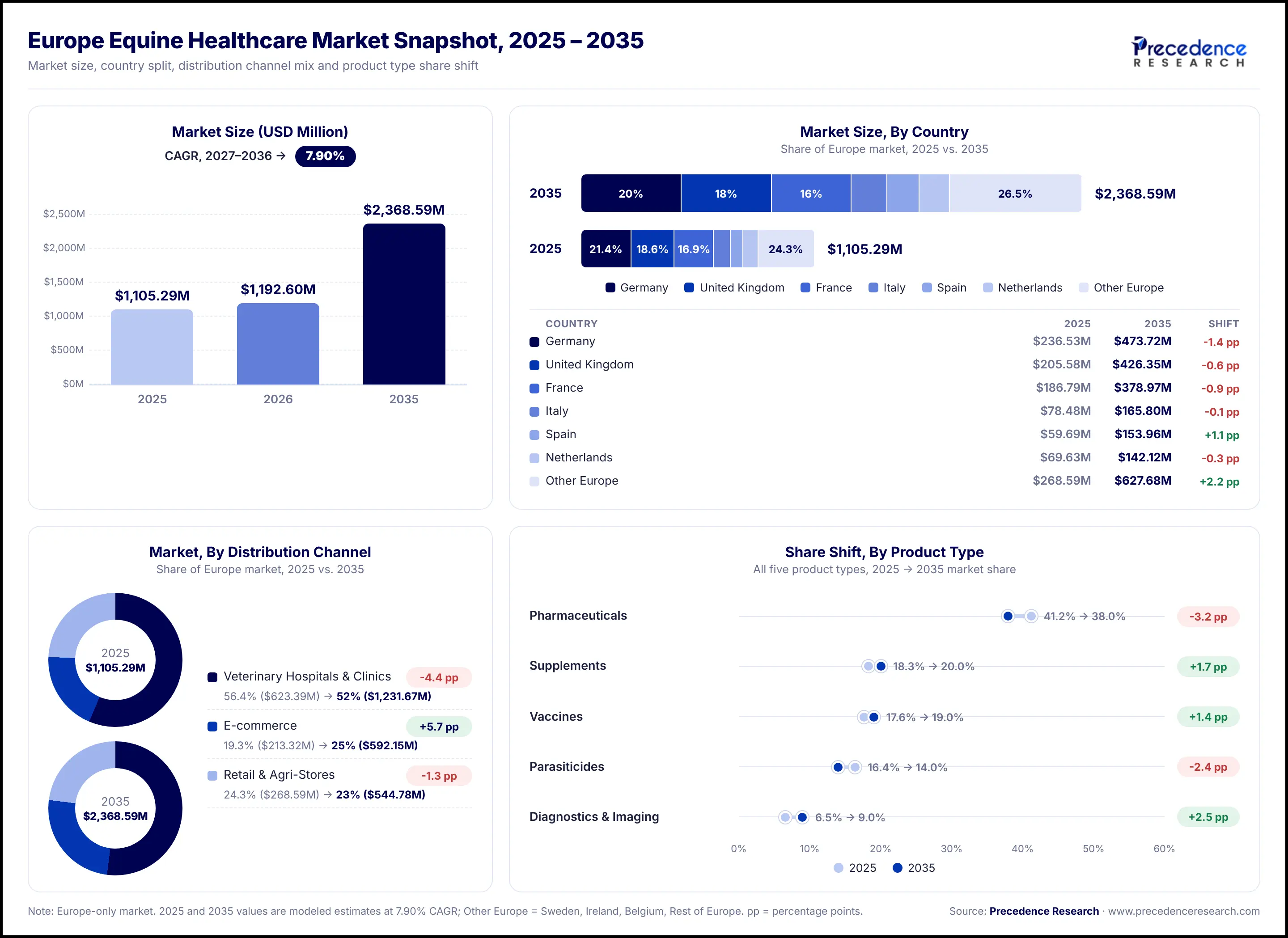
The Europe equine healthcare market is estimated at USD 1,289.20 million in 2027. The market is projected to reach USD 2,555.72 million by 2036 with a growing CAGR of 7.90% from 2027 to 2036.
Key Takeaways
Market Size & Growth Outlook
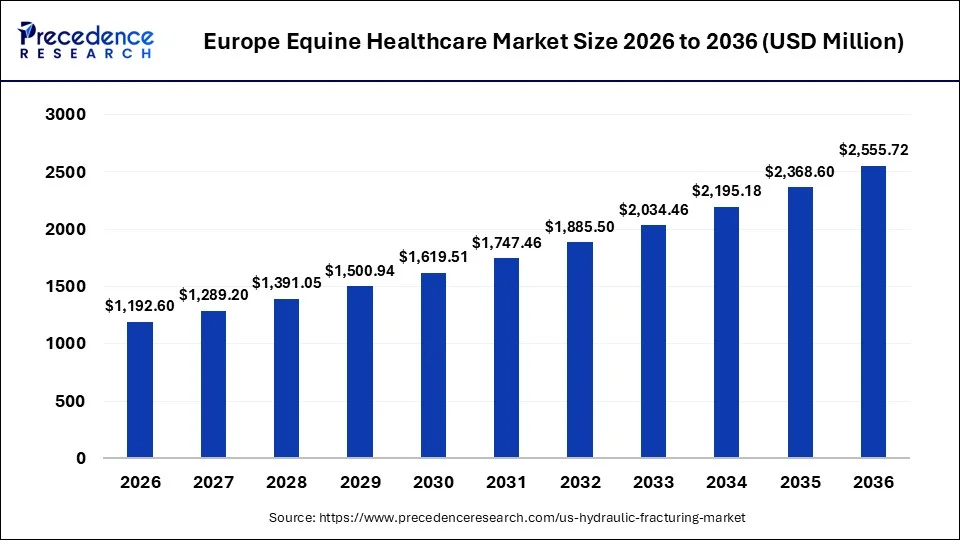
- Market Size in 2026: USD 1,192.60 million
- Estimated Market size in 2027: USD 1,289.20 million
- Projected Market size by 2036: USD 2,555.72 million
- CAGR (2027-2036): 7.90%
Regional Market Spotlight
- Germany led the market with an estimated 21.40% (USD 255.22 million) share in 2026.
- The United Kingdom accounted for an estimated 18.60% (USD 221.82 million) of the market in 2026.
- France accounted for an estimated 16.90% (USD 201.55 million) of the market in 2026.
- Spain accounted for an estimated 5.40% (USD 64.40 million) in 2026 and is projected to be the fastest-growing country, at a CAGR of 9.72% from 2026 to 2036.
Segmental Spotlight
- By product type, Pharmaceuticals accounted for an estimated 41.20% (USD 491.35 million) in 2026.
- By indication, Musculoskeletal Disorders accounted for an estimated 29.40% (USD 350.62 million) in 2026.
- By activity, Sport & Competition accounted for an estimated 41.80% (USD 498.51 million) in 2026.
- By distribution channel, Veterinary Hospitals & Clinics accounted for an estimated 56.40% (USD 672.63 million) in 2026.
Europe Equine Healthcare Market Size 2026-2036
The 2026 base-year value of the Europe equine healthcare market is estimated at USD 1,192.60 million. The market covers the medicines, vaccines, parasiticides, supplements, and diagnostic systems used to keep sport, leisure, and breeding horses healthy across European countries. The pharmaceuticals segment accounted for the largest product share in 2026, with an estimated 41.20%, led by anti-inflammatory and joint therapies for lameness. Germany is estimated to account for 21.40% of revenue in 2026, supported by one of Europe's largest equestrian communities. Higher spending per horse in sport and leisure riding, preventive vaccination and parasite control, and wider use of advanced imaging are driving the demand for equine healthcare. New biologics such as the Strangvac strangles vaccine and Boehringer Ingelheim's equine allergy pipeline are adding innovation.
Market Trends
- Owners are switching from routine worming to targeted, test-based parasite control
- New equine vaccines such as Strangvac are expanding preventive care
- Equine allergy and immunotherapy products are entering development pipelines
- Standing MRI and advanced ultrasound are spreading to referral practices
- Growing online sales of joint and gut-health supplements
- Regenerative therapies are gaining preference for tendon and joint injuries in sport horses
Drivers, Restraints and Opportunities
Driver
Higher spending per horse on sport performance, preventive care, and diagnostics is a prime factor supporting the market revenue generation. Owners treat horses as athletes and companions, not working animals.
Restraint
A highly stable horse population and rising anthelmintic resistance hamper volume growth for routine products. Also, the process of equine-specific drug development is costly relative to market size.
Opportunity
Biologics, allergy treatments and advanced imaging create premium growth segments. Newly invented vaccines, such as Strangvac, show that innovation can open new preventive care spending.
Market Segmentation 2026 Share and Value
Europe Equine Healthcare Market By Product Type 2026 Share & Size
Note: 2026 values are estimates.
Sources: Expert interviews, secondary sources, Precedence Research database and Precedence Research analysts.
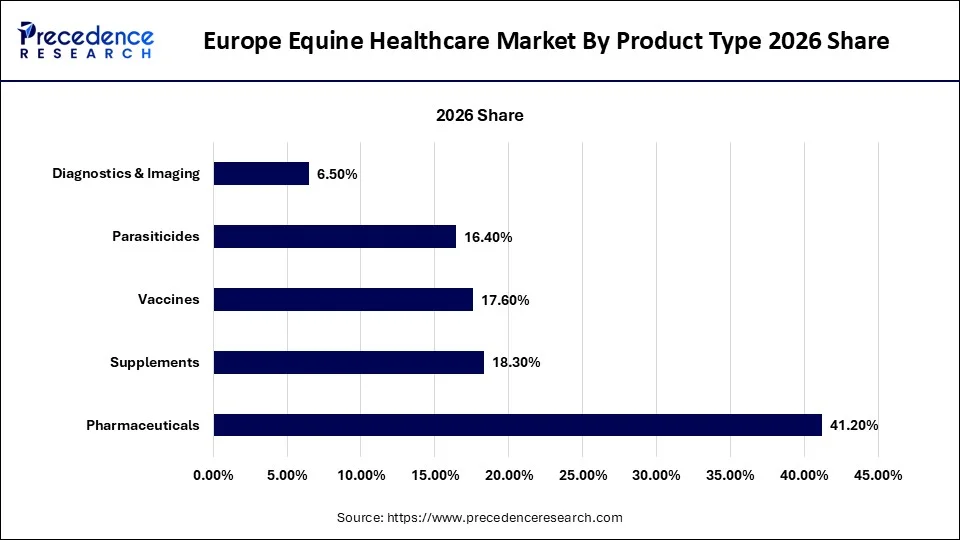
Pharmaceuticals accounted for an estimated 41.20% (USD 491.35 million) in 2026 because anti-inflammatory, joint, and gastrointestinal treatments are the most frequent purchases for performance horses. Supplements are leading with 18.30% (USD 218.25 million), due to high focus on joint and gut health
Moreover, vaccines, at 17.60% (USD 209.90 million)due to expansion oF new products such as strangles vaccines. Parasiticides, at 16.40% (USD 195.59 million), remain a steady category as targeted worming replaces routine dosing, and diagnostics and imaging, at 6.50% (USD 77.52 million), grow as referral practices invest in ultrasound, MRI and CT.
Europe Equine Healthcare Market By Indication 2026 Share & Size
| Segments | 2026 Share | 2026 Market Value |
| Musculoskeletal Disorders | 29.40% | USD 350.62 million |
| Infectious Diseases | 19.80% | USD 236.13 million |
| Parasitic Infections | 18.70% | USD 223.02 million |
| Gastrointestinal Disorders | 11.20% | USD 133.57 million |
| Respiratory Disorders | 8.60% | USD 102.56 million |
| Others | 6.20% | USD 73.94 million |
| Reproductive Health | 6.10% | USD 72.75 million |
Note: 2026 values are estimates.
Sources: Expert interviews, secondary sources, Precedence Research database and Precedence Research analysts.
Musculoskeletal disorders accounted for an estimated 29.40% (USD 350.62 million) in 2026 because lameness is the leading health problem in sport and leisure horses. Infectious diseases, at 19.80% (USD 236.13 million), grow with vaccination programs, while parasitic infections, at 18.70% (USD 223.02 million), remain steady as targeted worming replaces routine dosing. Gastrointestinal disorders, at 11.20% (USD 133.57 million), include colic and gastric ulcer treatment; respiratory disorders account for 8.60% (USD 102.56 million), reproductive health, at 6.10% (USD 72.75 million), is driven by breeding programs, and other indications account for 6.20% (USD 73.94 million).
Europe Equine Healthcare Market By Activity 2026 Share & Size
Note: 2026 values are estimates.
Sources: Expert interviews, secondary sources, Precedence Research database and Precedence Research analysts.
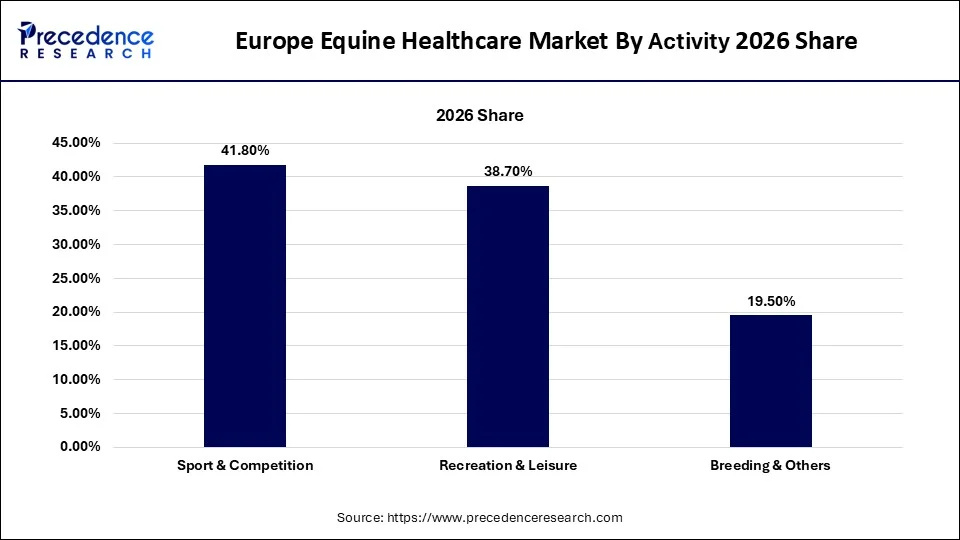
Sport and competition horses accounted for an estimated 41.80% (USD 498.51 million) in 2026. The segmental growth is attributed to the rising spending on preventive care, imaging, and joint therapy. Recreation and leisure horses, at 38.70% (USD 461.54 million), form a large stable base, while breeding horses, at 19.50% (USD 232.56 million), drive reproductive and vaccine demand. Spending per horse is highest in competition, where performance and resale value justify advanced diagnostics and therapies. Leisure owners focus on routine vaccination, worming, and supplements.
Europe Equine Healthcare Market By Distribution Channel 2026 Share & Size
| Segments | 2026 Share | 2026 Market Value |
| Veterinary Hospitals & Clinics | 56.40% | USD 672.63 million |
| Retail & Agri-Stores | 24.30% | USD 289.80 million |
| E-commerce | 19.30% | USD 230.17 million |
Note: 2026 values are estimates.
Sources: Expert interviews, secondary sources, Precedence Research database and Precedence Research analysts.
Veterinary hospitals and clinics accounted for an estimated 56.40% (USD 672.63 million) in 2026 because most prescription medicines and vaccines are supplied through equine vets.
Retail and agri-stores, at 24.30% (USD 289.80 million), serve supplements and OTC wormers, while e-commerce, at 19.30% (USD 230.17 million), is gaining share with online supplement and wormer sales. Equine vets also the supplement and wormer choices that owners buy through other channels. Online sales are expanding as owners buy supplements and OTC products on subscription.
- Analyst View: We see pharmaceuticals and musculoskeletal care remaining the value core through 2036, while vaccines and diagnostics gain share as new biologics and imaging systems reach practices. Sport and competition horses will keep setting spending trends, and e-commerce will take a growing share of supplement and wormer sales.
Country Analysis
Europe Equine Healthcare Market By Country 2026 Share & Size
| Country | 2026 Share | 2026 Market Value |
| Germany | 21.40% | USD 255.22 million |
| United Kingdom | 18.60% | USD 221.82 million |
| France | 16.90% | USD 201.55 million |
| Italy | 7.10% | USD 84.67 million |
| Netherlands | 6.30% | USD 75.13 million |
| Spain | 5.40% | USD 64.40 million |
| Sweden | 5.20% | USD 62.02 million |
| Ireland | 4.10% | USD 48.90 million |
| Belgium | 3.20% | USD 38.16 million |
| Rest of Europe | 11.80% | USD 140.73 million |
Note: 2026 values are estimates.
Sources: Expert interviews, secondary sources, Precedence Research database and Precedence Research analysts.
Germany accounted for an estimated 21.40% (USD 255.22 million) in 2026, growing on one of Europe's largest equestrian communities and strong sport-horse breeding. The United Kingdom, at 18.60% (USD 221.82 million). The segment is experiencing growth due to high spending on racing and leisure horses, while France, at 16.90% (USD 201.55 million),due to its growing preferenceon racing and breeding, and Spain, at 5.40% (USD 64.40 million), is the fastest-growing country. Italy, at 7.10% (USD 84.67 million), the Netherlands, at 6.30% (USD 75.13 million), and Sweden, at 5.20% (USD 62.02 million), form a second tier driven by show jumping, warmblood breeding and trotting, while Ireland, at 4.10% (USD 48.90 million), is shaped by thoroughbred breeding and racing.
Germany accounted for 21.40% (USD 255.22 million) in 2026. It has one of Europe's largest equestrian communities and strong sport-horse breeding, driving spending on joint therapies and vaccines.
The United Kingdom registered 18.60% growth rate(USD 221.82 million) in 2026. Racing and leisure riding support high spending per horse, and Strangvac and other vaccines are expanding preventive care.
France projected for 16.90% (USD 201.55 million) in 2026. The growth is attributed to racing, breeding and a large leisure riding base drive demand for pharmaceuticals and reproductive health products.
Italy accounted for a projected growth of 7.10% (USD 84.67 million) in 2026. Show jumping and leisure riding support steady pharmaceutical and supplement demand.
The Netherlands accounted for an estimated 6.30% (USD 75.13 million) in 2026. Warmblood breeding and sport-horse exports support high spending on diagnostics and preventive care.
Spain accounted for an estimated 5.40% (USD 64.40 million) in 2026 and is the fastest-growing country. Growth in equestrian sport and leisure riding is lifting spending per horse.
Sweden is estimated at 5.20% (USD 62.02 million) in 2026. Trotting and a high horse-per-capita ratio support demand, and strict antimicrobial rules favor vaccines and diagnostics.
Ireland accounted for an estimated 4.10% (USD 48.90 million) in 2026. Thoroughbred breeding and racing drive demand for reproductive, musculoskeletal and imaging products.
Belgium is projected to showcase 3.20% CAGR (USD 38.16 million) in 2026. Show-jumping breeding programs support spending on sport-horse care.
The Rest of Europe accounted for an estimated 11.80% (USD 140.73 million) in 2026. Central and Eastern European and smaller Western markets add steady demand for routine medicines and wormers.
- Analyst View: Germany , the UK and France form more than half of demand and will stay the core markets through 2036. We expect Spain and other Southern European markets to grow fastest as equestrian sport expands, while the Netherlands, Sweden and Ireland remain high-spend markets for breeding and racing. On our regional forecast, Spain grows at a CAGR of 9.72% from 2026 to 2036, compared with 7.92% for the overall market.
Top 10 Companies in the Europe Equine Healthcare Market
| Rank | Company Name | Market-Specific Revenue (USD Million) | 2026 Share (Est.) | Key Products / Business | Headquarters |
| 1 | Boehringer Ingelheim Animal Health | 148.6 | 12.46% | Equine vaccines, Equioxx and Eqvalan; expanding allergy pipeline through Evax | Germany |
| 2 | Zoetis Inc. | 112.3 | 9.42% | Equine vaccines, Quest and anti-inflammatory products | United States |
| 3 | MSD Animal Health | 76.4 | 6.41% | Equilis vaccines and Panacur Equine | United States |
| 4 | Dechra Pharmaceuticals | 68.9 | 5.78% | Equine pharmaceuticals; European partner for Strangvac | United Kingdom |
| 5 | Ceva Santé Animale | 52.7 | 4.42% | Equine pharmaceuticals and vaccines | France |
| 6 | Vetoquinol SA | 38.6 | 3.24% | Equine pharmaceuticals and Equistro supplements | France |
| 7 | Virbac SA | 31.2 | 2.62% | Equine anthelmintics and pharmaceuticals | France |
| 8 | Norbrook Laboratories | 27.4 | 2.30% | Generic equine pharmaceuticals and wormers | United Kingdom |
| 9 | Elanco Animal Health | 24.6 | 2.06% | Equine anti-inflammatories and parasiticides | United States |
| 10 | HIPRA | 21.8 | 1.83% | Equine vaccines | Spain |
Note: 2026 company revenues and shares are estimates.
Sources: Company press releases, expert interviews, secondary sources, Precedence Research database and Precedence Research analysts.
Boehringer Ingelheim led the Europe equine healthcare market with an estimated 12.46% (USD 148.60 million) of 2026 revenue, followed by Zoetis at 9.42% (USD 112.30 million) and MSD Animal Health at 6.41% (USD 76.40 million). Boehringer Ingelheim stands out due to its products including equine vaccines, Equioxx and Eqvalan, Zoetis through vaccines and the Quest wormer range, and MSD Animal Health through Equilis vaccines and Panacur Equine. The top 10 companies accounted for an estimated 50.52% (USD 602.50 million) of 2026 revenue, while the remaining 49.48% (USD 590.10 million) was shared among regional pharmaceutical, supplement, and diagnostic suppliers. Competition focuses on new biologics and partnerships, such as Boehringer Ingelheim's acquisition of Evax and Dechra's European distribution of Strangvac.
Europe Equine Healthcare Market Segments
By Product Type
- Pharmaceuticals
- Supplements
- Vaccines
- Parasiticides
- Diagnostics & Imaging
By Indication
- Musculoskeletal Disorders
- Infectious Diseases
- Parasitic Infections
- Gastrointestinal Disorders
- Respiratory Disorders
- Others
- Reproductive Health
By Activity
- Sport & Competition
- Recreation & Leisure
- Breeding & Others
By Distribution Channel
- Veterinary Hospitals & Clinics
- Retail & Agri-Stores
- E-commerce
By Country
- Germany
- United Kingdom
- France
- Italy
- Netherlands
- Spain
- Sweden
- Ireland
- Belgium
- Rest of Europe
Research Methodology
The Europe equine healthcare market was defined as equine medicines, vaccines, parasiticides, supplements, and diagnostics sold at manufacturer level, excluding veterinary services and feed. The 2026 base was built bottom-up from horse numbers by activity and spending per horse by product category, and checked against company equine revenues and published estimates. Segment, country and company values were allocated from product portfolios, national equine populations and channel data, then reconciled before publication. Key estimates were verified by cross-checking company disclosures, regulatory and industry data and published third-party estimates, and inputs that could not be reconciled were excluded.
Analyst View Overall Market
Europe's horse population is broadly stable, so growth in equine healthcare comes from higher spending per horse rather than more horses. Owners of sport and leisure horses are paying for joint therapies, preventive vaccines, targeted worming and advanced imaging, and that shift supports a 7.90% CAGR from 2027 to 2036. there is wide scope of growth in musculoskeletal therapies, new vaccines and allergy treatments, and diagnostic imaging. The main risks are discretionary spending pressure, anthelmintic resistance, and the high regulatory cost of developing equine-specific medicines.
Sources and References
- The Horse. "Boehringer Ingelheim expands equine health pipeline with acquisition of Evax AG". Undated. Boehringer Ingelheim equine allergy pipeline expansion.(Source: https://thehorse.com)
- Zoetis Inc. (SEC EDGAR). "Form 10-K, fiscal year 2025". 2026. Zoetis horse product revenue and portfolio. (Source: https://www.sec.gov)
- Bionity. "Boehringer Ingelheim acquires Swiss biotech in bid to combat equine allergies". Undated. Evax acquisition details. .(Source: https://www.bionity.com)
- Krka, d. d., Novo mesto. "FY25 Results Presentation". 2026. Animal health sales and European veterinary market context. (Source:https://www.krka.biz)
For inquiries regarding discounts, bulk purchases, or customization requests, please contact us at sales@precedenceresearch.com
Frequently Asked Questions





Ask For Sample
No cookie-cutter, only authentic analysis – take the 1st step to become a Precedence Research client
 Get a Sample
.webp)



 sales@precedenceresearch.com
 Schedule a Meeting