



Europe AI in Life Science Market Size, Share and Trends 2026 to 2035
Europe AI in Life Science Market (By Component: Hardware, Software, Services; By Deployment Mode: On-premise, Cloud; By Application: Research & Development, Sales & Marketing Support, Supply Chain Analytics, Patient Health & Experience; By End-User: Pharmaceutical Companies, Biotechnology Companies, Medical Device & Diagnostics Firms, Contract Research Organizations (CROs)) - Industry Analysis, Size, Trends, Leading Companies, Regional Outlook, and Forecast 2026 to 2035
 Get a Sample
 Table Of Content


What is the Europe AI in Life Science Market Size?
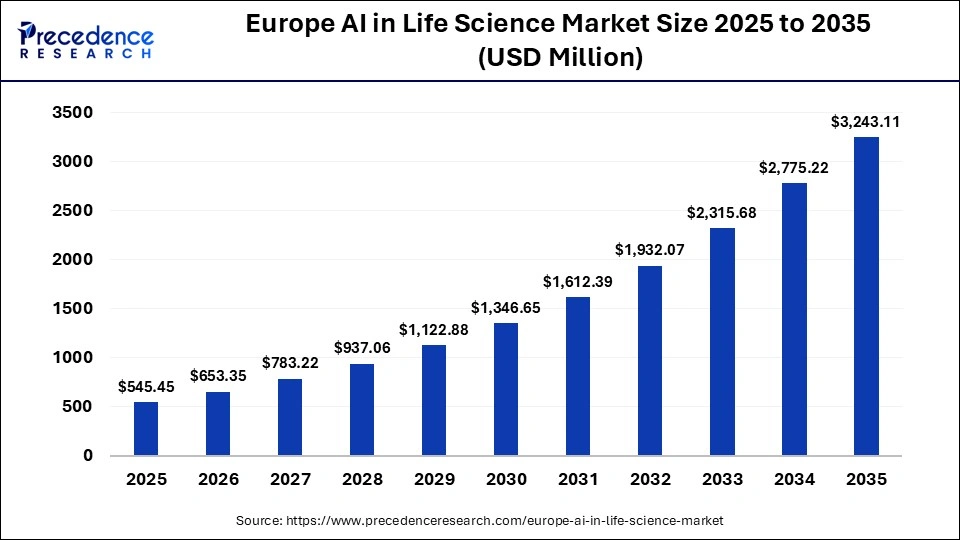
The Europe ai in life science market size was calculated at USD 545.45 million in 2025 and is predicted to increase from USD 653.35 million in 2026 to approximately USD 3243.11 million by 2035, expanding at a CAGR of 19.51% from 2026 to 2035. The Europe AI in life science market is rapidly expanding, driven by AI's transformative role in accelerating drug discovery, enhancing diagnostic accuracy, and enabling truly personalized medicine, with significant growth spurred by regulatory support and integration into clinical workflows, promising reduced timelines and costs while improving patient outcomes across the continent.
Market Highlights
- By component, the hardware segment held the largest market share of 58.3% in 2025.
- By component, the software segment is expected to grow at a remarkable CAGR of 8.4% between 2026 and 2035.
- By deployment mode, the on-premises segment held the largest market share of 68.4% in 2025.
- By deployment mode, the cloud segment is expected to grow at a remarkable CAGR of 8.5% between 2026 and 2035.
- By application, the research & development segment held the largest share of 46.4% in the Europe AI in life science market during 2025.
- By application, the clinical operations/regulatory & safety digitalization is set to grow at a remarkable share of 8.2% CAGR between 2026 and 2035.
Market Overview
The Europe AI in life science market is experiencing robust growth, driven by the growing use of AI-enabled solutions in personalized medicine, drug discovery, and diagnostics. Supportive regulatory frameworks, data sharing organizations, and growing investments in machine learning platforms suited to life science workflows all help.
Case Study: In September 2023, Owkin and Tribun Health launched a strategic partnership to deploy AI diagnostic and research solutions for pathology and pharma workflows.
Europe's Strategic Advantage in AI for Life Sciences
The Europe AI in life science market stands out globally because of its well-rounded strategy that combines innovation and governance. In contrast to markets that place more emphasis on quick adoption, Europe prioritized the responsible deployment of AI through strong cross-border cooperation, data protection regulations, and ethical frameworks. This guarantees long-term sustainability in biomedical innovations as well as public trust and technological advancements.
Key Technological Shifts in the Europe AI in Life Science Market
- Machine learning integration in drug discovery and development to accelerate molecule identification. It helps reduce research time and costs while improving the success rate of new drug formulations.
- AI-driven diagnostic technologies for precise and timely illness identification. These instruments facilitate quicker treatment interventions and improve clinical decision-making.
- Predictive analytics for personalized treatment planning and patient outcome forecasting. It allows clinicians to anticipate disease progression and tailor therapies accordingly.
- Automation in clinical trials through AI-based data monitoring and patient recruitment. It optimizes trial design, enhances participant diversity, and reduces operational delays.
Emerging Trends in the Europe AI in Life Science Market
| Trends | Description | Why it Matters |
| Ethical AI in Healthcare | Focus on responsible data use and transparent decision-making in clinical settings. | Builds trust and ensures regulatory compliance under EU AI laws |
| Multi-Omics Data Integration | Combining genomics, proteomics, and metabolomics data for precision medicine | Enables holistic disease understanding and targeted therapies Ai |
| Ai-Enhanced Clinical Workflows | AI streamlines clinical trial management, patient monitoring, and data analytics. | Reduces manual errors and accelerates drug approvals |
| Collaboration between Academia & Industry | Universities, startups, and pharma giants co-develop AI models | Fosters innovation and ensures practical, real-world AI development |
Europe AI in Life Market Trends
- Industry Growth Overview: The Europe AI in life science market is growing rapidly due to the growing use of AI in medical research, diagnostics, and drug discovery. The market is expanding thanks to strong R&D investments, supportive regulations, and tech pharma partnerships.
- Sustainability Trends: AI is being used by Europe life science companies to boost eco-friendly research, reduce waste, and increase efficiency. The emphasis on ethical and open AI practices supports the sustainability objectives of the area.
- Startup Ecosystem: AI-driven life science startups are flourishing throughout Europe, with the UK, Germany, and France leading the way. Innovations in digital health solutions, genomics, and AI diagnostics are drawing vectors to startups.
Market Scope
| Report Coverage | Details |
| Market Size in 2025 | USD 545.45 Million |
| Market Size in 2026 | USD 653.35 Million |
| Market Size by 2035 | USD 3243.11 Million |
| Market Growth Rate from 2026 to 2035 | CAGR of 19.51% |
| Base Year | 2025 |
| Forecast Period | 2026 to 2035 |
| Segments Covered | Component, Deployment Mode, Application, and End-User |
| Regions Covered | North America, Europe, Asia-Pacific, Latin America, and Middle East & Africa |
Segmental Insights
Component Insights
What made the hardware segment dominate the market in 2024?
The hardware segment is dominating the Europe AI in life science market by holding a share of 58.3%, propelled by the growing need for GPU data storage devices and high-performance computing systems, all of which are necessary for developing and implementing sophisticated AI models. To process massive biomedical datasets effectively and provide quicker insights and improved research accuracy, life science applications like genomic sequencing, molecular simulations, and diagnostics imaging mainly rely on sophisticated hardware infrastructure.
- In September 2024, Mindpeak announced a US$15.3 million Series A funding co-led by ZEISS Ventures to expand its AI-based digital pathology hardware and imaging capabilities.
The software segment is the fastest growing in the Europe AI in life science market, with a CAGR of 8.4%, motivated by growing use of predictive analytics platforms, machine learning tools, and AI algorithms for drug discovery and diagnostics. The increasing use of automation software and cloud-based AI solutions in research settings is speeding up workflow optimization and enhancing data-driven decision-making in the life sciences.
- In May 2025, Aqemia launched its AI-backed physics-based software platform for faster and cost-effective drug discovery.
Deployment Mode Insights
Why did the on-premises segment dominate the market in 2025?
The on-premises segment is dominating the Europe AI in life science market by holding a share of 68.4%, propelled by pharmaceutical and biotechnology companies preferring data systems that are internally managed, secure, and adaptable. While preserving operational dependability and high-performance computing capabilities on premises deployment provides more control over sensitive clinical and patient data and guarantees adherence to strict Europe data protection regulations.
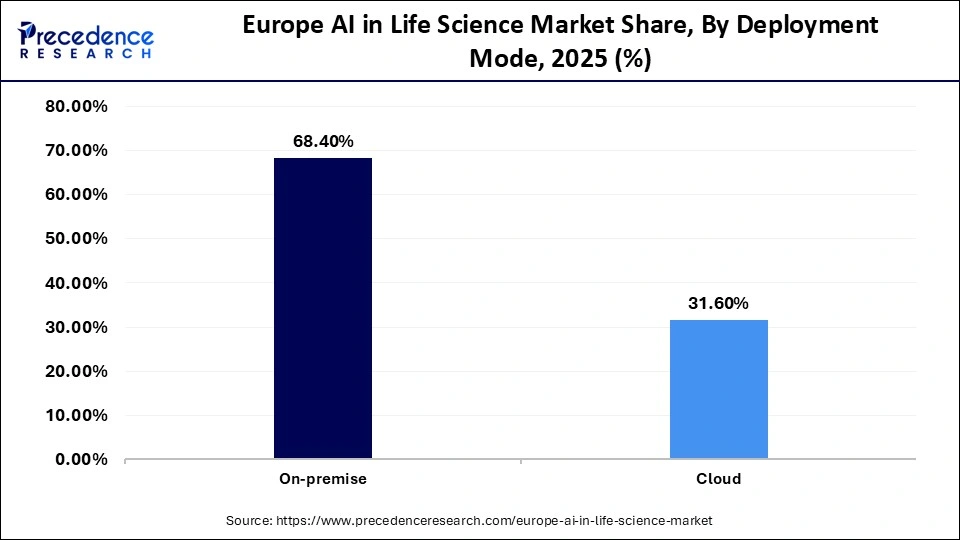
The cloud segment is the fastest growing in the Europe AI in life science market, with a CAGR of 8.5%, motivated by expanding demand for affordable, scalable, and cooperative AI solutions that facilitate remote research and real-time data access. Research institutions and up-and-coming biotech startups are increasingly choosing cloud platforms because they facilitate the smooth integration of various datasets and improve computational efficiency.
- In July 2025, Aiforia Technologies Plc established a new subsidiary in France to expand its cloud-based AI pathology software across Europe.
Application Insights
Why did the research & development segment dominate the market in 2025?
The research & development segment is dominating the Europe AI in life science market by holding a share of 46.4%. The widespread application of AI in drug discovery, molecular design, and clinical research optimization is the segment's main advantage. Businesses in the pharmaceutical and biotechnology industries are making significant investments in AI-driven research and development to reduce the time it takes to find new treatments, forecast the behavior of compounds, and boost their overall success rate.
The patient health & experience segment is expected to grow at a significant rate in the Europe AI in life science market, driven by the incorporation of AI to enhance pharmacovigilance, expedite regulatory compliance, and automate clinical trial management. Clinical procedures become more transparent, effective, and data-driven thanks to AI tools that move patient recruitment, track trial progress, and analyze safety data in real time.
Regional Insights
The Europe AI in life science market is growing due to robust research capacities, stringent data protection regulations, and significant investments in the digitization of healthcare. In fields like drug discovery and precision medicine, the region has a distinct advantage thanks to its emphasis on ethical AI and cross-border research partnerships. By providing funding for innovation and bolstering data-sharing frameworks, Europe and the European Health Data Space are speeding up the adoption of AI. Because of its robust research and policy framework, Europe continues to lead the world in AI-driven advances in life sciences.
Germany Market Analysis
Germany is the fastest-growing in Europe AI in life science market, reinforced by a thriving pharmaceutical sector and growing government spending on digital health. The countries' tech hubs, Heidelberg, Munich, and Berlin, are developing into hubs for biotech and AI cooperation. Innovation in drug development and diagnostics is being propelled by the German AI Strategies initiatives and collaborations with companies such as Siemens Healthiness and BioNTech. Germany is quickly emerging as a major growth engine for European AI in the life science market, thanks to these initiatives.
UK Market Analysis
The UK AI in life science market is growing rapidly, driven by substantial government investment in R&D, advanced infrastructure, and a strong, growing AI startup ecosystem. Key areas include drug discovery, clinical trials, and diagnostics, with significant adoption in the pharmaceutical industry.
SWOT Analysis: Europe AI in Life Science Market
Strengths
- Strong Research Ecosystem & Innovation Hubs: Europe boasts a world-class academic and pharmaceutical R&D base (e.g., in the UK, Germany, Switzerland) that fosters high-quality AI development.
- High-Quality Structured Data Access: The presence of extensive, centralized Electronic Health Records (EHRs) and biobanks, particularly in the UK (NHS) and Nordic countries, provides robust, high-quality data crucial for training reliable AI models.
- Focus on Precision Medicine & Rare Diseases: A strong regional commitment to tackling complex, rare, and cancer-related diseases enables specialized AI applications in drug discovery and diagnosis.
Weaknesses
- Fragmented Data Landscape: Despite national successes, cross-border health data sharing remains complex due to varying national regulations and data formats, limiting the scale of European AI applications.
- AI Talent Shortage: A significant gap exists between the demand for and supply of AI specialists, with estimates suggesting a 67–72% talent shortage in key areas like Germany.
- High Cost of Adoption: Developing and implementing customized AI tools, such as natural language processing (NLP) for specific life science needs, involves a high upfront investment, hindering smaller firms.
Opportunities
- Acceleration of Drug Discovery & Trials: AI-driven tools can significantly reduce the time and cost of drug discovery, target identification, and patient recruitment for clinical trials.
- The European Health Data Space (EHDS): The implementation of the EHDS in 2025 provides a unified framework to foster better access to health data, accelerating AI innovation across borders.
- Strategic Partnerships & CRO Growth: Increasing collaboration between pharma companies, AI startups, and Contract Research Organizations (CROs) is driving the adoption of specialized AI for drug repurposing and manufacturing.
Threats
- Stringent Regulatory Hurdles: The EU AI Act, while fostering trust, imposes strict, high-risk compliance requirements on medical AI, which could stifle speed, increase costs, and delay market entry compared to the US or Asia.
- Ethical and Bias Risks: The risk of AI producing biased results due to unrepresentative data or opaque, complex algorithms (black boxes) poses safety and legal challenges.
- Competition from Global Players: Intense competition from North America and Asia-Pacific, backed by larger investments, poses a risk of Europe losing its competitive advantage in AI innovation.
Top Companies and Their Offerings and Contributions in the Market
| Company | Offerings & Contributions |
| IBM Corporation | Provides the WatsonX platform, emphasizing explainability and governance, aligning with the EU AI Act. Key for secure, compliant AI solutions in regulated sectors. |
| Microsoft Corporation | Integrates AI into Azure cloud services and healthcare-specific clouds. Focuses on partnerships (e.g., with Mercy) to optimize patient care and streamline operations using generative AI. |
| Google LLC | Offers AI-driven cloud platforms like Google Cloud that prioritize compliance and innovation through collaborations with institutions like CERN. |
| SAS Institute Inc. | A key player in life science analytics, providing a platform to manage large datasets and drive AI-driven insights for commercial teams. |
| IQVIA Holdings Inc. | A market leader in data and analytics, it launched an AI-powered MI Contact Center. Its platforms are central to AI in commercialization strategies. |
| Databricks, Inc. | Offers a platform for building data and AI apps. Partnered with TetraScience to advance scientific AI, accelerating therapeutic development. |
| Accenture plc | A major consulting firm, leading in the market by leveraging technology and strategic partnerships to enhance overall life sciences operations. |
| Oracle Corporation | Focuses on new product developments and strategic collaborations, such as with NVIDIA, to integrate AI software with its cloud infrastructure (OCI). |
| Siemens Healthineers AG | Integrates AI into diagnostic imaging (AI-Rad Companion), clinical workflows, and laboratory diagnostics, supporting precision medicine with a strong European presence. |
| Bayer AG | (Information not explicitly detailed in search results, but generally contributes through R&D and digital farming initiatives leveraging AI). |
Who are the Major Players in the Europe AI in Life Science Market?
The major players in the europe ai in life science market include IBM Corporation, Microsoft Corporation, Google LLC (Alphabet Inc.), SAS Institute Inc., IQVIA Holdings Inc., Databricks, Inc., Accenture plc, Oracle Corporation, Siemens Healthineers AG, Bayer AG, BenevolentAI Ltd., Exscientia Ltd., PTC Therapeutics (AI partner), Novartis AG (AI initiatives), Roche Holding AG
Recent Developments in the Europe AI in Life Science Market
- In January 2025, TME Pharma N.V. announced a collaboration with Almed Analytics GmbH to deploy AI-driven drug discovery and optimization tools, bolstering the company's strategic capabilities.(Source: https://www.life-sciences-europe.com)
- In February 2025, ArisGlobal signed the EU AI Pact, committing to ethical AI development and deployment in life sciences across European markets. (Source: https://www.arisglobal.com)
Segments Covered in the Report
By Component
- Hardware
- Software
- Services
By Deployment Mode
- On-premise
- Cloud
By Application
- Research & Development
- Sales & Marketing Support
- Supply Chain Analytics
- Patient Health & Experience
By End-User
- Pharmaceutical Companies
- Biotechnology Companies
- Medical Device & Diagnostics Firms
- Contract Research Organizations (CROs)
For inquiries regarding discounts, bulk purchases, or customization requests, please contact us at sales@precedenceresearch.com
Frequently Asked Questions





Ask For Sample
No cookie-cutter, only authentic analysis – take the 1st step to become a Precedence Research client



 sales@precedenceresearch.com
 Schedule a Meeting



