


Aromatherapy Diffusers Market Size, Key Companies, Company Product Portfolio, Hospital Procurement Trends, Manufacturing Capacity, Sales Performance, Regulatory Approvals, Company Market Share, and Forecast
The aromatherapy diffusers market is expected to grow through 2035, driven by rising demand for home fragrances, wellness products, and innovative diffusion technologies. This report benefits stakeholders across the value chain, including diffuser manufacturers, essential oil providers, e-commerce platforms, R&D teams, and hospitality, healthcare, and wellness facilities.
Source: https://www.precedenceresearch.com/aromatherapy-diffusers-market
 Get a Sample
 Report Description


Aromatherapy Diffusers Market Size, Share, Trends, and Growth Forecast 2035
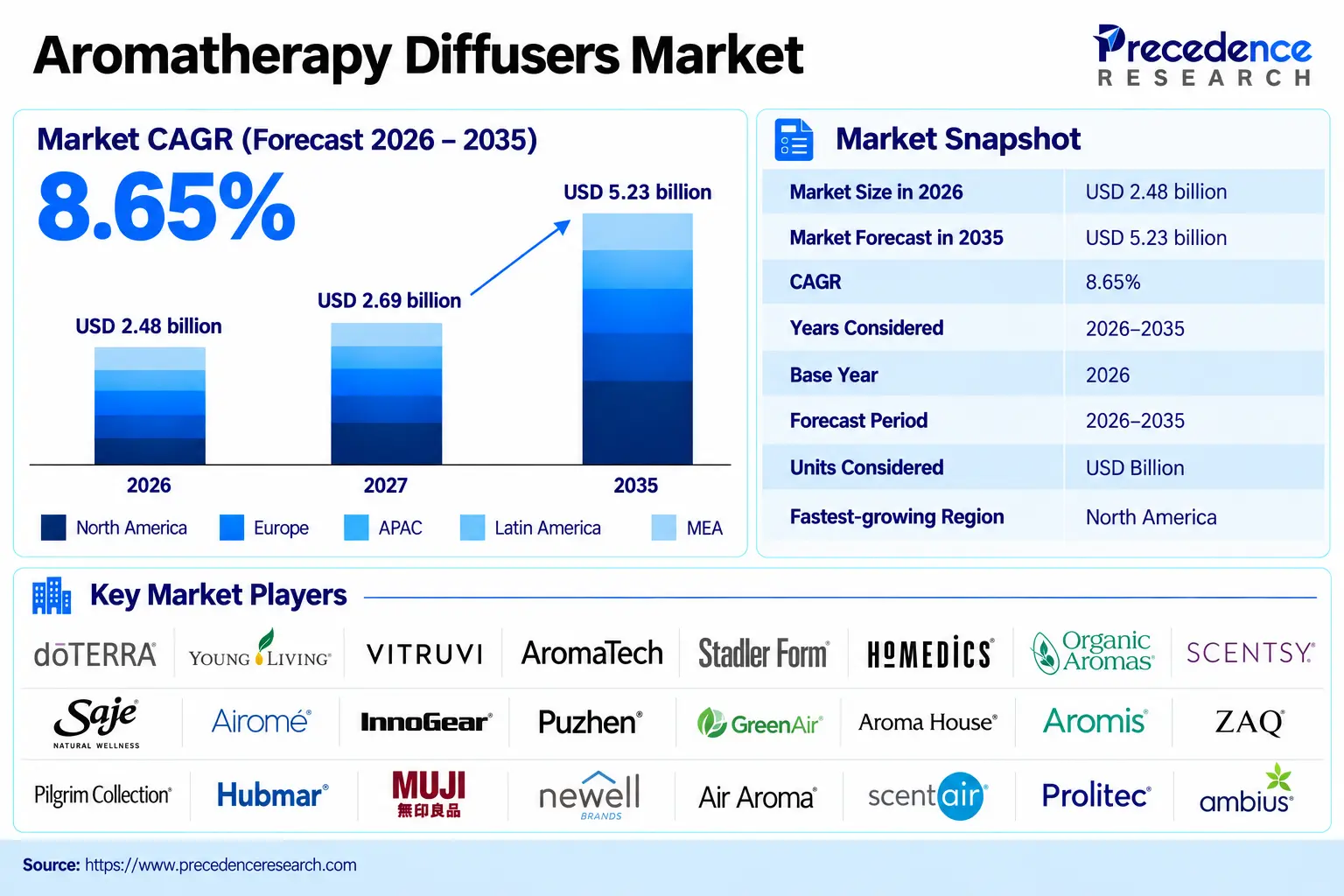
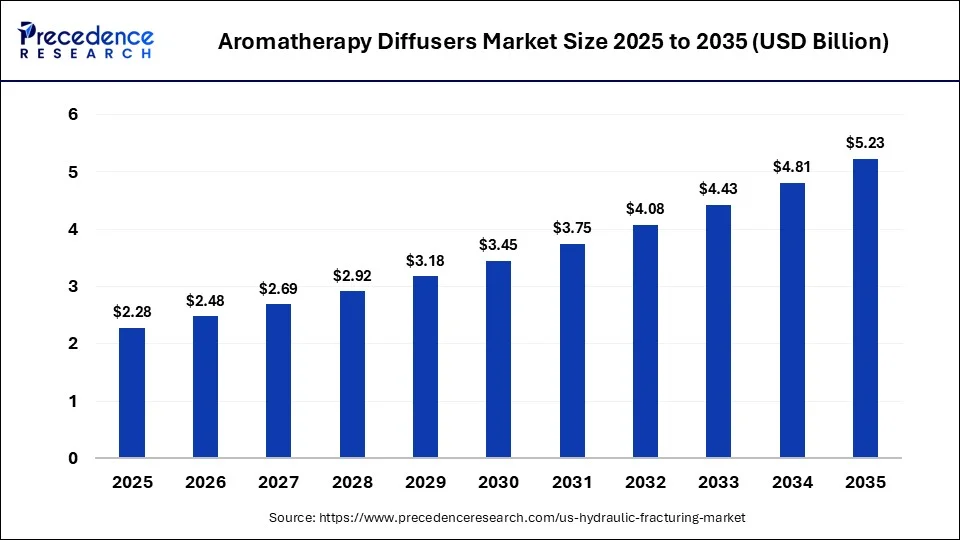
The aromatherapy diffusers market is forecasted to expand from USD 2.48 billion in 2026 to USD 5.23 billion by 2035, growing at a CAGR of 8.65% from 2026 to 2035.
Key Takeaways
Market Size & Growth Outlook
- Market size in 2026: USD 2.48 billion.
- Estimated market size in 2027: USD 2.69 billion.
- Projected market size by 2035: USD 5.23 billion.
- CAGR (2026–2035): 8.65%.
Regional Market Spotlight
- North America market share 2026: 32%.
- Europe market share 2026: 27%.
- Asia-Pacific market share 2026: 28%.
Segmental Spotlight
- Ultrasonic diffusers segment share 2026: 48%.
- Residential application segment share 2026: 58%.
- Online channels segment share 2026: 42%.
Aromatherapy Diffusers Market Size 2026 to 2035
The aromatherapy diffusers market is growing due to rising demand for home wellness, premium fragrances, and smart scenting solutions. Increasing adoption across residential, hospitality, and wellness settings is creating new opportunities for manufacturers.
What are Aromatherapy Diffusers?
The global aromatherapy diffusers market estimates vary according to product boundaries, treatment of commercial scent-diffusion equipment, and inclusion of associated devices. Market growth is driven by home wellness expenditure, use of essential oils, premium home fragrances, hospitality sector applications, and the growth of e-commerce. Future market growth will depend on demand for replacement diffusers, increasing preference for premium products, growing use of commercial scenting systems, and consumer willingness to pay more for smart features and enhanced fragrance delivery.
North America is the largest regional market while Asia Pacific has significant potential for population with disposable income, urban household formation, manufacturing economy of scale and growing interest in home fragrances and wellness. Ultrasonic diffusers benefit from low price points and versatility of use; nebulizers are positioned as more premium offerings, while evaporators are positioned as portable devices.
Key Coverage
- Revenue contribution by diffuser technology, application, price tier, and sales channel.
- Regional demand, consumer penetration, and commercial adoption.
- Device pricing, manufacturing economics, and recurring consumable opportunities.
- Competitive positioning across consumer, wellness, and commercial scenting markets.
- Growth scenarios, market-entry opportunities, and emerging profit pools.
How is the Aromatherapy Diffusers Market Evolving Through 2035?
These numbers are the output of scenarios and not independent forecasts based on market research. It illustrates the compounded impact of adoption and premiumization.
The difference in market share between 2030 and 2035 is commercially relevant; smart-device adoption, commercial installations, premiumization, and repurchases could all play a role in shaping the financial future of the industry.
Revenues are to be separated from shipments. Low-cost ultrasonic units, representing a greater shipment volume, could generate relatively little revenue, and higher-end nebulizers and commercial scent-diffusion systems might bring in more revenue per installed device. Essential oil revenue should be analyzed separately from the device revenue to avoid treating consumables as part of the addressable equipment market.
Coverage Highlights
- Historical and forecast revenue by country, region, and product type.
- Unit shipments, replacement demand, and average selling price.
- Revenue contribution from residential, hospitality, wellness, and commercial applications.
- Sensitivity to premiumization, e-commerce penetration, and repeat-purchase behavior.
Segmentation Analysis
Aromatherapy Diffusers Market by Product Type 2026 Share & Size
| Segments | 2026 Share | Market Value (USD Billion) |
| Ultrasonic Diffusers | 48% | 1.19 |
| Nebulizing Diffusers | 22% | 0.55 |
| Evaporative Diffusers | 18% | 0.45 |
| Heat-Based Diffusers | 12% | 0.3 |
Sources: Expert Interview, Secondary Sources, Precedence Research Database, Precedence Research Analysts and Researcher.
Ultrasonic diffusers are estimated to lead due to their affordability, quiet operation and widespread suitability for home use.
Aromatherapy Diffusers Market by Technology 2026 Share & Size
| Segments | 2026 Share | Market Value (USD Billion) |
| Conventional Diffusers | 48% | 1.19 |
| Smart/Connected Diffusers | 20% | 0.5 |
| Portable/Battery-Operated Diffusers | 18% | 0.45 |
| Waterless Diffusion Systems | 14% | 0.35 |
Sources: Expert Interview, Secondary Sources, Precedence Research Database, Precedence Research Analysts and Researcher.
Conventional diffusers are estimated to account for the largest share because of their established availability and lower prices, while smart and waterless products offer opportunities for premiumization
Aromatherapy Diffusers Market by Price Range 2026 Share & Size
| Segments | 2026 Share | Market Value (USD Billion) |
| Economy | 32% | 0.79 |
| Mid-Range | 38% | 0.94 |
| Premium | 22% | 0.55 |
| Luxury/High-End | 8% | 0.2 |
Sources: Expert Interview, Secondary Sources, Precedence Research Database, Precedence Research Analysts and Researcher.
Mid-range diffusers are estimated to lead by balancing affordability, design and features for everyday consumers.
Aromatherapy Diffusers Market by Application 2026 Share & Size
| Segments | 2026 Share | Market Value (USD Billion) |
| Residential | 58% | 1.44 |
| Commercial | 20% | 0.5 |
| Healthcare and Wellness Facilities | 10% | 0.25 |
| Automotive | 7% | 0.17 |
| Other Applications | 5% | 0.12 |
Sources: Expert Interview, Secondary Sources, Precedence Research Database, Precedence Research Analysts and Researcher.
Residential applications are estimated to dominate as consumers increasingly use diffusers for home fragrance, relaxation and personal wellness.
Aromatherapy Diffusers Market by Commercial End User 2026 Share & Size
| Segments | 2026 Share | Market Value (USD Billion) |
| Hotels, Resorts, Spas and Wellness Centers | 35% | 0.87 |
| Salons and Healthcare Facilities | 20% | 0.5 |
| Offices and Corporate Facilities | 15% | 0.37 |
| Retail Stores and Shopping Malls | 15% | 0.37 |
| Other Commercial Establishments | 15% | 0.37 |
Sources: Expert Interview, Secondary Sources, Precedence Research Database, Precedence Research Analysts and Researcher.
Hotels, resorts, spas and wellness centers are estimated to lead commercial demand through their use of fragrance to enhance customer experiences and indoor ambience.
Aromatherapy Diffusers Market by Distribution Channel 2026 Share & Size
| Segments | 2026 Share | Market Value (USD Billion) |
| Online Channels | 42% | 1.04 |
| Specialty Stores | 20% | 0.5 |
| Supermarkets and Hypermarkets | 15% | 0.37 |
| Home Décor, Lifestyle, Electronics and Appliance Stores | 13% | 0.32 |
| Direct Sales and B2B Distribution | 10% | 0.25 |
Sources: Expert Interview, Secondary Sources, Precedence Research Database, Precedence Research Analysts and Researcher.
Online channels are estimated to lead distribution because consumers can compare prices, features, designs and customer reviews across a wide product selection.
Aromatherapy Diffusers Market by Diffuser Connectivity 2026 Share & Size
| Segments | 2026 Share | Market Value (USD Billion) |
| Non-Connected Diffusers | 65% | 1.61 |
| Bluetooth-Enabled Diffusers | 10% | 0.25 |
| Wi-Fi-Enabled Diffusers | 8% | 0.2 |
| App-Controlled/Smart-Home-Integrated Diffusers | 17% | 0.42 |
Sources: Expert Interview, Secondary Sources, Precedence Research Database, Precedence Research Analysts and Researcher.
Non-connected diffusers are estimated to dominate due to their simplicity and affordability, although connected products provide opportunities for automation and personalized controls.
Aromatherapy Diffusers Market by Power Source 2026 Share & Size
| Segments | 2026 Share | Market Value (USD Billion) |
| Electric/Plug-In | 45% | 1.12 |
| USB-Powered | 20% | 0.5 |
| Battery-Operated and Rechargeable | 25% | 0.62 |
| Passive/Non-Electric | 10% | 0.25 |
Sources: Expert Interview, Secondary Sources, Precedence Research Database, Precedence Research Analysts and Researcher.
Electric and plug-in diffusers are estimated to lead because they support continuous operation in residential and commercial environments.
Aromatherapy Diffusers Market by Fragrance Delivery Mechanism 2026 Share & Size
| Segments | 2026 Share | Market Value (USD Billion) |
| Water-Based Essential Oil Diffusion | 48% | 1.19 |
| Waterless Essential Oil Diffusion | 22% | 0.55 |
| Fragrance Oil Diffusion | 18% | 0.45 |
| Passive Evaporation | 12% | 0.3 |
Sources: Expert Interview, Secondary Sources, Precedence Research Database, Precedence Research Analysts and Researcher.
Water-based essential oil diffusion is estimated to lead due to the popularity and broad availability of ultrasonic diffuser products.
Aromatherapy Diffusers Market by Region 2026 Share & Size
| Segments | 2026 Share | Market Value (USD Billion) |
|---|---|---|
| North America | 32% | 0.79 |
| Europe | 27% | 0.67 |
| Asia-Pacific | 28% | 0.69 |
| Latin America | 6% | 0.15 |
| Middle East and Africa | 7% | 0.17 |
Sources: Expert Interview, Secondary Sources, Precedence Research Database, Precedence Research Analysts and Researcher.
North America is estimated to lead in revenue, supported by consumer spending on home fragrance and wellness products. Asia-Pacific also benefits from its manufacturing base and growing consumer demand.
The market is best segmented across product technology, application, distribution channel, price band, power source, and customer type. Ultrasonic, nebulizing, evaporative, and heat-based devices serve distinct performance and affordability requirements.
What is the Significance of Ultrasonic Devices and Nebulizing and Commercial Systems in Product Technology Segments?
Ultrasonic diffusers
Affordable price range, noise-free operation, variable mist generation, lighting options, and sometimes even humidification capabilities enable widespread use in homes.
Nebulizing diffusers
Waterless fragrance delivery and concentrated aroma output appeal to premium consumers and selected commercial users. Pricing can lead to differentiation, although use of oil, noise, and maintenance can constrain it.
Evaporative and heat-based diffusers
These products serve portable, compact, low-cost, and selected decorative applications. They rely on their convenience, safety, smell potency, and ability to be used in small places.
Which Application Segment Led the Market in 2025?
Residential use topped the list for that year including bedrooms, living rooms, office areas, and relaxation areas. Other commercial uses include hotels, spas, salons, office parks, retail outlets and some health and wellness centers. The institutional and specialized applications provide a smaller potential, where functional reliability becomes more important than aesthetics.
What is the Emerging Distribution Channel for Aromatherapy Diffusers?
Online channels are the fastest-growing in the market, supporting product discovery, comparison, and direct-to-consumer sales. Offline specialty retail, home-goods stores, wellness outlets, and department stores remain important where consumers prefer physical inspection or fragrance demonstrations.
A complete segmentation model would measure each segment in terms of revenue, shipments, ASP, growth contribution, and CAGR. Accurate segment market share needs a defined market border; percentages without a market border are not to be considered facts about the market.
What are the Main Drivers and Challenges in the Aromatherapy Diffusers Market?
Demand is supported by the mainstreaming of self-care, sleep-oriented routines, home fragrance, and ambient wellness. Consumers increasingly evaluate diffusers as part of the home environment rather than solely as essential oil accessories. Scent marketing is another source of demand generation through hotels, spas, and upscale retail stores as part of the branding effort.
Three forces are especially important:
- Premiumization: Better materials, adjustable output, timers, low-noise operation, and refined design can justify higher prices.
- Digital discovery: E-commerce websites and social networking enable easier customer acquisition but bring price pressure.
- Commercial scenting: With a bigger area, there is a need for even distribution, programming capabilities, refills, and technical support.
Limitations include lack of consistency and durability, incompatibility of oils with some systems and maintenance requirements. Diffusers cannot be positioned as clinically tested treatments for diseases unless there is proper substantiation.
This implies that mist capacity may not differentiate the company competitively. Brands need defensible advantages in design, reliability, safety, customer retention, or service-led commercial deployments.
What Does the Pricing Analysis of Aromatherapy Diffusers Indicate?
Retail pricing differs considerably on the basis of capacity, technology, material, features, positioning and the nation. Indicative consumer price bands are:
| Product category | Illustrative retail price |
| Entry-level ultrasonic | USD 10–25 |
| Mid-range ultrasonic | USD 25–60 |
| Premium ultrasonic | USD 60–150 |
| Premium nebulizing | USD 60–200+ |
| Portable and evaporative | USD 10–50 |
| Commercial scent-diffusion systems | USD 100–1,000+ |
These are indicative positioning ranges for products rather than actual average market-wide selling prices. Installation costs can be higher when controls, installation, ductwork, and services are taken into account.
Economics of manufacturing depend on electronics, pumps or ultrasonic transducers, enclosures, reservoirs, packaging, testing, transportation costs, and warranties. Special materials, together with special tooling, increases costs, while standardization, as well as high volume, lowers unit costs.
Gross margin comparisons must distinguish factory economics from retail economics. Online branding does not necessarily require that they pay wholesale margins but may end up paying more for customer acquisition and delivery. Retail brands create value for the distributors and retail outlets but benefit from physical presence and an existing customer base.
Coverage Highlights
- Retail ASP by technology, capacity, feature set, and region.
- Entry-level, mid-range, premium, and commercial pricing benchmarks.
- Component costs, assembly economics, freight, and packaging exposure.
- Distributor margins, direct-to-consumer economics, and promotional discounting.
- Price elasticity and premiumization scenarios through 2035.
What is the Demand-Supply Analysis of the Aromatherapy Diffusers Market?
Aromatherapy diffusers combine relatively accessible electronics and plastic component manufacturing with product-specific engineering, branding, and quality control requirements. There can be more than one brand served by the contract manufacturer or private label manufacturer, thus enabling fast product launches without each brand owning factories.
China and other Asian manufacturing locations are important to the supply ecosystem because of their electronics, plastics, tooling, and export capabilities. North American and European businesses participate through product development, branding, specialist technology, distribution, and commercial scenting services.
Key risks that exist in the supply chain include differences in the quality of components, contract manufacturing risk, logistics interruption risk, oil incompatibility, non-product differentiation, and more. It is easy to meet the demand for regular consumer models, but the demand for customized business systems will need installations among others.
A reliable public measure of global diffuser manufacturing capacity, utilization, or unsatisfied demand is not consistently available. Thus, the complete analysis clearly segregates production footprints from capacity and does not provide any speculative percentage usage as a matter of fact.
Coverage Highlights
- Manufacturing Geography,
- Supplier Concentration
- Shipping Estimates
- Lead Time Factors
- Inventory Risk
- Sourcing Options
- Supply Chain Resilience by Product Categories.
How Do Product Design, Branding, and Repeat Purchases Create Value?
The value chain extends from electronic components, plastics, ceramics, glass, motors, transducers, and packaging to assembly, quality testing, branding, distribution, and end-user sales. Essential oils and fragrance formulations form an adjacent consumables ecosystem rather than an automatic component of device-market revenue.
Value capture differs by business model. Standard hardware depends on scale and efficient supply chain management; luxury brands depend on design, performance, and trust; scenting firms can generate repeat revenue from fragrance refill sales, maintenance, and equipment servicing.
The report categorizes costs into bill-of-materials costs, landed costs and customer costs, thus identifying the sources of profit derived from scale, differentiation and channel strategies.
Coverage Highlights
- Component procurement
- contract manufacturing
- private labelling
- logistics
- distribution margins
- consumables and warranty costs
- vertical integration.
How Does Cross-Border Trade Balance Cost Competitiveness with Supply Chain Resilience?
Diffusers are suitable for international trade because most consumer models are compact, standardized electrical products. Trade analysis needs to be done in an effective way with proper classification, and the classification of electric appliances, humidifiers, fragrance machines, and miscellaneous home appliances may not identify aroma diffusion machines properly.
Consequently, aggregate trade values cannot reliably be equated with the global aromatherapy diffuser market. Import dependency, export competitiveness, and regional manufacturing share must be estimated on the basis of trade data and supplier identification at the product level, not simply on the basis of aggregate customs data.
Coverage Highlights
Key manufacturing and consumer routes, import dependency, export potential, tariff vulnerability, freight costs, country-of-origin issues, and localization economics.
What are the Technological Innovations in the Aromatherapy Diffusers Market?
Ultrasonic diffusers are popular because they use affordable components, operate quietly, and come in different designs. Nebulizing diffusers release concentrated fragrance without using water, while evaporative and heat-based diffusers are often compact, portable, and affordable.
Manufacturers can make their products stand out by adding features such as timers, automatic shut-off, motion sensors, easier cleaning, reduced noise, and smart controls. For commercial users, features such as adjustable fragrance output, even scent distribution, centralized controls, and maintenance alerts may be more useful than simple smartphone connectivity.
New designs must also solve common problems, such as oil buildup, leakage, difficult cleaning, inconsistent fragrance release, and component failures. Smart features are valuable only when they make diffusers easier to use or improve performance without significantly increasing product costs or the risk of breakdowns.
Coverage Highlights
- Technology trends
- Feature trends
- Product design trends
- Innovation activity
- Research & development focus
- Connectivity solutions
- Commercial opportunities.
What are the Regulatory Requirements of Aromatherapy Diffusers?
Requirements vary according to the destination market and design of the product. Electricity safety, electromagnetic compatibility, compliance of wireless devices, restrictions of chemicals, packaging regulations, and safety regulation for consumer products can impact the product design as well as market entry. Devices can have further requirements concerning radio equipment, cybersecurity, and data protection.
Concerns relating to sustainability can include power consumption, life of the product, recyclable packaging, replaceable parts, repairable parts, and proper procurement of scent material. Product designs involving proprietary refills may offer benefits from a financial perspective but can pose challenges with regards to customer satisfaction if the refill is not affordable.
Coverage Highlights
- Compliance requirements specific to the market
- Electricity and wireless requirements
- Chemical restrictions
- Packaging requirements
- Product stewardship
- Sustainability concerns
- Business aspects of safety and quality certification.
Aromatherapy Diffuser Buyer Profiles
Residential interest is driven by design, cost, convenience, noise, scent strength, and cleaning. Gift purchases and aesthetics could be part of the conversion process, but reviews and demonstrations reduce performance uncertainty.
Commercial consumers such as the hospitality industry, spas, salons, retail, and office spaces consider elements such as coverage, programming, smell, maintenance, fragrance consistency, cost, and service response.
Scenting through commercial use also helps in earning recurring revenue by way of refills. Nonetheless, the revenue earned through this method must be separated from the proceeds of device sales.
Coverage Highlights
- Customer profiles
- Purchase frequency
- Replacement cycles
- Commercial installation economics
- Customer acquisition
- Channel preferences
- Unmet needs by application.
Which Competitive Models are Best Positioned to Capture Value in a Fragmented Aromatherapy Diffusers Market?
The market comprises specialist diffuser manufacturers, essential oil businesses, design-led consumer brands, home fragrance companies, commercial scenting providers, and Asian OEM/ODM suppliers. Competition is segmented by branded devices and private label products, with participants being involved in substantially different income generation methods.
Consumers' ultrasonic diffusers compete against each other using such factors as design, cost, availability in stores, and brand name, while commercial fragrance business models generate income through equipment installation, servicing, fragrance refills, etc. Such a situation complicates comparison of market shares, since the income of both firms will comprise not only hardware of diffusers but also essential oils, etc.
Competitive advantage is gained more through product differentiation, distribution, and building long-term customer relationships than through hardware sales. The ecosystem of essential oils can use existing relationships with consumers to sell their diffusers and consumables; design-focused brands can gain premium pricing through aesthetics, materials, and gifting; technological firms can distinguish themselves through waterless diffusion, nebulization, portability, or special delivery systems.
Lastly, OEM/ODM can distinguish themselves through efficient manufacturing, customization and timely release of the product. Such different business models lead to different ways of profitability and make competition assessment based on corporate revenues a rather inaccurate measure of the firms' competitiveness in the diffuser market.
The most important strategic consideration, therefore, is for brands to determine the revenue segment where they are able to maintain differentiation through means other than competing strictly based on device costs. Brands that offer recurring consumables, have access to retail channels or e-commerce and good product positioning will be better positioned to safeguard their relationship with the consumer, while commercial businesses may leverage contract-driven services and fragrance offerings.
However, specialized brands with less financial disclosure will most likely be underpriced in the conventional rating systems, whereas diversified fragrance firms are likely to be overpriced since their extensive income can be traced back to diffuser machines. The report, therefore, analyzes the position in the market by defining the perimeter within which the analysis is carried out, separating out device revenue from consumables, wellness segments, and other corporate activities.
A full copy of the report offers more information on aspects such as competitive landscape, differentiating business models, product range, technology positioning, pricing strategies, geographical presence, future growth potential from consumables, service provision, and geographical coverage. The competitive intensity, consolidation opportunities, strategic white space, and necessary capabilities for improved market positioning are some of the issues that are analyzed. In cases where the required information is available, company benchmarking allows an analysis of diffuser company versus overall corporate performance in creating commercial value from differentiators and channels.
For clients requiring ongoing competitive monitoring, the underlying intelligence can also be structured into a company- and product-level competitive database, with fields covering manufacturer, brand, product model, diffusion technology, target application, price band, sales channel, geographic availability, consumables compatibility, and relevant commercial capabilities. This database enables filters based on technology, cost, application, and geographical coverage. It is useful for gaining an understanding of the competition in the form of more realistic benchmarks and to identify underrepresented segments of products.
Tentative Leading Companies
The following universe is a research shortlist, not a validated market-share ranking.
| Company | Headquarters | Market position | Core strength |
| doTERRA | Pleasant Grove, US | Essential-oil ecosystem | Consumer network |
| Young Living | Lehi, US | Essential-oil ecosystem | Direct selling |
| Vitruvi | Vancouver, Canada | Premium consumer | Design |
| AromaTech | North America | Premium and commercial | Scenting technology |
| Stadler Form | Zug, Switzerland | Design-led appliances | Product engineering |
| HoMedics | Commerce Township, US | Mass-market wellness | Retail reach |
| Organic Aromas | United States | Specialist premium | Nebulization |
| Scentsy | Meridian, US | Home-fragrance ecosystem | Direct sales |
| Saje Natural Wellness | Vancouver, Canada | Wellness retail | Consumer experience |
| Airomé | United States | Consumer specialist | Accessible designs |
| InnoGear | China | Online-led consumer | Value pricing |
| Puzhen | China | Technology specialist | Diffusion systems |
| GreenAir | United States | Consumer specialist | Product breadth |
| Aroma House | Canada | Manufacturer and OEM | Private label |
| Aromis | United States | Specialist | Waterless diffusion |
| ZAQ | United States | Lifestyle products | Design variety |
| Pilgrim Collection | United States | Consumer specialist | Fragrance-led products |
| Hubmar | Canada | Specialist manufacturer | Product development |
| MUJI | Japan | Lifestyle retail | Minimalist design |
| Newell Brands | United States | Diversified consumer products | Retail infrastructure |
| Air Aroma | Australia | Commercial scenting | Installation and service |
| ScentAir | United States | Commercial scenting | Enterprise customers |
| Prolitec | United States | Commercial technology | Controlled diffusion |
| Ambius | United Kingdom | Commercial services | Service-led deployment |
The complete report identifies the companies that have direct sales of diffusers to those whose relevance depends on their fragrances or wellness products range. Financial transparency, availability of products, and present-day company ownership are verified separately before the final ranking.
Why is Revenue Attribution More Important than Corporate Scale?
The market does not have a consistently disclosed, independently verifiable market share dataset covering all global diffuser manufacturers. Corporate revenue cannot be used as a proxy for diffuser revenue, particularly for businesses selling essential oils, wellness products, fragrances, or household appliances.
The competitive assessment therefore distinguishes estimated diffuser-equipment revenue, commercial scent-system revenue, consumables revenue, and broader corporate turnover. Company rankings are finalized only where product-level evidence supports the comparison.
Coverage Highlights
- Estimated company revenue
- Top-five and top-ten concentration
- Market-share ranges, regional positioning, share gains, and the contribution of untracked manufacturers and private-label suppliers.
What is the Competitive Benchmarking of the Aromatherapy Diffusers Market?
| Competitive dimension | Leaders' advantage | Strategic importance |
| Brand and consumer access | Established wellness and fragrance ecosystems | High |
| Product design | Premium, giftable, differentiated devices | High |
| Manufacturing scale | Standardized sourcing and efficient assembly | High |
| Diffusion technology | Reliable output and application-specific performance | High |
| Digital commerce | Customer acquisition and online conversion | High |
| Consumables | Repeat purchases and customer retention | High |
| Commercial service | Installation, maintenance, and refill delivery | High |
| Sustainability | Durability, repairability, and responsible packaging | Medium–High |
The analysis compares companies on product breadth, price positioning, geographic availability, commercial exposure, manufacturing model, customer retention, and innovation. Revenue growth and profitability are incorporated where applicable; however, privately held company information is kept separate from financial measures.
How Does Wide Selection Compete With Narrow Specialization?
Large portfolios have products for beginners, decorative needs, portability, and luxury homes. Brands differentiate themselves through waterless vaporization, quality of materials, perfumery, and aesthetics. The commercial segment targets centralization, programmability, installation, and maintenance.
Portfolio gaps consist of compact luxury products, refills, easy cleaning, connectivity, and commercial longevity. It further examines if the portfolio enables tiered pricing or not and if there is any threat of competition within the company's portfolio itself.
Coverage Highlights: Number of verifiable products, technology coverage, price range, reservoir volume, material composition, differentiation, ability to refill, and expansion of the product range.
What Technology Capabilities Will Generate Competitive Advantage Other Than Hardware Prices?
Benchmarking technology will assess transducer technology, nebulizer, evaporation technique, heat sources, intelligent controls, scheduling, safety devices, and maintenance of equipment.
Commercial technology specialists are assessed on fragrance consistency, coverage, programmability, and integration. Consumer brands are assessed on noise, cleaning, output control, energy use, and user experience. Patents and R&D spending figures are given only where their disclosure can be substantiated; patents numbers alone are not taken as sufficient evidence of commercial advantage.
Coverage Highlights
- Technology readiness
- Product innovation
- Patents
- Connectivity
- Collaborations
- Commercialization
- Design trends
Why Do Residential Brands and Commercial Specialists Compete on Different Economics?
| Application | Relevant competitive strengths | Opportunity |
| Residential | Design, price, ease of use | Premiumization and replacement |
| Spas and salons | Fragrance consistency, reliability | Repeat consumables |
| Hotels and hospitality | Coverage, control, service | Multi-site contracts |
| Offices and retail | Programmability, integration | Centralized scenting |
| Automotive and portable use | Compact size, safety, convenience | Mobility-focused products |
This assessment maps the leading participants against each application and identifies where consumer-oriented product portfolios are less suited to professional installations. It also discusses the opportunities of cross-selling and earning revenues from the services.
How do Local Requirements and Production Facilities Influence Geographical Competitiveness?
North America benefits from an established wellness consumer base, premium home fragrance demand, and commercial scenting opportunities across hospitality, retail, and workplace environments. Europe is ideal for design-driven diffusers and wellness retail, while Asia-Pacific has both manufacturing skills and growing consumer markets.
The strengths of the regions come about due to different factors that enhance competitiveness in each region, including buying power and premium positioning for mature markets, design and brand for Europe, and manufacturing efficiencies for Asia-Pacific. However, the relative contribution of each region to global diffuser revenue depends on product mix, local pricing, channel structures, and the distinction between end-market sales and manufacturing output.
The geographical competitive advantage will not be assessed by regional sales but by demand concentration and the location of the supply chain. Products that have established their distribution channels within North America and Europe might need to collaborate with manufacturers in Asia, while local producers will be able to compete due to faster delivery and adaptation.
Manufacturing origin and commercial market presence should therefore be evaluated separately: shipment volumes from a manufacturing hub do not necessarily represent local consumer demand, and a brand's reported regional revenue may not reveal where its products are manufactured. This is especially essential while evaluating market share, geographical pricing, and sustainability of cost advantages.
The best geographic strategies would combine strong access to consumer markets with strong logistics and distribution channels. Companies that are premium-focused can pay more attention to their brand positioning and distribution strategies in North America and Europe, while companies that are manufacturing-oriented can get more benefit from a good supply chain and production in the Asia Pacific region
However, for the development of the business on the regional level, it would be necessary to consider the company's reliance on imports, possible taxes, the economics of distribution, and consumer demands. The full report will include the analysis of revenues per country, product line, manufacturing capabilities, distribution channels, pricing, barriers, and expansion opportunities.
This information can also be used to construct a country-level geographic competitiveness database with revenues per country, available product lines and their prices, brand presence, manufacturing location, OEM/ODM relationships (when available), distribution channels, import dependency, and barriers to market entry. Users can filter and benchmark markets by demand potential, pricing, manufacturing concentration, and distribution reach, supporting market prioritization, localization decisions, and geographic expansion planning. Revenues and trade statistics can be studied independently so that one does not confuse end-user demands with production and export-import performance.
What Does the Manufacturing and Capacity Benchmarking Indicate?
In the case of the market's manufacturing model, there are options for scaling based on manufacturing from outsourcing, proprietary designs, and manufacturing partnerships. This includes supplier numbers, manufacturing locations, tooling, lead time, quality control procedures, certification of the products, and concentration of manufacturing.
The analysis is done by comparing disclosed manufacturing locations and capacity investment wherever this information is provided. When the supplier does not disclose capacity for the diffuser, then this analysis is done on the basis of manufacturing classification rather than usage assumptions.
Coverage Highlights
- Manufacturing footprint
- Contract manufacturing
- Sourcing diversification
- Quality control
- Capacity growth
- Localization
- Supply chain resilience.
Which Consumers and Distribution Channels Offer the Strongest Growth and Recurring Revenue Potential?
Brands for consumers use markets, their own websites, specialty retail, wellness centers, and distributors. Commercial scenting providers depend more heavily on enterprise sales, installation capability, service coverage, and ongoing consumables supply.
The online medium offers quick geographic coverage as well as measurement of conversions, but the cost of customer acquisition, returns, pricing comparisons, and competition may hurt margins. Business contracts ensure steady revenues, but require technical skills and delivery of services.
Coverage Highlights
- Distribution methods (direct/indirect)
- Customer acquisition
- Repeat business
- business contracts
- Channel economics
- Service delivery
- Customer retention policies.
Why are Connected Features and Commercial Expansion Important Competitive Priorities?
The strategic development review will cover product launches, smart device tie-ups, retail roll-outs, private label deals, commercial deployments, and partnerships from the last three years where data is available.
All these trends are evaluated for their influence on market entry, product differentiation, cost of operations, revenue generation, and geographical coverage. Planned investments and investments made are categorized separately, whereas financial numbers not provided in the press releases are not speculated on.
Coverage Highlights
- Product launches
- Partnerships
- Channel launches
- Commercial launches
- Planned investments
- Deal execution.
How Does Adjacent Fragrance and Wellness Capabilities Provide Possible Acquisition Opportunities?
Companies in the aromatherapy diffusers market can explore acquisitions and partnerships to expand their product portfolios, improve diffusion technology, strengthen distribution networks, and increase sales of essential oils and fragrance refills. Potential opportunities include collaborations with essential oil brands, smart-home technology providers, and commercial scenting service companies. The analysis examines how these partnerships and acquisitions could help businesses reach new customers, improve product offerings, and create additional revenue opportunities.
This is based on all the deals mentioned in the report, which contain information related to deal size, target capability, geography, and reasons behind the deal. The assessment also takes into account the possibility of vertical and commercial opportunities without relying on the assumption that fragrance deals imply diffuser market share growth.
What are Potential Opportunities and White Spaces in the Aromatherapy Diffusers Market?
Priority opportunities include:
- Premium Residential: Quiet, attractive, easy-to-clean devices with dependable output.
- Commercial Scenting: Programmable systems, service contracts, and multi-site deployments.
- Connected Products: Scheduling, productivity management, and valuable automation, not connectivity for connectivity's sake.
- Consumables: Easily replaceable and fragrances to increase repurchase behavior.
- Emerging Markets: Affordable products supported by local distribution and after-sales service.
- Sustainable Design: Robust building materials, interchangeable parts, and less packaging waste.
Every opportunity will be evaluated based on addressable revenue, growth prospects, pricing strength, barrier to entry, and competition. White space quantification will be done based on segment-based assumptions for demand and adoption rather than market share targets.
What are the Potential Entry Barriers in the Aromatherapy Diffusers Market?
| Force | Assessment | Market Specific Rationale |
| Supplier power | Medium | Standard components are available, but specialized electronics and quality suppliers can constrain sourcing choices. |
| Buyer power | High | Consumers can compare similar products online and switch brands relatively easily. |
| Threat of new entrants | Medium–High | Outsourced manufacturing lowers capital requirements, although brand building and distribution remain challenging. |
| Threat of substitutes | High | Candles, reed diffusers, sprays, and other home-fragrance products compete for spending. |
| Competitive rivalry | High | Numerous brands compete through pricing, design, features, and online visibility. |
The principal implication is that basic hardware alone offers limited defensibility. Competitive protection can be provided through customer loyalty, product dependability, differentiated fragrant delivery, and repeated business relationships.
How Does Consumer Spending, Product Compliance, and Technology Shape Market Resilience?
- Political: Trade policy and import duties can change sourcing economics.
- Economic: Disposable income, discretionary expenditure, and cost of transportation affect demand and profitability.
- Social: Good health practices, home scents, and gifts encourage adoption.
- Technological: Smart controls, better diffusion systems, and product design lead to differentiation.
- Legal: Electrical safety, regulatory compliance for wireless products, chemical regulations, and advertising claims affect market access.
- Environmental: Sustainability, recyclable packaging, product repairability, and responsible ingredient sourcing affect buying decisions.
Which are the Market Attractive Parameters of the Aromatherapy Diffusers Market?
| Opportunity | Attractiveness | Rationale |
| Mass market ultrasonic | Moderate | Broad demand but intense price competition |
| Premium residential | Attractive | Scope for differentiation and higher ASPs |
| Nebulizing technology | Attractive, specialist-led | Performance differentiation with narrower reach |
| Commercial scenting | Attractive | Service and consumable revenue potential |
| Low-cost private label | Moderate–Challenging | Scale opportunities but limited brand protection |
| Connected premium devices | Attractive, execution-dependent | Differentiation depends on useful features and reliability |
The criteria for investment decision-making should include cost of acquisition, return on the product, warranty exposure, margin in channels, attachment to consumables, and repeat purchase.
Key Strategic Questions
- Which diffuser technologies generate the highest revenue, and which offer the strongest growth potential?
- What are the differences between residential and commercial buyers in purchase criteria and profitability?
- How are ASPs, components, margins, and warranty costs affecting economics?
- Which countries combine attractive demand with manufacturing or distribution advantages?
- How much competitive advantage can brands derive from essential-oil and refill ecosystems?
- Which companies lead in consumer devices, premium nebulization, and commercial scenting?
- How fragmented is the market, and what can be established reliably about company market shares?
- Which technological capabilities truly warrant the higher price?
- How are online marketplaces and direct-to-consumer distribution impacting costs and margins?
- Where are the weaknesses in the chain from overconcentration of production and quality of the goods?
- What impact will safety, chemical, and sustainability considerations have on product design?
- Which alliances and acquisitions could redefine competition?
- Which product, customer, and geographic white spaces offer the strongest commercial potential?
- What priorities will set apart sustainable market growth from growth through low-margin shipments?
Aromatherapy Diffusers Market Segments
By Product Type
- Ultrasonic Diffusers
- Nebulizing Diffusers
- Evaporative Diffusers
- Heat-Based Diffusers
By Technology
- Conventional Diffusers
- Smart/Connected Diffusers
- Portable/Battery-Operated Diffusers
- Waterless Diffusion Systems
By Price Range
- Economy
- Mid-Range
- Premium
- Luxury/High-End
By Application
- Residential
- Commercial
- Healthcare and Wellness Facilities
- Automotive
- Other Applications
By Commercial End User
- Hotels and Resorts
- Spas and Wellness Centers
- Salons
- Offices and Corporate Facilities
- Retail Stores and Shopping Malls
- Healthcare Facilities
- Other Commercial Establishments
By Distribution Channel
- Online Channels
- E-commerce Marketplaces
- Brand-Owned Websites
- Offline Channels
- Specialty Stores
- Supermarkets and Hypermarkets
- Home Décor and Lifestyle Stores
- Electronics and Appliance Stores
- Direct Sales and B2B Distribution
By Diffuser Connectivity
- Non-Connected Diffusers
- Bluetooth-Enabled Diffusers
- Wi-Fi-Enabled Diffusers
- App-Controlled/Smart-Home-Integrated Diffusers
By Power Source
- Electric/Plug-In
- USB-Powered
- Battery-Operated
- Rechargeable
- Passive/Non-Electric
By Fragrance Delivery Mechanism
- Water-Based Essential Oil Diffusion
- Waterless Essential Oil Diffusion
- Fragrance Oil Diffusion
- Passive Evaporation
By Region
- North America
- United States
- Canada
- Mexico
- Europe
- Germany
- United Kingdom
- France
- Italy
- Spain
- Rest of Europe
- Asia Pacific
- China
- Japan
- India
- South Korea
- Australia
- Rest of Asia Pacific
- Latin America
- Brazil
- Rest of Latin America
- Middle East & Africa
- GCC Countries
- South Africa
- Rest of Middle East & Africa
For inquiries regarding discounts, bulk purchases, or customization requests, please contact us at sales@precedenceresearch.com
Frequently Asked Questions





Ask For Sample
No cookie-cutter, only authentic analysis – take the 1st step to become a Precedence Research client
 Get a Sample




 sales@precedenceresearch.com
 Schedule a Meeting