



Diffractive Optical Element Market Size, Companies, Share, Patient Volume, Treatment Adoption Rates, Pricing Analysis, Regulatory Landscape, Competitive Positioning, and Demand Forecast
Diffractive Optical Element Market (By DOE Type: Beam shapers, Beam splitters, Diffusers and homogenizers, Pattern generators, Diffractive gratings; By Manufacturing Technology: Photolithography, Nanoimprint lithography, Electron-beam lithography, Laser direct writing and grayscale lithography, Holographic recording; By Substrate Material: Fused silica, Optical glass, Polymer, Silicon, Sapphire; By Application: Laser material processing, Medical and aesthetic lasers, Telecom and datacom optics, 3D sensing and LiDAR, AR and VR displays and head-up displays; By End-use Industry: Industrial manufacturing, Healthcare, Telecommunications and data centers, Automotive, Consumer electronics) - Global Industry Analysis, Size, Trends, Leading Companies, Regional Outlook, and Forecast 2026 to 2035
Source: https://www.precedenceresearch.com/diffractive-optical-element-market
 Get a Sample
 Table Of Content


What is the Diffractive Optical Element Market Size?
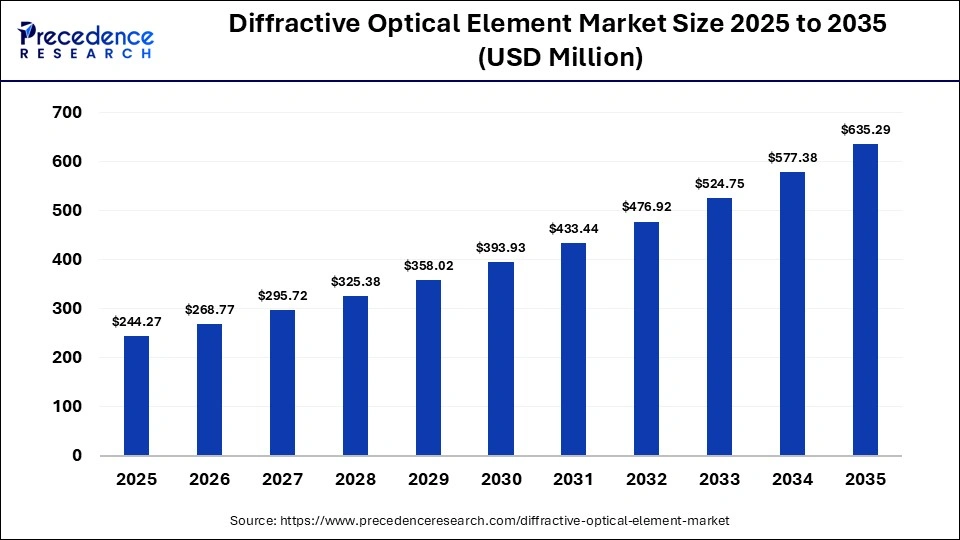
The global diffractive optical element market size was calculated at USD 244.27 million in 2025 and is predicted to increase from USD 268.77 million in 2026 to approximately USD 635.29 million by 2035, expanding at a CAGR of 10.03% from 2026 to 2035. The diffractive optical element market is driven by rising demand for compact and advanced optical systems.
Key Takeaways
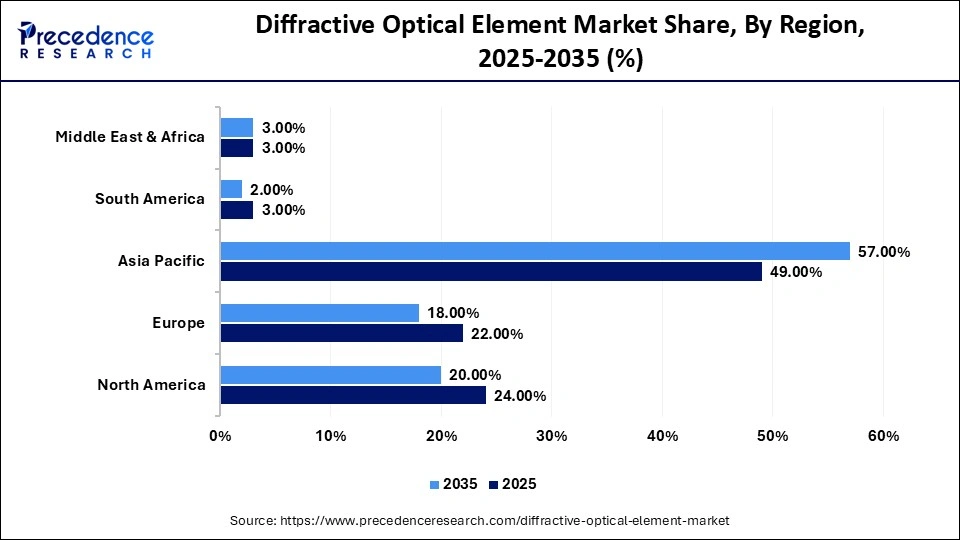
- Asia Pacific dominated the diffractive optical element market with a share of 48.70% in 2025.
- North America is expected to grow at the fastest CAGR in the market during the forecast period.
- By DOE type, the beam shapers segment held a dominant position in the market, holding a share of 26.70% in 2025.
- By DOE type, the pattern generators segment is expected to grow at the fastest CAGR of 11.20% in the market between 2026 and 2035.
- By manufacturing technology, the photolithography segment accounted for a major revenue share of 32.60% in the market in 2025.
- By manufacturing technology, the nanoimprint lithography segment is expected to grow at the highest CAGR of 13.20% in the market during the studied years.
- By substrate material, the fused silica segment led the global market with a share of 34.80% in 2025.
- By substrate material, the polymer segment is expected to expand rapidly in the market with a CAGR of 12.30% in the coming years.
- By application, the laser material processing segment registered its dominance in the global market with a share of 28.60% in 2025.
- By application, the 3D sensing and LiDAR segment is expected to grow at a CAGR of 12.80% over the forecast period.
- By end-use industry, the industrial manufacturing segment dominated the global market with a share of 30.70% in 2025.
- By end-use industry, the automotive segment is expected to grow at the highest CAGR of 13.10% between 2026 and 2035.
Market Overview
The diffractive optical element market deals with engineered microstructured optical elements that control the phase of the transmitted light and allow optical beams to be shaped, split, diffused, or patterned in a suitable manner. Products include beam shapers, beam splitters, homogenizers, pattern generators, and diffractive gratings fabricated using lithography, nanoimprint, direct-write, or holographic methods on silica, glass, polymers, or silicon. The market has been witnessing significant growth, owing to the increased application of lasers and optical systems in various industries. The telecommunications industry is increasingly using DOEs to manage light in fiber-optic networks effectively, and the industrial laser industry is using them to create and cut beams with the right thickness, welding, and marking.
Diffractive Optical Element Market Trends
- The rising demand for compact, lightweight optical elements in AR/VR, wearables, and mobile imaging is driving the adoption of diffractive optical elements (DOEs), which can precisely radiate and deflect beams at small scales.
- The adoption of DOEs is rising in LiDAR, depth sensing, and gesture recognition technologies, enabling precise light distribution for autonomous vehicles, robotics, and smart devices, boosting their use in sensing and AR/VR applications.
- Medical diagnostics, imaging, and surgical lasers are increasingly incorporating DOEs to enhance the level of resolution, precision, and efficiency of treatment, which contributes to the demand in hospitals, clinics, and research centers all across the globe.
- The expansion of fiber-optic networks and high-speed data transmission relies on DOEs for beam fractionation, diffraction, and wavelength management, supporting improved network performance and scalability.
- Increasing use of DOEs with AI-enabled optical systems, adaptive optics, and photonic devices is enhancing precision, enabling novel applications in defense, aerospace, and industrial automation.
How is AI Impacting the Diffractive Optical Element Market?
Artificial Intelligence (AI) is significantly impacting the diffractive optical element market by enhancing the precision, functionality, and application scope of these optical components. AI algorithms optimize light control, beam shaping, and diffraction patterns, enabling more accurate image processing, pattern recognition, and data analysis in imaging and sensing systems. In telecommunications, AI-driven DOEs improve network signal routing, wavelength management, and beam alignment for faster, more reliable data transmission. In consumer electronics and AR/VR, AI integration allows compact, high-precision optical systems, driving innovation in cameras, 3D sensing, and immersive devices.
Market Scope
| Report Coverage | Details |
| Market Size in 2025 | USD 244.27 Million |
| Market Size in 2026 | USD 268.77 Million |
| Market Size by 2035 | USD 635.29 Million |
| Market Growth Rate from 2026 to 2035 | CAGR of 10.03% |
| Dominating Region | Asia Pacific |
| Fastest Growing Region | North America |
| Base Year | 2025 |
| Forecast Period | 2026 to 2035 |
| Segments Covered | DOE Type, Manufacturing Technology, Substrate Material, Application, End-use Industry, and region |
| Regions Covered | North America, Europe, Asia-Pacific, Latin America, and Middle East & Africa |
Market Dynamics
Driver
Popularity of AR and VR glasses
The popularity of AR and VR glasses has grown significantly as hardware components have become cheaper, smaller, and extremely powerful in recent times. The improvement in displays, superior battery life, and integration with AI make them suitable for a wide range of end-users. These glasses find application in various sectors, including fitness, entertainment, and professional work.
- In May 2026, XREAL launched a new series of AR glasses. These glasses are based on Google's Android XR operating system and allow users to view immersive 180 and 360-degree YouTube videos. (Source: https://www.roadtovr.com)
Restraint
Complex Manufacturing Process and Wavelength Sensitivity
The diffractive optical element market is restrained by several factors. The production methodology of diffractive elements is highly complex due to the limitations in photolithography and high manufacturing costs, which in turn hampers the industry. Additionally, DOEs can operate within a limited wavelength, which limits their adoption among end-users, thereby restraining the market growth.
Opportunity
Meta-surfaces are sub-wavelength structures that help in controlling light phase, polarization, and amplitude simultaneously.  Also, the flat optics are widely adopted by the end-users as they are significantly thinner and lighter elements compared to traditional micro-optics, which makes them suitable for use in wearable technologies and medical devices. Thus, the growing developments in flat optics and meta-surfaces will create opportunities for investors in the future.
Segment Analysis
DOE Type Insights
Why Did the Beam Shapers Segment Dominate the Diffractive Optical Element Market?
The beam shapers segment holds a dominant position in the market with a 26.70% share in 2025. This is because of their ability to manipulate the laser beams to the required intensity profiles without making them weak, which is a very crucial factor in precision applications. The manufacturing, defense, medical, and semiconductor processing industries are among those that use beam shapers extensively in the laser cutting, welding, and micromachining of materials. Advances in material and microfabrication technologies have also increased the performance, durability, and scalability of beam shapers. The dominance of the segment is also reinforced due to the increased demand for customized optical solutions in medical imaging, lithography, and optical instrumentation.
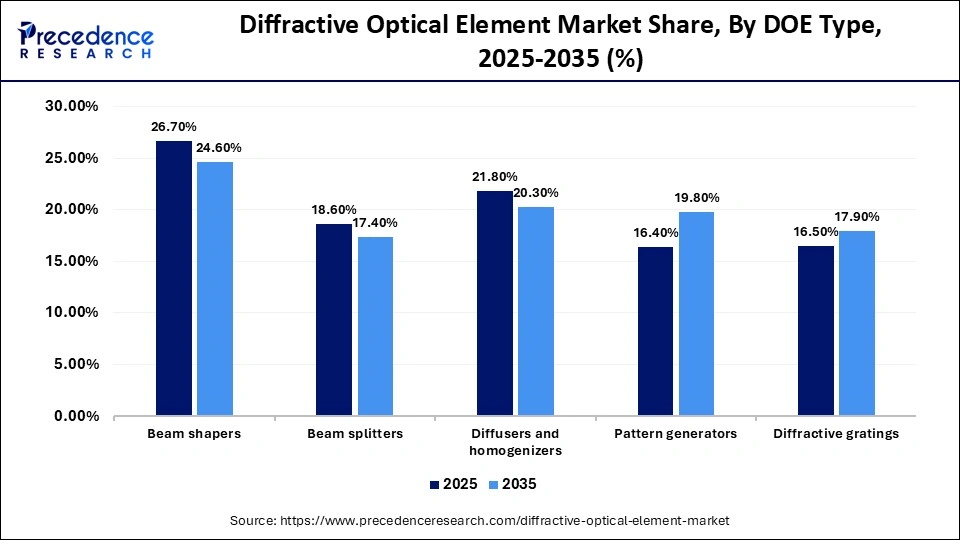
The pattern generators segment is expected to grow at the fastest CAGR of 11.20% in the market between 2026 and 2035. This is because pattern generators enable the manufacturing of sophisticated light patterns in optical trapping, holography, laser projection, and other high-imaging systems. Rising applications of DOEs in biomedical research, AR, and photonics-based data storage, where precise light control is essential, are fueling demand. Additionally, the trend toward miniaturized and portable laser systems for research and industrial use is further boosting the segment's growth.
Manufacturing Technology Insights
What Made Photolithography the Dominant Segment in the Diffractive Optical Element Market?
The photolithography segment dominated the global market with a major share of 32.60% in 2025, driven by the fact that photolithography has always been a well-known method in the microfabrication process of high-precision imaging. Photolithography is used to form very complex, accurate optical patterns essential for semiconductors, optical communication, and precision instrumentation. Strong industry infrastructure and expertise support large-scale production, allowing efficient manufacturing of uniform, high-volume DOEs. Additionally, its reliability and proven performance in advanced optical applications have made it the preferred fabrication method over newer techniques.
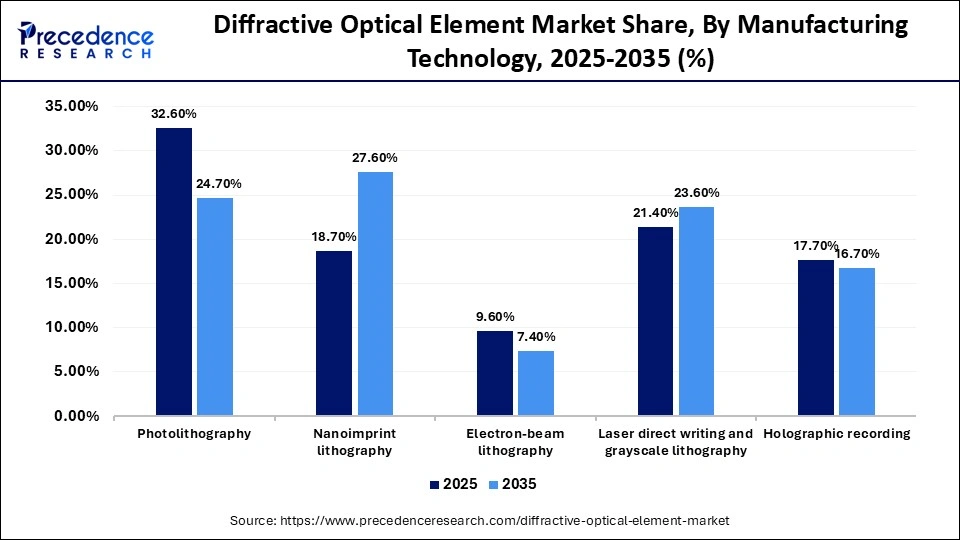
The nanoimprint lithography (NIL) segment is expected to grow at the highest CAGR of 13.20% between 2026 and 2035. This is because of its ability to produce highly precise nanoscale patterns at lower costs than traditional photolithography. NIL efficiently replicates complex micro- and nanostructures with minimal material waste, making it ideal for optical sensors, diffractive gratings, and advanced photonic devices. Its adoption is rising in commercial electronics, augmented reality, and biomedical optics, where miniaturization and high-resolution patterning are critical.
Substrate Material Insights
Why Did the Fused Silica Segment Lead the Diffractive Optical Element Market?
The fused silica segment registered its dominance in the global diffractive optical element market, accounting for a 34.80% share in 2025. This is due to its outstanding optical characteristics, such as high transparency of the material in the UV to IR wavelengths, low thermal expansion, and high chemical stability. These properties make it suitable for precision optics of laser systems, microscopy, lithography, and high-power industrial applications. Additionally, its robustness in harsh or abusive environments ensures a long operational life, minimizing the need for maintenance or replacement of critical optical components. Leading manufacturers continue to employ fused silica in applications that demand high accuracy, minimal optical distortion, and excellent thermal shock resistance, further emphasizing its market dominance and preference in high-performance optical systems.
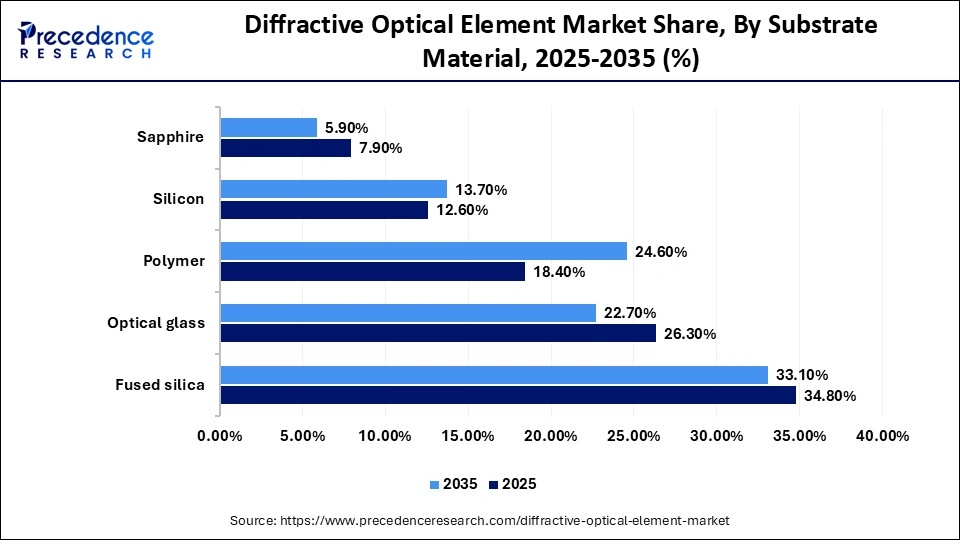
The polymer segment is expected to expand at a CAGR of 12.30% over the forecast period. This is because polymers are inexpensive, lightweight, and flexible, and can be produced in large volumes, making them widely applicable in consumer electronics, display technologies, and wearable optical devices. They are particularly compatible with high-throughput fabrication of complex diffractive patterns, as they work well with rapid replication techniques such as nanoimprint lithography, which significantly reduces production time and costs. As industries increasingly seek cost-effective and scalable optical solutions, polymer-based DOEs are gaining popularity due to their efficiency, versatility, and adaptability in mass production environments.
Application Insights
Why Did the Laser Material Processing Segment Lead the Diffractive Optical Element Market?
The laser material processing segment led the global market with a share of 28.60% in 2025, driven by the ability of DOEs to shape, divide, and homogenize laser beams, resulting in uniform energy distribution crucial for cutting, welding, marking, and microfabrication applications. The growing adoption of laser systems in industries such as electronics, semiconductors, aerospace, and medical devices, where precision and high-speed processing are essential, further supports this dominance. DOE designs have evolved to include multi-order diffraction and high-damage-threshold optics, enabling complex beam shaping without energy loss. Consequently, industrial users are leveraging DOEs to increase productivity, reduce material waste, and enhance product quality, making them an indispensable tool in advanced manufacturing processes.
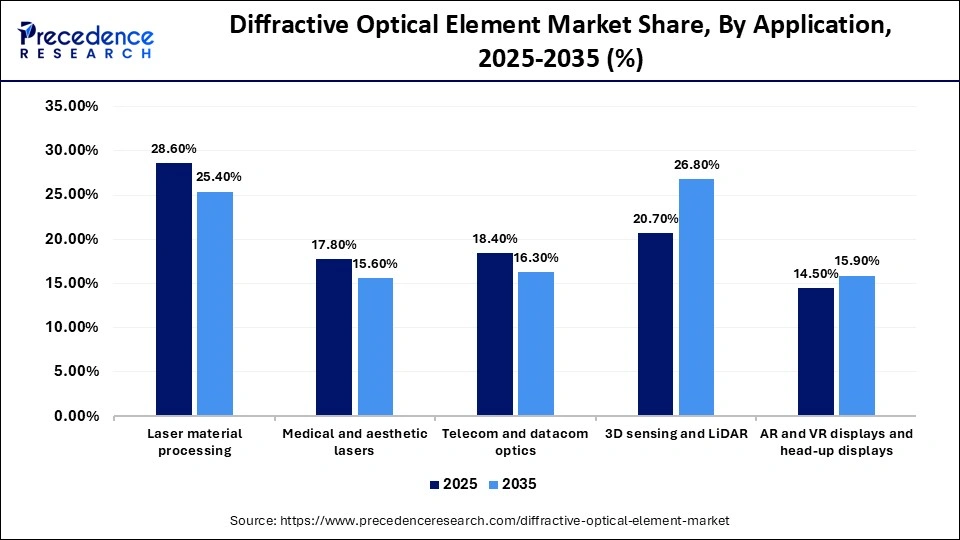
The 3D sensing and LiDAR segment is expected to expand at the highest CAGR of 12.80% in the coming years, driven by the growing adoption of autonomous vehicles, robotics, and AR/VR applications. DOEs play a crucial role by precisely shaping and bending laser beams, enhancing depth mapping, object detection, and scanning accuracy. The increasing demand for real-time 3D sensing in the automotive, industrial, and consumer electronics sectors further fuels market growth. Additionally, rising investments in smart transportation, automation, and interactive devices are pushing manufacturers to adopt high-resolution optical systems, solidifying the segment's rapid expansion.
End-use Industry Insights
Why Did the Industrial Manufacturing Segment Lead the Diffractive Optical Element Market?
The industrial manufacturing segment held a major revenue share of 30.70% in the market in 2025, driven by the growing demand for precision and efficiency in manufacturing processes. This growth is fueled by the ability of DOEs to maintain uniform energy distribution in laser-based manufacturing applications, including cutting, welding, marking, and microfabrication. The rise of industrial automation further supports the segment, as DOEs enable repeatable operations with high throughput and reduced defects. Sectors such as electronics, aerospace, automotive, semiconductors, and medical devices, which require high-precision optical elements, rely on DOEs to ensure product quality and optimize operational efficiency.
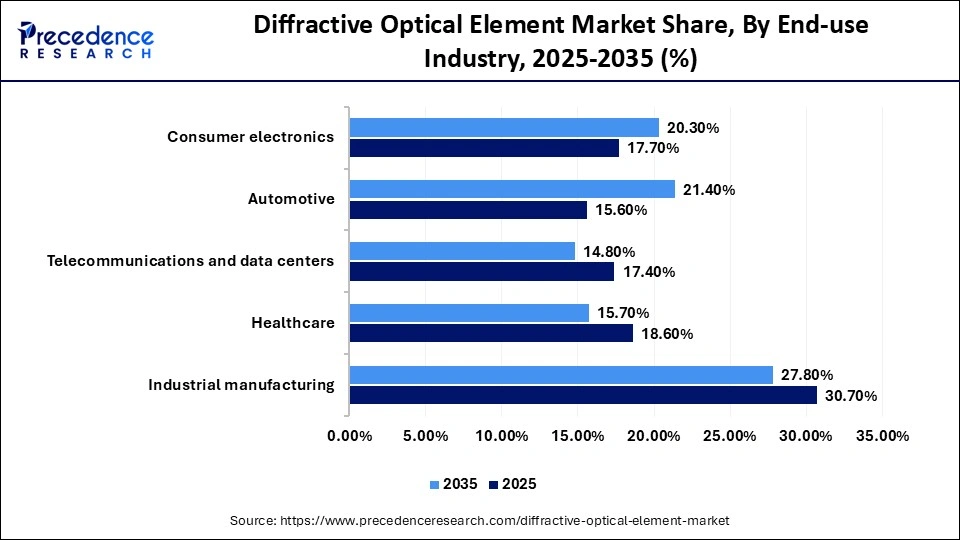
The automotive segment is expected to grow at the fastest CAGR of 13.10% over the forecast period, due to the increased use of sophisticated driver-assistance systems, LiDAR-based autonomous navigation, adaptive headlights, and head-up displays. DOEs have the capability of accurately directing and subdividing laser beams that enhance precision in detection, safety, and illumination. There is also a growing demand being generated by the rising production of autonomous and electric vehicles. Also, continued investments in smart mobility and next-generation lighting technology demand solid and high-resolution optical components.
Regional Insights
What is the Asia Pacific Diffractive Optical Element Market Size?
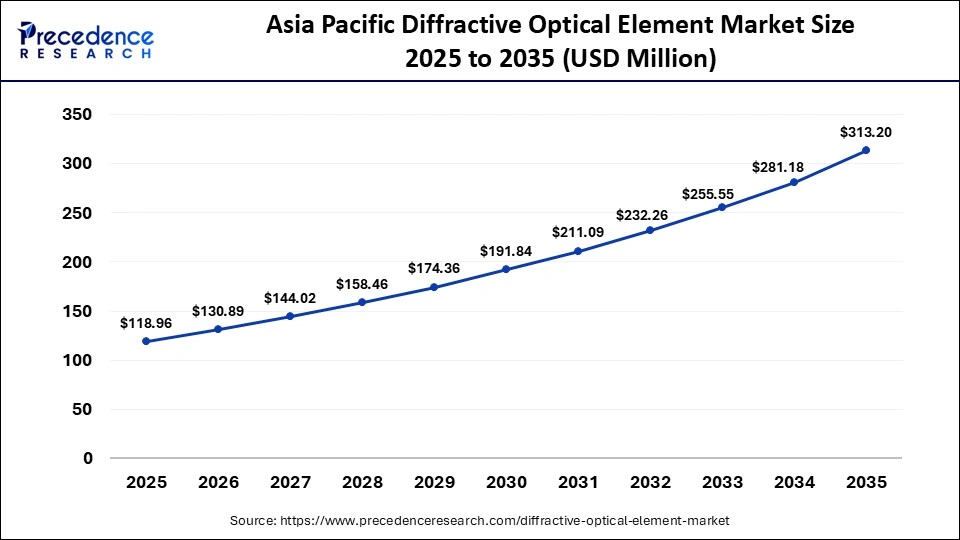
The Asia Pacific diffractive optical element market size is estimated at USD 118.96 million in 2025 and is projected to reach approximately USD 313.20 million by 2035, with a 10.16% CAGR from 2026 to 2035.
Why Did Asia Pacific Lead the Global Diffractive Optical Element Market?
Asia Pacific dominated the diffractive optical element market with a major share of 48.70% in 2025. This is mainly due to the increased need for high-precision optical components in semiconductor, automotive, aerospace, and medical equipment sectors. The region benefits from strong industrial adoption, advanced electronics production, and a large concentration of DOE manufacturers in China, Japan, and South Korea. Government initiatives supporting smart manufacturing, photonics research, and industrial automation further accelerate market growth. With economies of scale, high-volume production capabilities, and rapid innovation, Asia Pacific has become the hub for DOE production and deployment.
Why is North America Experiencing the Fastest Growth in the Diffractive Optical Element Market?
North America is expected to grow at the fastest CAGR in the market during the forecast period, owing to the rising usage of DOEs in high-tech applications. DOEs are increasingly integrated into laser systems, optical sensors, telecommunications, and imaging, enabling precise control of light. The region's growth is supported by large technology clusters, substantial R&D investments, and advanced manufacturing capabilities. Furthermore, the defense and aerospace sectors actively leverage diffractive optics for laser targeting, simulation, and optical communication, while government funding and collaborations among universities, research centers, and industry players further propel market expansion.
What are the Advancements in the Diffractive Optical Element Market in Europe?
Europe is expected to witness significant growth in the market. This growth and development are driven by various factors such as advancements in photonics technology, increasing applications in telecommunications, and the surging demand for innovative lighting solutions. Enhanced efficiency and precision in optical components are pushing industries like telecommunications and consumer electronics to adopt DOE, thus fostering market growth. Countries such as Germany, France, and the UK are leading players.
Germany Market Trends
The region is witnessing a growing emphasis on renewable energy technologies, which offer potential for DOEs in solar concentrators and other innovative light management solutions, thus broadening the scope for manufacturers in this dynamic sector.
What are the Key Trends in the Diffractive Optical Element Market in Latin America?
Latin America is expected to witness significant market growth in the upcoming years, driven by a rise in semiconductor manufacturing and a boost in electronics production. The region also benefits from large-scale manufacturing infrastructure and cost-efficient fabrication. Growing adoption of LiDAR in robotics and automation also supports market expansion. Countries like Brazil and Argentina are leading players.
Brazil Market Trends
The country is witnessing increased investments in advanced manufacturing technologies. Optical sensing applications in industrial automation are also expanding steadily. Rapid industrialization is also boosting demand for precision optics.
How is the Middle East and Africa Region Growing in the Diffractive Optical Element Market?
The Middle East and Africa are expected to witness a significant amount of growth throughout the forecast period. Defense modernization programs drive demand for advanced optical components. Research institutions and government-backed projects are gaining traction, helping to support photonics development. Laser-based systems are also being increasingly used in industrial and security applications. Countries such as Saudi Arabia, the UAE, and South Africa are leading players.
Saudi Arabia Market Trends
The country is witnessing a growing interest in advanced manufacturing, which supports future growth. Academic collaborations and various partnerships are also helping in enhancing the country's technical capabilities.
Value Chain Analysis - Diffractive Optical Element Market
- Raw Material Procurement: The sourcing of high-quality silicon wafers, specialty glasses, and gases is done to ensure accuracy in the performance of DOE.
Key Players: Jenoptik, SILIOS Technologies, Thorlabs, Edmund Optics - Wafer Fabrication: Wafers are effortlessly fabricated, whereby the fabricated parts provide the base upon which the diffractive optical elements are built.
Key Players: SUSS MicroOptics, Teledyne e2v, HOLO OR, Jenoptik - Photolithography and Etching: Photolithography involves developing more advanced lithography and etching to create microstructured patterns on wafers to be used in optical functionality.
Key Players: HOLOEYE Photonics, Wasatch Photonics, Luminit, HOLO OR
Diffractive Optical Element Market Companies
- HOLO OR
- Edmund Optics
- Luminit
- HOLOEYE Photonics
- PowerPhotonic
- SILIOS Technologies
- Wasatch Photonics
- Jenoptik
- SUSS MicroOptics
- Thorlabs
- Laser Components
- Plymouth Grating Laboratory
- Ibsen Photonics
- Teledyne e2v
- ZEISS
Recent Developments
- In February 2026, Milliken launched a new range of polymers. These polymers are designed to provide faster cycle times, crisper aesthetics, and improved optical clarity.
- (Source: https://www.indianchemicalnews.com)
- In February 2026, Citizen launched a new series of smart watches. These smart watches are manufactured using sapphire glass to enhance visibility.
- (Source: https://www.notebookcheck.net)
- In January 2026, Vuzix Corporation collaborated with Himax. This collaboration was done to develop an optical glass for enhancing AR capabilities. (Source: https://www.prnewswire.com)
- In January 2025, Coherent Corp introduced its Ultrabroadband UV-VIS and VIS-NIR diffraction gratings, which improve the work of optical systems in life science, medical, and industrial fields. These high-precision gratings enhance spectral resolution, ease the system design, and also accommodate wide wavelengths in flow cytometry, Raman spectroscopy, OCT, and stabilizing laser diodes. (Source: https://www.coherent.com)In Janua
- ry 2025, Radiant Opto-Electronics Corporation acquired NIL Technology, combining NILT's high-technology optics with the NILT expertise and the large-scale manufacturing capabilities of ROE. The activity is part of acquiring to speed up high-volume manufacturing of next-generation optical solutions for different industries. (source: https://www.radiant.com.tw)
- In March 2024, Broadcom announced a series of optical interconnect products based on AI and machine learning to support high-speed connections in large-scale clusters of AI computers. This growth builds technology and volume leadership in the high-performance data center networking of Broadcom. (Source: https://investors.broadcom.com)
Segments Covered in the Market
By DOE Type
- Beam shapers
- Beam splitters
- Diffusers and homogenizers
- Pattern generators
- Diffractive gratings
By Manufacturing Technology
- Photolithography
- Nanoimprint lithography
- Electron-beam lithography
- Laser direct writing and grayscale lithography
- Holographic recording
By Substrate Material
- Fused silica
- Optical glass
- Polymer
- Silicon
- Sapphire
By Application
- Laser material processing
- Medical and aesthetic lasers
- Telecom and datacom optics
- 3D sensing and LiDAR
- AR and VR displays and head-up displays
By End-use Industry
- Industrial manufacturing
- Healthcare
- Telecommunications and data centers
- Automotive
- Consumer electronics
By Region
- North America
- Latin America
- Europe
- Asia-pacific
- Middle and East Africa
For inquiries regarding discounts, bulk purchases, or customization requests, please contact us at sales@precedenceresearch.com
Frequently Asked Questions





Ask For Sample
No cookie-cutter, only authentic analysis – take the 1st step to become a Precedence Research client
 Get a Sample
.webp)



 sales@precedenceresearch.com
 Schedule a Meeting
