



Automated Microscopy Market Size, Share and Trends 2026 to 2035
Automated Microscopy Market (By Product Type: Optical Microscope, Electron Microscope, Scanning Probe Microscope; By Application: Medical Diagnosis, Life Science Research, Drug Discovery and Pharmaceutical; By End-user: Diagnostic Laboratories, Research Facilities, Pharmaceutical Industry) - Global Industry Analysis, Size, Trends, Leading Companies, Regional Outlook, and Forecast 2026 to 2035
Source: https://www.precedenceresearch.com/automated-microscopy-market
 Get a Sample
 Table Of Content
What is the Automated Microscopy Market Size?
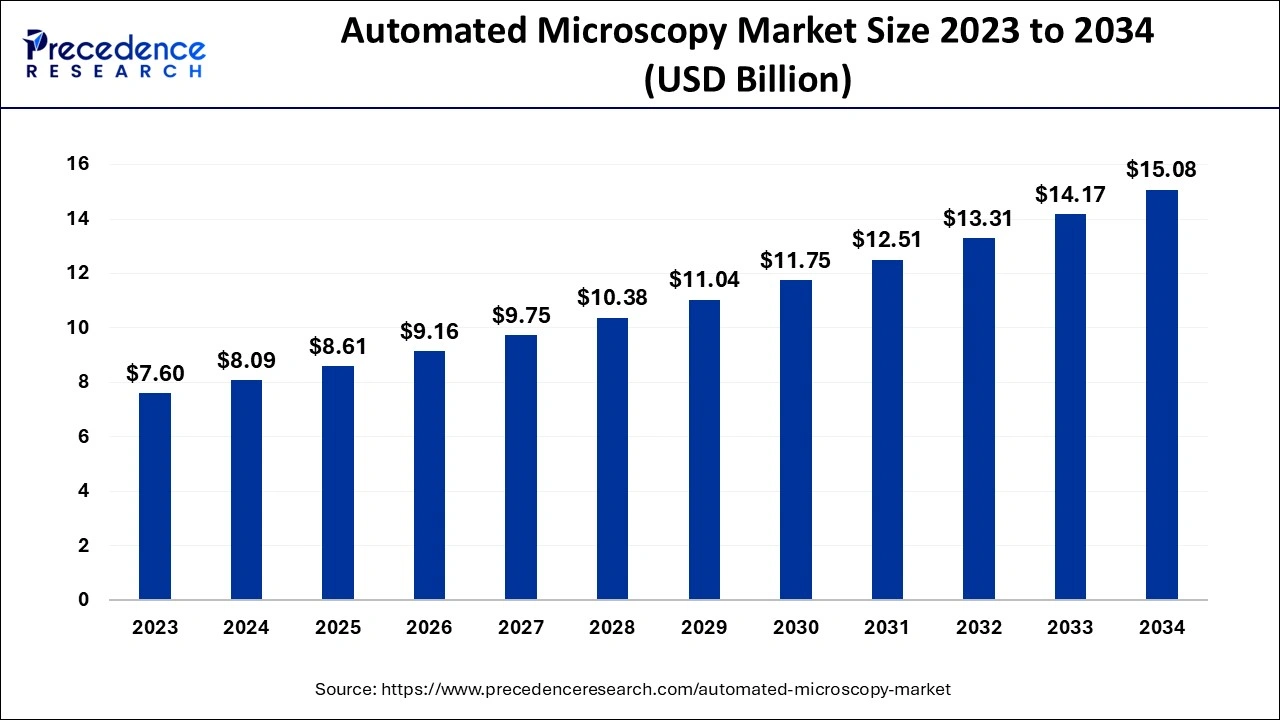
The global automated microscopy market size is calculated at USD 8.61 billion in 2025 and is predicted to increase from USD 9.16 billion in 2026 to approximately USD 15.99 billion by 2035, expanding at a CAGR of 6.39% from 2026 to 2035. The automated microscopy market is driven by the growing need in the healthcare industry for precise and effective diagnostics.
Automated Microscopy Market Key Takeaways
- North America dominated automated microscopy market in 2025.
- Asia Pacific is observed to be the fastest growing in market during the forecast period.
- By product type, the optical microscope segment contributed the highest market share in 2025.
- By product type, the electron microscope segment is anticipated to grow at the fastest CAGR during the forecast period.
- By application, the drug discovery and pharmaceutical segment contributed the highest market share in 2025.
- By application, the medical diagnosis segment is anticipated to grow at the fastest CAGR during the forecast period.
- By end-user, the pharmaceutical industry segment captured the biggest market share in 2025.
- By end-user, the research facilities segment shows notable growth during the forecast period.
Integration of Artificial Intelligence in Automated Microscopy
Artificial intelligence (AI) algorithms can detect cellular structures, abnormalities, and specific biological markers more precisely. This is important for identifying minute patterns in intricate samples that are difficult to see with the naked eye. AI makes it possible for workflows to be completely automated, requiring little human involvement in sample analysis, processing, and reporting. This is very helpful for large-scale investigations where speed and consistency are essential. Enabling super-resolution techniques that overcome the diffraction limit of light can produce more accurate photographs that would otherwise require sophisticated, costly equipment.
What is Automated Microscopy?
By enabling high-throughput imaging with little operator intervention, automated microscopy greatly has raised the accuracy and efficiency of research. This is especially crucial in domains where accuracy and timeliness are essential, such as drug discovery. High-resolution photographs are reliably produced by automated imaging equipment, which lowers the possibility of human error in repetitive activities. Unlike classical microscopy, automated systems can incorporate image analysis software that evaluates images quantitatively. This makes it possible to assess cell count, intensity, shape, and other properties objectively, all of which are essential for studying cancer, cell biology, and neurology. The reproducibility and validation of scientific discoveries depend on quantitative data.
- In October 2024, Zomedica Corp. declared the release of the Ear Cytology Quick Scan protocol, a latest feature of the TRUVIEW microscope equipped with the TRUprep automated slide preparation system. This innovative feature streamlines the slide preparation and scanning of ear cytology cases, helping veterinary professionals to diagnose and treat companion animals faster and more efficiently.
Automated Microscopy Market Growth Factors
- The need for automated systems is driven by advancements in high-resolution cameras and advanced microscopy methods such as confocal, multiphoton, and super-resolution microscopy.
- The explosion in life science research, especially in fields like cellular biology, drug development, and diagnostics, is fueling the use of automated microscopy for precise and practical analysis.
- Automated microscopy systems are becoming increasingly popular in clinical and research settings because of the need for quick, high-throughput examination of huge sample quantities.
Market Outlook
- Industry Growth Overview: There is a broad increase in demand for faster and more accurate analysis. AI as a partner in integrated automated microscopy workflows changes the whole scenario.
- Sustainability Trends: The companies producing such instruments are all looking at the efficient operation as well as being eco-friendly. The way they design their products already speaks of the three aspects being recyclability, modular upgrading, and longevity.
- Global Expansion: North America is the main market, as it can adopt the new technology integration on a high level. Asia Pacific is the market where the volume of adoption would be the highest during the next years since it would have the capacity to drive the region.
- Major Investors: The investors consist of Bruker Corporation, Carl Zeiss AG. Nikon Corporation, Olympus Corporation, and Thermo-Fisher Scientific Inc. also fall in the list of investors.
Market Scope
| Report Coverage | Details |
| Market Size by 2035 | USD 15.99 Billion |
| Market Size in 2025 | USD 8.61 Billion |
| Market Size in 2026 | USD 9.16 Billion |
| Market Growth Rate from 2026 to 2035 | CAGR of 6.39% |
| Largest Market | North America |
| Base Year | 2025 |
| Forecast Period | 2026 to 2035 |
| Segments Covered | Product Type, Application, End-user, and Regions |
| Regions Covered | North America, Europe, Asia-Pacific, Latin America, and Middle East & Africa |
Market Dynamics
Drivers
Increased demand for high-throughput screening
Rapid picture acquisition and processing are made possible by automated microscopy techniques, essential for screening enormous compound libraries. The throughput of drug discovery procedures is increased when thousands of samples can be processed and analyzed quickly. It is utilized in cancer research to evaluate tumor cell responses, and screen for possible therapeutic chemicals.
Growing investments in life sciences research
Governments and private groups are raising funding for life sciences research to address urgent global health challenges such as infectious diseases, cancer, and genetic disorders. This funding infusion makes the acquisition of cutting-edge microscopy equipment that improves research capacity possible. Researchers seek systems that combine different imaging modalities (such as electron microscopy). These multi-modal systems improve research results by enabling thorough examinations of biological samples.
Restraint
High initial costs
The initial expenses of automated microscopy systems are frequently substantial and include the cost of the microscope and any associated technologies (such as cameras). These expenses are further raised by advanced features, including digital analytic capabilities, automated sample processing, and high-resolution photography. The cost of purchasing such equipment can be prohibitive for many labs and institutions, significantly smaller or underfunded ones. Due to the high upfront expenditures, the industry may become segmented, with smaller labs being left behind as only well-funded organizations, such as universities, pharmaceutical corporations, and large research hospitals, invest in automated microscopy. Because the technology is restricted to a few customers, this segmentation may impede innovation and adoption in the larger market.
Opportunity
Advancements in imaging techniques
With resolutions that go beyond conventional optical bounds, new imaging methods like super-resolution microscopy allow scientists to see structures at the molecular level. This skill enables a more thorough examination of biological materials and specimens, leading to advances in diagnoses and research. The sophisticated software that uses artificial intelligence and machine learning algorithms frequently goes hand in hand with advanced imaging techniques. These tools make it simpler for researchers to understand complex data sets by facilitating real-time data analysis, pattern detection, and quantification.
Product Type Insights
The optical microscope segment dominated the automated microscopy market in 2025. Digital imaging and automation elements formerly reserved for more costly and sophisticated microscopy techniques, including electron microscopy, are now included in modern optical microscopes. These improvements boost workflow consistency and efficiency by enabling researchers to automatically take high-resolution photos. It requires less specialized technical knowledge and is easier to maintain, lowering institutions' long-term expenses. Research and educational institutions find this appealing, particularly smaller labs and emerging markets.
The electron microscope segment is observed to be the fastest growing in the automated microscopy market during the forecast period. For study in materials science, nanotechnology, and the biological sciences, electron microscopes, such as transmission electron microscopes (TEM) and scanning electron microscopes (SEM), are essential because they produce incredibly detailed images at the atomic and molecular levels. High-precision molecular and cellular process observation is made possible by electron microscopy in biotechnology, which supports studies on medication delivery, disease causes, and genetic engineering. This demand is mainly driven by advancements in tissue engineering and nanomedicine.
Application Insights
The drug discovery and pharmaceutical segment dominated the automated microscopy market in 2023. To identify viable therapeutic options, drug discovery procedures must test hundreds of molecules. For high-throughput screening, automated microscopy has become crucial because it enables researchers to quickly examine and see vast quantities of cells, tissues, or substances. This feature reduces the time and resources required for drug discovery by speeding up the identification of active molecules. Automated microscopy streamlines several processes, such as lead identification, hit-to-lead optimization, and validation tests, which helps lower the expenses related to the drawn-out drug development cycle. Faster imaging and analysis aid innovative pharmaceuticals reach the market sooner, which is crucial in a highly regulated and competitive business.
The medical diagnosis segment is observed to be the fastest growing in the automated microscopy market during the forecast period. A key component of precision medicine is early, precise diagnosis, which attempts to customize care to each patient's unique profile. For the development of tailored medicines in oncology, genetics, and infectious disease management, automated microscopy makes it possible to identify biomarkers and molecular alterations. To enable the precise profile of patient conditions and improve results by matching medicines to specific disease pathways, hospitals, research labs, and biotech businesses make significant investments in automated microscopy systems.
End-user Insights
The pharmaceutical industry segment dominated the automated microscopy market in 2025. The process of finding new drugs is time-consuming and intricate, including the examination of several biological processes and cellular interactions. Due to automated microscopy, pharmaceutical businesses can perform these analyses with speed and accuracy. These systems may screen large compound libraries, and they can quantitatively analyze cellular responses, speeding up the drug development process and increasing the results' accuracy.
Repetitive imaging activities can be handled by automated microscopy systems with little assistance from humans. By lowering labor requirements and minimizing human mistakes, this automation significantly reduces costs in the pharmaceutical sector. Its high throughput and quick turnaround time boost output and make it an affordable option for drug development pipelines.
The research facilities segment shows a notable growth in the automated microscopy market during the forecast period. Extensive imaging is frequently used in cell and molecular biology research to track cellular responses, interactions, and structure-function correlations. In high-content screening (HCS), which screens enormous libraries of chemicals for possible biological effects, automated microscopy is especially useful. Automated systems are a great option for research centers performing high-content analysis because they lower the possibility of human mistakes in these intricate procedures and increase the precision of cellular experiments.
Regional Insights
North America dominated automated microscopy market in 2025. Researchers and physicians may now perform complex studies more quickly because of advancements in high-resolution imaging and automation tools. Microscopy automation has improved throughput, decreased human error, and enabled large-scale data collection, all critical in industries like biotechnology and pharmaceuticals. A competitive atmosphere is produced by the presence of both big and up-and-coming companies, which encourages quick innovation and supports North America's market supremacy. Substantial intellectual property (IP) protections also help these businesses, enabling them to make significant technological investments without worrying about losing their competitive advantage.
- In January 2023, Bruker Corporation declared the acquisition of ACQUIFER Imaging GmbH, a pioneer in big-data management solutions for bioimaging and high-content microscopy. This acquisition has enhanced high-performance on-premises processing, secure storage, and networking technology that will complements Bruker's advanced fluorescence microscopy imaging products, such as light-sheet and super-resolution microscopy products, which offer high information content.
U.S. Automated Microscopy Market Trends:
The U.S. is the leader in the use of AI in microscopy. The field of pathology and diagnostics is one where image analysis can offer rapid information and make a significant contribution. The research funding is so intense that the expedited which the development of correct automated microscopy platforms is expedited. The trend of personalized medicine has contributed to the convergence of digital pathology and clinical processes.
Asia-Pacific is observed to be the fastest growing in the automated microscopy market during the forecast period. For diagnostic applications like pathology and cytology, where high-throughput imaging systems can increase precision and efficiency in identifying disease indicators, automated microscopy is essential. South Korea and Japan oversee integrating AI-driven automated microscopy systems into clinical and research applications, two countries renowned for their proficiency in electronics and AI technologies. The requirement for automated microscopy systems is also rising in these areas due to expanding healthcare facilities, particularly in hospitals and diagnostic labs.
- In August 2024, SigTuple, a Bengaluru-based medtech startup, secured $4 million. Existing investors, including Endiya Partners and strategic leaders from the healthcare field, also participated in the funding. It has been making crucial strides in the digital pathology space.
What Are the Driving Factors of The Automated Microscopy Market in Europe?
Europe is expected to grow at a notable rate during the forecast period. Europe is at the intersection between innovation and regulation of the automated microscopy research ecosystem. Through the cooperation of research networks, academic research labs are permitted to adopt the technology responsibly. AI is also contributing to Imaging workflows as well as the privacy of data management expectations. The expansion of the market can be said to indicate the cautious integration of the systems into the healthcare settings.
Germany Automated Microscopy Market Trends:
Germany is maintaining precision engineering and automated microscopy as the main tools for the research industries. Optics leadership provides systems for academic laboratories and quality control that are always in line with the latest technology. Innovation is made possible through conformance with data protection and diagnostic regulations at the same time. Hardware & software integration has increased reproducibility in neuroscience and immunology research.
China Automated Microscopy Market Trends:
China is investing in the expansion of its scientific infrastructure with the help of the government. The growing healthcare sector has been a reason for the adoption of microscopy in hospitals and centers. High throughput imaging is said to be the solution provided to the diagnosis of the volume of patients coming and the requirement for efficiency. The local manufacturers are putting their attention on cost-effective systems while at the same time bringing in the smart features.
Value Chain Analysis
- R&D: The identification and development of improved drugs and therapies that are more innovative than the existing ones.
Key Players: Pfizer, Roche) - Clinical Trials and Regulatory Approvals: Human research studies to obtain data regarding safety and efficacy, and regulatory approvals.
Key players: IQVIA, Syneos Health, FDA, EMA - Formulation and Final Dosage Preparation: The active components, along with other components, are mixed and prepared into a form that is appropriate to the patient.
Key Players: Catalent, Lonza) - Packaging and Serialization: Packaging of the product with an identifying number that can be traced so that counterfeit products cannot be made.
Key players: Optel Group, Antares Vision - Automated Microscopy Delivery to Hospitals and Pharmacies: Delivery of the completed pharmaceutical products to the hospitals and pharmacies via the existing supply channels.
Key Players: McKesson, Cardinal Health)
Key Players' Offering
- Horiba Scientific: Offers analytical instruments that are crucial for microscopy research, including AFM techniques. These systems cater to the needs of materials science, life science, and interdisciplinary laboratory applications.
- Bruker Corporation: Presents cutting-edge research instruments that combine microscopy with spatial biology workflows. The portfolio not only provides high-end analytical platform ecosystems but also supports the studies of molecular materials.
- Hitachi High-Technologies: Produces top-quality electron and probe microscopes suitable for research purposes. The product line includes scanning, transmission, and atomic force techniques, all of which allow imaging.
Automated Microscopy Market Companies
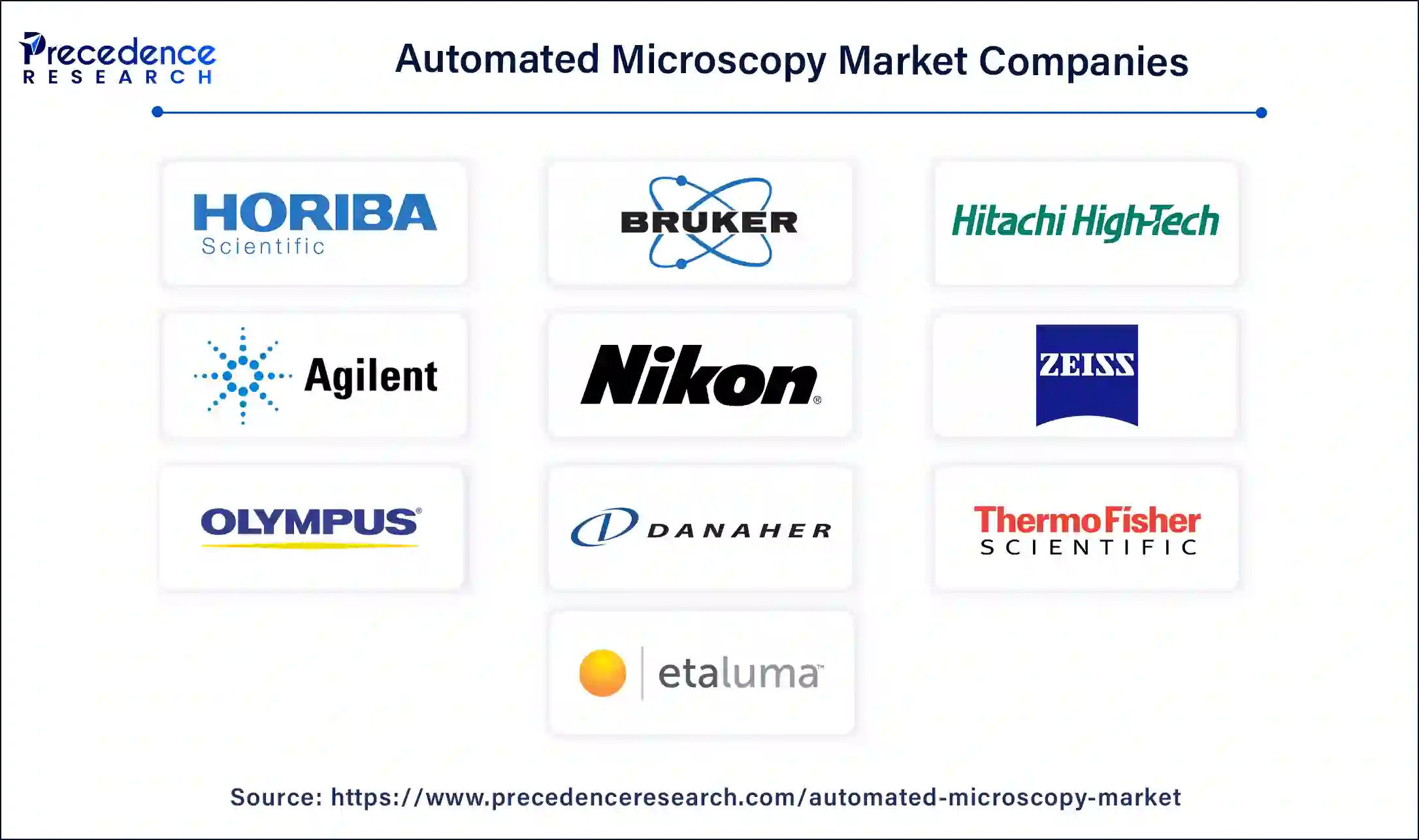
- Horiba Scientific
- Bruker Corporation
- Hitachi High-Technologies
- Agilent Technologies, Inc.
- Nikon Corporation.
- Carl Zeiss AG
- Olympus Corporation
- Danaher Corporation
- Thermo Fisher Scientific Inc.
- Etaluma, Inc.
Recent Developments
- In October 2024, ZEISS declared its new ZEISS Crossbeam 550 Samplefab, a well-focused ion beam scanning electron microscope (FIB-SEM), particularly for fully automated preparation of transmission electron microscopy (TEM) samples (lamellae).
- In August 2024, Hitachi High-Tech Corporation declared the global launch of TM4000PlusIII and TM4000III Tabletop Microscopes equipped with supporting features for automation and stable operation.
- In October 2025, Hitachi High-Tech Corporation introduced the Ultrahigh-Resolution Scanning Electron Microscope SU9600, enabling precise observation at the sub-nano level. It features world-leading resolution and automated functions for enhanced data acquisition throughput. This supports large-scale data analysis and aids research in next-generation semiconductors and advanced materials amidst increasing AI-driven demand. (https://www.hitachi.com)
- In April 2025, Thermo Fisher Scientific launched the Thermo Scientific™ Krios™ 5 Cryo-TEM, an advanced atomic-resolution platform using enhanced optics and AI automation. It facilitates molecular structure studies through single-particle analysis and cryo-electron tomography. This offers unprecedented insights into biological mechanisms involving viruses, proteins, and cells at an atomic level. (https://www.businesswire.com)
Segments Covered in the Report
By Product Type
- Optical Microscope
- Electron Microscope
- Scanning Probe Microscope
By Application
- Medical Diagnosis
- Life Science Research
- Drug Discovery and Pharmaceutical
By End-user
- Diagnostic Laboratories
- Research Facilities
- Pharmaceutical Industry
By Geography
- North America
- Asia Pacific
- Europe
- Latin America
- Middle East and Africa
For inquiries regarding discounts, bulk purchases, or customization requests, please contact us at sales@precedenceresearch.com
Frequently Asked Questions





Ask For Sample
No cookie-cutter, only authentic analysis – take the 1st step to become a Precedence Research client
 Get a Sample



 sales@precedenceresearch.com
 Schedule a Meeting
