



Surgical Instruments Tracking Systems Market Size, Companies, Share, Patient Volume, Treatment Adoption Rates, Pricing Analysis, Regulatory Landscape, Competitive Positioning, and Demand Forecast
Surgical Instruments Tracking Systems Market (By Solution Type: RFID-based Tracking Systems, Hybrid / Multi-technology Systems; By Component: Hardware Devices, RFID readers & tags, Services, Installation & integration, Maintenance & support; By Technology: Active RFID Systems, Passive RFID Systems, Barcode / Optical Systems, Bluetooth Low Energy (BLE); By Instrument Category: Surgical Trays & Sets, Reusable Implants & Accessories, Other Items (sterile packs, specialty tools); By End-User: Hospitals & Surgical Centers, Diagnostic & Specialty Clinics Academic & Research Institutions) - Global Industry Analysis, Size, Trends, Leading Companies, Regional Outlook, and Forecast 2026 to 2035
Source: https://www.precedenceresearch.com/surgical-instruments-tracking-systems-market
 Get a Sample
 Table Of Content


What is the Surgical Instruments Tracking Systems Market Size?
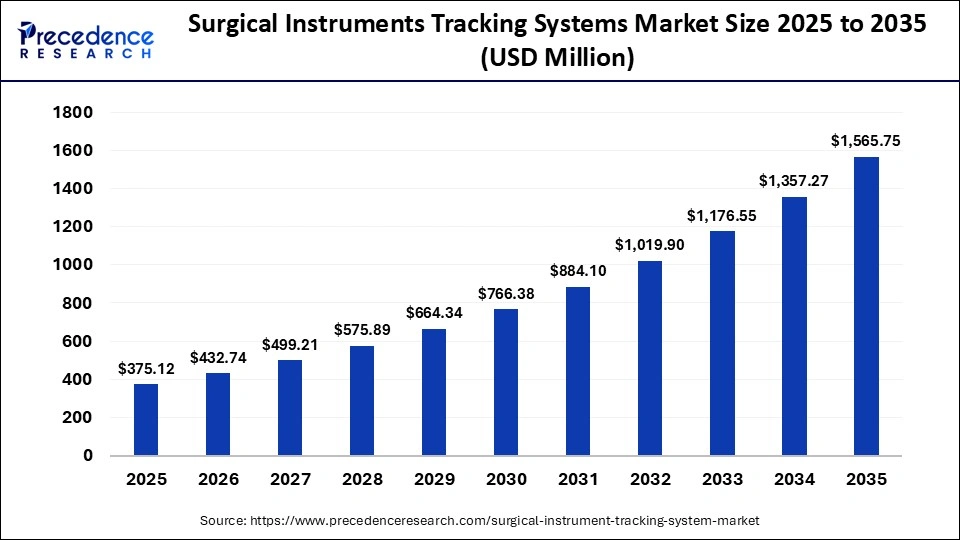
The global surgical instruments tracking systems market size was calculated at USD 375.12 million in 2025 and is predicted to increase from USD 432.74 million in 2026 to approximately USD 1565.75 million by 2035, expanding at a CAGR of 15.36% from 2026 to 2035.The surgical instruments tracking systems market is observed to grow rapidly due to its higher demand in the healthcare industry to monitor and track patients' data and vitals, reduce surgical errors, retain surgical items, and prevent hospital-acquired infections. Maintaining regulatory compliance and operational efficiency are other major factors propelling the growth of the market.
Market Highlight
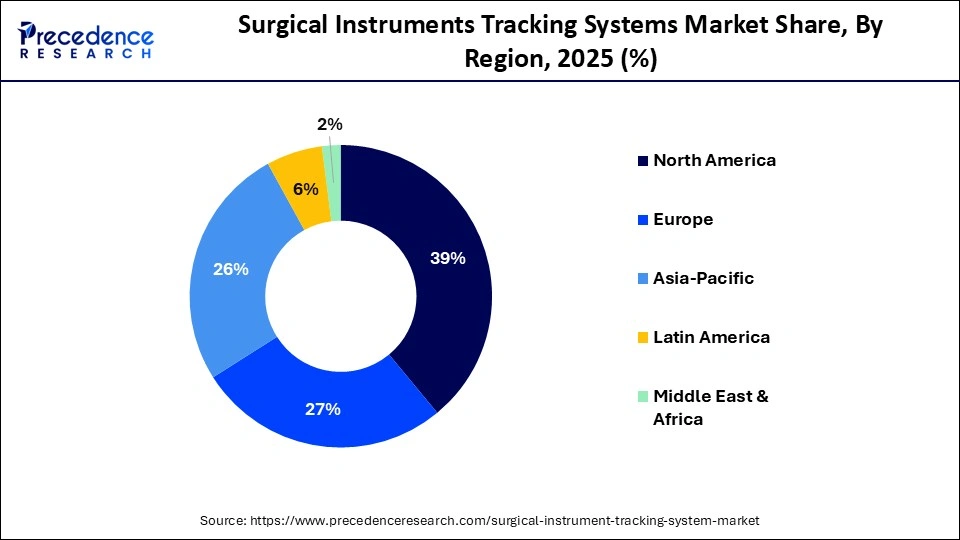
- By region, North America led the surgical instruments tracking systems market in 2025 with approximately 39% market share.
- By region, the Asia Pacific is observed to be the fastest-growing region in the foreseen period.
- By solution type, the RFID-based tracking systems with approximately 42% share led the global market in 2025.
- By solution type, the BLE/other IoT-enabled tracking solutions segment is observed to be the fastest growing in the foreseen period.
- By component, the hardware devices segment led the global market in 2025 with approximately 51% share.
- By component, the software solutions segment is observed to be the fastest-growing segment in the foreseen period.
- By technology, the active RFID systems segment, with approximately 37% share, led the global surgical instruments tracking systems industry in 2025.
- By technology, the Bluetooth low energy segment is observed to be the fastest growing segment in the foreseen period.
- By instrument category, the surgical trays and sets segment led the global market in 2025 with approximately 46% market share.
- By instrument category, the reusable implants and accessories segment is observed to be the fastest-growing segment in the foreseen period.
- By end user, the hospitals and surgical centers segment, with approximately 68% share, led the global market in 2025
- By end user, the ambulatory surgical centers segment is observed to be the fastest-growing segment in the foreseen period.
What is the Surgical Instruments Tracking Systems Market?
The global surgical instruments tracking systems market includes hardware, software, and services used to identify, monitor, and manage surgical instruments and trays throughout the sterilization, storage, intra-operative, and post-operative lifecycle. These systems leverage barcodes, RFID, IoT sensors, and software analytics to improve instrument utilization, reduce loss & misplacement, support sterilization compliance, and optimize inventory in hospitals, surgical centers, and healthcare facilities. The growing technological advancements are helpful to make the whole procedure cost-efficient, and accurate tracking also helps to fuel the growth of the market.
Role of Technology in the Growth of Surgical Instruments Tracking Systems Market
Technological advancements have a major role in the growth of the market. Integration of technological aspects such as AI, ML, IoT, and cloud-based systems further fuels the growth of the market by enabling flexibility and maintaining track of surgical instruments with ease. Barcode tracking and RFID tags for efficient tracking and real-time monitoring also help to fuel the growth of the market. The segment also focuses on inventory management and regulatory compliance, further fueling the growth of the market.
Surgical Instruments Tracking Systems Market Trends
- Technological Advancements- integration of AI and IoT, along with barcode tracking and RFID tags for real-time updates and monitoring, helps to fuel the growth of the market.
- Software Platforms- cloud-based systems offering data analytics and integration also help to fuel the growth of the market.
Regulatory Compliance- ensuring tracking data meets requirements for documentation, such as UDI, also helps to fuel the growth of the industry.
Market Scope
| Report Coverage | Details |
| Market Size in 2025 | USD 375.12 Million |
| Market Size in 2026 | USD 432.74 Million |
| Market Size by 2035 | USD 1565.75 Million |
| Market Growth Rate from 2026 to 2035 | CAGR of 15.36% |
| Dominating Region | North America |
| Fastest Growing Region | Asia Pacific |
| Base Year | 2025 |
| Forecast Period | 2026 to 2035 |
| Segments Covered | Solution Type, Component, Technology, Instrument Category, End-User, and Region |
| Regions Covered | North America, Europe, Asia-Pacific, Latin America, and Middle East & Africa |
Segmental Insights
Solution Type Insights
The RFID-based tracking systems segment led the global market with approximately 42% share in 2025. The segment observed major growth due to factors such as higher demand for speed, non-line-of-sight, and bulk scanning. The segment also observes growth as it has the capacity for bulk scanning in challenging environments, further fueling the growth of the market. Higher demand for active RFID tracking for better and enhanced detection is another major factor fueling the growth of the market. The segment also helps to fuel the growth of the market due to higher demand for automation and reduced manual errors.
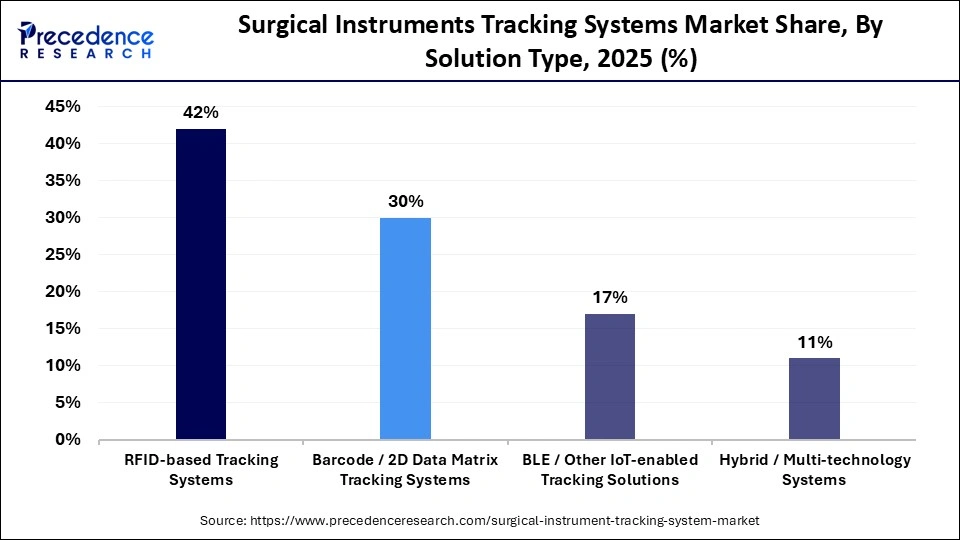
The BLE/other IoT-enabled tracking solutions segment is observed to be the fastest growing in the foreseen period as the segment focuses on patient safety, infection control, and operational efficiency, further fueling the growth of the market. The segment also provides non-line-of-sight tracking and real-time inventory visibility, further fueling the growth of the market. Such devices also aid remote monitoring, automated data collection, and lower human error, further fueling the growth of the market. Passive and active RFID tags embedded on instruments help with usage analytics and automated sterilization tracking, further fueling the growth of the surgical instruments tracking systems market in the foreseeable period.
Component Insights
The hardware devices segment, with approximately 51% share, led the market in 2025, mainly due to higher demand for patient safety, enhanced inventory management, and sterilization tracking, further fueling the growth of the market. The segment majorly emphasizes the use of barcode scanners, RFID tags, readers, and printers, which are helpful for the growth of the industry. Lower data entry errors, lower instrument loss, and compliance with stringent regulatory standards are also some of the major factors propelling the growth of the market. Higher demand for disposable tags and labels for elevated tracking of the surgical instruments also helps to fuel the growth of the market. Real-time visibility capabilities also help to fuel the growth of the market.
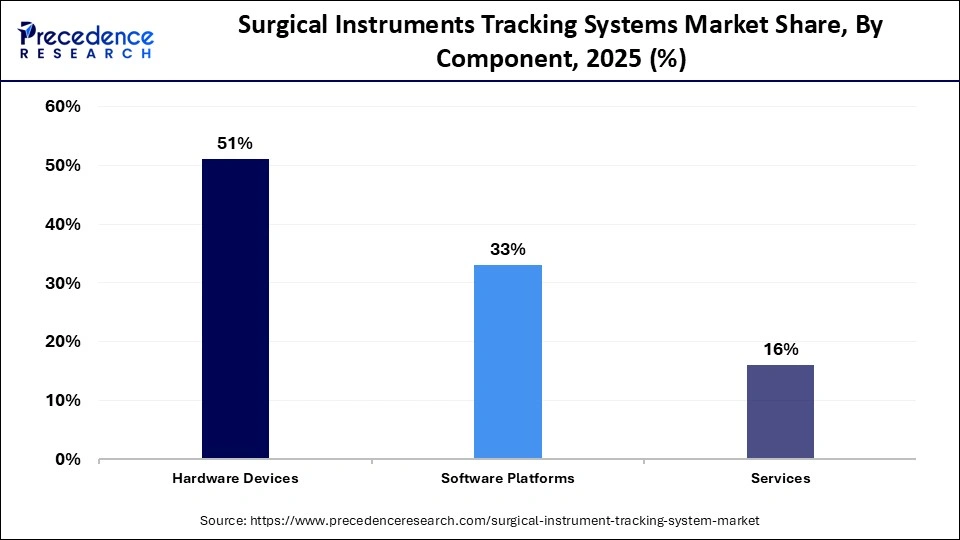
The software platforms segment is observed to be the fastest-growing segment in the foreseen period, mainly due to factors such as real-time data management, regulatory compliance, and workflow optimization, fueling the growth of the market. The segment also observes growth as it involves on-premises and cloud-based tracking of instruments through sterilization, inventory, and surgical usage for proper tracking and infection control. Higher demand for digitizing sterile processing departments and integrating with hospital information systems is another major factor propelling the growth of the market in the foreseeable period. Higher integration of the platform with RFID and barcode technologies further aids in propelling the growth of the surgical instruments tracking systems market in the foreseeable period.
Technology Insights
The active RFID systems segment, with approximately 37% share, led the market in 2025 as the segment enables real-time tracking, ideal replacement of traditional barcodes, and also offers real-time and high-speed tracking, which is helpful for the growth of the market. The segment also offers superior, long-range detection suitable for tracking, identifying, and locating surgical tools and trays in real-time, fueling the growth of the market. The segment also enables automatic, batch, and non-line-of-sight scanning to lower the time consumption and fuel the growth of the market. Lower surgical site infections and facilitating compliance with sterilization also help to fuel the growth of the market.
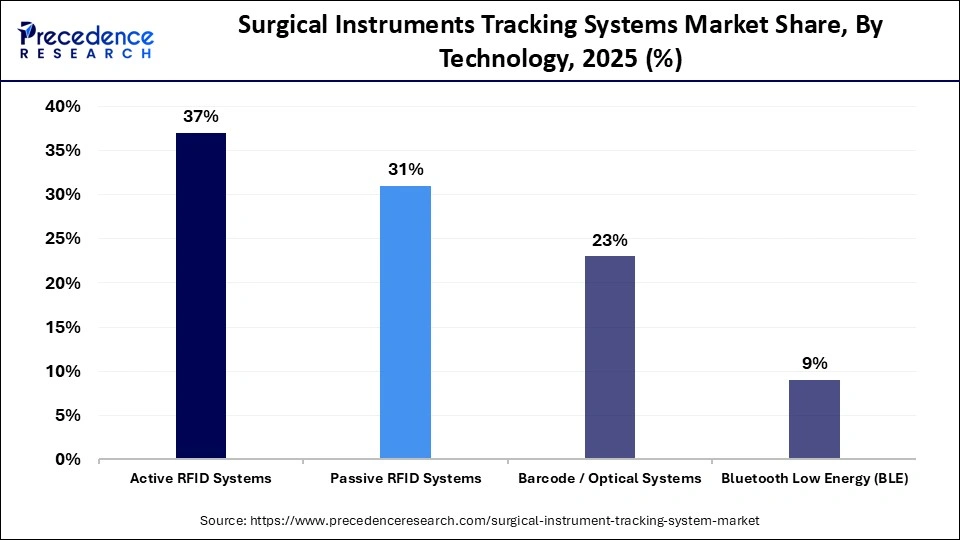
The Bluetooth low energy segment is observed to be the fastest-growing in the foreseen period, as the segment focuses on power efficiency and smartphone compatibility. Higher demand for continuous asset tracking and real-time data transmission in the healthcare domain is one of the vital factors for the growth of the market. Such devices require lower power and can work for years on a coin-sized battery, unlike traditional Bluetooth devices, further propelling the growth of the market. The segment emphasizes providing real-time location data with ideal accuracy to find critical equipment, which is another major factor propelling the growth of the market in the foreseen period.
Instrument Category Insights
The surgical trays and sets segment, with approximately 46% share, led the global surgical instruments tracking systems market in 2025. Growing demand for regulatory compliance, sterilization tracking, and reduced surgical site infections helps to fuel the growth of the surgical instruments tracking systems industry. Higher demand to reduce tray packing errors, manage inventory efficiently, and ensure compliance with Unique Device Identification (UDI) regulations also helps to fuel the growth of the market. Technological advancements allowing bulk tracking of entire trays without line-of-sight also help to fuel the growth of the market. A major shift of the market from manual tracking to advanced systems is another major factor fueling the growth of the market.
The reusable implants and accessories segment is observed to be the fastest-growing segment in the foreseen period due to higher demand for UDI regulations, high cost of instrument loss, and requirement for efficient and sterile handling of complex and multi-component instrument sets, further fueling the growth of the market in the foreseen period. Major transition of the segment from manual tracking to RFID-enabled systems to lower human errors, and improve operational efficiency, also helps to fuel the growth of the market in the foreseeable period. Such systems also help to lower the instrument loss and allow bulk scanning of trays, further fueling the growth of the surgical instruments tracking systems market in the foreseeable period.
End User Insights
The hospitals and surgical centers segment led the global market with approximately 68% share in 2025, mainly due to growth factors such as enhanced patient safety, reduced errors, and improved inventory management, which are helpful for the growth of the market. The market also observes growth due to higher volumes of surgeries and the adoption of advanced integrated tracking solutions for patient safety. The rising prevalence of chronic diseases and the higher demand for advanced and integrated tracking solutions for patient safety also help to fuel the growth of the market. Technological advancements, helpful to aid low installation costs and accurate tracking systems, further fuel the growth of the market. Technology also helps to optimize workflow and improve data management.
The ambulatory surgical centers segment is observed to be the fastest growing in the foreseen period due to supportive factors such as higher demand for enhanced sterilization compliance, inventory optimization, and efficient high-throughput workflows, aiding the growth of the market. Higher demand for quick instrument turnover, stringent infection control regulations, and the demand to lower surgical site infections also help boost the growth of the market. Higher demand for efficient automated tracking to manage the inventory seamlessly also helps to fuel the growth of the market. Increasing volume of outpatient surgeries is another major factor helpful for the growth of the surgical instruments tracking systems market in the foreseeable period.
Regional Insights
How Big is the North America Surgical Instruments Tracking Systems Market Size?
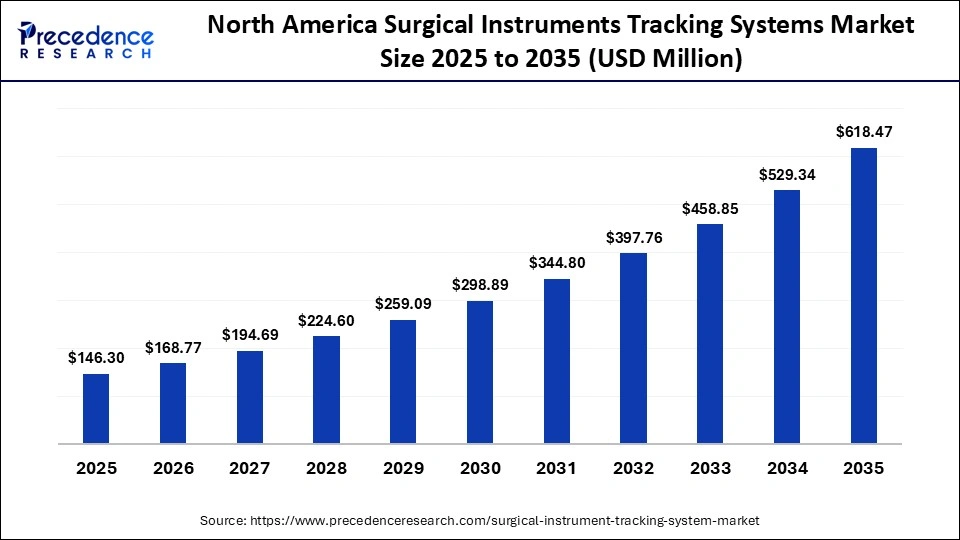
The North America surgical instruments tracking systems market size is estimated at USD 146.30 million in 2025 and is projected to reach approximately USD 618.37 million by 2035, with a 15.51% CAGR from 2026 to 2035.
How did North America lead the Surgical Instruments Tracking Systems Market in 2025?
North America led the global market with approximately 39% share in 2025, mainly due to factors such as higher surgical volume, higher demand for infection control, barcoding for inventory management, and use of RFIS technology for real-time tracking. Strict US FDA regulations are a vital factor propelling the growth of the market in the region. Growing surgical site infections leading to higher demand for efficient sterilization tracking is another major factor fueling the growth of the market. Advanced healthcare infrastructure, growing disposable income, and higher demand for efficient and high-quality healthcare management are also some of the growth-driving factors of the market. Technological and cost-effective advancements in the industry also help to propel the growth of the market.
What is the Size of the U.S. Surgical Instruments Tracking Systems Market?
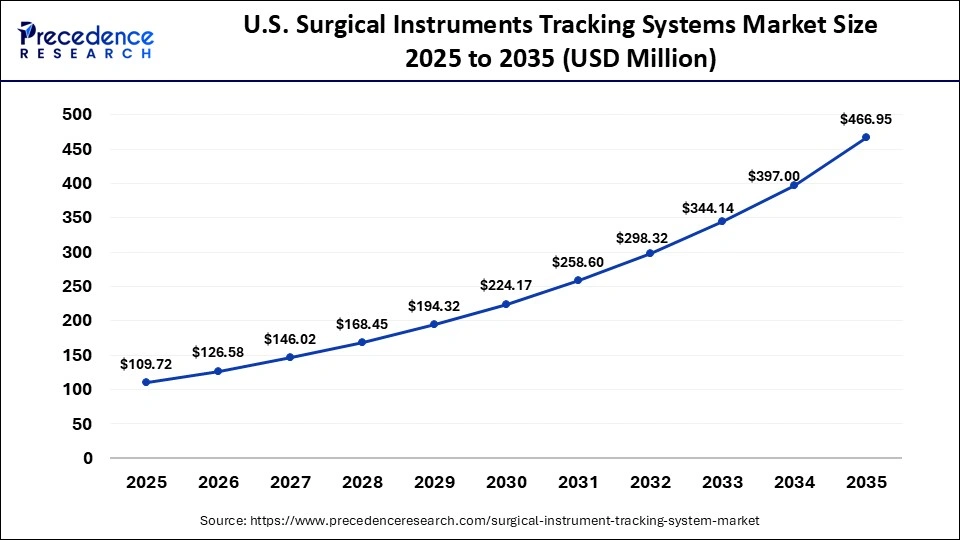
The U.S. surgical instruments tracking systems market size is calculated at USD 109.72 million in 2025 and is expected to reach nearly USD 466.95 million in 2035, accelerating at a strong CAGR of 15.58% between 2026 and 2035.
The U.S. Surgical Instruments Tracking Systems Market Trends:
The U.S. has a major contribution in the growth of the market due to rising infection control, surgical volumes, mandatory FDA UDI regulations, and growing use of advanced technologies such as barcode and RFID technologies. Higher adoption of tracking systems in hospitals to manage sterilization records and reduce retained surgical items also helps to fuel the growth of the market. Reduced manual errors and advanced tracking of essential surgical instruments also help to fuel the growth of the market.
Why is the Asia Pacific observed to be the fastest-growing segment in the Foreseen Period?
Asia Pacific is observed to be the fastest-growing segment in the foreseen period due to increasing surgical volumes, heightened infection control awareness, and adoption of UDI regulations. The market is also observed to grow due to a growing aging population, higher investments in healthcare infrastructure of the region, and higher demand to lower surgical errors. Technological advancements in the form of barcode technology and RFID tags for improved automation and real-time tracking also help to fuel the growth of the market in the foreseeable period. Use of advanced technologies such as AI, IoT, and cloud-based solutions for real-time monitoring and predictive maintenance also helps to fuel the growth of the market.
China Surgical Instruments Tracking Systems Market Trends
China has a major contribution to the growth of the market due to supportive factors such as growing healthcare infrastructure, increased surgical volume, AI/RFID integration, and barcode tracking, which help fuel the growth of the market. Mandatory UDI regulations, higher demand for improved hospital inventory management, and lower surgical errors also help to improve the growth of the market.
Who are the Major Players in the Global Surgical Instruments Tracking Systems Market?
The major players in the surgical instruments tracking systems market include Becton, Dickinson and Company (BD), Fortive Corporation (Censis Technologies), Getinge AB, STERIS plc, Stanley Black & Decker, Inc. (Stanley Healthcare), ASANUS Medizintechnik GmbH, B. Braun SE (Aesculap), Xerafy Singapore Pte Ltd, FingerPrint Medical Limited, SpaTrack Medical Limited
Recent Developments
- In May 2025, Aesculap, Inc., an industry leader in sterile processing and operating room solutions, announced the extension of its partnership with Ascendco Health, an innovative health tech company, for another ten years. The main motto of the partnership is to transform perioperative workflows by combining Aesculap's industry-leading expertise in surgical instrumentation and sterile processing with Ascendco Health's proprietary asset management technology.(Source- https://www.prnewswire.com)
- In February 2026, the Ministry of Health and Medical Services decided to begin an internal review of surgical procedures and patient safety protocols after the unfortunate death of a woman at the Colonial War Memorial Hospital. (Source- https://fijisun.com)
Segments Covered in the Report
By Solution Type
- RFID-based Tracking Systems
- Barcode / 2D Data Matrix Tracking Systems
- BLE / Other IoT-enabled Tracking Solutions
- Hybrid / Multi-technology Systems
By Component
- Hardware Devices
- RFID readers & tags
- Barcode scanners & label printers
- Sensors & gateways
- Software Platforms
- Tracking dashboards
- Inventory & analytics apps
- Services
- Installation & integration
- Maintenance & support
By Technology
- Active RFID Systems
- Passive RFID Systems
- Barcode / Optical Systems
- Bluetooth Low Energy (BLE)
By Instrument Category
- Surgical Trays & Sets
- Individual Instruments
- Reusable Implants & Accessories
- Other Items (sterile packs, specialty tools)
By End-User
- Hospitals & Surgical Centers
- Ambulatory Surgical Centers (ASCs)
- Diagnostic & Specialty Clinics
- Academic & Research Institutions
By Region
- North America
- Europe
- Asia-Pacific
- Latin America
Middle East & Africa
North America
For inquiries regarding discounts, bulk purchases, or customization requests, please contact us at sales@precedenceresearch.com
Frequently Asked Questions





Ask For Sample
No cookie-cutter, only authentic analysis – take the 1st step to become a Precedence Research client
 Get a Sample




 sales@precedenceresearch.com
 Schedule a Meeting
