



Artificial Turf Market Size, Companies, Share, Production Capacity, Raw Material Pricing, Export & Import Analysis, Manufacturing Cost, Competitive Positioning, and Demand Forecast
Artificial Turf Market (By Material Type: Polyethylene, Polypropylene, Nylon, Other Material; By Installation Type: Flooring/Outdoor Installation, Wall Cladding/Other; By Application: Sports Fields, Residential Landscaping, Commercial Areas) - Global Industry Analysis, Size, Trends, Leading Companies, Regional Outlook, and Forecast 2026 to 2035
Source: https://www.precedenceresearch.com/artificial-turf-market
 Get a Sample
 Table Of Content


What is the Artificial Turf Market Size?
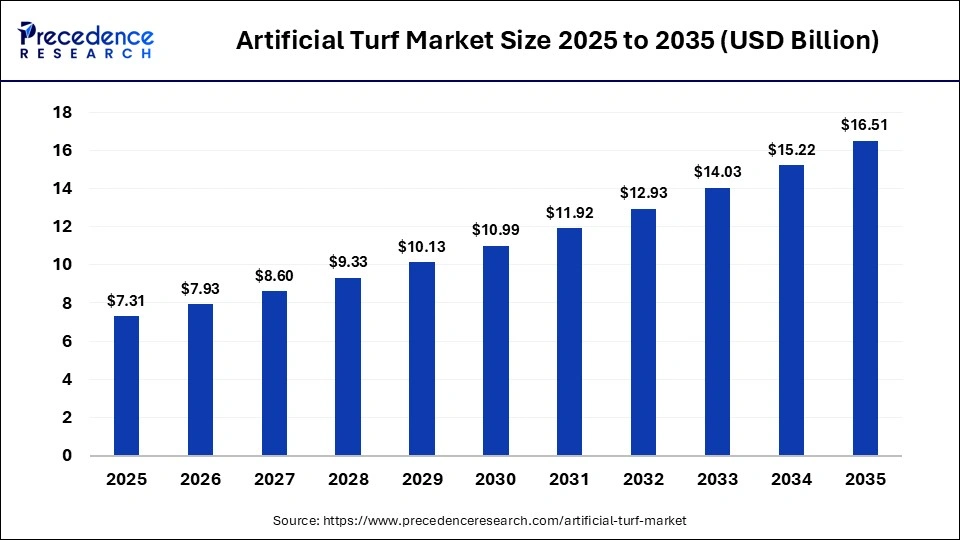
The global artificial turf market size was calculated at USD 7.31 billion in 2025 and is predicted to increase from USD 7.93 billion in 2026 to approximately USD 16.51 billion by 2035, expanding at a CAGR of 8.49% from 2026 to 2035. The artificial turf market growth is attributed to optimized maintenance costs, water conservation, rapid urbanization, and the expansion of sports infrastructure.
Market Highlights
- North America dominated the artificial turf market with the largest market share of approximately 38% in 2025.
- Asia Pacific is projected to host the fastest-growing market with a CAGR of 9.0% in the coming years.
- By material, the polyethylene segment contributed approximately 56% of the market share in 2025.
- By material, the polypropylene segment is expected to grow at the fastest rate in the market during the forecast period of 2026 to 2035.
- By installation, the flooring and outdoor installation segment accounted for the major market share of approximately 68% market in 2025.
- By installation, the wall cladding segment is anticipated to grow with the highest CAGR in the artificial turf market during the studied years.
- By application, the sports fields segment recorded major market share of approximately 55% in 2025.
- By application, the commercial areas segment is projected to expand rapidly with a CAGR of 7.5% in the market in the coming years.
What is the Landscape of the Artificial Turf Market?
The Artificial Turf Market involves synthetic grass surfaces used as a low-maintenance alternative to natural grass in sports fields, residential lawns, commercial landscapes, and recreational spaces. Made from polymers like polyethylene, polypropylene, or nylon, artificial turf offers durability, water savings, and consistent performance across climates. It includes various installation types and applications, catering to both aesthetic and functional needs in outdoor and indoor environments, driven by demand for sustainability, sports infrastructure growth, and reduced upkeep costs.
Artificial Turf Market Trends
- Collaborations and Partnerships: Manufacturers are increasingly collaborating with sports associations and real estate developers to innovate advanced artificial turf solutions that are sustainable and eco-friendly. Such partnerships facilitate research and development of advanced features for player safety, longevity of turf and its appearance. Artificial turfs are being adopted in sports and landscaping operations. For instance, FieldTurf collaborated with FIFA accredited testing organizations to design professional football fields with high performance artificial turf systems.
- Government Initiatives: Various governments are promoting the use of artificial turf to support water conservation, sustainable development and the development of modern sports infrastructure. Governments are investing in development of artificial turf in public sports stadiums and academic institutions. For instance, the Saudi Arabian government has promoted the development of artificial turfs in public sports amenities as a part of the Vision 2030 initiative aimed at increasing sports participation while optimizing water usage.
- Business Expansions: Artificial turf companies are increasing their production capacities and improving their distribution channels. Optimized operation methods helps companies keep up with the demand from sports grounds, landscape gardens and residential areas. This increment in production capacity helps in cutting down delivery times. For instance, TenCate Grass increased their production facilities in Europe to meet demands for hybrid and artificial turf.
How is AI contributing to the Artificial Turf Market?
Artificial Intelligence is accelerating innovation in artificial turf industry through enhanced design and manufacturing accuracy and life cycle management. Big data analysis enables the optimization of fibre alignment, material composition and shock absorption properties in artificial turf. AI-based quality assurance systems minimize errors while optimizing production. Intelligent monitoring systems are capable of anticipating wear and tear and maintenance schedules. In sports turf, AI examines players dynamics and impact patterns to improve player performance while preventing injuries.
Market Scope
| Report Coverage | Details |
| Market Size in 2025 | USD 7.31 Billion |
| Market Size in 2026 | USD 7.93 Billion |
| Market Size by 2035 | USD 16.51 Billion |
| Market Growth Rate from 2026 to 2035 | CAGR of 8.49% |
| Dominating Region | North America |
| Fastest Growing Region | Asia Pacific |
| Base Year | 2025 |
| Forecast Period | 2026 to 2035 |
| Segments Covered | Material Type, Installation Type, Application Type, and region |
| Regions Covered | North America, Europe, Asia-Pacific, Latin America, and Middle East & Africa |
Market Dynamics
Driver
Environmental Sustainability
One of the growth factors in terms of the artificial turf sector is the move towards sustainable materials. Turf producers are excessively using recyclable and recycled materials in their respective products, along with vegetal infills and organic ones, which is an environmentally friendly choice to regular options. By operating this, the sector not only lessens waste but also invests in the circular economy, in which materials are recycled and reused constantly. Such transformation pushes cutting-edge invention as producers create the latest technologies and procedures to smoothly include such sustainable materials into their products.
Restraint
Health and Safety Concerns
Artificial turf presents significant challenges, including health and safety concerns. Extreme heat can damage the artificial turf surface and can pose health risks to children and pets. Artificial turfs are reported to have higher chances of lower-extremity injuries. The breakdown of infill materials and fibers may cause chemical exposure.
Opportunity
The eco-friendly advantages of selecting artificial turf are proven. Pesticides or fertilisers are meant to reduce chemical runoff into local water systems. Apart from this, drought-potential landscaping is in the desert Southwest, which is present in artificial turf and real water scarcity that includes it directly. The advantages of artificial turf are that it is suitable for dog breeds that do not require maintenance or staining. Urine has passed with assistance without poling. Solid waste has come off conveniently with a fast rinse. Pet urine drainage has been excessively relying on the infill, and backing is utilized. An explanation of turf infill is worth benefiting heavily used spaces. The benefits of the artificial turf have shown constant benefits for athletic layers that demand to manage heavy traffic, cleats, and rain without making bare mud or patches.
Segmental Insights
Material Type Insights
Why Did Polyethylene Segment Dominate the Artificial Turf Market in 2025?
Polyethylene segment contributed approximately 56% of the market share in 2025. This segment led the market because of its ability to provide durability along with natural soft and grass like feel. Polyethylene provides excellent UV protection, color consistency and climate resilience. It minimizes injury risks for players and boosts player comfort. It facilitates development of dense fibers for enhanced resilience and aesthetics. These factors contribute to its widespread adoption in a diverse array of sectors.
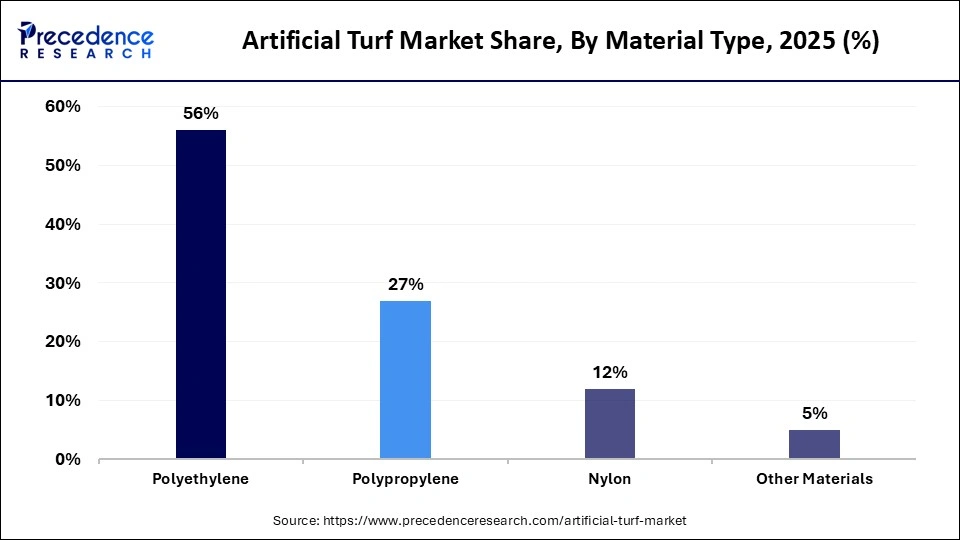
The polypropylene segment is expected to grow at the fastest rate of 7.3% in the market during the forecast period of 2026 to 2035. This segment market growth is attributed to polypropylene being lightweight and cost effective. It offers adequate performance for low traffic applications such as residential lawns, balconies, landscaping and other beautified areas. It facilitates straightforward manufacturing, installation and replacement. The rising demand for cost effective artificial turf solutions drive the market growth for this segment.
Installation Type Insights
Why Did Flooring and Outdoor Installation Segment Dominate the Artificial Turf Market?
Flooring and outdoor installation segment accounted for the major market share of approximately 68% in 2025. This segment led the market due to widespread demand in sports grounds, commercial spaces and landscaping. This segment facilitates simplicity of setup and minimal maintenance. These factors make it an economical as well as aesthetic choice. Flooring and outdoor installation segment market growth can be attributed to increasing urbanization and the emphasis on developing eco friendly spaces.
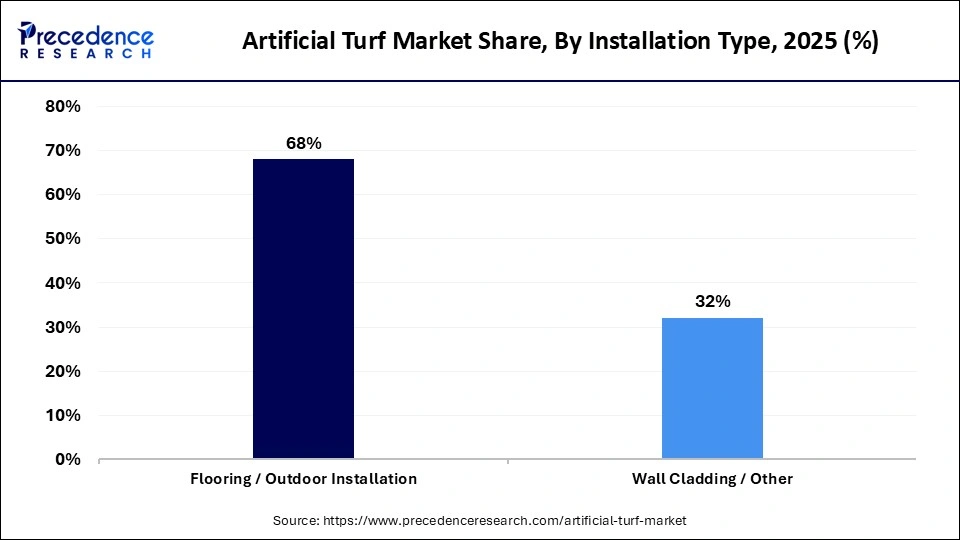
The wall cladding segment is anticipated to grow with the highest CAGR in the market during the studied years. The market growth of this segment can be attributed to increasing use of modern and sophisticatedly designed spaces. Commercial buildings, shops, cafes, hotels and offices are adopting the use of turf wall installations for a natural ambience inside buildings. The pace of market growth of wall cladding segment can be attributed ease of maintenance and customization as well as influence from social media and experimental designs.
Application Type Insights
Why Did the Sports Fields Segment Dominate the Artificial Turf Market?
The sports fields segment recorded major market share of approximately 55% in 2025. The market growth of this segment is driven by its adoption in football, hockey, cricket and multi sport grounds. Artificial turf offers excellent durability, playing conditions and all weather usability. This segment offers low maintenance and lifecycle compared to grass making it a economical solution. The market growth of sports fields segment in artificial turf market is further driven by substantial investments in sports facilities and training grounds.
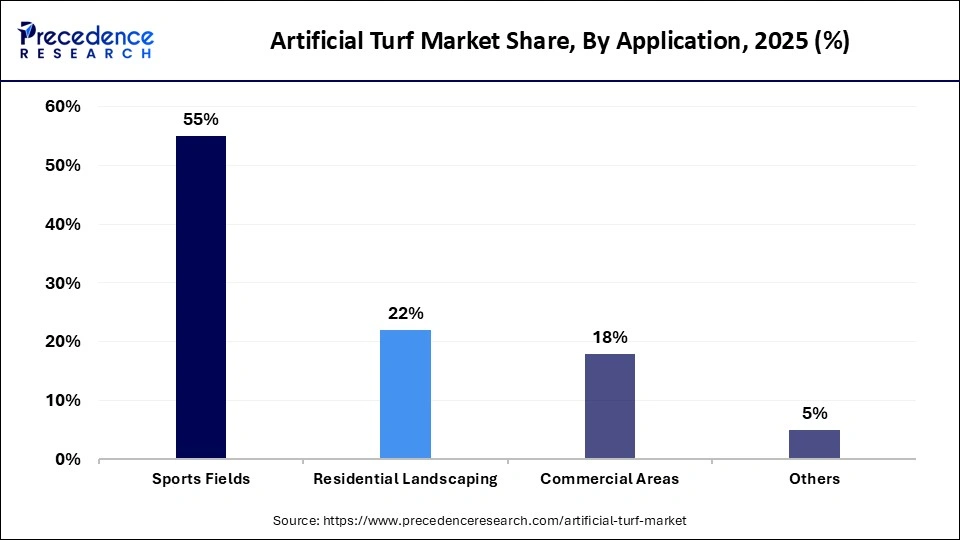
The commercial areas segment is projected to expand rapidly with a CAGR of 7.5% in the market in the coming years. The market growth of this segment can be attributed to high demand from offices, retail complexes, hotels, airports and entertainment hubs. Artificial turfs in commercial businesses provide companies with beautiful green areas in optimized budget. The market growth of this segment is further driven by increasing focus on sustainability, branding and experience oriented customer environments.
Regional Insights
How Big is the North America Artificial Turf Market Size?
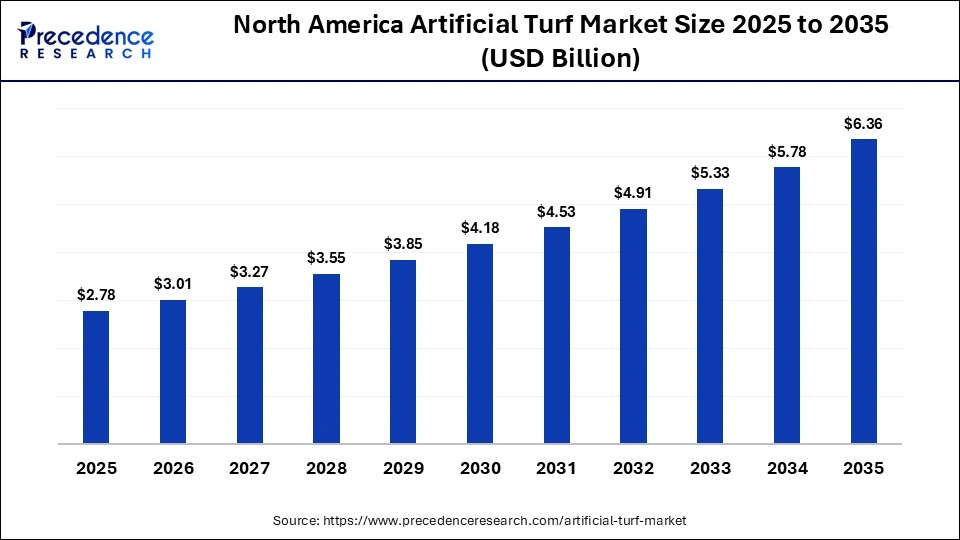
The North America artificial turf market size is estimated at USD 2.78 billion in 2025 and is projected to reach approximately USD 6.36 billion by 2035, with a 8.63% CAGR from 2026 to 2035.
What Made North America the Leading Region in the Artificial Turf Market?
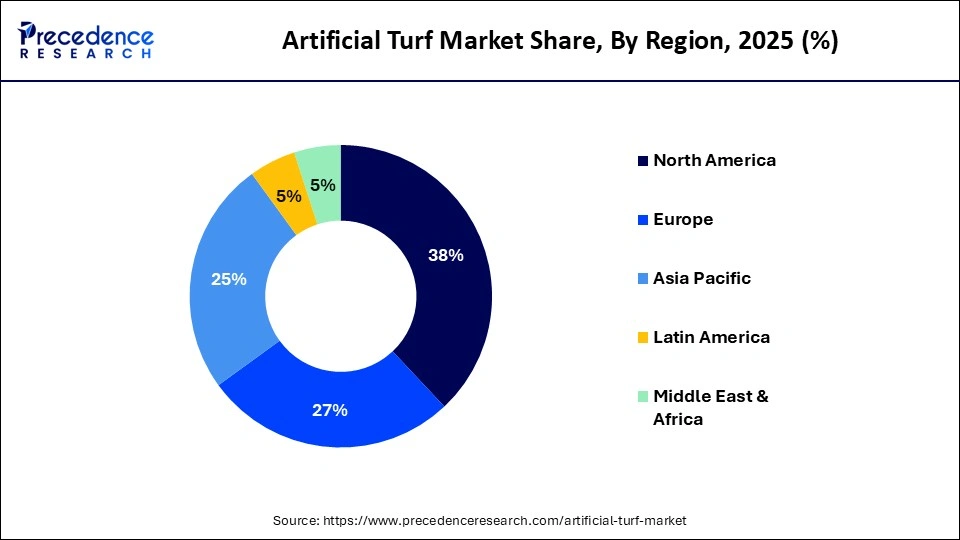
North America dominated the artificial turf market with the largest market share of approximately 38% in 2025. This region has strong sports culture and well developed athlete wellness infrastructure. market demand in the region is driven by its widespread adoption across schools, universities, stadiums and community sports complexes. High awareness of water conservation and rising maintenance costs of natural grass encourage turf replacement. This region has benefitted from early adoption and strict performance standards for advanced artificial turf technologies. The market growth in this region is further driven by presence of major manufacturers and frequent renovation cycles.
What is the Size of the U.S. Artificial Turf Market?
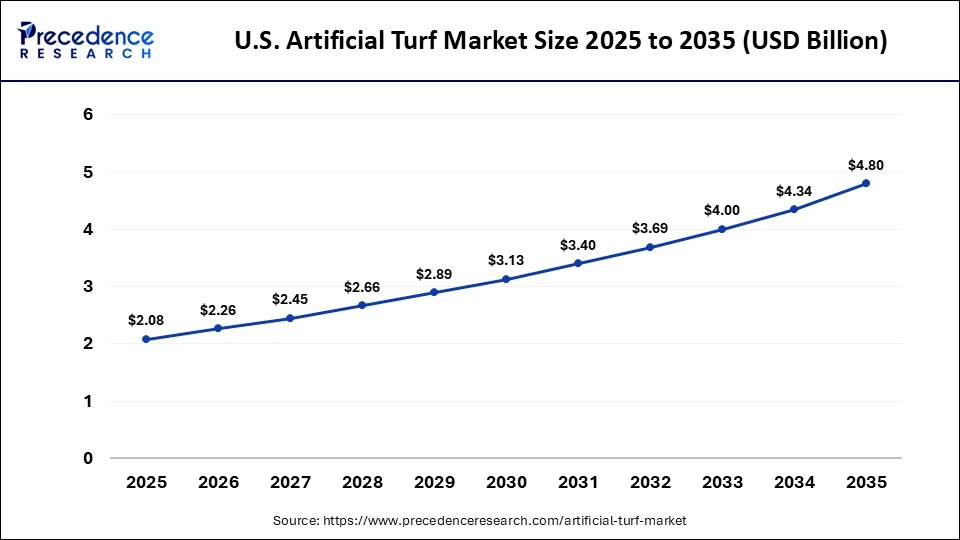
The U.S. artificial turf market size is calculated at USD 2.08 billion in 2025 and is expected to reach nearly USD 4.80 billion in 2035, accelerating at a strong CAGR of 8.72% between 2026 and 2035.
U.S Artificial Turf Market Trends
U.S dominated the North American market because of its prolific and well financed athletic programs. The market growth in the country is driven by widespread adoption in schools, universities, professional leagues and municipal sports complexes. The increase in maintenance costs and pressure to make natural grass available all year round without needing frequent requirements emphasize the importance of artificial turfs. Conservation measures related to water usage also accelerate the adoption in the country. The market growth is further driven by strong presence of leading turf manufacturers, advanced installation and regular field renovation cycles.
Why is Asia Pacific Considered the Fastest-Growing Region in the Artificial Turf Market?
Asia Pacific is projected to host the fastest-growing market with CAGR of 9% in the coming years. The market growth in this region is attributed to rapid urbanization and increased investments in sports infrastructure. Limited presence of natural grass and high maintenance costs also prompt the need to develop artificial turfs. The market growth in the region is further driven by landscaping projects in residential and commercial areas. Technological advancements and increasing disposable incomes are also accelerating adoption in emerging markets.
China Artificial Turf Market Trends
China leads the market in Asia Pacific region because of significant investments in sports and education infrastructure. Government initiatives for the development of school playgrounds, public parks and sports facilities are driving the installation of artificial turfs on a large scale. The market growth in the country is further driven by high urbanization rate and lack of presence of natural grass. An increase in hosting of sporting events in the country drives the demand for sports turfs. Upgrades to FIFA and World Rugby approved sports turfs fuel the demand for premium infrastructure. Improved local supply chains cut down on installation times and rising awareness about water conservation further drives the market growth.
What Are the Driving Factors of The Artificial Turf Market in Europe?
Europe is expected to grow at a significant CAGR during the forecast period. Europe is highly adopting artificial turf because of stringent environmental regulations and insistence on long-lasting sports turf. An important area of application is football. There is a drift towards recyclable and environmentally friendly materials. The area concentrates on sustainable solutions that can help use the area throughout the year with minimal maintenance.
Germany Market Trends
Due to stringent environmental policies, Germany focuses on sustainable and recyclable artificial turf solutions. Its use is high in urban sports areas and public spaces, which need low maintenance. Firms are coming up with new materials that enhance appearance and durability. The other focus of the market is the production that is environmentally friendly, as well as the minimization of environmental impact through innovation and recycling.
What Are the Driving Factors of The Artificial Turf Market in Latin America?
Latin America is expected to grow at a significant CAGR during the forecast period. Artificial turf is a process of enhancing sports facilities and minimizing maintenance. The growing urbanization is driving the need to find cost-effective landscaping solutions. Synthetic turf is also another advantage to the region as it has the ability to work well in tropical climates, and can be used all year round.
Brazil Market Trends
The use of artificial turf in sports infrastructure, in particular football fields and football training centers, is on the rise in Brazil. Residential and hospitality markets are also increasingly in need of landscaping. Artificial turf assists in preserving the green areas with minimal effort. The emphasis is on delivering superior surfaces that are durable, convenient, and capable of performing consistently all year round.
How is the Middle East and Africa Performing in The Artificial Turf Market?
The Middle East and Africa are expected to grow at a significant CAGR during the forecast period. Artificial turf is more popular in countries such as the UAE and Saudi Arabia because it minimizes the use of water. Governments are spending on sports infrastructure and green spaces. The market is in need of a heat-resistant turf capable of withstanding the unfriendly environment and delivering a long-lasting performance.
Saudi Arabia Market Trends
Saudi Arabia is embracing artificial turf in order to cut down on water consumption in landscape gardening and urbanization. Extreme weather conditions render natural grass hard to keep. The turf, which is resistant to high temperatures and sunlight, has great demand. The use of long-lasting artificial turf solutions with high resistance to climate and other environmental factors is on the rise due to government projects and smart city developments.
Competitive Landscape
The competitive landscape of artificial turf is classified by a mixture of sustainability, inventions, and strategic mergers. As the industry continues to develop, brands are stretching their respective product lines and developing their full concentration on the surrounding effect. The mixing of high-level materials and technologies paves the path for a more advanced future in sports turf fields, in which eco-friendliness and results are becoming excessively intermixed.
Companies related to artificial turf are examined depending on the product discoveries, strategic positioning, and roles present within the sector ecosystem. Such criteria are fully dependent that enables for more overall understanding of every company's investments and the competitive benefits without depending on numerical analysis.
Value Chain Analysis: Artificial Turf Market
- Innovation and Design
Innovation and design operations involve research and development in the production of high quality polymer fibers and environment friendly infill materials. This enhances material resilience, UV protection, drainage and player comfort. Production operations involve extrusion, tufting and finishing.
Companies involved include TenCate Grass, Shaw sports turf, Tarkett and CCGrass. - System Assembly and Distribution
Companies integrate turf roll products with infill materials, shock pads and drainage layers depending on the application. The integrated systems are distributed through sports infrastructure contractors and landscaping companies. Product assembly operations depend on the respective application.
Companies involved include FieldTurf, SYNLawn, TenCrate Grass, and ACT Global. - Installation and Maintenance
Installation stage involves base construction, turf installation, infill application and performance verification. Maintenance operations involve turf grooming, cleaning, safety checks and turf renovation. Optimal maintenance facilitates consistent turf performance and extended lifecycle.
Companies involved include FieldTurf, Shaw Sports Turf and GreenFields.
Who are the Major Players in the Global Artificial Turf Market?
The major players in the artificial turf market include Tarkett Group, TenCate Grass, FieldTurf, AstroTurf, Shaw Sports Turf, CCGrass / CoCreation Grass, Domo Sports Grass, Polytan GmbH, Act Global, SIS Pitches, Limonta Sport S.p.A., Global Syn-Turf, TigerTurf, Victoria PLC, and Beaulieu International Group
Recent Development
- In November 2025, Gallant Sports signed a five-year master agreement with CC Grass to introduce the 100% non-infill artificial grass system "Leap" in India. This partnership will focus on distributing and installing this innovative turf in various sports and recreational facilities nationwide. (Source: https://www.passionateinmarketing.com)
- In April 2025, Jamshedpur FC will launch its inaugural football school at JRD Tata Sports Complex, focusing on young talent. Catering to U5, U7, U9, U11, and U13 age groups, the school aims to provide professional training to nurture future Indian football stars. (Source: https://www.fcjamshedpur.com)
- In June 2025, AstroTurf launched RootZone GT-B BioPreferred turf system which is a next generation artificial turf product. This product combines biobased materials with superior quality playability, durability and low maintenance costs. This product is a major step towards development of eco friendly synthetic turf solutions. (Source: https://astroturf.com)
- In June 2025, AstroTurf launched Diamond series turf systems which is a advanced synthetic turf which found adoption in professional baseball facilities demonstrating its quality and performance. This product uses advanced software technologies to facilitate real time player and turf condition monitoring. This product was a major milestone in adoption of synthetic turfs in professional sports academies. (Source: https://astroturf.com)
- In September 2025, Tarkett launched FieldTurf which is a innovative turf technology with next generation drainage capabilities. This turf is specifically designed to facilitate better drainage and minimize downtime for sports fields. This product is well suited for sports facilities as it allows for optimal play even in rainy conditions. (Source: https://fieldturf.com)
Segments Covered in the Report
By Material Type
- Polyethylene
- Polypropylene
- Nylon
- Other Material
By Installation Type
- Flooring/Outdoor Installation
- Wall Cladding/Other
By Application
- Sports Fields
- Residential Landscaping
- Commercial Areas
By Region
- North America
- Europe
- Asia-Pacific
- Latin America
- Middle East & Africa
For inquiries regarding discounts, bulk purchases, or customization requests, please contact us at sales@precedenceresearch.com
Frequently Asked Questions
Tags





Ask For Sample
No cookie-cutter, only authentic analysis – take the 1st step to become a Precedence Research client
 Get a Sample




 sales@precedenceresearch.com
 Schedule a Meeting
