



Basic Chemicals Market Size, Key Companies, Company Market Share, Production Capacity, Raw Material Pricing, Export & Import Analysis, Manufacturing Cost, Competitive Positioning, and Demand Forecast
Vidyesh Swar, a Chemical and Materials Industry Expert, estimates the basic chemicals market at USD 778.72 billion in 2026, with the market projected to reach USD 1,096.26 billion by 2035 at a CAGR of 3.88%. Major basic chemicals market companies such as Borealis AG, BASF SE, Eastman Chemical Company are competing across key material and application segments, including device, type, end user, region.
Source: https://www.precedenceresearch.com/basic-chemicals-market
 Get a Sample
 Table Of Content


What is the Basic Chemicals Market Size?
The global basic chemicals market size is calculated at USD 749.49 billion in 2025 and is predicted to increase from USD 778.72 billion in 2026 to approximately USD 1,096.26 billion by 2035, expanding at a CAGR of 3.88% from 2026 to 2035.
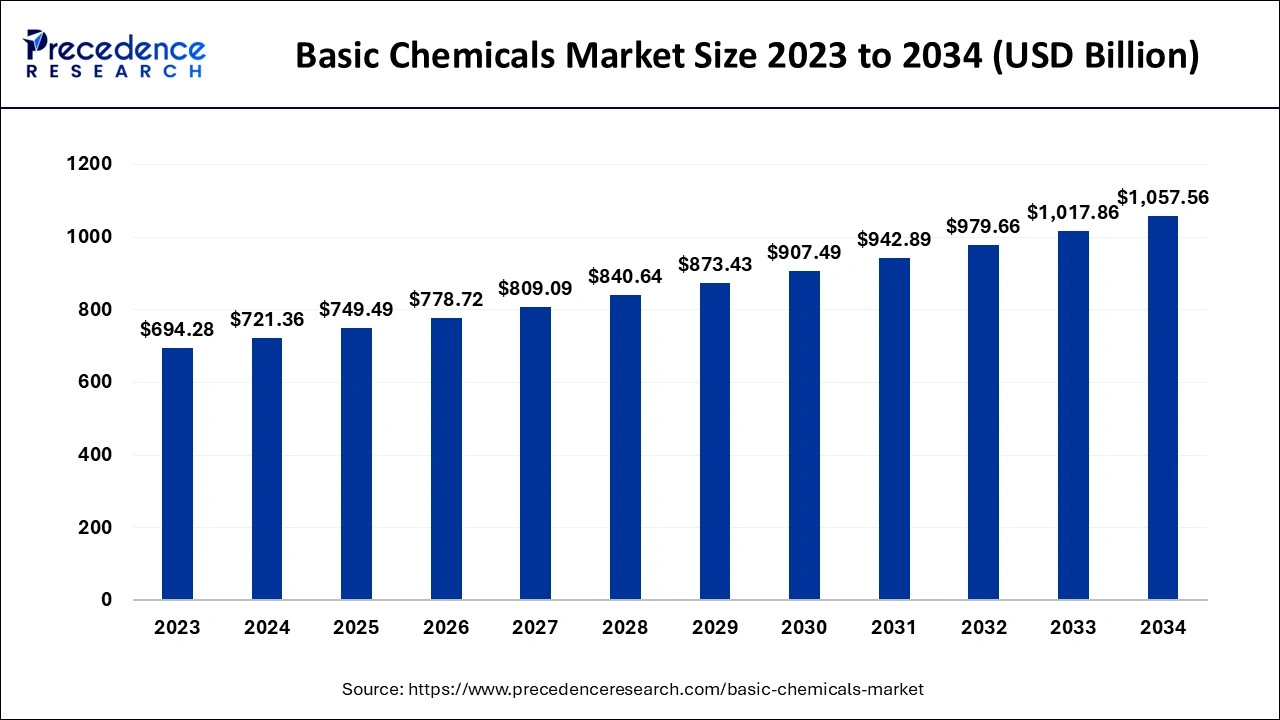
Basic Chemicals Market Key Takeaways
- The Asia Pacific region has garnered a 39% revenue share in 2025.
- By device, the organic segment has extended 57% revenue share in 2025.
- By end user, the chemical industry has outstretched 43% revenue share in 2025.
Market Overview
Basic chemicals are produced in vast numbers and play a significant role in the creation of goods that are consumed by consumers and the general public. Among them are fundamental inorganics, intermediates in chemical processes, and chemical raw materials derived from oil. Understanding the manufacturing procedures and chemical composition of these fundamental compounds is essential for achieving cost-saving objectives and adhering to increasingly strict security and ecological norms. One of the key reasons driving the worldwide market for basic chemicals is the expanding use of these chemicals in the food and beverage sector. To enhance the flavors and fragrance, and appearance of food, a variety of chemicals are used as direct food additives. These substances can also function as preservatives, limiting bacterial activity and avoiding spoilage. In the food industry, chemical products are also employed to create packaging that will come into contact with food. They include utensils, containers, foils, and a range of other things.
The pharmaceutical business is expanding quickly, which is motivating the major players to increase the production of organic and inorganic basic chemicals. A fundamental chemical raw material utilized in pharmacies is chlorine. It serves as the first stage in the manufacturing of medications. Additionally, it's conceivable that it enters their molecules. There are several different sorts of medicines that may be made with chlorine. Health risks related to basic chemicals and tight regulatory requirements for their use are some of the reasons that are restricting the market's growth. Chemical and hazardous chemicals can result in a range of physical and physiological issues, including flammability, corrosion, and explosibility, as well as health issues including irritability, sensitization, and carcinogenicity. The OSHA-recognized Hazard Communication Standard (HCS) is designed to ensure that employers and employees are educated about potential dangers from dangerous chemical substances in the workplace as well as preventative actions. In addition, the expansion of private and public major investments in the chemical sector is one of the trends in the global basic chemicals market that is anticipated to open up a lot of potentials for the market to expand in the years to come.
Chemicals are more in demand when emerging sectors start to take off as a result of development. The term "basic chemical products" refers to a broad range of chemicals used in anything from engineering to textiles, paints, and inks to crop protection. To suit consumer demands and new environmental restrictions, new goods are continually being produced.
Basic Chemicals Market Growth Factors
The key drivers of the growth of the global basic chemicals market are the expanding use of basic chemicals in the food and beverage industry and the expansion in the pharmaceutical industry. Chemicals may be extremely important in the production and preservation of food. Food additives, for instance, may increase the shelf life of some meals while others, like colors, may make them look more appetizing. Food is given a flavor boost through the use of flavorings.
Market Scope
| Report Coverage | Details |
| Market Size in 2025 | USD 749.49 Billion |
| Market Size in 2026 | USD 778.72 Billion |
| Market Size by 2035 | USD 1,096.26 Billion |
| Growth Rate from 2026 to 2035 | CAGR of 3.88% |
| Largest Market | Asia Pacific |
| Fastest Growing Market | North America |
| Base Year | 2025 |
| Forecast Period | 2026 to 2035 |
| Segments Covered |
|
| Regions Covered |
|
Market Dynamics
Key Market Drivers
Strong demand from the construction market
- The market for basic chemicals will rise during the forecast period due to the rising number of construction projects being undertaken throughout the globe. As per the Construction Review Survey, India, China, and the US will dominate the $8 trillion global construction market by 2030. This is due to the fact that these substances boost a building's structural and aesthetic qualities while also increasing its lifespan.
- Additionally, they lessen the requirement for maintenance and support the strength of concrete structures. Some of the most crucial elements of the building process are chemicals used for surface treatment, foaming agents, or coatings. They so make up a sizable share of the market for basic chemicals. After the epidemic, it is anticipated that the building industry would recover. It is anticipated to fuel the expansion of the basic chemical sector.
Research and development proficiencies
- R&D and innovation are two areas with substantial development potential in the basic chemical sector since it is often consumer-focused. Due to manufacturers' attention on producing new and customized product offers for target applications and satisfying specific clients' expectations, innovative basic chemicals have been created. As a result, there are now a greater number of products present on the market.
Key Market Challenges
- Sluggish industrial activities and covid 19 - The COVID-19 pandemic and rising environmental concerns are two obstacles impeding the basic chemical market's expansion. The suspension of international travel and transportation has resulted in inventory shortages, which have further reduced chemical sales. Almost all industries have been affected by the COVID-19 epidemic. 2019 has already seen the chemical sector grapple with sustainability-related concerns including trade restrictions, lower earnings, economic sanctions, and others. The COVID-19 outbreak and the drop in oil prices have added to the stress on the chemical industry. But the impact differed across various groups.
Key Market Opportunities
- Surging demand for individual care goods - Key manufacturers are observing a significant surge in the need for hygiene goods including liquid soaps, hand sanitizers, disinfectant sprays, and germ-protecting products as the COVID-19 epidemic spreads around the globe. The chemical industry has observed a rise in the use of fundamental chemical products during the last 12 to 18 months. In the wake of the present situation, they have recently evaluated their manufacturing plans and are swiftly expanding and simplifying their production capacities. Therefore, the industry has been increased by the rising acceptance of cleansers and disinfectants. In addition, 960 million people aged 60 and over lived in the world in 2017, and by 2050, that figure is projected to nearly quadruple. These elderly individuals experience aging and health issues including loss of hair and skin degeneration, which will encourage them to use market-friendly cosmetic chemicals. The market for basic chemicals is expanding as a result of the significant increase in demand for personal care chemicals and surfactants.
- Increase in demand for a wide range of consumer goods - One of the key reasons driving the market is the increasing use of fundamental chemicals in the manufacturing of consumer products. Many products that we use on a daily basis, like paints, plastics, dish soap, and cosmetics, are made mostly of chemicals. Chemicals that serve as raw materials in other processes include specialty chemicals and commodity chemicals as examples of intermediate products. Contrarily, consumer products are the end result of a certain process. For instance, in Europe, downstream industries fabricate their final products using around 70% of the chemicals produced.
Basic Chemicals Market Segment Insights
[[segment_insights]]
Basic Chemicals Market Regional Insights
[[regional_insights]]
Basic Chemicals Market Value Chain Analysis
[[value_chain]]
Basic Chemicals Market Companies
[[market_company]]
Recent Developments
- In July 2021, Platinum Equity stated that it will merge with Sigura Water and purchase Solenis, a chemical company from Clayton, Dubilier, and Rice and BASF, for $5.25 billion. In order to fulfill the growing demand, the combination would enable Sigura to increase the supply of chemicals and water treatment products to the food packaging and paper sectors.
- Canlak Inc., a Canadian coatings company, and Valentus Chemicals, a US-based company, were both acquired by private investment firm SK Capital in May 2021. SK Capital focuses its investments on the basic chemicals and pharmaceutical industries. The company intends to combine the twp firms to become Canlak Coatings, a North American wood coatings company. The new company is anticipated to provide a broad range of wood finishing solutions for the fabrication of cabinets, furniture, and flooring for use in sports facilities, business and residential buildings, and homes.
- The H2O Innovation Speciality Chemicals Group was established in July 2021 from the merger of the two chemical business divisions of H2O innovation Inc., PWT, and Genesys. The business will increase the Cheshire (UK) facility's manufacturing capacity.
Basic Chemicals Market Segment Covered in Report
[[segment_covered]]
For inquiries regarding discounts, bulk purchases, or customization requests, please contact us at sales@precedenceresearch.com
Frequently Asked Questions





Ask For Sample
No cookie-cutter, only authentic analysis – take the 1st step to become a Precedence Research client
 Get a Sample




 sales@precedenceresearch.com
 Schedule a Meeting
