



Carbohydrase Food Enzymes Market Trends, Companies, Revenue / Sales Performance, Food Production, Processing Capacity, Sales Volume, Distribution Performance, Competitive Landscape, and Industry Outlook
Carbohydrase Food Enzymes Market (By Type: Amylase, Cellulase, Lactase, Pectinase, Others; By Source: Microorganisms, Plants, Animals; By Application: Bakery, Dairy, Beverages, Processed Foods, Others; By Form: Liquid, Granules) - Global Industry Analysis, Size, Trends, Leading Companies, Regional Outlook, and Forecast 2026 to 2035
Source: https://www.precedenceresearch.com/carbohydrase-food-enzymes-market
 Get a Sample
 Table Of Content


What is the Carbohydrase Food Enzymes Market Size in 2026?
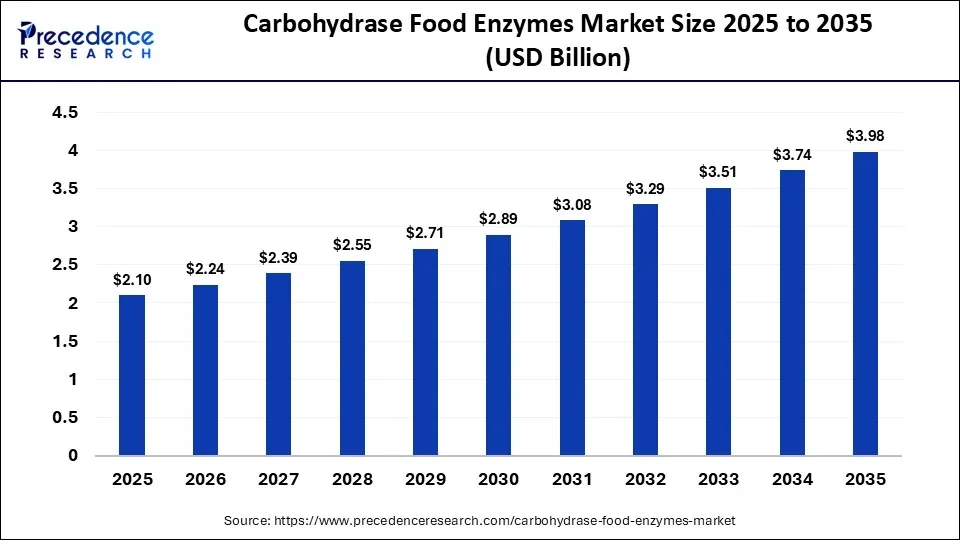
The global carbohydrase food enzymes market size was calculated at USD 2.10 billion in 2025 and is predicted to increase from USD 2.24 billion in 2026 to approximately USD 3.98 billion by 2035, expanding at a CAGR of 6.6% from 2026 to 2035. Market growth is driven by rising demand for clean-label foods, increased production of processed foods, and advances in enzyme technologies.
Key Takeaways
- North America dominated the global market in 2025.
- Asia-Pacific is expected to grow at the fastest CAGR between 2026 and 2035.
- By type, the amylase segment contributed the highest market share in 2025.
- By type, the lactase segment is expected to grow at a strong CAGR between 2026 and 2035.
- By source, the microorganisms segment held a major market share in 2025.
- By source, the plants segment is expected to expand at a rapid CAGR from 2026 to 2035.
- By application, the bakery segment captured the highest market share in 2025.
- By application, the processed foods segment is poised to grow at the fastest CAGR between 2026 and 2035.
- By form, the liquid segment generated the biggest market share in 2025.
- By form, the powder segment is expected to expand at the fastest CAGR between 2026 and 2035.
Which Factors Influence the Carbohydrase Food Enzymes Market?
The rising global demand for processed, convenience, and sustainably manufactured foods is a major driver accelerating the carbohydrase food enzymes industry. These enzymes facilitate the effective conversion of starch, better texture and less chemical consumption in modern food production.
Amylase, cellulase, and lactase are some examples of special biocatalysts that degrade complex carbohydrates to simple sugars. This is used in applications in baking, brewing, dairy substitutes, and the production of glucose syrup. Furthermore, the growing consumer preference for plant-based diets is driving the adoption of plant-derived carbohydrase enzymes in food processing.
Carbohydrase Food Enzymes Market Set to Transform the Food Industry with Rapid Regional Expansion and Innovation in Industrial Biotechnology
- Novonesis, which reported between 2024 and 2026 that it supplies food enzymes, including carbohydrases, to customers in more than 140 countries, supported by its flagship Kalundborg industrial biotechnology complex, one of the world's largest enzyme production hubs.
- North America ranks second in global carbohydrase consumption, with the United States representing the dominant share due to its large-scale corn wet milling industry, which processes over 300 million metric tons of corn annually, requiring extensive amylase and glucoamylase utilization.
- India has emerged as a major carbohydrate-consuming market, supported by its rapidly expanding packaged food sector and over 357 million metric tons of annual grain processing, increasing enzyme usage in flour standardization and baking applications.
- China has significantly expanded domestic enzyme fermentation output, as Angel Yeast increased its fermentation production capacity to over 11,000 tons annually across multiple industrial biotechnology bases, strengthening the Asia-Pacific supply of microbial food enzymes used in baking, starch, and beverage processing.
Carbohydrase Food Enzymes Market Growth Factors
- Boosting Functional Food and Nutraceutical Innovation: Increasing development of digestive health and fiber-enriched products is fueling enzyme integration for enhanced functionality.
- Driving Process Efficiency in Industrial Baking: Manufacturers are leveraging carbohydrases to improve dough handling, fermentation, and product consistency, boosting production efficiency.
- Growing Demand for Gluten-Free and Specialty Products: Expanding specialty food segments are fueling enzyme use to improve texture, taste, and shelf-life in gluten-free formulations.
Impact of Artificial Intelligence on the Carbohydrase Food Enzymes Market
Artificial intelligence (AI)) accelerates innovation in the market by enabling faster discovery of highly efficient carbohydrate-degrading enzymes. These AI systems process millions of genetic sequences and detect the variants of enzymes. They enhance the process of converting starch into a valuable product in baking. Furthermore, the AI is also useful in enhancing fermentation productivity through predicting the best growth conditions and boosting carbohydrase productivity in industrial bioreactors.
Carbohydrase Food Enzymes Market Trends
- Clean Label Processing Redefining Enzyme Demand : Food manufacturers are increasingly replacing artificial additives with biocatalytic solutions to meet clean label expectations. Enzymes allow producers to reduce emulsifiers and stabilizers while maintaining product quality and texture. Regulatory agencies and consumer surveys indicate an increased demand for ingredient disclosure, which has resulted in increased enzyme consumption in various food groups.
- Precision Fermentation Shaping Next Gen Carbohydrases Sector: Enzyme production is improving in precision fermentation processes and reducing environmental impact. Innovations in biotech increase the production of customized carbohydrases of better stability and activity. Industry forecasts show increasing adoption of precision fermentation to meet sustainability and performance targets.
Market Scope
| Report Coverage | Details |
| Market Size in 2025 | USD 2.10 Billion |
| Market Size in 2026 | USD 2.24 Billion |
| Market Size by 2035 | USD 3.98 Billion |
| Market Growth Rate from 2026 to 2035 | CAGR of 6.6% |
| Dominating Region | North America |
| Fastest Growing Region | Asia Pacific |
| Base Year | 2025 |
| Forecast Period | 2026 to 2035 |
| Segments Covered | Type, Source, Application, Form,and region |
| Regions Covered | North America, Europe, Asia-Pacific, Latin America, and Middle East & Africa |
Segmental Insights
Type Insights
Which Type Segment Dominated the Carbohydrase Food Enzymes Market?
The amylase segment dominated the market in 2025, as global baking and starch processing industries depend heavily on starch conversion efficiency. Amylase is used by industrial bakeries to hydrolyze starch into fermentable sugars and enhance the performance of dough handling to a high degree.
This application improves the volume of bread, the softness of the crumb, and the shelf life of bakery products packaged globally. Furthermore, the high demand for processed food manufacturers has been propagating widely in commercial baking and starch conversion facilities.
The lactase segment is expected to grow at the fastest CAGR in the market between 2026 and 2035, as lactose intolerance affects a large share of the global population. The demand of digestive friendly dairy products by consumers in Asia-Pacific, Europe, and North America is growing steadily. This is a health-motivated demand that highly favors the fast growth of lactase in contemporary dairy processing applications.
Source Insights
Why Did the Microorganisms Segment Dominate the Carbohydrase Food Enzymes Market?
The microorganisms segment held the largest revenue share in the market in 2025, due to the fact that fermentation in industries provides high levels of enzyme products with predictable and scalable efficiency on processing. The major manufacturers rely on bacteria and fungi to maintain stable levels of carbohydrases in the food industry around the world.
Stable species like Aspergillus and Bacillus produce stable enzymes that can be used in harsh food processing conditions. Microbial enzymes play a key role in production as of 2024, according to the Food and Agriculture Organization, a higher percentage of the world's industrial food enzyme applications rely on them. Moreover, the technological flexibility supports cost efficiency and strengthens microbial market dominance across commercial food enzyme manufacturing sectors globally.
The plants segment is expected to grow with the highest CAGR in the market during the studied years, due to rising demand for natural and clean-label ingredients. Plant-based enzymes have become the favorite of food manufacturing companies as they seek to match consumer demands of low processed foods. Furthermore, the growing clean label trends strongly support expanding adoption of plant-sourced carbohydrases across global food applications.
Application Insights
How the Bakery Segment Dominated the Carbohydrase Food Enzymes Market?
The bakery segment contributed the biggest market share in 2025, as enzyme technology improves dough handling, fermentation control, and finished product consistency. The carbs, like amylase, turn starch into fermentable sugars, which helps the yeast to ferment and make bread rise and have a good texture.
Carbohydrases are preferred by industrial producers as they minimize the use of chemical additives and enable producers to maintain the same standard of baking performance. In 2024, the European Commission Directorate-General for Health and Food Safety affirmed that the use of enzymes was in line with the clean-label bakery manufacturing goals. Additionally, bakery manufacturers worldwide adopted enzyme systems to control quality in high-speed lines of automated processing.
The processed foods segment is expected to expand rapidly in the market in the coming years, as manufacturers require enzymes to improve texture, sweetness, and stability. Starch is changed by carbohydrases into sugars, which aid in the formation of flavors and enhancing overall consistency of the product in packaged foods.
Enzyme technologies are making significant inroads in food processing by food processors in order to maximize efficiency and satisfy the changing consumer product demands. Furthermore, the increasing global consumption of packaged and ready to eat process food products further boosts the segment growth.
Form Insights
Which Form Segment Led the Carbohydrase Food Enzymes Market?
The liquid segment led the market in 2025, as manufacturers preferred direct dosing and faster integration into processing systems. Liquid enzymes are easily dissolved and aid in homogeneous mixing in brewing, baking, and starch hydrolysis processes. Factories chose liquid forms as they would be easy to automatically dose and save a lot of time in preparing the product. Moreover, food companies integrated liquid carbohydrases to maintain precise enzyme dosing and improve batch consistency, fuelling the segment's growth.
The powder segment is expected to witness the fastest growth in the market over the forecast period, owing to the need of manufacturers to have better storage stability and product shelf life. Powder enzymes are also active longer and facilitate transportation through supply chains globally. Manufacturers' preferred powder formats for packaged enzyme products serving bakery premixes and specialty foods. These technological and operational advantages are estimated to accelerate powder carbohydrase adoption in future food processing applications.
Regional Insights
Why Did North America Dominate the Carbohydrase Food Enzymes Market?
North America held a major revenue share of the market in 2025, as the region operates highly advanced commercial baking and brewing industries. Manufacturers of food added carbohydrases to enhance their efficiency, texture, and fermentation activity in a variety of foods. Major producers of enzymes, such as International Flavors and Fragrances, increased the capacity of enzyme production and innovation in the U.S.
Good biotechnology infrastructure assisted in the fast commercialization of improved enzyme technology towards industrial food production. The presence of strong regulations made companies implement the use of enzyme processing to assist in achieving clean labeling and efficiency objectives. Furthermore, the close partnership between biotechnology companies and food processors has been one of the factors that has accelerated the uptake of industrial enzymes in North America.
U.S. Strengthening North America's Leadership in the Market
U.S. leads the market due to the presence of advanced enzyme manufacturing ecosystems. The use of carbohydrases became widespread in large food companies in a bid to enhance efficiency, uniformity of products, and control fermentation in production plants. International Flavors and Fragrances and other enzyme producers increased domestic biotechnology and fermentation production infrastructure.
Why is Asia-Pacific Growing in the Carbohydrase Food Enzymes Market?
Asia-Pacific is expected to witness the fastest growth during the predicted timeframe, owing to the rapid and continuous expansion of processed food production. The growth of the urban population positively affected the demand for bakery, dairy, and convenience food products that needed support in the form of enzyme processing.
Carbohydrases were incorporated in regional manufacturing in order to enhance the efficiency of production and meet consumer demand. Companies like Advanced Enzymes and others increased enzyme production capacity to achieve growth in the regional food industry. Additionally, the increased investment in the power of biotechnology innovation is expected to enhance regional leadership in future applications of enzymes.
China Emerging as Asia-Pacific's Fastest-Growing Country in the Market
China is leading the charge in the Asia-Pacific market due to the growing consumption of processed food. Domestic food producers incorporated carbohydrases to enhance the efficacy of converting starch into fermentation and high production productivity. Enzyme manufacturers like Sunson Industry Group were increasing their production capacity in response to the domestic and export demand. The fast rate of industrialization reinforced the demand in the bakery, brewing, and processed food production industries.
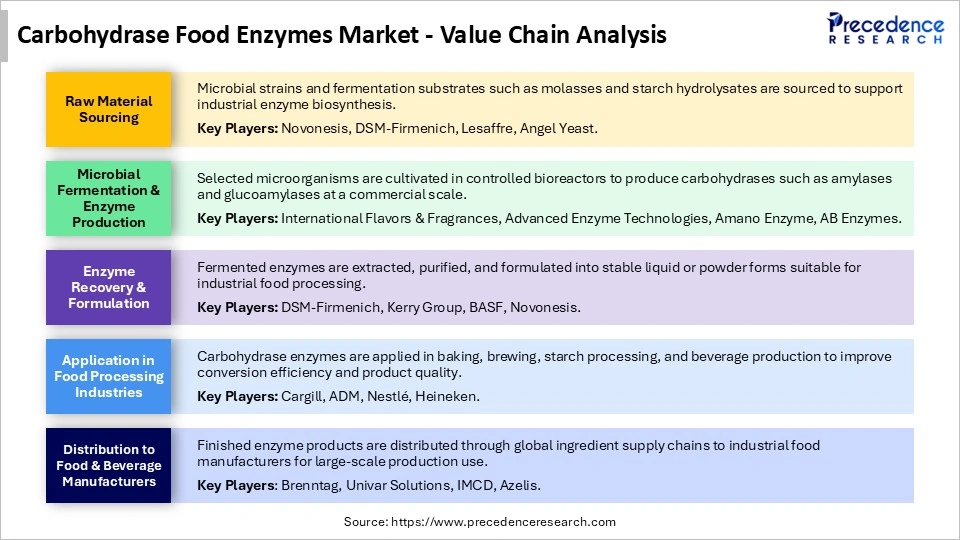
Carbohydrase Food Enzymes Market Value Chain Analysis
Carbohydrase Food Enzymes Market Companies
- Novozymes
- DuPont Danisco
- DSM
- AB Enzymes
- BASF
- Chr. Hansen
- Amano Enzyme Inc.
- Advanced Enzyme Technologies
- Enzyme Development Corporation
- Specialty Enzymes & Biotechnologies
Recent Developments
- In October 2025, BASF announced a strategic collaboration with IFF to accelerate the development of IFF's Designed Enzymatic Biomaterials platform. This partnership focuses on next-generation enzyme technologies for fabric care, dishwashing, personal care, and industrial cleaning, reinforcing both companies' commitment to sustainable innovation and biotechnology-driven solutions.
- In October 2024, Biocatalysts Ltd, a global leader in specialty enzyme development, launched a new enzymatic solution aimed at enhancing flavor profiles in enzyme-modified dairy ingredients. The innovation addresses rising demand for high-quality, natural flavors, offering dairy manufacturers a novel approach to improving taste and consumer appeal.(Source: https://www.biocatalysts.com)
- In November 2024, International Flavors & Fragrances (IFF) introduced TEXSTAR, an advanced enzymatic texturizing solution for dairy and plant-based fresh fermented products. TEXSTAR provides optimal viscosity without added stabilizers, enabling manufacturers to create distinctive textures with familiar ingredients while improving supply chain resilience and reducing Scope 3 emissions associated with texturants.(Source: https://www.iff.com)
Segments Covered in the Report
By Type
- Amylase
- Cellulase
- Lactase
- Pectinase
- Others
By Source
- Microorganisms
- Plants
- Animals
By Application
- Bakery
- Dairy
- Beverages
- Processed Foods
- Others
By Form
- Liquid
- Powder
- Granules
By Region
- North America
- Europe
- Asia-Pacific
- Latin America
- Middle East & Africa
For inquiries regarding discounts, bulk purchases, or customization requests, please contact us at sales@precedenceresearch.com
Frequently Asked Questions





Ask For Sample
No cookie-cutter, only authentic analysis – take the 1st step to become a Precedence Research client
 Get a Sample




 sales@precedenceresearch.com
 Schedule a Meeting
