



Cold Chain Market Size, Key Companies, Company Market Share, Vehicle Production Volume, Sales Performance, Export & Import Analysis, Technology Adoption, Market Share, and Demand Trends
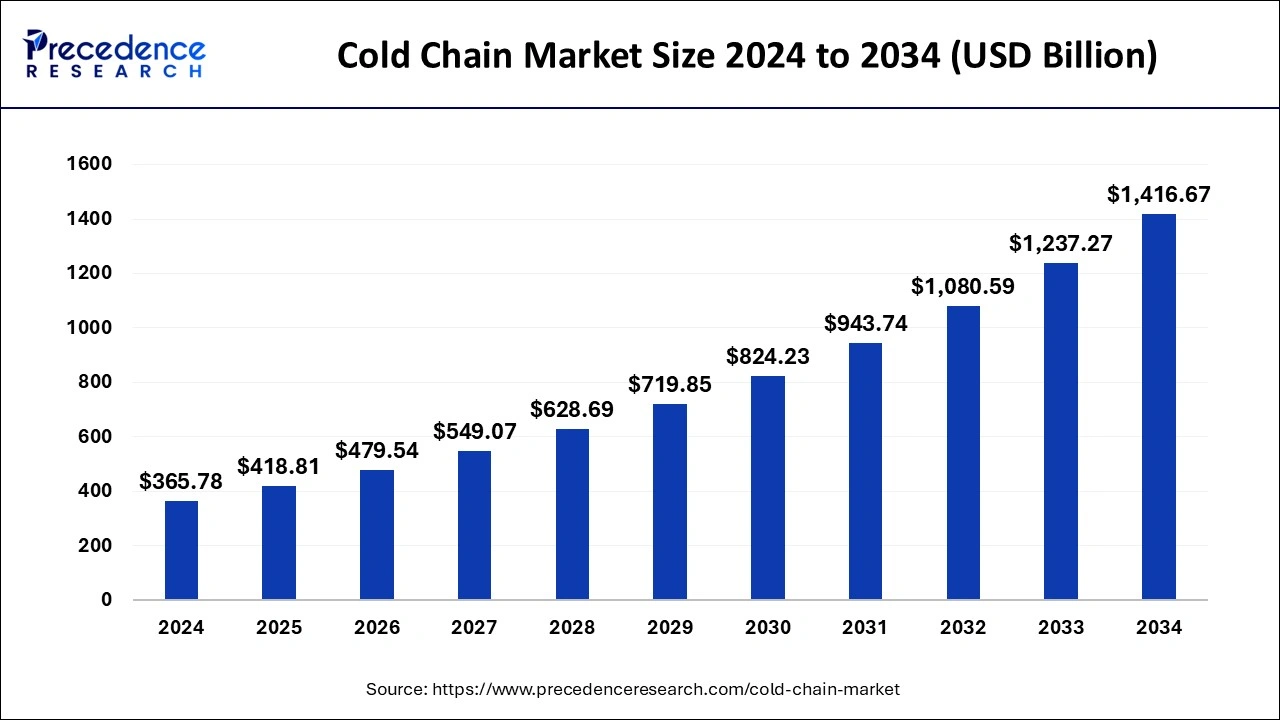
The global cold chain market was valued at USD 479.54 billion in 2026 and is projected to grow from USD 479.54 billion in 2026 to USD 1,580.92 billion by 2035, expanding at a CAGR of 14.21% during the forecast period. Market growth is driven by rising demand for temperature-controlled logistics in the food, pharmaceutical, and biotechnology sectors, increasing organized retail, expanding e-commerce, and growing investments in cold storage infrastructure. The adoption of AI, IoT, RFID, automation, and sustainable refrigeration technologies is further improving supply chain efficiency, product traceability, and regulatory compliance, accelerating global market expansion.
Source: https://www.precedenceresearch.com/cold-chain-market
 Get a Sample
 Table Of Content


What is the Cold Chain Market Size?
The global cold chain market size is calculated at USD 418.81 billion in 2025 and is predicted to increase from USD 479.54 billion in 2026 to approximately USD 1,580.92 billion by 2035, expanding at a CAGR of 14.21% from 2026 to 2035. An increasing number of organized retail stores in developing economies is leading to the growing demand for cold chain solutions. Rising investments in cold chains and various government initiatives aiming to minimize food waste are expected to boost market growth. The growing adoption of technologies such as RFID and automation in cold chain applications also helps to provide significant growth opportunities in the market.
Key Takeaway
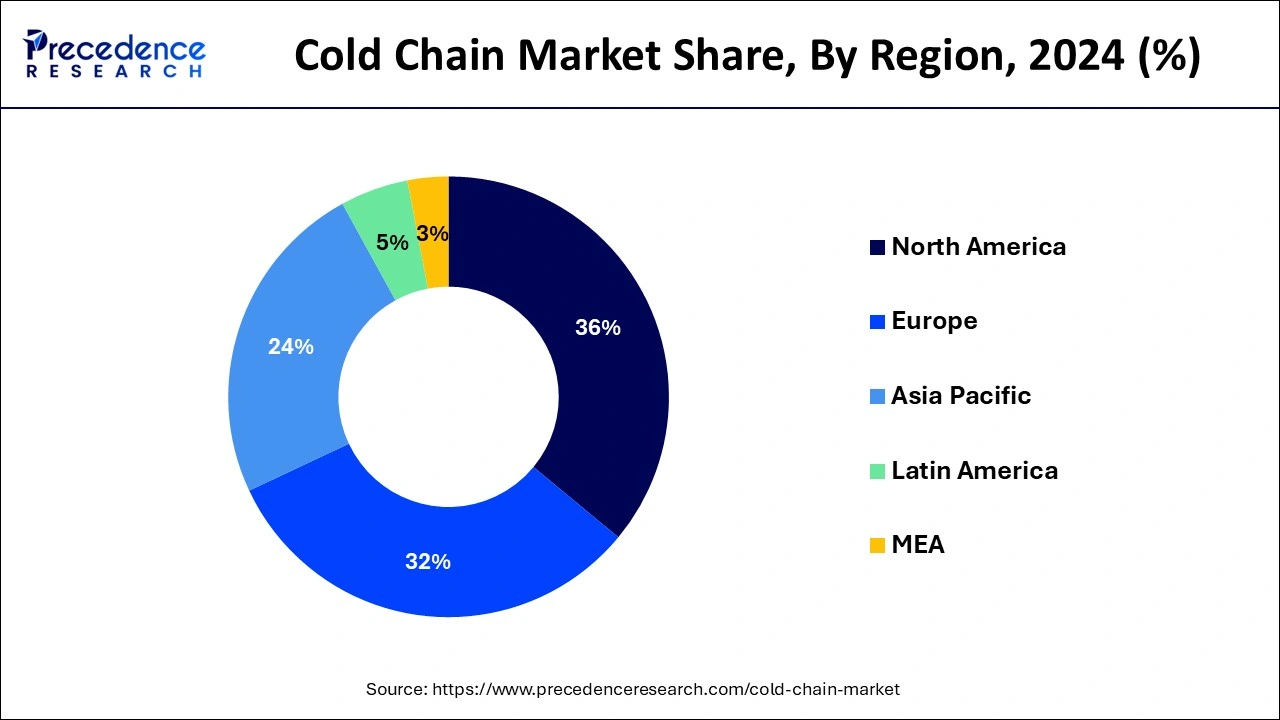
- The North America market has garnered a revenue share of around 36% in 2025.
- By type, the storage segment has accounted highest revenue share of around 60% in 2025.
- By packaging, the product packaging segment has captured a revenue share of around 74% in 2025.
- By equipment, the storage equipment segment has contributed a revenue share of around 76% in 2025.
- By application, the fish, meat, and seafood segment accounted highest revenue share of around 24% in 2025.
Market Overview
The cold chain market is a critical logistics and infrastructure ecosystem that is designed to maintain temperature-controlled environments across storage, transportation, and distribution. This market supports industries where product integrity, safety, and shelf stability are essential, including food, pharmaceuticals, biotechnology, and even chemicals. Cold chain systems integrate refrigeration technologies, monitoring software, insulated packaging, and specialized logistics services. The market continues to expand as global supply chains become more complex and quality-driven. It is witnessing a strong demand for traceability, automation, and regulatory compliance.
Impact of AI in the Cold Chain Market
Artificial Intelligence (AI) has emerged as a transformative tool in cold chain logistics, offering solutions to improve asset management, forecasting, and operational efficiency. AI-driven solutions are increasingly being deployed in order to enhance decision-making, streamline logistics, and ensure that products stay in optimum condition.
AI tools help minimize the risk of cold chain failures by monitoring shipment conditions and ensuring containers are available when needed. By enabling proactive adjustments to logistics, AI helps customers receive containers on time and in optimal condition. The AI demand-forecasting system also helps to predict container needs weeks in advance, positioning containers in anticipation of demand, reducing bottlenecks, and preventing delays.
AI tools and systems also help in optimizing container availability by balancing the locations of inbound and outbound containers, significantly improving fleet utilization, reducing inefficiencies, and maintaining timely delivery. Additionally, the system also suggests cost-effective routes that help reduce transportation costs, ensuring better resource allocation and more predictable logistics. Furthermore, AI's ability to process real-time data alongside advanced analytics allows for quick, informed responses to disruptions or demand fluctuations. This helps create a more agile logistics network, reducing delays and enhancing operational efficiency.
Cold Chain Market Growth Factors
With the rapid technological advancements, the manufacturers of the temperature sensitive products are now extensively using the cold chain supply system and this is expected to drive the growth of the cold chain market. Furthermore, rise in demand for the temperature sensitive products such as meats, medicines and others across the globe have boosted the growth of the cold chain market.
The trade liberalization, focus on reducing food waste and expansion of retail chain in the market is anticipated to fuel the growth of the cold chain market. Furthermore, the rising disposable income of the consumers and the desire to consume ready to eat food products that needs to be preserved in a temperature-controlled environment is estimated to drive the growth of the cold chain market.
In recent times, there is a shift to protein rich foods in the developing economies and this factor is anticipated to drive the growth of the cold chain market. The surge in demand for refrigerated transportation vehicles in order to transport the perishable food product will contribute significantly in the growth of the cold chain market.
Furthermore, the growing Governments subsidies in order to boost the cold chain market are also a major attribute that will boost the growth of the cold chain market. Moreover, the significant growth of the ecommerce industry that delivers the perishable products is anticipated to fuel the growth of the cold chain market.
Market Trends
- Technological Advancements: The market is witnessing a surge in technological innovations that enhance operational efficiency. Automation, IoT, and data analytics are increasingly being integrated into logistics processes, allowing for real-time monitoring of temperature-sensitive goods. These advancements not only help to improve tracking but also facilitate proactive decision-making, thus reducing spoilage and ensuring product integrity.
- Sustainability Initiatives: Sustainability is becoming increasingly vital in the global market landscape. Companies are increasingly adopting eco-friendly practices, such as utilizing energy-efficient refrigeration systems and sustainable packaging materials. This trend reflects a broader commitment to reducing environmental impact while also meeting consumer demand for responsibly sourced products.
- Regulatory Compliance: The market is heavily influenced by stringent regulatory requirements aimed at ensuring food safety and quality. As regulations evolve, companies are adapting and modifying their practices in order to comply with these standards.
Market Outlook
- Industry Growth Overview: The global market is rapidly growing due to increasing consumer necessity for fresh food delivery, reduced food waste, surging demand for perishable foods and temperature-sensitive pharmaceuticals, and rapid expansion in e-commerce. Additionally, adoption of advanced technologies and a shift toward automated refrigerated warehousing and advanced phase-change materials for precise temperature maintenance.
- Global Expansion: The growth of hypermarkets and organized food retail in emerging economies drives a critical need for refrigerated storage, with streamlining regulatory frameworks and pilot programs by agencies like the U.S. FDA actively accelerating global manufacturing and supply chain buildouts.
- Major Investors: Key logistics and infrastructure corporations like Americold, Lineage Logistics, and DHL lead capital deployment. Furthermore, private equity and specialized real estate investment trusts heavily finance temperature-controlled facilities.
- Startup Ecosystem: Vibrant innovative startups mainly focus on modular, solar-powered cold rooms and AI-driven route optimization to lower spoilage. Emerging tech ventures also offer compact IoT data loggers for granular supply chain visibility.
- Sustainability Trends: Government frameworks focus on low-global warming potential refrigerants and energy efficiency through initiatives like the India Cooling Action Plan, while public agencies such as the Bureau of Energy Efficiency enforce stricter energy-performance standards for cold storage facilities to reduce total power consumption.
Market Report Coverage and Key Metrics
| Report Coverage | Details |
| Market Size in 2025 | USD 418.81 Billion |
| Market Size in 2026 | USD 479.54 Billion |
| Market Size by 2035 | USD 1,580.92 Billion |
| Growth Rate from 2026 to 2035 | CAGR of 14.21% |
| Largest Market | North America |
| Fastest Growing Market | Asia Pacific |
| Base Year | 2025 |
| Forecast Period | 2026 to 2035 |
| Segments Covered | Type, Sector, Temperature Type, Packaging, Application, Region |
| Regions Covered | Asia Pacific, North America, Europe, Latin America, Middle East and Africa |
Market Dynamics
Driver
Rising Demand for Perishable Goods and Globalization of Food Supply Chains
The market is experiencing a surge in demand for perishable goods, driven by changing consumer preferences and increased health consciousness. As consumers increasingly seek fresh produce, dairy products, and pharmaceuticals, the need for efficient cold chain logistics becomes crucial, thus reflecting the growing importance of maintaining product integrity throughout the supply chain.
The globalization of food supply chains is also another key market driver that is propelling the market forward. As countries all over the world engage in international trade, the need for efficient cold chain logistics becomes increasingly vital to maintain product quality across borders. This is due to the growing import and export of perishable goods, which require specialized handling and transportation, further driven by the need for reliable cold chain solutions that can accommodate the complex nature of global trade.
Restraint
High Infrastructure and Operational Complexities
Despite promising growth prospects, the cold chain market does go through its fair share of challenges. One such challenge is the high capital and operational complexity associated with cold storage and refrigerated transport. The market does face challenges related to energy consumption, equipment maintenance, and skilled labor requirements. Smaller logistics providers often struggle to invest in advanced refrigeration systems and monitoring technologies. Additionally, maintaining consistent temperature conditions across long distances increases operational risk. These factors can limit market expansion in emerging regions and create barriers to entry for new participants.
Opportunity
Technological Advancements and Expansion of E-commerce
Technological innovations are playing a pivotal role in the market, opening up several opportunities for innovation and growth. The integration of IoT devices, temperature monitoring systems, and automated warehousing solutions now enables real-time tracking and management of temperature-sensitive products. These advancements not only help to improve operational efficiency but also reduce spoilage rates. As companies increasingly adopt these technologies, the market is poised for substantial growth in the upcoming years.
The rapid expansion of e-commerce and online grocery shopping is also another such opportunity that is reshaping the market. As consumers increasingly turn to online platforms for their grocery needs, the demand for efficient cold chain logistics solutions has further intensified. This shift is particularly evident in the rise of home delivery services for perishable items, necessitating reliable temperature-controlled transportation.
Market Segmentation Analysis
Type Insights
Which Type Segment Dominated the Cold Chain Market?
The storage segment dominated the market in 2025. This dominance is due to the surge in demand for ready-to-eat and frozen foods across the globe. The rapidly changing lifestyles of consumers and their dietary patterns are driving the demand for packaged food products, and this attribute is estimated to drive the growth of the market.
The monitoring components segment is expected to expand rapidly in the coming years, due to the need for continuous tracking of products under the cold chain. The availability of a wide range of products, from hardware to software, simplifies the tasks of operators. Technological advancements over the past decades have led to the development of wireless sensors, cloud-based platforms, and automated alert systems.
Sector Insights
Which Sector Segment Led the Cold Chain Market?
The public segment led the global market in 2025. This dominance can be attributed to the fact that these cold storages are operated by the government in order to preserve the vegetables, medicines, and other temperature-sensitive products. The public cold chain needs to be maintained properly, as a huge number of products are generally stored and managed.
The private segment is expected to have the fastest growth throughout the forecast period, due to the increase in demand for perishable food products such as milk, meat, cheese, and others. The rapid growth in the demand for packaged food products across the globe is also set to contribute significantly to the growth of the cold chain market. Moreover, the continuous research and developmental activities performed by major market players to develop advanced cold chain systems propel the segment's growth.
Temperature Type Insights
Why Did the Chilled Segment Dominate the Cold Chain Market?
The chilled segment dominated the market in 2025, due to its versatility and the broad range of products it supports. This segment caters to a wide range of perishable products, including dairy, fruits, and vegetables. It is characterized by temperatures generally between 1°C and 5°C, ensuring the freshness of perishable goods. This segment also caters to diverse industries, including food and beverage, pharmaceuticals, and even cosmetics.
The frozen segment is expected to grow at the fastest CAGR throughout the forecast period, driven by the increasing consumer demand for convenience foods and meal solutions that require frozen storage. The market is also experiencing rapid growth as the demand for frozen foods rises globally due to changing consumer preferences and increased online grocery shopping. The evolution of freezer technologies and efficient logistics practices also boosts this segment further, leading to better storage solutions and distribution networks.
Market Regional Analysis: North America, Europe, Asia-Pacific
North America Market Outlook
North America hold the largest revenue share contributing more than 36% in 2025 and is expected to remain in dominant position during the forecast period. The significant growth in this region is due to the presence of major market players continuously involved in developing new technologies to produce an energy efficient cold chain system. Furthermore, the increasing demand for the perishable food products in the North American market contributes significantly towards the growth of the cold chain market.
What is the U.S. Cold Chain Market Size?
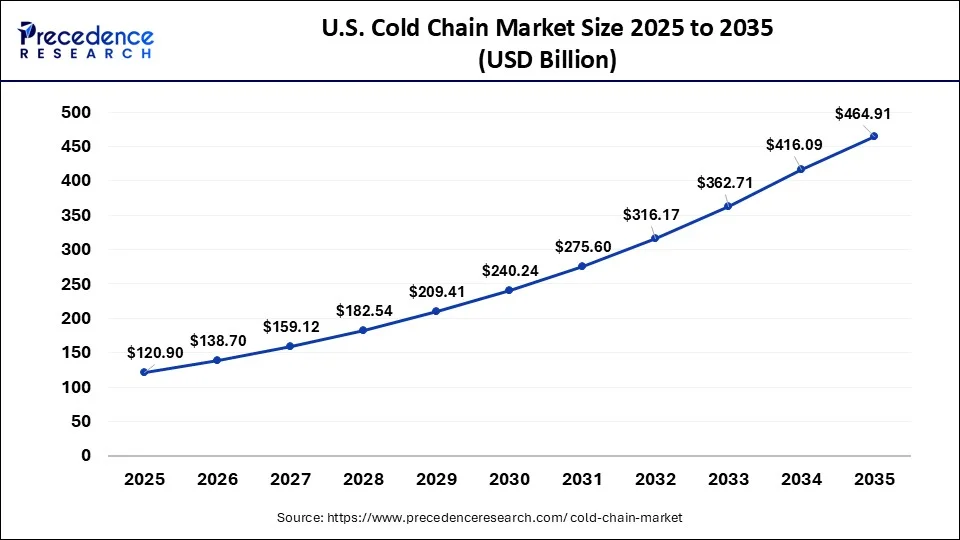
The U.S. cold chain market size was estimated at USD 120.90 billion in 2025 and is predicted to be worth around USD 464.91 billion by 2035, at a CAGR of 14.42% from 2026 to 2035.
- For instance, in April 2025, Identiv, Inc., a digital security and Internet of Things technology company and Tag-N-Trac formed a new strategic business development and marketing partnership, for developing and commercializing a smart labelling solution for cold chain tracking across pharmaceutical supply chains. The alliance aims at delivering real-time and item-level visibility insights from origin to delivery by leveraging Tag-N-Trac's SaaS platform, RELATIVITY combined with Identiv's advanced BLE smart labels designed for capturing raw environmental data throughout the transportation of a product.
U.S Market Trends
The region has a dense network of refrigerated warehouses, cold storage hubs, and temperature-controlled transportation fleets. The widespread adoption of automation, robotics, and digital temperature monitoring across storage and transport operations is also a significant growth factor. High consumption of frozen food, dairy products, and processed meals significantly drives cold chain demand in the country.
Asia-Pacific Market Outlook
Asia Pacific region is anticipated to be the fastest growing region owing to the rise in Government investments in order to develop advanced logistics infrastructure. In this region, China is expected to hold a significant share owing to the rise in demand for technological advancements in food processing, packaging and storage of seafoods. Moreover, the development in the pharmaceutical sector in India and China will fuel the growth of the cold chain market in this region.
China Market Trends
The country is characterized by high standards of precision and quality control. The country's strong pharmaceutical and seafood industries rely heavily on temperature-controlled logistics, leading to growth and innovation. High consumer expectations for freshness further support cold chain utilization.
Europe Market Outlook
Europe shows a significant growth during the forecast period. It is driven by the surging need for temperature-controlled logistics in the food and pharmaceutical sectors. The rapid expansion in need for vaccines and temperature-sensitive biologics, like mRNA, monoclonal antibodies, and cell or gene therapies, necessitates highly specialized, ultra-low temperature, and compliant logistics, with remarkable investments in this sector.
Germany Market Trends
The region's growth is fueled by increasing consumer demand for fresh and organic products, alongside stringent regulations on food safety and quality. The European Union's regulations, such as the General Food Law, mandate strict compliance for temperature-controlled logistics, driving investments in cold chain infrastructure. The market is also witnessing collaborations between logistics providers and food manufacturers, which will ensure a robust cold chain ecosystem.
Latin America Market Outlook
Latin America shows a notable growth during the forecast period. It is driven by busy lifestyles, growing disposable incomes, and urbanization. Increased consumption of meat, seafood, and dairy demands stringent, uninterrupted temperature-controlled storage and even logistics to guarantee safety and quality. Significant investments in modern warehouses and refrigerated transport, alongside infrastructure facilities, mainly in Brazil, are facilitating better, more reliable cold chain logistics.
Brazil Market Trends
This region's growth is driven by increasing urbanization, rising disposable incomes, and a growing demand for perishable goods. The region's regulatory landscape is evolving, with new policies promoting the development of cold chain infrastructure to meet the rising demand for temperature-sensitive products. The competitive landscape is characterized by a mix of local and international players, all competing to enhance their service offerings and operational efficiencies.
Middle East and Africa Market Outlook
MEA shows a rapid growth during the forecast period. This is due to the rising need for pharmaceutical and fresh food products, which demand strict, reliable temperature control to guarantee safety and quality. Technologies such as IoT sensors, GPS, and cloud analytics enable real-time monitoring and visibility, which assists prevent, detecting, and fixing temperature fluctuations that cause food and drug spoilage. AI and big data analytics are used to improve supply chain routes, manage inventory, and forecast disruptions, reducing overall operational expenses.
Saudi Arabia Market Trends
The country's growth is driven by increasing investments in infrastructure and a rising demand for perishable goods, particularly in the food and pharmaceutical sectors. The competitive landscape is evolving at a steady pace, with a high focus on improving logistics capabilities and adopting new technologies.
Regulatory Guidelines for the Cold Chain Market
- U.S. FDA Regulations: Enforce 21 CFR 211.142 to avoid quality loss by storing drugs under proper temperature, humidity, and light for storage and handling. Supply chain security further implements the Drug Supply Chain Security Act (DSCSA) for electronic tracking and serialization across transport networks.
- EU Guidelines: Enforce EU Good Distribution Practice (GDP) guidelines (2013/C 343/01) to keep products in safe conditions. Monitoring and alarms require continuous temperature tracking using calibrated tools and instant deviation alarms.
- India CDSCO Mandates: Good Distribution Practices for pharmaceutical and biological products enforce strict warehouse and transit control through mandatory Infrastructure Qualification. This requires adherence to revised Schedule M standards, including mandatory Equipment Qualification (IQ/OQ/PQ) and automated deviation logging for all cold rooms and reefer transport.
Supply Chain Analysis
- Research and Development: It focuses on identifying target genes, developing vectors, and initial lab testing.
Key Players: Novartis, Pfizer, Sarepta Therapeutics, Charles River Laboratories, and IQVIA. - Clinical Trials and Regulatory Approval: This involves conducting human safety testing and handling global regulatory submissions.
Key Players: Sarepta Therapeutics, Novartis, and Bluebird Bio. - Manufacturing: This focuses on the production of complex viral vectors and sterile final drug formulations.
Key Players: Catalent, Lonza, FUJIFILM Diosynth Biotechnologies, Biogen, and Gilead Sciences. - Logistics and Patient Delivery: This primarily focuses on leveraging specialized cryogenic and cold chain systems for global transport.
Key Players: DHL Group, FedEx Logistics, Marken, and UPS Healthcare. - Treatment and Commercialization: This focuses on managing patient administration in certified centers and high-value payments.
Key Players: Novartis, Roche, Vertex, and St. Jude Children's Research Hospital.
Market Competitive Landscape: Leading Companies and Strategies
The global cold chain market is currently characterized by a dynamic competitive landscape, driven by the increasing demand for temperature-sensitive products across various sectors, including pharmaceuticals, food and beverage, and biotechnology. Key players are actively engaging in strategies that emphasize innovation, digital transformation, and strategic partnerships to enhance operational efficiency and customer service.
In terms of business tactics, companies are increasingly localizing their operations to optimize supply chains and reduce lead times. The market structure appears to be moderately fragmented, with several key players holding substantial market shares. This fragmentation allows for a diverse range of services and innovations, as companies strive to differentiate themselves in a competitive landscape.
Cold Chain Market Companies
Agro Merchant Group: AGRO Merchants Group provides comprehensive global cold chain solutions, specializing in refrigerated warehousing and transportation, along with value-added services for food and perishables.
Creopack: Creopack provides specialized cold chain packaging solutions aiming on protecting temperature-sensitive goods via custom, durable, and protective materials engineered for shipping, storing, and handling. They offer moisture-barrier packaging along with custom-designed cases that safeguard products from environmental damage during transit.
Cold Box Express Inc.: Cold Box Express Inc. provides active, palletized, battery-functioned temperature-controlled containers for shipping as well as storing sensitive cargo, offering a sustainable option to traditional refrigerated trucks.
Other Major Key Players
- Nordic Logistics and Warehousing LLC
- Preferred Freezer Services LLC
- Cold Chain Technologies Inc.
- Cryopack Industries Inc.
Recent Developments in the Cold Chain Market (2025–2026)
- In March 2026, DB Schenker launched a new AI digital platform aimed at enhancing visibility and tracking within its cold chain operations. This initiative is indicative of the broader trend towards digitalization in the logistics sector, as companies seek to provide real-time data and improve customer experience. The platform is expected to streamline operations and enhance supply chain transparency, which is increasingly critical in today's market. (Source: https://ports.marinelink.com)
- In October 2025, Lineage Logistics unveiled its new state-of-the-art cold storage facility in the Midwest, equipped with advanced automation technologies. This facility is expected to significantly increase the company's storage capacity and operational efficiency. The investment reflects Lineage's commitment to leveraging technology to improve service delivery and meet the rising demand for cold storage solutions, particularly in the food sector. (Source: https://ir.onelineage.com)
- In May 2025, Cold Chain Technologies (CCT), a provider of insulated packaging solutions, launched its latest product, TRUEtemp Naturals Shipper which is designed for first-mile, parcel-sized shipments offering a truly curbside recyclable, universal solution combining strong thermal performance, operational efficiency and cost-effectiveness, while retaining CCT's dedication for innovation and sustainability in cold chain logistics. The new product is qualified for ISTA 7E RFG profile and ensures a reliable temperature control within a range of 2°C – 8°C for up to 48 hours.
- In May 2024, Identiv collaborated with InPlay Inc., a pioneering technology company, for developing an innovative portfolio of Bluetooth Low Energy (BLE) enabled smart labels for industrial IOT applications. InPlay's IN100 NanoBeacon SoC will power the smart labels enabling real-time tracking capabilities as well as sensor integration for temperature, humidity and motion monitoring with potential for high-value applications in asset tracking, cold-chain compliance, and pharmaceutical and food logistics.
- In April 2025, Thermo King and Range Energy announced the conduction of operational trials which are designed for testing the capacity, capability and functionality of an electrified refrigerated transport technology with the potential for transforming the cold chain transport technology. With plans for large-scale deployment in late 2025, this latest line of cold chain electrification solution aims for setting a new standard in low-to no-carbon refrigerated transport.
- In April 2025, DHL Group, a leading shipping and logistics company, announced an investment of about $2.2 billion for strengthening its biopharma cold chain operations. The company plans at investing half of the total in Americas, while the remaining half will be split between Asia Pacific region, Europe, Middle East and Africa in the upcoming 5 years.
Segments Covered in the Report
By Type
- Storage
- Warehouses
- On-grid
- Off-grid
- Reefer Containers
- Warehouses
- Monitoring Components
- Hardware
- Software
- Transportation
- Road
- Sea
- Rail
- Air
By Sector
- Private
- Cooperative
- Public
By Temperature Type
- Frozen
- Chilled
By Packaging
- Product
- Crates
- Dairy
- Pharmaceuticals
- Fishery
- Horticulture
- Insulated Containers & Boxes
- Payload Size
- Large (32 to 66 liters)
- Medium (21 to 29 liters)
- Small (10 to 17 liters)
- X-small (3 to 8 liters)
- Petite (0.9 to 2.7 liters)
- Type
- Cold Chain Bags/Vaccine Bags
- Corrugated Boxes
- Others
- Payload Size
- Cold Packs
- Labels
- Temperature-controlled Pallet Shippers
- Crates
- Materials
- Insulating Materials
- EPS
- PUR
- VIP
- Cryogenic Tanks
- Others (Insulating Pouches, Hard Cased Thermal Boxes, and Active Thermal Systems)
- Refrigerants
- Fluorocarbons
- Inorganics
- Ammonia
- CO2
- Hydrocarbons
- Fluorocarbons
- Insulating Materials
By Application
- Fruits & Vegetables
- Fruit Pulp & Concentrates
- Dairy Products
- Milk
- Butter
- Cheese
- Ice cream
- Fish, Meat, and Seafood
- Processed Food
- Pharmaceuticals
- Vaccines
- Blood Banking
- Bakery & Confectionary
- Others (Ready-to-Cook, Poultry)
By Geography
- North America
- U.S.
- Canada
- Mexico
- Europe
- U.K.
- Germany
- France
- Russia
- Italy
- Spain
- Rest of Europe
- Asia Pacific
- China
- India
- Japan
- South Korea
- Rest of Asia-Pacific
- LAMEA
- Latin America
- Middle East
- Africa
For inquiries regarding discounts, bulk purchases, or customization requests, please contact us at sales@precedenceresearch.com
Frequently Asked Questions
Tags





Ask For Sample
No cookie-cutter, only authentic analysis – take the 1st step to become a Precedence Research client
 Get a Sample




 sales@precedenceresearch.com
 Schedule a Meeting
