



Computed Tomography Market Size, Key Companies, Company Market Share, Patient Volume, Treatment Adoption Rates, Pricing Analysis, Regulatory Landscape, Competitive Positioning, and Demand Forecast
Computed Tomography Market (By Technology: High slice, Mid slice, Low slice, Cone beam; By Application: Neurology, Orthopedics, Oncology, Cardiovascular, Respiratory, Gastrointestinal, Others; By Modality: O arm, C arm; By End-User: Hospitals, Ambulatory surgery centers, Health clinics, Diagnostics imaging centers, Others) - Global Industry Analysis, Size, Trends, Leading Companies, Regional Outlook, and Forecast 2026 to 2035
Source: https://www.precedenceresearch.com/computed-tomography-market
 Get a Sample
 Table Of Content


What is the Computed Tomography Market Size?
The global computed tomography market size is calculated at USD 6.89 billion in 2025 and is predicted to increase from USD 7.36 billion in 2026 to approximately USD 13.21 billion by 2035, expanding at a CAGR of 6.73% from 2026 to 2035. Rising prevalence of chronic disorders and advancements in computed tomography are driving the market.
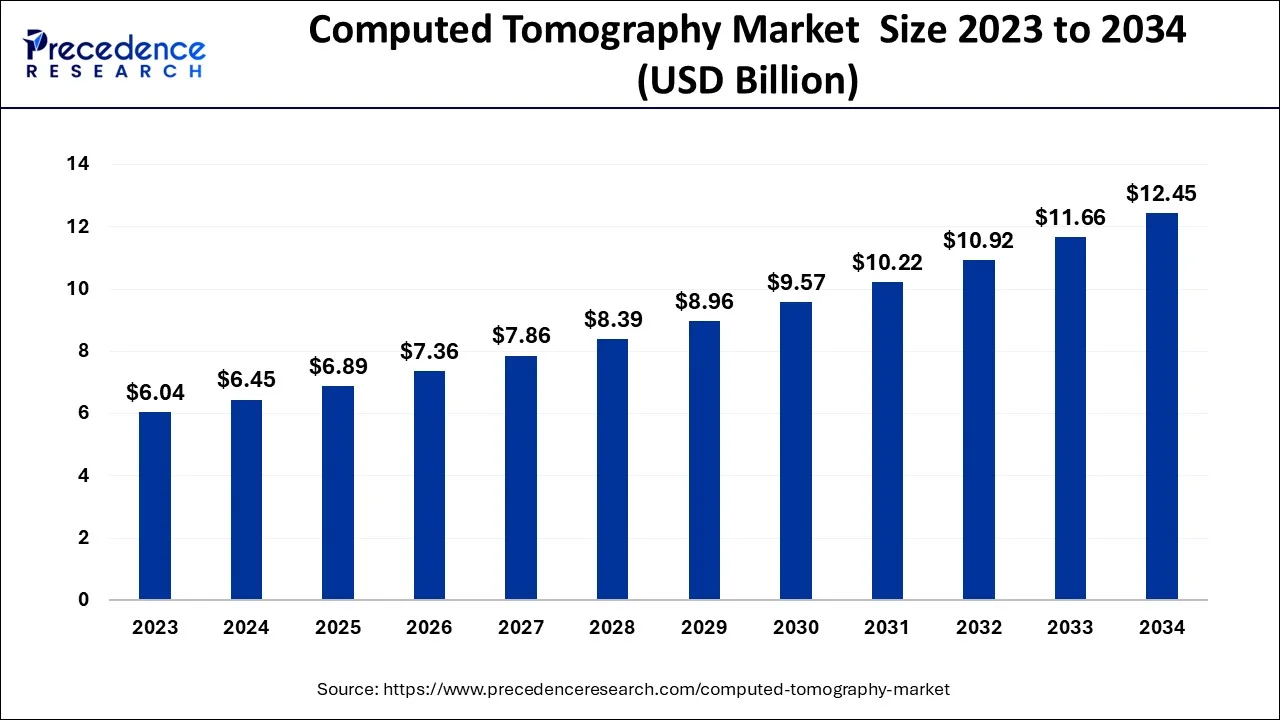
Computed Tomography Market Key Takeaways
- By technology, the high-end slice (more than 64 slices) segment reached highest market share of over 35.4% in 2025.
- The CBCT segment is growing at the strongest CAGR over the forecast period.
- By application, the oncology segment has accounted market share of over 26.9% in 2025.
- By end user, the hospitals & clinic segment has contributed 49% market share in 2025.
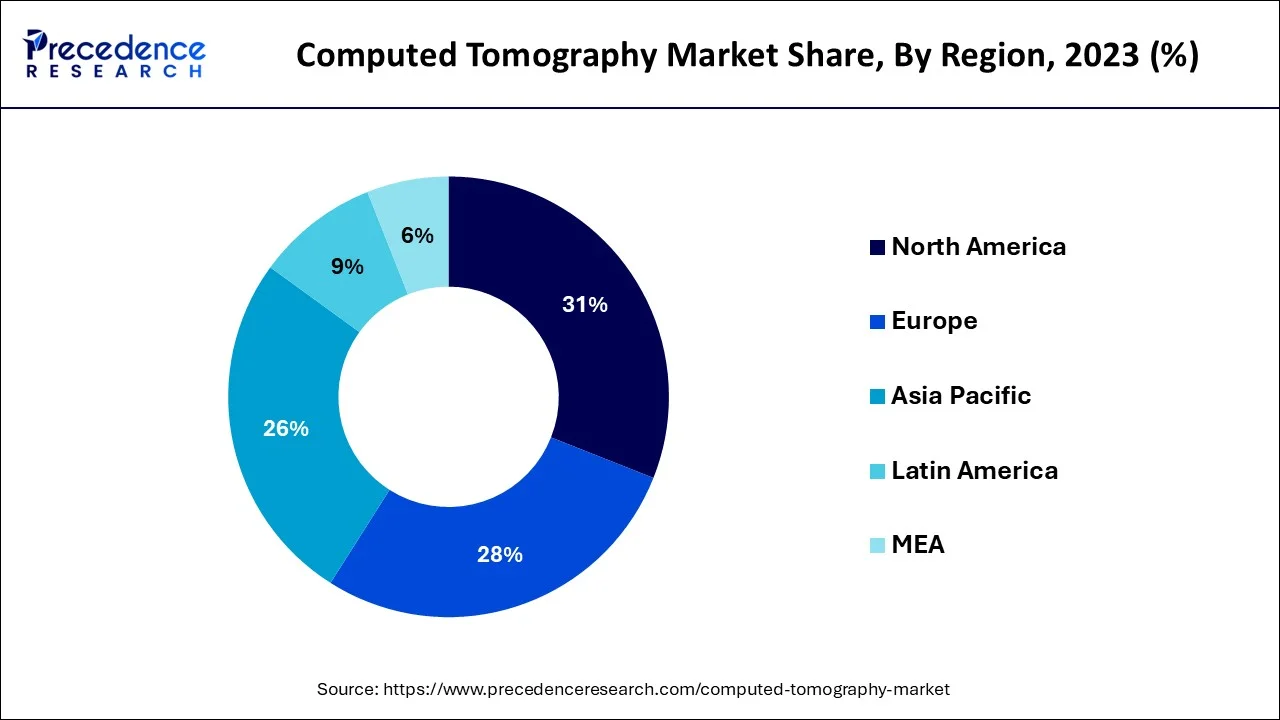
- North America has held market share of over 31% in 2025.
- The Asia Pacific market is expected to witness a highest CAGR from 2026 to 2035.
Market Overview
Computed tomography scan gradually named as CT scan widely used technology in medical sector with increased imaging of the organs in the body with increased detail information of the organs with developed technologies such as radiology with increased demands from the market. Utilization of X-ray tubes with detectors placed in the CT scanners for measuring the attenuations and diagnosis of the organs and tissues in the body. Major tool to be used in medical for imaging with utilization of x-ray imaging and ultrasonography. Widely used in screening and diagnosis of the disorder and increased therapeutics effect in various disorders.
The enhance benefits from the computed tomography with improved advance technologies, diagnosis, mitigation and prevention of the disorders and increased medical procedures with increased efficiency, reduced time of operation, cost effectivity impels the market to grow. Computed tomography developed as fast imaging of the organs and quick results with increase in treatment during the emergency conditions or road accidents taking place urge the market of computed tomography with increased value of the computed tomography.
Impact of covid-19 led to positive affect with increasing wide spread of corona virus among the population and increased patients with imaging of the organs, tissues, blood vessels and other organs with increased diagnosis of the disorder. Increasing prevalence of chronic disorders and increased imaging with enhance benefits from the computed tomography. Increased digitalization in medical sector with electrification system involved with software developed with increased connectivity for easy access of the results which drives the market of computed tomography during the forecast period.
How is AI Influencing the Computed Tomography Industry?
AI is changing the computed tomography industry by allowing faster image acquisition, enhancing diagnostic accuracy, and decreasing radiation doses through advanced, intelligent image reconstruction along with denoising techniques. AI utilizes convolutional neural networks to perform "denoising" and even artifact correction, significantly improving image quality even when utilizing lower radiation doses.
AI automates patient positioning, scan parameter settings, and image reconstruction, contributing to faster, more standardized imaging processes. It also assists in triaging urgent cases, thereby decreasing turnaround times.
Computed Tomography Market Growth Factors
The advance developed technologies that are adopted by the health care sector with faster imaging of the organs, tissues, blood vessels and other with increased diagnosis of the disorder with increased imaging may boost the market of computed tomography. Enhance development and technologies with various techniques available with increased feature may enhance the market of computed tomography and development of infrastructures in the health care sectors. Increasing number of chronic disorders with increased imaging disorders such as cardiovascular disorder, orthopedics, oncology disorder, brain injury with increased imaging of the disorder with increased diagnosis helps to boost the market of computed tomography.
Increasing disorder among the geriatric population with increase in demands from the customers with developed technologies in computed technology. Advancements in the computed tomography with quick imaging and diagnosis of the organs, tissues, blood vessel with increased scanning and faster results with increased adoption of the computed tomography from past few years. Decreased cost of the computed tomography led to significant rise of the market. Government with increased interest for development of advance technologies in the medical sectors with increased investment for new developments in the market.
The key market players with introduction of new features in computed tomography with integration of software with increased connectivity and increased investment from the players helps to boost the market to grow at a larger extend during the forecast period.
Market Scope
| Report Coverage | Details |
| Market Size in 2025 | USD 6.89 Billion |
| Market Size in 2026 | USD 7.36 Billion |
| Market Size by 2035 | USD 13.21 Billion |
| Growth Rate from 2026 to 2035 | CAGR of 6.73% |
| Base Year | 2025 |
| Forecast Period | 2026 to 2035 |
| Segments Covered | Technology, Application, Modality, End-User, and Geography |
Market Dynamics
Key Market Drivers
- Enhance number of chronic disorders - Increasing rise of chronic disorders among the population with increasing pollution with the changing modern lifestyle with changing dietary intake and increase in geriatric population with increase in chronic disorders and increase in diagnosis of the disorder with quick treatment with immediate scanning of the organs with developed technology for imaging of the organs and detection of disease. Increased installation of the computer tomography with increased rate of imaging and increased demand from the market for developing the and installation of computed tomography with easy and fast detection of the disease with increased utilization from the health care with increased advance technologies and new functions developed in computed tomography drives the market to grow with increased market value during the forecast period.
- Developing health care sector with improving infrastructures - The rapid acceptance of the developed technologies in the market with increased imaging of the organs or other parts with developing the health care sectors with improving health care infrastructures with increased investment for increasing the developments and improving medical sector with increasing demands from the customer. Which led to rise the market of computed tomography with increased value.
Key Market Challenges
- Increased cost of scanning and increased maintenance - Enhance rates of scanning the images with fast detection of the disorder which led to increased cost of computed tomography can challenge the market of computed tomography to increase the market value. Increased cost for maintenance of the computed tomography may require the cost about 300,000 to 2,000, 000 for maintaining the scanner. Increased costing of the scanner for maintenance health clinics with small scale are not able to afford the cost for computed tomography. Which may decrease the market of computed tomography during the forecast period.
- Lack of skill - The newly developed advance technologies with increased features and integration of software and hardware system in the computed tomography which require updated skill for performing and imaging the scan. Lack of skill among the individuals and with lack of experience may challenge the market of computed tomography with decreased growth.
Key Market Opportunities
- Increased government support - Increased rapid technologies and features in computed tomography with new features installed in the system with quick access to diagnosis of the disorder and increase in installation of the computed tomography with increased interest by the government for increasing the medical sector with equipment with fast detection of the disorder and increased providence by the government for development of the health care sector with improving infrastructure.
- The key market players - The key market players involved in introducing the new technologies and developments on computed tomography with increase in continuous research and development with increase in investment from the key market players. Which helps to boost the market of computed tomography during the forecast period.
Segments Insights
Technology Insights
Which Technology Segment Dominated the Computed Tomography Market in 2025?
The high slice segment dominated the market in 2025, driven by growing technological advancements and rising healthcare demands globally. High-slice CT scanners, such as 128-, 256-, and 320-slice systems, capture large volumes of data with greater speed and resolution. Higher slice counts can significantly lower the number of gantry rotations needed, thus speeding up the scan process. Technological evolution has positioned high slice CT systems as vital tools in advanced medical imaging, boosting higher adoption rates in both developed and emerging markets.
The cone beam segment is expected to grow at the fastest rate during the forecast period. This is due to growing demand in teledentistry, endodontics, oral & maxillofacial surgery, and orthodontics. Cone beam computed tomography is an innovative medical imaging technique that offers endodontists three-dimensional views of the patient's teeth and surrounding structures. In certain cases, cone beam images significantly improve the endodontist's ability to diagnose, evaluate, and treat their patients.
Application Insights
Why did the Oncology Segment Dominate the Computed Tomography Market in 2025?
The oncology segment held the largest share of the market in 2025. This is due to its widespread application of CT, which spans the entire continuum of cancer care, including early detection, precise staging, treatment planning, and post-therapy monitoring. CT scans can show a tumour's shape, size, and location. They can even show the blood vessels that feed the tumour. In addition to this, the growing prevalence of cancer is driving the growth.
The cardiovascular segment is anticipated to grow at the fastest rate during the forecast period. Increasing healthcare expenditure and escalation in innovation and technologies are major drivers that are anticipated to fuel cardiac computed tomography. CT plays a primary role in structural heart assessments for heart valves, repair of congenital defects and left atrial appendage occlusion for both pre-procedure planning and procedural guidance. Cardiovascular CT is being widely used in the diagnosis of cardiovascular disease because of quick technological advancements in CT scanning techniques.
Modality Insights
Why did the C-Arm Segment Dominate the Computed Tomography Market in 2025?
The C-arm segment dominated the market in 2025. This is mainly because C-arm CT scanners have been in use for a long time in interventional procedures and surgeries. C-arm CT scanners are often used in orthopedic, neurological, and trauma surgeries. These CT scanners offer real-time imaging during complex procedures. C-arm CT scanners are also very effective in minimally invasive surgeries, allowing doctors to obtain a clear view without large incisions.
The O-arm segment is expected to grow at the fastest rate during the forecast period. With increased demand from consumers due to the increased use of CT scan processes with increased technologies in computed tomography. Moreover, the potential benefits of these systems, such as improved visualization, seamless navigation, and improved accuracy, further propelled segment growth.
End-User Insights
Which End User Segment Dominated the Computed Tomography Market in 2025?
The hospital segment held the largest share of the market in 2025, due to the high patient volumes and increased number of emergency admissions. The presence of specialized staff also increased the use of CT scanners for various applications, which improved patient outcomes.
The diagnostic imaging centers segment is anticipated to grow at the fastest rate during the upcoming years, due to rising outpatient imaging. They also provide advanced CT scanners, which are attracting patients. Similarly, their lower wait time and affordable services are also growing their preference.
Regional Insights
What is the U.S. Computed Tomography Market Size?
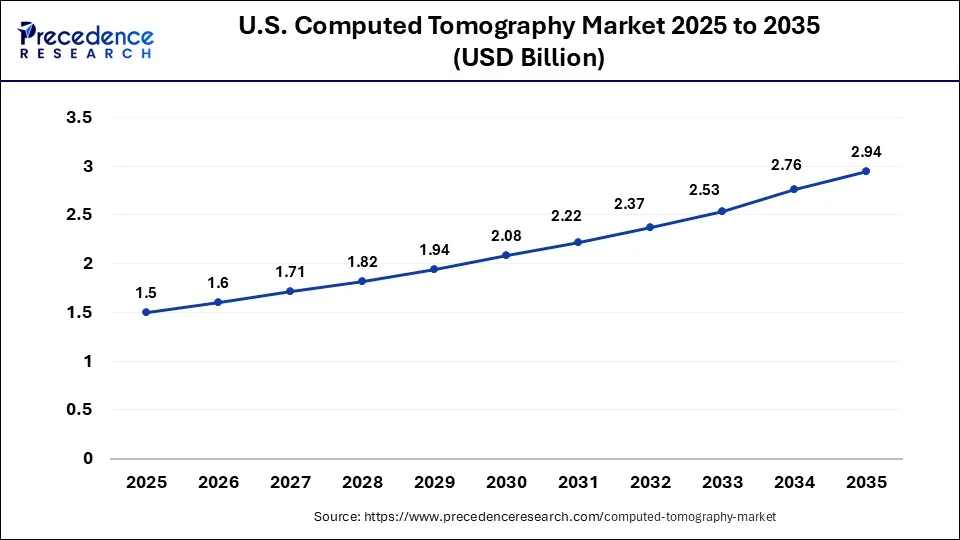
The U.S. computed tomography market size is evaluated at USD 1.60 billion in 2026 and is predicted to be worth around USD 2.94 billion by 2035, rising at a CAGR of 6.96% from 2026 to 2035.
What Makes North America the Dominant Region in the Market?
North America dominated the computed tomography market with the largest share in 2024. This is mainly due to its well-established healthcare infrastructure, high adoption of advanced imaging technologies, and strong emphasis on early and accurate disease diagnosis. The presence of leading manufacturers, ongoing R&D, and robust reimbursement frameworks accelerates the uptake of cutting-edge CT systems, including multi-slice and AI-enabled scanners.
The U.S. is a major contributor to the North American market, driven by a high prevalence of chronic diseases and growing demand for minimally invasive diagnostic procedures. The combination of advanced hospitals, skilled radiologists, and strong healthcare spending positions the U.S. as the largest and most mature market globally.
What Makes Asia Pacific the Fastest-Growing Region in the Computed Tomography Market?
Asia Pacific is expected to grow at the fastest CAGR during the projection period. This is primarily due to factors such as increasing healthcare spending and the rapid expansion of diagnostic services. Several countries in the region are turning to advanced imaging technologies to enhance the early detection of diseases that threaten life. The gradual surge in the prevalence of chronic diseases, such as cancer and cardiovascular disorders, also contributes to regional market growth.
China is leading the market in Asia Pacific. The country is witnessing the rapid adoption of CT systems, driven by massive investments in hospital capacity expansion and the integration of AI-enabled diagnostic tools. The country is also increasingly deploying spectral and high-slice CT scanners in tertiary hospitals to enhance imaging precision. India is experiencing fast growth as private diagnostic chains expand and government initiatives fund new imaging centers under public health programs. Rising medical tourism and the demand for affordable imaging solutions are mutually reinforcing factors that sustain strong CT deployment across the country.
What Opportunities Exist in the Middle East & Africa for the Market?
The Middle East & Africa (MEA) presents immense opportunities for the computed tomography market due to substantial investments in the modernization of healthcare infrastructure. The Gulf countries are quickly extending the sophisticated imaging departments of their multi-specialty hospitals. The advent of medical tourism, with the resultant increase in patient inflow, is at the core of the extensive installation of the latest CT systems, especially in the UAE and Saudi Arabia.
Saudi Arabia leads the Middle East & Africa market, driven by significant capital investments under its healthcare transformation initiatives, which are creating a favorable environment for upgrading to high-slice and low-dose CT scanners. Tertiary hospitals in Riyadh and Jeddah are modernizing their imaging infrastructure, adopting next-generation CT systems to provide more accurate and efficient diagnostic services.
How is the Opportunistic Rise of Latin America in the Computed Tomography Market?
Latin America is experiencing an opportunistic rise in the market due to growing investments in healthcare infrastructure and the modernization of hospitals, particularly in urban centers. Countries like Brazil and Mexico are expanding CT capacity in both public and private hospitals, driven by rising chronic disease prevalence and increased demand for diagnostic imaging. Additionally, the adoption of multi-slice and AI-enabled CT scanners is accelerating as hospitals seek to improve diagnostic accuracy and efficiency, creating strong growth opportunities across the region.
Computed Tomography: Imaging Precision in Europe
Europe's market shows notable growth during the forecast period. European healthcare is integrating high-speed CT, AI-driven, and low-dose techniques, like iterative reconstruction algorithms, to deliver high-quality images with decreased radiation, mainly for pediatric patients. National Diagnostic Reference Levels are regularly upgraded to ensure high diagnostic quality with minimum, optimized, and appropriate patient radiation dose.
France Computed Tomography Market Trends
AI-driven image reconstruction is becoming standard to decrease scan times and radiation dose while raising diagnostic confidence. Meanwhile, there is a strong shift toward advanced, high-slice CT scanners, which are generally preferred for enhanced cardiac and oncology imaging.
Argentina Computed Tomography Market Trends
The Argentine computed tomography market is driven by a rising adoption of AI-improved CT systems, high-resolution imaging, and even faster scan times, which enhance diagnostic accuracy and speed. Public healthcare institutions depend heavily on investing in upgrading outdated equipment, while private manufacturers are aiming to purchase premium, advanced CT scanners.
Value Chain Analysis for the Computed Tomography Market
- R&D
It is mainly driven by the need to enhance diagnostic accuracy, decrease radiation exposure, and speed up imaging workflows.
Key Players: GE HealthCare Technologies Inc., Canon Medical Systems Corporation, Koninklijke Philips N.V. - Clinical Trials and Regulatory Approvals
These essential processes ensure the efficacy, safety, and quality of imaging hardware and software before they are utilized on patients.
Key Players: Fujifilm Holdings Corporation, Neusoft Medical Systems, Hitachi, Ltd., Shimadzu Corporation - Formulation and Final Dosage Preparation
They are crucial for improving the visibility of internal organs, blood vessels, and even tissues. This process guarantees the contrast agent is stable, safe, and even effective for enhancing image contrast.
Key Players: Siemens Healthineers AG, GE HealthCare Technologies Inc., Canon Medical Systems Corporation
Competitive Landscape
The computed tomography industry is highly competitive due to rapid technological advancements and a rising demand for advanced imaging solutions. Key players like Siemens Healthineers, Philips Healthcare, and GE Healthcare are at the forefront of this competitive landscape. These industry leaders are consistently expanding the capacities of technology to develop advanced CT systems with enhanced imaging capabilities, decreased radiation doses, and improved diagnostic precision.
Moreover, the competition in this industry is further rising with the emergence of new companies and startups that are bringing forward advanced technologies and innovative approaches. These emerging players often launch technologies that challenge the dominance of established firms.
Computed Tomography Market Top Companies
|
Company |
Overview |
Key Medical Products/Areas |
|
A Chinese technology company specializing in cost-effective, scalable medical imaging solutions and hospital IT. It was the first Chinese company to develop a CT scanner with independent intellectual property rights. |
CT scanners (NeuViz series), MRI systems, digital radiography (X-ray), ultrasound, PET/CT, and a full suite of hospital management and clinical informatics software (PACS/RIS). |
|
|
Koninklijke Philips |
A Dutch health technology company focused on precision diagnosis, image-guided therapy, and connected care solutions. Philips is a prominent manufacturer in the medical equipment market. |
MRI and CT systems, advanced X-ray and fluoroscopy systems, ultrasound equipment, patient monitoring devices, and sleep and respiratory care products (e.g., Trilogy ventilators). |
|
Siemens Healthineers |
A leading German medical technology company and a market leader in diagnostic imaging and laboratory diagnostics. It is known for pioneering hybrid imaging systems like the PET/CT scanner. |
High-end CT (SOMATOM family), MRI, molecular imaging, angiography systems, laboratory and point-of-care diagnostics, and radiation oncology solutions (via its Varian segment). |
|
Hitachi, Ltd |
A Japanese multinational conglomerate offering diverse products and services, including advanced medical technology within its healthcare segment. |
Particle beam (proton beam) therapy systems for cancer treatment, clinical diagnostic systems and analyzers, and IT infrastructure for electronic patient records. |
|
GE Healthcare |
An independent, publicly traded US company spun off from General Electric in 2023. It is a global leader in medical imaging and patient care solutions. |
Medical imaging (CT, MRI, X-ray, molecular imaging, mammography), ultrasound devices, patient monitoring systems, anesthesia delivery, and pharmaceutical diagnostics (contrast agents). |
|
NeuroLogica Corp |
A US-based medical imaging company that is a healthcare subsidiary of Samsung Electronics Co., Ltd. It specializes in innovative point-of-care imaging solutions. |
Portable/mobile CT scanners, including the full-body BodyTom and head/neck-specific. |
- Fujifilm Corporation
- Planmeca Oy
- Carestream Health
- Canon Medical Systems corporation
- Koninklijke Philips
- Shenzhen Anke High-Tech Co.
Recent Developments
- In February 2026, the Brainomix 360 Stroke Next Generation software was unveiled at the International Stroke Conference in New Orleans. This software provides an automated evaluation of net water uptake (NWU), and its addition is expected to improve the management of patients with severe strokes, according to Brainomix, the developer of the software.
- In June 2026, St. David's Heart Hospital in Austin became the first facility in Central Texas to offer a cutting-edge photon-counting computed tomography (CT) scanner. This new scanner is designed to generate high-resolution images with greater diagnostic consistency for physicians treating pulmonary and cardiology patients, as stated in a recent hospital news release.
- In December 2025, Canon announced that the U.S. Food and Drug Administration (FDA) granted 510(k) clearance for its Alphenix 4D CT with Aquilion ONE/INSIGHT Edition, following a successful launch in Europe in August. This next-generation Angio-CT hybrid solution (Alphenix 4D CT) represents Canon's commitment to advancing interventional therapy with enhanced clinical workflows.
- In the year 2020 May, Fujfilm corporation introduced newly based technology such as AL- based technology for detection of the nodule in the lung. This developed technology is used for diagnosis of lung cancer. Utilization of screening and imaging of chest CT scan used for detecting the pulmonary nodules.
- In the year 2020 January, Development of product with advance features increased visibility and cross-sectional image screening from the Carestream Health's Digital Tomosynthesis and clearance of 510(k) from the U.S. Food and Drug Administration.
Segments Covered in the Report
By Technology
- High slice
- Mid slice
- Low slice
- Cone beam
By Application
- Neurology
- Orthopedics
- Oncology
- Cardiovascular
- Respiratory
- Gastrointestinal
- Others
By Modality
- O arm
- C arm
By End-User
- Hospitals
- Ambulatory surgery centers
- Health clinics
- Diagnostics imaging centers
- Others
By Geography
- North America
- Europe
- Asia-Pacific
- Latin America
- Middle East & Africa (MEA)
For inquiries regarding discounts, bulk purchases, or customization requests, please contact us at sales@precedenceresearch.com
Frequently Asked Questions
Tags





Ask For Sample
No cookie-cutter, only authentic analysis – take the 1st step to become a Precedence Research client
 Get a Sample
.webp)



 sales@precedenceresearch.com
 Schedule a Meeting
