



North America Glycerol Market Size is USD 1.45 Billion in 2026
North America Glycerol Market (By Raw Material: Biodiesel, Fatty Alcohols, Fatty Acids, Soap; By Type: Crude, Refined; By Source: Plant, Animal, Synthetic; By End-use: Food & Beverage, Pharmaceutical, Nutraceutical, Personal Care & Cosmetics, Industrial, Other End-uses) Industry Size, Share, Growth, Trends 2026 to 2035.


The North America glycerol market size was estimated at USD 1.38 billion in 2025 and is expanding at A CAGR of 5.1% from 2026 to 2035. The market is mainly fueled by strong demand for biodiesel, significant growth in personal care and pharmaceutical uses, and a move towards natural, bio-based ingredients.
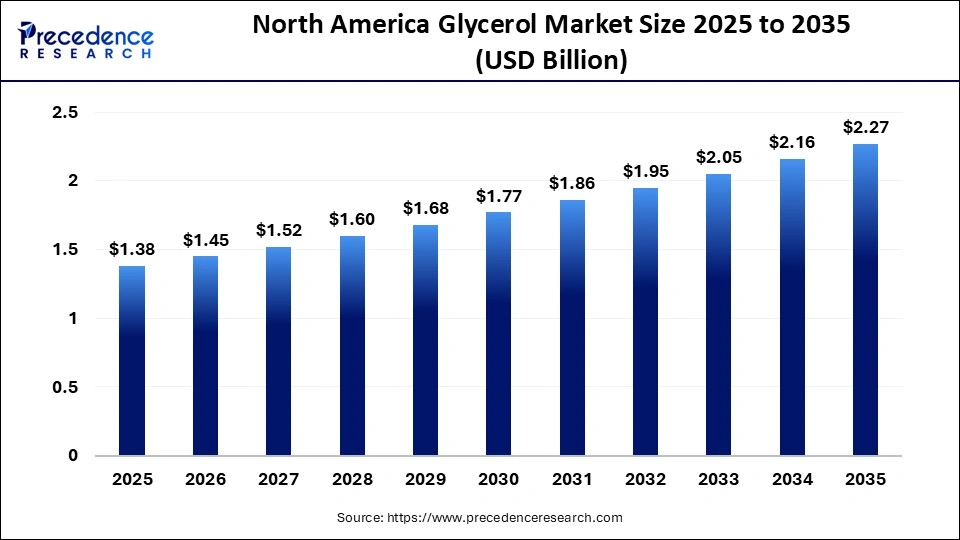
North America Glycerol Market Statical Scope
| Reports Attributes | Statistics |
| Market Size in 2025 | USD 1.38 Billion |
| Market Size in 2026 | USD 1.45 Billion |
| Market Size by 2035 | USD 5.1% Billion |
| CAGR 2026 to 2035 | 3.7% |
| Base Year | 2025 |
| Forecast Period | 2026 to 2035 |
The glycerol market in North America is important because of its high demand in personal care, pharmaceutical, and food industries, which is backed by a large supply of byproducts from the expanding biodiesel industry. It is vital for production as it offers sustainable ingredients for soaps, pharmaceuticals, and lubricants. As North America grows its renewable fuel industry, glycerol is produced as a key byproduct, making it a sustainable and easily accessible resource.
The personal care and cosmetics industry is the biggest user, fueled by the need for moisturizers and skincare items. It is widely used in pharmaceuticals as an excipient and in food and beverages as a sweetener and humectant, with broad FDA approval. The rising consumer preference for natural, bio-based products is leading to the replacement of synthetic options with glycerol.
Additionally, it plays a crucial role in the production of alkyd resins and polyurethane foams and is increasingly used in biodegradable plastics.
North America Glycerol Market, Raw Material, 2025 (%)
| Segments | Shares (%) |
| Biodiesel | 56% |
| Fatty Alcohols | 20% |
| Fatty Acids | 15% |
| Soap | 9% |
- Biodiesel - The biodiesel segment, with a share of 56%, is crucial in the glycerol market, serving as the primary source of industrial glycerol through large-scale crude glycerol production from biodiesel transesterification. This benefits industries like personal care and pharmaceuticals with abundant, cost-effective feedstock.
- Fatty Alcohols - The fatty alcohol segment, with a share of 20%, is vital to the market, supplying high-purity, bio-based glycerol as a byproduct of manufacturing. This is driven by the rising demand for sustainable ingredients in personal care, detergents, and industrial cleaning.
- Fatty Acids - The fatty acids segment, with a share of 15%, is significant in the market, providing a stable source of high-purity, refined glycerol used in high-demand sectors like personal care, cosmetics, and pharmaceuticals, particularly for biodegradable surfactants, lubricants, and polymers.
- Soap - The soap segment, with a share of 9%, is essential to the market, serving as a major production source and a key application for refining, spurred by the high demand for moisturizing personal care products.
North America Glycerol Market, By Type, 2025 (%)
| Segments | Shares (%) |
| Crude | 34% |
| Refined | 66% |
- Crude - The crude glycerol segment, with a share of 34%, is crucial due to the rapid growth in biodiesel production, generating significant amounts of this byproduct. It serves as a cost-effective and sustainable feed source for animal nutrition, industrial applications, and further refinement into high-quality glycerin.
- Refined - The refined segment, with a share of 66%, dominates the market because of its high purity, essential for personal care, pharmaceuticals, and food applications. Its moisturizing and non-toxic properties make it vital for cosmetics and premium, safe products.
North America Glycerol Market, By Source, 2025 (%)
| Segments | Shares (%) |
| Plant | 51% |
| Animal | 35% |
| Synthetic | 14% |
- Plant - The plant-based segment, with a share of 51%, is dominant due to the rising demand for renewable and eco-friendly ingredients in personal care, food, and pharmaceutical industries.
- Animal - The animal segment, with a share of 35%, is essential as animal fats like tallow and lard provide a reliable source of triglycerides for producing valuable glycerol.
- Synthetic - The synthetic segment, with a share of 14%, is significant, offering high-purity, consistent quality, and reliable supply, which are critical for pharmaceuticals, cosmetics, and industrial applications.
North America Glycerol Market, By End-Use, 2025 (%)
| Segments | Shares (%) |
| Food & Beverage | 12% |
| Pharmaceutical | 25% |
| Nutraceutical | 30% |
| Personal Care & Cosmetics | 33% |
- Food & Beverage - The food & beverage (F&B) sector, with a share of 12%, is a key player in the market, being a major consumer due to its use of humectants, sweeteners, and preservatives in processed food and beverages.
- Pharmaceutical - The pharmaceutical sector, with a share of 25%, is crucial in the market, requiring high-purity glycerol as a safe and effective excipient in drug formulations, driven by the demand for cough syrups and medicinal products.
- Nutraceutical - The nutraceutical sector, with a share of 30%, is a rapidly growing segment of the market, fueled by the increasing demand for functional food and health supplements.
- Personal Care & Cosmetics - The personal care & cosmetics sector, with a share of 33%, significantly impacts the market, as glycerol is a vital ingredient in skin and hair care products, driven by consumer preferences for natural and effective beauty solutions.
Top Companies in the North America Glycerol Market
- ADM
- BASF SE
- Cargill, Inc.
- CREMER OLEO GmbH & Co. KG
- Dow
- Emery Oleochemicals
- Kao Corporation
- KLK OLEO
- Oleon NV
- Procter & Gamble Chemicals
- Wilmar International Ltd.
Segments Covered in the Report
By Raw Material
- Biodiesel
- Fatty Alcohols
- Fatty Acids
- Soap
By Type
- Crude
- Refined
By Source
- Plant
- Animal
- Synthetic
By End-use
- Food & Beverage
- Pharmaceutical
- Nutraceutical
- Personal Care & Cosmetics
- Industrial
- Other End-uses
| Type | 2025 | 2026 | 2027 | 2028 | 2029 | 2030 | 2031 | 2032 | 2033 | 2034 | 2035 |
|---|---|---|---|---|---|---|---|---|---|---|---|
| Crude | 0.25 | 0.26 | 0.27 | 0.28 | 0.29 | 0.30 | 0.31 | 0.31 | 0.32 | 0.33 | 0.34 |
| Refined | 1.13 | 1.19 | 1.26 | 1.33 | 1.40 | 1.48 | 1.56 | 1.65 | 1.74 | 1.83 | 1.93 |
| Source | 2025 | 2026 | 2027 | 2028 | 2029 | 2030 | 2031 | 2032 | 2033 | 2034 | 2035 |
|---|---|---|---|---|---|---|---|---|---|---|---|
| Plant | 0.72 | 0.76 | 0.81 | 0.86 | 0.91 | 0.96 | 1.02 | 1.08 | 1.14 | 1.21 | 1.28 |
| Animal | 0.25 | 0.26 | 0.27 | 0.28 | 0.29 | 0.30 | 0.31 | 0.32 | 0.33 | 0.34 | 0.35 |
| Synthetic | 0.41 | 0.43 | 0.45 | 0.47 | 0.49 | 0.52 | 0.54 | 0.56 | 0.59 | 0.61 | 0.64 |
Research Methodology
Related Databooks
March 2026
March 2026
April 2026
April 2026


 sales@precedenceresearch.com
 +1 804-441-9344
 Download Databook
 Schedule a Meeting