



Dual Interface Payment Card Market Trends, Companies, Revenue / Sales Performance, Subscriber Growth, Pricing Strategies, Cloud Adoption, Infrastructure Expansion, Competitive Landscape, and Industry Outlook
Dual Interface Payment Card Market (By Interface Type: Contactless, Chip-and-PIN; By Security Feature: Single-Factor Authentication, Two-Factor Authentication, Biometric Authentication; By Type: Standard Cards, Premium Cards, Business Cards; By Application: Credit Cards, Debit Cards, Prepaid Cards; By End-user: Retail, Transportation, Healthcare, Hospitality, Financial Services) - Global Industry Analysis, Size, Trends, Leading Companies, Regional Outlook, and Forecast 2026 to 2035
Source: https://www.precedenceresearch.com/dual-interface-payment-card-market
 Get a Sample
 Table Of Content


What is the Dual Interface Payment Card Market Size?
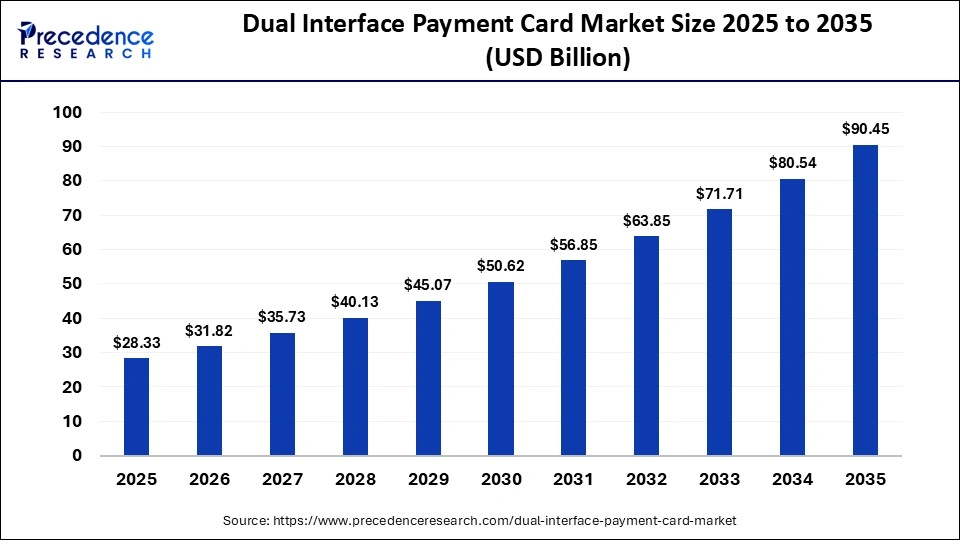
The global dual interface payment card market size was calculated at USD 28.33 billion in 2025 and is predicted to increase from USD 31.82 billion in 2026 to approximately USD 90.45 billion by 2035, expanding at a CAGR of 12.31% from 2026 to 2035. This market is growing due to increasing demand for fast, secure, and contactless payment solutions across retail and digital transactions.
Key Takeaways
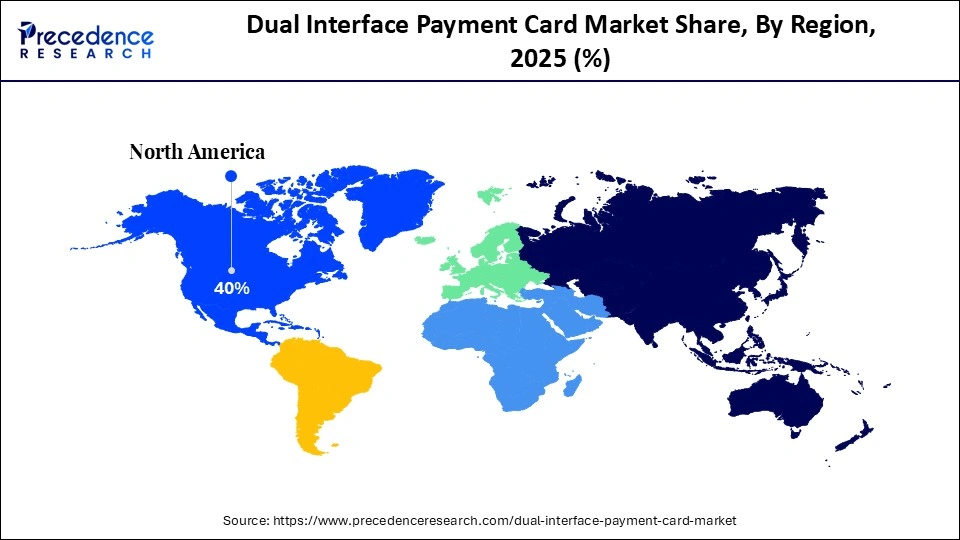
- North America dominated the market with the largest market share of 40% in 2025.
- Asia Pacific is expected to grow at the fastest CAGR between 2026 and 2035.
- By interface type, the contactless segment held the biggest market share in 2025.
- By interface type, the chip-and-pin segment is expected to expand at the fastest CAGR between 2026 and 2035.
- By security feature, the biometric authentication segment led the market in 2025.
- By security feature, the two-factor authentication segment is expected to grow at the fastest rate in the coming years.
- By card type, the standard cards segment dominated the market in 2025.
- By card type, the premium cards segment is expected to expand at the fastest rate between 2026 and 2035.
- By application, the credit cards segment held a major share of the market in 2025.
- By application, the prepaid cards segment is expected to expand at a significant CAGR during the projection period.
- By end use, the retail segment contributed to the highest market share in 2025.
By end use, the financial services segment is expected to grow at a strong CAGR between 2026 and 2035.
Market Overview
The dual interface payment card market is witnessing strong growth as seamless payment experiences that integrate contact and contactless features into a single card are becoming increasingly popular among consumers and businesses. The convenience and flexibility of these cards have increased, driven by ongoing technological advances, allowing users to conduct transactions using both near-field communication (NFC) technology and conventional chip-and-PIN. Growing e-commerce penetration, the increasing use of digital payments, and the increasing demand for safe authentication techniques are all driving market growth. The market's growth trajectory is further reinforced by financial institutions' upgrading of card infrastructures to facilitate quicker transactions and better fraud protection.
What Does the Dual Interface Payment Card Market Offer Strong ROI Potential?
The dual interface payment card market presents strong ROI potential as financial institutions benefit from higher transaction volumes, reduced fraud losses, and improved customer retention. By combining contact and contactless capabilities in a single card, user convenience increases, driving higher usage rates and boosting fee-based income for banks. Advanced security features further enhance profitability by minimizing operational risks and chargeback costs. As digital payments continue to expand globally, dual interface cards provide a scalable, future-ready solution that supports steady revenue growth and long-term returns.
Why is the Dual Interface Payment Card Market Considered Highly Resilient?
| Resilient Factor | Impact on Market Stability |
| Cashless Economy Push | Ongoing government initiatives ensure a steady demand for digital payment cards. |
| Rising Contactless Adoption | Consumers prefer fast, tap-and-pay solutions, supporting long-term usage. |
| Strong Banking Infrastructure | Advanced systems in the United States and Germany sustain continuous card upgrades |
| Transit Digitalization | Growing smart transport systems in India drive contactless card adoption. |
| Technological Advancements | NFC and secure chip innovations keep dual-interface cards future-ready. |
Future Market Overview
- Expansion in Emerging Markets: Developing economies offer strong growth potential due to increasing banking penetration.
- Integration with Biometric Authentication: Fingerprint-enabled and facial recognition-based cards present innovation opportunities.
- Partnerships with Fintech Companies: Collaboration between banks and fintech firms can accelerate product innovation and distribution.
- Transit and Smart City Applications: Dual interface cards can be widely adopted for public transport and smart infrastructure payments.
- Corporate and Commercial Card Programs: Businesses are increasingly adopting advanced payment cards for expense management.
- Growth of Subscription-Based Services: Recurring digital payments create demand for secure and flexible card solutions.
- AI-Driven Fraud Prevention Solutions: Advanced analytics can further enhance transaction monitoring and risk management.
- Sustainable Card Materials Development: Eco-friendly and recyclable card materials provide opportunities aligned with ESG goals.
How are Government Initiatives Accelerating the Dual Interface Payment Card Market?
Dual-interface payment card adoption is accelerating as governments worldwide promote cashless economies, secure digital transactions, and financial inclusion. Initiatives such as the National Common Mobility Card in India and stricter payment security regulations in the U.S. and Germany are encouraging banks to issue contact- and contactless-enabled cards. Coupled with investments in smart payment infrastructure, these regulatory measures are driving sustained market growth.
How is Artificial Intelligence Influencing the Dual Interface Payment Card Market?
Artificial Intelligence plays a transformative role in the dual interface payment card market, strengthening fraud detection, enhancing transaction security, and improving customer experience. Algorithms powered by AI examine transaction patterns in real time to quickly spot questionable activity and lower the risk of payment fraud. Additionally, machine learning models assist banks in streamlining authentication procedures, optimizing credit scoring, and personalizing spending insights. Dual interface cards are becoming more dependable and efficient in the changing financial ecosystem because of AI integration, which is facilitating faster approvals, smarter risk management, and safer contact and contactless transactions as digital payments expand quickly.
Dual Interface Payment Card Market Trends
- Rapid Adoption of Contactless Payments: Consumers are increasingly preferring tap-and-go transactions for faster and more convenient payments.
- Growth in NFC-Enabled Infrastructure: Retailers and service providers are upgrading point-of-sale systems to support near-field communication (NFC) technology.
- Rising Demand for Secure Authentication: Enhanced security features such as biometric verification and tokenization are becoming more common.
- Expansion of Digital Banking Services: Banks are integrating dual interface cards with mobile apps for real-time tracking and personalized services.
- Increase in E-commerce Transactions: Growing online shopping activities drive demand for secure and flexible payment solutions.
- Government pushes Toward Cashless Economies: Many countries are promoting digital payments to improve transparency and financial inclusion.
- Advancements in Card Manufacturing Technology: Improved chip designs and durable materials enhance card performance and lifespan.
- Rising Consumer Awareness of Payment Security: Customers are prioritizing secure payment methods, boosting dual interface card adoption.
Market Scope
| Report Coverage | Details |
| Market Size in 2025 | USD 28.33 Billion |
| Market Size in 2026 | USD 90.45 Billion |
| Market Size by 2035 | USD 90.45 Billion |
| Market Growth Rate from 2026 to 2035 | CAGR of 12.31% |
| Dominating Region | North America |
| Fastest Growing Region | Asia Pacific |
| Base Year | 2025 |
| Forecast Period | 2026 to 2035 |
| Segments Covered | Interface Type, Security Feature , Type, Application, End-user and Region |
| Regions Covered | North America, Europe, Asia-Pacific, Latin America, and Middle East & Africa |
Segment Insights
Interface Type Insights
What Made Contactless the Dominant Segment in the Dual Interface Payment Card Market?
The contactless segment dominated the market in 2025 as quick tap-and-go payments became more popular among consumers. With the proliferation of NFC-capable point-of-sale terminals, contactless transactions are now widely available. Adoption in the transportation and retail industries has increased due to shorter checkout times and improved convenience. Post-pandemic increases in hygiene awareness also boosted the demand for contactless cards.
The chip-and-PIN segment is expected to grow at the fastest CAGR in the coming years because of growing security concerns and legal requirements. An extra degree of security is offered by PIN-based authentication, particularly for high-value transactions. Chip-and-PIN cards are being promoted by financial institutions in areas where fraud is more likely to occur. Additionally, segment expansion is being supported by ongoing improvements in EMV technology.
Security Feature Insights
Why Did the Biometric Authentication Segment Lead the Dual Interface Payment Card Market?
The biometric authentication segment dominated the market in 2025 as consumers and banks increasingly prioritize cutting-edge security solutions. Dual-interface cards that accept fingerprints provide easy yet extremely secure payment verification. By lowering the risk of fraud, these cards do away with the need to remember PINs. Increased awareness of identity theft has made adoption even more robust.
The two-factor authentication segment is expected to grow at the fastest CAGR in the coming years because regulatory compliance requirements are more stringent. By combining PINs, OTPs, or device-based verification, two-factor authentication adds another degree of security. The demand for multi-layered protection has grown as a result of the increase in digital and cross-border transactions. Stronger authentication methods are becoming more necessary as e-commerce grows.
Card Type Insights
What Made Standard Cards the Dominant Segment in the Dual Interface Payment Card Market?
The standard cards segment dominated the market in 2025 due to its large-scale issuance by banks for everyday consumer transactions. These cards provide a cost-effective combination of contactless and chip functionality, making them suitable for mass adoption. Financial institutions prefer standard cards because of their affordability and compatibility with existing payment infrastructure. Their widespread use across retail, e-commerce, and ATM transactions further strengthened their dominant position.
The premium cards segment is expected to grow at the fastest CAGR in the coming years because of the growing demand for exclusive banking services and rising disposable incomes. Customers are looking for more benefits like cashback incentives, travel privileges, and lifestyle benefits. Additionally, banks are aiming to attract high-net-worth individuals by incorporating value-added features into dual-interface technology. Growth in this segment is being accelerated by the move toward luxury and customized financial products.
Application Insights
How Does the Credit Cards Segment Dominate the Dual Interface Payment Card Market?
The credit cards segment dominated the market in 2025, owing to strong consumer spending patterns and attractive reward programs. Dual-interface functionality enables fast and secure transactions, encouraging higher usage across physical and online retail channels. The availability of EMI options and cashback incentives further supports credit card penetration. Established partnerships between banks and global payment networks also contributed to the segment's leadership.
The prepaid cards segment is expected to grow at the fastest CAGR in the coming years because of the growing acceptance of digital payments and financial inclusion. Prepaid cards are used by businesses and governments for gift programs, welfare benefits, and salary distribution. These cards appeal to young and unbanked consumers because they provide responsible spending and lower credit risk. Further accelerating growth is the increasing integration with fintech platforms.
End-User Insights
What Made Retail the Dominant Segment in the Dual Interface Payment Card Market?
The retail segment dominated the market with the largest share in 2025 due to the rapid adoption of contactless payment methods across supermarkets, shopping centers, and online retailers. Retailers benefit from dual-interface cards, improved transaction security, and faster checkout experiences. Growing consumer preference for convenient “tap-and-pay” options further accelerated the sector's dominance.
The financial services segment is expected to grow at the fastest rate in the coming years, driven by the increasing adoption of advanced digital payment technologies and secure transaction systems by banks, fintech firms, and other financial institutions. The expansion of digital banking, mobile wallets, and real-time payment systems further supports the strong growth of this segment. Additionally, stricter regulatory requirements for secure transactions and fraud prevention are driving investments in innovative payment technologies.
The transportation segment is expected to grow at a notable rate in the coming years because of contactless payment systems becoming more widely integrated into railway, bus, and metro networks. Smart ticketing systems are being promoted by governments and transit authorities to improve commuter convenience and lessen reliance on cash. The adoption of dual interface cards in public transportation systems is fueled by their ability to facilitate easy-fair payments.
Regional Analysis
What is the North America Dual Interface Payment Card Market Size?
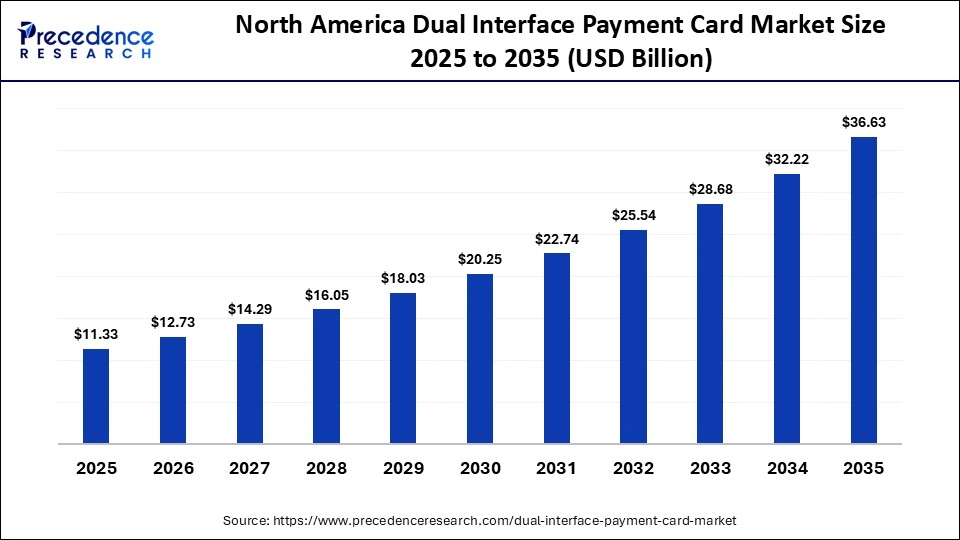
The North America dual interface payment card market size is estimated at USD 11.33 billion in 2025 and is projected to reach approximately USD 36.63 billion by 2035, with a 12.45% CAGR from 2026 to 2035.
Why Did North America Dominate the Dual Interface Payment Card Market?
North America dominated the dual interface payment card market by capturing the largest share in 2025. The region's dominance in the market is attributed to the early adoption of contactless technologies, a robust digital payment infrastructure, and widespread credit card usage. The existence of a large number of companies offering advanced payment technologies and financial institutions has sped up innovations in dual interface cards. Customers across the region have more faith in electronic payments thanks to robust cybersecurity frameworks and regulatory compliance standards. Regional dominance has been further reinforced by ongoing improvements to point-of-sale terminals in the retail and hospitality industries.
U.S. Dual Interface Payment Card Market Size and Growth 2026 to 2035
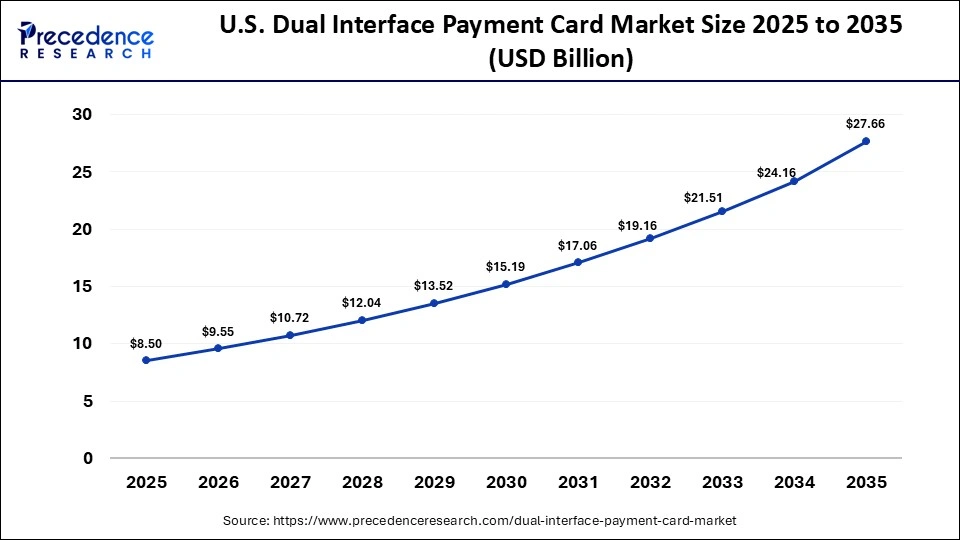
The U.S. dual interface payment card market size is calculated at USD 8.50 billion in 2025 and is expected to reach nearly USD 27.66 billion in 2035, accelerating at a strong CAGR of 12.52% between 2026 and 2035.
U.S. Dual Interface Payment Card Market Trends
The U.S. is a major contributor to the North American market. Strong consumer awareness and the broad acceptance of contactless payments are driving the market in the U.S. Growing numbers of NFC-enabled point of sale terminals and quick fintech developments are driving market expansion. Fintech companies and banks in the U.S. are working together, which is encouraging product innovation. Transaction volumes are also increasing due to the growing trend of digital wallets connected to dual interface cards.
What Makes Asia Pacific the Fastest-Growing Region in the Market?
Asia Pacific is expected to grow at the fastest CAGR in the coming years because of the growing digitalization, government programs encouraging cashless economies, and the expansion of banking services. In developing nations, the use of contactless payments is also accelerated by growing smartphone penetration and urbanization. The ecosystem for digital payments is getting stronger as e-commerce platforms and fintech startups grow. Another factor driving demand is the large unbanked populations moving to formal banking systems.
India Dual Interface Payment Card Market Trends
India is emerging as a high-growth market within Asia Pacific due to growing innovations in UPI-linked cards and government-led digital payment programs. Financial inclusion initiatives and growing retail infrastructure are bolstering demand for dual-interface cards. Market expansion is further accelerated by the growth of POS terminal penetration and the emergence of digital banking services. Further increasing adoption rates is the growing consumer preference for contactless and secure transactions.
How is the Opportunistic Rise of Europe in the Market?
Europe is expected to grow at a significant rate in the market because of robust regulatory frameworks that facilitate safe electronic payments and high customer confidence in contactless banking systems. The established banking industry in the area keeps updating conventional cards to dual-interface designs. Contactless cards are becoming more widely accepted because of increased cross-border travel and tourism. Eco-friendly payment methods and sustainable card materials are also becoming more popular in European markets.
Germany Dual Interface Payment Card Market Trends
Germany is a key contributor to the European market, supported by expanding consumer demand for contactless transactions and sophisticated banking infrastructure. Market expansion is being reinforced by the growing use of NFC-enabled terminals in retail and public transportation. Technology advancements are supported by the robust presence of top banking institutions and fintech innovation hubs. The nation's demand is being driven by rising awareness of safe and quick digital payments.
How is Latin America Growing in the Dual Interface Payment Card Market?
Latin America is expected to grow at a notable CAGR in the foreseeable future, driven by growing levels of banking participation, a growing number of contactless Point of Sale (POS) terminals, and an increasing number of consumers who are using digital payments. Governments and financial institutions have been promoting cashless transactions in order to promote financial transparency and inclusion. In recent years, Brazil and Mexico, along with several other countries in the region, have invested heavily to modernize the payment infrastructure using EMV & NFC based technology. Increasingly, retailers and transportation companies accept tap-to-pay transactions, which lead to higher demand for dual interface cards.
Brazil Market Trends
The Brazilian market is driven by strong digital banking growth and the rapid development of contactless payment infrastructure. Consumers are increasingly utilizing tap-to-tap payment cards to make retail purchases, ride transit, and perform other types of transactions. In addition, banks have benefited greatly from the growth in fintech and from real-time payment systems, which are encouraging banks to issue more secure dual interface cards. More recently, the rapid increase in smartphone usage and the growing number of businesses accepting NFC-based payments further support solid demand for dual interface payment cards throughout the country.
Will the Middle East and Africa Grow in the Dual Interface Payment Card Market?
The Middle East and Africa region is considered to be a significantly growing area, due to improved banking availability, advancing smartphone usage, and increased investments into digitally transforming businesses. Many governments within the United Arab Emirates (UAE), Saudi Arabia, and South Africa are incentivising merchants and consumers alike toward establishing a digitally secure infrastructure to facilitate cashless transactions. In addition to tourists visiting larger cities, smart city developments will also support the continued growth in demand for dual interface payment technologies within the larger region.
UAE Market Trends
Within the Middle East and Africa, the UAE has emerged as the leader for the adoption of digital banking and the introduction of new smart payment technologies. As a result of a rapidly developing economic environment, banks are creating new premium contactless biometric-enabled cards to increase transaction security and speed within the UAE's banking system. Additionally, the UAE government continues to develop initiatives associated with its smart city program and to invest in fintech innovation, thereby supporting the creation of a highly effective payment ecosystem. Furthermore, as the tourism sector continues to drive additional economic growth and luxury retail spending increases, the demand for premium tap-to-pay payment solutions in the United Arab Emirates will also continue to grow.
Dual Interface Payment Card Market Companies
- Thales
- IDEMIA
- Giesecke+Devrient (G+D)
- CPI Card Group
- Valid
- Eastcompeace
- Wuhan Tianyu
- Goldpac
- Watchdata
- Austriacard
- NXP Semiconductors
- Infineon Technologies
- STMicroelectronics
- Samsung Electronics
Recent Developments
- In May 2024, GlobalFoundries and IDEMIA Secure Transactions announced a collaboration to develop next-generation smart card hardware using GF's 28SLP and 28ESF3 platforms. This partnership aims to improve performance and security for payment and connectivity solutions by providing higher memory capacity and enhanced energy efficiency for future biometric and digital payment cards (Source: https://gf.com)
- In June 2025, Scapia announced the launch of a dual-network credit card with Federal Bank, combining Visa and RuPay networks into a single platform. The accompanying Summer Release 2025 introduced features like AI-powered train route suggestions, map-based accommodation booking, and specialized airfare categories for students and seniors. This integration allows users to manage various transactions, including online, offline, international, and UPI, through one credit card statement(Source: https://www.scapia.cards)
- In February 2026, Thales announced the launch of its biometric payment card with an integrated fingerprint sensor. This card, certified by Mastercard and Visa, replaces the standard PIN with an on-card sensor for secure contactless payments of any amount. It works with existing point-of-sale terminals without requiring hardware upgrades.(Source: https://enterpriseviewpoint.com)
- In August 2025, IndiGo and IDFC FIRST Bank announced the launch of a co-branded travel credit card available in "6E Rewards" and "6E Rewards XL" variants. The card features a dual-network offering, allowing users to choose between Mastercard and RuPay. This integration aims to reduce travel costs through accelerated "6E Rewards" and complimentary lounge access(Source: https://www.business-standard.com)
Segments Covered in the Report
By Interface Type
- Contactless
- Chip-and-PIN
By Security Feature
- Single-Factor Authentication
- Two-Factor Authentication
- Biometric Authentication
By Type
- Standard Cards
- Premium Cards
- Business Cards
By Application
- Credit Cards
- Debit Cards
- Prepaid Cards
By End-user
- Retail
- Transportation
- Healthcare
- Hospitality
- Financial Services
By Region
- North America
- Europe
- Asia-Pacific
- Latin America
- Middle East & Africa
For inquiries regarding discounts, bulk purchases, or customization requests, please contact us at sales@precedenceresearch.com
Frequently Asked Questions





Ask For Sample
No cookie-cutter, only authentic analysis – take the 1st step to become a Precedence Research client
 Get a Sample




 sales@precedenceresearch.com
 Schedule a Meeting
