



Essential Oils Market Size, Key Companies, Company Expansion Strategies, Food Processing Capacity, Sales Performance, Export Analysis, Consumer Preferences, Company Investment Strategies, and Market Positioning
The global essential oils market is experiencing strong growth, driven by increasing consumer demand for natural, plant-based ingredients across personal care, food and beverages, aromatherapy, and preventive healthcare. Rising awareness of holistic wellness, clean-label products, and sustainable sourcing, combined with advancements in extraction technologies, is accelerating market expansion and creating new opportunities through 2035
Source: https://www.precedenceresearch.com/essential-oils-market
 Get a Sample
 Table Of Content


What is Driving the Growth of the Essential Oils Market?
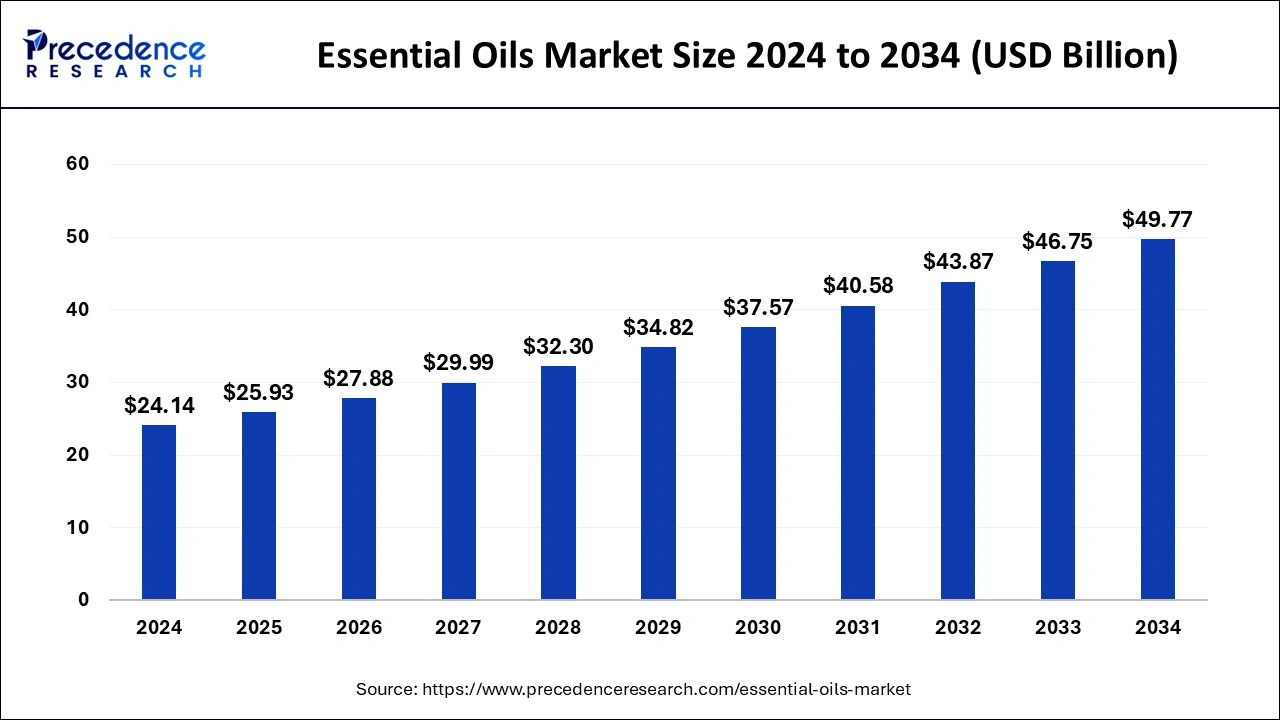
The global essential oils market size was calculated at USD 25.93 billion in 2025 and is predicted to increase from USD 27.88 billion in 2026 to approximately USD 52.70 billion by 2035, expanding at a CAGR of 7.35% from 2026 to 2035. One-liner: The market is witnessing substantial growth mainly due to growing consumer demand for natural, plant-based alternatives in personal care, functional foods, and preventive healthcare.
Key Takeaways
- Europe dominated the market with a major market in 2025.
- Asia-Pacific is expected to grow at the fastest CAGR between 2026 and 2035.
- By product, the orange segment generated the biggest market share in 2025.
- By product, the lemon segment is expanding at the fastest CAGR between 2026 and 2035.
- By application, the spa and relaxation segment accounted for the largest market share in 2025.
- By application, the food and beverage segment is projected to grow at a solid CAGR between 2026 and 2035.
- By sales channel, the direct selling segment captured the highest market share in 2025.
- By sales channel, the online sales segment is poised to grow at a healthy CAGR between 2026 and 2035.
- By method of extraction, the distillation segment contributed the highest market share in 2025.
- By method of extraction, the carbon dioxide extraction segment is growing at a strong CAGR between 2026 and 2035.
- By type, the singles segment held a major market share in 2025.
- By type, the blends segment is expected to expand at a notable CAGR from 2026 to 2035.
Market Size and Forecast
- Market Size in 2025: USD 25.93 Billion
- Market Size in 2026: USD 27.88 Billion
- Forecasted Market Size by 2035: USD 52.70 Billion
- CAGR (2026-2035): 7.35%
- Largest Market in 2025: Europe
- Fastest Growing Market: Asia Pacific
Market Overview
The global essential oils market, as outlined by agricultural and trade authorities like the USDA Foreign Agricultural Service, consists of natural, concentrated, volatile aromatic compounds extracted from plant materials. These oils are typically obtained through specialized processes such as steam distillation, which helps retain the original scent and active biological properties of the plants. The market's growth is largely driven by the emerging clean-label food movement, organic beauty trends, and natural wellness practices, placing it at the intersection of several rapidly expanding consumer goods sectors.
How AI is Changing the Enhanced Oil Recovery Market?
Artificial intelligence is revolutionizing various industries, and the enhanced oil recovery industry is no exception. By enabling more efficient, cost-effective, and precise operations, the integration of AI technologies has introduced a new dimension to enhanced oil recovery. AI, with its capabilities for data-driven decision-making, predictive analysis, and machine learning, can transform how oil fields are managed, particularly in terms of reducing operational uncertainties and optimizing recovery rates. Operators can analyze and process huge amounts of data from m reservoirs in real-time, minimize the risks associated with traditional EOR methods, and adjust recovery strategies dynamically, through the use of AI. In addition, the integration of AI improves the accuracy of forecasts, enhances recovery, allows for better resource allocation, and reduces downtime, owing to significant cost savings. These advanced trends are expected to revolutionize the growth of the enhanced oil recovery market in the coming years.
Essential Oils Market Growth Factors
- Increasing Demand for Natural Wellness: Due to the growing interest of consumers towards natural treatments, aromatherapy, and plant-based wellness products, the demand for essential oils is also on the rise. Their purported therapeutic benefits, which include stress-relief and improvement in sleep and wellness, continue to see new applications in the field of medicine and personal care.
- Increase in Personal Care Sector: The rise in the usage of essential oils in beauty, hair, cosmetics, and fragrances is positively affecting market growth. Companies are including the elements of plants to meet the increasing demand for pure and eco-friendly cosmetic products.
- Increase in Acceptability in Food Industry: Essential oils have started to gain importance as natural flavoring and preservatives in food and drink. The increasing need for eco-friendly goods and making natural ingredients will continue to encourage manufacturers to use vegetables instead of chemical additives.
- Expansion of Online Services: The rapid growth of e-commerce services has made the availability of essential oil products possible worldwide. Online marketing, direct marketing, and increased consumer knowledge made it possible for producers to reach wider audiences and promote their goods.
Essential Oils Market Trends
- As secondary and primary oil recovery techniques may leave oil in the reservoir up to 70%, various oil extracting companies have further started relying more on tertiary oil recovery or enhanced oil recovery techniques, further driving the market growth.
- Gas injection, thermal recovery, and chemical injection are the most commonly utilized enhanced oil recovery techniques all around the world and the majority of the enhanced oil recovery technologies are currently utilized offshore, as oil companies are developing methods to enlarge onshore enhanced oil recovery methods.
- The growing demand for oil has also added to the rising demand for enhanced oil recovery around the globe and several governments worldwide are taking initiatives to use technologies that are advanced in nature for the extraction of oil in order to achieve more and more profits from the existing fields of oil & gas.
- The increasing number of key market players around the globe are deploying innovative technologies for the development of the enhanced oil recovery industry is further expected to drive the growth of the enhanced oil recovery market.
Trade Analysis on the Essential Oils Market
- Based on Volza's Global Export Data, the industry experienced a total of 103 shipments from March 2024 to February 2025, marking an impressive 98% year-over-year growth in trade activities globally.
- The market involved 3 validated exporters and 4 validated buyers, suggesting rising business interest in essential oils, which are used in cosmetic products, aromatherapy treatments, food ingredients, and personal care products.
- Russia, Colombia, and Vietnam were among the top importers of essential oils, owing to their rising consumption in wellness products, medicines, and natural scents.
- Germany topped global exports with 156 shipments, aided by its advanced botanical extraction methods and high demand for organic and therapeutic quality essential oils.
- Additionally, Mexico and Russia had notable roles in the export sector, contributing 7 and 5 shipments, respectively, attributed to increasing production and distribution of essential oil products made from plants.
- Volza's trade analytics tool, with coverage of 203 nations and more than 3.5 billion validated shipments, assists companies in discovering new buyers, tracking trade trends, and maximizing profits in the global essential oils industry.
Market Outlook
- Industry Growth Overview: Natural products in cosmetics, food, and aromatherapy have become the main reason for the steady increase in the market.
- Sustainability Trends: Ethics in product sourcing is a heavy topic, and consumers are increasingly expecting companies to be on the right side; hence, the use of sustainable sourcing, organic farming, and eco-friendly extraction methods is becoming a trend.
- Global Expansion: The market is progressively being opened up to the whole world, with the most significant growth areas being North America, Europe (having the largest share), and Asia-Pacific, owing to the rising awareness and use cases.
- Major Investors: Among the global giants are Givaudan, International Flavors & Fragrances (IFF), Robertet, Symrise, doTERRA, and Young Living Essential Oils.
- Startup Ecosystem: An ever-expanding ecosystem that is giving way to opportunities in personalized blends, direct-to-consumer sales, and the crew of tech integration, particularly in developing countries like India.
Future Outlook and Strategic Recommendations for the Essential Oils Market
- Long-Term Industry Outlook: The future of the essential oils industry looks buoyant while the preference of consumers for natural products in cosmetics, food, aromatherapy or home products will only escalate. The continuing innovations in products, new applications, and the high regulatory pressure regarding quality control and traceability will drive the industry forward.
- Emerging Business Models: Businesses nowadays apply innovative approaches like vertically integrated procurement, direct sales to customers through e-commerce channels, subscripted wellness offers and communication with farmers to obtain raw materials in a sustainable way. An increasing number of companies use online platforms and AI to harness the power of personalized marketing.
- Strategic Recommendations for Stakeholders: All stakeholders ought to spend money on sustainable farming practices, ethical procurement, innovative extraction technologies, and stringent quality measures to gain the necessary credibility. The companies should expand into fast-growing markets, create organic product lines, cooperate with personal care brands, and develop digital marketing channels to ensure a competitive advantage.
Market Scope
| Report Coverage | Details |
| Market Size in 2025 | USD 25.93 Billion |
| Market Size in 2026 | USD 27.88 Billion |
| Market Size by 2035 | USD 52.70 Billion |
| Market Growth Rate from 2026 to 2035 | CAGR of 7.35% |
| Dominating Region | Europe |
| Fastest Growing Region | Asia Pacific |
| Base Year | 2025 |
| Forecast Period | 2026 to 2035 |
| Segments Covered | Product, Application, Sales Channel, Type, Method of Extraction, and region |
| Regions Covered | North America, Europe, Asia-Pacific, Latin America, and Middle East & Africa |
Market Dynamics
Driver
Explosive Demand for Chemical-Free Alternatives
Consumers are increasingly shifting toward chemical-free lifestyles, and the trend of preventive wellness is fueling the worldwide adoption of plant-based extracts. This shift, prompted by growing awareness of aromatherapy and clean-label preferences, is leading to a significant replacement of synthetic preservatives and flavorings with natural essential oils. The escalating demand spans mainstream food and beverage, personal care, and therapeutic sectors.
Restraint
Strict Scrutiny and Volatile Supplies
Despite the market's strong potential, it faces fragmented and ambiguous regulatory frameworks globally, with compliance varying based on the intended use. Oversight bodies like the FDA enforce strict labeling and ingredient adherence to manage risks related to skin sensitization and toxicity. Additionally, volatile raw material supplies and the presence of synthetic adulteration hinder market trust and complicate international compliance.
Opportunity
Advanced Recovery Shaping the Future of Wellness
Advancements in extraction technologies, such as supercritical COâ‚‚ and ultrasound-assisted recovery, allow for the production of high-yield, pharmaceutical-grade botanical extracts. This enables companies to target emerging and specialized markets. By exploring research on antimicrobial and nutraceutical properties, manufacturers can innovate beyond traditional cosmetics, offering premium, scientifically validated therapeutic products.
Strategic Growth Opportunities for the Essential Oils Market
Commercial Growth Potential
- Increase in demand for plant-derived wholesome and all-natural products creates commercial prospects in cosmetics, food and beverages, personal care, pharmaceutical, household cleaning, and aromatherapy. Firms can seek growth by using high-end and organic essential oils to make unique products focused on wellness seekers and industrial clients.
Technological Growth Potential
- Technological advancements in extraction methods like supercritical carbon dioxide extraction, microwave extraction, and steam distillation have resulted in increasing purity, yield, and sustainability. Moreover, artificial intelligence-based quality measures, blockchain technology moving us towards better traceability, as well as precision agriculture add to product quality, efficiency, and transparency of supply chains.
Market Potential Evaluation
- There are many market niches which are yet to be widely developed. These include functional foods, nutraceuticals (foods with health benefits), veterinary care (health for animals), sustainable biopesticides, and environmentally safe products for cleaning at home. If companies create viable products which are effective, uniquely formulated, and affordable, they will be able to beat their competitors on the long-run.
Segments Insights
Product Insights
How did the Orange Segment Dominate the Essential Oils Market?
The orange segment dominated the market in 2025, primarily due to its antimicrobial properties, high vitamin C content, and diverse industrial applications. Orange oil is widely used as a natural flavoring agent in baked goods, confectionery, and beverages for clean-label consumer products. Additionally, its antioxidant and anti-aging properties make it popular in formulations for anti-acne, anti-inflammatory, and skin-brightening products aimed at reducing dark spots and wrinkles. The active volatile compounds in orange oil also provide stress relief, boost mood, and enhance overall mental well-being.
The lemon segment is expected to witness the fastest growth during the forecast period. This growth is largely attributed to its extensive applications in aromatherapy, cosmetics, and clean-label food and beverage products. The USDA Foreign Agricultural Service, states that the use of lemon essential oil in aromatherapy is driven by its documented antioxidant profile and effectiveness in massage, inhalation, and spa treatments. Clean beauty formulations and natural fragrances often rely on lemon oil for its antibacterial properties and refreshing scent.
Application Insights
What Made the Spa and Relaxation Segment Lead the Essential Oils Market?
The spa and relaxation segment led the market in 2025. This growth is primarily driven by increasing societal stress, a growing preference for holistic medicine, and the proven therapeutic benefits of inhalation and massage with aromatic oils. These options offer a natural and holistic alternative for stress relief and mental well-being. There is also a demographic shift towards complementary and alternative health systems to treat anxiety, depression, and sleep disorders. Popular plant derivatives such as eucalyptus, lavender, and citrus essential oils provide calming and mood-lifting effects, helping to reduce physiological markers of stress through massage and aromatherapy.
The food and beverage segment is expected to experience the fastest growth during the forecast period. This trend is largely a result of the increasing movement towards clean-label reformulations and the adoption of natural preservatives over synthetic options. As consumers become more health-conscious, there is a rising demand for minimally processed, organic food items. Essential oils effectively combat pathogens and molds, serving as replacements for artificial preservatives. They can also be integrated as safe flavoring agents in food, especially as consumers seek premium flavor profiles.
Sales Channel Insights
Why did the Direct Selling Segment Dominate the Essential Oils Market?
The direct selling segment dominated the market in 2025. This is due to the direct sales model, which allows distributors to physically demonstrate the usage of essential oils and educate consumers about their complex therapeutic benefits. This distribution network fosters deep relationships with consumers, driving recurring wholesale purchasing and long-term customer retention. Personalized experiences and direct consultations build strong consumer trust, in contrast to the blind purchasing often found in standard retail. The direct sales giants have promoted these products as essential tools for daily wellness and household use.
The online sales segment is anticipated to grow the fastest during the forecast period. This growth is primarily driven by the expanding online reach and the adoption of direct-to-consumer brands, broadening consumer accessibility. Continuous development in online sales is fueled by a growing desire among consumers to review product compositions, compare suppliers, and access a wider variety of botanical extracts. Increased digital trust and safety measures, along with robust legal frameworks and consumer protection, boosted confidence in purchasing wellness and aromatherapy products online.
Method of Extraction Insights
What made the Distillation Segment Dominate the Essential Oils Market?
The distillation segment held market dominance in 2025, as methods like steam and hydro distillation account for the largest volume of the world's essential oils. This process is considered the industry standard due to its low initial investment, making it highly accessible for rural cooperatives and small- to medium-sized farmers. Distillation remains the most commercially viable method for heavily traded commodity crops such as eucalyptus, lemongrass, citronella, and mint, aided by government-supported programs aimed at improving extraction yields and lowering energy consumption.
The carbon dioxide extraction segment is projected to grow the fastest during the forecast period. This growth is attributed to strict regulatory compliance, its function as a green solvent, and its superior ability to preserve heat-sensitive compounds. CO2 is generally recognized as safe (GRAS), and its use is strongly supported by government sustainability mandates. Operating at high pressures and low temperatures, supercritical CO2 extraction prevents thermal degradation of delicate botanical compounds, and its systems operate on a closed-loop cycle, fully recycling the CO2.
Type Insights
How did the Singles Segment Dominate the Essential Oils Market?
The singles segment dominated the market in 2025, driven by increasing consumer preference for chemical-free personal care and the proven effectiveness of botanical therapies. Government organizations are supporting the installation of local distillation units, providing farmers with both technical and financial assistance to scale the production of raw single oils. Growing health consciousness is driving stringent international regulations on synthetic products, prompting the beauty and skincare industries to adopt plant-based, single-source extracts.
The blends segment is projected to experience the fastest growth during the forecast period due to the increasing consumer demand for targeted holistic wellness, natural skincare, and aromatherapy. Consumers are shifting towards premium-priced functional blends for mood enhancement and at-home spa treatments. These oils are used as natural ingredients by cosmetics and pharmaceutical companies to create value-added organic products. Local distillation and processing units are producing proprietary, high-margin botanical blends to serve growing consumer preference for chemical-free products.
Regional Insights
How did Europe dominate the Essential Oils Market?
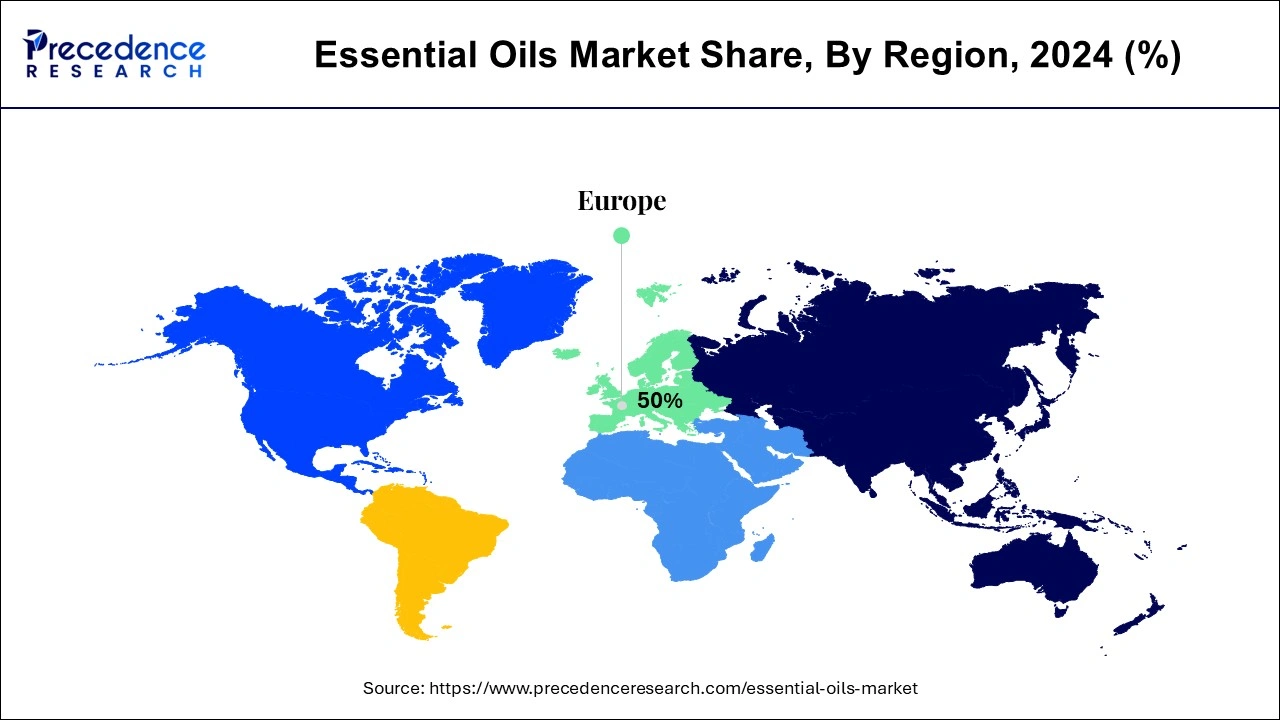
Europe dominated the market in 2025, primarily due to strong consumer demand for natural and sustainable clean-label products, widespread legal acceptance of plant-based oils as ingredients, and a well-established industrial base. The region exhibits high rates of aromatherapy usage for stress, anxiety, and pain relief. The EU Green Deal and sustainability initiatives uphold strict standards of traceability, environmental responsibility, and safety. Europe is also home to advanced extraction technologies, allowing manufacturers in countries like Germany and France to produce premium oils.
What is the Europe Esse ntial Oils Market Size?
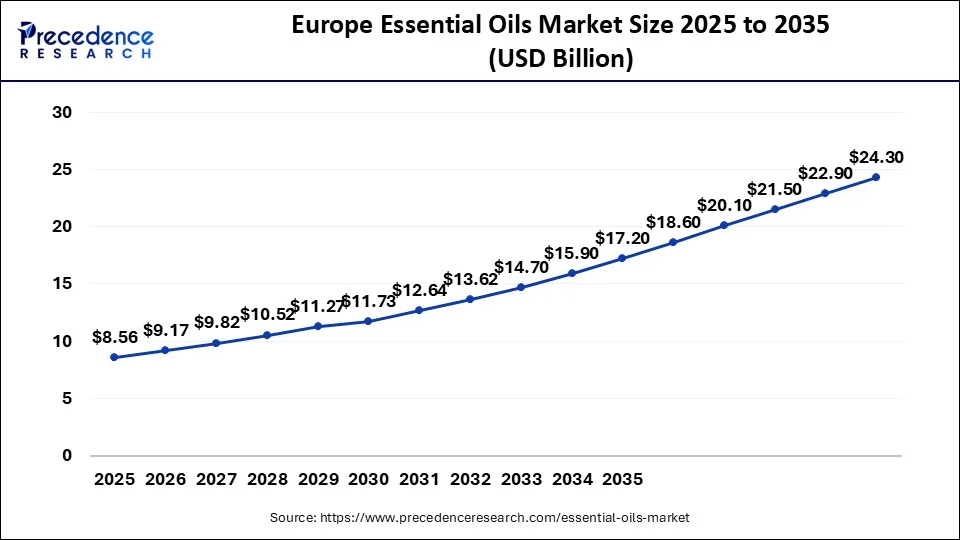
The europe essential oils market size reached USD 11.73 billion in 2025 and expected to be worth around USD 24.30 billion by 2035, growing at a CAGR of 7.56% between 2026 to 2035.
Germany Essential Oils Market Trends
The market of Germany is boosted by the highly sophisticated production system and innovative product development in the natural fragrances and flavors sector. It possesses a robust distribution network that facilitates large-scale exports and supports stable domestic consumption. Consumer emphasis on health, transparency, and natural sourcing allows the country to retain its status as a primary hub for essential oil innovation and distribution.
How will Asia Pacific Grow in the Essential Oils Market?
Asia Pacific region is expected to experience the fastest growth during the forecast period, driven by rapid urbanization and increasing disposable incomes that fuel demand for organic, plant-based products. Rising stress levels have contributed to a regional boom in aromatherapy, complemented by rich botanical biodiversity that supports robust production. The Department of Industries and Commerce and the National AYUSH Mission are promoting the cultivation of aromatic plants, offering financial and technical assistance to farmers to meet the growing global demand for natural products.
India Essential Oils Market Trends
India's essential oils industry is greatly favored by the availability of natural resources and the country's wellness culture that has existed for a long time. The growing focus on herbal and Ayurveda formulations is the main driving force for the domestic and export market growth. The sustainable farming practices, along with the local entrepreneurship and the digital trade channels, are allowing India to reinforce its presence in the global market for natural aromatic ingredients.
North America Essential Oils Market Booms on Natural Products and Innovation
North America is expected to witness significant market growth throughout the forecast period. This growth and development is driven by the region's rising consumer preference for natural and organic products across various aspects such as personal care, wellness, and food sectors. There is also a growing awareness regarding aromatherapy's health benefits, coupled with increasing demand for clean-label, chemical-free ingredients, which helps to fuel adoption.
The region is also seeing expanding applications in functional beverages, natural flavors, and eco-friendly home care. The regio also benefits from strong retail networks, a robust e-commerce ecosystem, and active product innovation, which fosters innovation and propels the market forward even more.
Latin America's Essential Oils Industry Thrives on Wellness, Biodiversity, and Sustainability Growth
Latin America is growing steadily in today's day and age, and its expected to keep growing all throughout the forecast period. This growth is driven by increasing consumer interest in natural wellness products and traditional remedies. There is also a rising demand for aromatherapy, spa treatments, and herbal cosmetics, especially in countries such as Brazil and Mexico. The food and beverage industry is also seen as increasingly adopting essential oils for clean-label flavoring.
Moreover, the region's abundant biodiversity helps provide rich raw material sources, and sustainable harvesting practices attract ethical buyers. The region's rapidly expanding e-commerce, urbanization, and a health-conscious population further boost market growth.
Brazil Essential Oils Market Trends
Brazil's market is growing due to increasing consumer interest in natural wellness products, aromatherapy, and herbal cosmetics. The food and beverage sector is adopting essential oils for clean-label flavoring. Abundant biodiversity provides rich raw material sources, while sustainable harvesting practices, rising disposable incomes, urbanization, and a health-conscious population further drive market expansion.
MEA Essential Oils Industry Grows on Tradition, Luxury, and Wellness Trends
The Middle East and Africa essential oils market is expanding at a steady rate due to rising awareness of natural health products, wellness tourism, and premium fragrance demand. Traditional use of oils like frankincense and oud highlights strong cultural acceptance. The region is also experiencing growth in the luxury personal care, perfume, and spa sectors, which fuels consumption even more. Increasing disposable incomes, urbanization, and a focus on well-being contribute to the region's market expansion.
The UAE Essential Oils Market Trends
The UAE essential oils market is expanding due to rising consumer awareness of natural health and wellness products, growing demand for luxury fragrances, perfumes, and spa services. Strong cultural acceptance of traditional oils like oud, increasing disposable incomes, urbanization, and a focus on holistic well-being are further driving market growth across personal care, aromatherapy, and lifestyle applications.
Competitive Landscape
The essential oils market is highly consolidated and established, and major players such as doTERRA International, Young Living, Plant Therapy, and Edens Garden are heavily investing in research and development and technological advancements to improve product durability. For instance, Robertet launched specialized online sales platforms for organic essential oils to streamline professional procurement.
Looking ahead, many emerging players and startups, including Secret Alchemist, Vitruvi, Public Goods, and Khadi Natural, have opportunities in pharmaceutical drug development and advanced extraction technologies. However, they also face barriers such as strict quality regulations and the prevalence of adulterated synthetic products that distort fair competition.
Value Chain Analysis
- Raw Material Procurement: Sourcing of natural ingredients that are of the highest quality and produced in a sustainable way.
Key Players: Robertet, Young Living, and doTERRA - Processing and Preservation: Carrying out a transformation process of raw botanicals into oils that involves maintaining and minimizing waste.
Key Players: doTERRA, Young Living, Givaudan, Symrise, Robertet Group - Quality Testing and Certification: Performing the processes of verifying and checking the quality of a product through automated quality tests.
Key Players: USDA Organic, Ecocert, GMP, ISO - Packaging and Branding: Creating attractive, planet-friendly packaging that helps in brand building and also in premium perception.
Key players: doTERRA and Young Living - Cold Chain Logistics and Storage of Essential Oils: Overseeing delivery that is climate-controlled to preserve the stability of oil and prolong its shelf life.
Key Players: Givaudan and IFF
Essential Oils Market Companies
- Firmenich SA
- Synthite Industries Ltd
- ROBERTET GROUP
- International Flavors and Fragrances Inc.
- Norex Flavours Private Limited
- BMV Fragrances Pvt. Ltd.
- MOKSHA LIFESTYLE PRODUCTS
- Takasago International Corporation
- Flavex Naturextrakte GmbH
- Ultra International
Recent Developments
- In May 2026, Youluxeo introduced the Youluxeo Aromatherapy Nasal Inhaler to increase its range of products that promote wellness. This particular product provided users with portability of aroma therapy through the use of refillable essential oils, adjustable airflow controls, BPA-free material, and was reusable. (Source: https://www.issuewire.com)
- In December 2025, a new range of essential oils known as Organic Essential Oils was introduced by Natural Grocers under their body care category. These Organic Essential Oils come in ten different flavors, including Organic Lavender Essential Oil, Organic Peppermint Essential Oil, and Organic Tea Tree Essential Oil, all of which are additive-free.
(Source: https://www.chartmill.com) - In September 2025, doTERRA (US) announced the launch of a new line of sustainably sourced essential oils, which underscores its commitment to environmental stewardship and consumer health. This strategic move not only enhances its product portfolio but also aligns with growing consumer preferences for eco-friendly products. The introduction of this line is likely to strengthen doTERRA's market position by appealing to environmentally conscious consumers. (Source: Episode 340: Every Product Launched at doTERRA Convention 2025 | doTERRA Essential Oils)
- In October 2024, Japan Petroleum Exploration Co. launched an inter-well CO2 injection test in collaboration with national energy company PT Pertamina in Indonesia. The aim behind this launch was to conduct CO2 injection across multiple wells to improve the effectiveness of CO2 sequestration and CO2-EOR (Enhanced Oil Recovery).
- In June 2024, India's leading private oil and gas producers, Vedanta Group and Cairn Oil & Gas announced the commencement of the largest commercial ASP flooding in Rajasthan. This ASP technique is designed to enhance oil recovery in mature fields and boost output potential significantly.
Segments Covered in the Report
By Product
- Acorus Calamus
- Ajowan
- Basil
- Black pepper
- Cardamom
- Carrot Seed
- Cassia
- Cedarwood
- Celery
- Cinnamon
- Citronella
- Clove
- Cornmint
- Cumin Seed
- Curry Leaf
- Cypriol
- Davana
- Dill Seed
- Eucalyptus
- Fennel
- Frankincense
- Garlic
- Ginger
- Holy Basil
- Juniper Berry
- Lemon
- Lemongrass
- Lime
- Mace
- Mustard
- Neem
- Nutmeg
- Orange
- Palmarosa
- Pepper Mint
- DMO
- Rosemary
- Spearmint
- Turmeric
- Vetiver
- Ciz-3 Hexanol
- Tea Tree
- Others
By Application
- Medical
- Pharmaceutical
- Nutraceuticals
- Food & Beverages
- Bakery
- Confectionery
- Dairy
- RTE meals
- Beverages
- Meat, Poultry & Seafood
- Snacks & Nutritional Bars
- Spa & Relaxation
- Aromatherapy
- Massage Oil
- Personal Care
- Cleaning & Home
- Kitchen Cleaners
- Floor Cleaners
- Bathroom Cleaner
- Fabric Care
By Sales Channel
- Direct Selling
- Online Sales
- Others
By Method of Extraction
- Distillation
- Carbon dioxide extraction
- Cold press extraction
- Solvent extraction
- Other extraction methods (resin tapping and maceration)
By Type
- Singles
- Blends
By Region
- North America
- Europe
- Asia-Pacific
- Latin America
- Middle East & Africa
For inquiries regarding discounts, bulk purchases, or customization requests, please contact us at sales@precedenceresearch.com
Frequently Asked Questions
Tags





Ask For Sample
No cookie-cutter, only authentic analysis – take the 1st step to become a Precedence Research client
 Get a Sample




 sales@precedenceresearch.com
 Schedule a Meeting
