



Europe Desiccants Market Size, Share and Trends 2026 to 2035
Europe Desiccants Market (By Type: Barrel Plating, Rack Plating, Continuous Plating, and Line Plating; By Metal Type: Gold, Zinc, Platinum, Copper, Nickel, Chromium, and Others; By End Use: Automotive, Electrical & Electronics, Aerospace & Defense, Jewelry, Industrial Machinery, and Others) Industry Size, Share, Growth, Trends 2025-2035
Source: https://www.precedenceresearch.com/europe-desiccants-market
 Get a Sample
 Table Of Content


The Europe desiccants market size was estimated at USD 380 million in 2025 and is projected to be worth around USD 610.19 million by 2035, growing at a CAGR of 4.85% from 2026 to 2035. The market in Europe is mainly driven by strict quality and environmental regulations, the rising need for moisture-sensitive pharmaceutical and biologic products, and the packaged food and beverage industry.
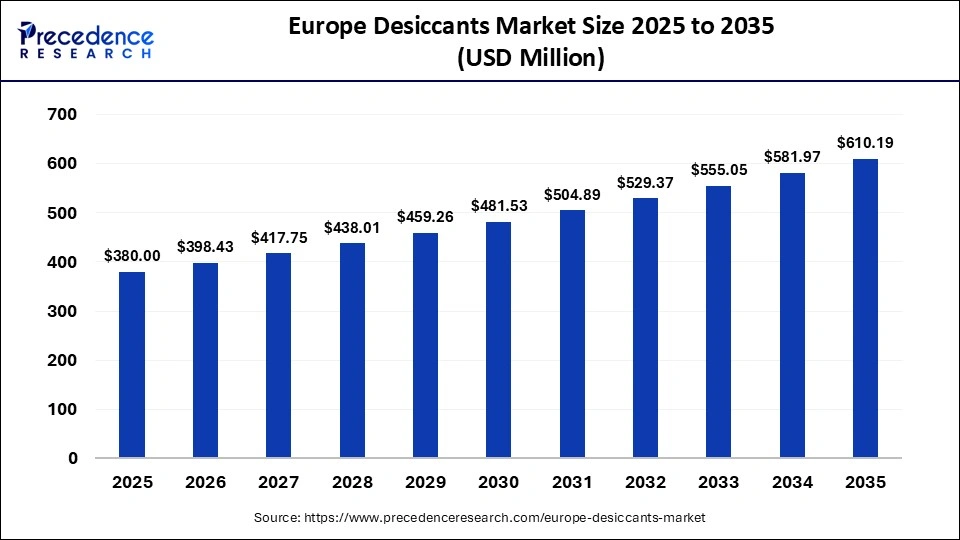
Europe Desiccants Market Statical Scope
| Reports Attributes | Statistics |
| Market Size in 2025 | USD 380 Million |
| Market Size in 2026 | USD 398.43 Million |
| Market Size by 2035 | USD 610.19 Million |
| CAGR 2026 to 2035 | 4.85% |
| Base Year | 2025 |
| Forecast Period | 2026 to 2035 |
Desiccants play a vital role in ensuring the stability and safety of products during transportation and storage throughout Europe, as they help prevent moisture damage, mold, and corrosion in food, pharmaceuticals, and electronics. Compliance with European regulations like REACH and global shipping requirements makes the selection of desiccants crucial. Goods transported from warm tropical areas to cooler regions in Europe often encounter significant condensation, needing strong cargo desiccants in shipping containers.
The European Commission and FDA cGMP enforce strict rules for moisture control in medications to maintain their effectiveness, making desiccants an essential part of medical logistics. Companies in Europe are increasingly prioritizing environmental sustainability, leading to more investments in biodegradable and reusable desiccant technologies.
Europe Desiccants Market, By Type, 2025
| Segments | Shares (%) |
| Silica Gel | 33.80% |
| Activated Alumina | 17.60% |
| Activated Charcoal | 10.90% |
| Zeolite | 15.40% |
| Calcium Chloride | 9.80% |
| Clay | 8.70% |
| Others | 3.80% |
- Silica Gel - The silica gel segment, with a share of 33.80% in 2025, plays a leading role in the European desiccants market due to its ability to adsorb moisture, safety, and versatility. It serves as a top moisture control solution for advanced manufacturing, helping to maintain the quality and longevity of moisture-sensitive products in various European sectors.
- Activated Alumina - The activated alumina segment, with a share of 17.60% in 2025, is essential in the European desiccant industry due to its high surface area, porous design, and strength. It is highly recognized for its ability to control deep moisture, prevent corrosion in manufacturing, and safeguard sensitive items like pharmaceuticals and electronics.
- Activated Charcoal - The activated charcoal segment, with a share of 10.90% in 2025, is important in the Europe desiccants market as it effectively neutralizes volatile organic compounds (VOCs) and unpleasant smells while protecting products. It is widely used in active pharmaceutical packaging to prevent outgassing and eliminate harmful gases from delicate medical items.
Europe Desiccants Market, By End-user, 2025
| Segments | Shares (%) |
| Packaging | 34.20% |
| Food | 18.60% |
| Pharmaceutical | 22.80% |
| Electronics | 15.30% |
| Others | 9.10% |
- Packaging - The packaging segment, with a share of 34.20% in 2025, is dominating the European desiccants market as it ensures the safety, stability, and longevity of moisture-sensitive products. Strict regional regulations and the rise of e-commerce require the use of strong moisture-control solutions, making desiccants a key quality-assurance standard in various important industries.
- Food - The food segment, with a share of 18.60% in 2025, is significant in the European desiccants market as it reduces food waste, prolongs shelf life, and ensures adherence to strict regional food safety standards. Desiccants help avoid moisture-related spoilage in convenience foods and maintain the quality of agricultural exports.
- Pharmaceutical - The pharmaceutical segment, with a share of 22.80% in 2025, is a driving force in the European desiccant market as it demands precise moisture control to preserve drug effectiveness. By absorbing humidity in sealed packaging, desiccants like silica gel and clay help prevent the deterioration of active ingredients and extend the shelf life of medications.
Competitive Landscape
The European desiccants market is very competitive and consolidated, driven by strict regulations and need in the pharmaceutical, electronics, and food industries. Key players are concentrating on effective moisture control, plastic-free options, and environmentally friendly desiccant materials such as natural clay and synthetic zeolites.
- Clariant International Ltd. is a leading specialty chemical company that provides naturally sourced, responsibly mined clay solutions and plastic-free moisture-absorbing packets, including the Desi Pak ECO range.
- Multisorb Technologies focuses on active packaging solutions, offering desiccant packets, Drop-In Desiccants, and sorbent canisters, primarily for sensitive applications in pharmaceuticals, food, and electronics.
- BASF SE supplies specialty synthetic adsorbents like activated alumina and highly porous zeolites, which are commonly used in industrial chemical and gas dehydration.
- Evonik Industries AG produces Aerolyst products, specialty silica gels, and custom-designed desiccants tailored for electronics, pharmaceuticals, and delicate food preservation.
- Absortech is a leading European company that specializes in cargo and container desiccants, providing calcium chloride-based moisture absorbers (such as Absorpoles) to protect against moisture damage during international shipping.
Segments Covered in the Report
By Type
- Silica Gel
- Activated Alumina
- Activated Charcoal
- Zeolite
- Calcium Chloride
- Clay
- Others
By End-user
- Packaging
- Food
- Pharmaceutical
- Electronics
- Others
For inquiries regarding discounts, bulk purchases, or customization requests, please contact us at sales@precedenceresearch.com
Frequently Asked Questions
Tags





Ask For Sample
No cookie-cutter, only authentic analysis – take the 1st step to become a Precedence Research client
 Get a Sample




 sales@precedenceresearch.com
 Schedule a Meeting
