



Europe Magnetic Beads Market Size, Share and Trends 2026 to 2035
Europe Magnetic Beads Market (By Type: Cells & Microbes, Nucleic Acid, Proteins, and Others; By Application: Cell Separation & Expansion, Protein Sample Preparation & Protein Purification, IVD Assay Development, Nucleic Acid Isolation, Immunoprecipitation, Exosome Analysis, Antibody Purification, and Others; By End-use: Healthcare Facilities, Individual Pathology Labs, Research Labs, and Others) Industry Size, Share, Growth, Trends 2025-2035
Source: https://www.precedenceresearch.com/europe-magnetic-beads-market
 Get a Sample
 Table Of Content


The Europe magnetic beads market size accounted for USD 5.63 billion in 2025 and is predicted to touch around USD 10.66 billion by 2035, growing at a CAGR of 6.59% from 2026 to 2035. The market is mainly driven by strong R&D funding, regulatory framework, and molecular diagnostics and genomics.
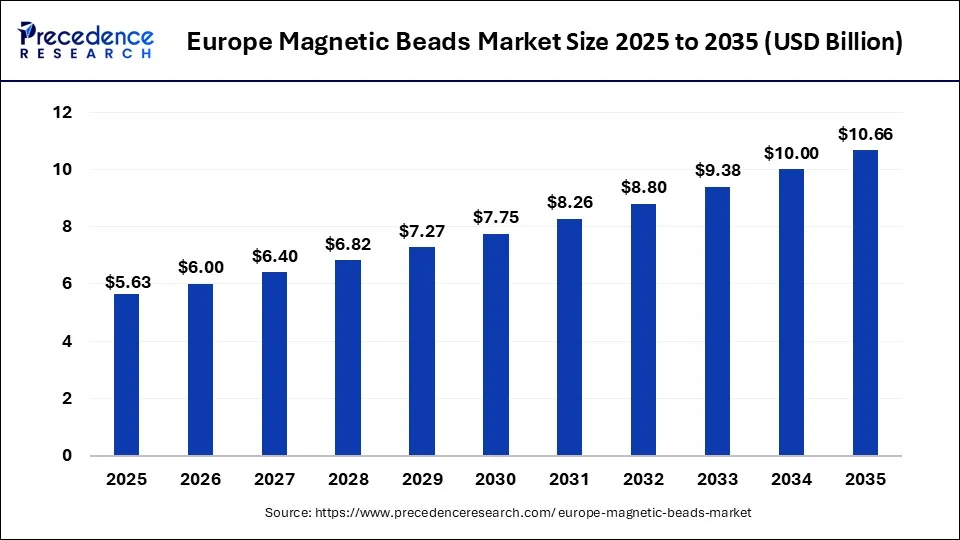
Europe Magnetic Beads Market Statical Scope
| Reports Attributes | Statistics |
| Market Size in 2025 | USD 5.63 Billion |
| Market Size in 2026 | USD 6 Billion |
| Market Size by 2035 | USD 10.66 Billion |
| CAGR 2026 to 2035 | 6.59% |
| Base Year | 2025 |
| Forecast Period | 2026 to 2035 |
Magnetic beads play a crucial role in biotechnology, life sciences, and clinical diagnostics throughout Europe. They support the rapid isolation and purification of nucleic acids (DNA/RNA), proteins, and specific cells (like T-cells for cancer immunotherapy) through automated processes. The European market for these beads is on the rise, expected to experience significant growth in the upcoming years, in line with global research and personalized medicine trends.
Additionally, decorated beads (such as Protein A/G) are used specifically to capture and purify antibodies. Major global companies provide these essential tools to European institutions, while European-specific consortia actively support ongoing innovations in nanoparticle synthesis and biocompatible polymer coatings. Investments from both public and private sectors in precision healthcare, along with advanced clinical laboratory facilities, are key drivers for market growth in countries such as Germany and the UK.
Europe Magnetic Beads Market, By Type, 2025
| Segments | Shares (%) |
| Cells & Microbes | 26.80% |
| Nucleic Acid | 34.70% |
| Proteins | 28.10% |
| Others | 10.40% |
- Cells & Microbes - The cells and microbes segment, with a share of 26.80% in 2025, plays a crucial role in the European magnetic beads market due to precision oncology, targeted immunotherapies, and rapid infectious disease diagnostics. By allowing precise, automated isolation of live cells and pathogens from complex samples, it directly contributes to Europe's strong focus on personalized medicine.
- Nucleic Acid - The nucleic acid segment, with a share of 34.70% in 2025, is leading the European magnetic bead applications as it facilitates rapid, high-purity extraction and isolation of DNA/RNA from complex biological samples. By modifying the beads, they selectively bind, wash, and release genetic targets, which is important for clinical diagnostics and sequencing processes.
- Proteins - The protein segment, with a share of 28.10% in 2025, is crucial as it allows for highly specific, scalable, and automation-friendly workflows for isolating, purifying, and analyzing proteins.
Europe Magnetic Beads Market, By Application, 2025
| Segments | Shares (%) |
| Cell Separation & Expansion | 20.80% |
| Protein Sample Preparation & Protein Purification | 17.40% |
| IVD Assay Development | 14.20% |
| Nucleic Acid Isolation | 22.60% |
| Immunoprecipitation | 8.10% |
| Exosome Analysis | 5.80% |
| Antibody Purification | 7.30% |
| Others | 3.80% |
- Cell Separation & Expansion - The cell separation and expansion segment, with a share of 20.80% in 2025, is crucial in the European magnetic beads market as it helps the production of clinical-grade target cells for immunology, oncology, and Advanced Therapy Medicinal Products (ATMPs). This segment ensures high-purity yield and cell viability, making it essential for Europe's growing biotechnology and personalized medicine industries.
- Protein Sample Preparation & Protein Purification - The protein sample preparation and protein purification segment, with a share of 17.40% in 2025, is vital as it supports high-throughput biopharmaceutical production, streamlines mass spectrometry workflows, and helps in rapid, automated clinical diagnostics.
Europe Magnetic Beads Market, By End-use, 2025
| Segments | Shares (%) |
| Healthcare Facilities | 39.60% |
| Individual Pathology Labs | 23.40% |
| Research Labs | 29.80% |
| Others | 7.20% |
- Healthcare Facilities - The healthcare facilities sector, with a share of 39.60% in 2025, plays a dominant role in the European magnetic beads market, as it heavily depends on automated, high-throughput testing and precision medicine. Hospitals and diagnostic centers need magnetic beads to quickly extract and purify DNA, RNA, and proteins for clinical diagnostics.
- Individual Pathology Labs - The individual pathology labs sector, with a share of 23.40% in 2025, is also essential to the European magnetic beads market, acting as the main high-volume endpoint for clinical diagnostics (IVD). By implementing automated bead-based protocols, these smaller, decentralized labs enhance regional testing turnaround times, with rapid infectious disease screening and precision oncology for local patients.
Competitive Landscape
The European market for magnetic beads is both consolidated and competitive, led by major global life sciences companies and specialized manufacturers from Germany and
- the Netherlands. These beads play a vital role in high-throughput DNA and RNA extraction, protein purification, and immunodiagnostics. Key competitors mainly focus on research and development, automated kit integration, and bulk customization for clinical diagnostics.
- Thermo Fisher Scientific (USA) has significant manufacturing operations in Europe. Their Dynabeads and Pierce Magnetic Beads are recognized as industry standards, commonly used for isolating specific cells, immunoprecipitation, and purifying nucleic acids.
- Merck KGaA (Germany) is a prominent regional leader. They provide the PureProteome line for protein purification and the MACS and MagPrep brands, developed through strategic partnerships, aimed at high-purity biomolecule separation.
- QIAGEN N.V. (Netherlands) is a leading multinational in Europe. Their MagAttract and QIAamp product lines offer automated magnetic bead-based protocols that are optimized for rapid and high-yield testing of pathogens and nucleic acids.
- Miltenyi Biotec (Germany) focuses on immunology and cell biology. Their MACS technology is well-known for using superparamagnetic MicroBeads, which allow for precise and gentle separation of cells directly from blood and other biological samples.
- Micromod Partikeltechnologie GmbH (Germany) A specialized developer in a niche market. They provide a wide range of magnetic nanoparticles, including silica, dextran, and polymer-coated beads, available in sizes from nanometers to micrometers for various biomedical research applications.
- Eurofins Technologies (Germany) concentrates on food diagnostics and clinical sectors. They offer magnetic bead-based extraction kits designed to identify contaminants, GMOs, and infectious diseases in high-throughput settings.
Segments Covered in the Report
By Type
- Cells & Microbes
- Nucleic Acid
- Proteins
- Others
By Application
- Cell Separation & Expansion
- Protein Sample Preparation & Protein Purification
- IVD Assay Development
- Nucleic Acid Isolation
- Immunoprecipitation
- Exosome Analysis
- Antibody Purification
- Others
By End-use
- Healthcare Facilities
- Individual Pathology Labs
- Research Labs
- Others
For inquiries regarding discounts, bulk purchases, or customization requests, please contact us at sales@precedenceresearch.com
Frequently Asked Questions





Ask For Sample
No cookie-cutter, only authentic analysis – take the 1st step to become a Precedence Research client
 Get a Sample




 sales@precedenceresearch.com
 Schedule a Meeting
