



Europe Gift Card Market Size, Key Companies, Company Market Share, Sales Volume, Consumer Demand, Pricing Trends, Distribution Performance, Competitive Positioning, and Growth Forecast
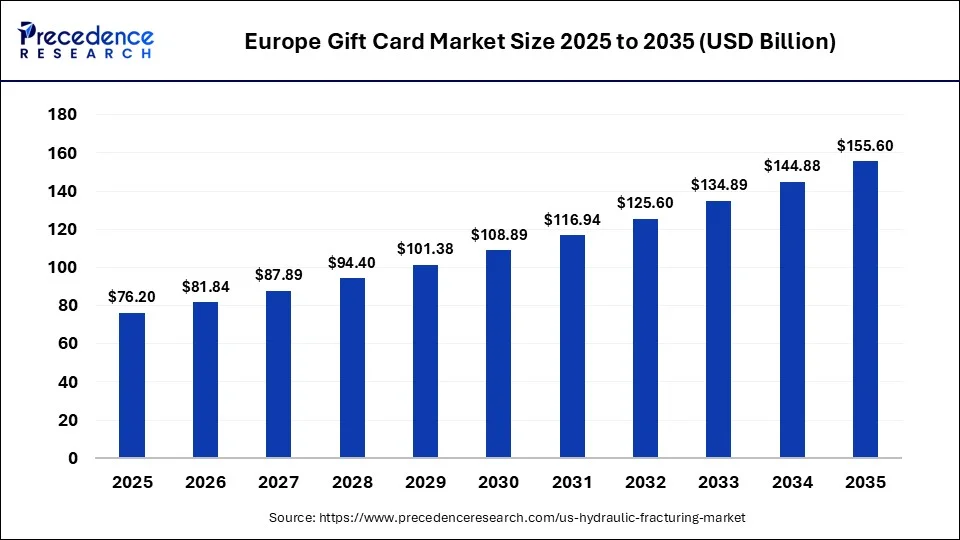
The Europe gift card market was valued at USD 81.84 billion in 2026, expanding at a CAGR of 7.4% by 2035. The market is driven by rising digital gifting, increasing corporate incentive programs, and growing adoption of prepaid payment solutions. Key trends include the shift toward digital and mobile gift cards, personalized gifting, omnichannel distribution, and stronger integration with e-commerce platforms. Expanding cross-border gifting, B2B applications, and demand for flexible digital payment options are expected to create new opportunities for market participants through 2035.
Source: https://www.precedenceresearch.com/europe-gift-card-market
 Get a Sample
 Table Of Content


Europe Gift Card Market Size, Demand, and Trends Analysis 2035
The Europe gift card market is undergoing a structural shift from traditional physical gifting toward digital, omnichannel, and corporate reward ecosystems. The market is estimated at USD 81.84 billion in 2026, compared with, and is projected to reach approximately USD 155.60 billion by 2035, representing a 7.4% CAGR. Digital cards already account for approximately 58.8% of market value, while online distribution contributes approximately 62.9%, reflecting the growing role of e-commerce, mobile delivery, and digital fulfillment. Corporate and B2B purchasing represents approximately 68.1% of current market value, supported by employee rewards, customer incentives, loyalty programs, and corporate gifting.
 Key Takeaways
- Europe's gift card market is estimated at USD 81.84 billion in 2026, up from and is projected to reach approximately USD 155.60 billion by 2035 at a 7.4% CAGR.
- Digital gift cards account for approximately 58.8% of market value, demonstrating the market's shift from physical gifting toward digital formats.
- Online distribution represents approximately 62.9% of market value, highlighting the growing importance of e-commerce and digitally enabled fulfillment.
- Corporate and B2B purchasing represents approximately 68.1% of current market value, driven by employee rewards, incentives, customer promotions, and corporate gifting.
- The U.K. accounts for approximately 25.3% of European market value, making it the largest national market in the region.
- Spontaneous gift-card purchases increased approximately 17% year over year in 2025, reflecting stronger demand for convenient and immediate gifting.
- Digital gift-card selection increased approximately 17% in 2025, reinforcing the shift toward mobile-first and digitally delivered gifting.
- The market is projected to increase from USD 81.84 billion in 2026 to USD 155.60 billion by 2035, creating a substantial incremental revenue opportunity for digital, corporate, and multi-merchant platforms.
- The report covers 3 card types, including closed-loop, open-loop, and multi-merchant gift cards, alongside digital, physical, and hybrid formats.
- The geographic analysis covers 14 named European countries plus the rest of Europe, including Germany, the U.K., France, Italy, Spain, the Netherlands, Belgium, Switzerland, Austria, Sweden, Denmark, Norway, Finland, and Poland.
Europes Gift Card Economy is Shifting from Physical Gifting Toward Digital, Omnichannel and Corporate Reward Ecosystems
The Europe gift card and incentive card market is estimated at approximately USD 81.84 billion in 2026, following an estimated, and is projected to reach approximately USD 155.60 billion by 2035, representing a 7.4% CAGR during 2026-2035. The market therefore represents an incremental opportunity of roughly over the forecast period. Digital cards already represent approximately 58.8% of market value, while online distribution accounts for approximately 62.9%, demonstrating that gift cards have moved decisively beyond traditional physical retail displays.
Corporate/B2B purchasing represents approximately 68.1% of current market value, reflecting the importance of employee rewards, incentives, customer acquisition campaigns and corporate gifting. Individual B2C demand, however, is expanding rapidly as instant digital delivery, mobile wallets, personalization and self-use increasingly blur the distinction between “gift” and “payment.
The U.K. represents approximately 25.3% of European market value, making it the largest national market, while Spain is among the fastest-growing major markets. Germany, France, Italy and the Nordic markets provide additional high-value pools characterized by mature retail infrastructure and high digital-payment adoption.
Key Coverage
- 2026 market value: ~USD 81.84 billion
- 2035 forecast: ~USD 155.60 billion
- 2026-2035 CAGR: ~7.4%
- Digital-format share: ~58.8%
- Online distribution share: ~62.9%
- Corporate/B2B share: ~68.1%
- U.K. share: ~25.3%
- Incremental 2026-2035
Market Size & Forecast - More Than USD 37 Billion of Incremental Value is Emerging Through Digital Gifting and Corporate Incentives
This moderation reflects market maturation in Western Europe rather than structural demand weakness. The largest incremental pools are expected to come from digital gifting, corporate rewards, online commerce, gaming and entertainment, travel and multi-merchant cards.
Under a base case, the market reaches approximately by 2031. An upside scenario based on faster digital penetration, stronger corporate incentive spending and greater cross-border gifting would push market value materially above the base case. In contrast, a downside scenario would reflect weaker discretionary consumption, tighter corporate budgets and regulatory friction.
The full analysis quantifies gross load value, transaction value, redemption value, unused value, average card value, transaction volume and card issuance, rather than relying solely on headline revenue.
Key Coverage
- 2020-2024 historical growth
- 2025 base-year valuation
- 2026-2031 annual forecasts
- Base/upside/downside scenarios
- Incremental revenue opportunity
- Transaction-volume forecasts
- Average card-value trends
- Country-level growth contribution
Segmentation Analysis - Digital, Corporate and Multi-Merchant Cards Are Capturing the Fastest Structural Gains
The market is segmented across open-loop vs closed-loop cards, digital vs physical formats, B2C vs B2B buyers, online vs offline channels, merchant category, purchase occasion, and geography.
Digital cards captured a significant share of 2025 market value, while digital issuance is expected to experience strong expansion, substantially above overall market growth. Online sales already represent a sizeable share, with online penetration continuing to expand at a strong pace.
Corporate/B2B currently represents a substantial share, supported by employee recognition, incentive programs and customer promotions. B2C is nevertheless one of the faster-growing demand pools, supported by last-minute gifting, mobile delivery and self-use.
Consumer electronics, gaming, entertainment, food delivery and travel are emerging as high-growth categories, while traditional department-store and general retail cards remain important volume generators.
Key Coverage
- Closedloop/openloop segmentation
- Digital/physical market share
- B2B/B2C revenue and CAGR
- Online/offline distribution
- Retailcategory contribution
- Corporate incentive occasions
- Average transaction value
- Countrylevel segment penetration
Market Dynamics - Convenience, Digital Payments and Corporate Engagement Are Repositioning Gift Cards as Commerce Infrastructure
Demand is being supported by instant delivery, mobile-first purchasing, e-commerce integration, personalization, corporate employee engagement, and increasing self-use. Recent consumer behavior indicates a stronger tendency toward spontaneous purchasing: spontaneous gift-card purchases increased approximately 17% year over year in 2025, while digital gift-card selection increased approximately 17%.
At the same time, fraud, chargebacks, account takeover, card-number theft, and regulatory compliance remain structural restraints. Merchant-funded discounts and promotional commissions can also pressure economics where platforms compete primarily on price.
The report quantifies the contribution of digital adoption, corporate spending, e-commerce penetration, disposable income, seasonal gifting and self-use to annual market growth.
Key Coverage
- Digitalization drivers
- Corporate reward spending
- Selfuse behavior
- Ecommerce penetration
- Fraud and security risks
- Consumer price sensitivity
- Seasonality
- Regulatory and margin pressures
Tentative Leading Company Universe
| Company | Headquarters | Market Position | Core Strength | Major Applications |
| Blackhawk Network | U.S. | Global program manager | Multi-brand distribution | Retail, corporate |
| InComm Payments | U.S. | Global prepaid platform | Retail distribution | Gift cards, digital content |
| Edenred | France | Corporate specialist | Employee rewards | Incentives, benefits |
| Pluxee | France | Corporate specialist | Employee engagement | Benefits, incentives |
| Givex | Canada | Technology specialist | Gift-card processing | Retail, hospitality |
| Sodexo | France | Corporate ecosystem | Employee benefits | Incentives |
| PayPal | U.S. | Digital commerce platform | Online distribution | Consumer gifting |
| Mastercard | U.S. | Open-loop infrastructure | Network acceptance | Prepaid/open-loop |
| Visa | U.S. | Open-loop infrastructure | Payment network | Prepaid/open-loop |
| Amazon | U.S. | Major closed-loop issuer | E-commerce | Retail/digital |
| Apple | U.S. | Digital-content issuer | Ecosystem integration | Digital content |
| Tillo | U.K. | API specialist | Global gift-card API | Rewards/incentives |
| Gifted | Sweden | European aggregator | Multi-brand gifting | B2C/B2B |
| Prezzee | Australia | Digital gifting specialist | Multi-brand digital cards | Consumer/corporate |
| WeGift | U.K. | Digital/API specialist | Enterprise gifting | Rewards |
| OptioPay | Germany | Digital rewards platform | Employee/customer incentives | B2B |
| Swile | France | Employee engagement platform | Digital benefits | Corporate |
| Tango Card | U.S. | Rewards platform | Incentive distribution | B2B |
| Miconex | U.K. | Local-gifting specialist | Town/local cards | Local retail |
| HUBUC | U.K. | Embedded-finance platform | Digital rewards | Fintech/B2B |
| Fiserv | U.S. | Payments infrastructure | Processing | Merchant/payments |
| Pine Labs/Qwikcilver | India | Gift-card technology | Issuance/processing | Enterprise |
| Voucher Express | U.K. | Voucher specialist | Corporate gifting | B2B |
| Giftcloud | U.K. | Rewards platform | Digital incentives | B2B |
| Bitrefill | Europe/U.S. | Digital-value specialist | Digital/crypto-linked gifting | Digital commerce |
Which Competitive Capabilities Are Most Likely to Determine Leadership in Europe's Gift Card Market?
Europe's gift card market is estimated at a substantial level in 2025 and is projected to expand to a significant market size by 2031, reflecting a positive growth trajectory over the forecast period. Competition is increasingly shifting from traditional physical-card distribution toward digital issuance, multi-merchant aggregation, corporate reward platforms, API connectivity, fraud management, and cross-border capabilities. Digital cards already account for a notable share of market value, while online distribution represents a substantial share, indicating that technology-enabled distribution is becoming a core competitive requirement rather than a secondary channel.
Our analysis indicates that scale alone is no longer sufficient to establish durable competitive advantage. The strongest competitive positions are increasingly associated with the ability to combine broad merchant coverage, high-volume corporate distribution, instant digital fulfillment, payment infrastructure, and sophisticated fraud controls. Global program managers retain structural advantages through extensive merchant relationships and enterprise distribution, while corporate-reward specialists benefit from established employer relationships. At the same time, API-first platforms are creating competitive pressure by enabling banks, fintechs, retailers and enterprise customers to integrate thousands of gift-card products without developing their own infrastructure. Our assessment is that the market will therefore remain fragmented across business models even as leading platforms consolidate transaction volume.
In our view, the most significant strategic implication is that competition will increasingly be fought at the platform and ecosystem level rather than at the individual gift-card level. Companies able to aggregate more brands, currencies, countries, and redemption options can improve customer choice while reducing integration friction for enterprise buyers. Corporate/B2B purchasing already represents approximately 67.1% of market value, making enterprise relationships particularly important for recurring transaction volumes and customer retention. Meanwhile, gaming, entertainment, e-commerce, travel and food-related digital gifting are creating additional high-growth application pools. This creates opportunities for challengers with differentiated technology or specialist distribution, but also raises entry barriers around merchant acquisition, compliance, settlement infrastructure, cybersecurity and fraud prevention.
How Large is Europe's Gift Card Market, and Where Will the Next Wave of Growth Come From?
Europe's gift card market is estimated at a significant market size in 2025 and is projected to reach a notable market value by 2031, representing a substantial incremental opportunity and continued growth during 2026-2031. Growth is being supported by the accelerating shift toward digital gifting, expanding e-commerce penetration, corporate reward programs, and broader merchant acceptance. Digital gift cards already represent a substantial share of market value, while online channels account for a sizeable share of distribution, indicating that a significant portion of future market expansion is likely to be captured through digitally enabled purchasing and fulfillment models.
Our analysis indicates that the market's growth is increasingly being driven by structural channel and format shifts rather than simply higher consumer spending on traditional gift cards. The incremental market opportunity through 2031 provides a significant growth pool, but its distribution is unlikely to be uniform across countries, formats and customer segments. Corporate/B2B purchasing represents a substantial share of market value, highlighting the importance of employee incentives, customer rewards and enterprise gifting alongside consumer-led occasions. Our assessment is that digital issuance, enterprise distribution and multi-merchant platforms will capture a significant share of incremental value as buyers prioritize convenience, immediacy, personalization and broader redemption choice.
In our view, the most significant implication is that future growth will depend increasingly on where and how gift cards are distributed, rather than on market expansion alone. The U.K. accounts for a notable share of European market value, demonstrating the concentration of revenue within established high-value markets, while continental Europe provides additional opportunities through differing levels of digital adoption, e-commerce penetration and corporate rewards activity. This creates opportunities for providers to target high-growth digital channels, expand merchant ecosystems and localize offerings across individual European markets, while also requiring careful attention to cross-border payments, currencies, regulatory requirements and fraud management.
How Are Pricing Structures and Economics Shaping Profit Pools Across Europe's Gift Card Market?
Pricing economics in Europe's gift card market are increasingly shaped by digital issuance, merchant commissions, distribution fees, corporate program economics and transaction-processing costs, rather than by the nominal face value of the card alone. With digital gift cards accounting for approximately 58.8% of market value and online distribution representing around 62.9%, the economics are shifting toward lower physical fulfillment requirements and greater emphasis on platform, technology and transaction-level monetization. At the same time, corporate/B2B purchases represent approximately 67.1% of market value, increasing the importance of volume-based pricing, enterprise contracts, incentive discounts, and recurring program relationships.
Our analysis indicates that pricing competitiveness is increasingly determined by the ability to optimize the economics of the entire transaction chain rather than simply offering a lower-priced gift card. Digital formats can reduce physical production, inventory and distribution costs, while high-volume corporate programs can create scale advantages through larger transaction values and recurring demand. Our assessment is that margin pools are therefore likely to differ materially by card format, merchant model, distribution channel, customer type and application, with platform operators and enterprise-focused providers having greater scope to monetize technology, aggregation and program-management capabilities in addition to the underlying card value.
In our view, the most significant implication is that sustainable profitability will depend on balancing customer acquisition, merchant economics, incentive discounts, transaction costs, fraud exposure and fulfillment efficiency. High-volume B2B relationships may support attractive economics through recurring purchases, but they can also involve greater pricing pressure from enterprise buyers. From our assessment, this creates an opportunity for providers to improve economics through digital-first fulfillment, multi-merchant aggregation, automated distribution, API-based integration and higher-value corporate services, while reducing dependence on purely physical-card distribution.
Which Customer and Channel Dynamics Will Determine Where Europe's Gift Card Growth is Captured?
Europe's gift card market is increasingly driven by digitally enabled purchasing and enterprise-led demand. Online distribution accounts for approximately 62.9% of market value, while B2B/corporate purchases represent around 67.1%, highlighting a market where employers, loyalty programs and corporate incentive buyers are major demand generators alongside individual consumers. Digital formats already represent approximately 58.8% of market value, reinforcing the shift toward instant delivery, mobile accessibility, and digitally integrated purchasing journeys.
Our analysis indicates that the channel structure is becoming as strategically important as the underlying consumer demand. The combination of high B2B penetration and online distribution suggests that providers with strong enterprise relationships, digital fulfillment capabilities and scalable distribution infrastructure can capture recurring transaction volumes more effectively than participants dependent primarily on physical retail channels. Our assessment is that purchasing behavior is also becoming more fragmented across e-commerce platforms, mobile applications, corporate reward portals, and multi-merchant platforms, increasing the importance of seamless integration and broad merchant selection.
In our view, the most significant implication is that customer ownership and distribution access will increasingly determine revenue capture. Corporate buyers can provide larger and more repeatable volumes, while consumer channels remain important for seasonal gifting, spontaneous purchases and self-use. From our assessment, this creates opportunities for providers that can connect B2B and B2C demand with online distribution, mobile delivery, multi-brand aggregation and personalized redemption options, while traditional offline channels face increasing pressure to differentiate through convenience, physical availability or complementary retail experiences.
Europe Gift Card Market Segments Covered in the Report
By Card Type
- ClosedLoop Gift Cards
- OpenLoop Gift Cards
- MultiMerchant Gift Cards
By Format
- Digital Gift Cards
- Physical Gift Cards
- Hybrid Gift Cards
By Purchase Type
- B2C
- B2B / Corporate
By Distribution Channel
- Online / Ecommerce
- Offline / Retail Stores
- Mobile Applications
- Corporate / Employee Reward Platforms
By Application
- Retail & Ecommerce
- Food & Beverage
- Travel & Hospitality
- Entertainment & Media
- Gaming
- Consumer Electronics
- Fashion & Apparel
- Beauty & Personal Care
- Home & Lifestyle
- Experiences & Leisure
- Others
By End User
- Individual Consumers
- Employees
- Corporate Customers
- Loyalty & Rewards Participants
By Gift Occasion
- Birthdays
- Holidays & Festivals
- Weddings & Anniversaries
- Employee Rewards
- Customer Incentives
- Promotional Campaigns
- SelfUse
By Country
- Germany
- United Kingdom
- France
- Italy
- Spain
- Netherlands
- Belgium
- Switzerland
- Austria
- Sweden
- Denmark
- Norway
- Finland
- Poland
- Rest of Europe
For inquiries regarding discounts, bulk purchases, or customization requests, please contact us at sales@precedenceresearch.com
Frequently Asked Questions





Ask For Sample
No cookie-cutter, only authentic analysis – take the 1st step to become a Precedence Research client
 Get a Sample




 sales@precedenceresearch.com
 Schedule a Meeting
