



Fast Food Market Revenue, Leading Companies, Company Technology / Innovation, Product Consumption, Production Efficiency, Pricing Trends, Retail Performance, Product Innovation, and Growth Opportunities
Fast Food Market (By Product: Pizza/Pasta, Burgers/Sandwich, Chicken, Asian/Latin American, Seafood, Others; By End User: Quick Service Restaurants, Fast Casual Restaurants, Caterings, Others) - Global Industry Analysis, Size, Trends, Leading Companies, Regional Outlook, and Forecast 2026 to 2035
Source: https://www.precedenceresearch.com/fast-food-market
 Get a Sample
 Table Of Content


What is Fast Food Market Size?
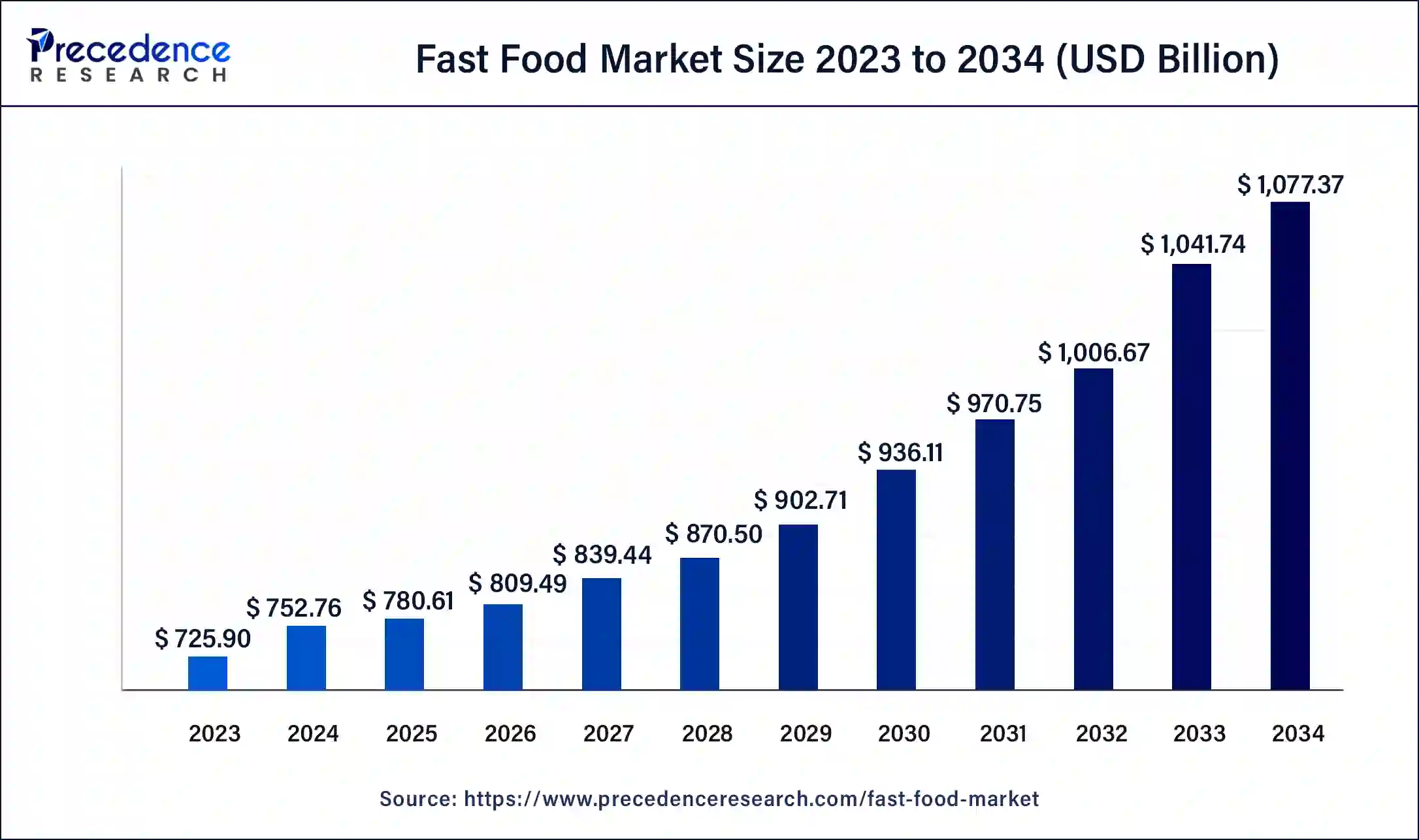
The global fast food market size is calculated at USD 809.49 billion in 2026 and is expected to reach around USD 1,112.63 billion by 2035, expanding at a CAGR of 3.61% from 2026 to 2035. The contributing factors of fast food consumption in daily life are convenience, taste, health concerns, and cultural influences.
Market Highlights
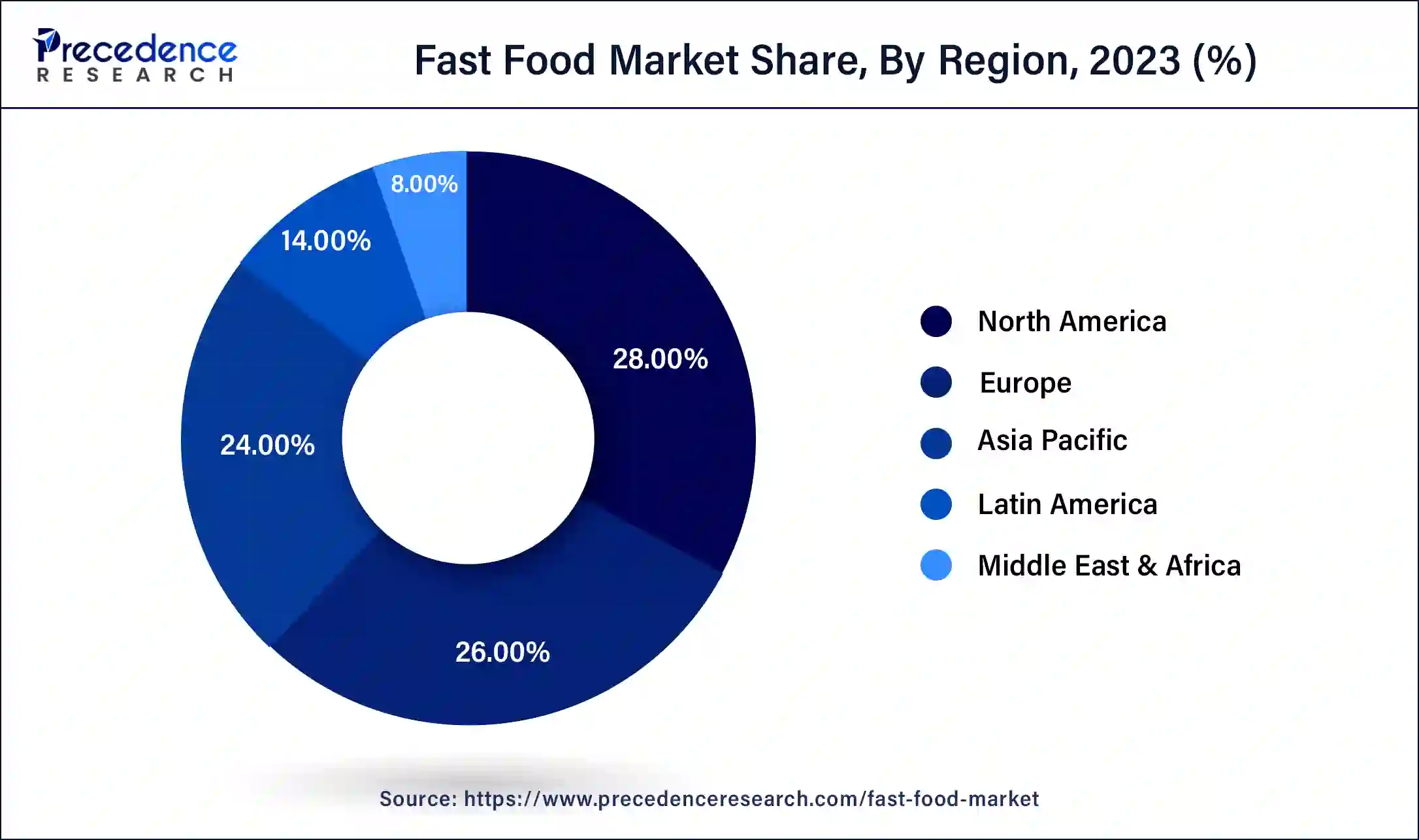
- North America dominated in the Fast Food Market with the largest market share of 28% in 2025.
- Asia-Pacific is observed to be the fastest growing in the Fast Food Market during the forecast period.
- By Product, the burgers/sandwich segment has contributed more than 43% of revenue share in 2025.
- By Product, the motion preservation technologies segment is anticipated to grow at the fastest rate in the market over the forecast period
- By End User, the quick service restaurants segment has held a major revenue share of 45% in 2025.
- By End User, the quick service restaurants segment is observed to be the fastest growing in the market during the forecast period.
Market Overview
What is Fast Food?
Research studies have shown that fast food consumption has increased globally due to promotional offers, cost-effectiveness, time- and effort-saving qualities, taste, easy accessibility, affordability, and convenience. Moreover, advertising and media also drive positive public opinion of fast food. Adults are prioritising junk food due to education, changes in daily routines, limited time, and taste. It has also been found that some of the key end-users have less awareness of health issues, elevated cost of fruits and vegetables, busy daily lives, and taste.
Fast Food Market Growth Factors
- One of the significant factors driving the growth of global fast food market is the growing number of working women globally. The female employment rate in the U.S. in 2019 was 46%, as per the U.S. Department of Labor. Consequently, women's employment rates in South Africa and China were around 45% and 43.7% respectively. In addition, the growing number of hotels and restaurants is also driving the expansion of global fast food market.
- The fast food market is continuously developing due to rising demand for on the go snacks, convenience foods, and ready meals. The busy lifestyle of millennials and the worldwide rise of working people had an impact on the fast food consumption. This will almost certainly help the fast food industry expand globally. The consumer spending on food eaten away from home has increased over the last few years. The increase in employment rates around the world adds to this. Thus, it is now easier to consume on the go cuisine.
- Another factor contributing towards the growth of global fast food market is rapid industrialization and urbanization. In addition, rising disposable income is also driving the global fast food market. The growing demand for ready to eat food and beverages is boosting the demand for fast food in the global market. Moreover, the expansion of food and beverage industry is supporting the expansion of worldwide fast food market over the projected period.
- The other factors driving the expansion and development of global fast food market is the growing adoption of online sales channel as a distribution channel. The restaurants and hotels are selling their food products through e-commerce platforms, which is contributing towards the growth and development of global fast food market over the forecast period.
- The fast food market's major players have well developed global distribution networks. To meet evolving consumer tastes, companies in the global fast food market are updating their menus and services. Furthermore, an increase in the number of quick service restaurants in the fast food market is assisting businesses in increasing sales. To broaden their presence globally, the market players are actively investing in media and collaborations with content providers. In addition, the corporation has introduced an application that allows employees to select their preferred career paths. All such strategies are driving the growth of global fast food market.
Fast Food Market Trends
- Modernised Comfort Food: Customers respect creativity and want comfort in food services. It is possible to reinvent burgers, pies, fried chicken, and sandwiches with premium touches and global twists. The emerging trends for this purpose include adding new interest to your classics, adding flavor depth while keeping the core comforting, and positioning these dishes as affordable treats.
- Borderless Cuisine: This trend unites flavors, techniques, and ingredients from different cultures to innovate something new to make the food highly relevant for fast food menus. Gen Z diners always look for globally inspired, bold dishes and see them as a genuine treat, which further drives this trend where fusion formats thrive. It involves the integration of ingredients like matcha, miso, etc., which are popular globally and can be added to sauces, dips, or marinades for easy upsell. Moreover, the menu boards and digital channels are ideal for storytelling about the global inspiration behind particular dishes.
- Street Food Couture: Street food is one of the most popular foods on global dining, specifically for Gen Z, who are more attracted to this easily accessible option than any other generation. They are considered affordable and are delivered by fast-food restaurants. This trend is going into action by taking inspiration from global street food staples, like Indonesian satay, Mexican tacos, and Korean tteokbokki. They are adapted into quick, handheld service restaurant-friendly formats.
Fast Food Market Outlook
- Market Overview: The fast food market is growing steadily, driven by urbanization, rising disposable incomes, and increasing demand for convenient, on-the-go meals. Health-conscious trends and the popularity of digital ordering and delivery services are further fueling market expansion.
- Global Expansion: The market is expanding worldwide as fast-food chains continue to enter emerging economies with growing middle-class populations and urban centers. Opportunities are particularly strong in regions like Latin America, Asia-Pacific, and the Middle East & Africa, where increasing tourism, modern retail infrastructure, and e-commerce adoption enhance accessibility.
- Major Investors: Major investors include multinational fast-food corporations, private equity firms, and venture capital funds that support expansion, technological adoption, and menu innovation. Their investments help drive growth by funding new outlets, digital platforms, and healthier or localized menu offerings tailored to regional consumer preferences.
Market Scope
| Report Coverage | Details |
| Market Size in 2025 | USD 780.61 Billion |
| Market Size in 2026 | USD 809.49 Billion |
| Market Size by 2035 | USD 1,112.63 Billion |
| Market Growth Rate from 2026 to 2035 | CAGR of 3.61% |
| Largest Market | North America |
| Base Year | 2025 |
| Forecast Period | 2026 to 2035 |
| Segments Covered | Product, End User, and Region |
| Regions Covered | North America, Europe, Asia-Pacific, Latin America, and Middle East & Africa |
Segments Insights
Product Insights
The burgers/sandwich segment accounted revenue share of around 43% in 2025. The demand for burgers/sandwich is growing at rapid pace in the global market. The consumers consume about 50 billion burgers each year, according to the United States Department of Agriculture. The demand for convenience food is driving demand for burgers/sandwich. In addition, the growing trend of ready to eat food products is also propelling the expansion of segment.
The Asian/Latin American segment is projected to reach at the fastest rate over the forecast period. The expansion of this segment is fueled by rising demand for wide range of food products. The demand for Mexican food is increasing in the U.S., due to an increase in the Hispanic population. According to the Simmons National Consumer Survey and the U.S. Census Bureau, about 110 million Americans ate tortillas in 2017.
End User Insights
The quick service restaurants segment accounted largest revenue share 45% in 2025. The quick service restaurants serve cuisine that requires little preparation time and is served quickly. The quick service restaurants often offer a restricted menu of fast food items that can be prepared in a shorter amount of time with the least amount of diversity. Many fast food businesses have implemented hospitality point of sale systems to allow for speedy service while also ensuring security and reliability. This allows kitchen staff members to see real time orders placed at the front counter or through the drive through. The wireless technologies enable cashiers and cooks to take orders given at drive through speakers. Thus, technological advancements are driving the growth of the quick service restaurants segment.
The fast casual restaurants segment is expected to witness strong growth from 2023 to 20302. The fast casual restaurants provide customers with freshly cooked, high-quality meals in a relaxed setting with counter service to keep things moving quickly. The fast casual restaurant, which is mostly located in the U.S. and Canada, does not provide full table service but promotes high quality meals with less processed or frozen ingredients than fast food restaurants. It's a hybrid of fast food and informal dining.
Regional Insights
U.S. Fast Food Market Size and Growth 2026 to 2035
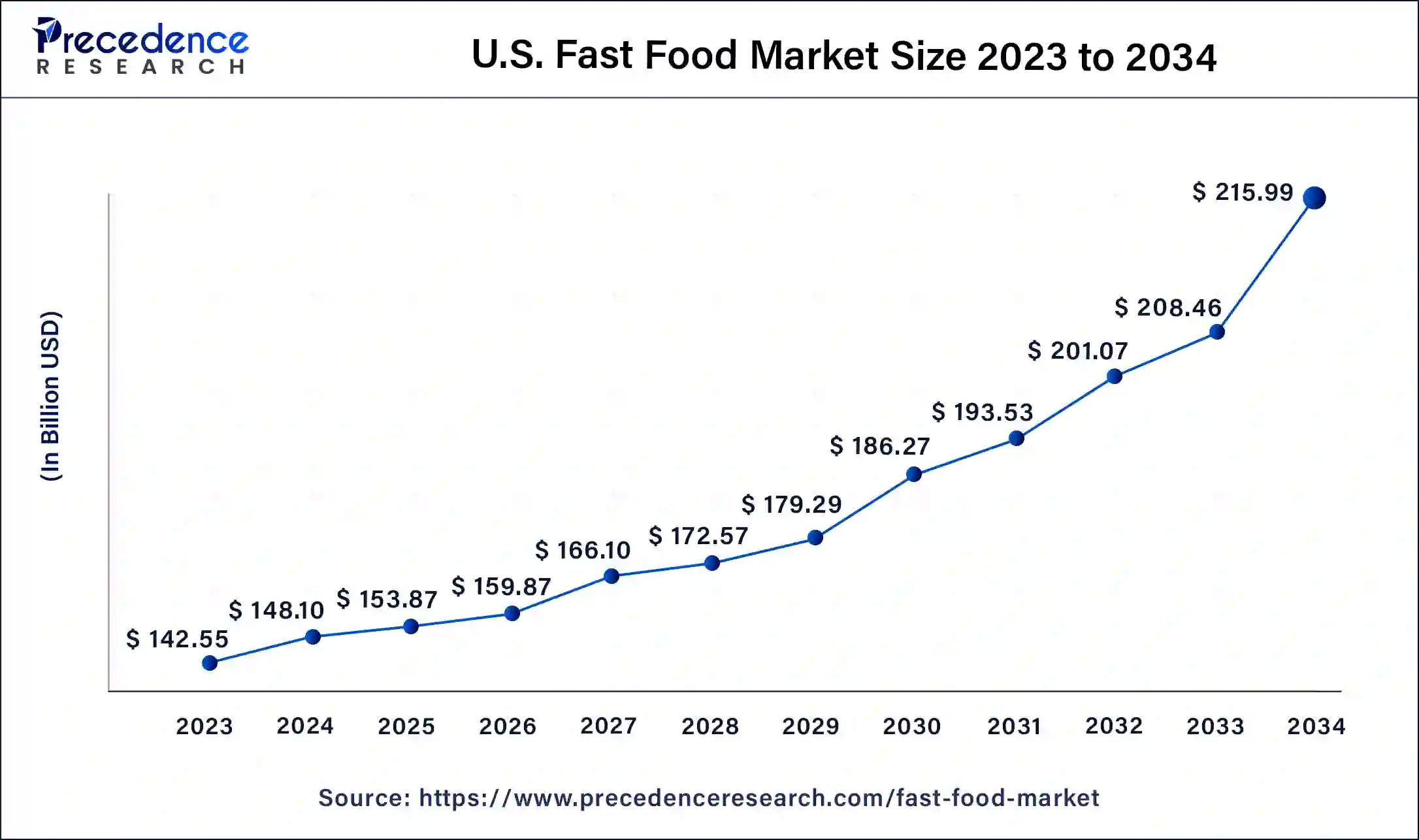
The U.S. fast food market size is valued at USD 153.87 billion in 2025 and it is predicted to reach USD 223.42 billion by 2035 with a CAGR of 3.8% from 2026 to 2035.
North America Dominated the Fast Food Market
North America dominated the fast food market in 2025 with revenue share of 28%. The growth of North America fast food market is attributed to the growing consumer expenditure on fast food. In addition, the shift in consumer taste and preference is driving the demand for fast food in regional market. The introduction of new flavors is also driving the growth and expansion of fast food market in North America region.
In North America, the U.S. led the market owing to the affordability, convenience, and long-standing culture of eating fast food. The US market is majorly dominated by players such as Burger King, McDonald's, and Wendy's, and witnessing ongoing growth due to technological innovations, evolving consumer preferences, and expanding delivery networks.
How can the Fast Food Market Contribute to the Growth of the U.S.?
The U.S. industry is scaling app integration and hyper-personalised loyalty, and boosting kitchen and drive-thru automation. The U.S. Food and Drug Administration (FDA) is tracking food industry pledges to remove petroleum-based food dyes from the American food supply. The U.S. Department of Health and Human Services and the U.S. FDA took a national initiative to make America healthy again.
What Makes Asia Pacific the Fastest-Growing Region in the Fast Food Market?
Asia-Pacific is expected to develop at the fastest rate during the forecast period. India, China, and Japan dominate the fast food market in Europe region. The factors are growing population, rising disposable income and changing consumer preferences. Furthermore, the fast food produced with natural ingredients is boosting the growth and development of Asia-Pacific fast food market.
In Asia Pacific, India dominated the market due to the changing consumer lifestyles, urbanization, and the option of quick dining options. Major cities such as Delhi, Mumbai, and Bangalore are leading the Indian market because of their cultural acceptance of global cuisines, high population density, and higher disposable incomes. Moreover, the market is also propelled by the emergence of international brands.
How is the Expansive Reach of the Fast Food Market in India?
India is advancing in the market through the increased preference for fast food over fully home-cooked meals due to the affordability associated with junk food. India's food processing sector is enhancing the availability of processed foods and driving value addition to the market.
What Makes Europe a Notably Growing Area in the Fast Food Market?
Europe is expected to grow at a notable CAGR over the forecast period. The growth of the region can be credited to the evolving lifestyles, rapid urbanization, and the convenience-oriented behaviours of consumers. Furthermore, in Europe, the UK, Germany, and France are leading the market due to strong consumer bases and strong fast-food infrastructure.
The regional market growth is also driven by evolving consumer preferences and changing dietary habits due to urbanization. There is a growing demand for healthier options, as consumers are becoming more health-conscious and seeking meals that align with their individual dietary needs. This trend is pushing many fast-food establishments to innovate their menus by incorporating fresh ingredients and offering plant-based as well as gluten-free alternatives.
What is the Key Role of the Fast Food Market in Germany?
Germany is growing and expanding in the market due to the emerging trends in the country, which include to-go convenience, matcha, stress relief, organic reaches, etc. The cabinet adopted the food and nutrition strategy for Germany, which aims to achieve balanced diets and sufficient exercise, more vegetables, legumes, and fruits, valuing food, and many other goals.
What Opportunities Exist in Latin America?
Latin America offers immense opportunities in the fast food market due to rapid urbanization and a growing middle-class population with increasing disposable incomes. Expanding modern retail chains and the proliferation of shopping malls are improving accessibility to fast-food options. The rise of digital platforms and food delivery services is further boosting market reach and convenience for consumers. Additionally, there is a growing demand for healthier menu options, encouraging fast-food operators to innovate with plant-based, fresh, and customizable meals.
How can the Fast Food Market Expand in Brazil?
Brazil is transitioning toward supportive initiatives to promote public policy innovation for sustainable food systems in the Global South. This initiative aims to establish a free and public digital archive of innovative public policy experiences. It is backed by the Brazilian Ministry of Social Development and Fight Against Hunger and coordinated by the National Secretariat for Food and Nutritional Security.
What Potentiates the Market in the Middle East & Africa?
The fast food market in the Middle East & Africa is driven by factors such as rapid urbanization, a large and youthful population, rising disposable incomes, and continued lifestyle shifts toward convenient, on-the-go meals. Growing tourism has further boosted demand for diverse fast-food offerings and the presence of international brands. Countries such as Saudi Arabia, the UAE, and Turkey lead the market. This is mainly due to high income levels, a strong tourist base, and densely populated urban centers.
What is the Major Footprint of Saudi Arabia in the Fast Food Market?
Saudi Arabia is transforming due to its food security strategy, which is revolutionary for import-dependent economies. Saudi Arabia's food security model is ideal for food processors, investors, and policymakers across the GCC. It helps import-dependent economies build resilience.
Value Chain Analysis
- Raw Material Sourcing
This stage involves sourcing agricultural and food inputs such as meat, poultry, vegetables, grains, dairy products, oils, and spices required for fast-food preparation.
Key players: Tyson Foods, Cargill, Nestlé, JBS, Sysco, and Archer Daniels Midland (ADM). - Food Processing & Ingredient Manufacturing
Raw materials are processed into semi-prepared or ready-to-use ingredients such as frozen patties, sauces, buns, and pre-cut vegetables.
Key players: Nestlé Professional, McCain Foods, Kerry Group, Hormel Foods, and Conagra Brands. - Distribution & Logistics
Processed ingredients are transported through cold-chain and ambient logistics networks to restaurants and franchise locations.
Key players: Sysco, US Foods, DHL Supply Chain, Lineage Logistics, and Americold Realty Trust.
Top Companies in the Fast Food Market and Their Offerings
- Auntie Anne's Franchisor SPV LLC: Core hand-rolled pretzels & twists, signature beverage framework, dipping sauces, etc.
- Domino's Pizza Inc.: Hybrid cloud scaling, modernized pizza tracker, core pizza and crust innovations, etc.
- CKE Restaurants Holdings Inc.: Green Burrito / Red Burrito, sides and shakes, Charbroiled burgers, west coast breakfast, etc.
- Firehouse Restaurant Group Inc.: Signature hot sauces, sides and extras, group catering, French Dip Sub, etc.
- Jack in the Box Inc.: Burgers, signature tacos, snacks and sides, snack innovations, beverage upgrades, etc.
Fast Food Market Companies
- Auntie Anne's Franchisor SPV LLC
- Domino's Pizza Inc.
- CKE Restaurants Holdings Inc.
- Firehouse Restaurant Group Inc.
- Jack in the Box Inc.
- McDonald's
- Restaurant Brands International Inc.
- Yum Brands Inc.
- Inspire Brands Inc.
- Doctor's Associates Inc.
Recent Developments
- In March 2026, McDonald's announced that it will launch a new value menu in April 2026 that will include food items like Sausage Biscuit or a 4-piece Chicken McNuggets priced at $3 or less. The company has also presented a $4 breakfast bundle containing a hash brown, a coffee, and a McMuffin, among other options. (Source: https://fortune.com)
- In May 2026, research implied that two of South Africa's most popular fast food brands launched a Steers and Debonairs combo in Malaysia, and entered into the market on an international level. This success is linked to South Africa, where most of its franchises and restaurants operate. (Source: https://businesstech.co.za)
- In May 2025, Burger King and Wendy's have launched summertime promotions designed to boost lagging early-year sales, while McDonald's is opening later. Restaurant companies are intensifying their marketing efforts this summer as they look to break out of an early-year traffic slump. (Source: https://www.restaurantbusinessonline.com)
- In March 2025, Leading vegan fast-food restaurant chain and food technology company announced its strategy to expand from Canada into the United States amid the recently announced tariffs on Canadian goods. The company also announced a non-brokered private placement to support the initiatives. (Source: https://www.streetwisereports.com)
Segments Covered in the Report
By Product
- Pizza/Pasta
- Burgers/Sandwich
- Chicken
- Asian/Latin American
- Seafood
- Others
By End User
- Quick Service Restaurants
- Fast Casual Restaurants
- Caterings
- Others
By Region
- North America
- Latin America
- Europe
- Asia-pacific
- Middle and East Africa
For inquiries regarding discounts, bulk purchases, or customization requests, please contact us at sales@precedenceresearch.com
Frequently Asked Questions
Tags





Ask For Sample
No cookie-cutter, only authentic analysis – take the 1st step to become a Precedence Research client
 Get a Sample




 sales@precedenceresearch.com
 Schedule a Meeting
