



Fraud Detection and Prevention in BFSI Market Size, Share, Trends, and Forecast 2026-2035
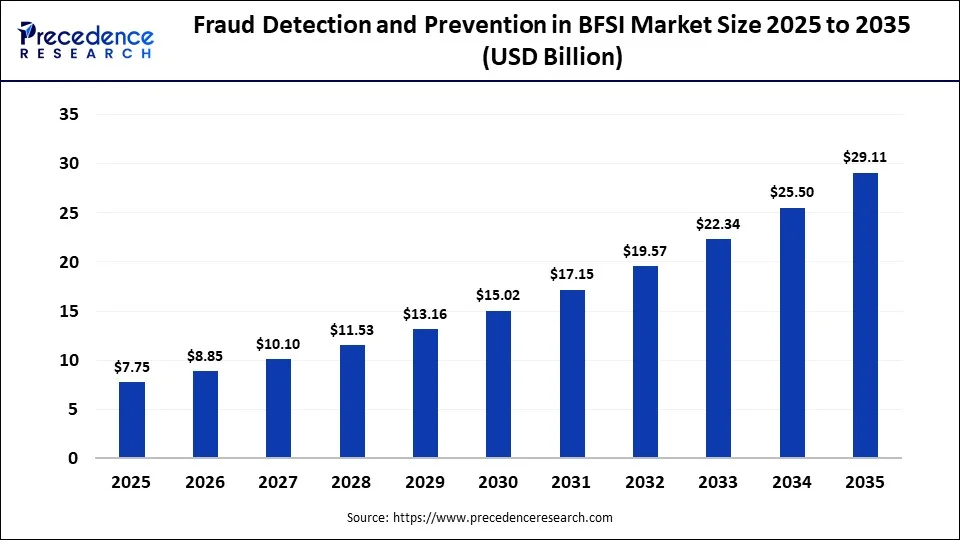
Gautam Mahajan is an ICT market research analyst. He conducted research on machine learning-based fraud scoring, behavioral biometrics, device intelligence, identity verification, payment fraud, and account takeover prevention across BFSI. His research supports banks, insurers, fintech companies, payment providers, and fraud technology vendors in assessing market opportunities, competitive positions, and technology adoption. The fraud detection and prevention in BFSI market was expected to reach USD 29.1 billion in 2035.
Source: https://www.precedenceresearch.com/fraud-detection-and-prevention-in-bfsi-market
 Get a Sample
 Table Of Content


Fraud Detection and Prevention in BFSI Market Size and Forecast 2026 to 2035
With more than 5 years of financial technology market experience, Gautam Mahajan states that fraud prevention is shifting from investigating it after the transaction to detecting it in real time. Rather than relying on rules, banks and financial institutions are turning to machine learning models, behavioral biometrics, device fingerprinting, graph analytics, and real-time transaction scores to detect fraud. The global fraud detection and prevention in BFSI market was valued at USD 8.85 billion in 2026 and is growing at a CAGR of 14.15% over the forecast period. Additionally, the increasing complexity and sophistication of digital payments are driving BFSI institutions to adopt a continuous monitoring and risk-based approach to fraud prevention.
Key Takeaways
- By technology, the artificial intelligence & machine learning segment led the market with a share of 28.4% in 2026.
- By financial institution, the banks segment led the market with a 54.7% share in 2026.
- By application, the digital banking segment captured a major revenue share of 19.8% in 2026.
- By solution, the fraud analytics segment captured the largest market share of 31.6% in 2026.
- By fraud type, the payment fraud segment led the market with a 24.8% share in 2026.
- Rising digital payments are driving fraud losses toward nearly USD 50 billion by 2035.
- Persistent U.S. payment infrastructure gaps continue to fuel disproportionately high fraud rates.
- Major acquisitions by Visa and Mastercard highlight rapid consolidation in the fraud detection and prevention in BFSI market.
- Visa's announced BioCatch acquisition for USD 2.4 billion and Mastercard's Recorded Future acquisition for USD 2.65 billion illustrate the payment networks' investment in fraud prevention and threat intelligence.
- North America held the largest market share of 37.8% in 2026, and Asia-Pacific emerged as the fastest-growing region with a CAGR of 16.1% from 2026 to 2035.
Overview - Digital Fraud Is Driving a Structural Shift Toward Intelligent Financial Crime Prevention
The global fraud detection and prevention in BFSI market is estimated at around USD 8.85 billion in 2026 and will grow at 14.15% CAGR through 2035. This is a potential incremental USD 21.4 billion market for the period. Services played the remainder of the market in 2026, accounting for 20.9% of the market revenue, and is projected to grow to 18.2% by 2035, while solutions' share of the market increases to 79.1% in 2035.
Prevention of fraud is more than a set of rules and basic transaction checks. Financial institutions are adopting increasingly adaptive risk models that evaluate customers and transactions over the entire life cycle of a relationship, from account opening, authentication through transactions, payment monitoring, investigations, and recovery. Finalizing the leader of the solution pack is fraud analytics (31.6%), followed by identity verification, which is growing at the fastest rate in the main solution camps at a 16.10% CAGR, with the growth of remote onboarding and synthetic identity fraud.
The regional market of the region showed significant growth, with North America contributing most of the market share with 37.8%, followed by Europe with 27.1% and Asia-Pacific with 24.2% in 2026. Asia-Pacific will witness the highest growth rate, at 16.10% CAGR, owing to the continued growth of digital payments, mobile banking, and fintech services in the region.
Key Insight: The global fraud detection and prevention in BFSI market is expected to increase to 79.1% in 2035, and growth in the APAC region is expected to drive the market in the coming years.
Key Coverage: The full deep-dive report includes a comprehensive revenue breakdown, history and forecast on the market's development, growth scenarios, institution-level adoption, and the correlation between fraud losses and prevention technology investments.
Source: Precedence Research Database
Market Size & Forecast - A USD 21 Billion Incremental Opportunity Through 2035
| Milestone | Value |
| 2026 Market Size | USD 8.85 Billion |
| 2035 Implied Market Size | USD 29.11 Billion |
| 2026-2035 CAGR | 14.15% |
| Implied Incremental Opportunity, 2026-2035 | USD 21.36 Billion |
The growth in the market is projected to reach around USD 8.85 billion in 2026 and surge to USD 29.11 billion by 2035 with a 14.15% CAGR, adding opportunity worth USD 21.4 billion. While smaller institutions might be more likely to use cloud-based fraud tools and managed services. The large enterprises segment holds the majority of revenue in 2025 (72.2%). Currently accounting for 27.8% of the market, SME share is expected to grow to 34.2% by the end of the forecast period, due to the reduced costs and complexity of implementing fraud technology.
Key Insight: There is increasing access to fraud prevention technology through cloud delivery and managed services, as more SMEs gain access to what has until now been a market dominated by large institutions.
Key Coverage: The full deep-dive report delivers segment revenues in absolute terms, market forecasts for the year, absolute segment revenue pools, regional contribution, adoption curves, and sensitivity analysis based on various fraud-loss and regulatory scenarios through 2030.
Source: Precedence Research Database
Market Dynamics - Fraud Is Evolving From Transaction Abuse to Identity and Ecosystem-Level Attacks
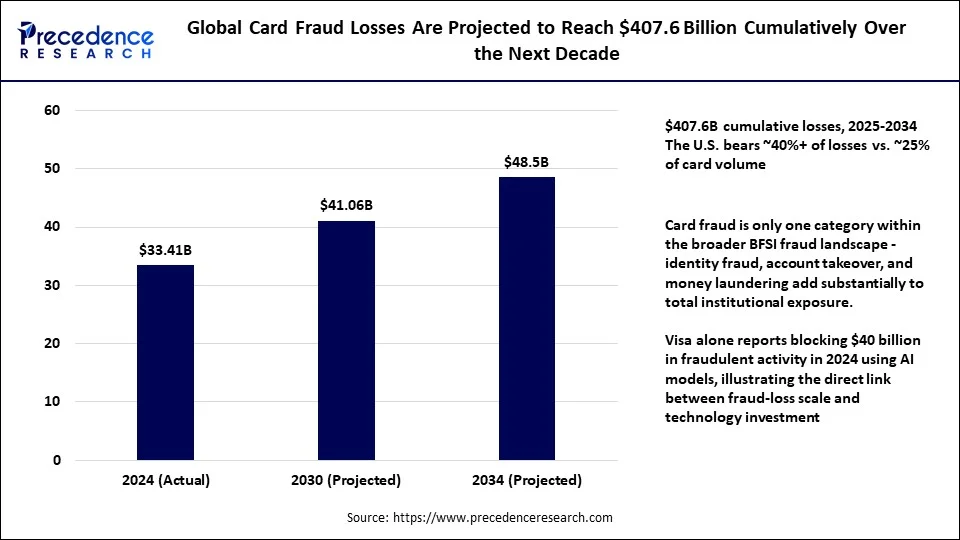
The most obvious driver for the banks' and payment companies' investment in the technology is that the fraud problem itself is large. Based on the Nilson Report's estimate of USD 33.41 billion in 2024 losses. This figure alone would warrant an entire line in the technology budget at any one of the large issuers. That's expected to increase to USD 41.06 billion by 2030 and USD 48.5 billion by 2034, or total losses of USD 407.6 billion during the 2025-to-2034 period.
Fueled primarily by an increase in the volume of digital payments, fraud on that monorail is outpaced by the growth in its number. The U.S., which represents only about 25% of global card volume, suffers from excessive losses compared to the rest of the world. Because US card infrastructure did not stay in step with the emergence of chip-and-PIN and tokenized payment technologies as quickly as the rest of the world.
Key Insight: Global card fraud losses reached USD 33.41 billion in 2024 and are projected to hit USD 407.6 billion cumulatively by 2034.
Key Coverage: The full report also includes quantitative segment analysis, a comprehensive fraud-typology analysis covering transaction, ID, and ecosystem-level attacks, and deepfake & generative AI.
Source: The Nilson Report; Visa Corporate
Pricing Analysis - Transaction Volume, Risk Complexity and AI Intensity Reshape Fraud-Prevention Economics
| Commercial Model | How It Works | Typical Fit |
| Per-Transaction / Volume-Based Pricing | Fee scales with the number of transactions or risk-decisioning calls processed | Card networks, payment processors, transaction monitoring platforms |
| Subscription / Platform License | Recurring fee for platform access, independent of transaction volume | Enterprise fraud and financial-crime platforms |
| Chargeback / Fraud-Guarantee Model | Vendor assumes chargeback liability in exchange for a fee tied to approved transaction value. | Ecommerce fraud specialists (Forter, Riskified, Signifyd) |
| Per-Identity / Per-Verification Pricing | Fee charged per identity check or onboarding verification | Identity verification specialists (Socure, Jumio, Onfido, GBG) |
| Managed-Service / Outcome-Based Pricing | Bundled technology plus managed investigation, priced against measurable fraud-loss reduction. | Managed services and larger institutional engagements |
There is a trend towards changing traditional flat software licensing prices to fraud prevention pricing models. Instead, vendors are pricing their offerings in a manner that reflects their value, such as by considering transaction volumes, number of protected accounts, risk-decisioning requests, or guarantees for results. For chargeback-guarantee pricing models, chargeback specialists are able to tie chargeback fees to the success of chargeback prevention, such as through the use of Forter, Riskified, and Signifyd. For enterprise solutions, a category that includes financial institutions and banks, the systems are normally priced based on bank transactions, data ingestion and processing needs, and the types of fraud prevention modules installed.
Key Insight: Fraud prevention vendor solutions increasingly move from a software license basis and are moving toward value-based pricing based on transaction volume, risk management goals, and risk protection scope.
Key Coverage: This deep-dive report offers analysis of the cost of fraud prevention, chargeback guarantees, identity verification costs, delivery model economics, regional pricing trends, and the influence of AI-powered fraud automation on costs.
Source: Precedence Research Database
Demand-Supply Analysis - Digital Transaction Growth Is Outpacing Traditional Fraud Infrastructure
Information regarding online payments, mobile applications, and instant payment mechanisms is growing more rapidly than the traditional rule-based fraud system. Adding more rules will result in more false positives and add more workload for fraud groups in the subsequent process. Therefore, financial institutions such as commercial banks, credit unions, and other lending institutions are turning more to automated screening of most transactions and redirecting their investigators to the smaller number of transactions that carry the most risk.
While the market demonstrates prowess in transaction monitoring and card fraud analytics. Supply across other categories like identity intelligence, synthetic identity detection, and across-institutional graph analytics is more limited. The capabilities need large data pools that are reliable, which advantage major card networks, credit bureaus, and big techs.
Key Insight: As volumes continue to grow, there is a growing need for automated screening, and proprietary data is also a significant deadlock to advanced fraud detection.
Key Coverage: The full deep-dive report covers transaction growth by channel, both automated screening and manual screening capacity, investigator productivity, data limitations, adoption of managed services, and investment made by key platform vendors.
Value Chain & Supply Chain - Data, Risk Intelligence and Decisioning Capture the Highest Strategic Value
| Stage | Description |
| Data Capture | Transaction, device, identity & behavioral signals |
| Enrichment & Normalization | Identity intelligence and third-party data enrichment |
| Risk Analytics | AI/ML, behavioral and graph models score risk in real time |
| Decisioning & Authentication | Risk-based authentication and automated approve/decline logic |
| Case Management & Investigation | Analyst review of flagged and high-risk cases |
| Recovery & Reporting | Chargeback recovery, SAR filing, and regulatory reporting |
The fraud prevention value chain begins with transaction, device, and behavioral data and spans the process of identity enrichment, risk analysis, real-time decisioning, investigation, recovery, and reporting. Risk analytics and decisioning offer the most strategic benefit, and their applications to detection and false-positive volume are driven directly by model quality and access to proprietary data.
Key Insight: The strongest value creation occurs where proprietary data is converted into fast and accurate fraud decisions.
Key Coverage: The full deep-dive report provides insights such as data-asset ownership, margin pools, build-versus-buy decision, shared fraud intelligence and network effects, and vendor switching costs across the value chain.
Source: Precedence Research Database
Technology & Innovation - AI Is Transforming Fraud Detection From Static Rules to Adaptive Risk Decisioning
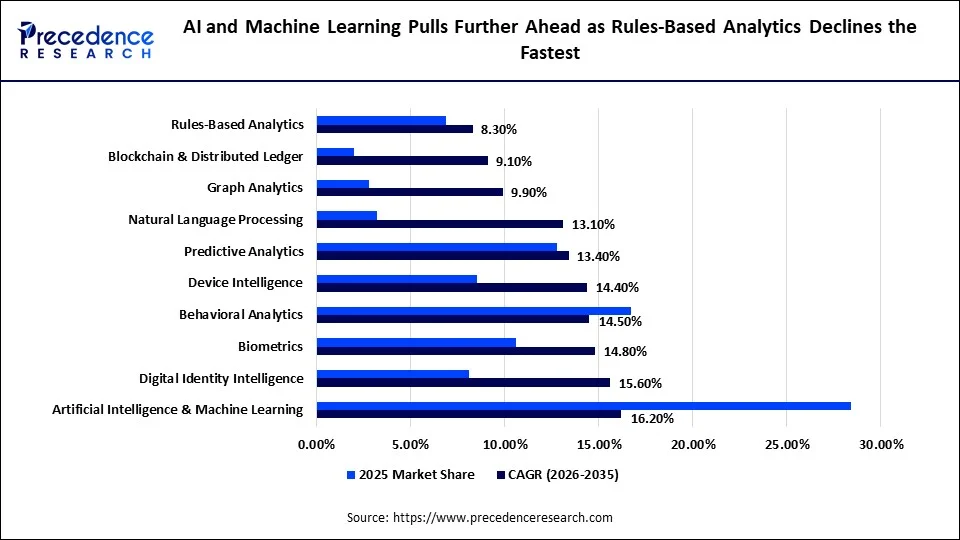
Compared side by side with the remaining core technologies, two technologies dominate both the market share and CAGR charts: artificial intelligence and machine learning, with 28.4% market share and a 16.2% CAGR. This is because these two technologies are both the most mature and widely used in the market. Behind is digital identity intelligence at 15.6% CAGR and 8.1% market share. Biometrics is at 10.6% market share and is growing at a 14.8% CAGR. It is good to use because it's much more difficult for a fraudster to establish a convincingly fake fingerprint or face scan than a password. Rules-based analytics is responsible for 6.9% market share and is the slowest-growing of all technology categories at 8.3% CAGR, with rule engines being sold and purchased as part of a wider AI platform.
Key Insight: AI and machine learning hold a major market with 28.4% market share and 16.2% CAGR.
Key Coverage: The full report explains the marketing position of AI model architecture from major vendors and a commercialization timetable for new entrants for AI functions like agentic fraud investigation and graph-native platforms.
Source: Precedence Research Database
Regulatory & Risk Environment - Compliance Requirements Are Becoming Embedded Within Fraud Architecture
AML/KYC and financial-crime compliance are now becoming embedded more in fraud-prevention systems, as opposed to being managed as a compliance-first, fraud-prevention-second approach. The money laundering & financial crime segment is projected to grow at a 15.0% CAGR, as regulations are paying more attention to the segment and transaction monitoring is increasingly relying on technology.
Financial institutions must also take into account the processing location of customer and transaction information and be able to explain the decisions made with AI. Ensure that every decision has a suitable audit trail. These are far from being extraneous requirements but are becoming a significant factor when deciding on technology to consider along with detection performance.
Key Insight: Fraud technology is emerging as a choice for not just ease of detection, but explainability, data governance, and regulatory compliance.
Key Coverage: The full deep-dive report delivers various factors such as AML/KYC requirements, regional AML/KYC requirements, SAR automation, cross-border data restrictions, requirements of explainability of AI, and regulatory cycles driving technology replacements.
Competitive Intelligence
Competitive Landscape - Integrated Fraud, Identity, Payments and Financial Crime Platforms Intensify Competition
| Category | Companies |
| Payment Networks & Credit Bureaus |
|
| Enterprise Fraud & Financial Crime Platforms |
|
| AI-Native Fraud Analytics Specialists |
|
| Digital Commerce Fraud Specialists |
|
| Identity Verification & AML/Crypto Specialists |
|
Competition is a bit wide-ranging in several related categories. Visa and Mastercard take fraud scoring to where payment networks go, while some large financial-crime platforms, namely NICE Actimize, SAS, FICO, Oracle and IBM, also offer extended financial-crime solutions. Other competitors primarily rely on large properties of identity data and credit data, which include Experian, TransUnion, and Equifax, or on AI-based fraud analytics, such as Feedzai, Featurespace, BioCatch, and Sift. A group of firms specializes in digital-commerce fraud (Forter, Riskified, Signifyd), while others (Socure, GBG, Jumio, Onfido, Nasdaq Verafin, Chainalysis) focus on identity, AML, and financial-crime cases.
The competitive line is also shifting, based on acquisitions. As shown by the acquisition of Featurespace earlier this year by Visa and the purchase of Recorded Future by Mastercard, fraud intelligence seems to be gaining traction as a key new capability, one that needs to be part of the payment network's services, rather than an external service.
Key Insight: Payment networks are acquiring their way to better control of fraud intelligence, as competition strives to make this partnership with fraud the central focus.
Key Coverage: The full deep-dive report provides, including understanding competitive intensity by segment and by region, vendor overlap, market white spaces, partnership ecosystems, and AI-native companies emerging onto the market.
Source: Precedence Research Database
Tentative Leading Company Universe - 25 Companies Shaping the Fraud Detection and Prevention Market
| Company | HQ | Market Position | Core Strength | Major Applications/Segments |
| Visa | US | Payment network leader | Embedded network-level fraud scoring | Card payments, real-time authorization |
| Mastercard | US | Payment network leader | Threat intelligence + fraud analytics | Card payments, cyber risk, digital identity |
| NICE Actimize | US | Financial crime platform leader | Fraud, AML, and case management | Banks, capital markets |
| SAS | US | Enterprise analytics leader | AI-driven fraud & AML analytics | Banks, insurers, government |
| FICO | US | Fraud scoring pioneer | Falcon fraud platform, decisioning | Card issuers, banks |
| LexisNexis Risk Solutions | US | Identity & risk data leader | ThreatMetrix digital identity intelligence | Banks, fintechs, insurers |
| Experian | Ireland/UK | Credit bureau & identity leader | Fraud & identity data (NeuroID) | Banks, lenders, fintechs |
| TransUnion | US | Credit bureau & identity leader | Device and identity risk intelligence | Banks, lenders, fintechs |
| Equifax | US | Credit bureau & identity leader | Identity verification (Kount) | Banks, lenders, ecommerce |
| Oracle Financial Services | US | Core banking & GRC leader | Integrated fraud, AML, compliance | Large banks |
| IBM | US | Enterprise risk technology leader | AI fraud & financial crime (Safer Payments) | Banks, payment processors |
| Feedzai | Portugal/US | AI-native fraud platform | Real-time transaction risk scoring | Banks, fintechs, payment providers |
| Featurespace (Visa) | UK | AI-native fraud platform (Visa subsidiary) | Adaptive behavioral AI (ARIC Risk Hub) | Banks, acquirers, PSPs |
| BioCatch (Visa, pending) | Israel | Behavioral biometrics specialist | Continuous behavioral authentication | Banks, fraud prevention |
| Sift | US | Digital trust & safety platform | Account, payment, and content fraud | Fintechs, marketplaces |
| ComplyAdvantage | UK | AML/financial crime data specialist | Real-time AML screening & monitoring | Banks, fintechs, PSPs |
| Forter | US | Ecommerce fraud specialist | Merchant-focused transaction decisioning | Ecommerce, digital merchants |
| Riskified | Israel/US | Ecommerce fraud specialist | Chargeback guarantee model | Ecommerce, digital merchants |
| Signifyd | US | Ecommerce fraud specialist | Guaranteed fraud protection | Ecommerce, digital merchants |
| Socure | US | Identity verification leader | AI-driven identity verification | Banks, fintechs, gig platforms |
| GBG | UK | Identity verification specialist | Global identity data & verification | Banks, fintechs, gaming |
| Jumio | US | Identity verification specialist | Biometric & document verification | Banks, fintechs, crypto exchanges |
| Onfido (Entrust) | UK | Identity verification specialist | AI document & biometric verification | Banks, fintechs |
| Nasdaq Verafin | Canada | AML/fraud detection specialist | Cloud-native fraud & AML platform | Banks, credit unions |
| Chainalysis | US | Crypto compliance specialist | Blockchain transaction intelligence | Crypto exchanges, banks, government |
Company Profiles - Detailed Intelligence Across Leading Fraud Detection and Prevention Participants
Visa
- HQ: San Francisco, California, US Founded: 1958 Ownership: Public (NYSE: V)
- Visa embeds fraud scoring right into its payment network, and in 2024, an expansion of its use of hundreds of AI models blocked USD 40 billion in fraud. Last year (2024), the company wrapped up its purchase of AI fraud-detection outfit Featurespace, and it also signed a deal to purchase biometrics-of-behavior outfit BioCatch last year (2026) for USD 2.4bn. It would officially put Visa's investment in fraud technology at over USD 13 billion through 2015.
- Key Strengths: Two industry-leading acquisitions of fraud-AI companies, Featurespace and BioCatch, bolster advanced fraud detection in network-level authorization, as well as unmatched scale on the global card network at the transaction level.
- Key Vulnerabilities: The BioCatch deal is anticipated to close in fiscal Q2 of 2027, which means there is an integration timeline gap when compared to Mastercard's built-in Recorded Future capacity.
Mastercard
- HQ: Purchase, New York, US Founded: 1966 Ownership: Public (NYSE: MA)
- In September 2024, Mastercard announced its USD 2.65 billion acquisition of threat-intelligence firm Recorded Future in advance of two weeks of Visa's announcement of its USD 2 billion acquisition of Featurespace. Check out the BVNK acquisition completed by Mastercard in 2026, the same day that Visa announced its BioCatch deal.
- Key Strengths: First-mover advantage in the card networks' 2024 fraud-AI acquisition wave; Recorded Future integration has been in place since 2024, ahead of Visa's pending BioCatch deal.
- Key Vulnerabilities: Mastercard is grappling with a gruesome competition at the level of capability as it faces Visa that is now also throwing money into threat intelligence with the acquisition of behavioral-biometrics provider BioCatch.
NICE Actimize
- HQ: Hoboken, New Jersey, US Founded: 1999 (NICE Ltd. subsidiary) Ownership: Private (NICE Ltd., NASDAQ: NICE)
- NICE Actimize is an industry-leading integrated financial-crime solution that includes fraud detection, AML, and case management capabilities. It has been implemented in many large banks in the USA and other capital-markets enterprises around the world.
- Key Strengths: Suite approach to fraud and AML - not a one-point solution; penetration on enterprise banking customers.
- Key Vulnerabilities: Clearly identified by challenges from AI-native specialists that can be deployed quickly and provide models that are more adaptable and frequently superior to traditional enterprise platforms.
FICO
- HQ: Bozeman, Montana, US Founded: 1956 Ownership: Public (NYSE: FICO)
- One of the industry's oldest fraud-scoring platforms is FICO's Falcon fraud platform. Card issuers and banks are using it widely for real-time transaction decisioning.
- Key Strengths: Decades of fraud score experience, wide distribution across card issuers, and robust brand recognition in credit and fraud risk scoring.
- Key Vulnerabilities: As more companies adopt cloud-native, AI-first platforms, it is increasingly challenged by legacy platform designs, quicker model development, and model iteration.
Socure
- HQ: Incline Village, Nevada, US Founded: 2012 Ownership: Private (VC-backed)
- Socure is an AI-powered identity verification expert providing banks, fintechs, and gig-economy platforms. The firm is leveraging the identity-verification space, sitting at the intersection of account opening and onboarding fraud prevention.
- Key Strengths: AI-driven Biometric Verification continues to be a high-specialization space and is the solution category with one of the fastest growth rates in the dataset, based on a 16.1% CAGR.
- Key Vulnerabilities: While the integrated financial-crime platforms have been broader in their product offerings, serious competition has been brought about by dedicated identity specialists like Jumio, Onfido, and GBG, and bureau-scale companies such as the likes of Experian, Equifax, and TransUnion.
Feedzai
- HQ: Coimbra, Portugal/San Mateo, California, US Founded: 2011 Ownership: Private (VC-backed)
- Feedzai is an AI-native, cloud-based real-time transaction risk scoring platform for banks, fintechs, and payment providers. It is set up as a standalone solution that competes against card network empowerment fraud-AI systems like Featurespace and BioCatch.
- Key Strengths: The stand-alone, cloud-based design is a big attraction for financial institutions that don't want to be bound by one card network's fraud-technology plan.
- Key Vulnerabilities: Feedzai is put in direct competition with emerging well-capitalized platforms owned by the card networks, like Visa's Featurespace and BioCatch, and Mastercard's Recorded Future, which have far more resources.
Company Strategic Positioning - Technology Depth, Distribution Reach and Financial Crime Expertise Define Future Leaders
The payment networks (Visa and Mastercard) have a strong position since they link transaction-level information with direct access to actual payment flows. Large financial institutions have extensive fraud control, AML, and GRC needs and, by extension, enterprise platforms like NICE Actimize, SAS, FICO, Oracle, and IBM. These provide wide-ranging fraud, AML, and GRC capabilities. Large identity and data assets include Experian, TransUnion, Equifax, and LexisNexis Risk Solutions.
Feedzai, Featurespace, BioCatch, and Sift are among those providing AI-enabled expertise, such as the ability to detect patterns from users' behavior and develop models faster. Forter, Riskified, Signifyd, Socure, GBG, Jumio and Onfido provide various digital-commerce and identity solutions. Large platforms and networks benefit from a distribution edge, specifically in terms of providing built-out infrastructure, and specialists can win by addressing some of these specific problems of high growth like synthetic identity or cryptocurrency fraud.
Key Insight: The gap between future leaders will be breaking down data access, technology sophistication, reach, and experience with key fraud categories.
Key Coverage: Covered in the full deep-dive report, including strategic positioning scores, growth prospects based on vendor archetype, acquisition targets, and comparisons of talent and R&D investment.
Market Share & Competitive Ranking - Scale, Data Assets and Embedded Distribution Determine Revenue Capture
| Competitive Tier | Indicative Market Position |
| Payment network-embedded fraud scoring | Estimated share range, not separately disclosed |
| Enterprise financial-crime platform leader | Estimated share range, not separately disclosed |
| Credit bureau/identity data leader | Estimated share range, not separately disclosed |
| AI-native fraud analytics specialist | Estimated share range, not separately disclosed |
| Digital-commerce / identity-verification specialist | Smaller current revenue base, disproportionate growth |
Since the BFSI fraud detection and prevention category overlaps adjacent areas of adjacent markets, such as fraud analytics, identity verification, AML and payment risk, there isn't an independently audited market-share ranking for the market as a whole. The majority of vendors provide no information on separately recognizing fraud-prevention revenue. Therefore, it would be more accurate to define competition's strength not by just one market share figure but by the holding or building of proprietary data, distribution backfill, customer relationships, product breadth and M&A.
Key insight: In a market that is fragmented and where there is no visibility of revenue, data ownership, data distribution and product reach is a more useful indicator of marketplace competitors' strength than just market-share data.
Key Coverage: The full deep-dive report, such as estimated competitive ranges, financial exposure analysis, recent distribution movement, market concentration and economics of platforms versus specialist providers.
Source: Precedence Research Database
Customer & Application Analysis - Digital Banking, Mobile Payments and Remote Onboarding Drive Demand
Digital banking is the number one app in terms of 2026 market share at 19.8% as it has become a larger single application since digital banking now covers almost all transactions a bank can offer, rather than one specific type. Furthermore, at 14.6% market share, mobile banking is followed by online payments at 14.1%. These are both big numbers because most transactions occur in the mobile or online channels at most institutions. ATM & Branch Transactions, at 1.3%, are still the smallest application market share, which highlights the level of banking activity that has already shifted away from the physical counter in a branch. However, they have different growth rates and sizes.
Banks are still the largest buyer group at 54.7% market share, a trend reinforced over decades by banks having been the largest, most regulated, and most fraud-exposed financial-institution type in the entire BFSI category. The insurance companies' market share (15.2%) has increased at 15.55% CAGR, and investment and wealth management firms' market share (3.2%) has increased at 12.7% CAGR.
Cryptocurrency and digital assets are growing fastest with 17.7% CAGR, helped by the fact that the rails of cryptocurrencies have been underdeveloped and under-defended over the years versus those of card payments. Account opening and onboarding is projected to increase at a 16.2% compound annual rate from a base of 9.7% of the market, as remote onboarding has provided the perfect identity verification opening for synthetic identity fraud. In terms of region, North America holds the major share of the global market due to the strong prevalence of digital card payments.
Key Insight: Cryptocurrency & digital assets will have a faster growth rate of 17.7% CAGR from just 2.7% market share, and finTech companies are outgrowing banks among buyers, a 16.3% CAGR compared to 13.6% as embedded fraud controls become commonplace.
Key Coverage: The full report also offers insights into crypto fraud exposure as a separate purchasing category, channel dynamics that range from direct sales to systems integrators to embedded partnerships, and the differences between application-level switching costs and renewal cycles, as well as differences between the purchasing criteria of SMEs and large enterprises.
Source: Precedence Research Database
Segmentation Analysis - AI, Identity Intelligence and Real-Time Monitoring Capture the Fastest-Growing Pools
Identity verification accounts for the largest growth at 16.1% CAGR, while having the smallest share of the solutions market. The biggest percentage of market share is fraud analytics at 31.6% and is increasing at a 13.65% CAGR, because it is the most mature function already and the most broadly deployed.
Payment fraud dominates the fraud types segment with a 24.8% share, and is still expanding at a healthy 13.4% CAGR. The volume of payments keeps increasing despite improvements in payment defense capabilities. Despite a small 2.1% market share, insurance fraud expands steadily at a 17.0% CAGR, reflecting the extent of the underperformance of claims fraud detection when compared with industry-wide claims payment fraud detection.
The cloud segment is growing from 48.6% of market share in 2026 to 61.2% in 2035, as banks are now flipping the switch on traditional on-premises infrastructure for a cloud-based install with an ongoing push for regular updates. On the other hand, large enterprises were larger than their small and medium enterprise counterparts, as larger institutions have typically been the only ones to have enough budgets to justify a dedicated fraud-technology stack. However, that is beginning to change because of the drop in the cost of cloud pricing.
Key Insight: In terms of solution growth, identity verification has the highest market growth with a CAGR of 16.1%, and cloud deployment surpasses on-premises outright in terms of market share, going from 48.6% in 2023 to 61.2% in 2035.
Key Coverage: The full report includes complete cross-tabulation of segments, a complete breakdown of the service types including professional, managed, consulting, implementation and support, absolute dollar revenue by segment for each forecast year, a tracking of emerging micro-segments such as real-time payments fraud and embedded finance fraud, and competitive intensity and concentration for each segment.
Source: Precedence Research Database
Competitive Benchmarking - Real-Time Intelligence and Proprietary Data Create Structural Competitive Advantages
There are several important elements in which leading vendors compare, such as the scope of transaction and identity information they have access to, their integration with banking apparatus and payment platforms, and the evidence of measurable fraud-loss reduction they can provide.
Payment networks have the benefit of having access to the scale of transaction volume, and specialist providers that have the ability to be more successful in certain specific areas, such as identity, e-commerce, or AML.
This competitive advantage is therefore qualitative technology-wise but will also be confounded by access. A strong model is good, but its power boosts when it can leverage a wide range of data and then run directly within the transaction or payment chain within a given institution.
Key Insight: Real-time decisioning, proprietary data, and deep integration with financial infrastructure are becoming the clearest sources of competitive advantage.
Key Coverage: The full deep-dive report covers customer-retention metrics, processing scorecards, detection/false-positive benchmarking, R&D and patent activity, and partnership ecosystem strength.
Product Portfolio Benchmarking - Broad Financial Crime Platforms Compete With Specialized Fraud Technology Providers
Plans for broader platforms that support numerous functions in the areas of fraud and AML, GRC and case management include NICE Actimize, SAS, Oracle and IBM. Specialist providers tackle specific fields in which they can offer more in-depth functionality, such as identity verification, e-commerce fraud and behavioral analytics. This poses a very clear competitive challenge for markets.
The capacity for neighboring capabilities to now link via APIs and already in-place banking systems is becoming more significant. It's possible for vendors who can offer a wider range of integration capabilities to grow into their existing customer base, and for specialists with narrow products to find niche entry points and offer related services.
Key Insight: Broad financial-crime suites and specialists that have greater depth within specific types of fraud are in balance with each other in the market.
Key Coverage: Product capability comparisons, portfolio gaps, cross-selling opportunities, API/integration scope and remaining new product development/roadmaps.
Technology & Innovation Benchmarking - Multi-Signal AI Emerges as the Core Competitive Differentiator
The number of players targeting fraud has risen, and they're using more than one indicator. Patterns of transactions, device information, behavioral patterns, and interactions between accounts or entities can all be analyzed as a group to find patterns. That would likely be normal for any single point of data. For synthetic identity and ATO fraud, this is especially true, as criminals go around circumvention of individual detection controls. The technology side is thus moving toward systems that can integrate multiple signals and update models with the evolution of fraud, and towards supporting investigators with improved, more timely information for their cases.
Key Insight: Transaction signals, device signals, behavioral signals, and network signals provide a more robust foundation for attacks to be detected that are trying to circumvent a single point of control.
Key Coverage: This report covers AI/ML model comparison, multi-signal detection capabilities, model-update frequency, generative AI use in investigations, and innovation-pipeline tracking.
Application Competitive Benchmarking - Fraud Prevention Is Expanding Across Digital Banking, Payments and Identity
The application with the highest growth rate is cryptocurrency & digital assets with 17.7% CAGR, and the second is account opening & onboarding with 16.2%. These provide opportunities for vendors, which may be able to integrate transaction intelligence with robust identity controls as the risks of fraud evolve in the context of financial services going digital.
The difficulty when opening accounts is now focused on verifying that the applicant is a legitimate customer. In the digital asset sector, providers are additionally required to deal with complicated, evolving payment environments and detect irregular payment patterns.
Key Insight: New application-level opportunities with specialized fraud and ID technologies include a boost in digital assets and remote onboarding.
Key Coverage: The full deep-dive report provides, including vendor-to-application mapping, specialist identification, analysis of digital-asset fraud connected to an application, and competitive benchmarking of account-opening and onboarding controls.
Geographic Competitive Landscape - Asia-Pacific Emerges as the Fastest-Growing Competitive Battleground
Built on the back of existing fraud-management systems and high fintech adoption, North America accounted for the biggest market share, at 37.8% of the total, in 2026. Financial regulation and digital banking have influenced demand for fraud/finally-crime controls in Europe, making up 27.1% of the total. Asia-Pacific is the largest part of the market, accounting for a 24.2% share, and this part is anticipated to gain the fastest growth in the market with a CAGR of 16.10% during the forecast period.
Highly correlated growth is observed between the region's growth and the adoption of digital payments and fintech, mobile banking, and increased exposure to digital fraud. This gives an opportunity to both international vendors and local providers, which have the ability to accommodate country-specific requirements for regulatory or deployments.
Key Insights: North America remains the biggest market, while Asia-Pacific is the best growth avenue, according to an increase in digital financial activity in the region.
Key Coverage: The Full Deep-Dive Report Provides: Country-level competitive positions, regional specialist mapping, localization needs and regulatory drivers, along with vendor expansion strategies throughout the Asia-Pacific region.
Manufacturing & Capacity Benchmarking - Processing Scale, Data Infrastructure and Model Deployment Define Technology Capacity
The capacity for fraud cannot be compared to what is observed in the industry where hardware makes up the core business. Important metrics include the number of transactions a platform is capable of handling in real-time, the size of their data infrastructure, their ability to deploy and run AI models without issues, and the size of the analysts they employ for managed services.
Speed and reliability are especially vital for financial institutions, as fraud systems are embedded within payment and authorization processes that, when delayed, can impact customer transactions; as well as model performance, vendors compete by how quickly models are processed, how long it takes to make decisions, the resilience of the infrastructure, and uptime.
Key Insight: In fraud prevention, technology capacity is measured by transaction throughput, decision speed, model infrastructure, and operational reliability rather than physical production capacity.
Key Coverage: Transaction throughput, real-time decision latency, managed-service workforce, disaster-recovery and uptime benchmarking, and cloud infrastructure are covered in the full report.
Customer & Channel Benchmarking - Embedded Distribution and Banking Integrations Strengthen Customer Stickiness
Deeply embedded fraud platforms for banking systems such as core banking, payment authorization, or pre-existing banking technology ecosystems can prove difficult to replace. These integration relationships are advantageous to providers that are linked to platforms like Oracle, Fiserv, FIS, and Temenos, as it can be technologically and operationally challenging to replace a fraud system.
The distribution advantage of payment networks is further enhanced by the ability to detect fraud directly in the payment flow that is authorized. The rise of network-level access is a good example of how Visa's Featurespace and Mastercard's Recorded Future can benefit fraud technology providers' ability to bolster their role.
Key Insight: Switching costs raised by deep embedding in payment and banking infrastructure provide a robust basis for a QUAD vendor to retain customers.
Key Coverage: The Full Deep-Dive Report: Banking and payment integrations, customer concentration, contract and renewal metrics, channel partnerships and switching-cost analysis.
Strategic Developments - AI, Cloud and Integrated Risk Intelligence Shape Competitive Priorities
I believe there is increased competition to integrate AI into fraud detection tools more closely with payment infrastructure, enhance behavioral and identity intelligence, and integrate fraud monitoring with AML and cyber-risk data. The direction in which it's headed is toward wider risk platforms capable of assessing various financial-crime signals from a shared system instead of being handled by different systems for each type of threat.
Key Insight: Vendors are developing towards Connected Risk Platforms where they are consolidating all aspects of fraud, identity, AML and other intelligence instead of addressing each risk type alone.
Key Coverage: The full deep-dive report delivers strategic activity spanning AI-native fraud detection, behavioral biometrics, identity intelligence and payment infrastructure, as well as fully integrated financial crime platforms.
M&A Landscape - Fraud Intelligence, Behavioral Analytics and Cyber Risk Drive Strategic Consolidation
| Date | Company / Event | Details |
| Sep-24 | Mastercard agrees to acquire Recorded Future for $2.65 billion | Adds threat-intelligence capability from Insight Partners to strengthen Mastercard's cybersecurity and fraud-prevention portfolio. |
| Sep-Dec 2024 | Visa acquires Featurespace | Adds real-time AI behavioral-profiling fraud detection (ARIC Risk Hub); announced Sep. 26 and completed Dec. 19, 2024. Featurespace served 80+ direct customers, including HSBC and NatWest. |
| 2024 | Visa reports blocking $40 billion in fraudulent activity | Attributed to hundreds of AI models and decades of global fraud data deployed across Visa's network. |
| 2026 | Visa agrees to acquire BioCatch for $2.4 billion | Adds behavioral-biometrics fraud prevention; brings Visa's five-year cumulative fraud-technology investment to over $13 billion; expected to close by fiscal Q2 2027. |
| 2026 | Mastercard completes acquisition of BVNK | Adds stablecoin infrastructure capability, intensifying the card networks' technology arms race. |
Aman interpreted that card network acquisition activity since 2024 is concrete evidence that consolidation is actually happening in this market. In September 2024, Mastercard inked a deal with Recorded Future to acquire it for USD 2.65B, and agreed to acquire its cyber threat intelligence. From September to December 2024, Visa followed a similar move, acquiring over 80 direct customers its new partner served, including HSBC and NatWest, to immediately build a customer base for a real-time AI model of behaviour-based fraud detection. This was delivered via its ARIC Risk Hub. In 2024, Visa revealed it prevented USD 40 billion in fraudulent transactions. In 2026, Visa signed a USD 2.4 billion investment in BioCatch to purchase its behavioral-biometrics fraud-prevention capabilities. This will be finalized in fiscal Q2 2027, marking Visa's five-year total investment in fraud-tech beyond USD 13 billion already. On the other hand, Mastercard responded on that same day with its own acquisition of BVNK, introducing stablecoin infrastructure capability.
Key Insight: Mastercard and Visa's combined spend for AI fraud capability in the last three years has surpassed USD 5 billion. The former with its Recorded Future buy for USD 2.65 billion and the latter with its BioCatch purchase for USD 2.4 billion in total. Bringing Visa's total fraud-technology purchases within five years to exceed USD 13 billion.
Key Coverage: The full report also covers the individual space-based M&A disclose/estimate data, a deep dive into the strategic drivers behind each deal, an analysis of post-acquisition integration experiences, an evaluation of market themes arising from the space in disclosed M&A transactions and future acquisition targets, and covers venture and growth equity investment activity in startups focused on AI-native fraud.
Source: Precedence Research Database
Opportunity & White-Space Analysis - Identity, AI, Cloud and Emerging Markets Create High-Value Growth Opportunities
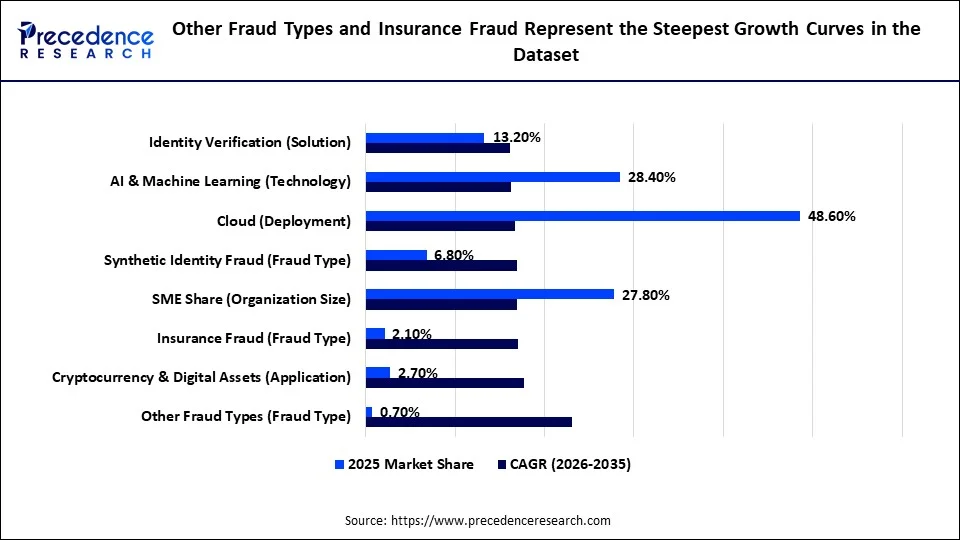
Other fraud types' 23.1% CAGR is largely due to the fact that their base market shares are thin compared to the rest of the market and are not necessarily a result of any single breakout fraud type. At 17.0% CAGR, insurance fraud is growing, as claims-fraud detection has yet to catch up to the payment-fraud detection industry-wide. As an application, cryptocurrency and digital assets expand at a 17.7% CAGR, reflecting the current lack of coverage of fraud in the crypto rails compared to legacy rails. Both these shifts are fueled by a move to cloud-based, accessible platforms. Cloud deployment, with more than 61.2% share, and the number of SMEs, more than 34.2% of market share, suggest the market is on the trajectory of accessible and cloud native platforms.
Key Insight: Other fraud types (23.1% CAGR), insurance fraud (17.0% CAGR), and cryptocurrency & digital assets (17.7% CAGR) are the fastest-growing in the market.
Key Coverage: This full report also includes individual return on investment calculations on addressable revenue in each of the white space areas, competitive density mapping, investment and M&A tracking per white space area, and go-to-market recommendations for each opportunity type.
Source: Precedence Research Database
Industry Structure - High Competitive Rivalry Meets Increasing Technology and Integration Barriers
| Porter's Five Forces | Assessment |
| Supplier Power MEDIUM | Data providers, identity bureaus and cloud/AI infrastructure vendors influence vendor economics. |
| Buyer Power HIGH | Large banks and payment networks have substantial procurement leverage and can demand integration and outcome-based terms. |
| Threat of New Entrants MEDIUM | AI lowers technology barriers, but proprietary fraud data, bank-core integration and regulatory trust remain difficult to replicate. |
| Threat of Substitutes LOW-MEDIUM | In-house fraud teams and legacy rules engines remain viable substitutes for smaller institutions. |
| Competitive Rivalry HIGH | Card networks, core banking vendors, credit bureaus and AI-native specialists increasingly compete for the same fraud budgets. |
In terms of Porter's five forces analysis, buyer power is also high, as there are enough banks and payment networks to apply procurement leverage. Demanding an amount of deep integration work and outcome-based pricing terms from the various vendors that want to come into their business. Similarly, some of the competition is rated as competitive rivalry; there are now competing card networks, core banking vendors, credit bureaus, and AI-native specialists competing for the same budgets within an individual institution for prevention.
Since the cost structure of every business for whom an FTV is supplying fraud technology is influenced in some way by the data provider, identity bureau, cloud provider, or AI infrastructure provider, supplier power is rated as medium. Threat of new entrants is also rated at the medium level because AI has essentially dropped the technology hurdle to building a product in the fraud detection space. The second lowest of the five is Threat of Substitutes, where in-house fraud teams or legacy rules engines will still work just as well, though they won't be as effective, especially for smaller institutions that are not ready to invest in a dedicated vendor platform.
Key Insight: buyer power is rated high, and competitive rivalry is rated High, providing large institutions with substantial negotiating power over the amount of investment in the market.
Key Coverage: The full report includes quantified concentration analysis by force, bargaining-power case studies particular to big bank-vendor negotiations, substitute-threat comparatives between in-house and vendor-supplied fraud ability, and entry-barrier analysis associated with own proprietary needs for fraud information.
Source: Precedence Research Database
PESTLE Analysis - Regulation, Digitalization and AI Governance Reshape Market Economics
| PESTLE Factor | Assessment |
| Political | AML, KYC and financial-crime regulations increase mandatory fraud-control investment. |
| Economic | Rising digital transaction volumes increase the financial value of fraud prevention. |
| Social | Consumers expect frictionless digital banking alongside strong fraud protection. |
| Technological | GenAI-enabled fraud (deepfakes, synthetic identity) accelerates adaptive AI defense adoption. |
| Legal | Data privacy, cross-border data transfer and AI governance rules shape deployment choices. |
| Environmental | Limited direct impact, though cloud/AI compute efficiency draws increasing scrutiny. |
Political pressure in this market is anti-money-laundering, know-your-customer, and general financial-crime regulation. All of which effectively have become mandatory, non-negotiable investments for a regulated institution. There is economic pressure due to the amount of transactions that are digital nowadays.
Technological forces may be the most disruptive of the six. They are driving the increased speed of the institutions' need to get adaptive AI defenses up and running to keep up with the speed at which attackers can create fraud and deepfakes with generative AI tools. Environmental factors have the least direct impact, although at the fringes, cloud and AI compute efficiencies are gaining attention as energy consumption in data centers is now emerging as a regulatory issue of its own.
Key Insight: Political and Legal pressure, driven by AML, KYC, and emerging AI-governance regulation, is emerging as an effective requirement for investment in fraud control. Technological change, namely generative-AI-powered deepfake and synthetic identity fraud, is the most challenging of the six PESTLE forces impacting this market.
Key Coverage: Other areas covered in the full report include AI-governance regulatory timelines, quantified social and consumer-trust drivers, economic-cycle sensitivity of fraud-prevention tech budgets and jurisdiction-specific political and regulatory driver analysis.
Source: Precedence Research Database
Market Attractiveness - AI, Identity Intelligence and Cloud Represent the Highest-Value Growth Pools
Fraud detection and prevention in the BFSI market is seen as highly attractive with a CAGR of 14.15%, owing to its high switching costs after embedding fraud platforms in banking and payment systems, high regulatory requirements, increased digital transaction volumes, and continued fraud losses. The rise of financial services going digital creates a growing demand to secure the security of digital accounts and transactions, resulting in the market's benefits.
The best opportunities are focused on areas of increased fraud exposure and increased and more specialized technology needs. Such as identity verification, synthetic identity fraud, AI/ML-based detection, cloud-native fraud platforms, and cryptocurrency transaction intelligence.
Key Insight: The market has good long-term potential. The biggest opportunities are likely to be around detection via AI, ID intelligence, cloud deployment, and prevention of digital asset fraud.
Key Coverage: The full deep-dive report provides, including opportunity ranking within a segment, market attractiveness scoring, and benchmarking of investment return from recent fraud-technology M&A activity.
Future Outlook - Fraud Prevention Evolves From Detection Toward Predictive and Autonomous Financial Crime Management
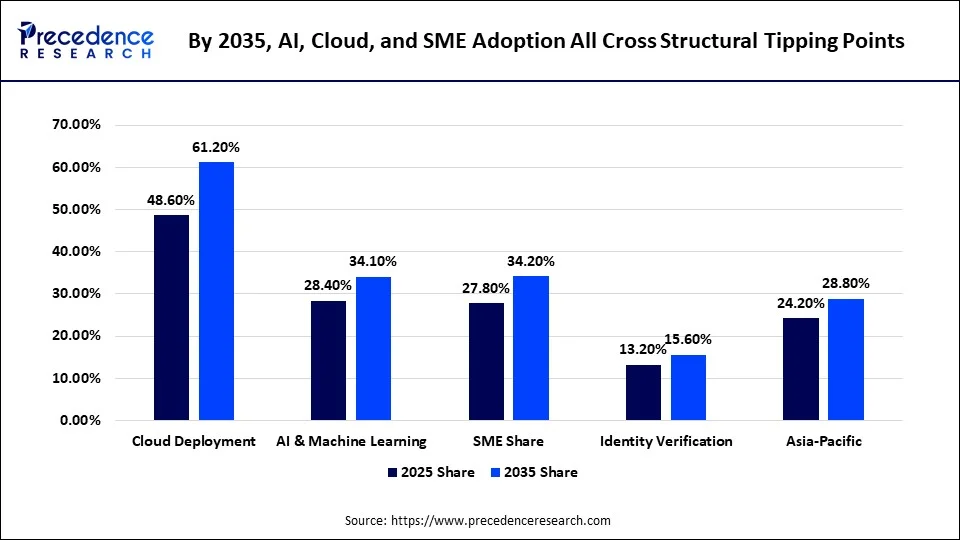
The market for fraud detection and prevention is estimated to be around USD 29.1 billion in 2035, with the rising implementation of cloud technology solutions, AI/machine learning applications, and identity verification solutions. The expected market share for cloud deployments is 61.2%, with 34.1% coming from AI and machine learning technologies. On the other hand, the SME segment is expected to grow its share to 34.2%, while ID verification solutions would account for 15.6% of overall solution revenue.
The forecast is rooted in ongoing digital payment growth, AI-driven efforts to better combat fraud, and a shift to more proactive, identity-focused approaches to security. The market may accelerate further if more card networks continue to acquire, and if generative AI fraud becomes more sophisticated, leading to more robust usage across the enterprise of defensive AI capabilities. Growth might ramp up even more if more companies accept real-time payments, as well as if card networks pick up more and more generative AI products. Fraud becomes more sophisticated while defenses become more powerful. But other factors could curb growth, such as waning business confidence in AI technology, implementation challenges, and shifting policies and laws for cross-border data transfers.
Key Insight: Cloud use goes over parity at 61.2% share, AI/Machine learning dominates at 34.1% of technology revenue, and the incremental gains or losses between the high and low end projections turn largely on the speed of institutional awareness of AI and the generative-AI-fueled fraud.
Key Coverage: The full report features in-depth scenario modelling with explicit probability-weighted outlooks, a profit-pool migration analysis highlighting the financial institution consumer movement from detection to predictive and autonomous fraud management, a ten-year technology roadmap, as well as specific scenario-prioritized recommendations for the technology vendor, investor, and financial institution audiences.
Source: Precedence Research Database
Expert Insights
In BFSI, fraud prevention is shifting from a periodic transaction-based approach to real-time risk detection at every customer touchpoint. Transaction intelligence, behavioral analytics, identity verification, and automated fraud investigation are interesting areas of intersection for me. I believe that in the coming years, machine learning, behavioral biometrics, device intelligence, graph analytics, and adaptive authentication will drive competitiveness.
I also anticipate that financial institutions will continue investing in real-time fraud transaction monitoring, automated case management, fraud prevention and detection capabilities, and synthetic identity detection and account takeover prevention. Vendors who have a robust capacity to provide data, have established partnerships in the financial services sector, and have implementation experience. This will benefit BFSI institutions making a shift towards continuous and risk-based fraud prevention.
Our Experts
The report's analytical basis was provided by Gautam Mahajan, who conducted major market research, created the methodology, and performed market segmentation, technology adoption, regional segmentation, competitive positioning, and forecasts.
Aman did the data collection and validation on regulatory filings, financial data of companies, fraud-related statistics, transaction data, among other quantitative data that were sourced independently to support the market estimates produced.
Aditi had read through the research paper, did quality checks, verified the results, put the analysis in perfect shape, aligned it to the developmental aspects, and put it in a clean and accurate format.
Fraud Detection and Prevention in BFSI Market Segmentation
By Offering
- Solutions
- Services
By Solution
- Fraud Analytics
- Authentication
- Identity Verification
- Governance, Risk & Compliance
- Transaction Monitoring
- Fraud Risk Management
- Case Management & Investigation
By Service
- Professional Services
- Managed Services
- Consulting Services
- Implementation & Integration
- Support & Maintenance
By Fraud Type
- Payment Fraud
- Identity Fraud
- Account Takeover Fraud
- Card Fraud
- Application Fraud
- Synthetic Identity Fraud
- First-Party Fraud
- Insider Fraud
- Investment Fraud
- Money Laundering & Financial Crime
- Insurance Fraud
- Other Fraud Types
By Technology
- Artificial Intelligence & Machine Learning
- Behavioral Analytics
- Predictive Analytics
- Biometrics
- Device Intelligence
- Digital Identity Intelligence
- Rules-Based Analytics
- Natural Language Processing
- Graph Analytics
- Blockchain & Distributed Ledger Technology
By Deployment
- Cloud
- On-Premises
- Hybrid
By Organization Size
- Small & Medium Enterprises
- Large Enterprises
By Financial Institution
- Banks
- Insurance Companies
- FinTech Companies
- Payment Service Providers
- Credit Unions
- Investment & Wealth Management Firms
- Other Financial Institutions
By Application
- Digital Banking
- Mobile Banking
- Online Payments
- Card Payments
- Account Opening & Onboarding
- Loan & Credit Applications
- Insurance Claims
- Money Transfer & Remittance
- Investment & Wealth Management
- Cryptocurrency & Digital Assets
- ATM & Branch Transactions
By Region
- North America (U.S., Canada, Mexico)
- Europe (Germany, U.K., France, Italy, Spain, Netherlands, Switzerland, Rest of Europe)
- Asia-Pacific (China, Japan, India, South Korea, Australia, Singapore, Rest of Asia-Pacific)
- Latin America (Brazil, Argentina, Mexico, Rest of Latin America)
- Middle East & Africa (UAE, Saudi Arabia, Israel, South Africa, Rest of Middle East & Africa)
Questions This Report Deliberately Leaves Open
- What will be the market size of Fraud Detection and Prevention in BFSI by 2030 and 2035?
- What is fueling the leverage and around USD 21 billion annual opportunity in the market until 2035?
- What categories of Fraud will see the Crab pick up the highest proportion of incremental revenue?
- How is Identity Verification and Synthetic Identity Fraud detection gaining momentum compared to other payment fraud analytics?
- What will be the rate of replacement of on-premises fraud infrastructure over the coming years, compared to cloud-based deployment in large banks?
- Which applications will create the highest incremental revenues up to 2035?
- What will new operating models be like in the face of AI and behavioral analytics?
- Which transaction-based, subscription, and outcome-based pricing models are gaining adoption among fraud-prevention providers?
- Which financial institution types will increase fraud-prevention spending most rapidly?
- What effect will the adoption of SMEs have on the market's competitive landscape?
- Which vendors currently possess the strongest combination of data assets, embedded distribution, and AI capability?
- What are the most likely AI-centric upstarts to threaten legacy fraud solutions?
- What are the biggest geographic white spaces, including in APAC?
- What are some of the changing M&A themes that are likely to impact fraud-prevention competition following the recent acquisitions by the major card networks?
- What technologies, applications, and business models look best positioned to help create the next generation of fraud-prevention profit pools?
References
- Precedence Research Database
"Fraud Detection and Prevention in BFSI Market - Market Size and Segmentation Data"
https://www.precedenceresearch.com
Data used: Market size, CAGR, and all segment share/CAGR tables - The Best VPN
"How Much Money Is Lost to Credit Card Fraud Globally? (2026)" - February 26, 2026
https://thebestvpn.com/statistics/how-much-money-is-lost-to-credit-card-fraud-globally/
Data used: Year-over-year card fraud loss trend - BankInfoSecurity
"Visa Acquires AI Leader Featurespace for Payments Protection" - September 26, 2024
https://www.bankinfosecurity.com/visa-acquires-ai-leader-featurespace-for-payments-protection-a-26394
Data used: Visa-Featurespace acquisition details - Visa Investor Relations
"Visa Completes Acquisition of Featurespace" - December 19, 2024
https://investor.visa.com/news/news-details/2024/Visa-Completes-Acquisition-of-Featurespace/default.aspx
Data used: Featurespace acquisition completion date - Yahoo Finance / Zacks
"Visa (V) vs. Mastercard (MA): USD 2.4B BioCatch Acquisition Escalates the Payments Security War" - August 2026
https://finance.yahoo.com/markets/stocks/articles/visa-v-vs-mastercard-ma-221521206.html
Data used: Visa-BioCatch and Mastercard-BVNK deal details - Heise Online
"Visa and Mastercard Invest Billions in Cybersecurity AI to Combat Bank Fraud" - September 27, 2024
https://www.heise.de/en/news/Visa-and-Mastercard-invest-billions-in-cybersecurity-AI-to-combat-bank-fraud-9955084.html
Data used: Mastercard-Recorded Future deal value and context - Visa Corporate
"AI and Trust at Scale - Securing the Future of Payments" - October 23, 2025
https://corporate.visa.com/en/sites/visa-perspectives/security-trust/ai-and-trust-at-scale.html
Data used: Visa's USD 40 billion blocked-fraud figure and AI model deployment scale
For inquiries regarding discounts, bulk purchases, or customization requests, please contact us at sales@precedenceresearch.com
Frequently Asked Questions





Ask For Sample
No cookie-cutter, only authentic analysis – take the 1st step to become a Precedence Research client
 Get a Sample




 sales@precedenceresearch.com
 Schedule a Meeting
