


Gastrointestinal Diagnostics Market Size, Key Companies, Company Product Portfolio, Hospital Procurement Trends, Manufacturing Capacity, Sales Performance, Regulatory Approvals, Company Market Share, and Forecast
Payal Rabde, a Healthcare Industry Expert, highlights that the gastrointestinal diagnostics market has reached USD 6.44 billion in 2026 and is on track to reach USD 10.16 billion by 2035, advancing at a CAGR of 5.20%. Key gastrointestinal diagnostics market companies shaping the market include Olympus, Exact Sciences, bioMérieux while major growth segments span test type, technology, application, test location, region.
Source: https://www.precedenceresearch.com/gastrointestinal-diagnostics-market
 Get a Sample
 Table Of Content


Gastrointestinal Diagnostics Market Size, Demand, and Trends Analysis 2035
The gastrointestinal diagnostics market is forecasted to expand from USD 6.44 billion in 2026 to USD 10.16 billion by 2035, growing at a CAGR of 5.20% from 2026 to 2035.
Key Takeaways
Market Size & Growth Outlook
- Market size in 2025: USD 6.12 billion
- Estimated market size in 2026: USD 6.44 billion
- Projected market size by 2035: USD 10.16 billion
- CAGR (2026-2035): 5.20%
Regional Market Spotlight
- North America led the market with a 39.60% (USD 2.42 billion) share in 2025.
- Europe accounted for 27.40% (USD 1.68 billion) of the market in 2025.
- Asia Pacific accounted for 24.20% (USD 1.48 billion) of the market in 2025 and is projected to be the fastest-growing region, at a CAGR of 6.47% from 2025 to 2035.
Segmental Spotlight
- By test type, Endoscopy accounted for 38.40% (USD 2.35 billion) in 2025.
- By technology, Others (Imaging & Histology) accounted for 36.20% (USD 2.22 billion) in 2025.
- By application, Infection accounted for 32.60% (USD 2.00 billion) in 2025.
- By test location, Central Laboratories accounted for 78.40% (USD 4.80 billion) in 2025.
Gastrointestinal Diagnostics Market Size and Forecast, 2025-2035 (USD Billion)
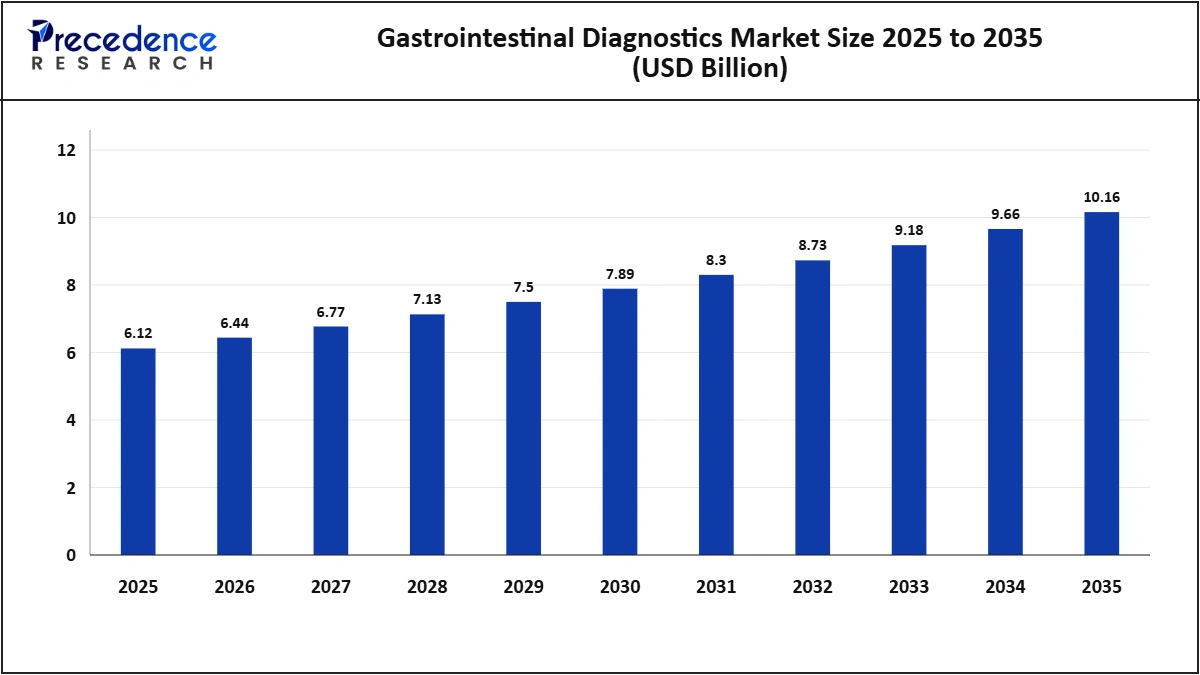
Note: 2025 is the base year; 2026-2035 values are forecasts.
Sources: Expert interviews, secondary sources, Precedence Research database, and Precedence Research analysts.
The gastrointestinal diagnostics market is projected to grow from USD 6.12 billion in 2025 to USD 10.16 billion by 2035 because health systems screen more people for colorectal cancer and test more patients with diarrhea, abdominal pain, and bleeding using endoscopy, stool tests, and molecular panels. Non-invasive stool DNA and blood screening tests and fast multiplex PCR panels add higher-value testing, lifting the market to USD 7.89 billion by 2030 and sustaining a CAGR of 5.20% from 2026 to 2035.
- Analyst View: We built the estimate from procedure and test volumes by type and region, including diagnostic endoscopies, stool and blood tests, H. pylori tests and molecular GI panels, multiplied by average procedure and test prices covering devices, reagents and laboratory services. Volumes reflect screening program coverage, the prevalence of gastrointestinal infections and chronic diseases, and the share of testing done in central laboratories and at the point of care. The total was cross-checked against the gastrointestinal diagnostics revenue of leading endoscopy, assay and laboratory companies and against published estimates, which distinguishes our base year slightly above the comparable figures. The forecast reflects the expansion of screening programs and adoption of molecular diagnostics, moderated by mature endoscopy volumes in developed markets.
Market Trends
- Syndromic PCR panels detect many GI pathogens in one test.
- Blood and stool DNA tests offer non-invasive colorectal screening.
- Average-risk colorectal cancer screening generally begins at age 45 in the United States.
- AI-assisted endoscopy improves polyp detection.
- Calprotectin testing guides IBD monitoring.
- Mini panels support targeted outpatient testing.
Drivers, Restraints and Opportunities
Driver
Colorectal cancer screening programs are expanding, including earlier starting ages, which raises endoscopy and stool test volumes. Gastrointestinal infections, C. difficile, and H. pylori remain common causes of testing. Inflammatory bowel disease prevalence is rising, and patients need regular monitoring. Syndromic PCR panels give fast, broad results that improve treatment decisions. Non-invasive screening tests encourage more people to get screened. These factors collectively contribute to the growth of the market.
Restraint
Endoscopy requires preparation and sedation, which discourages some patients. Reimbursement for broad molecular panels is under pressure in some markets. Non-invasive tests can produce false positives that need follow-up colonoscopy. Endoscopy capacity and staff shortages limit procedure growth. Price competition affects stool tests and immunoassays.
Opportunity
Blood-based screening can be a better alternative for people who avoid stool tests and colonoscopy. AI in endoscopy can improve detection and support training. Targeted mini panels can balance cost and clinical value. Point-of-care tests can speed diagnosis in outpatient care. Expansion of screening and endoscopy in Asia offers strong growth.
Market Segmentation: 2025 Share and Value
Gastrointestinal Diagnostics Market By Test Type 2025 Share & Size
| Segments | 2025 Share | 2025 Market Value |
| Endoscopy | 38.40% | USD 2.35 billion |
| Blood Tests | 18.60% | USD 1.14 billion |
| Stool-based Tests | 16.80% | USD 1.03 billion |
| Molecular GI Panels | 11.20% | USD 0.69 billion |
| H. pylori Tests | 9.40% | USD 0.58 billion |
| Others | 5.60% | USD 0.34 billion |
Note: 2025 is the base year.
Sources: Expert interviews, secondary sources, Precedence Research database and Precedence Research analysts.
Endoscopy accounted for 38.40% (USD 2.35 billion) in 2025 because colonoscopy, gastroscopy and capsule endoscopy allow direct viewing, biopsy and removal of polyps, and remain the reference method for cancer, inflammatory disease and bleeding. Blood tests ranked second by market share at 18.60% (USD 1.14 billion). It includes anemia, liver, coeliac antibody, and newer blood-based colorectal cancer screening tests. Stool-based tests accounted for 16.80% of the market (USD 1.03 billion), covering FIT, stool DNA, calprotectin, and pathogen antigen tests. Molecular GI panels, at 11.20% (USD 0.69 billion), are the fastest-growing type because one PCR test can detect many bacteria, viruses, and parasites in about an hour, H. pylori tests account for 9.40% (USD 0.58 billion), and other tests for 5.60% (USD 0.34 billion).
Gastrointestinal Diagnostics Market by Technology 2025 Share & Size
| Segments | 2025 Share | 2025 Market Value |
| Others (Imaging & Histology) | 36.20% | USD 2.22 billion |
| PCR | 26.40% | USD 1.62 billion |
| ELISA & Immunoassays | 22.80% | USD 1.40 billion |
| Microbiology | 14.60% | USD 0.89 billion |
Note: 2025 is the base year.
Sources: Expert interviews, secondary sources, Precedence Research database and Precedence Research analysts.
Imaging and histology methods accounted for 36.20% (USD 2.22 billion) in 2025, reflecting endoscopic imaging and biopsy pathology. These tests detect, target, and provide confirmation of disease. PCR, at 26.40% (USD 1.62 billion), is the fastest-growing technology as it supports pathogen detection in syndromic GI panels and molecular testing applications, including certain stool-based screening tests. ELISA and immunoassays account for 22.80% (USD 1.40 billion) through FIT, calprotectin, H. pylori antigen and antibody tests, and microbiology culture accounts for 14.60% (USD 0.89 billion).
Gastrointestinal Diagnostics Market By Application 2025 Share & Size
| Segments | 2025 Share | 2025 Market Value |
| Infection | 32.60% | USD 2.00 billion |
| Cancer | 28.40% | USD 1.74 billion |
| Inflammatory Bowel Disease | 16.20% | USD 0.99 billion |
| Gastroesophageal Reflux Disease | 12.40% | USD 0.76 billion |
| Others | 10.40% | USD 0.64 billion |
Note: 2025 is the base year.
Sources: Expert interviews, secondary sources, Precedence Research database and Precedence Research analysts.
Infection segment accounted for 32.60% (USD 2.00 billion) in 2025 because gastroenteritis, C. difficile and H. pylori infections lead to high testing volumes. Cancer, at 28.40% (USD 1.74 billion), is the fastest-growing application as it covers colorectal and gastric cancer screening. However, inflammatory bowel disease accounts for 16.20% (USD 0.99 billion) as calprotectin and endoscopy monitor disease activity and gastroesophageal reflux disease accounts for 12.40% (USD 0.76 billion). Other conditions account for 10.40% (USD 0.64 billion).
Gastrointestinal Diagnostics Market By Test Location 2025 Share & Size
| Segments | 2025 Share | 2025 Market Value |
| Central Laboratories | 78.40% | USD 4.80 billion |
| Point-of-Care | 21.60% | USD 1.32 billion |
Note: 2025 is the base year.
Sources: Expert interviews, secondary sources, Precedence Research database and Precedence Research analysts.
Central laboratories accounted for 78.40% (USD 4.80 billion) in 2025 because stool, blood, and molecular tests are mostly run in hospital and reference laboratories. Biopsy specimens obtained during endoscopy are subsequently analyzed in pathology laboratories. Point-of-care testing, at 21.60% (USD 1.32 billion), is the fastest-growing category, supported by rapid H. pylori, FIT and calprotectin tests and compact molecular panels in outpatient settings.
- Analyst View: Segment values were allocated by matching test and procedure volumes based on application and location to test types and technologies, using average prices. Endoscopy leads because of high procedure value, while molecular panels and non-invasive screening are growing fastest. We expect molecular GI panels, cancer screening, and point-of-care testing to gain share.
Regional Analysis
Gastrointestinal Diagnostics Market By Region 2025 Share & Size
| Region | 2025 Share | 2025 Market Value |
| North America | 39.60% | USD 2.42 billion |
| Europe | 27.40% | USD 1.68 billion |
| Asia Pacific | 24.20% | USD 1.48 billion |
| Latin America | 5.00% | USD 0.31 billion |
| Middle East & Africa | 3.80% | USD 0.23 billion |
Note: 2025 is the base year.
Sources: Expert interviews, secondary sources, Precedence Research database and Precedence Research analysts.
North America accounted for the largest market share of 39.60% (USD 2.42 billion) in 2025 because colorectal cancer screening starts at age 45 in the region. Also, high colonoscopy volumes, stool DNA and blood-based screening tests, and wide use of syndromic GI panels support the regional market. Europe is at 27.40% (USD 1.68 billion), and the growth is supported by organized FIT-based colorectal screening in most countries, strong use of calprotectin testing for inflammatory bowel disease, and established endoscopy services in Germany, the UK, France, and Italy. Asia Pacific, at 24.20% (USD 1.48 billion), is the fastest-growing region, supported by high gastric cancer and H. pylori rates in Japan, South Korea and China, expanding endoscopy capacity and rising colorectal cancer screening. Latin America, at 5.00% (USD 0.31 billion), and the Middle East and Africa, at 3.80% (USD 0.23 billion), are smaller markets where infection testing and growing endoscopy services in urban hospitals support demand.
North America accounted for 39.60% (USD 2.42 billion) in 2025. Screening from age 45 and high colonoscopy volumes drive demand. Stool DNA and blood screening tests are growing.
Europe accounted for 27.40% (USD 1.68 billion) in 2025. FIT-based national screening programs support stool testing. Endoscopy services are well established across the region.
Asia Pacific accounted for 24.20% (USD 1.48 billion) in 2025 and is the fastest-growing region. Colorectal screening is gaining prominence across the region. High gastric cancer and H. pylori rates drive endoscopy and testing in Japan and South Korea. Additionally, China is expanding screening and endoscopy.
Latin America accounted for 5.00% (USD 0.31 billion) in 2025. Infection testing drives volumes for diagnostics. Endoscopy capacity is growing in Brazil and Mexico.
The Middle East and Africa accounted for 3.80% (USD 0.23 billion) in 2025. Gulf hospitals are heavily investing in endoscopy and molecular testing. Rising prevalence of infectious diarrhea remains a major problem in Africa.
Analyst View: Regional shares were built from procedure and test volumes and prices in each region. North America leads because of high screening and testing intensity. We project Asia Pacific to have the highest growth premium because endoscopy capacity and screening programs are expanding fastest there.
Top 10 Companies in the Gastrointestinal Diagnostics Market
| Rank | Company Name | Market-Specific Revenue (USD Billion) | 2025 Share | Key Products / Business | Headquarters |
| 1 | Olympus | 0.62 | 10.13% | Diagnostic endoscopes and imaging systems | Japan |
| 2 | Exact Sciences | 0.58 | 9.48% | Cologuard stool DNA colorectal screening | United States |
| 3 | bioMérieux | 0.44 | 7.19% | BIOFIRE FilmArray GI panels and stool tests | France |
| 4 | Fujifilm | 0.30 | 4.90% | Endoscopy systems | Japan |
| 5 | Cepheid | 0.20 | 3.27% | Xpert C. difficile and GI molecular tests | United States |
| 6 | Pentax Medical | 0.18 | 2.94% | Endoscopy systems | Japan |
| 7 | QIAGEN | 0.16 | 2.61% | QIAstat-Dx GI panels | Netherlands |
| 8 | Thermo Fisher Scientific | 0.16 | 2.61% | Microbiology culture and GI assays | United States |
| 9 | Abbott | 0.14 | 2.29% | H. pylori and stool tests | United States |
| 10 | Meridian Bioscience | 0.10 | 1.63% | H. pylori and GI pathogen tests | United States |
Note: Company revenues and shares are 2025 estimates.
Sources: Company press releases, expert interviews, secondary sources, Precedence Research database and Precedence Research analysts.
Olympus led the gastrointestinal diagnostics market with an estimated 10.13% (USD 0.62 billion) of 2025 revenue, followed by Exact Sciences at 9.48% (USD 0.58 billion) and bioMérieux at 7.19% (USD 0.44 billion). Olympus leads through the largest installed base of diagnostic endoscopes and imaging systems, with Fujifilm and Pentax Medical also holding strong positions in endoscopy. Exact Sciences leads non-invasive colorectal cancer screening through Cologuard, while bioMérieux dominates syndromic molecular testing with BIOFIRE GI panels used in many hospital laboratories. QIAGEN, Cepheid, Thermo Fisher Scientific, Abbott and Meridian Bioscience compete in molecular panels, culture, H. pylori and other stool tests, and new entrants are bringing blood-based colorectal cancer screening.
The top 10 companies accounted for an estimated 47.06% (USD 2.88 billion) of 2025 revenue, while the remaining 52.94% (USD 3.24 billion) was shared among regional endoscope makers, stool and FIT test suppliers, molecular panel developers and laboratory service providers. The gastrointestinal diagnostics market is moderately fragmented across endoscopy, screening tests and molecular panels, and competition focuses on image quality and AI detection in endoscopy, test sensitivity, panel breadth, automation and reimbursement. Non-invasive screening tests and syndromic panels are the fastest-growing competitive arenas.
Recent Developments
- January 2025: QIAGEN received US clearance for its first QIAstat-Dx mini gastrointestinal panel, targeting the most common pathogens for outpatient testing.
- February 2025: Cepheid received FDA clearance for its Xpert C. difficile/Epi test, which detects C. difficile toxin genes in stool.
- March 2026: The FDA approved QIAGEN's QIAstat-Dx gastrointestinal panels for the automated QIAstat-Dx Rise system, which runs up to 160 tests a day with results in about one hour.
Market Segments
By Test Type
- Endoscopy
- Blood Tests
- Stool-based Tests
- Molecular GI Panels
- H. pylori Tests
- Others
By Technology
- Others (Imaging & Histology)
- PCR
- ELISA & Immunoassays
- Microbiology
By Application
- Infection
- Cancer
- Inflammatory Bowel Disease
- Gastroesophageal Reflux Disease
- Others
By Test Location
- Central Laboratories
- Point-of-Care
By Region
- North America (U.S., Canada, Mexico)
- Europe (Germany, U.K., France, Italy, Spain, Rest of Europe)
- Asia Pacific (China, Japan, India, South Korea, Taiwan, Rest of Asia Pacific)
- Latin America (Brazil, Argentina, Rest of Latin America)
- Middle East & Africa (GCC, South Africa, Rest of MEA)
Research Methodology
The gastrointestinal diagnostics market was defined as diagnostic endoscopy, blood tests, stool-based tests, H. pylori tests, molecular GI panels, and related products used to diagnose digestive diseases worldwide. The 2025 base year was built bottom-up from procedure and test volumes by type and region and average procedure and test prices and checked top-down against the gastrointestinal diagnostics revenue of leading endoscopy, assay and laboratory companies.
Segments, regional, and company values were allocated from test types, technologies, applications, test locations, and regional activity. Key estimates were verified by cross-checking company disclosures, regulatory and industry data, and published third-party estimates, and inputs that could not be reconciled were excluded. All segment, regional and company figures were reconciled to the same 2025 base year, and the 2026-2035 forecast, which applies a constant CAGR from the 2025 base, was recalculated and validated.
Analyst View: Overall Market
The market spans high-value endoscopy, molecular panels and non-invasive screening, each with distinct revenue drivers. Our estimate links demand to procedure and test volumes and prices by type and location, so the forecast follows screening programs, disease prevalence and technology adoption. The main upside comes from non-invasive screening, molecular panels and Asia Pacific growth, while the main risks are reimbursement pressure and endoscopy capacity limits.
Sources and References
- QIAGEN. "FDA clearance of QIAstat-Dx GI panels on QIAstat-Dx Rise". 2026-03-10. Automated GI panel clearance. https://s28.q4cdn.com/125951340/files/doc_news/2026/03-March/2026-03-10_FDA-clearance-QIAstat-Dx-GI-Panel-on-Rise/2026-03-10_Press-release-QIAGEN_QIAstat-Dx-GI-on-Rise_EN_FINAL.pdf
- Business Wire / QIAGEN. "QIAGEN secures U.S. clearance for first QIAstat-Dx mini gastrointestinal panel". 2025-01-09. Mini GI panel clearance. https://www.businesswire.com/news/home/20250109643246/en/QIAGEN-secures-U.S.-clearance-for-first-QIAstat-Dx-mini-gastrointestinal-panel-to-support-year-round-outpatient-care
- 510(k) Database. "Xpert C. difficile/Epi (K243730)". 2025-02-28. Cepheid clearance. https://510kdatabase.net/k243730a
For inquiries regarding discounts, bulk purchases, or customization requests, please contact us at sales@precedenceresearch.com
Frequently Asked Questions





Ask For Sample
No cookie-cutter, only authentic analysis – take the 1st step to become a Precedence Research client
 Get a Sample




 sales@precedenceresearch.com
 Schedule a Meeting