


Genetic Disease Diagnostic Market Size, Key Companies, Company Production Capacity, Healthcare Infrastructure Growth, Product Utilization, Regulatory Compliance, Company Expansion Strategies, Company Investment Strategies, and Market Outlook
Payal Rabde, a Healthcare Industry Expert, highlights that the genetic disease diagnostic market has reached USD 12.62 billion in 2026 to USD 22.64 billion by 2035, growing at a CAGR of 13.71%, Key genetic disease diagnostic market companies shaping the market include Illumina Myriad Genetics, Labcorp (incl. Invitae) while major growth segments span application, Product, technology, end user, region.
Source: https://www.precedenceresearch.com/genetic-disease-diagnostic-market
 Get a Sample
 Table Of Content


Genetic Disease Diagnostic Market Growth, Innovations, and Market Size Forecast 2035
The genetic disease diagnostic market is forecasted to expand from USD 12.62 billion in 2026 to USD 22.64 billion by 2035, growing at a CAGR of 13.71% from 2026 to 2035.
Key Takeaways
Market Size & Growth Outlook
- Market size in 2025: USD 12.62 billion
- Estimated market size in 2026: USD 14.18 billion
- Projected market size by 2035: USD 40.62 billion
- CAGR (2026–2035): 12.40%
Regional Market Spotlight
- North America led the market in 2025, with a 43.20% share worth USD 5.45 billion.
- Europe accounted for 26.60% of the market in 2025, valued at USD 3.36 billion.
- Asia Pacific held a 22.40% share in 2025, worth USD 2.83 billion. It is expected to be the fastest-growing region, with a CAGR of 13.71% from 2025 to 2035.
Segmental Spotlight
- By technology, NGS held a 46.80% share in 2025, worth USD 5.91 billion.
- By application, Diagnostic Testing led with a 34.20% share, valued at USD 4.32 billion in 2025.
- By disease type, Monogenic & Rare Diseases accounted for 38.40% of the market, worth USD 4.85 billion in 2025.
- By end use, Diagnostic Laboratories held the largest share at 52.40%, valued at USD 6.61 billion in 2025.
Genetic Disease Diagnostic Market Size and Forecast, 2025-2035 (USD Billion)
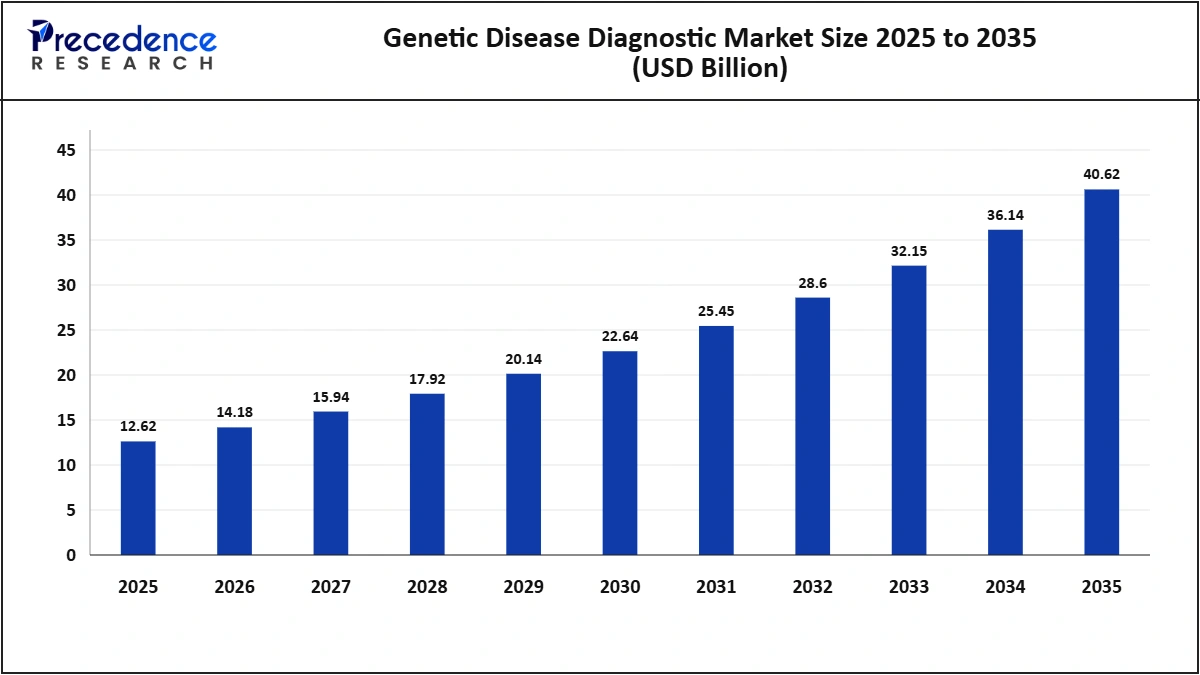
Note: 2025 is the base year, while the figures from 2026 to 2035 are forecasts.
Sources: Expert interviews, secondary sources, Precedence Research database and Precedence Research analysts.
The genetic disease diagnostic market is expected to increase from USD 12.62 billion in 2025 to USD 40.62 billion by 2035. This growth is mainly due to the rising use of exome, genome, and gene panel tests to diagnose rare and inherited diseases. More people are also undergoing carrier screening and tests that identify the risk of inherited conditions.
Rapid genome sequencing in intensive care units and research into newborn genomic screening are creating further opportunities. With these developments, the market is projected to reach USD 22.64 billion by 2030 and grow at a CAGR of 12.40% from 2026 to 2035.
- Analyst View: We estimated the market by looking at the number of clinical genetic tests performed across different test types and applications. These include exome and genome sequencing, gene panels, microarrays, carrier screening, newborn screening, and tests for inherited disease risks. We then considered the average price of each test, along with the cost of related equipment and testing materials.
The estimates also consider testing demand from rare disease referrals, children and newborns, people planning a pregnancy, and patients undergoing hereditary cancer testing. We also considered the growth in testing volumes reported by major laboratories.
To check the estimates, we compared them with genetic testing revenue reported by leading laboratories and sequencing companies, as well as published estimates for clinical genetic testing. Ancestry and trait testing were excluded. The forecast reflects strong growth in exome and genome testing, while also allowing for lower prices in gene panels and carrier screening.
Market Trends
- Exome and genome sequencing are increasingly being used as early tests to diagnose genetic conditions.
- Rapid genome sequencing is helping doctors diagnose critically ill newborns in intensive care.
- Newborn genome screening is being studied in large-scale programmes.
- Expanded carrier screening can now check for hundreds of genetic conditions.
- Artificial intelligence (AI) tools are helping laboratories understand genetic test results faster.
- Connecting genetic testing systems with electronic health records (EHRs) is making it easier for doctors to order tests and review results.
Drivers, Restraints and Opportunities
Driver
Thousands of rare diseases are caused by genetic changes, and many patients spend years trying to get the correct diagnosis. Exome and genome sequencing can help identify the cause of a disease in many of these cases. These tests are also recommended as early testing options for children with developmental conditions.
At the same time, sequencing costs are falling, and insurance and Medicaid coverage for genomic testing is expanding. Carrier screening, newborn screening, and tests for inherited disease risks are also increasing the number of people undergoing genetic testing.
Restraint
Insurance coverage for genetic testing differs widely, and many payers still limit coverage for genome sequencing. Understanding variants of uncertain significance, which are genetic changes whose health effects are not yet clear, can also be difficult and requires expert review.
A shortage of genetic counsellors can delay testing and follow-up care. Concerns about privacy and the protection of genetic information may also prevent some people from taking tests. In addition, price competition is putting pressure on revenue from gene panels and carrier screening.
Opportunity
Newborn genomic screening could create significant demand if more healthcare systems introduce these programmes. Rapid genome sequencing in intensive care can help doctors make decisions sooner, reduce some healthcare costs, and improve patient outcomes.
Rechecking existing genetic data as scientific knowledge improves can also create repeat business for testing providers. National genome programmes in the Middle East and Asia offer further growth opportunities. AI tools and larger genetic databases may also help reduce the cost and time needed to interpret test results.
Market Segmentation 2025 Share and Value
Genetic Disease Diagnostic Market By Technology 2025 Share & Size
| Segments | 2025 Share | 2025 Market Value |
| NGS | 46.80% | USD 5.91 billion |
| PCR | 18.60% | USD 2.35 billion |
| Microarray | 16.40% | USD 2.07 billion |
| Others | 9.60% | USD 1.21 billion |
| FISH & Cytogenetics | 8.60% | USD 1.09 billion |
Note: 2025 is the base year.
Sources: Expert interviews, secondary sources, Precedence Research database and Precedence Research analysts.
NGS held the largest technology share in 2025, accounting for 46.80% of the market, or USD 5.91 billion. It is also the fastest-growing technology segment. Exome and genome sequencing can help find the cause of a disease in patients who might otherwise need many separate gene tests over several years. These methods can also provide a diagnosis in more cases than some older testing methods.
Rapid and ultra-rapid genome sequencing can deliver results within days, which is especially useful for critically ill newborns.
PCR accounted for 18.60% of the market, worth USD 2.35 billion. It is used to detect specific genetic changes, repeat expansions, and conditions included in newborn screening programmes. Microarray testing held a 16.40% share, valued at USD 2.07 billion. It helps identify changes in chromosome copy numbers, including those linked to developmental delays and birth defects.
Other technologies accounted for 9.60% of the market, or USD 1.21 billion, while FISH and cytogenetics represented 8.60%, worth USD 1.09 billion.
Genetic Disease Diagnostic Market By Application 2025 Share & Size
| Segments | 2025 Share | 2025 Market Value |
| Diagnostic Testing | 34.20% | USD 4.32 billion |
| Predictive & Predisposition Testing | 22.40% | USD 2.83 billion |
| Carrier Screening | 18.60% | USD 2.35 billion |
| Newborn Screening | 14.60% | USD 1.84 billion |
| Others | 10.20% | USD 1.29 billion |
Note: 2025 is the base year.
Sources: Expert interviews, secondary sources, Precedence Research database and Precedence Research analysts.
Diagnostic testing was the largest application segment in 2025, with a 34.20% share worth USD 4.32 billion. It includes tests for people who may have a genetic condition, such as children with developmental delays, epilepsy, or birth defects.
Predictive and predisposition testing accounted for 22.40% of the market, valued at USD 2.83 billion. These tests help identify the risk of inherited conditions, including certain cancers and heart diseases.
Carrier screening represented 18.60% of the market, or USD 2.35 billion. Its use is growing as more people planning a pregnancy choose tests that check for several genetic conditions at once.
Newborn screening accounted for 14.60% of the market, worth USD 1.84 billion. It is expected to grow quickly as researchers and healthcare systems study the use of genomic testing in newborns.
Other applications accounted for the remaining 10.20%, valued at USD 1.29 billion.
Genetic Disease Diagnostic Market By Disease Type 2025 Share & Size
| Segments | 2025 Share | 2025 Market Value |
| Monogenic & Rare Diseases | 38.40% | USD 4.85 billion |
| Hereditary Cancer | 26.80% | USD 3.38 billion |
| Cardiovascular & Neurological | 18.20% | USD 2.30 billion |
| Chromosomal Disorders | 10.40% | USD 1.31 billion |
| Others | 6.20% | USD 0.78 billion |
Note: 2025 is the base year.
Sources: Expert interviews, secondary sources, Precedence Research database and Precedence Research analysts.
Monogenic and rare diseases formed the largest disease segment in 2025, accounting for 38.40% of the market, or USD 4.85 billion. Thousands of rare conditions are caused by changes in a single gene. As exome and genome sequencing become more widely used as early diagnostic tests, demand for these services continues to rise.
Hereditary cancer testing accounted for 26.80% of the market, worth USD 3.38 billion. These tests look for inherited changes in genes linked to cancer, including BRCA genes and those associated with Lynch syndrome.
Cardiovascular and neurological conditions represented 18.20% of the market, valued at USD 2.30 billion. Chromosomal disorders accounted for 10.40%, or USD 1.31 billion, while other conditions made up 6.20%, worth USD 0.78 billion.
Genetic Disease Diagnostic Market By End Use 2025 Share & Size
| Segments | 2025 Share | 2025 Market Value |
| Diagnostic Laboratories | 52.40% | USD 6.61 billion |
| Hospitals & Clinics | 36.80% | USD 4.64 billion |
| Others | 10.80% | USD 1.36 billion |
Note: 2025 is the base year.
Sources: Expert interviews, secondary sources, Precedence Research database and Precedence Research analysts.
Diagnostic laboratories held the largest end-use share in 2025, accounting for 52.40% of the market, or USD 6.61 billion. This is because many genetic tests are carried out by specialist laboratories that process samples for hospitals, doctors, and other healthcare providers.
Hospitals and clinics accounted for 36.80% of the market, valued at USD 4.64 billion. These facilities perform tests such as newborn screening and cytogenetic testing, while some large academic medical centres also carry out sequencing in-house.
Other users, including research organisations and public health programmes, accounted for 10.80% of the market, or USD 1.36 billion.
- Analyst View: We estimated each segment by matching genetic test volumes across applications and disease types with the technologies used and the settings where tests are performed. Average test prices were also considered.
NGS and monogenic disease testing lead because exome and genome sequencing are high-value tests and demand for them is growing quickly. We expect NGS, newborn screening, and rare disease testing to gain more market share as genome sequencing becomes a more common part of medical care.
Regional Analysis
Genetic Disease Diagnostic Market By Region 2025 Share & Size
| Region | 2025 Share | 2025 Market Value |
| North America | 43.20% | USD 5.45 billion |
| Europe | 26.60% | USD 3.36 billion |
| Asia Pacific | 22.40% | USD 2.83 billion |
| Latin America | 4.40% | USD 0.56 billion |
| Middle East & Africa | 3.40% | USD 0.43 billion |
Note: 2025 is the base year.
Sources: Expert interviews, secondary sources, Precedence Research database and Precedence Research analysts.
North America held the largest share of the genetic disease diagnostic market in 2025, accounting for 43.20%, or USD 5.45 billion. Its growth is supported by insurance and Medicaid coverage for exome and genome sequencing in many states, large genetic testing laboratories, wider use of carrier screening, and rapid genome testing in neonatal and paediatric intensive care units.
US laboratories reported that their exome and genome testing volumes grew by around 30% in 2025.
Europe accounted for 26.60% of the market, worth USD 3.36 billion. National genomic medicine programmes support testing across the region. These include England's Genomic Medicine Service and the Generation Study, which is examining newborn genome sequencing. Rare disease testing is also growing in countries such as France, Germany, and the Netherlands.
Asia Pacific held a 22.40% share in 2025, valued at USD 2.83 billion. It is the fastest-growing region, supported by China's domestic sequencing capacity, wider newborn and carrier screening in Japan, South Korea, and Australia, and increasing demand for genetic testing in India.
Latin America accounted for 4.40% of the market, or USD 0.56 billion, while the Middle East and Africa represented 3.40%, worth USD 0.43 billion. These regions are smaller markets, but some Gulf countries are investing in national genome testing and premarital screening programmes because inherited conditions are a major healthcare concern.
North America accounted for 43.20% of the market, worth USD 5.45 billion, in 2025. Insurance coverage for exome and genome sequencing supports demand. Rapid genome sequencing is being used in neonatal intensive care units, and expanded carrier screening is also widely available.
Europe held a 26.60% share, valued at USD 3.36 billion, in 2025. National genomic programmes support rare disease testing. England's Generation Study is exploring genome screening for newborns, while France and the Netherlands have established networks focused on rare diseases.
Asia Pacific accounted for 22.40% of the market, or USD 2.83 billion, in 2025 and is the fastest-growing region. China has a large domestic sequencing industry, while Japan, South Korea, and Australia are expanding screening programmes. India's genetic testing market is also growing.
Latin America held a 4.40% share in 2025, worth USD 0.56 billion. Private laboratories in Brazil and Mexico play an important role in genetic testing, and newborn screening programmes are expanding.
The Middle East and Africa accounted for 3.40% of the market in 2025, valued at USD 0.43 billion. Gulf countries are investing in national genome and premarital screening programmes. However, access to genetic testing remains limited in many parts of Africa.
Analyst View: We estimated regional market shares by considering genetic test volumes, coverage, and average prices in each region. North America leads because testing rates are high and genomic tests are covered by insurance in many cases. We expect Asia Pacific to grow the fastest because sequencing capacity and screening programmes are expanding rapidly.
Top 10 Companies in the Genetic Disease Diagnostic Market
| Rank | Company Name | Market-Specific Revenue (USD Billion) | 2025 Share | Key Products / Business | Headquarters |
| 1 | Illuimna | 0.86 | 6.81% | Sequencing systems and clinical genome workflows | United States |
| 2 | Myriad Genetics | 0.84 | 6.66% | Hereditary cancer and carrier screening tests | United States |
| 3 | Labcorp (incl. Invitae) | 0.82 | 6.50% | Genetic and hereditary testing services | United States |
| 4 | Quest Diagnostics | 0.70 | 5.55% | Genetic testing services | United States |
| 5 | Natera | 0.62 | 4.91% | Carrier screening and genetic tests | United States |
| 6 | Thermo Fisher Scientific | 0.56 | 4.44% | PCR, microarray and sequencing products | United States |
| 7 | Revvity | 0.48 | 3.80% | Newborn screening and genetic testing | United States |
| 8 | GeneDx | 0.43 | 3.41% | Exome and genome sequencing for rare disease | United States |
| 9 | BGI Genomics | 0.36 | 2.85% | Genetic disease sequencing and screening | China |
| 10 | Roche | 0.30 | 2.38% | Molecular and sequencing products | Switzerland |
Note: Company revenues and shares are 2025 estimates.
Sources: Company press releases, expert interviews, secondary sources, Precedence Research database and Precedence Research analysts.
Illumina ranked first in the genetic disease diagnostic market, with an estimated 6.81% share of 2025 revenue, equal to USD 0.86 billion. Myriad Genetics followed with a 6.66% share, worth USD 0.84 billion, while Labcorp held a 6.50% share, valued at USD 0.82 billion.
Illumina has a leading position because it supplies sequencing systems used for many clinical exome and genome tests. Myriad Genetics and Labcorp provide a wide range of hereditary and diagnostic genetic testing services. Labcorp acquired Invitae's assets in 2024.
Quest Diagnostics and Natera are also important providers of carrier screening and other genetic tests. GeneDx is a growing specialist in exome and genome sequencing for rare diseases, including rapid testing for critically ill babies. Revvity focuses strongly on newborn screening, while Thermo Fisher Scientific and Roche supply products used for PCR, microarray, and sequencing tests. BGI Genomics is a major provider in China.
The top 10 companies accounted for an estimated 47.31% of the market in 2025, equal to USD 5.97 billion. The remaining 52.69%, or USD 6.65 billion, was shared by regional genetic testing laboratories, academic genomics centres, newborn screening programmes, and bioinformatics companies.
The market remains moderately fragmented, with several companies competing for customers. Competition mainly depends on how accurately a test identifies a condition, how quickly results are delivered, the quality of genetic interpretation, the range of tests available, insurance coverage, and how easily test results can be added to electronic health records.
Large genetic databases and AI-based interpretation tools are also becoming more important as genome sequencing becomes a regular part of medical care.
Recent Developments
- February 2025: GeneDx announced ultraRapid whole genome sequencing for critically ill infants in neonatal and paediatric intensive care units (NICUs and PICUs). The test can provide results in as little as two days, with ordering available from March 2025.(Source: ir.genedx.com)
- January 2026: GeneDx reported preliminary revenue of about USD 427 million for 2025. It also reported 97,271 exome and genome test results, an increase of 30.5% compared with 2024. (Source: ir.genedx.com)
Genetic Disease Diagnostic Market Segments
By Technology
- NGS
- PCR
- Microarray
- Others
- FISH & Cytogenetics
By Application
- Diagnostic Testing
- Predictive & Predisposition Testing
- Carrier Screening
- Newborn Screening
- Others
By Disease Type
- Monogenic & Rare Diseases
- Hereditary Cancer
- Cardiovascular & Neurological
- Chromosomal Disorders
- Others
By End Use
- Diagnostic Laboratories
- Hospitals & Clinics
- Others
By Region
- North America (U.S., Canada, Mexico)
- Europe (Germany, U.K., France, Italy, Spain, Rest of Europe)
- Asia Pacific (China, Japan, India, South Korea, Taiwan, Rest of Asia Pacific)
- Latin America (Brazil, Argentina, Rest of Latin America)
- Middle East & Africa (GCC, South Africa, Rest of MEA)
Research Methodology
The genetic disease diagnostic market covers clinical tests used to identify inherited and genetic conditions around the world. These include exome and genome sequencing, gene panels, microarrays, PCR, cytogenetic tests, carrier screening, newborn screening, and tests for inherited disease risks. Ancestry and trait testing are excluded.
The 2025 market estimate was prepared by calculating the number of clinical genetic tests performed across different test types and applications and multiplying these volumes by average test prices. The results were then checked against the genetic testing revenue of major laboratories and sequencing companies.
Market values for different segments, regions, and companies were estimated by looking at the technologies used, the purpose of each test, the diseases being tested for, the type of healthcare provider, and regional testing activity.
The main estimates were checked against company disclosures, regulatory and industry data, and published estimates from other sources. Figures that could not be reasonably matched were excluded. All segment, regional, and company estimates were aligned with the same 2025 base year. The forecast for 2026–2035 was then calculated using a constant CAGR from the 2025 base and checked for consistency.
Analyst View: Overall Market
The genetic disease diagnostic market is growing quickly as exome and genome sequencing replace the need for many separate, step-by-step tests. Screening programmes are also expanding, bringing genetic testing to more people.
Our market estimate connects demand with the number of tests performed and their prices across different applications and technologies. This means future growth will depend on insurance coverage, sequencing costs, and the expansion of screening programmes.
The biggest growth opportunities are likely to come from genome sequencing, newborn screening, and national genomic programmes. However, gaps in reimbursement and the difficulty of interpreting some genetic results remain important challenges for the market.
Sources and References
- GeneDx. "GeneDx announces preliminary 2025 financial results and provides 2026 guidance". 2026-01-12. Exome and genome volumes. (Source: ir.genedx.com)
- GeneDx. "GeneDx announces ultraRapid whole genome sequencing". 2025-02-13. Ultra-rapid genome test. (Source: ir.genedx.com)
- Global Genes. "Genomics England screens first newborns for more than 200 genetic conditions". 2024-10-03. Generation Study launch. (Source: globalgenes.org)
For inquiries regarding discounts, bulk purchases, or customization requests, please contact us at sales@precedenceresearch.com
Frequently Asked Questions





Ask For Sample
No cookie-cutter, only authentic analysis – take the 1st step to become a Precedence Research client
 Get a Sample




 sales@precedenceresearch.com
 Schedule a Meeting