



Geocomposites Market Size, Key Companies, Company Market Share, Crop Production Volume, Yield Analysis, Export & Import Trends, Pricing Metrics, Competitive Positioning, and Demand Forecast Deoxycholic Acid Obesity Drugs Market
Geocomposites Market (By Product: Geotextile-geonet, Geotextile-geogrid, Geotextile-geocore, Geotextile-geomembrane, Other; By Function: Containment, Drainage, Others; By Application: Road & Highway, Land & Mining, Water& Wastewater Management, Soil Reinforcement for Civil Construction, Others) - Global Industry Analysis, Size, Trends, Leading Companies, Regional Outlook, and Forecast 2026 to 2035
Source: https://www.precedenceresearch.com/geocomposites-market
 Get a Sample
 Table Of Content


What is the Geocomposites Market Size?
The global geocomposites market size is calculated at USD 624.88 million in 2025 and is predicted to increase from USD 678.81 million in 2026 to approximately USD 1,415.32 million by 2035, expanding at a CAGR of 8.52% from 2026 to 2035.
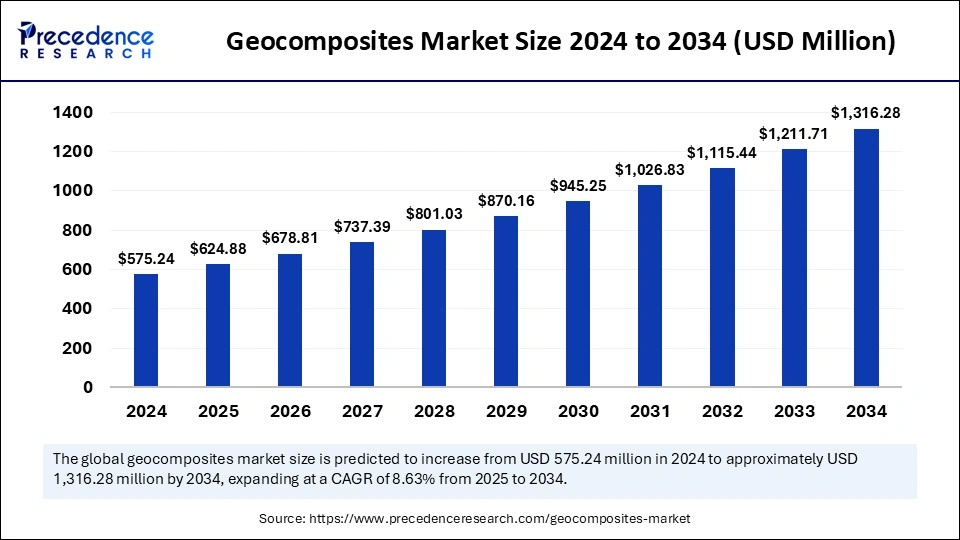
Geocomposites Market Key Takeaways
- Asia Pacific dominated the market with the largest share of 32% in 2025.
- Europe is expected to witness the fastest growth during the forecast period.
- By product, the geotextile-geonet segment contributed the highest market share in 2025.
- By product, the geotextile-geocore segment is expected to grow at the fastest CAGR between 2026 and 2035.
- By function, the drainage segment accounted for the largest market share of 45% in 2025.
- By function, the separation segment is anticipated to grow at the highest CAGR 8.73% during the studied years.
- By application, the road and highway segment captured the biggest market share of 46% in 2025.
- By application, the water and wastewater management segment is expected to grow at a solid CAGR of 9.13% during the forecast period.
What is the Geocomposite?
The geocomposites market is witnessing rapid growth as the building & construction sector is seeking sustainable materials that provide environmental advantages. Geocomposites harness the capabilities of geosynthetics via engineered connections between geotextiles, geogrids, and geomembranes. They are widely used in civil engineering projects requiring separation and reinforcement, and drainage and filtration functions. Their ability to stabilize soil and reduce erosion, alongside infrastructure longevity extension, makes them essential for modern construction. The rising urbanization and infrastructure development are boosting the growth of the market. With the growth in construction activities, the urgency to control erosion has increased over the years. Furthermore, the municipalities' need for resilient, sustainable infrastructure that withstands environmental impacts supports market growth.
What is the Role of Artificial Intelligence in Geocomposites Manufacturing?
Integrating Artificial Intelligence technologies in the manufacturing processes of geocomposites optimizes production parameters and identifies inefficiencies. The deployment of automated systems that use AI algorithms streamlines operations while enhancing productivity, thus enabling companies to achieve greater efficiency in scaling operations. AI helps businesses create customized marketing strategies to connect better with their audience, thereby increasing sales. AI-driven quality control systems enable consistent product quality, reducing product defects and waste. Moreover, manufacturers can use AI analytical solutions to predict future demands, optimize supply chain management perations, and deliver superior customer interactions. The analysis of substantial datasets through machine learning algorithms helps businesses find patterns that result in strategic planning.
What are the Growth Factors in the Geocomposites Market?
- Rising investments in expanding rail and highway networks are anticipated to boost the demand for geocomposites for soil stabilization and drainage applications.
- The rise in mining operations, particularly in resource-rich regions, is expected to boost the market growth. Geocomposites are used in mining operations for heap leach pads, containment, and erosion control.
- Stringent regulations regarding waste disposal further boost the use of geocomposites in waste containment and leachate management systems.
- The growing focus on coastal erosion mitigation and flood control measures boosts the adoption of geocomposites in shoreline stabilization and seawall construction.
- Ongoing innovations in geocomposite materials, including enhanced durability and biodegradable options, are expanding the area of applications in infrastructure projects, supporting market growth.
- Increased public sector spending on large-scale infrastructure projects, particularly in emerging economies, is likely to boost the growth of the market.
Competitive Landscape
The geocomposites industry is partly consolidated, with global players competing on product quality, technical performance, and innovation capabilities. Leading companies such as Solmax, Tencate Geosynthetics, HUESKER Synthetic GmbH, and NAUE GmbH & Co. KG have strengthened their positions through diversified product portfolios and strong international presence.
To enhance competitiveness, firms are actively pursuing mergers and acquisitions, strategic partnerships, and capacity expansions to meet rising global demand. The market is increasingly shaped by innovations in drainage, filtration, reinforcement, and sustainable geosynthetic solutions, while high capital requirements, strict regulatory compliance, and certification standards continue to act as significant barriers to new entrants.
Geocomposite s Market Outlook
- Industry Growth Overview: From 2025 to 2030, we expect robust growth in the geocomposites market, powered by more infrastructure upgrades, increased urbanization, and heightened soil stabilization. Demand is increasing in the Asia-Pacific and North American regions as governments push for durable, cost-effective construction and improved drainage.
- Sustainability Trends: Sustainability is affecting demand, with expanded use of recycled polymers and low-impact manufacturing. Stricter environmental codes are putting pressure on manufacturers to produce lightweight, longer-lasting geocomposites that use fewer materials. Manufacturers are also increasing research and development targeting sustainable drainage and erosion control systems.
- Global Expansion: Key manufacturers are expanding into Southeast Asia, the Middle East, and Latin America to gain a share of large infrastructure pipelines and reduce logistics costs. New facilities and partner facilities will be established to supply road, rail, and mining culture-specific geocomposite suppliers.
- Major Investors: There is a growing interest in private equity as the sector has stable margins, strong public spending, and high barriers to entry. Investors in infrastructure are supporting organizations with advanced technologies and product lines that are environmentally responsible.
- Startup Ecosystem: New entrants to the geosynthetics segment are developing new biodegradable geotextile drainage blends, smart geocomposites with embedded sensors, and using polymer-efficient manufacturing. U.S, India, and European-based startups continue to secure early-stage funding by addressing these sustainability-oriented projects with differentiated performance-based approaches to traditional geocomposites.
Market Scope
| Report Coverage | Details |
| Market Size by 2035 | USD 1,415.32 Million |
| Market Size in 2025 | USD 624.88 Million |
| Market Size in 2026 | USD 678.81 Million |
| Market Growth Rate from 2026 to 2035 | CAGR of 8.52% |
| Dominating Region | Asia Pacific |
| Fastest Growing Region | Europe |
| Base Year | 2025 |
| Forecast Period | 2026 to 2035 |
| Segments Covered | Product Type, Function, Application, and Regions |
| Regions Covered | North America, Europe, Asia-Pacific, Latin America, and Middle East & Africa |
Market Dynamics
Drivers
Increasing Investments in Infrastructure Development
The rising investments in infrastructure development projects worldwide are driving the growth of the geocomposites market. According to the World Bank's 2024 report, global investments through private entities in infrastructure projects in low- and middle-income countries reached USD 86 million in 2024 through 322 ventures distributed across 68 nations. As the construction of roads, highways, and bridges rises, so does the demand for geocomposites due to their cost-effectiveness and durability.
In addition, the rising worldwide focus on building better transportation, waste disposal, and water management systems drives market growth. Engineers embrace geocomposites over other materials due to their superior drainage capabilities, filtration functions, and soil stabilization properties that result in durable infrastructure. The rapid expansion of urban areas across emerging economies further contributes to market growth since these regions focus on developing infrastructure, including highways and bridges.
Restraint
Fluctuating Raw Material Prices
Constant fluctuations in the prices of raw materials required for geocomposites hamper the market's growth. Fluctuations in raw materials prices lead to high production costs, reducing profitability for manufacturers. The production of geocomposites requires petroleum-based polymers, reinforcing fibers, and adhesives. These materials are subject to price volatility due to supply chain disruption, increased crude oil prices, and geopolitical conflicts. Price fluctuations in raw materials create manufacturing instability, limiting the market's growth.
Opportunity
Rising Focus on Sustainable Construction
The rising focus on sustainable construction is expected to create immense growth opportunities in the geocomposites market. Geocomposites are suitable for sustainable building construction due to their durability and environmentally friendly nature. The increasing investments in eco-friendly infrastructure projects are projected to propel the market in the coming years. The rising regulations to reduce carbon emissions are key to boosting the focus on sustainable construction practices. This, in turn, creates the need for sustainable construction materials, including geocomposites, to meet carbon emission targets. The properties of geocomposites, like improved land stabilization and water drainage while protecting against erosion, make them ideal material for sustainable infrastructure.
Segment Insights
Product Type Insights
The geotextile-geonet segment dominated the geocomposites market in 2025. Geotextile-geonet provides excellent drainage properties with affordable cost benefits. These composites have excellent filtration capabilities with superior flow output, which makes them suitable for use in landfills to collect leachate, ensure drainage across roads and railways, and prevent erosion on structures. New construction projects choose geotextile-geonet composites as they excel at maintaining soil stability during water flow management, thus preventing civil engineering structures from failing. The rise in infrastructure development activities bolstered the segmental growth.
The geotextile-geocore segment is expected to grow at the fastest rate in the foreseeable future. The segmental growth is attributed to the rising need for drainage and containment solutions, specifically in highway constructions. Engineers heavily used geotextile-geocore composites for their excellent load support capability and enhanced soil stability, which makes them perfect for demanding reinforcement needs. Furthermore, improvements in manufacturing technologies can boost the production of geotextile-geocore, supporting segmental growth.
Function Insights
The drainage segment held the largest share of the geocomposites market in 2025 due to the rise in investments in infrastructure development. Roads, railways, landfills, and retaining structures require effective water management solutions. Geocomposites are heavily used in drainage systems due to their ability to handle large drainage capacities in a single plane and provide efficient water distribution, which protects against water-related structural damage. The rapid pace of urban development and worldwide infrastructure expansion demand superior drainage systems, bolstering segmental growth.
The separation segment is anticipated to grow at the highest CAGR during the studied years. Geocomposites used for separation applications successfully stop different soil layers from blending, extending the lifespan of infrastructure by preserving each layer's structural integrity. Government agencies and private sectors are investing heavily in infrastructure developments, boosting the market demand for geocomposites for separation systems. Furthermore, the geosynthetics usage in India's urban infrastructure projects has rapidly increased, especially in Western Indian states like Maharashtra and Gujarat, fueling the segmental growth.
Application Insights
The road & highways segment dominated the geocomposites market in 2025. This is mainly due to the rise in road & highway construction and renovation projects. The expansion of road networks received substantial funding from governments and private groups as they sought better connectivity to boost economic development. The U.S. Department of Transportation's Federal Highway Administration (FHWA) has announced the allocation of USD 61 million in the Fiscal Year 2024 for 12 formula programs. This funding is designated to support essential infrastructure development, such as roads, bridges, and tunnels. Geocomposites are heavily used in modern road construction because they deliver higher durability while boosting structural performance.
The water & wastewater management segment is projected to expand rapidly in the coming years due to rising concerns about wastewater management. Governments in various countries have established rigorous wastewater regulation standards that push industries and municipalities to choose geocomposite solutions as their treatment standard. Geocomposites are used to build reservoirs and canals while creating landfill liners, as they have exceptional drainage, filtration, and reinforcement capabilities.
Regional Insights
What is the Asia Pacific Geocomposites Market Size?
The Asia Pacific geocomposites market size is exhibited at USD 199.96 million in 2025 and is projected to be worth around USD 461.68 million by 2035, growing at a CAGR of 8.52% from 2026 to 2035.
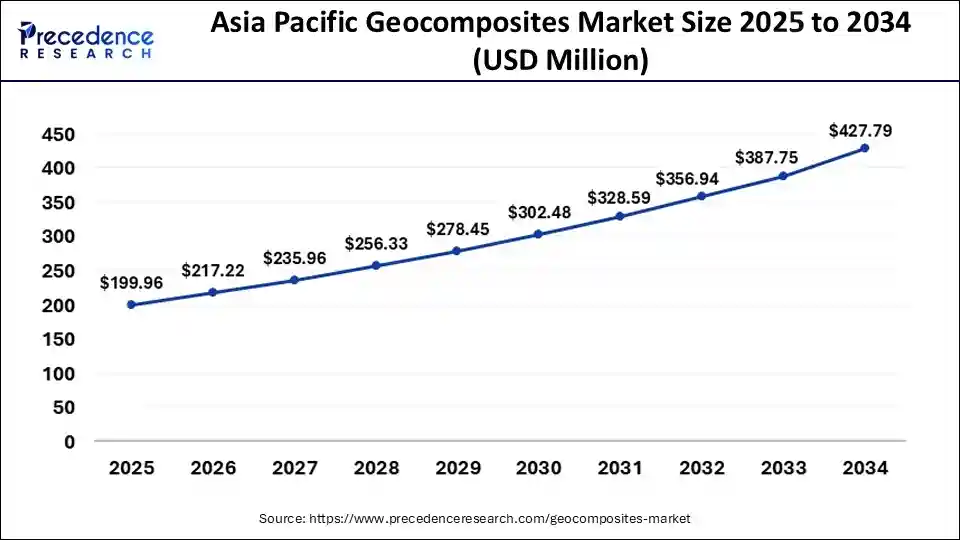
Asia Pacific led the geocomposites market by capturing the largest share in 2025. This is mainly due to the rapid pace of urbanization and increase in infrastructure development, especially in emerging countries like China, India, and Japan. With the increased urban population and per capita income, there is rising spending on construction projects. As geocomposites provide necessary drainage solutions and erosion control in addition to soil stabilization, they are widely used as sustainable construction materials.
China plays a major role in the Asia Pacific geocomposites market. This is mainly due to the expanding highway and railway networks, in which geocomposites are essential in soil reinforcement and erosion prevention. India is also a significant player in the market. The rising smart city projects and highway expansion projects under the government's Bharatmala Pariyojana project are supporting market expansion. Japan's strong emphasis on developing flood control systems and disaster-resistant infrastructure to strengthen structures within flood-prone areas is contributing to regional market growth.
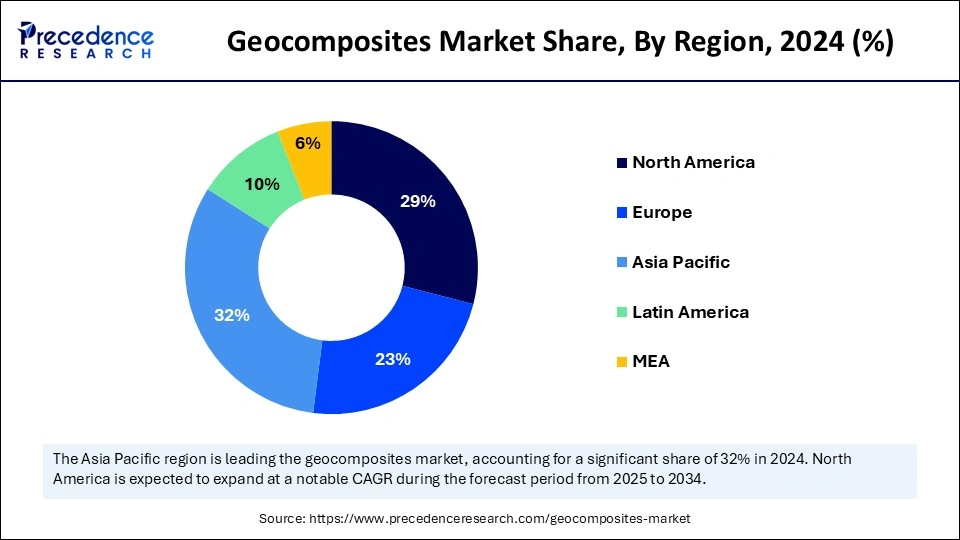
Europe is anticipated to witness the fastest growth in the market during the forecast period. The regional market growth can be attributed to the rising number of infrastructure development projects. There is a high demand for sustainable construction materials in the European construction sector. The German government is investing heavily in updating railway infrastructure and flood protection measures, boosting the demand for geocomposites in drainage systems. Furthermore, the Baltic Sea area and other coastal zones depend heavily on geocomposites to execute erosion control procedures, which help counter the effects of shoreline deterioration.
Germany Market Trends
Germany's geocomposites market is growing due to rising infrastructure development activities, particularly in transportation networks, landfills, and civil engineering projects where efficient drainage, reinforcement, and soil stabilization solutions are required. Increasing emphasis on sustainable construction practices and long-lasting geotechnical solutions is also driving the adoption of advanced geocomposites across the country.
Middle East & Africa is observed to grow at a considerable growth rate in the upcoming period, owing to rapid urbanization and increasing construction activities, especially in Saudi Arabia and the United Arab Emirates (UAE). Environmental regulations within the Dubai Building Code promote sustainable construction through the deployment of environmentally friendly materials, such as geocomposites, to improve sustainability while maintaining structural stability. Furthermore, the rising demand for efficient water management systems and the expansion of the construction sector are likely to boost the growth of the geocomposites market in Middle East & Africa.
Why did North America grow at a steady rate in the Geocomposites Market?
The North American continent continued with strong and established growth due to renovations of existing transportation networks, stormwater systems, and mining sites. The United States and Canada used geocomposites for erosion control, landfill expansions, and major infrastructure repairs, which prompted the continued strong demand as they have established and solid financing systems with standards in place.
There were opportunities in smart geocomposites, oil and gas protective layers, and enhanced drainage systems for urban applications. A growing interest in environmentally sustainable practices also influenced companies to manufacture lighter-weight, stronger materials for long-term use.
U.S. Geocomposites Market Trends
The U.S. once again led the region since there was a tremendous amount of road repairs and bridge renovations underway, along with expansions at landfill sites. The federal funding associated with geocomposites for soil reinforcement and drainage work supported demand. The U.S. was also applying geocomposites for energy pipeline applications, areas, and coastal defense projects.
Larger U.S. companies brought new, demanding materials to the market, along with increased distribution of those materials. The region's solid regulatory construction and its infrastructure relied on construction demand to keep it ahead of the rest of the countries in the region during this time.
Why did Latin America grow at an impressive rate in the Geocomposites Market?
Latin America experienced impressive growth as several countries initiated expansion of roadways, mining areas, and water-management projects. Associated landslides and poor soil conditions required geocomposites. Investments from both the public and the private sectors increased in response to drainage, erosion control, and slope stabilization.
There was a solid opportunity for reinforcement for mining, agricultural irrigation channels, and large construction projects. The region also became an attraction for foreign manufacturers looking for access to developing economies with a demand for infrastructure.
Brazil Geocomposites Market Trends
Brazil led the way due to its large construction and mining initiatives. The country invested in local transport networks, river protection, and large erosion control projects. Its vast land area required thorough drainage and soil stabilization techniques. Brazil also invited foreign firms that established plants and partnerships. From the combination of continual mining operations and urban expansion, Brazil quickly became the largest buyer of geocomposites for reinforcement, drainage, and environmental protection systems.
UAE Market Trends
The UAE market is driven by constant development through big construction projects, the development of smart cities, and innovative methods in water management. The UAE is also seeing increased application of geocomposites in transport infrastructure, coastal defense, and drainage. Investments in sustainability-related infrastructure have been growing, contributing to the demand for the product.
Government Initiatives Supporting the Geocomposites Market
- United States – Bipartisan Infrastructure Law (BIL)
The U.S. government is focusing on investments in roads, bridges, drainage, and flood management projects, thereby raising the usage of geocomposites for soil stabilization and erosion control. - Germany - BVWP 2030 (Federal Transport Infrastructure Plan)
The focus of the government of Germany is on sustainable transportation and infrastructure projects that have resulted in increased use of geocomposites in roads and railways. - China - 14th Five-Year Plan
China has a lot of focus on investments in infrastructure, water management, and environmental management projects that would result in increased use of geocomposites in drainage, reinforcement, and landfill. - India - National Master Plan (PM Gati Shakti)
India is investing heavily in highway construction, railway network, logistics, and urban infrastructure projects that will be using geocomposites for ground stabilization. - UAE - UAE Net Zero 2050 Strategy
The focus of the UAE government is on investments in sustainable infrastructure, water management, and coastal protection projects that drive the use of geocomposites.
Supply Chain Analysis of the Geocomposites Market
- Harvesting and Post-Harvest Handling: Getting off machinery, trimming, sorting, and quality control prior to storage.
Key players: Solmax, TenCate Geosynthetics, GSE Environmental - Storage and Cold Chain Logistics: Adequate warehousing, temperature regulation, and inventory control to avoid degradation before shipping.
Key players: Snowman Logistics, Coldman Logistics, CONCOR Cold Chain - Processing and Packaging: Turning raw materials into finished products by means of layering, bonding, customization, protection packaging.
Key players: SKAPS Industries, TenCate Geosynthetics, ABG Ltd. - Distribution to Wholesalers/Retailers: Movement of logistics within factories to distribution centers, with the allocation of inventory according to demand.
Key players: Ocean Global, Terrain Geoinfra, Siddhi Rubber - Export and Trade Compliance: Aims to ensure shipments are in standards, certifications, and documentation requirements to keep compliance.
Key players: Solmax, Maccaferri, HUESKER
Geocomposites Market Companies
- ABG Ltd.: Creates high-performance geosynthetic solutions such as Pozidrain geocomposites, drainage layers, green roofs, and sustainable drainage systems in all parts of the world.
- CLIMAX SYNTHETICS PVT. LTD.: Produces geomembranes, geotextiles, and geocomposites in farming, landfill, and water management infrastructure solutions across the globe.
- GSE Environmental (Part of Solmax): Offers high-technology drainage geocomposites, geomembranes, and containment systems in mining, waste management, and environmental protection projects worldwide.
- HUESKER for Geocomposites: Offers geocomposites, erosion control mats, as well as geotextiles, concerned with durability, infrastructure stability, and solutions to environmental safety.
Other Major Key Players
- Leggett & Platt, Incorporated
- Ocean Global
- Officine Maccaferri Spa
- TenCate Geosynthetics Americas
- Terram
- Thrace Group
Recent Developments
- In February 2026, Soprema India launched a new geocomposites manufacturing facility and headquarters in Ahmedabad, Gujarat, serving as its central hub for geocomposite products and supporting the government's "Make in India" initiative. (Source: https://themachinemaker.com )
- In October 2024, E Squared Technical Textiles announced the launch of its new website focused on geomembranes, www.e2geomembranes.com. This dynamic online platform showcases the company's extensive range of BABAA-certified geomembrane products designed to meet the needs of various industries, including environmental management, civil engineering, and water management.
- In July 2024, West Midlands-based Wrekin Products launched its new geosynthetics brand, Geoworks. The Geoworks division encompasses the company's existing geosynthetics product line, which has been in development and expansion since 1995. The product offerings include geotextiles, geogrids, geomembranes, geomats, geocells, and geocellular paving solutions.
- In January 2022, Freudenberg Performance Materials, a leading global supplier of high-performance geosynthetics for the civil engineering market, introduced a new geogrid composite. This innovative product aims to enhance the efficiency of construction projects and consists of a reinforcing grid bonded to a separation and filtration nonwoven geotextile. The new geocomposite, EnkaGrid MAX C, is now available and is part of the Enka Solutions range for civil engineering applications.
Segments Covered in the Report
By Product
- Geotextile-geonet
- Geotextile-geogrid
- Geotextile-geocore
- Geotextile-geomembrane
- Other
By Function
- Containment
- Drainage
- Others
By Application
- Road & Highway
- Land & Mining
- Water& Wastewater Management
- Soil Reinforcement for Civil Construction
- Others
By Region
- North America
- Europe
- Asia Pacific
- Latin America
- Middle East and Africa
For inquiries regarding discounts, bulk purchases, or customization requests, please contact us at sales@precedenceresearch.com
Frequently Asked Questions
Tags





Ask For Sample
No cookie-cutter, only authentic analysis – take the 1st step to become a Precedence Research client
 Get a Sample



 sales@precedenceresearch.com
 Schedule a Meeting
