



Supply Chain Management Market Size, Key Companies, Company Market Share, Patient Volume, Treatment Adoption Rates, Pricing Analysis, Regulatory Landscape, Competitive Positioning, and Demand Forecast
Supply Chain Management Market Size (By Component: Solution, Service; By Solution Type: Transportation Management System, Warehouse Management System, Supply Chain Planning, Procurement And Sourcing, Manufacturing Execution System; By Deployment Mode: On-premise, On-Demand/Cloud-Based; By Enterprise Size: Large Enterprise, SMEs; By Industry Vertical: Retail and Consumer Goods, Healthcare and Pharmaceuticals, Manufacturing, Food and Beverages, Transportation and Logistics, Automotive, Others) - Global Industry Analysis, Size, Trends, Leading Companies, Regional Outlook, and Forecast 2026 to 2035
Source: https://www.precedenceresearch.com/supply-chain-management-market
 Get a Sample
 Table Of Content


What is the Supply Chain Management Market Size?
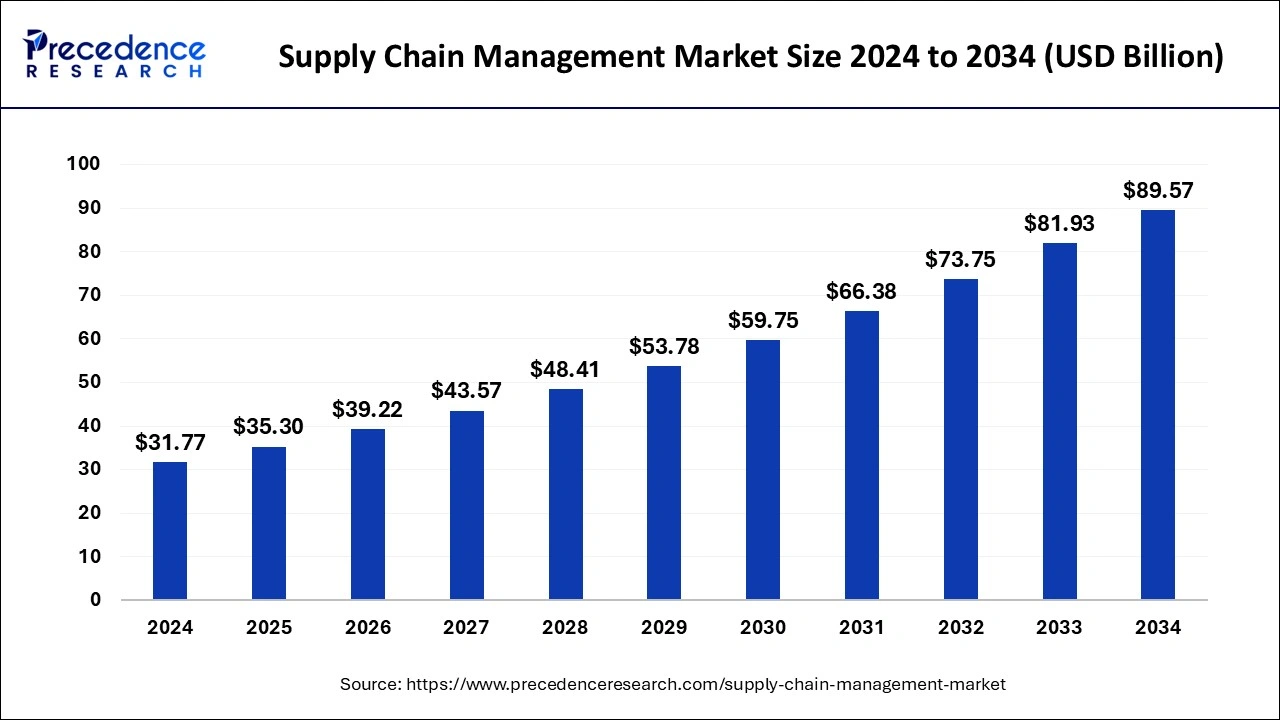
The global supply chain management market size is calculated at USD 35.30 billion in 2025 and is predicted to increase from USD 39.22 billion in 2026 to approximately USD 97.57 billion by 2035, expanding at a CAGR of 10.70% from 2026 to 2035. The market is driven by advancements in technology and evolving consumer expectations. Organizations are increasingly adopting digital solutions to enhance visibility and efficiency across their supply chains. This shift towards automation and data analytics is reshaping traditional practices, enabling firms to respond more swiftly to market fluctuations.
Key Takeaways
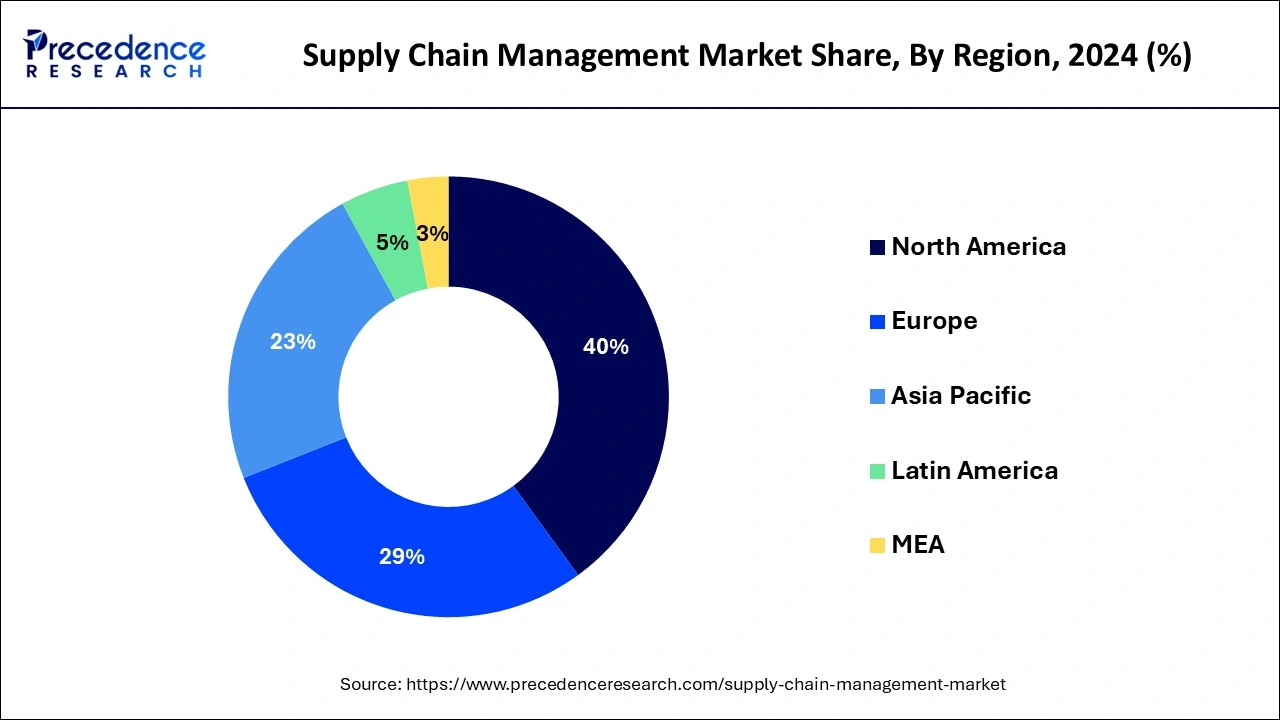
- North America generated the largest market share of 39.34% in 2025.
- By Component, the solution segment recorded the maximum market share in 2025.
- By Enterprise Size, the large enterprise segment contributed the highest market share in 2025.
- By Deployment Mode, the on-premises segment generated the largest market share in 2025.
Market Overview
The rise in demand and greater understanding of the advantages of SCM solutions, such as logistics management, transportation planning and analytics, predicting future accuracy, warehouse and inventory management, supply chain optimization, acquisition and sourcing, minimization of waste, manufacturing execution, and pertinent synthesis of business data, can be attributed to the growth of the SCM market. Also, the fast-expanding use of information systems and technological advancements supports and improves the entire supply chain, which helps the industry thrive.
The COVID-19 outbreak had a favourable effect on the intended audience. Due to the increased use of SCM to forecast and fulfil supply and demand requirements during the COVID-19 pandemic, a considerable increase has been seen.
What is the Impact of AI in the Supply Chain Management Market?
Artificial intelligence (AI) and machine learning tools are increasingly driving supply chain management across sectors such as retail and e-commerce, manufacturing, pharmaceuticals and healthcare, and beyond. Artificial intelligence is helping in reshaping traditional supply chain and logistics practices by integrating advanced technologies to optimize operations and improve outcomes. By leveraging AI, companies can now easily automate complex tasks, analyze vast amounts of data, and make more informed decisions. This enables smarter decision-making, enhancing efficiency, and responding to dynamic market demands. It also provides companies with the ability to anticipate changes, adapt swiftly, and maintain a competitive edge in an increasingly complex market.
Another area where AI systems are increasingly being adopted is design and management. Traditional supply chain planning relies on models built around costs and transport times. AI helps to enhance these models by integrating real-time data, thus allowing organizations to dynamically reconfigure routes, locations, and inventory. AI is now used to make real-time decisions about last-mile delivery, such as rerouting drivers based on traffic, weather, or shifting priorities, which makes every process easy and efficient.
Supply Chain Management Market Growth Factors
A supply chain is the collection of activities that include developing new goods or services, acquiring raw materials, processing those materials into semi-finished or finished goods, transporting those goods, and distributing or distributing them to customers. Supply chain management refers to the group of applications used to coordinate and integrate all the aforementioned actions in a seamless manner as well as to offer customer care after the sale (SCM). It is simply the coordinated oversight of the movement of commodities from the supplier to the user stage.
The links and connections in this chain connect each of the partners, including information technology vendors, vendors, independent contractors, carriers, and others. The global SCM market is expanding as a result of increased technical development, investments, and demand for supply chain administration services and software across various businesses and industries. Also, a rise in the use of SCM software by pharmaceutical and healthcare organisations has a beneficial effect on the expansion of the supply chain management market. However a lack of knowledge about supply chain management technology and a rise in privacy and security worries among companies are impeding the market's expansion.
On the other hand, it is anticipated that throughout the projected period, an increase in modern technology for communication and information would present lucrative chances for the advancement of the SCM market.
Market Trends
- Digital Transformation: The market is witnessing a significant shift towards digital transformation. Companies all over the world are increasingly leveraging advanced technologies such as artificial intelligence, machine learning, and blockchain to enhance operational efficiency. This trend highlights a global shift from traditional methods, as organizations seek to improve visibility and responsiveness within their supply chains.
- Sustainability Initiatives: Sustainability initiatives are becoming a priority within the market. Companies are seen actively integrating eco-friendly practices into their supply chain strategies, aiming to reduce waste and carbon footprints. This also reflects a growing awareness of environmental issues and a strong commitment towards social and ecological responsibility.
- Global Trade Optimization: The globalization of trade is significantly impacting the market. Businesses are increasingly focusing on optimizing their supply chains across various regions, necessitating the development of robust logistics networks. This also highlights the importance of strategic partnerships and risk management to navigate the complex nature of international operations.
Supply Chain Management Market Outlook
- Industry Growth Overview: The supply chain management market is expected to experience strong growth between 2025 and 2034, driven by rapid digital transformation and the need to enhance operational efficiency. Enterprises are prioritizing end-to-end, real-time monitoring to manage complex multi-tier supply networks effectively. The adoption of cloud-based and AI-enabled solutions is facilitating predictive analytics and dynamic decision-making, while omnichannel retail strategies and rising delivery demands are further accelerating market growth.
- Digitalization and Technology Innovations: Advanced technologies are revolutionizing supply chain functions, making them smarter, faster, and more resilient. Companies are leveraging AI, machine learning, IoT sensors, and advanced analytics to predict demand, optimize inventory, and boost operational efficiency. Blockchain is being adopted to enhance transparency, traceability, and compliance across supplier networks, particularly in industries like food, pharmaceuticals, and high-value manufacturing. Cloud-based solutions enable real-time collaboration among suppliers, manufacturers, and distributors, minimizing delays and bottlenecks.
- Global Expansion: Leading SCM solution vendors are actively expanding their global presence to tap into emerging markets and offer localized services to multinational clients. Regions such as Southeast Asia, Latin America, and Eastern Europe are attracting significant investments due to rising industrialization, booming e-commerce, and growing demand for digital logistics solutions. Companies like Oracle, Kinaxis, and Manhattan Associates are setting up regional offices and innovation hubs to ensure faster deployment, regulatory compliance, and customized solutions. Collaborations with local logistics providers and system integrators are further easing implementation in these new markets.
- Major Investors: Investments are focused on AI-powered planning, real-time visibility solutions, digital procurement platforms, and autonomous logistics technologies. Firms such as Silver Lake, Thoma Bravo, and Warburg Pincus are actively investing in SCM startups and mid-sized companies with strong growth potential.
- Ecosystem Startup: The SCM startup ecosystem is rapidly maturing, focusing on AI-driven predictive analytics, autonomous logistics, and cloud-based supply chain orchestration and risk management. Emerging companies such as FourKites (USA), Logically (UK), and Project44 (USA) are providing innovative solutions for real-time tracking, demand forecasting, and supplier risk monitoring. This dynamic startup environment ensures a continuous influx of new tools aimed at enhancing efficiency, visibility, and sustainability across the global supply chain network.
Market Report Coverage and Key Metrics
| Report Coverage | Details |
| Market Size in 2025 | USD 35.30 Billion |
| Market Size in 2026 | USD 39.22 Billion |
| Market Size by 2035 | USD 97.57 Billion |
| Growth Rate from 2026 to 2035 | CAGR of 10.70% |
| Largest Market | North America |
| Base Year | 2025 |
| Forecast Period | 2026 to 2035 |
| Segments Covered | Component, Solution Type, Deployment Mode, Enterprise Size, and Industry Vertical |
| Regions Covered | North America, Europe, Asia-Pacific, Latin America, and Middle East & Africa |
Market Dynamics
Drivers
Increasing adoption of cloud supply chain management among SMEs
Contemporary organizations are heavily reliant on technology. While most startups and SMEs lack a functional IT department system on their own, large corporations have a dedicated IT department for managing and sustaining business processes. The rationale is that managing and sustaining an IT department is more expensive. Therefore, the majority of SMEs and startups choose to use a cloud-based SCM system so they may benefit from an IT department's services without having to hire additional people or incurring additional expenses. This enables internal staff to concentrate on ongoing business operations.
The scalability provided by the cloud-based SCM's flexibility in storage is crucial for SMEs and will aid them in coping with unforeseen growth during the first year of operation. Moreover, cloud-based SCM provides SMEs with strong inventory management that is very responsive to current business trends. When purchasing goods, for instance, the cloud-based SCM offers cost savings and an alluring pay-as-you-go model, such as real-time payment over the cloud, allowing SMEs to position themselves as effective and competitive competitors among other firms. The cloud-based SCM system can also be used by SMEs to create business initiatives that increase sales and profits.
Restraint
Growing security and privacy concerns among enterprises
Businesses using cloud-based SCM must deal with security and privacy concerns. Businesses have sensitive information that must be kept secure to prevent theft and data breaches, which could damage the companies' overall brand. Data leakage via the Internet and access by unauthorized users are concerned businesses are becoming more and more concerned about.
For instance, a multitenant architecture is required for the cloud-based transportation management system, which runs a single instance of the software on a server that is shared by several clients. Thus, there is a chance that customers of a business could see information about rivals. The enterprise's security of data and competitive market position will likely be threatened by these security issues involving unauthorized persons accessing the data. Due to the increased concern among businesses about security and privacy, the cloud SCM market's growth is being constrained over the projected period.
Opportunity
Advances in technologies are making evolution to the supply chain industry
The evolution of the supply chain is becoming increasingly feasible thanks to developments in technology for communication and information. Cloud computing, IoT, 5G, 3D printing, blockchain, AI, and robotics are just a few of the technologies that will be essential to the development of the future digital supply network. For instance, a functional distribution network must include critical components that enable real-time tracking, such as openness and accountability. Today's GPS monitors can track everything about a shipment, including its location and temperature, giving logistics professionals real-time information that helps them completely comprehend how their supply chains work.
For high-value products and items during the ongoing COVID-19 outbreak, real-time tracking is helpful. With IoT data and device check-ins, the whole chain of custody for a cargo can be shown and confirmed. One example of how IoT devices might help safeguard clients from ruined goods is by automatically flagging shipments that have left a proper temperature zone.
Market Segmentation Analysis
Component Insights
Which Component Segment Dominated the Supply Chain Management Market?
The software segment dominated the market in 2025. This dominance is driven by its essential role in optimizing operations and enhancing decision-making capabilities, and due to its capability to facilitate advanced analytics, real-time tracking, and automation of workflows. The high demand for software solutions also stems from the necessity of organizations to enhance efficiency and reduce costs.
The services segment is expected to register the fastest CAGR throughout the forecast period. This rapid growth is characterized by its high focus on providing strategic consulting, system integration, and support services that enable seamless implementation of supply chain technologies. The rapid evolution of e-commerce and the need for agile responses to market fluctuations are propelling the segment forward, as businesses seek to partner with experts to navigate complexities in their supply chains.
Enterprise Insights
Why Did the Large Enterprise Segment Dominate the Supply Chain Management Market?
The large enterprise segment dominated the global market share in 2025. This segment includes multiple suppliers, distributors, and customers all across different geographic locations. Efficient supply chain management is crucial for large enterprises as it helps to ensure that their products are delivered to clients on schedule and with the required quality. This segment's growth can also be attributed to the growing complexity of supply chains, further driven by e-commerce expansion and globalization efforts.
The small and medium-sized enterprise (SMEs) segment is expected to grow at the fastest CAGR during the forecast years. SMEs are rapidly adopting supply chain management in order to boost their operational effectiveness and gain a competitive edge in the global market landscape. These solutions and services also help SMEs optimize their supply chain processes, reduce costs, and increase profitability.
Deployment Insights
Which Deployment Segment Led the Supply Chain Management Market?
The on-premises segment led the global market landscape in 2025. This segment helps provide businesses with full control over their supply chain data and operations by installing and managing the software on servers located within the company's premises, handled by the in-house IT staff. The on-premise model continues to remain the preferred choice in industries such as manufacturing, defense, and energy, where data sensitivity and operational continuity are the top priorities.
The on-demand/cloud-based segment is expected to grow at a significant CAGR during the forecast period. These types of solutions offer numerous advantages for businesses. One of the most significant benefits of this particular segment is cost savings. Companies can avoid the significant capital expenditures associated with implementing and maintaining an on-premises solution by opting for cloud-based solutions.
Industry Vertical Insights
How the Manufacturing Segment Dominated the Supply Chain Management Market?
The manufacturing segment dominated the market in 2025. This dominance is due to its vital role in producing goods and managing raw materials efficiently. This segment also emphasizes streamlining operations, reducing waste, and leveraging technology for inventory control. The segment's growth and development are further being driven by the growing demand for efficient production processes and inventory management.
The retail and consumer goods segment is expected to witness the fastest growth in the upcoming years. This particular segment is rapidly gaining traction as businesses prioritize customer satisfaction and quick delivery services. The rise of online shopping has further necessitated advanced supply chain solutions to meet consumers' demands for quick delivery and efficiency.
Solution Type Insights
Which Solution Type Held the Largest Supply Chain Management Market Share?
The supply chain planning segment held the largest market share in 2025, significantly influencing the overall efficiency and effectiveness of supply chains. This particular segment integrates demand forecasting, inventory management, and resource allocation, ensuring that organizations can meet customer needs while minimizing costs. This segment's dominance is further characterized by its pivotal role in orchestrating supply chains effectively.
The warehouse management system segment is expected to have the fastest growth rate throughout the forecast years. Effective warehouse management is crucial to ensuring that companies acquire high-quality materials and components from their complicated network of suppliers at reasonable costs. This can also help to improve supplier quality and reduce supply chain risks by implementing supplier performance metrics, conducting regular supplier audits, and developing long-term relationships with key suppliers.
Market Regional Analysis: North America, Europe, Asia-Pacific
What is the U.S. Supply Chain Management Market Size?
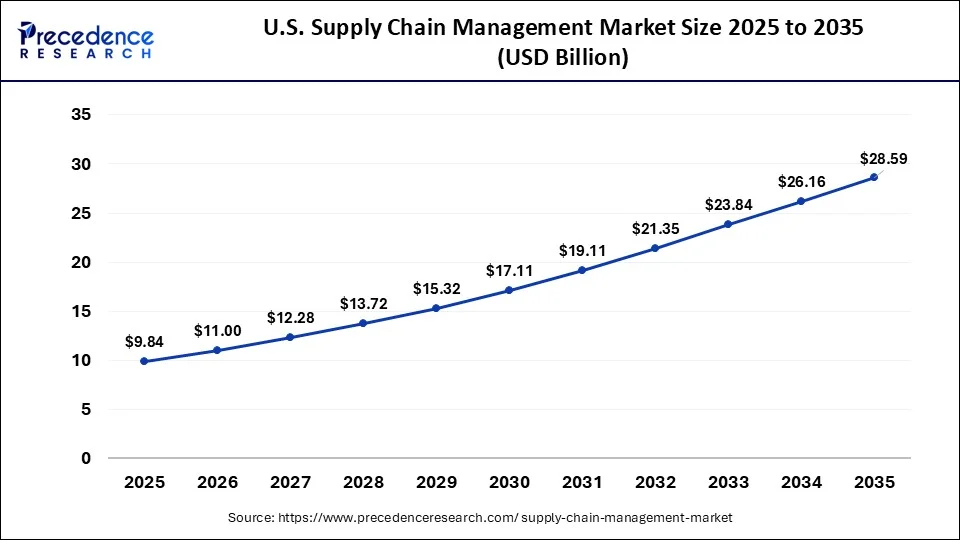
The U.S. supply chain management market size is evaluated at USD 9.84 billion in 2025 and is projected to be worth around USD 28.59 billion by 2035, growing at a CAGR of 11.26% from 2026 to 2035.
In terms of SCM vendor presence, North America is the most developed technological region in the globe. SCM services and solutions are widely used in North America. Her SCM market is dominated by the United States in North America. Several sectors in the region, including BFSI, healthcare, retail, manufacturing, and retail, have embraced SCM services. The need for his SCM in the area has grown as a result of the expanding IoT trend and emphasis on improving the efficiency of supply chain operations such as logistics, warehousing, fulfilment, production, and transportation management.
U.S. Supply Chain Management Market Analysis
The U.S. dominates the North American supply chain management market due to its advanced logistics infrastructure and widespread adoption of digital supply chain platforms. Companies are leveraging solutions for demand forecasting, inventory management, and real-time shipment tracking to meet the growing needs of e-commerce. Additionally, investments in sustainability, carbon footprint monitoring, and regulatory compliance are driving demand for sophisticated SCM tools.
Huge investments in infrastructure by governments and private companies, especially in India and Indonesia, to facilitate mobility and improve infrastructure, are expected to boost the demand for SCM in the Asia-Pacific region. The latest trends in trucking, containerization, and computerization are increasing the scale of shipments and deliveries of raw materials, work-in-progress (WIP), and finished goods around the world, effectively controlling supply chain cost, quality, and delivery. Improving. For SCM software and services.
What Makes Europe a Significantly Growing Area?
Europe is expected to grow significantly in the supply chain management market during the forecast period. The growing digitalization in Europe is increasing the use of advanced technologies to enhance supply chain management. This, in turn, improves their use in various sectors such as healthcare, automotive, etc. Moreover, the increasing manufacturing of the products is also increasing their demand. At the same time, the regulatory bodies are providing their support to make them more transparent, increasing their acceptance rates. Thus, all these developments, along with the government support, are promoting the market growth.
Germany Supply Chain Management Market Analysis
Germany's supply chain management market has been expanding due to its robust manufacturing and automotive sectors, which demand precise warehouse management, supplier coordination, and logistics planning. Companies are leveraging robotics, automated storage and retrieval systems, and advanced inventory optimization to maintain efficiency and reduce costs. The rise of omnichannel retail and digitalized manufacturing supply chains further drives the adoption of predictive analytics for scenario-based forecasting, while Germany's central location in Europe and strong IT infrastructure reinforce its role as a key SCM hub.
What are the Key Trends in the Supply Chain Management Market in Asia-Pacific?
Asia-Pacific is growing rapidly in the market, fueled by expanding manufacturing hubs, rising e-commerce activity, and government initiatives promoting digitalization. Countries like China, India, and Japan are leading players in the region as they are seen investing heavily in supply chain infrastructure and digital platforms to support their burgeoning economies. The region's market is further being driven by factors such as rising urbanization efforts and a growing middle class, which in turn increases the demand for sophisticated SCM solutions.
China Supply Chain Management Market Analysis
China's supply chain management market growth is driven by massive manufacturing output, rapidly expanding e-commerce, and government initiatives promoting smart manufacturing and digital infrastructure. Future growth is expected to come from cloud-based procurement and supply chain orchestration platforms, which offer predictive demand forecasting, supplier risk management, and real-time visibility. Additionally, business organizations are paying more attention to agility and responsiveness to market changes and regulatory demands.
What Potentiates the growth of the Market in Latin America?
Latin America's supply chain market is growing, driven by rising e-commerce penetration, regional trade expansion, and the modernization of logistics infrastructure. Demand is increasing for integrated tracking, route optimization, and freight management tools as businesses seek to reduce operational inefficiencies. Investments in digital platforms are enhancing supply chain responsiveness by improving warehouse coordination and product monitoring, with countries like Brazil and Mexico expected to lead growth due to infrastructure upgrades and private-sector digital adoption.
Brazil Supply Chain Management Market Analysis
Brazil leads the market in Latin America due to increasing e-commerce, expanding cross-border trade, and modernizing logistics networks. Transportation and distribution optimization solutions are expected to play a leading role in the coming years. Companies have tried to reduce delays, improve route efficiency, and manage fragmented supply chains. Additionally, the adoption of SCM technology is likely to increase through investments in warehouse automation, real-time shipment visibility, and freight management software.
How is the Opportunistic Rise of the Middle East & Africa (MEA) in the Market?
The MEA offers significant opportunities in the supply chain management market due to increased logistics and trade activity, expansion of free trade zones, and the adoption of modern warehouse practices in the oil & gas, construction, and retail sectors. Achieving demand visibility, collaborating with suppliers, and managing risks are some ways companies are navigating geographically dispersed and complex supply networks. The adoption is supported by e-commerce growth, increased regional trade integration, and investment in smart ports and logistics corridors.
UAE Supply Chain Management Market Analysis
In the UAE, the market is growing due to strategic investments in logistics infrastructure, smart ports, and regional trade corridors, especially in Dubai and Abu Dhabi. The growth of e-commerce, regional trade agreements, and the free-zone logistics hubs strengthens the adoption of digital supply chain solutions. Organizations are increasingly focused on resilience, regulatory compliance, and operational optimization, which drives continued expansion in the marketplace.
Supply Chain Management Market - Value Chain Analysis
- Supply Chain Planning & Strategy
The foundation of SCM lies in planning, forecasting, and strategizing the end-to-end flow of goods, services, and information across suppliers, manufacturers, and distributors.
Key Players: SAP, Oracle, Kinaxis, Blue Yonder, Logility - Procurement & Supplier Management
Organizations source raw materials, components, or services and manage supplier relationships, contracts, and compliance. Advanced procurement software ensures cost optimization and supplier collaboration.
Key Players: Coupa, JAGGAER, SAP Ariba, Epicor - Inventory & Warehouse Management
Goods are stored, tracked, and managed in warehouses, ensuring optimal inventory levels, reducing carrying costs, and improving order fulfillment efficiency.
Key Players: Manhattan Associates, Körber, BluJay Solutions, IBM - Transportation & Logistics Management
Movement of goods across the supply chain involves routing, fleet management, and real-time tracking to ensure timely deliveries and lower logistics costs.
Key Players: Descartes, BluJay Solutions, SAP, Oracle - Order Fulfillment & Customer Service
Completed orders are processed, tracked, and delivered to end-customers, integrating order management systems with fulfillment operations for seamless customer experience.
Key Players: Manhattan Associates, Blue Yonder, Epicor, Kinaxis - Data Analytics & Supply Chain Optimization
Advanced analytics, AI, and machine learning enable predictive insights, risk management, and continuous optimization of supply chain processes.
Key Players: IBM, SAP, Kinaxis, Blue Yonder, Logility
Market Competitive Landscape: Leading Companies and Strategies
The global supply chain management market is experiencing significant growth, driven by technological advancements, increased consumer demands, and the need for improved efficiency in supply chain operations. As organizations across various industries seek to enhance their supply chain performance, the competitive landscape is becoming increasingly dynamic. Companies all over the world are investing in innovative solutions in order to streamline processes, improve visibility, and reduce costs, thus leading to a surge in competition.
In terms of business tactics, the market appears to be moderately fragmented. The landscape is characterized by a mix of established players and emerging startups, all striving to offer cutting-edge solutions that cater to diverse operational needs, making it essential for participants to continuously innovate and stay ahead of the competition.
Top Companies in the Supply Chain Management Market
- SAP (Germany): Provides integrated supply chain solutions including planning, logistics, and real-time analytics for global enterprises.
- Oracle (U.S.): Offers cloud-based SCM software covering procurement, inventory management, logistics, and order fulfillment.
- Infor (U.S.): Delivers industry-specific SCM software for manufacturing, distribution, and supply chain planning.
- Descartes (Canada): Specializes in logistics and transportation management solutions, including route planning and fleet optimization.
- Manhattan Associates (U.S.): Provides supply chain and omnichannel commerce solutions, including warehouse, transportation, and inventory management.
- IBM (U.S.): Offers AI-driven supply chain solutions, blockchain for traceability, and predictive analytics for end-to-end visibility.
- Logility (U.S.): Provides supply chain planning and demand forecasting software for manufacturing and retail industries.
- Kinaxis (Canada): Delivers cloud-based supply chain planning and risk management solutions for real-time decision-making.
- Blue Yonder (U.S.): Offers AI-powered supply chain and retail solutions, including demand planning, fulfillment, and logistics optimization.
- Körber (Germany): Provides supply chain execution software and warehouse automation solutions for global logistics operations.
- Coupa (U.S.): Focuses on procurement, spend management, and supplier collaboration to optimize supply chain costs.
- Epicor (U.S.): Offers supply chain management and ERP software solutions for manufacturing, distribution, and retail sectors.
- BluJay Solutions: Provides global trade and transportation management software for logistics, customs, and compliance.
- OMP (Belgium): Delivers advanced supply chain planning and optimization software for demand, production, and inventory.
- E2open (U.S.): Provides a connected supply chain platform integrating planning, execution, and collaboration across partners
Other Major Key Players
- JAGGAER
- Zycus
- GEP
- Tive
- Calista
- MOST
- Freightify
- 4TiGo
- Trukky
- Lobb
Recent Developments in the Supply Chain Management Market (2025–2026)
- In June 2025, a collaboration to develop a new center for advancing logistics between FedEx and IIT Bombay was announced. To provide student entrepreneurship and innovative solutions for supply chain challenges will be the aim of this center, named the FedEx ALPHA Centre. Furthermore, real-world problem solving and data-driven approaches to promote future talent were highlighted in this initiative. (Source: https://www.devdiscourse.com)
- In June 2025, a new extended warehouse facility was inaugurated by DKSH Brunei, which is a leading provider of Market Expansion Services in Asia and beyond in Brunei. This inauguration will help to support the resilience and growth of the healthcare supply chain of the nation and will solidify the capabilities of DKSH Brunei. (Source: https://www.manilatimes.net)
- In May 2025, a new supply chain product as well as an expanded strategic partnership programme was launched by a Supply Chain Attack Surface Management (EASM) and Digital Asset Discovery expert, that is, ThingsRecon. To provide the government and organizations the next-generation, comprehensive security solutions and to support cybersecurity consultancies, managed security service providers (MSSPs), and application cybersecurity partners, the initiative will be utilized. (Source: https://www.sourcesecurity.com)
- By releasing its new Planning in May 2022, Kinaxis revealed development in supply chain planning using sophisticated analytics. At Kinexions' 2022 annual supply chain innovation conference, an AI analytical technique will be presented. Planning is a component of the Kinaxis RapidResponse platform. The only concurrent planning method that can automatically identify and combine the ideal blend of heuristics, optimisation, and machine learning is artificial intelligence.
- Descartes' multi-carrier parcel and less-than-truckload (LTL) shipping solution, Descartes ShipRush, has been linked with its collection of e-commerce warehouse management solutions, the company announced in March 2022. (WMS). Using a consolidated solution, this connection enables customers to increase the efficiency of their shipping and warehouse operations.
Segment Covered in the Report
By Component
- Solution
- Service
By Solution Type
- Transportation Management System
- Warehouse Management System
- Supply Chain Planning
- Procurement And Sourcing
- Manufacturing Execution System
By Deployment Mode
- On-premise
- On-Demand/Cloud-Based
By Enterprise Size
- Large Enterprise
- SMEs
By Industry Vertical
- Retail and Consumer Goods
- Healthcare and Pharmaceuticals
- Manufacturing
- Food and Beverages
- Transportation and Logistics
- Automotive
- Others
By Geography
- North America
- Europe
- Asia-Pacific
- Latin America
- Middle East and Africa
For inquiries regarding discounts, bulk purchases, or customization requests, please contact us at sales@precedenceresearch.com
Frequently Asked Questions





Ask For Sample
No cookie-cutter, only authentic analysis – take the 1st step to become a Precedence Research client
 Get a Sample




 sales@precedenceresearch.com
 Schedule a Meeting
