



Healthcare BPO Market Size, Share, and Trends 2026 to 2035
Healthcare BPO Market (By Provider Service: Revenue Cycle Management, Patient Enrolments, Patient Care; By Payer Service: Claims Management, Product Development & Business Acquisition,Member Management, Provider Management, Care Management, Integrated Front-End Services and Back-office Operations,Billing and accounts management services, HR Service; By Life Science Service: Manufacturing, R&D, Non-Clinical Services) - Global Industry Analysis, Size, Trends, Leading Companies, Regional Outlook, and Forecast 2026 to 2035
Source: https://www.precedenceresearch.com/healthcare-bpo-market
 Get a Sample
 Table Of Content


What is the Healthcare BPO Market Size?
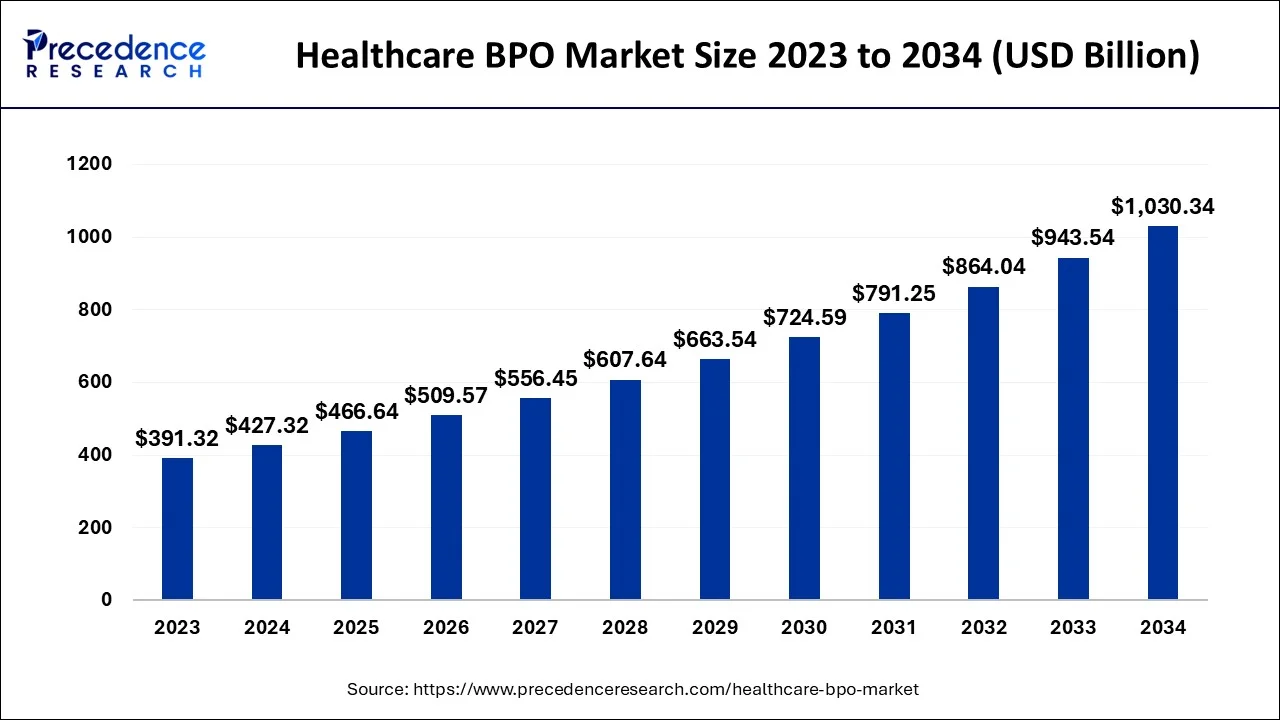
The global healthcare BPO market size is calculated at USD 466.64 billion in 2025 and is predicted to increase from USD 509.57 billion in 2026 to approximately USD 1,112.27 billion by 2035, expanding at a CAGR of 9.07% from 2026 to 2035.
Healthcare BPO Market Key Takeaways
- In terms of revenue, the healthcare BPO market is valued at $466.64 billion in 2025.
- It is projected to reach $1,112.27 billion by 2035.
- The healthcare BPO market is expected to grow at a CAGR of 9.07% from 2026 to 2035.
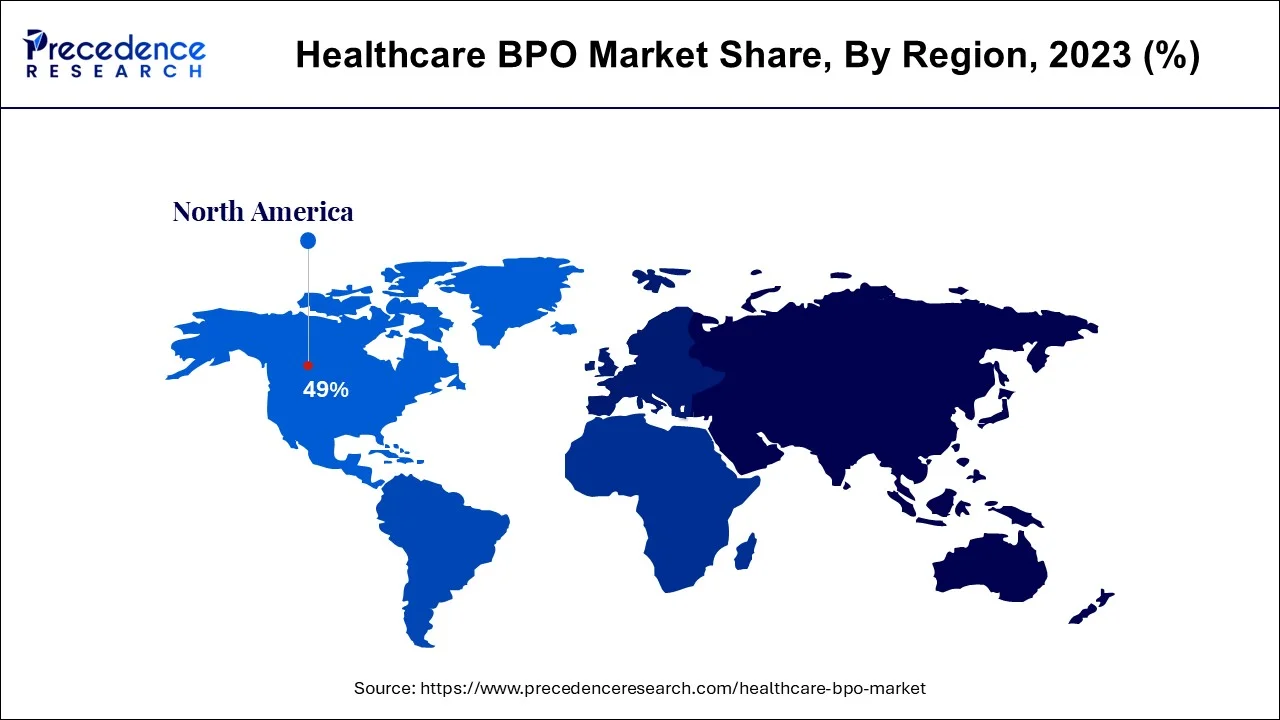
- North America region held the highest revenue share of 49% in 2025.
- Europe region accounted for 29.5% of revenue share in 2025.
- By provider service, the revenue cycle management segment captured the highest revenue share in 2025.
- Based on payer service, the claims management segment accounted highest share in 2024 and is expected to grow at the strongest CAGR between the years 2026 to 2035.
- By pharmaceutical service, the research & development segment is anticipated to hit notable growth over the forecast time period 2026 to 2035.
Market Overview
The Medical BPO research report provides a complete understanding of the industry and provides a snapshot of the industry. It contains the Covid 19 Research, market structure, an industry analysis, an industry analysis, product differentiation, a competitive environment, and important trend. It also enables investors to make investments in the Hospital BPO sector and allows them to thoroughly research the business before taking any actions.
The study identifies the main factors that are causing the health BPO industry to bloom and expand globally for a multitude of reasons, the majority of which encompass an increase in the number of individuals looking for insurance coverage and the guarantee of govt assistance. Furthermore, some limitations are insurmountable, such as the massive fees for system construction and repair and the swift shifts in market conditions.
The objective is to reach a point where there would be an expensive way to address the issue with no deceit or dishonesty throughout this industry to expand, however, the prospects are unlimited as practice goes. If organizations became a personality, there would be no opportunity for the company to work upon that offshore outsourcing and will have a substantial portion of customers who subcontract essential assigned jobs with the company. It would only enable little players to flourish alongside greater heavyweights. This study article analyses nursing service processes outsourced and analyses the prospects or difficulties. The effect of COVID 19 on the medical BPO sector is the subject of another phase of the report. The report also contains an estimate for growing markets and changes.
The healthcare BPO market is witnessing a structural evolution, primarily driven by rising demand for cost containment, process efficiency, and digitization in healthcare operations. Key trends include the rapid adoption of claim processing, patient engagement, and medical coding. Additionally, the increasing pressure on healthcare providers to focus on core patient care rather than admittivities complexities has paved the way for outsourcing services. Companies are now focusing on enhancing customer experience through omnichannel engagement, streamlining back-office operations, and ensuring regulatory compliance through digitally managed workflows. Moreover, the trend of outsourcing pharmacovigilance and clinical trial support is gaining traction due to the rising complexity of drug development processes.
Healthcare BPO Market Growth factors
Its explosive growth of clinical pathways outsourced and also the decline in faults across noncritical operations including accounting, financing, and services to customers are driving the development of the segment hospital BPO sector. Additionally, the demand for protection, the need to reduce health care expenditures, and also the threat of patent peaks for the pharmaceutical industry is indeed the main drivers of the expansion of the medical BPO sector. This increases stress upon the delivery of healthcare services.
In terms of balancing the many facets of controlling operating costs, company bottom lines, and legislation directed to better outcomes, medical care has indeed been changing continuously. Fresh company concepts have emerged as a result of the ongoing need to improve patient and consumer services in the context of budgetary as well as bottom line restrictions. The persistent efforts to improve care coordination and create medical care better consumers are what fuel the growth of the construction BPO industry.
Operations are contracted to experienced personnel in done to avoid damages and lower the likelihood of crime. Healthcare and network operators will benefit by reducing the cost and time, while consumers will benefit by receiving high-quality care. We believe that such issues will spread throughout the industry. Furthermore, it is projected that the fear of a cyber-attack, the possibility of relinquishing power well over activities that are delegated, and concerns about customer satisfaction will impede market expansion. Since the primary organization is no longer in charge of the operation, there seems to be a dangerous chance that its influence through it will be lost.
The increased contribution of their solutions to enhancing patient treatment, enhancing population health, and assisting medical providers in cost-optimization has strengthened the financial model for nursing service activity key suppliers. Additionally, there would be a danger to information security. Contracting exposes a lot of private information to any third company, raising questions about information security. Furthermore, there are concerns about the level of service provided because a service provider may not even be as interested inside or worried about proposing alternatives or treatments to the agreed-upon parties as the main business is. It is envisaged that these elements will serve as growth inhibitors.
The medical BPO sector has an environment considered by companies. Using outsourcing, a wide range of moment jobs are usually transferred, which helps to reduce operating costs. manufacturing, Drug development, marketing, and statistics are just one of the important end customers. Clinical coder and accounting, expense reports, and information processing operations are increasingly demanded after healthcare process services in the hospital BPO sector.
Market Outlook
- Industry Growth Overview: Due to the increasing complexity of healthcare operations, a push for greater efficiency through digitization of providers and payers, and a growing emphasis on cost reductions, there is a significant increase in demand for healthcare BPOs, as organizations seek out a strategic partner to assist them with their operations.
- Sustainability Trends: Healthcare BPOs are focused on utilizing technologies that support environmentally friendly workflows (e.g., minimizing paper), creating an energy-efficient IT environment, and supporting operations that align with ESG requirements as part of an overall strategy to create a sustainable healthcare administration.
- Global Expansion: Healthcare organizations are increasingly utilizing external vendors who can provide them with access to a wider selection of skilled workers and multi-lingual capabilities across a variety of regulations and industry practices.
Market Scope
| Report Coverage | Details |
| Growth Rate from 2026 to 2035 | CAGR of 9.07% |
| Market Size in 2025 | USD 466.64 Billion |
| Market Size in 2026 | USD 509.57 Billion |
| Market Size by 2035 | USD 1,112.27 Billion |
| Base Year | 2025 |
| Forecast Period | 2026 to 2035 |
| Segments Covered | Provider Service, Payer Service, Life Science Service, Geography |
Segment Insights
Provider Service Insights
Billing monitoring is a tool used by medical institutions to monitor all economic communication with customers, after their first consultation until the settlement of any outstanding recovery debt. All medical and management tasks that are needed to manage and recover care delivery payments collectively are referred to as the RCM. Therefore, it is anticipated that the growing demand for RCM products in hospitals will promote segment expansion.
In 2025, billing planning held the greatest customer base, and it is anticipated that it would continue to hold that position throughout the projected timeframe. The decrease in medical costs, expanding government attempts to integrate billing and coding technologies, and rising healthcare sector spending may all be contributing factors to the category expansion. This RCM provides the supplier with several advantages, including managing admin duties as well as invoicing and receivables. This cutting-edge system uses complex accounting, merchant services, and electronic medical record technologies to perform admin duties. According to Jul 2023 post "Billing Control in Medical," since many clinics manage to account for utilizing inefficient manual processes, human mistakes, such as mistakes in entering data, are the chief reason for payment problems.
Term supply chain administration is the collective name for the entire process of accepting revenues and managing returns. According to the previously cited source, RCM also efficiently and error-free blends payment details with aggregate records, insurer names, client private details, health findings, and medical classifications. As a result, RCM was once used quite regularly inside the medical industry, which is fueling product demand.
Payer Service Insights
The Medical BPO region is based upon the services that the aid measures. Types of assistance provided by suppliers include customer onboarding, reimbursement policies, and quality experience. The clinical situation has improved the quality of medical improvements. The biggest market position for worldwide health Outsourcing is held by the claims processing category by 2025 and therefore is anticipated to keep this position throughout the forecast timeframe. Claiming management is a strategy that manages complaints while creating initiatives to minimize expenses and reduce theft while maintaining client satisfaction. The market is anticipated to witness a result.
Life Science Service Insights
During the projected timeframe, technological advancements are predicted to have the highest growth. The company's overall expansion could be attributed to rising expenditure for novel medications and vaccinations in response to an increase in COVID-19 patients. According to health system predictions, the business technology development sector is predicted to grow at a rapid pace since that is still a marketplace where consumers are not fully informed and because the COVID epidemic still seems to be active.
Regional Insights
What is the U.S. Healthcare BPO Market Size?
The U.S. healthcare BPO market size was evaluated at USD 160.06 billion in 2025 and is predicted to be worth around USD 389.71 billion by 2035, rising at a CAGR of 9.31% from 2026 to 2035.
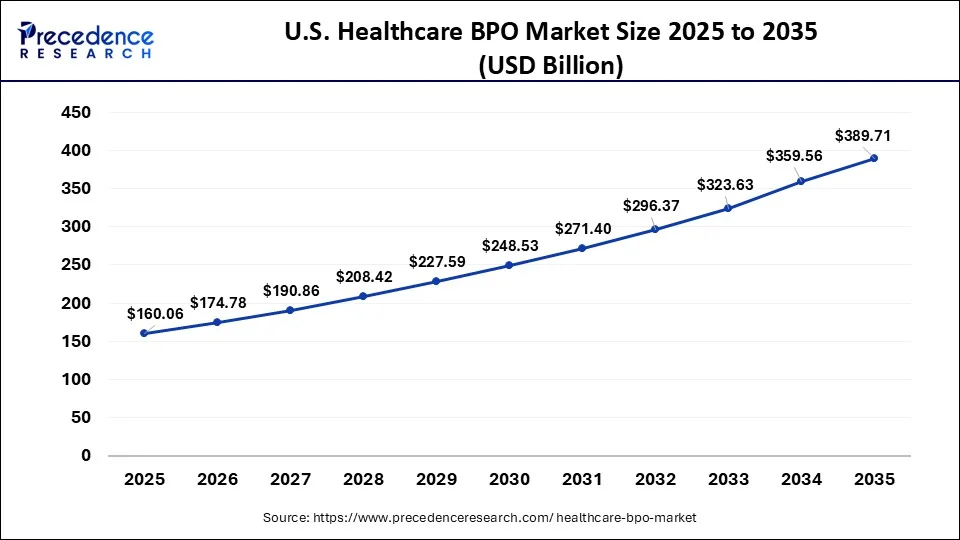
The Medical BPO industry inside the Atlantic is being driven by considerably large care costs item, a very well platform, and the development of significant business participants. The industry for medical BPO is now dominated by the United States, and this dominance is anticipated to last for another few decades. The United States has the number one position. The medical sector in particular, which consists of pharmacists, medical equipment makers, pharmaceutical firms, and health providers, is expanding quickly. Individuals with specialized training who manage these processes are essential to these intricately developed markets.
The significant adoption adopted by major market participants in the market as well as the significant knowledge of the potential direction ns medical IT solutions is credited with the expansion of both the market sector. Due to a noticeable cost of health care expenditure, the existence of huge companies, as well as advancements, this nation came in second within the medical BPO industry. In terms of providing significant potential for growth, the medical BPO industry throughout this sector is expanding at the quickest rate worldwide.
In the countries in the US, nursing service processes offshore seem to have the smallest pricing power. Additionally, expanding federal programs in the nation is predicted to fuel industry expansion there. To promote medical accessibility and affordability for underrepresented people using remote treatment, the Ministry of Health Administration granted roughly USD 56 m to 29 Connection exists medical clinics in Feb 2022. Consumers have benefited greatly from telemedicine, particularly even during epidemics. As a result, growing demand in the nation is anticipated to be fueled by policy measures.
North America remains the dominant region in the healthcare BPO landscape, owing to its advanced IT capabilities and high healthcare expenditure. The United States plays a pivotal role due to its strong regulatory frameworks, such as HIPAA, and its demand for comprehensive billing, coding, and revenue cycle management (RCM) services. On the other hand, Canada, the largest key contributor to this region's growth, contributes significantly by outsourcing bilingual services, especially in insurance verification and medical transcription. Governments in the region have been encouraging digitization and interoperability in healthcare records, which is pushing providers to collaborate with BPO vendors for seamless integration and data management. Public and private investments in cloud-based health platforms and electronic health record (EHR) systems are further amplifying the BPO market's growth.
Europe
Europe is swiftly rising as the fastest-growing region in the global healthcare BPO market. With increasing pressures on national healthcare systems like the NHS and rising administrative burdens in France and Germany, healthcare institutions are turning to BPO firms for support in managing documentation, coding, and analytics. Language diversity, GDPR compliance, and the need for regional-specific outsourcing strategies make Europe a unique and complex market. Major contributing factors to this growth include the rising demand for telehealth support services, cross-border medical tourism coordination, and data-heavy clinical research projects that require streamlined documentation support. Additionally, governments across Europe are actively supporting digital health initiatives and cross-national patient data sharing, thus widening the scope for business process outsourcing.
Regulation-Driven Healthcare Outsourcing Landscape
The healthcare business process outsourcing (BPO) market in Europe is influenced by large public sector health care delivery models with high levels of regulatory compliance and the continued expansion of digital transformation throughout healthcare delivery systems, both in hospitals and insurers. Administrative outsourcing will grow as demand for compliant administrative services continues to increase.
Germany is the fastest-growing country in Europe for healthcare, fuelled by digitization initiatives in hospitals and the increasing trend toward outsourcing of the revenue cycle.
Latin America's Healthcare BPO Industry
Latin America's market is growing as providers outsource administrative and back-office functions to reduce costs and improve efficiency. Nearshore advantages such as time-zone alignment, cultural affinity, and bilingual talent in countries like Brazil and Mexico are boosting demand from US clients. Increasing use of automation, cloud platforms, and analytics is enhancing service quality and value.
Middle East & Africa (MEA): Digitally Transforming Healthcare Services
The healthcare BPO market in MEA is driven by the ongoing upgrading of healthcare infrastructure, the expansion of medical tourism, and the focus of governments on developing digital health initiatives. The United Arab Emirates leads all MEA countries in terms of growth, and continues to invest in smart health care technology businesses while also continuing to grow the outsourcing of administrative and payer services.
Value Chain Analysis of the Healthcare BPO Market
- Patient Support and Services: This component of the value chain is the basis for healthcare BPO operations (business process outsourcing). This includes patient enrolment, appointment scheduling, insurance eligibility verification, medical transcription, and contact center services.
Key Players: WNS Global Services, Cognizant, and Accenture. - Clinical Documentation and Regulatory Compliance Support: This stage of the value chain focuses on these areas: medical coding, documentation of billing, utilization review support, and ensuring compliance with changing healthcare regulations, such as regulations regarding data privacy and reimbursement.
Key Players: Genpact, EXL Service, and HCLTech. - Distribution to Hospitals, Payers, and Healthcare Networks: This component of the value chain involves the integration of services, secure data exchange, service level agreement (SLA) management, and long-term outsourcing relationships with hospitals, insurance companies, and integrated delivery networks.
Key Players: Infosys BPM, TCS, and NTT DATA.
Healthcare BPO Market Companies
- Accenture (Ireland)
- Access Healthcare (US)
- Akurate Management Solutions (US)
- Cognizant (US)
- Firstsource Solutions (India)
- GeBBS Healthcare Solutions (US)
- Genpact (US)
- HCL Technologies (India)
- IBM Corporation (US)
- Infosys BPM (India)
- Invensis Technologies (India)
- IQVIA (US)
- Lonza (Switzerland)
- Mphasis (India)
- NTT Data Corporation (Japan)
- Omega Healthcare (India)
- Parexel International (US)
- R1 RCM (US)
- Sutherland Global (US)
- Sykes Enterprises (US)
- Tata Consultancy Services (India)
- UnitedHealth Group (US)
- Wipro (India)
- WNS (Holdings) Limited (India)
- Xerox Corporation (US)
Key Market Developments
- In May 2025, a U.S.-based healthcare BPO leader, Med Assure Global Solutions, launched a dedicated AI-powered revenue cycle management platform called Claim Swift Pro aimed at enhancing claim accuracy, reducing reimbursement delays, and automating compliance workflow.
- Firm that delivers quality healthcare, was purchased by CPSI in Mar 2022. HRG is a market leader in providing healthcare facilities with specialized claims processing solutions and advisory services which increase productivity, economics, and patient happiness.
- During the financial term of 2022, medical developer NextGen Hospital intended to increase the scope of the RCM operation inside its platform.
- NTT DATA, as well as Score Data, agreed to work together for several years to implement Score Data's nudging algorithms using NTT DATA's machine learning solutions to help global medical coverage and the practitioner community forecast the rate of premature development of disease conditions in May 2021.
- To expedite a digital strategy and broaden its presence inside the North American market, Xerox Company purchased Holding company CT throughout Apr 2021. Holding company CT was a locally owned document control supplier in Eastern Canada.
- To ensure full services for healthcare monitoring with Us insurance carriers and deal with a variety, Representation of knowledge Technologies chose IntelliH just like its systems integrator from Mar 2021.
- HCP/HCO Participation Administration, an integrated final stage, coordinated medical practitioner (HCP/HCO) system, was introduced by IQVIA in May 2020. It facilitates the scheduling, strategic planning, scheduling, and paying of HCP/HCOs internationally.
- Wipro joined PLEXIS Medical Systems that help medical payments and program contributors globally with something like simplified, reliable, and connected program management solutions in March 2020. This partnership advanced technological change for health insurance companies.
- To best represent its actual and future business and general public consumers, Conduent, a leader in medical products and medical services, has partnered with Provided Many benefits Extra and combined the administration production systems of the two businesses.
- To better meet customers' needs, Cognizant Information Systems purchased Brighter Health Services in Mar 2018, which included medical practices as well as other healthcare professionals in the U.S.
- To order to optimize sustainable procurement control and save cost, North Healthcare and Accenture recently merged in June 2018.
Segments are covered in the report
By Provider Service
- Revenue Cycle Management
- Patient Enrolments
- Patient Care
- Medical Transcription
- Medical Imaging
- Device Monitoring
By Payer Service
- Claims Management
- Claims Adjudication Services
- Claims Settlement Services
- Information Management Services
- Claims Repricing
- Claims Investigation Services
- Claims Indexing Services
- Fraud Detection & Management
- Product Development & Business Acquisition (PDBA)
- Member Management
- Provider Management
- Care Management
- Integrated Front-End Services and Back-office Operations
- Billing and accounts management services
- HR Services
By Life Science Service
- Manufacturing
- R&D
- Non-Clinical Services
- Supply Chain Management & Logistics
- Sales and Marketing Services
- Forecasting
- Performance Reporting
- Analytics
- Research
- Marketing
- Other Non-Clinical Services
By Geography
- North America
- U.S.
- Canada
- Europe
- U.K.
- Germany
- France
- Asia-Pacific
- China
- India
- Japan
- South Korea
- Malaysia
- Philippines
- Latin America
- Brazil
- Rest of Latin America
- Middle East & Africa (MEA)
- GCC
- North Africa
- South Africa
- Rest of the Middle East & Africa
For inquiries regarding discounts, bulk purchases, or customization requests, please contact us at sales@precedenceresearch.com
Frequently Asked Questions
Tags





Ask For Sample
No cookie-cutter, only authentic analysis – take the 1st step to become a Precedence Research client
 Get a Sample
.webp)



 sales@precedenceresearch.com
 Schedule a Meeting
